
International Research Journal of Engineering and Technology (IRJET) e-ISSN: 2395-0056
Volume: 13 Issue: 03 | Mar 2026 www.irjet.net p-ISSN: 2395-0072
International Research Journal of Engineering and Technology (IRJET) e-ISSN: 2395-0056
Volume: 13 Issue: 03 | Mar 2026 www.irjet.net p-ISSN: 2395-0072
Siddhesh
Shirish Kamble1, Prof. R. Mahadeva Swamy2, Dr. M. S. Kuttimarks2, Dr. Gyanendra Kumar
Chaturvedy
2
1M.E. Scholar, Department of Civil Engineering, Shivajirao S. Jondhle College of Engineering & Technology, Asangaon
2Associate Professor, Department of Civil Engineering, Shivajirao S. Jondhle College of Engineering & Technology, Asangaon ***
Abstract - The disposal of waste tires has emerged as a major environmental challenge, necessitating sustainable recycling strategies. Rubberized concrete, which incorporates recycled tire rubber into the cementitious matrix, has gained considerable attention as an eco-friendly construction material that supports sustainable waste management. However, the practical use of rubberized concrete in structural applications is often limited by reductions in mechanical strength and stiffness. This study investigates the effectiveness of nano silica (NS) in enhancing the mechanical and durability properties of rubberized concrete. Concrete mixtures were prepared by partially replacing manufactured sand with recycled rubber aggregates at 5%, 10%, and 15%, while NS was used as a partial cement replacement at 3% and 5%. A total of ten mix combinations were evaluated. The results demonstrate that NS significantly improves strength and durability by enhancing the interfacial bonding and densifying the cement matrix, thereby mitigating the adverse effects of rubber inclusion and improving the overall performance of rubberized concrete.
Key Words: Sustainable concrete, Rubber aggregate, Mechanical strength, Durability performance
Concrete has long been recognized as the most widely used construction material in the world and continues to play a fundamental role in the development of modern infrastructure. Its versatility, durability, and relatively low cost make it indispensableforawiderangeofcivilengineeringapplications,includinghigh-risebuildings,bridges,highways,dams,and transportation networks. Rapid urbanization and industrial expansion across the globe have significantly increased the demandforconcreteinrecentdecades.Ascountriescontinuetoinvestheavilyininfrastructure developmenttosupport economic growth and urban population expansion, the consumption of concrete has reached unprecedented levels. This increasing demand has consequently intensified the extraction and utilization of natural resources required for concrete production[1].
AccordingtorecentreportsbytheGlobalCementandConcreteAssociation,theworldwideproductionofconcreteisestimated tobeapproximately14billioncubicmetersannually,makingitthemostconsumedmanufacturedmaterialonEarth.The production of such enormous volumes of concrete requires vast quantities of natural aggregates, cement, and water. Construction aggregates, including sand and gravel, constitute nearly three-quarters of the total volume of conventional concrete.Globalaggregateproductionreachednearly51.7billionmetrictonnesin2014,andthisfigurecontinuestorise steadilyduetoongoinginfrastructuredevelopmentandurbanization.Similarly,globalcementdemandisprojectedtogrowat anannualrateofaround2.5%,reachingapproximately4.7billionmetrictonnesby2025.Theseprojectionshighlightthe increasingpressureonnaturalresourcesandunderlinetheurgentneedtoexploresustainablealternativesandinnovative constructionmaterialscapableofreducingtheenvironmentalfootprintoftheconstructionsector[2].
Theaccumulationofwastetiresposesmultipleenvironmentalhazards.Largestockpilesofdiscardedtiresoccupysignificant landareaandcanserveasbreedinggroundsformosquitoesandotherdisease-carryinginsects,therebyincreasingtheriskof vector-bornediseasessuchasdengue,malaria,andZikavirusinfections.Furthermore,wastetiredumpsarehighlysusceptible toaccidentalfiresthatareextremelydifficulttoextinguish.Tirefirescanburnforextendedperiodsandreleasetoxicgases, includingpolycyclicaromatichydrocarbonsandotherhazardouspollutants,whichseverelydegradeairqualityandthreaten surroundingecosystems.Consequently,thedevelopmentofsustainablemethodsforrecyclingandutilizingwastetirerubber hasbecomeapressingpriorityinbothenvironmentalmanagementandmaterialsengineering[3].
One promising approach to address this issue is the incorporation of waste tire rubber into cementitious composites to producerubberizedconcrete.Rubberizedconcreteisdevelopedbypartiallyreplacingconventionalaggregateswithrecycled
International Research Journal of Engineering and Technology (IRJET) e-ISSN: 2395-0056
Volume: 13 Issue: 03 | Mar 2026 www.irjet.net p-ISSN: 2395-0072
rubber particles, commonly in the form of crumb rubber or shredded tire chips. The integration of rubber particles into concreteoffersseveralenvironmentalandfunctionalbenefits.Fromasustainabilityperspective,theuseofrecycledrubber reducesthedemandfornaturalaggregateswhilesimultaneouslyprovidinganeffectivemethodfordivertingwastetiresfrom landfills.Inaddition,rubber particlesimpartuniquemechanical characteristicstoconcrete,suchasenhanced toughness, improvedductility,andsuperiorenergyabsorptioncapacity.Thesepropertiesmakerubberizedconcreteparticularlyattractive forapplicationswhereimpactresistance,vibrationdamping,andshockabsorptionaredesirable,includingroadpavements, safetybarriers,industrialflooring,andseismic-resistantstructuralelements[4].
Recentadvancesinnanotechnologyhaveopenednewopportunitiesforenhancingtheperformanceofcement-basedmaterials. Amongvariousnano-materialsinvestigatedforconcretemodification,nanosilica(nano-SiO₂)hasemergedasoneofthemost promisingadditives.Nanosilicapossessesanextremelyhighspecificsurfaceareaandexhibitsstrongpozzolanicreactivity withcalciumhydroxideproducedduringcementhydration.Whenincorporatedintoconcreteinsmallquantities,nanosilica can significantly improve the microstructure of the cementitious matrix by filling nano-scale voids and promoting the formationofadditionalcalciumsilicatehydrate(C–S–H)gel.Thisprocessresultsinadenserandmorecompactmicrostructure, leadingtoimprovementsinbothmechanicalstrengthanddurabilitycharacteristics[5].
The incorporation of nano silica in rubberized concrete has therefore attracted growing research interest, as it offers a potential solutiontomitigatethestrengthreductionassociatedwithrubberinclusion.Byrefiningthe porestructureand enhancingtheinterfacialtransitionzonebetweenaggregatesandcementpaste,nanosilicacanimprovebondingandoverall structuralintegrity.Furthermore,nanosilicahasbeenshowntoenhanceresistancetopermeability,chlorideionpenetration, and chemical attack, thereby improving the long-term durability of concrete exposed to aggressive environments. These characteristics suggest that nano-modified rubberized concrete could serve as a viable sustainable material capable of combiningenvironmentalbenefitswithimprovedmechanicalperformance[6].
Inthiscontext,thepresentstudyaimstodevelopasustainablerubberizedconcretesystembyincorporatingwastetirecrumb rubbertogetherwithsupplementarycementitiousmaterialssuchasflyashandnanosilica.Theresearchfocusesonevaluating theinfluenceofnanosilicaonthemechanicalanddurabilitypropertiesofrubberizedconcretewhilepromotingtheutilization of waste-derived materials in construction. Through this approach, the study seeks to contribute to the development of environmentally responsible construction materials that can reduce natural resource consumption, improve waste managementpractices,andenhancetheoverallsustainabilityofthebuiltenvironment.
For the experimental program, Ordinary Portland Cement (OPC) of 53 grade conforming to IS 12269:2013 was used in combinationwithmanufacturedsand(MS),coarseaggregate(CA),potablewater,crumbrubberaggregate(RA),superplasticizer (SP),flyash(FA),andnano-silica(NS).
Theexperimentalprogramwasdesignedtoevaluatethemechanicalstrengthanddurabilityperformanceofrubberizedconcrete containingnanosilica.Concretespecimenswerepreparedwithdifferentproportionsofrecycledrubberaggregatesandnano silica,andthehardenedpropertieswereassessedatcuringagesof7and28days.Themechanicalperformanceoftheconcrete wasevaluatedthroughcompressivestrength,splittensilestrength,andflexuralstrengthtests,whiledurabilitywasassessed throughanacidattacktest.
Thecompressivestrengthtestwasconductedtodeterminetheload-bearingcapacityoftheconcretemixes.Cubespecimensof size150×150×150mmwerecast,compactedproperly,andcuredundercontrolledconditionsuntilthetestingage.Thetest wasperformedusinganautomatedcompressiontestingmachine(CTM)withacapacityof3000kN.Loadwasapplieduniformly ata controlled rateof14N/mm² per minuteuntil failure occurred,followingthe procedurespecifiedin IS 516:1959.The compressivestrengthwascalculatedbydividingthemaximumloadcarriedbythespecimenbyitscross-sectionalarea.Three specimensweretestedforeachmix,andtheaveragevaluewasreported.
Thesplittensilestrengthtestwascarriedoutoncylindricalspecimensmeasuring100mmindiameterand200mminheightto evaluatethetensilebehavioroftheconcrete.Thecylinderswereplacedhorizontallyinthecompressiontestingmachine,and loadwasappliedataconstantrateof1.8N/mm²perminuteinaccordancewithIS5816:1999.Theappliedcompressiveload generatedindirecttensilestressesalongtheverticaldiameterofthespecimen,causingittosplit.Thesplittensilestrengthwas calculatedusingthestandardequation
Theflexuralstrengthtestwasperformedonbeamspecimensofsize100×100×500mmtodeterminethebendingresistanceof theconcrete.Thespecimensweretestedunderatwo-pointloadingarrangementwithaclearspanof400mmbetweenthe supportrollers.Loadwasappliedataconstantrateof180kg/mininaccordancewithIS516:1959untilfailureoccurred.The
International Research Journal of Engineering and Technology (IRJET) e-ISSN: 2395-0056
Volume: 13 Issue: 03 | Mar 2026 www.irjet.net p-ISSN: 2395-0072
modulus of rupture was calculated based on the peak load and the specimen dimensions, and the average value of three specimenswasrecorded.
Toevaluatedurability,anacidattacktestwasconductedfollowingASTMC267.Concretecubespecimensof150mmsizewere immersedin5%sulphuricacid(H₂SO₄)solutionfor7and28days.Theresistanceoftheconcretewasassessedbymeasuring masslossandcompressivestrengthreductionafterexposure.Foreachmix,threespecimensweretested,andtheaverage resultswereusedtoanalyzetheinfluenceofnano-modifiedrubberizedconcreteondurabilityperformance.
Thecompressivestrengthresultsofthedifferentconcretemixesatcuringagesof7and28daysarepresentedinFig.1.The controlmix(S1),whichcontainedneitherrubberaggregate(RA)nornanosilica(NS),exhibitedcompressivestrengthsof33.48 MPaat7daysand47.36MPaat28days.Thesevaluesrepresentthebaselinemechanicalperformanceofconventionalconcrete used for comparison with modified mixes. When 5% rubber aggregate was incorporated as a partial replacement, the compressivestrengthdecreasedto31.56MPaat7daysand42.89MPaat28days,indicatinganoticeabledeclineinloadbearingcapacity[6-8].
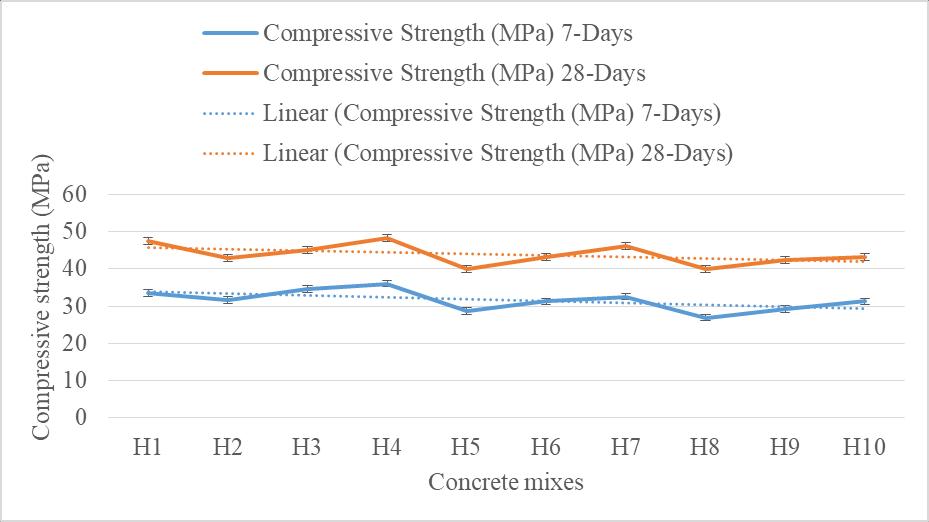
However,theincorporationofnanosilica(NS)significantlyimprovedthecompressivestrengthofrubberizedconcrete.The mixescontainingNSdemonstratedhigherstrengthvaluescomparedwiththeircorrespondingrubberizedmixeswithoutNS. The 5% NS dosage was found to provide the optimum improvement in compressive strength. This enhancement can be attributedtothenano-fillereffectofNSanditshighpozzolanicreactivity.Duetoitsextremelyfineparticlesizeandlarge surfacearea,NSfillsmicro-voidswithinthecementmatrixandpromotestheformationofadditionalcalciumsilicatehydrate (C–S–H)gelduringhydration.Asaresult,adenserandmorecompactmicrostructureisformed,whichenhancestheloadcarryingcapacityoftheconcretecomposite.
ThesplittensilestrengthresultsforthevariousconcretemixesareillustratedinFig.2.Thecontrolmixrecordedtensile strengthsof3.65MPaat7daysand5.12MPaat28days.Similartothecompressivestrengthbehavior,theinclusionofrubber aggregatesresultedinagradualreductionintensilestrength.When5%RAwasincorporated,thetensilestrengthdecreasedto 3.43MPaat7daysand4.88MPaat28days.FurtherincreasesinRAcontentto10%and15%resultedinadditionalreductions intensilestrength.
The decrease in tensile strength can primarily be attributed to the weak adhesion between rubber particles and the cementitiousmatrix.Rubberaggregatestendtocreatelocalizedstressconcentrationsanddiscontinuitieswithintheconcrete structure.Undertensileloading,thesezonesbecomepotentialsitesforcrackinitiationandpropagation,whichreducesthe
International Research Journal of Engineering and Technology (IRJET) e-ISSN: 2395-0056
Volume: 13 Issue: 03 | Mar 2026 www.irjet.net p-ISSN: 2395-0072
tensilecapacityofthecompositematerial.Furthermore,theelasticnatureofrubberparticleslimitseffectivestresstransfer acrossthematrix,therebycontributingtoprematurefailure[9-10].
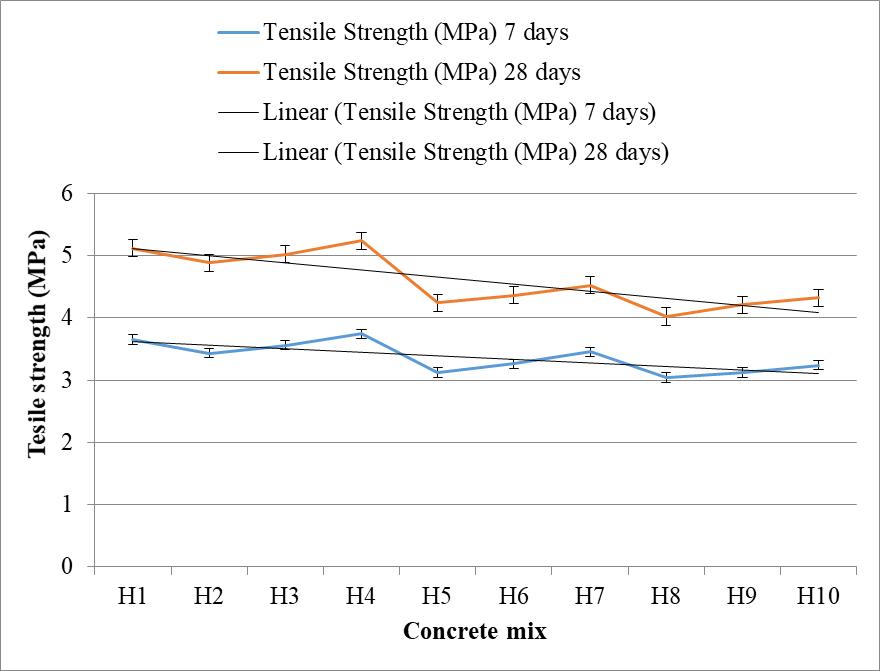
Fig. 2: Tensilestrengthofconcretemixes
Despitethenegativeinfluenceofrubberaggregates,theincorporationofnanosilicasignificantlyenhancedthetensile strengthoftheconcretemixes.TheadditionofNSimprovedtheinterfacialbondingbetweencementpasteandaggregatesby refiningthemicrostructureoftheinterfacialtransitionzone.Thenano-sizedparticlesactasmicro-fillersthatimproveparticle packingandreduceinternalporosity.Inaddition,thepozzolanicreactionofNSacceleratescementhydrationandpromotesthe formationofadditionalC–S–Hgel,whichstrengthensthematrixandincreasesitsabilitytoresisttensilestresses.Asaresult, theNS-modifiedrubberizedconcreteexhibitedimprovedtensileperformancecomparedwithmixescontainingonlyrubber aggregates.
TheflexuralstrengthresultsofthedifferentconcretemixesareshowninFig.3.Thecontrolmixrecordedflexuralstrengths of3.95MPaat7daysand5.24MPaat28days.Theintroductionofrubberaggregatesat5%,10%,and15%replacementlevels resultedinareductioninflexuralstrengthacrossallmixes.Thisreductionismainlyassociatedwiththelowstiffnessofrubber particlesandtheweakbondingbetweenrubberandcementpaste,whichcausesstressconcentrationunderbendingloads.
Underflexuralloading,crackstendtoinitiateatthetensionzoneofthebeamspecimen.Thepresenceofpoorlybonded rubberparticleswithinthisregionreducestheresistanceoftheconcretetocrackinitiationandpropagation.Additionally, achievinguniformdispersionofrubberparticleswithintheconcretematrixcanbechallenging,whichfurthercontributesto localizedweaknessesandreducedflexuralcapacity[11-12].
International Research Journal of Engineering and Technology (IRJET) e-ISSN: 2395-0056
Volume: 13 Issue: 03 | Mar 2026 www.irjet.net p-ISSN: 2395-0072
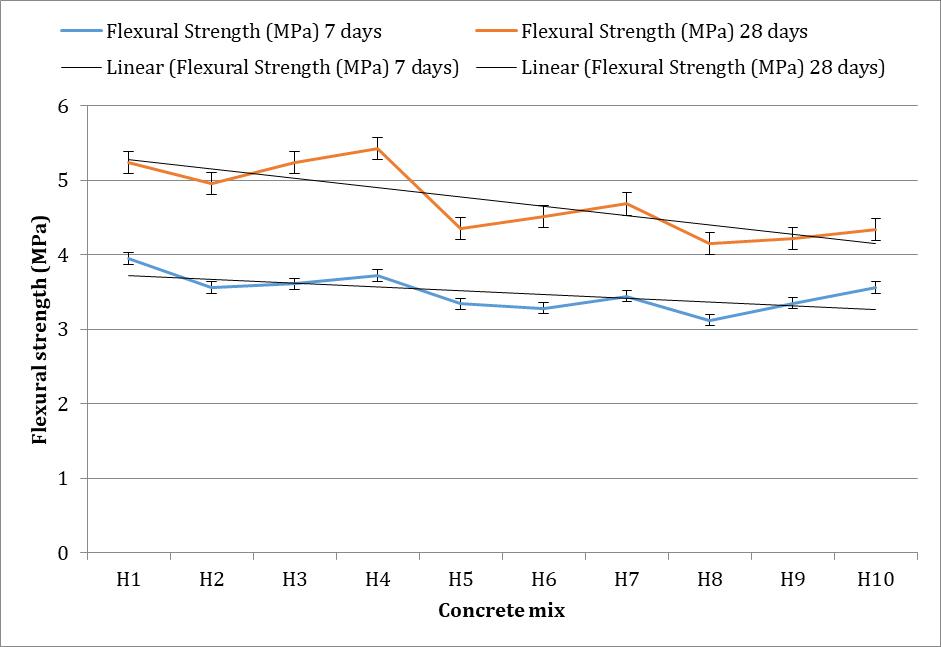
3: Flexuralstrengthofconcretemixes
Nevertheless,theincorporationofnanosilicaeffectivelyimprovedtheflexuralperformanceofrubberizedconcrete.The improvementisattributedtotheabilityofNStodensifythecementitiousmatrix,reduceporosity,andenhancethebonding betweenaggregatesandcementpaste.ThehighpozzolanicactivityofNSaccelerateshydrationreactionsandcontributestothe formationofamorehomogeneousmicrostructure.Consequently,theNS-modifiedmixesdemonstratedbetterresistanceto bendingstressescomparedwithmixescontainingrubberaggregatesalone.
The durability performance of the concrete mixes was evaluated by examining the loss in compressive strength after exposuretoanacidicenvironment,asshowninFig.4.Thereferenceconcretemix,containingneitherRAnorNS,exhibitedthe lowestreductionincompressivestrengthafterexposuretoacidatboth7and28days.Asthepercentageofrubberaggregate increasedto5%,10%,and15%,thelossinstrengthincreasedprogressively.
However, the inclusion of nano silica significantly reduced the loss in compressive strength after acid exposure. The improvedperformanceismainlyduetotheabilityofNStorefinetheporestructureandproduceadensermicrostructurethat limitstheingressofaggressivechemicals.Moreover,thepozzolanicreactionofNSconsumescalciumhydroxideandforms additionalC–S–Hgel,whichenhanceschemicalresistance.Consequently,theNS-modifiedrubberizedconcretedemonstrated improveddurabilityandbetterresistancetoacidattackcomparedwithconventionalrubberizedconcrete[11-12].
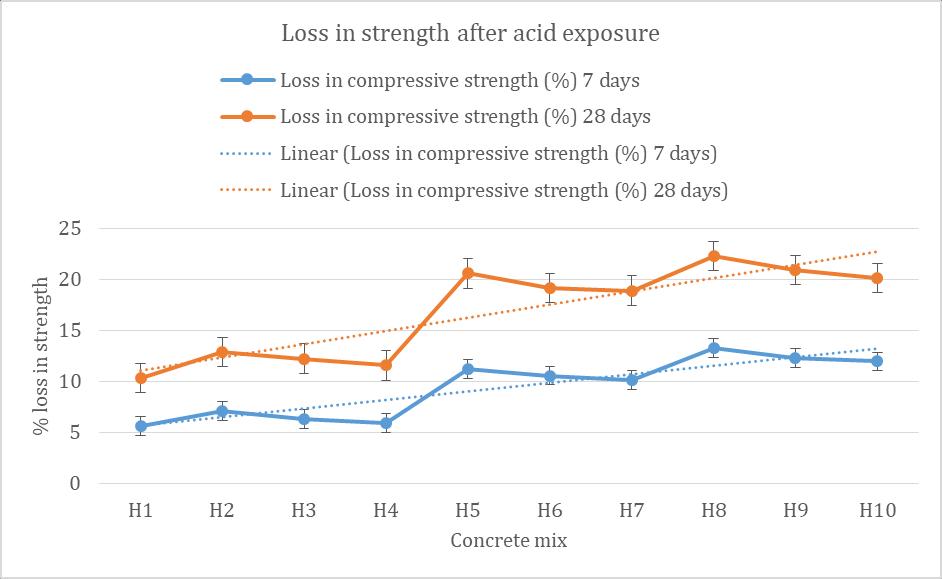
4: Lossinstrengthofconcretemixesafteracidexposure
International Research Journal of Engineering and Technology (IRJET) e-ISSN: 2395-0056
Volume: 13 Issue: 03 | Mar 2026 www.irjet.net p-ISSN: 2395-0072
Thecontrolconcretemixexhibitedthehighestcompressive,splittensile,andflexuralstrengthsatboth7and28days,serving asareferenceforcomparison.Theinclusionofrubberaggregate(RA)resultedinagradualreductioninmechanicalstrengths duetoweakbonding,lowstiffness,andpoorstresstransferwithintheconcretematrix.However,theadditionofnanosilica (NS)significantlyimprovedthemechanicalperformancebyrefiningparticlepackingandformingadensermicrostructure, withoptimumresultsat5%replacement.NSalsoenhancedtensileandflexuralstrengthsandreducedstrengthlossunderacid exposure.Overall,NSeffectivelymitigatesthenegativeeffectsofRA,producingmoredurableandsustainablerubberized concrete.
[1] GlobalCementandConcreteAssociation,CementandConcreteAroundtheWorld,[Accessed:sept,2020]
[2] Freedonia,Worldconstructionaggregates,TheFreedoniaGroup.IndustryStudy3389,(Accessed:March2016)
[3] Freedonia,Worldconstructionaggregates,TheFreedoniaGroup.IndustryStudy4147,(Accessed:June2021)
[4] GoldsteinIntelligenceGroup,GlobalTireRecyclingMarketAnalysis2025:Opportunity,Demand,GrowthandForecast 2017-2025,(Accessed:April2020)
[5] StatistaResearchDepartment,ConsumptionofnaturalrubberinIndiafrom2016/2017to2021/2022,(accessed: march2023)
[6] N.N.EldinandA.B.Senouci,“Rubber-tireparticlesasconcreteaggregate,”JournalofMaterialsinCivilEngineering, vol.5,no.4,pp.478–496,1993.
[7] I.B.Topçu,“Thepropertiesofrubberizedconcretes,”CementandConcreteResearch,vol.25,no.2,pp.304–310,1995.
[8] G.Li,S.Stubblefield,G.Garrick,J.Eggers,C.Abadie,andB.Huang,“Propertiesofrubberizedconcretemodifiedby latex,”JournalofMaterialsinCivilEngineering,vol.16,no.4,pp.367–373,2004.
[9] H.A.Toutanji, “Theuseof rubber tire particlesinconcreteto replacemineral aggregates,”Cement andConcrete Composites,vol.18,no.2,pp.135–139,1996.
[10] Z.K.KhatibandF.M.Bayomy,“RubberizedPortlandcementconcrete,”JournalofMaterialsinCivilEngineering,vol. 11,no.3,pp.206–213,1999.
[11] B.S.ThomasandR.C.Gupta,“Long-termbehaviorofcementconcretecontainingdiscardedtirerubber,”Journalof CleanerProduction,vol.102,pp.78–87,2016.
[12] M. Gesoğlu, E. Güneyisi, and G. Khoshnaw, “Mechanical properties of self-compacting rubberized concretes,” ConstructionandBuildingMaterials,vol.69,pp.297–306,2014.