
International Research Journal of Engineering and Technology (IRJET) e-ISSN: 2395-0056
Volume: 13 Issue: 03 | Mar 2026 www.irjet.net p-ISSN: 2395-0072
International Research Journal of Engineering and Technology (IRJET) e-ISSN: 2395-0056
Volume: 13 Issue: 03 | Mar 2026 www.irjet.net p-ISSN: 2395-0072
Ms. R. Gayathri1 , M. Dhayanithi2 , M. Dhinesh3 , K. Dineshraj4
1Assistant Professor, Department of Computer Science and Engineering, SRM Valliammai Engineering College, Kattankulathur, Chengalpattu, Tamil Nadu, India – 603 203.
2,3, 4 Student, Department of Computer Science and Engineering, SRM Valliammai Engineering College, Kattankulathur, Chengalpattu, Tamil Nadu, India – 603203.
Abstract - Student stress is a growing issue in educational institutions due to academic pressure, lifestyle imbalance, and increased digital engagement. Traditional methods of stress assessment rely on manual surveys and counseling, which are time-consuming and subjective. This project presents a machine learning-based Student Stress Level Prediction System that analyzes academic, personal, and lifestyle factors to classify students into Low, Moderate, or High stress levels. Multiple machine learning algorithms are evaluated, and the best-performing model is used for prediction. The system is implemented using Python and integrated with a Streamlit web application to provide real-time and user-friendly stress prediction.
Key Words: Stress detection, Machine learning, Random Forest Classifier, Decision Tree Classifier, Logistic Regression, KNN, SVM.
1.INTRODUCTION
The problem of student stress has become more prominent inrecentyears. This is largely due to the increased academic expectationsplacedonstudents,changingsocialhabits,andincreasinguseoftechnology.Academicworkload,lackofsleep and social media use, along with limited time to relax can significantly impact how students are feeling and performing academically. Current methods used to identify stressed students (such as surveys and counseling) are often slow and difficulttoadministeracrossalargenumberofstudents.Newmachinelearningtechnologiesallowfortheuseofacademic andlifestyledatatocreateamoreefficientwayofidentifyingthestresslevelsofstudents.ThisstudydevelopsaMachine Learning-basedStudentStressPredictionSystemthatusesmachinelearningalgorithmsincludingRandomForest,Decision Tree,LogisticRegression,SupportVectorMachine(SVM),K-NearestNeighbors(KNN)toclassifystudentsintolow,medium and high stress categories. The system is developed using Python and the Streamlit platform, with an intuitive user interface where users can enter student demographics to produce an accurate prediction of student stress level. The system will enable early identification of students in distress so that institutions can provide their students with timely assistance, thereby improving student mental health and academic success. Student stress is becoming an increasingly commonconcernintoday's schools andcolleges. Thereason is primarily due to academic stress and to stress caused by living conditions (lifestyle). When a student experiences elevated amounts of stress for prolonged periods of time, their mental well-being and ability to perform academically can be adversely affected. Traditional approaches for detecting studentstress(e.g.,studentsurveys/counseling)requireasubstantialamountoftimeandarenotscalable.
However,machinelearningtechniquesmakeitpossibletousestudentdatatopredictlevelsofstudentstressmuchmore quickly. Additionally, using predictive systems to identify students who may be stressed allows academic institutions to provide their students with earlier support thantheywouldotherwisebeabletodo.Ultimately,thiscanleadto improved well-being for those students[1]. Enriqu M s-Arias and his group of researchers have shown that due to academic pressure and lifestyle choices, student stress is increasingly being perceived as a problem in the education systems.Asa resultofallthesedifferentformsofstress,studentsarenegativelyaffectedintheirmentalhealthandacademicperformance as well. By applying machine learning techniques to both academic performance and behavioral data from students, researchershavebeenabletoutilizepredictiveanalyticstomakeaccuratepredictionsaboutstudentstress.Institutionswill beabletousepredictivemodelstoidentifystudentswithhighlevelsofstressbeforetheyrealizethattheyarestressedand providethemwithadequatesupportinatimelymanner[2].AccordingtoShahidShabeerMalikandAneequeKhan,dueto academicdemands,socialpressure,andlifestylechoices,studentstresshasbeenrecognizedinhighereducationasaserious consequenceofthisphenomenon.Highlevelsof stressnegativelyaffectstudents'mentalhealthandacademicperformance, aswellastheiroverallqualityoflife.Traditionalmethodsofassessingstress,suchascounsellingandsurveys,canbetimeconsuming and lack scalability; therefore, machine learning provides an adequate mechanism for evaluating studentrelated data and recognising the patterns of stress. Institutions can use predictive models to identify students at risk of
International Research Journal of Engineering and Technology (IRJET) e-ISSN: 2395-0056
Volume: 13 Issue: 03 | Mar 2026 www.irjet.net p-ISSN: 2395-0072
stressandoffertimelyassistancetoenhancestudents'mentalhealthandwell-being[3].AnuradhaParasar&herteam,The increasing pressure placed on students from academic, societal and health-related issues, has made student stress a significant issue for current educational settings. It has become apparent that high levels of stress have had a negative impact on stud nts’ mental health; learning skills; and their academic performance. Many traditional means of assessing stress have been done through manual effort and time-consuming processes that have resulted in delayed or missed opportunities for early detection. Machine learning offers a more efficient means of analyzing a variety of academic, psychologicalandbehavioraldatatopredictstresslevelsforstudents.Byusingthesepredictivemodels,schools maybeina positiontoidentifyat-riskstudentsearlyonand implementeffectiveearlyinterventionstrategiestoenhancestudent wellbeing[4].
Assessing student stressors including schoolwork completion pressure, how many hours of studying they get, amountofsleep,andamountoftimespentonsocialmedia.
Creating a machine learning model that will estimate student stress levels using both academics and lifestyle variables.
Categorizingstudentsinto3categoriesofstress-low,moderate,high.
Testingseveraltypesofmachinelearningmodels(e.g.,RandomForest,DecisionTree,LogisticRegression,SVM, KNN)toidentifytheonewiththebestoverallpredictiveperformance.
Developinganeasy-to-useweb-basedapplicationusingStreamlitforstudentstowillindicatetheircurrentlevel ofstress.
Providing students and colleges with a means to recognize stressors beforetheybecomesevereand allow for interveningwithpreventivemeasures.
Utilizingdatatoprovidestudentswithinsightthatwillimprovetheirwellnessandtheiracademicsuccess.
[1]L.Rahunathan,A.SuhanaNafais(2023).MachineLearningModelforStudentStressLevelPrediction.CausesofCurrent ResearchonMachineLearningSettingForPredicitingStudentStressLevelshavebeenprimarilyAroundStudentFactorsof Academic,Behavioral,SocialandLifestyle(iesleep,academicperformance,socialsupport).ThemostcommonAlgorithms used for classifying Student Stressed Levels are Logistic Regression, Decision Tree, Random Forest, Support Vector MachineandK-NearestNeighbors.Conductedoutofmanycharacteristicssuchasqualityofsleep,academicperformance, availablesocialsupports,andhistoryunderlyingstudent'sMHA,these UniqueCharacteristicswillalsoassistinIdentifying Patterns Associated with Student Stress. TheFindings oftheresearch support the use of Machine Learning for Efficiently supportingidentifyingstudentswithhighstresslevelstherebyfacilitatingcollegeswiththeabilitytoproactivelyprovide Early interventions to assist with Student Mental Health. [2]The paper "Stress Detection Among Higher Education Students:AComprehensiveSystematicReviewofMachineLearningApproaches,"writtenbyEnriqueMacías,JorgeParragaAlava, and David Zambrano, gives a thorough examination of various machine learning algorithms used to determine the level of stress in university students. The algorithms being evaluated in this paper include Logistic Regression, Support VectorMachine(SVM),DecisionTree,RandomForest,andK-NearestNeighborsasmeansofpredictingstressinstudents. The study demonstrates that machine learning models rely on three core types of data (academic, behavioral, and psychological) to reveal patterns of stress in university students. The authors stress that there are several elements that improve the accuracy of machine learning models when predicting student stress including data preprocessing, feature selection, and model evaluation. In particular, they found that Random Forest and other ensemble modelsproducemore accurateresultsthanother types oftraditional classifiers.Overall, the conclusionofthestudy is that machine learning can effectivelyassistintheidentificationofstressinuniversitystudentsandgiveeducationalinstitutionstheabilitytoprovide timely interventions. [3]Shahid Shabeer Malik, Aneeque Khan, Anxiety, Depression, and Stress Prediction Using Machine Learning Algorithms in College Students is a study that will utilizea machinelearningapproachtoidentify mental health problemsincollegestudents.Thefocus ofthis research will be on how to predict anxiety and depression as well as the levels of stress experienced by college students using a variety of supervised learning algorithms, along with the factors thathaveinfluencedthepredictionofmentalhealth issues such as school-relatedstressors,lifestylehabits, etc.In order to determinethebestmachinelearningmodelforpredictingmentalhealthproblemsamongcollegestudents,manydifferent machinelearningmodelswillbeused,andtheresultsofeachofthemodelswillbecomparedtodeterminewhichmachine learningmodel(s)providesthemostaccuratepredictionsaboutmentalhealthproblemsincollegestudents.Thefindingsof this research demonstrate that various machine learning techniques have the ability to successfully identify college studentswhomayhaveriskofstressand/ormentalhealthissuesassociatedwiththeircollegeexperience.
International Research Journal of Engineering and Technology (IRJET) e-ISSN: 2395-0056
Volume: 13 Issue: 03 | Mar 2026 www.irjet.net p-ISSN: 2395-0072
The authors of the study also provide evidence that early identification of mental health issues for college students is importantforenhancingstudents'overallwell-beingandacademicperformance.[4]AnuradhaParasar,SujathaN,SwetaPriya, Pramod S, Sasi Kumar A, Kogila Palanimuthu have studied how machine learning can help assess the stress levels of students due to social media addiction using their social media use and behaviour patterns. Theyhavelookedatvarious factorslikeacademicpressure,lifestylechoicesandsocialmediaaddictiontocomeupwithindicatorsforstress.Theywill analyse this collected data using machine learning algorithms to develop different levels of stress across the students sampled.Thefindingsoftheresearchindicatethatusingmachinelearningalgorithms,itispossibletodetectstudentstress levelsandmonitormentalhealthissuesbeforereachingcrisispoint.The proposedmodelwillenablevariouseducational institutions to identify students at risk and provide them with timely support. [5]Researchers from the fields of science and computer sciences at higher education institutions were responsible for conducting research that resulted in developingapredictivemodel.Thepredictivemodelusesamachinelearningalgorithmthathasbeendevelopedtopredict howandwhenstudentswill beunderstressbasedona setofdefinedcharacteristicsofstudentsthatindicatethelevelof stress(e.g.,studyhabits,sleeplevelandsocialinteraction).Studentswillbeplacedineitherthe"notstressed"or"stressed" category based on their response to stress levels, thus establishing an overall picture of student stress. Researchers attempted to test multiple types of algorithms through a comparative analysis to discover the best performing machine learning algorithm that provided the best results in predicting students' levels ofstress.In conclusion, the results ofthis studydemonstratethattherearestrongcorrelationsbetweenstudentstresslevelsandidentifiedstudentcharacteristics.
Therefore, early prediction of students likely to be under stress can be beneficial in some way to be able to provide assistance with their stress, thus improving their learning outcomes. [6]This study by Muskan Gupta, Ena Jain, Shreya Vashisth,&AanchalBishtexplorestheabilitytopredictthestresslevelofschoolkidsinIndiausingvarioustypesofmodelbased data. Datarelated to students' emotions and academia was collected from a sample of school children, including levellingcriteria (workload),lifestyle, and psychological criteria. The researcherstestedmodelstodeterminetheabilityto classifystressandmeasuretheaccuracyofeachmethod.Itwasfoundthatbyutilisingmachinelearningcoupledwithother methodsofevaluatingthestresslevelofstudents,problemsthatmayoccurtothemduetomentalhealthproblemscanbe detectedatamuchearlierphasethanwouldtypicallybe observed.[7]Dr.VishnukumarA,Kavitha A,AkshayaG,studying stresslevelsandpredictingcarebyevaluatingacademicandbehavioraldataforstudentslivingindormshave factoredin items such as the students' academic load, their lifestyle, and their psychological indicators (e.g., anxiety, depression) to assess stress levels of students over time. Machine learning algorithms of varying types were used to classify students' stress levels, evaluate the prediction quality of thealgorithms, and developsystems to identify students that exhibit high levelsofstress.Thefindings ofthisstudy provideinsightinto the abilityofmachine learningmodelstoidentifystudents experiencingelevatedstresslevels,andthatearlypredictionsystemsbaseduponthesemodelswillallowschools,colleges and universities to proactively monitor the mental well-being of students exhibiting high levels of stress and provide appropriate interventions promptly. [8]The research study called "Stress and Anxiety Level Prediction in Students Using PsychologicalMetricsandMachineLearningTechniques"includedHafizArslanRamzan,MuhammadArslanUlHaq,Maria Sehar,MinahilRauf,MuhammadAdnan,andSadiaRamzan.Thefocusesoftheresearchwerepsychological,physiological, academic, and social variables and how to measure and evaluate them. The researchers conducted a study onstressand anxietylevelswithasampleofstudentsusingadatasettoidentifyfactorscontributingtostresslevels.
Researchersemployed machine learning/classification modeling analysis (Random Forest and correlation analysis)ofthedatasettopredictthedegree ofinfluencebyeachoftheresearchvariables(sleepquality, self-esteem, and academicpressure)onstresslevels.Thefindingsoftheresearchindicatethatthethreeprincipalfactorslistedabovehave the strongest influence on stress levels in the student population. Additionally, the findings support the proposition that machine learning techniques areaneffectivetool foranalyzing patterns ofstudentstress and for providing evidence for earlyidentificationandinterventiontoenhancetheoverallwell-beingandacademicperformanceofstudents.
Inthisresearchproject,amachinelearningapproach-beendevelopedtodeterminehowmuchstressthestudentshave.The collection of questionnaire data (PSS and DASS-21) for the analysis, preprocessing of data items, selection of relevant features, and determination of student's stress levels using classification methods such as the K-Nearest Neighbors and NaïveBayeswereusedforthecreationofthis method[1].Thedatasetwas examinedthrougha systematic review method andalltheavailablemachine-learningmethodsforpredictingstresslevelswereexamined.Severalalgorithmswereincluded in the research, including: Support Vector Machines, Random Forest, Logistic Regression, Decision Tree and KNN were evaluatedusingexistingdatafromtheresearch[2].Themethodologyinthisresearchwastousesurveystocollectdatafrom students and then to apply different supervised machine-learning algorithms to determine mental illness (anxiety and
International Research Journal of Engineering and Technology (IRJET) e-ISSN: 2395-0056
Volume: 13 Issue: 03 | Mar 2026 www.irjet.net p-ISSN: 2395-0072
depression). After data preprocessing, data analysisandclassificationmodels werethenusedtodeterminestudentstress levels[3]. In this research, an analysis of the link between social media and student anxiety was performed using a machine-learning framework. The process consisted of data collection from social media habits, preprocessing the data, extractingfeatures,andapplyingclassificationtechniquestocreatemodelsthatpredictthelevelofanxiousnessstudents experienced[4]. To achieve that, the predictive modeling techniques of K-nearest neighbors (KNN) were applied, to find students in one of three levels of anxiousness: low, medium, or high, as predicted by another set of data collected from surveysaskingquestionsaboutanxiousness[5].Inthestudy,dataminingandmachinelearningtechniqueswereappliedto predict academic and/orbehavioralfactorsofstudentanxiousness.Fromthe datathatwerecollected,algorithmssuchas support vector machine (SVM), random forest, naïve bayes, and linear regression were used to predict and classify the anxiousness ofstudents[6]. Themethodologyofdatacollectionforeach student was used,thendata were processedand examined to find appropriate data features, and by using several classification analyses, such as decision trees, random forest, logistic regression, and SVM, predictive models were created to report on the anxiousness of students[7]. In this research project, wesetout tofind themainfactors of stress by using machinelearning toanalyzevarious features. The approachweusedtocompletethistaskwastoanalyzeadatasetbyusingcorrelationanalysisandthenanalyzeitagainto determine which of the features were the most predictive of stress among students using Random Forest feature importanceanalysis[8].
Inanotherstudy,Rahunathanetal.usedamachinelearningmodeltoclassifystud nts’stresslevelsbasedonresponsesto thePerceivedStressScaleandDASS-21questionnaires.Algorithms,suchasNaïveBayesandK-NearestNeighbors(KNN), were applied to classify students into distinct categories of stress relative to the use of these two surveys. The authors concluded that machine learning methods can be used to classify student stress levels and potentially allow for early intervention in mental health issues [1]. The existing system classifies stud nts’ str ss l v ls by using m hin l rning predictivemodelingmethods,includingSVM,RandomForest,DecisionTree,LogisticRegression,andKNN.Thecombination ofpredictionalgorithmsappliedtosurveyandquestionnaireresponsesabouteachstudent'sacademic,psychological,and behavioralfactorsallowspredictionsofstudentstress,andthereforeprovidesamechanismtoidentifyhigh-riskstudents and allow for appropriateearlyintervention.Thelimitationtotheexisting system is it relies primarily on limited surveybaseddatasets,whichhavethepotentialtolimitaccuratepredictionsandscalabilityofthesystem[2].Anotherresearch study examined theability ofmachinelearning to predict anxiety, depressionand stress incollegestudents. Data forthe study was collected using surveys and thenclassifiers were applied to classify students into categories representing those with mental health issues versus those without, showing that using data-driven methodologies can help with identifyinganddetectingmentalhealthissuesearlier[3].Throughtheuseofmachinelearningtechniques,theresearchers evaluated levels of stress in students by identifying key stress-inducing attributes using datasets from students. The researchfindingsutilizedmethodssuchascorrelationanalysisandusingRandomForestmodelforfeatureimportanceto find the psychological, physiological, academic, and social factors that contribute most to students' stress level, with findingsindicatingthatsleepquality,anxiety,andself-esteemhaveasignificanteffectonstudents'levelsofstressandtheir academicperformance.Theframeworkdevelopedwillassistinstitutionsinidentifyingthemostsignificantcontributor(s) of student stress as well as assist in developing effective targeted interventions to improve the overall health of students[8].Usingmachinelearningtechniquesappliedtosurvey-baseddataincludingacademicandpsychologicalfactors, they predict the amount of stress each student experiences. They accomplish this by having students respond to a questionnairethatdescribeswhathascausedthemstress.The responsestothequestionnaireareusedasinputintoa KNearest Neighbor classification model to determine whether thestudenthas highlevelsofstress,ornostress at all,and providerecommendations forhowtodecreasetheirlevels of stress. This study indicates that using machine learning can accuratelyidentifypatternsofstudentstress andhelpinstitutionstobettersupportstudentswithmentalhealthissues[5]. Usingmachinelearningalgorithmsimplementedondatasetsofstudentscontainingacademicandbehavioralinformation, student stress levels are predicted. The collected data is pre-processed for use in training classification models such as Support Vector Machine (SVM), Random Forest, Naïve Bayes and Linear Regression which will classify stress levels of students based on the same categorical variables ranging from exam pressure, use of the internet, and the amount of academic pressure experienced by students. This shows how well machine learning techniques such as these can effectivelyclassifystudentsintotheirlevelofstressandassistinearlyrecognitionofpotentialneedforsupport[6].Through theuseofmachinelearning methods,a systemcurrentlyexists whichiscapableof measuringandanalysing thelevelsof stress experienced by students as a consequence of being addicted to social media. The data collected for this study onsists of inform tion r g rding stud nts’ us of so i l m di , long with th ir b h viour l p tt rns nd psy hologi l aspects, in order to create an accurate and reliable set of machine learning models which can give an indication of an individu l’s l v l of str ss by n lysing p tt rns found within th ir d t s t th t r fl t how excessiveuseofsocialmedia
International Research Journal of Engineering and Technology (IRJET) e-ISSN: 2395-0056
Volume: 13 Issue: 03 | Mar 2026 www.irjet.net p-ISSN: 2395-0072
createsstressinstudents.Thisshowsthattheuseofmachinelearningisaneffectivemeansby which to detect patterns of stressandcanthereforeprovideeducationalinstitutionswiththeabilitytomonitorth irstud nts’psy hologi lst t [4]. Thestudysetoutto developameansofdetectingthepresenceofmentalstressincollegestudentsby meansofapplying machinelearningalgorithmstoasetofbehaviouralandpsychologicaldatacollectedfromstudents.Theclassifiersusedin this study included: Decision Tree, Random Forest, Support Vector Machines (SVM), and Logistic Regression, to examine the datacollectedtodevelop and identify factorscontributing to levels of stress in students and to subsequently classify students according to their level of stress. Based on the results produced from this analysis, there exists a clearindicationthatmachinelearningclassifierscanbeeffectivelyusedtoprovideearlydetectionofmentalstressandprovide ameansthroughwhichinstitutionscanbetteraidstud nt’spsychologicalwell-beinginastudentacademicsetting[7].
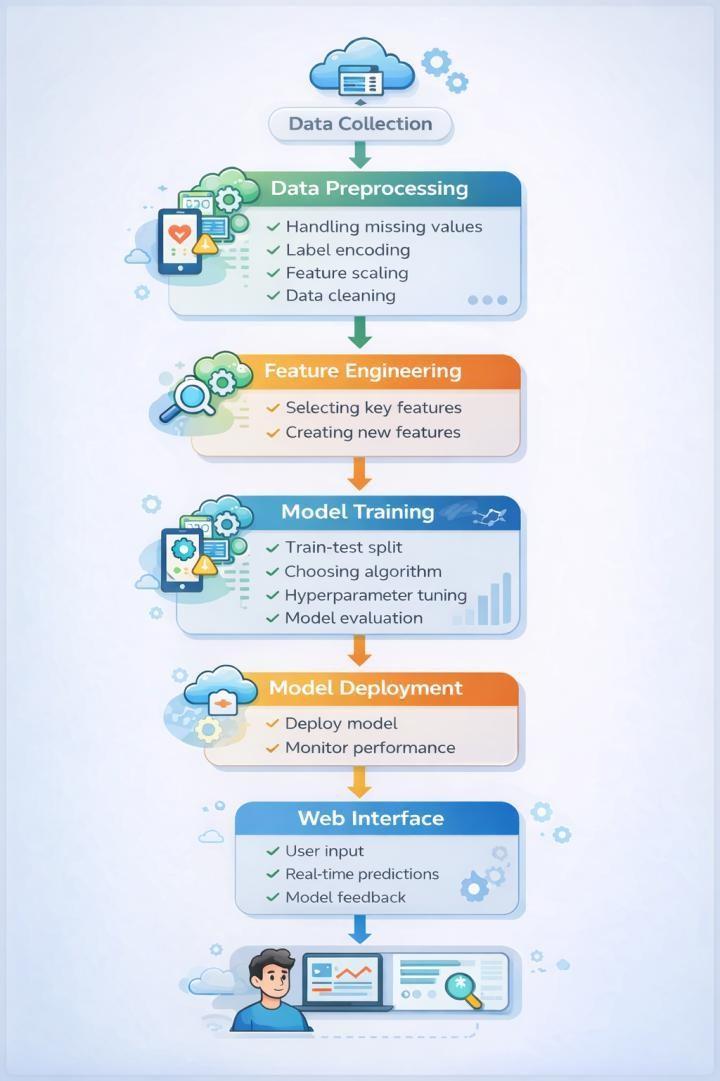
Theobjectiveofthesystemistobuildanintelligentmodelfor predictingstudentstressusingmachinelearning basedon both academic and lifestyle data. Data will include input parameters: study hours, amount of sleep, amount of academic workload, amount of social media usage, amount of physical activity and any other habits that influence stud nt’sstress. Thefirststepintheoverallsystemwillbetoperformapre-processingphaseontheoriginaldatasettoremovemissingdata, removenoise,andconvertallcategoricalvariablesintoanumericalformatthroughanappropriateencodingmethod.After pre-processing, exploratory analysis will be done to determine how each attribute relates to stress level. There will be a number of machine learning algorithms applied to the final data set to train the prediction model including Logistic
© 2026, IRJET | Impact Factor value: 8.315 | ISO 9001:2008 Certified Journal | Page734
International Research Journal of Engineering and Technology (IRJET) e-ISSN: 2395-0056
Volume: 13 Issue: 03 | Mar 2026 www.irjet.net p-ISSN: 2395-0072
Regression,DecisionTree,RandomForest,SupportVectorMachine(SVM)andK-NearestNeighbours(K-NN).Thedatais splitintotrainandtestsetsinordertoevaluateeach lgorithm’sp rform n . Tomeasuretheperformanceofeachmodel thereareseveralmetricsthatneedtobeused,whichinclude:accuracy,precision,recall,andF1-score,toidentifythe bestperforming model. The model selected for thepredictionwhenrunningthe algorithms wasthemodelwith the highest prediction accuracy. The final model is trained and is being deployed through a user-friendly interface using Streamlit, allowing the user to enter their academic/lifestyle information to receive a stress level prediction in real-time. Once implementedintheclassroom,thisproposedsystemwouldallowstudentstoearlyidentifytheirstresslevelandtoprovide institutionsandeducatorswithinsighttoassist studentsmakingproactivedecisionstowardimprovingtheirmentalhealth andacademicsuccess.
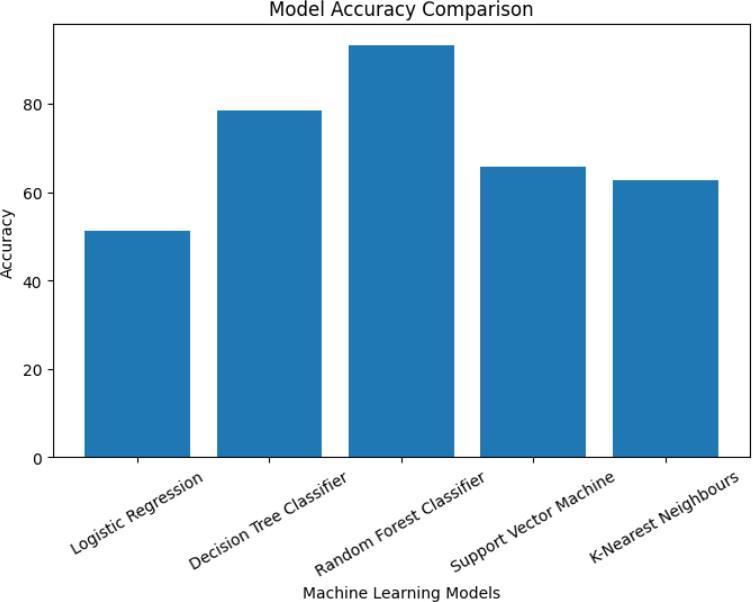
Table. 1 Accuracy of all the models
Using larger amounts of information in future developments of the enhanced system will allow for better prediction accuracy and have the enhanced system connected or integrated with internet or mobileapplications toallow real- time predictivecapabilities.Real-timemonitoringofstudent stress levels could be carried out through the use of one or more applicationsprovidingadditionalreliabledataasaresultofincludingalternativedatasources.Otheralternativedatasources suchasexercisehabits,overallmentalhealthandemotionalindicatorswillproduceamorecomprehensiveassessmentof the student and will enable departments to provide individualized recommendations for maintaining a healthy academic lifestyle.
This project aims to predict student stress levels using various machine learning methods and models based on factors linkedtothestudent'sacademicsandhowtheylive. For instance, amount of time studying, sleeping patterns, howmuch academic pressuretheyface,andhowfrequentlythey use social media are all included as input into the variousmachine learningalgorithmsusedforanalysisofthedatasetandclassificationofthestudentsintoappropriate
International Research Journal of Engineering and Technology (IRJET) e-ISSN: 2395-0056
Volume: 13 Issue: 03 | Mar 2026 www.irjet.net p-ISSN: 2395-0072
stresscategories(low,medium,andhigh)basedonthepredictionprovidedbyeachalgorithmtested(ex:randomforest was foundto bemost accurateand reliable). The data generated from this application of machinelearningshowed that patternsassociatedwithstudentstresscanbeidentified accurately using machine learning techniques. The information producedbythissystemwillalloweducationinstitutionsaswellasstudentsto identifystressearly,andtakeproactive stepstowardimprovingacademicperformanceandoverallwell-beingoftheirstudents.
[1] Dr.L.R hun th n,A.Suh n N f is,G.Arun,P.R gu,Mr.L.S.S tish,Ms.V.N.Sris kthi,“M hin L rningMod lfor Stud nt Str ss L v l Pr di tion”, 4th OPJU International Technology Conference (OTCON) on Smart Computing for InnovationandAdvancementinIndustry 5.0(2025).
[2] Enrique Macías Arias, Jorge Parraga-Alava, David ZambranoMontenegro,“Str ssDetectionamongHigherEducation Stud nts:ACompr h nsiv Syst m ti R vi wofM hin L rningAppro h s”,10thInt rn tion lConf r n on eDemocracy&eGovernment(ICEDEG-2024).
[3] Sh hid Sh b r M lik, An qu Kh n, “Anxi ty, D pr ssion nd Str ss pr di tion mong Coll g Students using M hin L rning Algorithms”, S ond Int rn tion l Conf r n on El tri l, El troni s, Information and CommunicationTechnologies(ICEEICT-2023).
[4] Anuradha Parasar, Sujatha N, Sweta Priya, Pramod S, Sasi KumarA,KogilaPalanimuthu,“M hin Learning- based Detection of Stress Levels in Students with So i l M di Addi tion”, 3rd Int rn tion l Conf r n on Int gr t d CircuitsandCommunicationSystems(ICICACS-2025).
[5] HassanAli,HamzaAminM,AttiqueUrRehman,SabeenJavaid,TahirMuh mm dAli,Azk Mir,“Pr di tiv Mod ling of Stud nts' Str ss L v ls Using M hin L rning Algorithm”, Int rn tion l Conf r n on Em rging Tr nds in NetworksandComputerCommunications(ETNCC-2024).
[6] AanchalBisht,ShreyaVashisth,MuskanGupta,EnaJain,“Str ss Pr di tion in Indi n S hool Stud nts Using M hin L rning”,3rdInt rn tion lConf r n onIntelligentEngineeringandManagement(ICIEM-2022).
[7] Dr. Vishnukum r A, K vith A, Aksh y G, “Str ss n lysis nd r pr di tion for host ll rs”, International ConferenceonCommunication,ComputingandInternetofThings(IC3IoT-2024).
[8] HafizArslanRamzan,MuhammadArslanUlHaq,MariaSehar,MinahilRauf,MuhammadAdnan,SadiaR mz n,“Str ss and Anxiety Level Prediction in Students Using Psy hologi l M tri s nd M hin L rning T hniqu s”, 5th InternationalConferenceonDigitalFuturesandTransformativeTechnologies(ICoDT2-2025).
[9] Bhatnagar, S., Agarwal, J., & Sharma, O. R. (2023). Detection and classification of anxiety in university students throughmachinelearning.
[10]Salma S Shahapur, Praveen Chitti, Shahak Patil, Chinmay Abhay Nerurkar, Vijay Shivaram Shivannagol, Vinayak C R y n ik r, Vishw jit S w nt, V dir j B t g ri, “Estim tion of Str ss L v l in Stud nts using M hin L rning”, IndianJournalofScienceandTechnology,Volume:17,Issue:19(2024).
[11]H rshith N llor ,“D t An lyti s ndM hin L rningAppro h sforPr di tingA d mi Str ss andEnhancing Stud ntW llb ing”,InternationalJournalofAdvanceResearchandInnovation(IJARI), vol.13,issue:4(2025).
[12]Sur jAry ,Anju,NorAzu n R mli,“Pr di tingth str ssl v lofstud ntsusingSup rvis dML nd ArtificalNeural N twork”,Indi nJourn lofEngineering,Vol.21,issue56(2024).
[13]Chung,J.,&Teo,J.(2022).Mentalhealthpredictionusingmachinelearning:taxonomy,applications,and challenges. AppliedComputationalIntelligenceandSoftComputing,2022(1),9970363.
[14]Nakao,M.,Shirotsuki,K.,&Sugaya,N.(2021).Cognitive– behavioral therapy for management of mental health and stress-relateddisorders:Recentadvancesintechniquesandtechnologies.BioPsychoSocialmedicine,15(1),16.
[15]Kris-Etherton,P.M.,Petersen,K.S.,Hibbeln,J.R.,Hurley, D., Kolick, V., Peoples, S., ... & Woodward-Lopez, G. (2021).
International Research Journal of Engineering and Technology (IRJET) e-ISSN: 2395-0056
Volume: 13 Issue: 03 | Mar 2026 www.irjet.net p-ISSN: 2395-0072
Nutritionandbehavioralhealthdisorders:depressionandanxiety.Nutritionreviews,79(3),247-260.
[16]J. G. Jayawickrama and R. A. H. M. Rupasingha, "Ensemble Learning Approach to Human Stress Detection Basedon BehavioursDuringtheSleep,"20224thInternationalConferenceonAdvancementsinComputing(ICAC).
[17] Prakruthi Manjunath, Twinkle S, Pola Shreya, Vismaya Ashok, and Dr. Shabana Sultana, “ Predictive Analysis of Stud ntStr ssL v l using M hin L rning,” International Journal ofEngineering Research&Technology(IJERT) NCCDS–2021,ISSN:2278-0181.
[18]Garima Verma, and Hemraj Verma, “Mod l for predicting academic stress among students of technical education in Indi ,”Int rn tion lJourn lofPsy hoso i lRehabilitation,February2020.
[19] Kavita Pabreja, Anubhuti Singh, Rishabh Singh, Rishita Agnihotri, Shriam Kaushik, and Tanvi Malhotra, “ Stress Prediction Model Using Machine L rning,” Proceedings of International Conference on Artificial Intelligence and Applications.AdvancesinIntelligentSystemsandComputing,2021.
[20] D.Sharma,N.Kapoor,D.R.Sandeep,andS.Kang,“Str ssPr di tionofStud ntsusingML,”SCOPUSInd x d Journ l Jun2024.
[21] A.R.Subhani,W.Mumtaz,M.N.B.M.Saad,N.Kamel,and A.S.M lik,“M hin l rningfr m workforth detection ofmentalstressatmultiplel v ls,”IEEEvol.5,Jul.2017.
[22] K.S i,S.R kh ,S.M thur,S.S dhukh n, ndJ.[19]M.Hum yun,N.T riq,M.Alf y d,M.Z kw n,J ngiti,“Stud nt StressPredictionUsingMachineLearningAlgorithmsAndComprehensiveAn lysis,”vol.20,2022.
[23]M.Firoz,M.M.Islam,M.Shidujaman,A.Islam,andMd.T.H bib, “Univ rsity stud nt’s m nt l str ss d t tion using m hin l rning,”S p2023.
[24]G.Verma,S.Adhikari,V.Khanduri,S.Tandon,S.Rawat,andP.Singh,“M hin LearningModelforPredictionofStress L v ls in Stud nts of T hni l Edu tion,” Conf r n Pro dings of Int rn tion l on Appli d M th m ti s & ComputationalSciences,Aug2020.
[25]S.Mutalib,N.SafikaMohdShafiee,S.Abdul-Rahman,S.Al m, ndS.D rulEhs n,“M nt lH lthPr di tionMod ls UsingM hin L rningin High rEdu tionInstitution,” Turkish Journ l ofComput r ndM th m ti sEdu tion (TURCOMAT),vol.12,April2021.
© 2026, IRJET | Impact Factor value: 8.315 | ISO 9001:2008 Certified Journal | Page737