
International Research Journal of Engineering and Technology (IRJET) e-ISSN: 2395-0056
Volume: 13 Issue: 03 | Mar 2026 www.irjet.net p-ISSN: 2395-0072
STUDENT FEEDBACK AND REVIEW SYSTEM
Samarth Narayankar1,Vedant Pardeshi2,Chaitanya Talekar3,Rushi Mate4,Prof.Anil Naik5
1,2,3,4(Students, Department Of Computer Engineering),S.Y.Pshreeyash College Of Engineering And Technology (Polytechnic), Chh.Sambhajinagar , India 5(Hod, Dept. Of Computer Engineering), S.Y.Pshreeyash College Of Engineering And Technology (Polytechnic), Chh.Sambhajinagar , India
Abstract – The Student Feedback and Review System is a structured, web-based application developed to enhance the quality, efficiency, and reliability of academic performance evaluation within educational institutions. In contemporary educational environments, maintaining high standards of teaching and learning requires systematic monitoring mechanisms that facilitate continuous improvement. One of the most effective tools for achieving this objective is a well-designed student feedback system. Feedback provided by students serves as a critical source of information for evaluating teaching effectiveness, subject comprehension, instructional methods, classroom engagement, and overall academic experience. However, traditional feedback collection methods, primarily paper-based systems, present significant challenges including manual processing errors, delayed result generation, limited scalability, data storage difficulties, and environmental concerns due to excessive paper usage.
To address these limitations, the proposed Student Feedback and Review System replace conventional manual processes with a secure and automated digital platform. The system is designed using Python Flask as the backend framework to manage application logic and request handling, HTML and CSS for creating an interactive and user-friendly interface, and SQLite as the relational database management system for structured and secure data storage.
Key Words: Key Words: Student Feedback System, Digital Feedback Platform, Teaching Evaluation, Automated Assessment, Anonymity in Feedback, Web-Based Application, Python Flask, SQLite Database, Real-Time Processing, Academic Performance Monitoring.
1. INTRODUCTION
Education is a systematic and structured process through which knowledge, skills, values, and competencies are transmittedfromeducatorstolearnerswithinaformalacademicenvironment.Itisnotmerelythetransferofinformation but a comprehensive process that shapes cognitive abilities, critical thinking, problem-solving skills, and social values in students. The quality of education delivered by an institution depends on multiple interconnected factors, including the effectiveness of teaching methodologies, faculty performance, course structure and design, student engagement, and institutional support systems. As educational systems evolve to meet global standards and the growing demands of society, continuous monitoring and evaluation mechanisms become essential to ensure academic excellence and holistic developmentoflearners.
Amongvariousevaluationtools,astructuredstudentfeedbacksystemhasemergedasoneofthemostreliableandwidely accepted mechanisms. A student feedback system can be defined as a formal process through which learners provide evaluativeresponsesregardingteachingquality,subjectunderstanding,classroominteraction,communicationclarity,and overall learning experiences. Feedback serves as a vital two-way communication channel between students and educational institutions, enabling educators and administrators to assess instructional effectiveness, identify strengths and weaknesses, and implement targeted improvements. Furthermore, systematic feedback collection helps foster transparency,accountability,andmutualtrustwithintheacademicenvironment.
Traditionally, feedback collection in academic institutions has relied heavily on manual, paper-based methods. These involve distributing physical feedback forms to students, collecting completed forms, performing manual data entry, calculating results, and storing physical documents for future reference. While this approach fulfills the basic purpose of gathering opinions, it suffers from several limitations. Manual feedback collection is time-consuming, prone to human error,lacksscalability,andoftenresultsindelaysingeneratingactionableinsights.Moreover,thestorageandretrieval of paper-baseddatacanbecumbersomeandresource-intensive,raisingconcernsaboutsustainabilityduetoexcessivepaper consumption. As institutions expand in size, with growing numbers of students, faculty, and courses, traditional systems becomeincreasinglyinefficientandinadequateformaintainingaccuraterecordsandtimelyperformanceevaluation.
International Research Journal of Engineering and Technology (IRJET) e-ISSN: 2395-0056
Volume: 13 Issue: 03 | Mar 2026 www.irjet.net p-ISSN: 2395-0072
The advancement of digital technologies has introduced automated feedback systems as a modern solution to these challenges. Automation refers to the application of technology to perform repetitive tasks with minimal human intervention, thereby improving accuracy, efficiency, and speed. A digital student feedback system integrates several components, including an intuitive user interface for students to submit responses, a backend processing unit to handle logical operations and data computation, and a structured database management system for secure and organized data storage. Such integration ensures real-time processing of feedback, immediate availability of results, and accurate generationofanalyticalreports,whichcollectivelyenhancedecision-makingprocessesattheinstitutionallevel.
Anonymity is a critical feature of any effective feedback system. It ensures that the identity of respondents remains undisclosed during and after data submission, which encourages students to provide honest, unbiased, and constructive feedback. Anonymity protects against potential biases and fear of repercussions, thereby increasing the reliability and authenticityof the collected data.When students feel confident thattheiropinionsare privateandrespected,the quality and usefulness of feedback significantly improve, providing administrators with valuable insights to enhance teaching strategiesandlearningoutcomes.
The proposed Student Feedback and Review System addresses the shortcomings of traditional manual methods by providingasecure,web-based,andautomatedplatformforcollectingandanalyzingstudentfeedback.Thesystemisbuilt usingPythonFlaskforbackendoperations,HTMLandCSSfordesigninganinteractiveandresponsiveuserinterface,and SQLite as the relational database for reliable data storage. This combination of technologies ensures that the system is robust,scalable,easytomaintain,andsuitableforimplementationindiverseacademicinstitutions.
In conclusion, the Student Feedback and Review System represents a significant step toward modernizing academic evaluationprocesses.Itcombinestechnologicalinnovation,securedatamanagement,anduser-centricdesigntotransform how educational institutions collect, analyze, and act upon student feedback. By adopting this system, institutions can ensurecontinuous monitoringofteaching effectiveness,improvestudentsatisfaction,andcontributetooverall academic growthandqualityassurance.
II.LITERATURE SURVEY
A literature review is a systematic and analytical examination of previously published research, academic studies, technologicaldevelopments,andpracticalimplementationsrelatedtoaspecificsubjectarea.Inthecontextof educational systems,literaturerelatedtostudentfeedback mechanismshighlightstheimportanceofstructuredevaluation processes in maintaining and improving academic quality. Researchers have consistently emphasized that feedback serves as a critical communication channel between students and faculty members, enabling institutions to measure teaching effectivenessandenhancelearningoutcomes.
Studentfeedbackiscommonlydefinedinacademicresearchasastructuredmechanismforcollectingstudent perceptions regarding course content, teaching methodologies, communication clarity, classroom engagement, and overall academic experience.Variousstudieshaveestablishedthatfeedbacksystemscontributesignificantlytoqualityassuranceinhigher education.Qualityassurancereferstothesystematicmonitoringandevaluationofteachingandadministrativeprocesses to ensure that educational standards are maintained and continuously improved. Without a structured feedback framework,institutionsoftenrelyoninformalopinions,whichlackreliabilityandmeasurablevalue.
Earliereducationalinstitutionsprimarilydependedonpaper-basedfeedbacksystems.Thesetraditionalmethodsinvolved distributingprintedquestionnairesattheendofacademicsessions,manuallycollectingresponses,andtabulatingresults. Althoughsimpleinstructure,thesesystemssufferedfrommultipleoperationallimitations.Researchindicatesthatmanual
International Research Journal of Engineering and Technology (IRJET) e-ISSN: 2395-0056
Volume: 13 Issue: 03 | Mar 2026 www.irjet.net p-ISSN: 2395-0072
data entry increases the probability of human errors, delays report generation, and consumes significant administrative time.Furthermore,physicalstorageoffeedbackformscreateschallengesrelatedtodatapreservation,retrieval,andlongterm record management. Environmental concerns associated with excessive paper usage have also been highlighted in severalstudies,promotingtheneedfordigitalalternatives.
With the advancement of Information and Communication Technology, web-based feedback systems began to replace manual approaches. An online feedback system is defined as a digital platform that enables users to submit responses electronically through internet-based applications. Academic research demonstrates that digital systems significantly improve efficiency by automating data collection, storage, and analysis. Automated systems reduce processing time, minimizecalculationerrors,andprovideimmediateaccesstoanalyticalreports.Real-timedataprocessing,definedasthe immediateinterpretationofdatauponsubmission,allowsadministratorstomaketimelyandinformeddecisions.
Anothermajoraspectemphasizedinpreviousresearchistheimportanceofanonymityinfeedbackcollection.Anonymity refers totheprotectionoftheparticipant’sidentityduringdata submission. Studies consistentlyreveal thatstudentsare more likely to provide honest, unbiased, and constructive responses when assured that their identities will not be disclosed. Non-anonymous systems often result in cautious or influenced feedback due to fear of negative consequences. Therefore,moderndigital feedback platformsprioritizeanonymous submissionmechanisms toenhanceauthenticityand reliabilityofcollecteddata.
Database integration has also been identified as a crucial component of effective feedback systems. A Database Management System (DBMS) is defined as software that enables structured storage, retrieval, and management of data. Research highlights that relational databases ensure data integrity, consistency, and security. Data integrity refers to the accuracy and consistency of stored information over its lifecycle. By using structured query mechanisms such as SQL, institutions can generate subject-wise, faculty-wise, and performance-based reports efficiently. The transition from unstructured physical records to structured electronic databases marks a significant improvement in institutional data managementpractices.
Recent technological developments have introduced QR code-based access systems to enhance user convenience. A QR code, or Quick Response code, is a two-dimensional barcode capable of storing information that can be quickly scanned using mobile devices. Literature suggests that QR-based access increases student participation rates by simplifying the process of accessing online forms. Instead of manually entering web addresses, students can directly scan the code and accessthefeedbackportalinstantly.Thisinnovationreduceseffortandencouragestimelysubmission.
Despite the availability of various digital platforms, literature also identifies certain gaps in existing systems. Some feedbackplatformsareoverlycomplexandrequireextensiveconfiguration,makingthemunsuitableforsmallormediumscale institutions. Others lack proper authentication mechanisms for administrative access, raising concerns regarding data security. Additionally, some systems fail to integrate lightweight databases, resulting in unnecessary resource consumption. These gaps highlight the need for a secure, simple, and scalable feedback solution tailored specifically to institutionalrequirements.
The overall analysis of existing research clearly indicates a shift from manual evaluation methods toward digital, automated, and database-driven systems. Scholars agree that technology-enhanced feedback mechanisms improve transparency, reliability, and operational efficiency. However, effective implementation requires proper system architecture,secureauthentication,guaranteedanonymity,andstructureddatastorage.
Basedonthecomprehensivereviewofpreviousstudies,itisevidentthatanintegrated,web-basedStudentFeedbackand Review System is essential for modern educational institutions. The proposed project builds upon established research principles while addressing identified limitations by combining anonymity, lightweight database integration, secure administration access, and user-friendly design into a unified digital platform. Thus, the literature strongly supports the development of an automated student feedback system as a necessary step toward achieving academic excellence and institutionalqualityenhancement.
III.PROPOSED METHOD FOR STUDENT FEEDBACK AND REVIEW SYSTEM
Theproposedmethodoutlinesastructuredandsystematicapproachtodesigningandimplementingaweb-based Student Feedback and Review System. In software engineering, a proposed method refers to a defined procedural framework that identifies a problem, analyzes its requirements, and provides a technological solution through well-defined development processes. The design and implementation of this system follow the Software Development Life Cycle (SDLC),whichisawidelyadoptedmethodologyforplanning,designing,implementing,testing,deploying,andmaintaining
International Research Journal of Engineering and Technology (IRJET) e-ISSN: 2395-0056
Volume: 13 Issue: 03 | Mar 2026 www.irjet.net p-ISSN: 2395-0072
software applications. The SDLC ensures that the final system satisfies both functional requirements, such as data collection and report generation, and non-functional requirements, including security, scalability, reliability, and user accessibility.
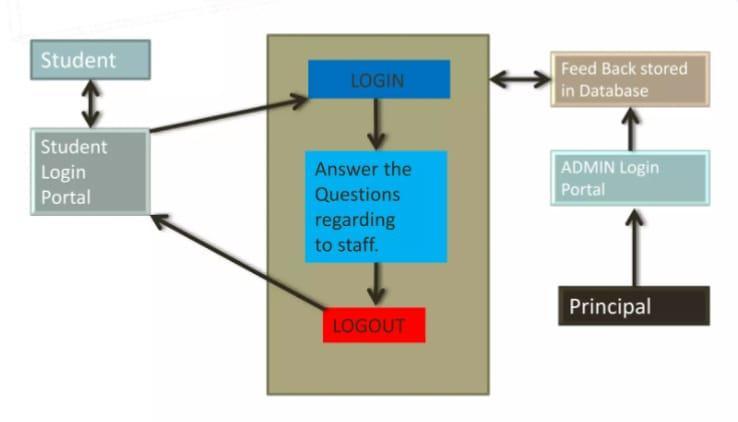
The system architecture isbasedona client-server model,adistributedcomputingparadigmwhereclientdevicessend requeststoacentralizedserver,whichprocessestherequestsandreturnsresponses.Inthissystem,theclientrepresents the student’s web browser, which provides an interactive interface for feedback submission. The server is implemented usingthe Python Flask framework,whichhandlesincomingrequests,executesapplicationlogic,validatesfeedbackdata, and communicates with the database for storage and retrieval. The database, built using SQLite, serves as a structured repository that organizes feedback records into relational tables, enabling efficient data management, retrieval, and analyticalprocessing.
The data flow within the system follows a logical sequence: it begins with student input through the web interface, proceeds to backend processing and validation, followed by storage in the database, and concludes with administrative analysis and report generation. Data validation mechanisms are integral to the system, ensuring that incomplete, inconsistent, or incorrect entries are filtered before storage. This maintains data integrity, prevents errors in report generation,andensurestheaccuracyofevaluations.
Thesystemalsoincorporates authentication and authorization mechanisms tocontrolaccess.Administrativemodules are accessible only to verified personnel, ensuring that sensitive data remains confidential and is protected from unauthorizedaccess.Authenticationverifiestheidentityofusers,whileauthorizationdefinestheirpermissionswithin the system.Thesesecuritymeasuresenhancetrustandensureresponsiblehandlingofacademicfeedback.
Akeyfeatureofthesystemisits modular design,whichdividestheapplicationintoindependentfunctionalcomponents, including:
1. Student Interface Module: Provides a responsive, interactive, and anonymous platform for students to submit feedback.
2. Administrative Dashboard Module: Allows faculty and administrators to view reports, analytics, and performancemetricsinrealtime.
3. Database Module: Organizes, stores, and retrieves feedback data efficiently, supporting queries and report generation.
Modular design enhances maintainability and scalability, allowing developers to modify or upgrade individual componentswithoutaffectingtheoverallsystemstructure.Theintegrationofwebtechnologies,backendprocessing,and database management creates a unified, automated environment that effectively replaces traditional manual feedback systems. The system is capable of processing large volumes of feedback efficiently, generating instant analytical reports, andprovidingactionableinsightsforinstitutionaldecision-making.
Inaddition,thesystememphasizes security, anonymity, and data reliability.Feedbacksubmissionsareanonymizedto encourage honest and unbiased responses from students, ensuring that collected data reflects genuine opinions. Stored data is protected using structured access controls, reducing the risk of unauthorized access or manipulation. By automating the feedback collection and analysis process, the system reduces human error, saves time, minimizes paper usage,andsupportssustainableinstitutionalpractices.
In conclusion, the proposed method represents a comprehensive, scalable, and secure approach to implementing a modern StudentFeedback andReview System.Bycombiningclient-serverarchitecture, modulardesign,secure database management, and automated processing, the system provides a reliable solution that improves teaching evaluation, supportscontinuousacademicimprovement,andenhancesoverallinstitutionalefficiency.
3. CONCLUSION
The Student Feedback and Review System represents a significant advancement in the digital transformation of traditional feedback collection mechanisms within educational institutions. At its core, a feedback system functions as a structured evaluation framework designed to systematically collect, analyze, and interpret participant responses for continuous performance enhancement. By transitioning from conventional paper-based methods to a web-based automated platform, this system addresses the limitations of manual processes, including delayed result generation,
International Research Journal of Engineering and Technology (IRJET) e-ISSN: 2395-0056
Volume: 13 Issue: 03 | Mar 2026 www.irjet.net p-ISSN: 2395-0072
human errors, limited scalability, and environmental concerns, while ensuring higher efficiency, accuracy, and transparency.Here,transparencyreferstotheclarityandopennessofprocesses,guaranteeingthatevaluationresultsare accessible,interpretable,andactionableforauthorizedstakeholders.
The system’s architecture integrates a frontend user interface, backend logic processing, and relational database storage, ensuring seamless data flow, structured information management, and reliable feedback evaluation. By implementing anonymity, the system protects student identities, which encourages honest, unbiased, and constructive feedback, thereby enhancing the reliability and authenticity of collected data. Automation reduces the administrative burdenofmanualprocessingandacceleratesdecision-makingthroughreal-timedatahandling,instantreportgeneration, and analytical visualization. The concept of scalability ensures that the system can accommodate growing numbers of users, courses, and feedback entries without compromising performance or responsiveness, making it suitable for institutionsofvaryingsizes.
This project demonstrates the practical application of modern web development technologies in solving real-world institutional challenges. By incorporating secure authentication protocols, structured data storage, and efficient backend processing,thesystemprovidesarobust,reliable,andsustainablesolutionforacademicevaluation.Moreover,itsupports a data-driven approach to monitoring teaching effectiveness, enhancing student engagement, and guiding administrative strategiesforcontinuousimprovement.
Looking ahead, future enhancements could include cloud-based deployment for improved accessibility and storage scalability, advanced analytical dashboards for deeper insights into student responses, and intelligent sentiment analysis mechanisms to interpret qualitative feedback more effectively. These additions would further strengthen the system’s capability, transforming raw feedback into actionable recommendations for pedagogical and institutional development.
In summary, the Student Feedback and Review System establishes a secure, efficient, and scalable framework for evaluating teaching performance and academic processes. By leveraging modern digital technologies, it contributes significantly to institutional quality improvement, promotes accountability and transparency, and aligns with contemporaryprinciplesofeducationalmanagement.Thesystemnotonlystreamlinesfeedbackcollectionbutalsofosters a culture of continuous assessment, reflection, and enhancement, making it an essential tool for modern educational institutions.
REFERENCES
[1]R.S.Pressman, Software Engineering: A Practitioner’s Approach,8thed.,NewYork,NY,USA:McGraw-Hill,2014.
[2]I.Sommerville, Software Engineering,10thed.,Boston,MA,USA:Pearson,2015.
[3]L.Bass,P.Clements,andR.Kazman, Software Architecture in Practice,3rded.,Boston,MA,USA:Addison-Wesley,2012.
[4]J.F.KuroseandK.W.Ross, Computer Networking: A Top-Down Approach,7thed.,Boston,MA,USA:Pearson,2016.
[5]M.Fowler, Patterns of Enterprise Application Architecture,Boston,MA,USA:Addison-Wesley,2003.
[6]S.W.Ambler, Agile Database Techniques: Effective Strategies for the Agile Software Developer,NewYork,NY,USA:Wiley, 2003.
[7]A.TanenbaumandD.Wetherall, Computer Networks,5thed.,Boston,MA,USA:Pearson,2011.
[8]PythonSoftwareFoundation,“FlaskDocumentation,”[Online].Available:https://flask.palletsprojects.com/
[9]SQLiteConsortium,“SQLiteDocumentation,”[Online].Available:https://www.sqlite.org/docs.html
[10] P. S. P. Chen, “The Entity-Relationship Model Toward a Unified View of Data,” ACM Transactions on Database Systems,vol.1,no.1,pp.9–36,Mar.1976.
[11] S. K. Sharma and R. K. Jain, “A Review on Web-Based Student Feedback System,” International Journal of Advanced Research in Computer Science and Software Engineering,vol.6,no.6,pp.45–50,2016.
International Research Journal of Engineering and Technology (IRJET) e-ISSN: 2395-0056
Volume: 13 Issue: 03 | Mar 2026 www.irjet.net p-ISSN: 2395-0072
BIOGRAPHIES
MR.SAMARTH NARAYANKAR
PursuingPoly(Co)
S.Y.PSHREEYASHCOLLEGEOFENGINEERINGA NDTECHNOLOGY(POLYTECHNIC)
MR.CHAITANYA TALEKAR
PursuingPoly(Co)
S.Y.PSHREEYASHCOLLEGEOFENGINEERING ANDTECHNOLOGY(POLYTECHNIC)
MR.VEDANT PARDESHI
PursuingPoly(Co)
S.Y.PSHREEYASHCOLLEGEOFENGINEERING ANDTECHNOLOGY(POLYTECHNIC)
MR.RUSHIKESH MATE
PursuingPoly(Co)
S.Y.PSHREEYASHCOLLEGEOFENGINEERING ANDTECHNOLOGY(POLYTECHNIC)
PROF.ANIL NAIK
HOD,Dept.ofComputerEngineering
S.Y.PSHREEYASHCOLLEGEOFENGINEERING ANDTECHNOLOGY(POLYTECHNIC)