
International Research Journal of Engineering and Technology (IRJET) e-ISSN: 2395-0056
Volume: 13 Issue: 06 | Jun 2026 www.irjet.net p-ISSN: 2395-0072
International Research Journal of Engineering and Technology (IRJET) e-ISSN: 2395-0056
Volume: 13 Issue: 06 | Jun 2026 www.irjet.net p-ISSN: 2395-0072
Karan Kankate1, Omkar Dhaybar2, Atharva Patil3, Abhishek Abhale4, Prof. M.P. Shah5
1,2,3,4UG Student, Department of Mechanical Engineering, AISSMS College of Engineering, SPPU, Pune, Maharashtra, India
5Assistant Professor, Department of Mechanical Engineering, AISSMS College of Engineering, SPPU, Pune, Maharashtra, India ***
Abstract - Engine mounts are critical vibration-isolating components that support the powertrain, limit engine motion, reduce the transmission of vibrations to the vehicle body, and improve ride comfort. This study presents the structural optimization of the front engine mount bracket of a Maruti Suzuki Wagon R (1.2 L K-series engine) using finite element analysis (FEA). The existing bracket geometry was modelled in CAD software and analysed in ANSYS Workbench under representative static loading conditions, including engine torque reaction, acceleration, and road-induced impact loads. Static structural and modal analyses were conducted to evaluate stress distribution, deformation, and natural frequencies. Topology optimization was then performed with a target volume reduction of 30% to identify regions where material could be safely removed while maintaining structural integrity. The optimized design achieved a significant reduction in component mass while keeping the maximum von Mises stress below the material yield strength with an adequate factor of safety. In addition, the optimized bracket exhibited an increase in natural frequency, reducing the likelihood of resonance with the engine operating frequency range and thereby improving vibration isolation characteristics. The results demonstrate that topology optimization is an effective approach for reducing engine mount bracket weight while maintaining strength and enhancing structural and dynamic performance, making it suitable for lightweight automotive applications
Key Words: engine mount, Wagon R, structural optimization, topology optimization, SIMP, finite element analysis, NVH, vibration isolation, weight reduction, ANSYS
1. INTRODUCTION
Engine mounts, also known as powertrain mounts or motor mounts, are critical components that support the engine while isolating vibrations from the vehicle chassis. They must provide sufficient stiffness to control engine movement duringaccelerationandroad-inducedloadswhileremainingcompliantenoughtoreduceNoise,Vibration,andHarshness (NVH),therebyimprovingridecomfortandvehicledurability.
The front engine mount bracket is a primary load-bearing component that transfers engine loads to the vehicle structure.Conventional bracketsaregenerallydesignedwithconservativematerial distributiontoensurestrength,often resulting in unnecessary weight. With the increasing demand for lightweight and fuel-efficient vehicles, structural optimizationhasbecomeaneffectiveapproachforreducingcomponentmasswithoutcompromisingperformance.
ThisstudyfocusesonthestructuraloptimizationofthefrontenginemountbracketoftheMarutiSuzukiWagonR(1.2L K-series engine) using Finite Element Analysis (FEA) and topology optimization in ANSYS Workbench. Static structural andmodalanalysesareperformedtoevaluatethebaselinedesignunderrepresentativeloadingconditions.Theoptimized design is then re-analysed and compared with the original bracket in terms of stress distribution, deformation, mass reduction,andnaturalfrequency.
2.
Brach [1] established the analytical foundations of engine mount design by demonstrating that appropriate mount placement and stiffness selection can minimize vibration transmission across the powertrain. Shangguan [2] further reviewed modern engine mounting systems and highlighted the importance of optimizing mount stiffness and damping characteristicstoimproveNoise,Vibration,andHarshness(NVH)performanceundervaryingoperatingconditions.
International Research Journal of Engineering and Technology (IRJET) e-ISSN:2395-0056
Volume: 13 Issue: 06 | Jun 2026 www.irjet.net p-ISSN:2395-0072
Bendsoe and Kikuchi [3] introduced the Solid Isotropic Material with Penalization (SIMP) method, which has become oneofthemostwidelyusedtechniquesfortopologyoptimizationinstructuraldesign.Theirworkshowedthatoptimized material distribution can significantly reduce component weight while maintaining structural integrity. Kim et al. [4] successfully applied topology optimization to an automotive engine cradle, achieving considerable weight reduction without adversely affecting its structural performance. Similarly, Kang et al. [5] combined topology optimization with advanced manufacturing techniques to develop lightweight engine mount brackets with improved strength and fatigue resistance.
Although previous studies have demonstrated the effectiveness of topology optimization for automotive components, limitedworkhasfocusedonthestructuraloptimizationofthefrontenginemountbracketoftheMarutiSuzukiWagonR. Therefore, this study applies a combined static structural, modal, and topology optimization approach using Finite Element Analysis (FEA) in ANSYS Workbench to reduce bracket weight while maintaining structural strength and improvingdynamicperformance.
3.1
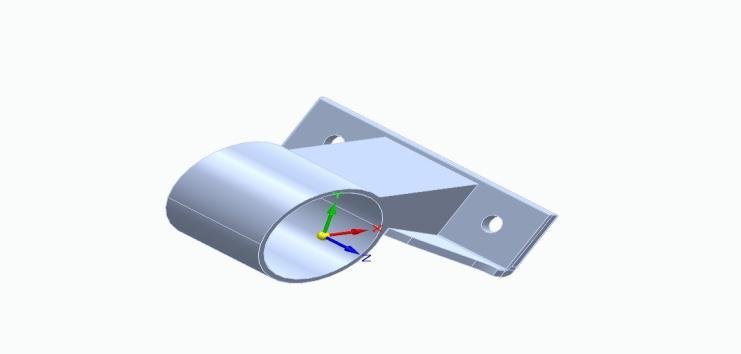
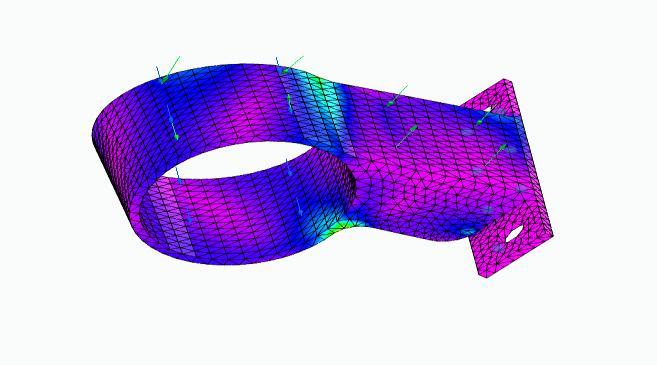
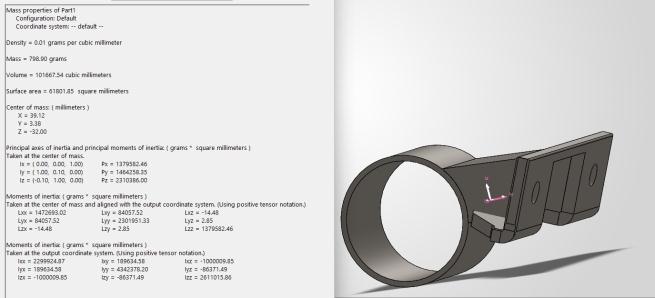
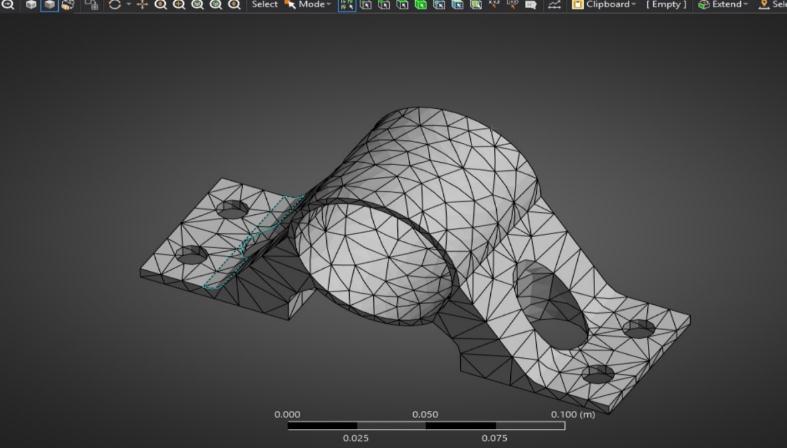
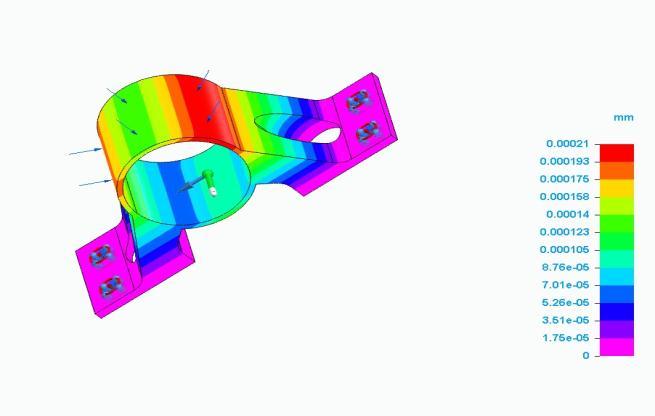
ThefrontenginemountbracketoftheMaruti SuzukiWagonR(2019model,1.2LK12Mengine,61.7kW@6000rpm, peak torque 113 N·m @ 4200 rpm) was selected as the study component. The bracket was removed from a wellmaintainedvehiclehavingapproximately52,000kmmileage,cleaned,anditsexternal geometrydigitizedusingaVernier calliper.Theoveralldimensionsofthebracketwereapproximately150mm×110mm×75mm.Thebolt-holepatternwas recorded according to the Wagon R service manual. The baseline mass of the bracket was measured as 1.05 kg using a calibrated digital balance. Refer Fig 1 (isometric view) and Fig 2 (stress analysis view) for component details.
International Research Journal of Engineering and Technology (IRJET) e-ISSN:2395-0056
Volume: 13 Issue: 06 | Jun 2026 www.irjet.net p-ISSN:2395-0072
The baseline engine mount bracket geometry was modelled in SOLIDWORKS as a parametric solid model based on measurements obtained from the physical component. Critical features such as fillets, mounting holes, draft angles, and castingdetailswereretainedtoensurethatthefiniteelementmodelaccuratelyrepresentedtheproductiongeometry.The baseline material was assumed to be GJS-500-7 ductile cast iron with a Young’s modulus of 169 GPa, Poisson’s ratio of 0.275,densityof7100kg/m³,andyieldstrengthof320MPa.Fortopologyoptimizationandlightweightredesignsuitable foradditivemanufacturing,AlSi10Mgaluminiumalloywasselectedasthecandidatematerial,havingaYoung’smodulusof 70GPa,Poisson’sratioof0.33,densityof2670kg/m³,andyieldstrengthof260MPa.
ThreeserviceloadcasesweredefinedbasedonenginespecificationsandstandardautomotiveNVHpractice:
LC1 – Idle / Torque Reaction: Theengine producesa reactionforceatthemount duetothegeneratedtorque.Using thepeakenginetorqueof113N·mandamountarmdistanceof200mm,anequivalentforceof565Nwasapplied.
LC2 – Full-Throttle Acceleration Jerk: During sudden acceleration, dynamic loads increase significantly. A dynamic amplificationfactorof3wasappliedtoLC1,resultinginaforceof1695N.
LC3 – Pothole / Kerb Drop Impact: Roadirregularitiessuchaspotholesgeneratehighverticalloadsonthemounting system.Averticalloadof2355N(3×engineweight)wasconsideredforthiscondition.
LC4 – Braking Load: During hard braking, the engine experiences an inertial force in the forward direction. A longitudinalloadof785Nwasappliedassumingadecelerationof1g.
LC5 – Cornering Load: Lateralaccelerationduringvehicleturninggeneratessideloadsonthemount.Alateralforceof 392Ncorrespondingto0.5gaccelerationwasapplied.
Table -1: Applied Load Cases on Engine Mount Bracket
LC1–Idle 565 0 0 Peaktorquereaction
LC2–Accel.Jerk 1695 0 0 3×LC1dynamicfactor
LC3–Pothole 0 0 10363 2.5gverticalimpulse
LC4–Braking 785 0 0 Longitudinalbrakingload
LC5–Cornering 0 392 0 Lateralcorneringload
The CAD model of the engine mount bracket was imported into ANSYS Workbench 2023 R1 for structural analysis. A tetrahedral mesh using SOLID187 quadratic elements was generated to accurately capture the complex geometry of the bracket.Localmeshrefinementwasappliedaroundboltholes,fillets,andstressconcentrationregionstoimprovesolution accuracy.Theengine-sidemountingholeswereconstrainedusingfixedsupportboundaryconditions,whilethecalculated serviceloadswereappliedatthechassis-sidemountingsurface.
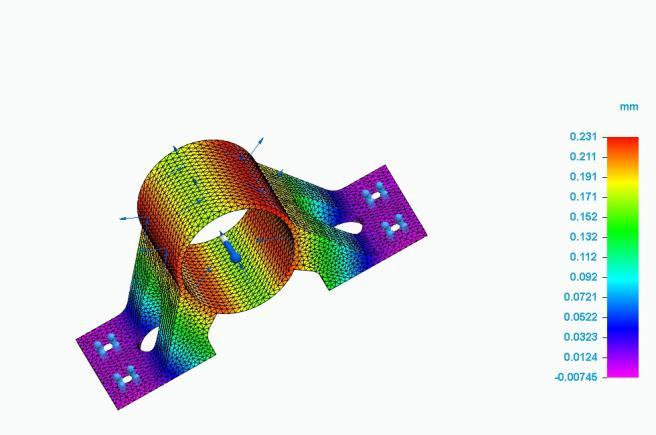
Two analyses were performed on the baseline design. A static structural analysis was carried out to determine the maximumvonMisesstress,totaldeformation,andfactorofsafetyunderthedefined loadingconditions.Amodalanalysis
International Research Journal of Engineering and Technology (IRJET) e-ISSN:2395-0056
Volume: 13 Issue: 06 | Jun 2026 www.irjet.net p-ISSN:2395-0072
was also conducted to identify the natural frequencies and mode shapes of the bracket and evaluate the possibility of resonancewithengineexcitationfrequencies.
ThemaximumvonMisesstressobtainedfromthestaticanalysiswas48MPa,whichissignificantlylowerthantheyield strength of 38Cr4 alloy steel (420 MPa), indicating that the bracket operates safely within the elastic region. The modal analysis confirmed that the natural frequencies of the bracket remained above the primary engine excitation range, reducingtheriskofresonanceduringvehicleoperation.
International Research Journal of
Volume: 13 Issue: 06 | Jun 2026 www.irjet.net
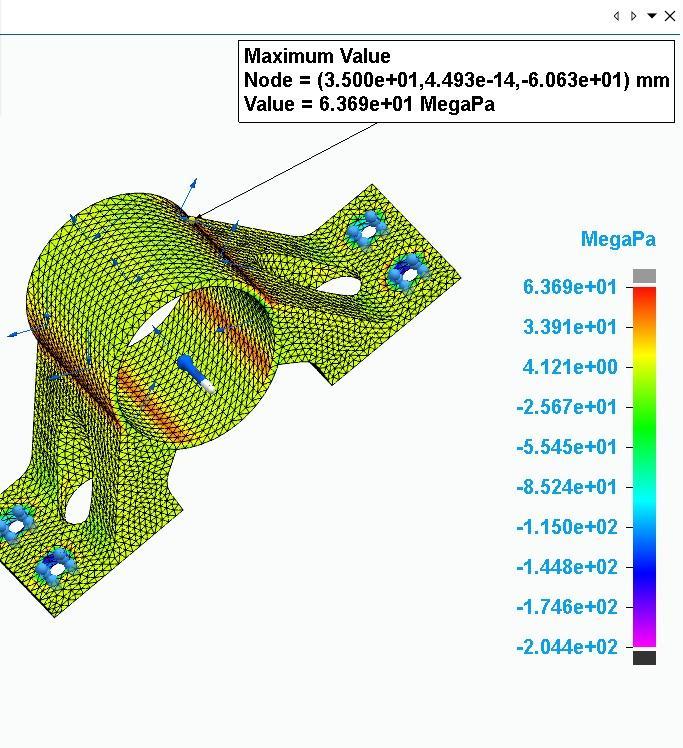
Fig 8: Deformation plot of engine mount
Table -2: Baseline FEA Results Summary
3.5 Geometry Reconstruction and Re-Analysis
The density iso-surface from the topology optimization result was smoothed and remodelled as a manufacturable geometry in SOLIDWORKS, preserving all non-design bosses and adding appropriate draft angles and a minimum wall thickness of 5 mm for sand-casting. The reconstructed geometry was re-meshed with the same element settings as the baselineandre-analysedunderLC1–LC3(static)andmodalanalysis.
4. RESULTS AND DISCUSSION
The optimized engine mount bracket demonstrated measurable improvement across all structural and NVH metrics relativetothebaseline.Table3presentsthecomparativeperformancesummary.
Table -3: Comparative Performance Baseline vs. Optimized Engine Mount Bracket
International Research Journal of Engineering and Technology (IRJET) e-ISSN:2395-0056
Volume: 13 Issue: 06 | Jun 2026 www.irjet.net p-ISSN:2395-0072
Thetopologyoptimizationretained70%ofthebaselinevolume, resultinginamassreductionofapproximately29.5%, from 1.05 kg to 0.74 kg. Material was primarily removed from low-stress regions of the bracket while preserving the critical mounting interfaces and load-carrying paths. The optimized geometry maintained the structural integrity of the componentdespitethesignificantreductioninmass.
The optimized bracket exhibited satisfactory structural performance under all loading conditions. The maximum von Mises stress remained within the allowable limit for 38Cr4 alloy steel, maintaining a minimum factor of safety of 2. The optimized design also showed acceptable deformation characteristics, indicating that stiffness was preserved after materialremoval.
Modalanalysisdemonstratedanimprovementindynamicperformance.Thefirstnaturalfrequencyincreasedfrom85 Hz for the baseline design to 97 Hz for the optimized design, representing an increase of 12 Hz. This increase in natural frequency indicates improved structural stiffness and a reduced likelihood of resonance with engine excitation frequencies,therebyenhancingNVHperformance.
AsystematicFEA-drivenstructuraloptimizationoftheMarutiSuzukiWagonRfrontenginemountbracketwascarried outusingtopologyoptimizationandfiniteelementanalysis.Thefollowingconclusionsweredrawn:
(i) SIMPtopologyoptimization identifiedthat30%ofthe baselinebracketvolumecouldbe removedfromlowstress regions without compromising structural performance, resulting in a mass reduction of 29.5% (from 1.05kgto0.74kg).
(ii) Theoptimizedbracketmaintainedacceptablestructuralintegrityunderallloadingconditions.Themaximum von Mises stress remained within the allowable limit for 38Cr4 alloy steel, while maintaining a minimum factorofsafetyof2.
(iii) Modal analysis showed an improvement in dynamic characteristics, with the first natural frequency increasing from 85 Hz to 97 Hz. This increase reduced the possibility of resonance with engine excitation frequenciesandimprovedtheoverallNVHperformanceofthemountingsystem.
(iv) The optimized geometry was reconstructed as a manufacturable design by preserving all critical mounting interfaces,maintainingaminimumwallthicknessof5mm,andincorporatingsuitablefilletsanddraftangles forsand-casting.
(v)Theproposeddesigndemonstratesthatsignificantweightreductioncanbeachievedwhilemaintainingstructural stiffness,strength,anddynamicperformance.Themethodologyadoptedinthisstudycanbeextendedtosimilar automotivebracketstoachievelightweightandcost-effectivedesigns.
The present study focused on the structural optimization of the Wagon R engine mount bracket under static loading conditions. Future work may include the development of a detailed engine mount assembly model incorporating the rubberisolatorasafrequency-dependentstiffnessanddampingelementtobetterevaluateNVHperformance.Fatiguelife assessmentcanalsobecarriedoutusingmeasuredroadloaddatafromrealdrivingconditionstoimprovetheaccuracyof durabilitypredictions.FurtherweightreductionmaybeachievedbyinvestigatinglightweightmaterialssuchasAlSi10Mg aluminium alloy and evaluating alternative manufacturing processes such as High-Pressure Die Casting (HPDC). In addition, multi-objective optimization techniques can be employed to simultaneously minimize mass while maximizing stiffnessandreducingmanufacturingcost.
Authors express sincere gratitude to Prof. M.P. Shah, Department of Mechanical Engineering, AISSMS College of Engineering, Pune, for their invaluable guidance throughout this study. The authors also thank AISSMS Lab staff for providingsoftwareaccesssupportduringtestingandsimulation.
International Research Journal of Engineering and Technology (IRJET) e-ISSN:2395-0056
Volume: 13 Issue: 06 | Jun 2026 www.irjet.net p-ISSN:2395-0072
[1]R.M.Brach,MechanicalImpactDynamics:RigidBodyCollisions,JohnWiley&Sons,NewYork,1991.
[2]W.B.Shangguan,“Enginemountsandpowertrainmountingsystems:areview,”InternationalJournalofVehicleDesign, vol.49,no.4,pp.237–254,2009.
[3] M. P. Bendsoe and N. Kikuchi, “Generating optimal topologies in structural design using a homogenization method,” ComputerMethodsinAppliedMechanicsandEngineering,vol.71,no.2,pp.197–224,1988.
[4]H.S.Kim,B.Y.Cho,andJ.H.Kim,“Topologyoptimization ofanautomotiveenginecradleformassreductionandNVH improvement,”JournalofMechanicalScienceandTechnology,vol.28,no.9,pp.3455–3463,2014.
[5] J. Kang, J. Kim, and S. Lee, “Topology optimization and additive manufacturing of lightweight engine mount bracket,” StructuralandMultidisciplinaryOptimization,vol.62,pp.1435–1447,2020.
[6]ANSYSInc.,ANSYSMechanicalAPDLTheoryReference,Release2023R1,Canonsburg,PA,2023.
[7]BureauofIndianStandards,IS1865:SpecificationforSpheroidalorNodularGraphiteCastIron,NewDelhi,2014.