
International Research Journal of Engineering and Technology (IRJET) e-ISSN: 2395-0056
Volume: 13 Issue: 01 | Jan 2026 www.irjet.net p-ISSN: 2395-0072
STRESS-MODULATED ANTIBACTERIAL INTERACTION OF CINNAMALDEHYDE AND CIPROFLOXACIN AGAINST GRAM-NEGATIVE BACTERIA IN VITRO
DR. T. Saravana Kumar¹, M. Malathi², T. Maruthavanan³, R. Mounitha⁴
1Associated professor, Department of Pharmaceutics, Sri Vijay Vidyalaya College of Pharmacy, Nallampalli, Dharmapuri, Tamil Nadu.
2B. Pharmacy student, Sri Vijay Vidyalaya College of Pharmacy, Nallampalli, Dharmapuri, Tamil Nadu.
3B. Pharmacy student, Sri Vijay Vidyalaya College of Pharmacy, Nallampalli, Dharmapuri, Tamil Nadu.
4B. Pharmacy student, Sri Vijay Vidyalaya College of Pharmacy, Nallampalli, Dharmapuri, Tamil Nadu. ***
ABSTRACT - Antibiotic resistance in Gram-negative bacteria necessitates alternative strategies to improve antimicrobial efficacy. This study investigated the antibacterial activity and interaction profiles of cinnamon oil, ciprofloxacin, and proline against Escherichia coli. Antimicrobial effects were evaluated using minimum inhibitory concentration (MIC), minimum bactericidal concentration (MBC), and checkerboard assays. Cinnamon oil and ciprofloxacin exhibited strong, dose-dependent antibacterial activity individually. However, combination treatments demonstrated indifferent interactions based on fractional inhibitory concentration index (FICI) analysis. The inclusion of proline reduced bactericidal efficacy and increased tolerance, highlighting stress-mediated modulation of bacterial susceptibility. These findings emphasize the influence of bacterial stress responses on antimicrobial performance and combination therapy outcomes
KEY WORDS: Antibacterial interaction, cinnamaldehyde, ciprofloxacin, Gram-negative bacteria, proline-induced stress, MIC, and checkerboard assay.
1. INTRODUCTION:
Escherichiacoli(E.coli)isaGram-negative,rod-shapedbacteriumbelongingtothefamilyEnterobacteriaceae.Whilemost strains are harmless commensals of the human intestinal tract, pathogenic variants are responsible for a wide range of intestinalandextraintestinalinfections,includingurinarytractinfections,pneumonia,diarrhea,bacteremia,andneonatal meningitis. The pathogenicity of E. coli is attributed to multiple virulence mechanisms such as adhesion to host tissues, evasion of immune defenses, toxin production, and the ability to form biofilms. Biofilm formation significantly enhances bacterial survival, persistence, and resistance to antimicrobial agents, making infections difficult to eradicate. Consequently, biofilm-producing E. coli is a frequent cause of hospital-acquired infections. The prolonged and indiscriminate use of antibiotics has further contributed to the emergence of multidrug-resistant E. coli strains, posing a majorglobalpublichealthchallenge.
Cinnamomumverum(cinnamon),a memberoftheLauraceaefamily,hasbeenused forcenturiesin traditional medicine and is well known for its natural antimicrobial properties. Cinnamon and its bioactive compounds exhibit inhibitory effects against both Gram-positive and Gram-negative bacteria, primarily by disrupting bacterial cell structures and interfering with essential cellular processes. In addition to antimicrobial activity, cinnamon demonstrates antioxidant, antifungal,antidiabetic,anti-inflammatory,andcholesterol-lowering properties.Cinnamonoil iswidelyusedasa natural flavoringandfoodpreservativeduetoitsbroad-spectrumactivityagainstfood-bornepathogens.
Prolineisa multifunctional proteinogenicaminoacidthatplays acritical roleincellularstressadaptationacrossdiverse biological systems. Beyond protein synthesis, proline contributes to stress signaling, redox balance, osmoprotection, and metabolic regulation. Under conditions such as osmotic stress, oxidative stress, heat shock, nutrient limitation, and antibioticexposure,intracellularprolinelevelsincreasesignificantly.
Quantitativeevaluationofantimicrobialactivityisessentialforassessingantibacterialefficacy.Methodssuchasminimum inhibitory concentration (MIC), minimum bactericidal concentration (MBC), and checkerboard assays provide comprehensive insights into inhibitory, bactericidal, and synergistic effects, which are particularly important in the contextofrisingantimicrobialresistanceandtheexplorationofcombinationtherapies.
International Research Journal of Engineering and Technology (IRJET) e-ISSN: 2395-0056
Volume: 13 Issue: 01 | Jan 2026 www.irjet.net p-ISSN: 2395-0072
2 . MATERIALS & METHODS
2.1 Materials:
a) Minimum inhibitory concentration (MIC)
E.coli-443waspurchasedfromMTCC,Chandigarh,India.NutrientbrothwaspurchasedfromHimedia,India.Sterile96well plates were purchased from Tarsan, India. The conical flasks were from Borosil, India. Spirit lamp, double-distilled water,andtestsamples
b) Minimum bactericidal concentration (MBC)
E. coli - 443 was purchased from MTCC, Chandigarh, India. Nutrient agar medium, nutrient broth, was purchased from Himedia, India. Test samples, petri plates, test tubes, beakers, and conical flasks were purchased from Borosil, India. A spiritlampanddouble-distilledwaterwereused.
C) Checkerboard assay
E.coli–443waspurchasedfromMTCC,Chandigarh,India.Nutrientbrothandgentamycinsolutionwerepurchasedfrom Himedia, India. Test samples, 96-well plates, test tubes, beakers, and conical flaskswere from Borosil, India. Spirit lamp, doubledistilledwater.
Luria Bertani Broth (LB Broth)
LBbrothwaspreparedbydissolvingtryptone(1gm),NaCl(1gm),andyeastextract(0.5gm)in100mldistilledwaterand boiling todissolvethemediumcompletely.Themediumwasdispensedasdesired andsterilizedbyautoclavingat15lbs pressure(121ºC)for15minutes.
2.2 Test Samples for MIC, MBC & Checkerboard
SampleA–CinnamonOil
SampleB–Ciprofloxacin
SampleC–Proline
2.3 Methods/Methodology
a) Minimum inhibitory concentration (MIC)
The broth micro dilution assay method was used to determine the MICs for the susceptibility of E. coli-443 in sterile disposableflat-bottomed96-wellmicrotiterplates.Briefly,the0.5McFarlandinoculumsuspensionswerefurtherdiluted 1:100innutrientbrothbeforeinoculation;50μLofthebacterialsuspensionwasseededintoa96-wellplatecontaining50 μL of test sample with serial concentrations. The final inoculum of the bacteria was approximately 5×10⁵ CFU/mL. The finalconcentrationsofSampleA,SampleB,SampleA+B,andSampleA+B+Cwere500,250,125,62.5,31.25,15.6,7.8,3.9, 1.9,and 0.9 μg/mL.Gentamicinwasusedasa positivecontrol.The plateswerethenincubatedat37°Cfor18–24h.The resultswere readat 600 nmusinga microplatereader.Changesofcolor wereobservedandrecorded.All the testswere doneintriplicate.
b) Minimum bactericidal concentration (MBC)
Themediumwaspreparedbydissolvingpeptone(0.5gm),NaCl(0.5gm),yeastextract(0.2gm),beefextract(0.1gm),and agar powder (1.75 gm of the commercially available Nutrient Agar Medium) in 100 ml of distilled water. The dissolved mediumwasautoclavedat15lbspressureat121°Cfor 15minutes.Theautoclaved mediumwasmixedwell andpoured onto100mmpetriplates(25-30ml/plate)whilestillmolten.1 mlculturesweretreatedwithIC50concentrationsofthe test sample A–E. coli (20.14 µg/ml), sample B– E. coli (15.93 µg/ml), sample A+B– E. coli (23.03 µg/ml), and sample A+B+C– E. coli (25.37µg/ml),obtainedfromMIC.Thecultureswereseriallydiluted,andthe106 dilutionwasplatedonthe nutrient agar medium by the spread plate method, and the plate was incubated at 37°C for 24 hrs. After incubation, colonieswerecounted,andMBCwascalculatedusingtheformula.
International Research Journal of Engineering and Technology (IRJET) e-ISSN: 2395-0056
Volume: 13 Issue: 01 | Jan 2026 www.irjet.net p-ISSN: 2395-0072
(No.ofcolonies×dilutionfactor) CFU/ml=________
Volumeofcultureplatedinml C) Checkerboard assay
Sample A & B
The stock solution of each drug was prepared so that the concentration is at least double the MIC of sample A (20.14 µg/ml) and sample B (15.93 µg/ml). 100 µl of the LB broth was added to each well of the flat-bottomed 96-well microdilution plate. Row 1 contains the serially diluted concentrations (40, 20, 10, 5, 2.5, 1.25, 0.75 µg/ml) of Sample A, andColumnAcontainstheseriallydiluted concentrations(32,16,8,4,2,1,0.5µg/ml)ofSampleB.FromColumn2to 8 and Row B to H, the samples were added in combinations. Column 12 was taken as a negative control. 50 μL of 0.5 McFarland inoculum suspensions was inoculated into a 96-well plate. The plates were then incubated at 37 °C for 48 h. Theresultswerereadat600nmusingamicroplatereader.Changesofcolorwereobservedandrecorded.
FORMULA:
TheFractionalInhibitoryConcentrationIndex(FICI)wascalculatedusingtheformula:
FICI=MICAincombination+MICBincombination
A
Sample A+B & C
B
The stock solution of each drug was prepared so that the concentration is at least double the MIC of sample A+B (23.03 µg/ml)andsampleC(10mM).100µloftheLBbrothwasaddedtoeachwell oftheflat-bottomed96-well microdilution plate.Row1containstheseriallydilutedconcentrations(46,23,11.5,5.75,2.875,1.437,0.718µg/ml)ofSampleA+B,and Column A contains the serially diluted concentrations (1000, 500, 250, 125, 62.5, 31.25, 15.6 µg/ml) of Sample C. From Column2to8andRowBtoH,thesampleswereaddedincombinations.Column12wastakenasanegativecontrol.50μL of0.5McFarlandinoculumsuspensionswasinoculatedintoa96-wellplate.Theplateswerethenincubatedat37°Cfor48 h.Theresultswerereadat600nmusingamicroplatereader.Changesofcolorwereobservedandrecorded.
FORMULA:
TheFractionalInhibitoryConcentrationIndex(FICI)wascalculatedusingtheformula:
FICI=MICA+Bincombination+MICCincombination
MICA+B MICC
3) RESULTS
3.1 MIC for Cinnamon Oil (Sample A)
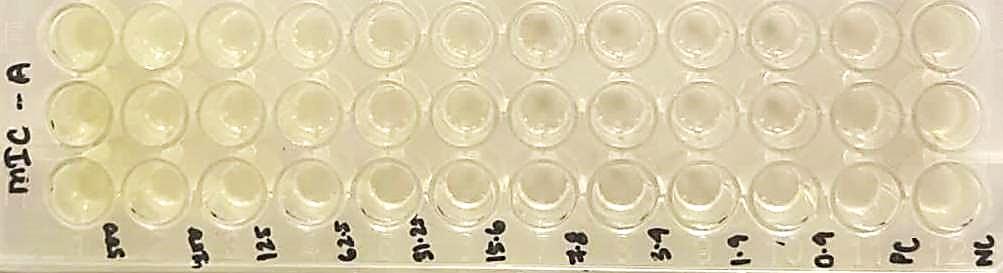
1: Well broth microdilution MIC plate for cinnamon oil
International Research Journal of Engineering and Technology (IRJET) e-ISSN: 2395-0056
Volume: 13 Issue: 01 | Jan 2026 www.irjet.net p-ISSN: 2395-0072
Figure 2: MIC OD₆₀₀ analysis of Sample B
The antimicrobial evaluation demonstrated a potent dose-dependent inhibition of bacterial growth, with the highest concentration (500 µg/ml) reaching an OD of 0.248, closely mirroring the positive control (0.215). The Minimum InhibitoryConcentration(MIC) wasidentifiedat500µg/ml,representingthethresholdfornear-completesuppressionof microbial proliferation. Significant potency was further evidenced by the IC50 value, which was approximately 31.25 µg/ml, where growth was reduced by roughly 54% compared to the negative control. In contrast, concentrations below 15.6 µg/ml failed to provide substantial inhibition, with optical density values trending toward the untreated growth baseline. Triplicate analysis across all concentrations confirmed high experimental precision and reproducibility of the sample’sinhibitory effects. Thesefindingscharacterize thetestedsampleasa functional antimicrobial agent witha clear therapeuticwindowforgrowthsuppression.
The antibacterial activity of cinnamon oil (Sample A) against Escherichia coli demonstrates a clear dose-dependent relationship between oil concentration and bacterial inhibition. The highest inhibitory effect was observed at a concentrationof500µg/ml,yieldingapproximately80%inhibition,whichisstatisticallycomparabletotheefficacyofthe positivecontrol(PC).AstheconcentrationofSampleAdecreased,agradualreductioninantimicrobialactivitywasnoted, though inhibition levels remained substantial (>60%) down to 62.5 µg/ml. A marked decline in efficacy was recorded at concentrationsbelow31.25µg/ml,withthelowesttestedconcentrationof0.9 µg/mlresultinginlessthan20%bacterial inhibition. The narrow error bars observed across all data points indicate high experimental reproducibility and consistent antimicrobial action. Collectively, these results suggest that cinnamon oil possesses significant potential as an antibacterialagentagainstE.coli,particularlyatconcentrationsexceeding60µg/ml.
International Research Journal of Engineering and Technology (IRJET) e-ISSN: 2395-0056
Volume: 13 Issue: 01 | Jan 2026 www.irjet.net p-ISSN: 2395-0072
Table 1:
S.NO
Nameofthetest sample
Nameofthe Microorganisms MIC MIC- 50
1. SampleA E. coli – 443
0.9µg/ml 20.14µg/ml
Result: SampleAshowedanMICof 0.9 µg/mL (novisiblegrowth)andanIC₅₀of 20.14 µg/mL (95%CI18.04–22.48,R²= 0.9848)fromthedose–responsecurve.
Interpretation: Sample A strongly inhibits E. coli with complete growth suppression at 0.9 µg/mL, while the dose–response(IC₅₀≈20µg/mL)indicatesaclear,well-fit,concentration-dependentinhibitoryeffect.
3.2
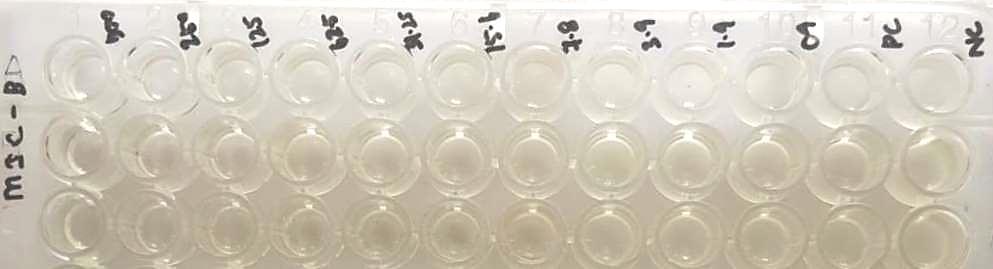
The antimicrobial evaluation revealed a significant, dose-dependent inhibition of bacterial growth, with the highest concentration (500 µg/ml) yielding a mean absorbance of 0.180, closely aligning with the positive control baseline of 0.138. The Minimum Inhibitory Concentration (MIC) was identified at 500 µg/ml, marking the threshold for near-total suppression of microbial proliferation. Significant potency was further evidenced by the IC50 value, located at approximately15.6µg/ml,wheregrowthwasreducedbyroughly59%comparedtothenegativecontrol.
Atransitionfromhightomoderateinhibitionwasobservedbetween125µg/mland31.25µg/ml,indicatingawell-defined bacteriostaticgradient.Incontrast,concentrationsbelow1.9µg/mlfailedtoprovidesubstantialsuppression,withoptical densityvaluestrendingtowardtheuntreatedgrowthsaturationpoint(ODapprox1.277).Thehighdegreeofconsistency across triplicates confirms the reproducibility of the sample’s inhibitory effects, making it a viable candidate for further antimicrobialcharacterization.
© 2026, IRJET | Impact Factor value: 8.315 | ISO 9001:2008 Certified Journal | Page653
International Research Journal of Engineering and Technology (IRJET) e-ISSN: 2395-0056
Volume: 13 Issue: 01 | Jan 2026 www.irjet.net p-ISSN: 2395-0072
The antimicrobial evaluation revealed a significant, dose-dependent inhibitory profile, with efficacy increasing from 25.10%atthelowestdoseto85.86%at500µg/ml.Themaximumconcentrationof500µg/mlexhibitednear-totalgrowth suppression(85.86±0.37%),closelyapproximatingtheperformanceofthepositivecontrol(89.15±0.79%).Basedonthe inhibition gradient, the half-maximal inhibitory concentration (IC50) was determined to be approximately 10.0 µg/ml, highlighting the high intrinsic potency of the tested sample. Potent bioactivity was sustained across the mid-range concentrations,with31.25 µg/ml maintaininga substantial 63.27 ±1.66% inhibition.Evenatthe extremedilutionof0.9 µg/ml,thesampleretainedanotable25.10%inhibitorycapacity,suggestingapersistentantimicrobialeffect.Theminimal varianceobservedacrosstriplicatemeasurementsindicateshighexperimentalprecisionandconfirmsthereliabilityofthe dose-responserelationship.
Table 2:
Result: MIC= 0.9 µg/mL (novisiblegrowth); IC₅₀ = 15.93 µg/mL (95%CI14.39–17.65),dose–responsefit R² = 0.9866.
Interpretation: Sample B strongly inhibits E. coli (complete growth suppression at 0.9 µg/mL); the IC₅₀ ≈16 µg/mL indicatestheconcentrationforhalf-maximalinhibition,andthehighR²showsthedose–responsedataarereliable.
3.3 MIC for Cinnamon Oil & Ciprofloxacin (Sample A+B)
International Research Journal of Engineering and Technology (IRJET) e-ISSN: 2395-0056
Volume: 13 Issue: 01 | Jan 2026 www.irjet.net p-ISSN: 2395-0072
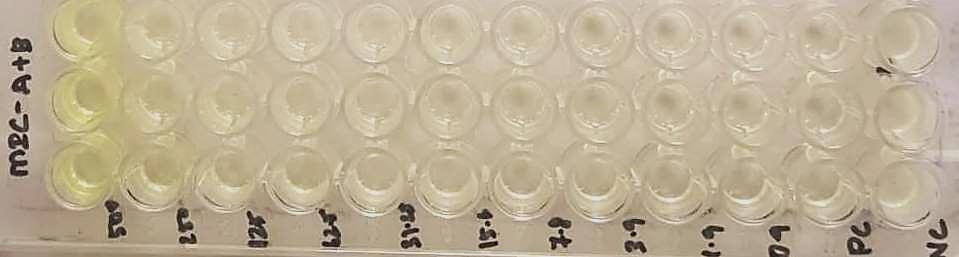
The antimicrobial evaluation revealed a significant, dose-dependent reduction in bacterial turbidity across the tested range(0.9–500 µg/ml), withthe negativecontrol (NC) maintaininga highmean absorbanceof1.423±0.010. The tested sampledemonstratedpotentinhibitoryeffectsathigherconcentrations,with500µg/mlachievingan80.30%reductionin growth(OD=0.280±0.006)relativetotheNC.TheMinimumInhibitoryConcentration(MIC)isidentifiedat500µg/ml,as it represents the lowest concentration where the absorbance most closely approached the baseline established by the positive control (0.187 ± 0.011). The half-maximal inhibitory concentration (IC50) was determined to be approximately 24.78µg/ml,markingthepointofsignificantmetabolic suppression.Moderate inhibitoryactivitywasobservedbetween 31.25 and 125 µg/ml, whereas concentrations below 7.8 µg/ml showed diminished efficacy with OD values exceeding 0.85.Thehighdegreeofconsistencyacross triplicates, reflected inlowstandarddeviationvalues,confirmsthe precision andreproducibilityofthesample'santimicrobialproperties.
Thetestedcompounddemonstratedacleardose-dependentinhibitoryeffectacrossa concentrationrangeof0.9µg/mLto500µg/mL.Atthehighestconcentrationof500µg/mL,thesampleachievedamean percentage of inhibition of 80.30%, closely approaching the positive control (PC) efficacy of 86.84%. Notably, the IC50 value the concentration required to inhibit 50% of growth falls between 15.6 µg/mL and 31.25 µg/mL, indicating potentbiologicalactivity.Evenataminimalconcentrationof0.9µg/mL,thesamplemaintainedabasalinhibitoryeffectof 20.75%. The narrow variance observed across the triplicates confirms the high reproducibility and precision of the experimental assay. These findings suggest that the sample possesses significant antimicrobial or enzymatic inhibitory propertiescomparabletostandardbenchmarks.
Table 3:
Result: MIC= 0.9 µg/mL (completegrowthsuppression); IC₅₀ = 23.03 µg/mL (95%CI20.90–25.37),dose–responsefit R² = 0.9881.
International Research Journal of Engineering and Technology (IRJET) e-ISSN: 2395-0056
Volume: 13 Issue: 01 | Jan 2026 www.irjet.net p-ISSN: 2395-0072
Interpretation: SampleA+Bstronglyinhibits E. coli (completeinhibitionat0.9µg/mL);theIC₅₀≈23µg/mLindicatesthe concentrationforhalf-maximalinhibition,andthehighR²showsthedose–responsedataarehighlyreliable.
3.4
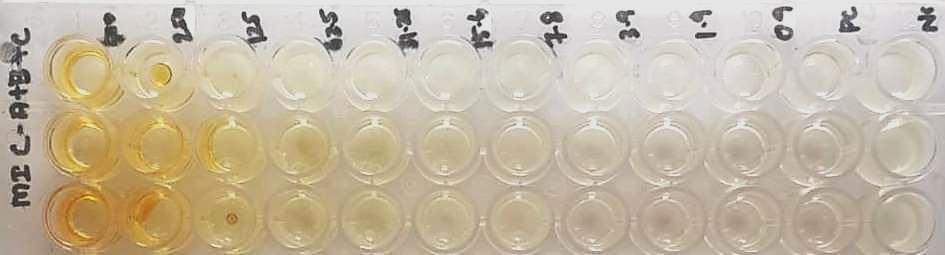
Thetestedsampleexhibitedasignificant,dose-dependentinhibitionofmicrobialgrowth,withODvaluesdecreasingfrom 1.016at0.9µg/mLto0.258at500µg/mL..Atthehighestconcentration(500µg/mL),thesampleachieved78.8%growth suppression compared to the negative control, approaching the efficacy of the positive control (84.5%). The IC50 (halfmaximal inhibitory concentration) was identified near the 31.25 µg/mL threshold, where growth was reduced by approximately 49.1%. The low standard deviation across triplicates (SD < 0.023) confirms high experimental precision and the reproducibility of the antimicrobial effect. These results validate the potent bacteriostatic activity of the sample, providingaquantitativebasisforitspotentialapplicationasatherapeuticagent.
The analysis of the percentage inhibition data reveals a strong, dose-dependent antimicrobial profile, with the tested sample demonstrating maximum inhibitory activity at 500 µg/mL (78.82% ± 1.37%). This peak efficacy closelyparallels the performance of the positive control (PC), which yielded a mean inhibition of 84.49% ± 0.21%. A clear linear-log relationship was observed between concentration and microbial suppression, with the IC50 value identified at
2026, IRJET | Impact Factor value: 8.315 | ISO 9001:2008 Certified Journal | Page656
International Research Journal of Engineering and Technology (IRJET) e-ISSN: 2395-0056
Volume: 13 Issue: 01 | Jan 2026 www.irjet.net p-ISSN: 2395-0072
approximately31.25µg/mL (mean:49.14%).Significantbacteriostaticeffects(>50%)weremaintainedacrossthehigher concentration gradient from 62.5 µg/mL to 500 µg/mL, whereas activity diminished to 16.50% at the lowest concentration of 0.9 µg/mL. The tight standard deviations across triplicates underscore the robustness of the assay and the consistency of the sample’s biological activity. Overall, these results categorize the sample as a potent antimicrobial agentwithhightherapeuticpotential,warrantingfurtherinvestigationintoitsmechanismofaction.
Result: Thesampleshoweddose-dependentantibacterialactivityagainst E. coli withanIC₅₀of 25.37 µg/mL andastrong curvefit(R²= 0.989).TheMICwasreportedas 0.9 µg/mL.
Interpretation: The data indicate moderate antibacterial potency; however, the low % inhibition at 0.9 µg/mL suggests thereportedMICmayneedre-verificationbasedonstandardMICcriteria.
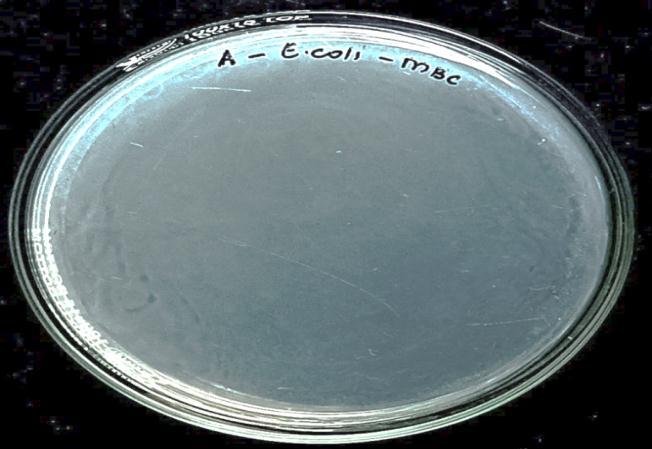
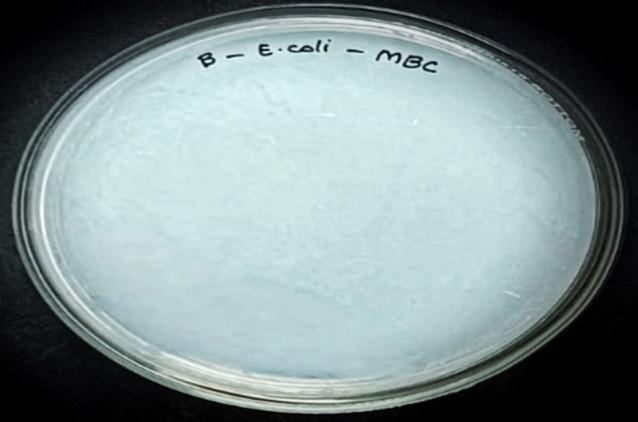
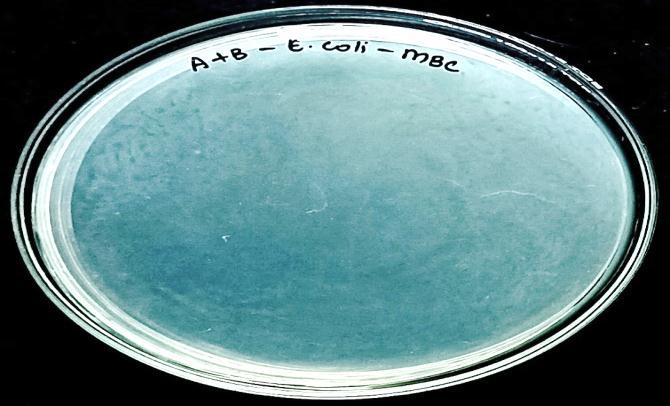
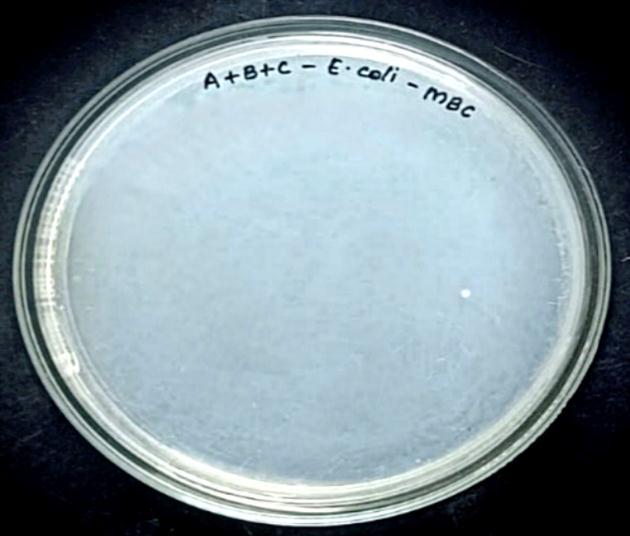
3.4 MBC Assay: Cinnamon Oil, Ciprofloxacin & Proline
ImagesforMinimumbactericidalconcentrationofmicroorganismfromthetestsample
International Research Journal of Engineering and Technology (IRJET) e-ISSN: 2395-0056
Volume: 13 Issue: 01 | Jan 2026 www.irjet.net p-ISSN: 2395-0072
Table 5:
S.No Nameofthetest samples No.ofbacterial colonies- 24hrs
The Minimum Bactericidal Concentration (MBC) assay was conducted to evaluate the antibacterial efficacy of the test samples against the target organism over a 24-hour incubation period. The results demonstrated that individual test samples A and B possessed strong bactericidal activity, as evidenced by the complete absence of bacterial growth (0 colonies)anda final count of0CFU/ml.Incontrast,thecombinedformulationsfailedtoachievecomplete eradicationof the bacteria. The combination of "A+B" resulted in the survival of a bacterial population at 1 x 10^7 CFU/ml (1 colony), while the "A+B+C" combination exhibited slightly higher growth with 2 x 10^7 CFU/ml (2 colonies). These findings indicatethatwhilesamplesAandBareeffectiveasstandaloneagents,theircombinedapplicationinthisspecificassaydid notresultintotalbacterialclearance.
3.5 Checkerboard Assay for Cinnamon Oil & Ciprofloxacin (Samples A & B)
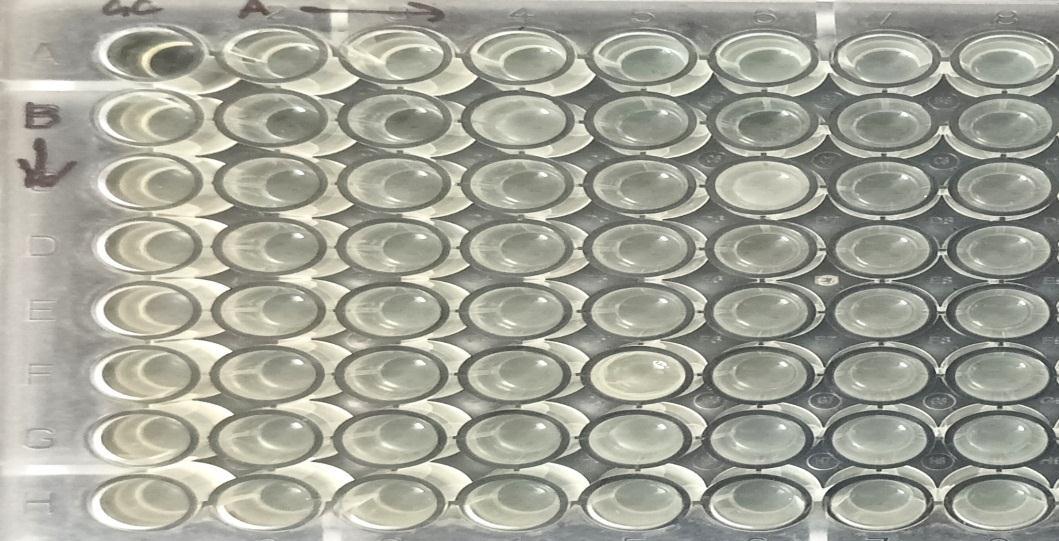

Figure 16: The FICI of the samples in combination is 2.06, which infers that the samples act indifferent to each other.
TheFractionalInhibitoryConcentrationIndex(FICI)valueof2.06indicatesthatthetwosamplesinthecombinationexert an indifferent (or non-synergistic) effect on the target organism. In pharmacological terms, an interaction is typically classifiedassynergisticiftheFICIis ≤0.5andantagonisticifitis>4.0.Becausethisresultfallswithintherangeof0.5to 4.0, it signifies that the combined antimicrobial activity is essentially no more effective than the sum of the individual parts;thedrugsdonotsignificantlyassistorhinderoneanother'sperformance.Consequently,whilethecombinationmay still be effective at inhibiting growth, there is no clinical or biochemical advantage to using these specific concentrations togetheroverusingthemorepotentagentalone.
International Research Journal of Engineering and Technology (IRJET) e-ISSN: 2395-0056
Volume: 13 Issue: 01 | Jan 2026 www.irjet.net p-ISSN: 2395-0072
Table 6:
(4
(2
G (1
H (0.5 µg/ml)
Basedontheopticaldensity(OD)valuesprovidedinthischeckerboardassay,thecombinationofthetwoagentsshowsa clear dose-dependent inhibitory effect compared to the negative control (NC) values, which consistently hover between 1.64 and 1.95. The most significant synergy or enhanced inhibition is observed at the highest concentrations of both agents,specificallyintheintersectionofrowB(32µg/ml)andcolumn3(20µg/ml),whichyieldedthelowestODof0.675. As the concentrations of either agent decrease (moving toward row H or column 8), the OD values steadily climb back toward the 1.3–1.5 range, indicating a loss of inhibitory pressure and a return toward baseline microbial growth. Interestingly, row A (40 µg/ml) shows an unusually low OD in column 1 (0.175), which may suggest a potent individual effectorapotentialoutlier,buttheoveralltrendconfirmsthattheagentsworkmosteffectivelyintandemattheiruppermiddleconcentrationranges.
MICofSampleAalone=20µg/ml
MICofsampleBalone=16µg/ml
MICofSampleAincombinationwithSampleB=1.25µg/ml
MICofSampleBincombinationwithSampleA=32µg/ml
Table 7:
The results of the checkerboard assay reveal a significant disparity in how the two samples behave when combined, ultimately resulting in an indifferent classification with an FICI of 2.06. While Sample A shows a dramatic increase in potencywhencombined reducingitsMICfrom20µg/mlto1.25µg/ml(anFICof0.06) thisbenefitisoffsetbySample B,whichactuallyperforms worsein the presence ofSampleA. Specifically,Sample B'sMICdoublesfrom 16µg/ml to32 µg/ml(anFICof2.0),suggestingthatSampleAmayinterferewithSampleB'smechanismofactionorthattheorganism's resistance to Sample B increases in this environment. Because the sum of these two fractional concentrations is greater than0.5butlessthan4.0,therelationshipisformallydefinedasindifferent,meaningthecombinationoffersnostatistical advantageoverusingtheindividualcomponents.
International Research Journal of Engineering and Technology (IRJET) e-ISSN: 2395-0056
Volume: 13 Issue: 01 | Jan 2026 www.irjet.net p-ISSN: 2395-0072
3.6 Checker Board assay for Cinnamon Oil, Ciprofloxacin & Proline (Sample A+B&C)
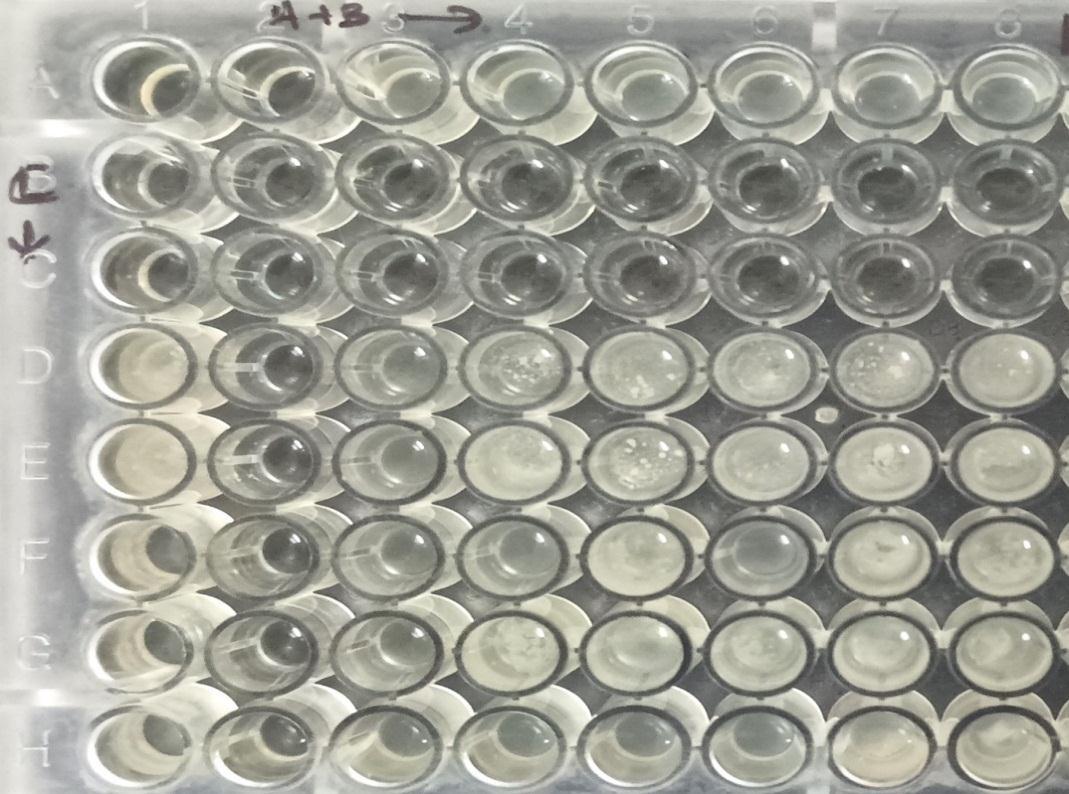
Figure 17: The FICI of the samples in combination is 1.03, which infers that the samples act indifferent to each other.
An FICI of 1.03 confirms that the combination of these two samples results in an indifferent (or additive-tending) interaction. In antimicrobial susceptibility testing, an interaction is only considered synergistic if the FICI is ≤ 0.5. Since thisvaluesitsslightlyabovethethresholdof1.0,itindicatesthatthecombinedeffectofthetwoagentsisessentiallyequal to the sum of their individual activities; they do not significantly enhance nor interfere with one another. While the samplesremaineffectiveatthetestedconcentrations,thereisno"bonus"efficacygainedbymixingthem,astheorganism respondstoeachagentindependently.
Table 8:
E (125
H (15.6
International Research Journal of Engineering and Technology (IRJET) e-ISSN: 2395-0056
Volume: 13 Issue: 01 | Jan 2026 www.irjet.net p-ISSN: 2395-0072
Based on the optical density (OD) values provided, this checkerboard assay demonstrates a potent inhibitory effect primarilydrivenbyhighconcentrationsofSampleB,regardlessofSampleA’spresence.TheNegativeControl(NC)values average approximately 1.62, while rows B and C (1000 µg/ml and 500 µg/ml of Sample B) show significantly low OD values ranging from 0.232 to 0.306 across all columns, indicating near-complete growth inhibition. A clear "cutoff" or transitionzoneisvisiblestartingatRowD(250µg/ml),whereODvaluesjumpsharplytowardorevenexceedthecontrol values(e.g.,2.289),suggestingthattheinhibitoryeffectislostbelowthe500µg/mlthresholdforSampleB.Column2(46 µg/ml of Sample A) appears to be a unique point of interest, as it maintains low OD values (~0.3) even when Sample B concentrations drop to their lowest (Row H), hinting at a potential individual potency of Sample A at that specific concentrationorapossibletechnicalvariationinthatcolumn.
MICofSampleA+Balone=23µg/ml
MICofsampleCalone=500µg/ml
MICofSampleA+BincombinationwithSampleC=0.718µg/ml
MICofSampleCincombinationwithSampleA+B=500µg/ml
Table 9:
1 A+B 23µg/ml 0.718µg/ml 0.03 1.03 Indifferent 2
TheanalysisofthecheckerboarddatarevealsanindifferentinteractionbetweenthecombinedSampleA+BandSampleC, withacalculatedFICIof1.03.Whiletheconcentrationof SampleA+Brequiredforinhibitiondroppeddrasticallyfrom23 µg/ml to 0.718 µg/ml (a Fractional Inhibitory Concentration of 0.03) when used alongside Sample C, Sample C itself showed no change in potency, maintaining its MIC at 500 µg/ml (an FIC of 1.0). This suggests that while Sample A+B becomes more effective in the presence of Sample C, the interaction does not meet the strict mathematical threshold for synergy(≤0.5).Instead,thetotaleffectisessentiallydominatedbytheindividualactivityofSampleC,andthetwoagents donotprovideasignificantmutualenhancementthatwouldjustifyasynergisticclassification.
4) DISCUSSION
The present study evaluated the antibacterial activity and interaction profiles of cinnamon oil, ciprofloxacin, and proline against Escherichia coli, with emphasis on stress-modulated effects and combination outcomes. Cinnamon oil showed dose-dependentantibacterialactivitywithanIC₅₀of~20µg/mL,consistentwithmembrane-disruptiveeffectsattributed to cinnamaldehyde. Ciprofloxacin exhibited stronger activity (IC₅₀ ~16 µg/mL) through inhibition of DNA gyrase and topoisomeraseIV,althoughpartialsurvivalatlowconcentrationssuggestedthepresenceoftolerantsubpopulations.The combination of cinnamon oil and ciprofloxacin enhanced growth inhibition at some concentrations; however, checkerboardanalysisindicatedanindifferentinteraction(FICI=2.06),suggesting interferenceratherthansynergy.The addition of proline increased IC₅₀ values and reduced bactericidal efficacy, reflecting stress-mediated tolerance and protection against antibiotic-induced damage. The A+B+C combination also showed an indifferent interaction (FICI = 1.03). Overall,thefindingshighlightthesignificantroleofbacterial stress responsesinmodulatingantimicrobial efficacy andcautionagainsttheuncriticalinclusionofstress-adaptiveagentsincombinationtherapies
5) CONCLUSION
The present study demonstrates that cinnamon oil and ciprofloxacin exhibit significant antibacterial activity against Escherichia coli when used individually, with clear dose-dependent inhibitory effects. However, combination treatments did not result in synergistic interactions, as indicated by indifferent FICI values in checkerboard assays. The inclusion of prolinereducedbactericidalefficacyandincreasedtolerance,highlightingtheroleofstress-modulatedbacterialresponses in diminishing antimicrobial effectiveness. Overall, these findings emphasize that bacterial stress adaptation can compromise combination therapy outcomes and should be carefully considered when developing strategies to combat Gram-negativeantibioticresistance.
International Research Journal of Engineering and Technology (IRJET) e-ISSN: 2395-0056
Volume: 13 Issue: 01 | Jan 2026 www.irjet.net p-ISSN: 2395-0072
1. Kaper,J.B.,Nataro,J.P.,&Mobley,H.L.T.(2004).PathogenicEscherichiacoli.NatureReviewsMicrobiology,2(2), 123–140.
2. Croxen, M. A., et al. (2013). Recent advances in understanding enteric pathogenic Escherichia coli. Clinical MicrobiologyReviews,26(4),822–880.
3. Flores-Mireles, A. L., Walker, J. N., Caparon, M., & Hultgren, S. J. (2015). Urinary tract infections: Epidemiology, mechanismsofinfection,andtreatmentoptions.NatureReviewsMicrobiology,13(5),269–284.
4. Donlan, R. M., & Costerton, J. W. (2002). Biofilms: Survival mechanisms of clinically relevant microorganisms. ClinicalMicrobiologyReviews,15(2),167–193.
5. Hall-Stoodley, L., Costerton, J. W., & Stoodley, P. (2004). Bacterial biofilms: From the natural environment to infectiousdiseases.NatureReviewsMicrobiology,2(2),95–108.
6. WorldHealthOrganization(WHO).(2014).Antimicrobialresistance:Globalreportonsurveillance.WorldHealth Organization,Geneva.
7. Ranasinghe,P.,etal.(2013).Medicinalpropertiesof“true”cinnamon(Cinnamomumverum):Asystematicreview. BMCComplementaryandAlternativeMedicine,13,275
8. Odds,F.C.(2003).Synergy,antagonism,andwhatthechequerboardputsbetweenthem.JournalofAntimicrobial Chemotherapy,52(1),1–5.
9. Gang Wang, Guobin Song,andYuanhong Xu. A Rapid Antimicrobial Susceptibility Test for Klebsiella pneumoniae Using a Broth Micro-Dilution Combined with MALDI TOF MS. Infect Drug Resist.2021; 14: 1823–1831.
10. Sun Min Lee,Jeong Man Kim,Joseph Jeong,Young Kil Park,Gill-Han Bai,Eun Yup Lee,Min Ki Lee,andChulhun L. Chang Evaluation of the Broth Microdilution Method Using 2,3-Diphenyl-5-thienyl-(2)-tetrazolium Chloride for RapidlyGrowingMycobacteriaSusceptibilityTesting.JKoreanMedSci.2007Oct;22(5):784–790.
11. Parvekar, P., Palaskar, J., Metgud, S., Maria, R., & Dutta, S. (2020). The minimum inhibitory concentration (MIC) and minimum bactericidal concentration (MBC) of silver nanoparticles against Staphylococcus aureus. Biomaterialinvestigationsindentistry,7(1),105-109.
12. Petrus, E. M., Tinakumari, S., Chai, L. C., Ubong, A., Tunung, R., Elexson, N., ... & Son, R. (2011). A study on the minimuminhibitoryconcentrationandminimumbactericidalconcentrationofnanocolloidalsilveronfood-borne pathogens. InternationalFoodResearchJournal,18(1).