
International Research Journal of Engineering and Technology (IRJET) e-ISSN: 2395-0056
Volume: 13 Issue: 04 | Apr 2026 www.irjet.net p-ISSN: 2395-0072
International Research Journal of Engineering and Technology (IRJET) e-ISSN: 2395-0056
Volume: 13 Issue: 04 | Apr 2026 www.irjet.net p-ISSN: 2395-0072
Prof. R. V. Chatse1 , Saloni Badhe2 , Shruti Chavan3 , Suhani Durgawale4 , Sakshi Gaikwad5
2,3,4,5 Student, Department of Information Technology, SVPM’s College of Engineering, Malegaon BK, Maharashtra, India. 1 Assistant Professor, Department of Information Technology, SVPM’S College of Engineering Malegaon BK, Baramati, Maharashtra, India
Abstract - The rapid expansion of online education has necessitated the development of secure, scalable, and reliable platforms for conducting practical examinations ThispaperpresentsanenhancedSmartProctorframework, a web-based practical examination monitoring and evaluation system designed using lightweight and deterministic methodologies. The proposed system integratesbrowserevent–listener–basedtablocking,realtimeactivitymonitoring,andwebcam-basedfacepresence verificationtoensureexaminationintegritywithoutrelying on complex behavioral inference models. A structured violation logging and scoring mechanism is introduced to provide transparent and auditable analysis of suspicious activities.Theevaluationmoduleemploystest-case–based automatedgradingwithsupportforpartialcorrectnessand errorhandling. The system isimplementedusingReact.js, Node.js, and MongoDB within a modular client–server architecture to ensure scalability and efficient performance. Experimental observations demonstrate reliabledetectionofviolationswithminimalcomputational overhead. The proposed approach provides a privacyaware and institutionally deployable solution for secure onlinepracticalexaminations.
Key Words: Online Practical Examination System, Browser-Based Monitoring, Rule-Based Proctoring, AutomatedCodeEvaluation,Privacy-AwareAssessment.
The rapid growth of online education platforms has significantly transformed assessment practices in higher education. Web-based examination systems offer scalability, flexibility, and reduced administrative overhead; however, ensuring academic integrity and reliable evaluationin distributedenvironments remainsa major challenge. The absence of physical invigilation increases the risk of impersonation, unauthorized collaboration,andmisuseofdigitalresources. Practical and programming-based examinations are particularly vulnerable due to their reliance on open computing environments. Common violations such as tab switching, window focus loss, and copy–paste operations aredifficulttocontrolusingconventionalsystems.Existing
online proctoring solutions often rely on computationally intensivetechniquesthatraiseconcernsrelatedtoprivacy, deploymentcomplexity,andsystemoverhead.
Recentapproachesemphasizetheuseofdeterministicand rule-based monitoring mechanisms as an effective alternative. Browser event–listener–based techniques enable real-time detection of suspicious activities with minimalcomputationalcostandimprovedtransparency.In addition, automated evaluation of programming tasks using predefined test cases ensures objective and consistentgrading.
Motivated by these observations, this paper presents an enhanced SmartProctor system, a web-based platform for monitoring and evaluating practical examinations. The systemintegratesbrowser-levelactivitytracking,webcambased presence verification, automated code evaluation, and structured reporting within a unified framework. Furthermore,aviolationloggingandscoringmechanismis introduced to provide transparent and auditable assessmentofstudentbehavior.
The proposed system demonstrates that secure and scalable online practical examinations can be achieved without reliance on complex or intrusive techniques, thereby offering a privacy-aware and institutionally deployablesolution.
Development of a secure online practical examination system to ensure academic integrity in remote environments. The system addresses challenges such as unauthorized activities, lack of real-time monitoring, and unreliable evaluation. It provides browser-based tracking, webcam verification, and automated assessment for transparentexaminationmanagement.
Severalresearchstudieshavefocusedonimprovingthe security and reliability of online examination systems. Early approaches relied on manual or video-based invigilation, which were difficult to scale and prone to humanerror.Recent works have explored browser-based monitoring techniques to detect activities such as tab
International Research Journal of Engineering and Technology (IRJET) e-ISSN: 2395-0056
Volume: 13 Issue: 04 | Apr 2026 www.irjet.net p-ISSN: 2395-0072
switching and copy–paste operations. Some systems incorporate automated evaluation using test-case–based assessment to ensure consistent grading. However, many existingsolutionslackintegrationbetweenmonitoringand evaluationmodules,leadingtofragmentedsystemdesigns. Additionally, complex approaches often introduce higher computational overhead and raise concerns related to transparency and deployment feasibility. Recent studies highlight the effectiveness of lightweight and rule-based monitoring mechanisms as a scalable alternative. These findings motivate the development of an integrated, efficient, and privacy-aware online practical examination system.
The rapid transition toward online education has exposed severalcriticallimitationsinexistingexaminationsystems, particularly in ensuring academic integrity, reliable monitoring, and fair evaluation in remote environments. The motivation for this work arises from the need to developalightweight,scalable,andintegratedsolutionthat addresses these challenges effectively while maintaining transparencyandusability.
Thekeymotivatingfactorsareasfollows:
A. Need for Academic Integrity in Remote Environments
Intheabsenceofphysicalinvigilation,onlineexaminations arehighlyvulnerable tomisconductsuchastabswitching, unauthorized resource access, impersonation, and collaboration. Ensuring integrity in such distributed environmentsrequiresrobustyetnon-intrusivemonitoring mechanismsthatcanoperatereliablyinrealtime.
B. Limitations of Existing Complex Systems
Manyexistingproctoringsolutionsrelyoncomputationally intensive techniques, increasing system overhead, hardware dependency, and deployment cost. Such complexity limits their scalability and makes them impractical for institutions with limited infrastructure or largestudentpopulations.
C. Lack of Integrated Monitoring and Evaluation
Currentsystemsoftenseparate monitoringandevaluation processes, resulting in fragmented workflows. This lack of integration reduces efficiency and makes it difficult to correlate student behavior with academic performance, therebyaffectingtheoveralleffectivenessoftheassessment process.
D.Requirement for Transparent and Explainable Assessment
Most systems lack structured violation analysis and clear reporting mechanisms, making it difficult for educators to
interpretstudentbehaviorandjustifyevaluationdecisions. A transparent and auditable system is essential to ensure fairness,consistency,andtrustintheexaminationprocess.
E. Demand for Scalable and Privacy-Aware Solutions
With increasing concerns regarding data privacy and user acceptance,thereisastrongneedforsystemsthatminimize intrusive monitoring while maintaining effectiveness. Lightweight, rule-based approaches can provide a balance between security, performance, and privacy, making them suitableforlarge-scaleinstitutionaldeployment.
E. Need for Real-Time Monitoring and Immediate Feedback
Existing systems often lack real-time responsiveness in detecting and reporting violations, which can delay correctiveactions.Asystemcapableofreal-timemonitoring and instant feedback can enhance examination control, improve user awareness, and reduce the likelihood of repeatedviolationsduringtheexaminationprocess.
5. System Architecture
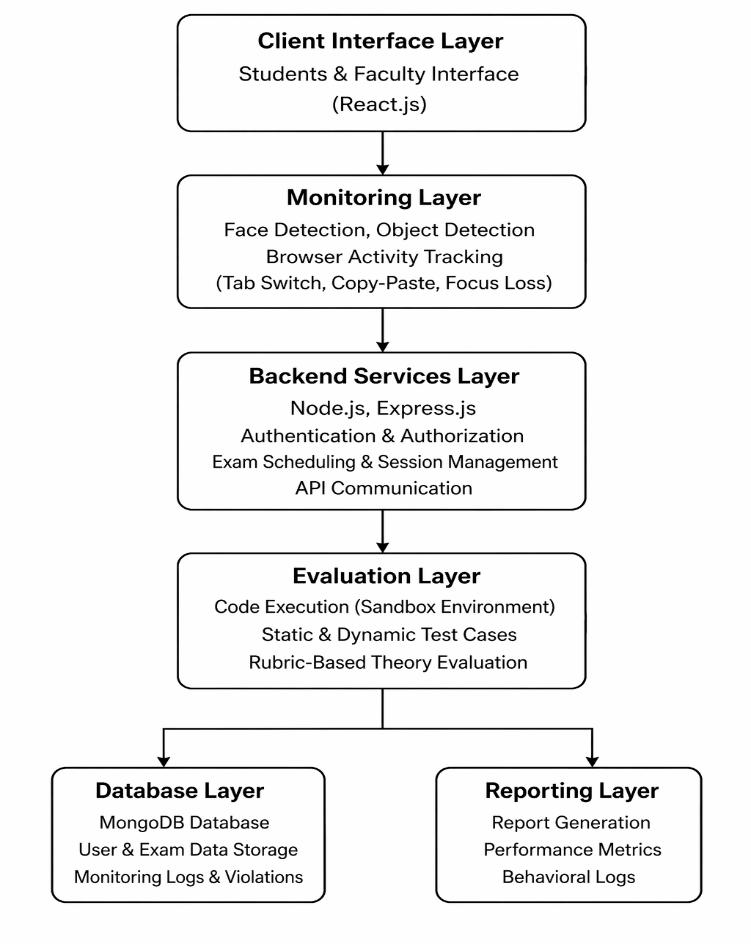
Fig1: SystemArchitecture
1. Client Interface Layer
This is the topmost layer, responsible for user interaction. It is developed using React.js, providing a
International Research Journal of Engineering and Technology (IRJET) e-ISSN: 2395-0056
Volume: 13 Issue: 04 | Apr 2026 www.irjet.net p-ISSN: 2395-0072
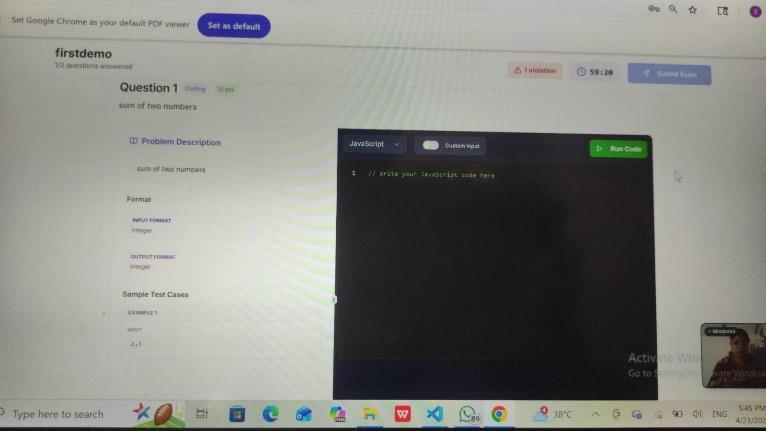
responsive and dynamic interface for both students and faculty members. Students can log in, access the exam dashboard,readquestions,writecodeusingtheintegrated editor,and submit responses.Faculty members can create exams, upload questions, and review results. This layer ensures smooth user experience and real-time interaction withthesystem.
The Monitoring Layer is responsible for maintaining examination integrity through continuous and real-time supervision; it employs browser-level event listeners to capture activities such as tab switching, window focus transitions, and clipboard interactions, ensuring detection of unauthorized actions; additionally, webcam-based presence verification is performed to confirm candidate availability and detect anomalies such as absence or multiple individuals; all monitored events are processed using deterministic rule-based logic, timestamped, and forwardedtothebackendforfurtheranalysisandstorage.
3. Backend Services Layer
TheBackendServicesLayeractsasthecentralcoordination and control component, implemented using Node.js and Express.js;itmanagessecureauthenticationandrole-based authorization, handles exam scheduling and session lifecycle management, and facilitates structured API communication between frontend, monitoring, and evaluation modules; the layer also performs request validation, data aggregation, and synchronization of monitoring logs with evaluation results, ensuring system consistency, reliability, and scalability under concurrent useraccess.
4.Evaluation Layer:
The Evaluation Layer is responsible for automated and objective assessment of student submissions; it executes programming code within a sandboxed environment to isolate execution and prevent system-level risks, validates outputs against predefined static and dynamic test cases, andassignsscoresbasedoncorrectnessandcompleteness; for theoretical responses, rubric-based evaluation criteria areappliedtomaintainconsistency;thelayeralsohandles compilationerrors,runtimeexceptions,andpartialoutputs, ensuringfairandcomprehensivegrading.
5.Database Layer:
TheDatabaseLayerutilizesMongoDBasaNoSQLdatabase to support flexible and scalable data storage; it maintains structured collections for user credentials, examination configurations,submissions,monitoringlogs,andviolation records;efficientindexingandqueryingmechanismsenable rapid data retrieval and real-time updates; this layer ensures data persistence, integrity, and scalability for
handlinglargevolumesofexaminationdataacrossmultiple sessions.
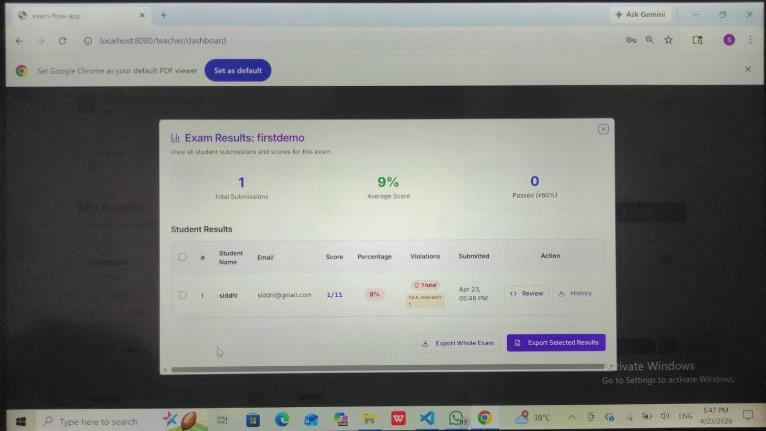
The Reporting Layer generates structured and comprehensive reports summarizing both academic performance and behavioral analysis; it includes detailed performance metrics, violation logs with timestamps, and final computed results; the reports provide insights into student behavior during examinations and support transparent evaluation and auditing processes; faculty members can access these reports through a secure interface, enabling efficient review, decision-making, and recordmaintenance.
The proposed SmartProctor system adopts a structured anddeterministicmethodologytoensuresecure,scalable, and transparent online practical examinations. The methodology integrates browser-based monitoring, webcam-based presence verification, automated evaluation, and structured reporting within a unified framework. Each stage of the methodology is designed to minimize computational overhead while maintaining reliabilityandfairnessinassessment.
The system initiates the examination process through secureuserauthenticationusingrole-basedaccesscontrol, ensuring that only authorized students and faculty members can access the platform; upon successful verification,adedicatedexaminationsessionisestablished with predefined parameters such as exam duration, questionset,andevaluationcriteria;sessionmanagement mechanisms enforce strict access control by preventing multiple concurrent logins, maintaining session integrity, and activating monitoring components prior to exam commencement to ensure a controlled and secure environment.
The monitoring process is implemented using an eventdriven approach that captures browser-level interactions in real time; JavaScript event listeners are configured to detect activities such as tab switching (visibility change), window focus transitions and clipboard operations (copy and paste); each captured event is evaluated against predefined rule-based conditions to identify violations, ensuring deterministic and immediate detection; the lightweight nature of this approach minimizes computational overhead while maintaining high responsiveness and accuracy in identifying suspicious behavior.
International Research Journal of Engineering and Technology (IRJET) e-ISSN: 2395-0056
Volume: 13 Issue: 04 | Apr 2026 www.irjet.net p-ISSN: 2395-0072
To ensure continuous candidate presence, the system activates webcam monitoring at the start of the examination session; video frames are periodically captured and processed to verify the presence of a single individual within the frame; abnormal conditions such as absence, multiple individuals, or prolonged inactivity are detected and recorded as violations; the verification process is designed to operate efficiently without employing complex behavioral inference techniques, thereby preserving user privacy while maintaining effectivesupervision.
Programmingsubmissionsareevaluatedusingatest-case–based approach. Code is executed in a controlled environment, and outputs are compared with expected results. Marks are assigned proportionally based on test casesuccess,ensuringconsistentandobjectivegrading.
All detected violations from browser monitoring and webcamverificationaresystematicallyloggedwithprecise timestampsandassociatedsessionidentifiers;thebackend serviceslayeraggregatesandsynchronizesthisdatainreal time,ensuringconsistencyacrosssystemcomponents;the logsarestoredinastructuredformatwithinthedatabase, creating a comprehensive and auditable record of user behaviorthroughouttheexaminationsession
Thefinalstageofthemethodologyinvolvesthegeneration ofcomprehensiveexaminationreportsthatintegrateboth performance and behavioral data; the reporting module processesevaluationresultsandviolationlogstoproduce structuredoutputscontainingmarks,violationsummaries, timestamps, and overall assessment outcomes; these reports are securely stored and made accessible to authorizedfacultymembersthroughadedicatedinterface, facilitating efficient review, auditing, and record management;theintegrationofmonitoringandevaluation data ensures a holistic assessment of both academic performanceandexaminationbehavior.
The system incorporates a real-time alert mechanism to notify administrators when suspicious activities exceed predefined thresholds. Alerts are triggered based on continuous evaluation of violation scores and behavioral patterns. This enables immediate intervention, such as warning the student or flagging the session for manual
review. The mechanism ensures proactive monitoring ratherthanpost-examanalysisalone.
To enhance authentication reliability, the system applies periodic face detection to verify that the same individual remains present throughout the session. Captured frames arecomparedwiththeinitialregisteredidentitytoensure consistency. This approach reduces impersonation risks while maintaining minimal computational overhead throughinterval-basedprocessing.
All programming code is executed within a sandboxed environment to ensure system security and isolation. The sandbox restricts unauthorized operations such as file access, network calls, or system-level commands. This preventsmaliciouscodeexecutionandensuresfairnessby providingauniformexecutionenvironmentforallusers.
A synchronized timing mechanism is implemented to enforce strict examination duration. The system continuously tracks elapsed time and automatically submits responses upon timeout. Session control also ensures that disruptions such as page refresh or connectivity loss do not compromise exam integrity, by restoringsessionstateswhereapplicable.
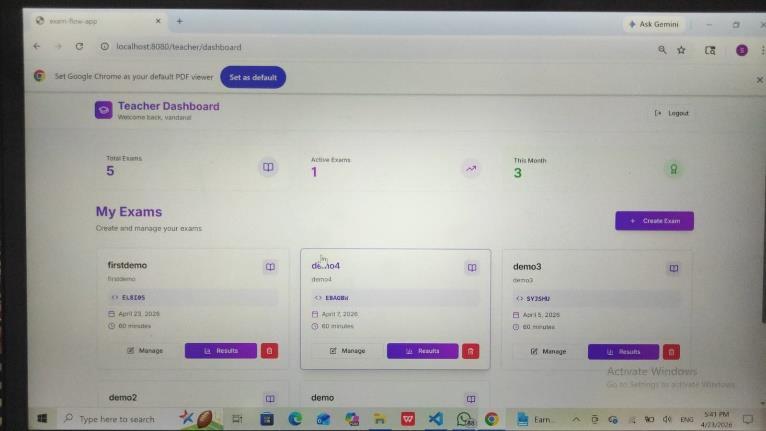
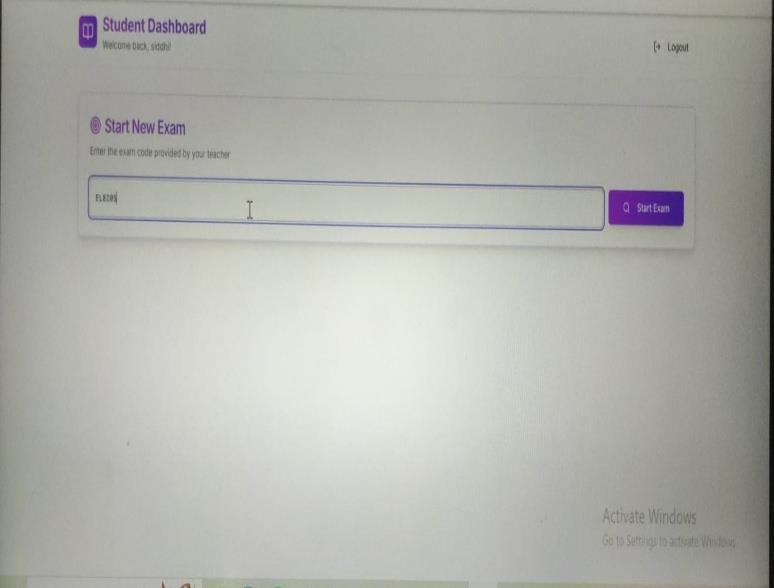
The implemented system demonstrates effective performance in conducting secure and automated online practical examinations. The user interface provides seamlessinteractionforbothstudentsandfaculty,enabling efficient exam creation, participation, and result visualization. The monitoring mechanism successfully detects and logs violations such as tab switching and identity mismatches in real time, ensuring examination integrity.
Experimental observations indicate that the system maintainslowlatencyduringexamexecutionandsupports smooth code submission and evaluation. The automated evaluation module accurately assesses programming responsesusingpredefinedtestcases,ensuringconsistent and objective grading. Additionally, the integration of violation tracking with performance metrics enables comprehensiveanalysisofstudentbehavior.
The reporting module generates structured outputs, including total submissions, average scores, violation counts, and individual performance details. The results
International Research Journal of Engineering and Technology (IRJET) e-ISSN: 2395-0056
Volume: 13 Issue: 04 | Apr 2026 www.irjet.net p-ISSN: 2395-0072
demonstrate that the system effectively combines monitoring and evaluation within a unified framework, providing reliable, transparent, and scalable assessment suitable for real-world academic environments. Furthermore, the system exhibits high usability and stability under continuous operation, ensuring minimal disruptionduringexaminationsessions.
Themodulararchitecturealsofacilitateseasyextensibility and future enhancements without affecting core system performance.


International Research Journal of Engineering and Technology (IRJET) e-ISSN: 2395-0056
Volume: 13 Issue: 04 | Apr 2026 www.irjet.net p-ISSN: 2395-0072
Astructuredandefficientapproachforconductingsecure online practical examinations has been presented. The system integrates browser-based monitoring, webcambased verification, automated evaluation, and structured reporting within a unified framework. The use of rulebased and event-driven mechanisms ensures transparent, low-overhead, and reliable detection of examination violations. The evaluation process provides objective and consistentgradingthroughtest-case–basedassessment. The overall system demonstrates scalability, robustness, and suitability for real-world academic deployment. Its modular design enables easy maintenance and future enhancements while ensuring system stability. Future improvementsmayfocusonoptimizingperformanceunder large-scale concurrent usage and enhancing monitoring capabilitieswhilemaintainingprivacyandefficiency.
[1] M. Labayen, “Online Student Authentication and Proctoring System,” University of Navarra, Technical Report,2021.
[2] T. Singh, R. Sharma, and P. Mehta, “Enhancing AcademicIntegrityinOnlineAssessmentsUsingObject Detection Models,” Procedia Computer Science, vol. 215,pp.324–331,2023.
[3] A. Ahmed and S. Hussain, “Unauthorized Activity Detection During Online Examination Using Browser Monitoring,”inProc.IEEEInternationalConferenceon ComputationalIntelligence,2020,pp.301–306.
[4] M.PawarandS.Bhattacharya,“AutomatedAssessment of Programming Assignments Using Test Case Evaluation,” IEEE Transactions on Education, vol. 61, no.3,pp.220–228,2018.