
International Research Journal of Engineering and Technology (IRJET) e-ISSN: 2395-0056
Volume: 13 Issue: 01 | Jan 2026 www.irjet.net p-ISSN: 2395-0072

International Research Journal of Engineering and Technology (IRJET) e-ISSN: 2395-0056
Volume: 13 Issue: 01 | Jan 2026 www.irjet.net p-ISSN: 2395-0072
Dr. Karan Sukhija1 , Dr. Shabina2 , Dr. Shefali Bedi3
1Assistant Professor, JGND Punjab State Open University, Patiala (Punjab-India)
2Assistant Professor, Government College, Mohali (Punjab-India)
3Assistant Professor, JGND Punjab State Open University, Patiala (Punjab-India)
Abstract - The Smart School Project initiated by the Government of Punjab represents a comprehensive effort to modernize government schools through improved infrastructure, digital integration, and learner-centric environments. This study evaluates the impact of the Smart School Project on three critical dimensions of school education equity, access, and quality. Adopting an exploratorymixed-methodresearchdesign,thestudydrawson quantitativedatacollectedthroughstructuredquestionnaires administeredtostudents,teachers,andschooladministrators, complemented by qualitative insights from semi-structured interviews. The findings suggest that smart school interventionshavesignificantlyenhancedphysicalanddigital infrastructure, strengthened enrolment patterns, and positivelyinfluencedclassroompracticesthroughtechnologyenabledteaching.Improvementsarealsoobservedinlearning environments andstudent engagement;however, disparities persist in implementation levels and access to advanced facilities across school categories and locations. The study concludes that while the Smart School Project has made substantialprogresstowardsinclusiveandqualityeducation, sustained policy support, targeted interventions, and systematic monitoring are essential to ensure equitable outcomesandlong-termimpact.
Keywords: Smart School Initiatives; Digital Pedagogy; EducationalEquity;AccesstoLearning;QualityofEducation; EducationalIndicators.
In recent years, governments across the world have increasingly adopted smart school models to address persistentchallengesinpublicschooleducation,including infrastructural deficits, digital exclusion, and unequal learning opportunities [1][4]. Smart schools are conceptualized as institutions that integrate physical infrastructure,informationandcommunicationtechnologies (ICT),andlearner-centredpedagogicalpracticestoenhance educational delivery and outcomes [5][7]. In India, statelevelinitiativessuchastheSmartSchoolProjectofPunjab represent systematic efforts to modernize government schoolsandalignthemwithnationaleducationalpriorities [26]. This review paper examines the existing body of literature to understand how smart school initiatives influenceequity,access,andqualityinschooleducation[17]
[19]. These three dimensions are widely recognized as foundational to inclusive and sustainable educational developmentandserveastheanalyticalframeworkforthis review[18].
According to the report of the Department of School Education,Punjab,thestatehasatotalof27,852schools,of which19,139aregovernmentschools.Thesearecategorized as12,827primaryschools,2,554middleschools,1,741high schools,and 2,017seniorsecondaryschools.Inalignment withtheobjectivesoutlinedinthe“SmartSchoolPolicy,”the Departmenthasinitiatedaplantoconvertallgovernment schoolsintoSmartSchools[26]
Thetransformationprocessisguidedbyspecificparameters tailored to each school category, ensuring that the requirementsofasmartschoolareappropriatelyaddressed attheprimary,middle,high,andseniorsecondarylevels[6] [8].Tosystematicallyimplementthisinitiative,theproject hasbeendividedintothreephases Phase1,Phase2,and Phase3 correspondingtothedifferentschoolcategories. This phased approach allows for structured planning, resourceallocation,andevaluationofprogressateachstage ofimplementation,ensuringthattheobjectivesofimproved infrastructure, digital integration, and learner-centric practices are achieved across all government schools in Punjab[2][3]
The concept of smart schools extends beyond the mere provision of digital tools [8] [12]. Existing literature characterizessmartschoolsasintegratedecosystemsthat combine modern infrastructure, technology-enabled classrooms, trained teachers, and supportive learning environments [4] [5] [14]. Studies emphasize that smart school models aim to create inclusive spaces that foster student engagement, collaborative learning, and skill development[6][24]
Research on learning environments suggests that welldesignedschoolinfrastructureandtechnologicallyenriched classrooms significantly influence student motivation, attendance, and academic performance [1] [2] [7]. Smart
International Research Journal of Engineering and Technology (IRJET) e-ISSN: 2395-0056
Volume: 13 Issue: 01 | Jan 2026 www.irjet.net p-ISSN: 2395-0072
school initiatives are therefore increasingly viewed as holisticinterventionscapableofaddressingstructuraland pedagogicalgapsinpubliceducationsystems[25][30].
Throughthispaperweareintendtoevaluatetheimpactof “SmartSchoolProject”intermsofAccess,EquityandQuality ofSchoolEducation,Punjab.Allthreefactorsareverycrucial toevaluatethesignificanceofprojecttowardsimprovisation of education level of state [17] [19]. We have considered variousfactorsalongwiththeparametersformulatedunder “SmartSchoolPolicy”toevaluatetheimpactonthebasisof aforesaidsections.Thedetailabouteachsectionisdescribed below:
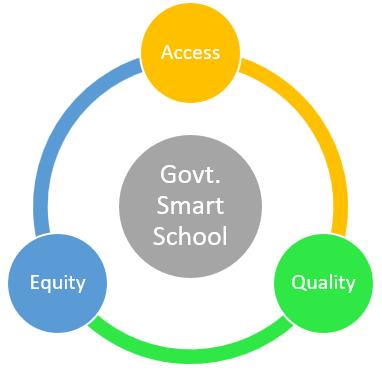
Educationalequity(educationforall)meansthatpersonalor socio-cultural circumstances like gender, caste, creed or religionshouldnotbecomeobstacleinachievingeducation [17][19].Theschoolsshouldensuretoreachouttostudents fromallsocialbackgrounds.Educationalequityimpliesthat factor’s specific to one’s personal condition should not interfere with the potential academic success. Inequity in education becomes apparent because of inequalities in socioeconomic standing or gender or disability [27] [28] Whenweneedtoanalyseequity,wemustrecognizethefact that some are at larger disadvantage than others and the systemmustaimtocompensateforthatdisadvantageevenif it means unequal distribution of resources [18] [21]. The mainfactorsthatarecanimproveequityistoaddressthe factorsthatcancauseinequity.So,thefactorsthatneedtobe consideredherearesocio-economicbackgroundofstudents, caste,genderanddisability,location[17][19]
1.3.2
Ineducation,thetermaccessreferstothewaysandmeans inwhicheducationalinstitutionsandpoliciesensure orat least strive to ensure that students have equal and equitable opportunities to take full advantage of their education[21][22].Increasingtheaccessrequiresschoolsto
provideadditionalservicesorremoveanyactualorpotential barriers [17] [19] that might prevent some students from equitable participation in certain courses or academic programs. Factors such as gender, disability, perceived intellectual ability, past academic performance, specialeducationstatus,English-languageability,andfamilyincome oreducational-attainmentlevels inadditiontofactorssuch as relative community affluence, geographical location, or school facilities may cause certain students having less “access”to educational opportunitiesthan other students. Thismayfurtherleadtoopportunitygapthatschoolsmust thrivetoreduceatallpossiblelevel.
Access refers to school strategies or policies designed to removeinstitutionaldisincentives,impediments,orbarriers toacademicsuccess,whetherintentionalorunintentional,or to provide the resources, social services, and academic supportthatcertainstudentsmayneedtosucceedinschool. Ifaccessisdeniedorleftunaddressedbyaschool,students may struggle academically or drop out, learning gaps will widenovertime,studentsmaypass-outunpreparedsoasto enrol and succeed in a postsecondary-degree program, or students may be unable to participate in certain courses, schoolprograms,extracurricularactivities,orsportsetc. Accessibility of education can be improved by increasing capacityviainvestmentsinschoolinfrastructure,resources and equipment needed to deliver the curriculum in an effectiveway.Smartschoolswithadequatefacilitiescould play a definitive role in improving education, increasing enrolment rates, and fostering student retention. Factors that improve access are: provision of special infrastructure/resources to deliver the curriculum, health and nutritional services, special provisions/policies for weakerstudents,cateringtothelearningneedsofdiverse rangeoflearners,career-counsellingforstudents[1][5][7]
Quality learning requires a safe, friendly environment, qualified and motivated teachers, and instruction in languageswhichthestudentscanunderstand[23][24].For effective teaching-learning process, education outcomes need to be monitored regularly and skilful assessment to facilitate learning and reduce disparities [8] [25]. Factors thatneedtobeconsideredforqualityare:qualitylearning environments, student-centred learning, diversity of processesandfacilities,andlearningoutcomes.Schoolsmust ensure quality education by delivering learning outcomes focusing on foundational learning and life skills. This includesnotjustbasiccompetencyinliteracyandnumeracy skills but also wide-range of abilities, attitudes and other socio-emotionalcompetencies[26][30]
Nevertheless, there is an understanding around the importance of life skills but there is a lack of alignment betweentraditionalcurriculaandtheincorporationoflifeskillslearningandalackofunderstandingofhowthesecan
International Research Journal of Engineering and Technology (IRJET) e-ISSN: 2395-0056
Volume: 13 Issue: 01 | Jan 2026 www.irjet.net p-ISSN: 2395-0072
bedevelopedthroughschooleducation.TheNEP,2020aims to bring this into focus by stressing the importance of leaningbydoing.
School education should focus on delivering education programmesdifferentlyand speedily to employsolutions, which accelerate impact and achieve scale across interventions targeted at children and adolescents. Smart schoolprojectwasalsoaimedinthisdirection.
The Smart School Project aims not only at infrastructural transformationbutalsoatimprovingeducationalinclusion and learning outcomes. Evaluating its impact on equity, access,andqualityisessential tounderstand whether the initiative has effectively addressed socio-economic disparities, improved enrolment and participation, and enhancedtheteaching–learningprocess.Thisstudyseeksto provideempiricalevidencetoinformpolicydecisionsand strengthenfutureschooleducationreforms[17][19][26].
Howhascommunityparticipationbeenreflectedin the implementation and sustainability of smart schoolinitiatives,asreportedinexistingliterature [6][25]?
What evidence does the literature provide regarding improvements in physical and digital infrastructureofgovernmentschoolsfollowingthe adoptionofsmartschoolmodels[1][2][5]?
How have smart school initiatives influenced enrolment trends and student retention in governmentschools,accordingtopreviousstudies andpolicyreports[21][22][28]?
Whatdoesexistingresearchrevealabouttheroleof smart classrooms in enhancing the teaching–learning process and classroom engagement [8] [10][24]?
What key factors identified in the literature determine the effectiveness of smart schools in improving students’ academic performance and learningoutcomes[23][24][25]?
What policy-level insights and recommendations emergefrompriorstudiesandstakeholderanalyses forstrengtheningsmartschoolinitiatives[26][30]?
Toreviewevidencefrompriorstudiesonchangesin enrolmentpatternsassociatedwiththeconversion ofgovernmentschoolsintosmartschools[21][22] [28]
To analyse the extent to which smart school initiatives have addressed gender equity, as reflected in existing research and policy assessments[17][19]
To synthesize findings from the literature on the socio-economicandcastecompositionofstudents enrolledinsmartschools[27][28]
To evaluate, through a review of scholarly and policy-basedevidence,theimpactofsmartschools onaccesstoeducation[21][22].
Toexaminetheroleofsmartschoolsinenhancing the quality of education by reviewing studies on teaching–learningprocessesandlearningoutcomes [23][24][26].
The reviewed literature collectively indicates that smart school initiatives represent a strategic intervention for strengtheningpublicschooleducationbyaddressinglongstanding challenges related to infrastructure, access, and instructionalquality[1][7].Acrossstudies,theintegrationof improved physical facilities and digital technologies is consistently associated with more engaging learning environments, increased school attractiveness, and enhanced student participation [5]. These infrastructural advancements are widely recognized as foundational to improving both accesses to education and learner engagementingovernmentschools.
Evidencefrompolicyreportsandempiricalstudiessuggests that smart school reforms have contributed to improved enrolment and retention, particularly in contexts where government schools previously experienced declining participation[21][22].Enhancedschoolenvironmentsand technology-enabled classrooms appear to positively influenceparentalperceptionsandstudentmotivation [8] [24].However,theliteraturealsohighlightsthatenrolment gains are uneven and remain contingent upon socioeconomic conditions, geographic location, and the availability of complementary support mechanisms [17] [19].
Thepedagogicalpotentialofsmartclassroomsemergesasa recurring theme in the reviewed studies. Technologysupportedinstructionisfoundtofacilitateinteractiveand
To critically examine the Smart School initiative implemented in Punjab through an analysis of existingliterature,policydocuments,andevaluation reports[1][7].
International Research Journal of Engineering and Technology (IRJET) e-ISSN: 2395-0056
Volume: 13 Issue: 01 | Jan 2026 www.irjet.net p-ISSN: 2395-0072
learner-centred teaching practices, thereby improving classroomengagementandconceptualunderstanding.Atthe sametime,theliteratureunderscoresthattheeffectiveness of smart classrooms is closely dependent on teacher preparedness, institutional leadership, and ongoing professionaldevelopment.Withouttheseenablingfactors, theeducationalbenefitsofdigitalinfrastructuremayremain limited[26][30]
From an equity and access perspective, smart school initiatives demonstrate the capacity to reduce certain structural barriers by expanding access to learning resourcesandimprovingschoolenvironments.Nonetheless, persistentdigitaldividesanddisparitiesinimplementation across regions and school categories are evident in the literature. These gaps suggest that infrastructure-focused reformsmustbecomplementedbytargetedequity-oriented policiestoensureinclusiveeducationaloutcomes. Overall,thereviewedevidenceemphasizesthatsmartschool initiatives can meaningfully contribute to improving educationalquality,access,andequitywhenimplemented within a coherent policy framework that integrates infrastructure development, pedagogical innovation, and systematicmonitoring.Theliteraturereinforcestheneedfor sustainedpolicycommitmentandcommunityengagementto translatesmartschoolreformsintolong-termeducational gains.
The Smart School Project in Punjab represents a transformativeinitiativeaimedatmodernizingpublicschool education through improved infrastructure, digital integration, and learner-centred practices. The review indicatesthattheprojecthascontributedtoenhancedschool facilities, increased enrolment, and greater classroom engagement, supporting improvements in access and learning environments. Evidence also suggests positive impacts on educational quality, reflected in enriched teaching practices and higher student participation. However,disparitiesinimplementationacrossschooltypes andgeographiclocationsremain,highlightingtheneedfor targeted interventions and sustained monitoring. Overall, the literature affirms that the Smart School Project has advancedequity,access,andqualityinschooleducation,but itslong-termsuccessdependsoncontinuouspolicysupport, community involvement, and evidence-based planning to ensureinclusiveandsustainableoutcomes.
[1] M. Schneider, “Do school facilities affect academic outcomes?” National Clearinghouse for Educational Facilities,Washington,DC,USA,2002.
[2]P.Woolner,E.Hall,S.Higgins,C.McCaughey,andK.Wall, “A sound foundation? What we know about the impact of environmentsonlearning,”OxfordReviewofEducation,vol. 33, no. 1, pp. 47–70, 2007, doi: 10.1080/03054980601094621.
[3]NationalResearchCouncil,GreenSchools:Attributesfor Health and Learning. Washington, DC, USA: National AcademiesPress,2006.
[4] J.Blackmore,D. Bateman, J.Loughlin, J. O’Mara,and G. Aranda, Research into the Connection between Built Learning Spaces and Student Outcomes. Melbourne, Australia: Department of Education and Early Childhood Development,2011.
[5]UNESCOInstituteforStatistics,APlacetoLearn:Lessons from Research on Learning Environments. Montreal, QC, Canada:UNESCO,2012.
[6]D.Davies,D.Jindal-Snape,C.Collier,R.Digby,P.Hay,and A. Howe, “Creative learning environments in education: A systematicliteraturereview,”ThinkingSkillsandCreativity, vol.8,pp.80–91,2013,doi:10.1016/j.tsc.2012.07.004.
[7]P.M.Bluyssen,D.Zhang,S.Kurvers,M.Overtoom,andM. Ortiz-Sanchez,“Health,comfort,andperformanceofchildren inclassrooms,”BuildingandEnvironment,vol.94,pp.114–123,2016,doi:10.1016/j.buildenv.2015.09.004.
[8]P.MishraandM.J.Koehler,“Technologicalpedagogical content knowledge: A framework for teacher knowledge,” Teachers College Record, vol. 108, no. 6, pp. 1017–1054, 2006.
[9] N. Selwyn, Education and Technology: Key Issues and Debates.London,U.K.:Continuum,2011.
[10]R.B.Kozma,“NationalpoliciesthatconnectICT-based education reform to economic and social development,” HumanTechnology,vol.1,no.2,pp.117–156,2005.
[11]C.P.LimandM.Smith,TheGlobalIntegrationofICTin Education.NewYork,NY,USA:Springer,2008.
[12] J. Voogt and G. Knezek, International Handbook of Information Technology in Primary and Secondary Education.NewYork,NY,USA:Springer,2008.
[13] G. I. Earthman, “Prioritization of 21st century school facilities,” American Civil Liberties Union Foundation of Maryland,Baltimore,MD,USA,2004.
[14] S. Higgins, E. Hall, K. Wall, P. Woolner, and C. McCaughey, The Impact of School Environments: A LiteratureReview.London,U.K.:DesignCouncil,2005.
International Research Journal of Engineering and Technology (IRJET) e-ISSN: 2395-0056
Volume: 13 Issue: 01 | Jan 2026 www.irjet.net p-ISSN: 2395-0072
[15] C. K. Tanner, “Effects of school design on student outcomes,” Journal of Educational Administration, vol. 47, no. 3, pp. 381–399, 2009, doi: 10.1108/09578230910955809.
[16]C.UlineandM.Tschannen-Moran,“Thewallsspeak:The interplay of quality facilities, school climate, and student achievement,”JournalofEducationalAdministration,vol.46, no.1,pp.55–73,2008,doi:10.1108/09578230810849817.
[17] OECD, Equity and Quality in Education: Supporting Disadvantaged Students and Schools. Paris, France: OECD Publishing,2012.
[18] A. Sen, Development as Freedom. New Delhi, India: OxfordUniversityPress,1999.
[19]L.TiklyandA.M.Barrett,“Socialjustice,capabilitiesand the quality of education in low-income countries,” InternationalJournalofEducationalDevelopment,vol.31, no.1,pp.3–14,2011,doi:10.1016/j.ijedudev.2010.06.001.
[20] UNESCO, Accountability in Education: Meeting Our Commitments.Paris,France:UNESCO,2017.
[21]K.M.Lewin,“Accesstoeducationinsub-SaharanAfrica: Patterns, problems and possibilities,” Comparative Education,vol.45,no.2,pp.151–174,2009.
[22] World Bank, World Development Report 2018: Learning to Realize Education’s Promise. Washington, DC, USA:WorldBank,2018.
[23] L. Darling-Hammond, “Teacher quality and student achievement,”EducationPolicyAnalysisArchives,vol.8,no. 1,2000.
[24]J.Hattie,VisibleLearning:ASynthesisofOver800MetaAnalysesRelatingtoAchievement.London,U.K.:Routledge, 2009.
[25] M. Fullan, Stratosphere: Integrating Technology, Pedagogy, and Change Knowledge. Toronto, ON, Canada: Pearson,2013.
[26]GovernmentofIndia,NationalEducationPolicy2020. NewDelhi,India:MinistryofEducation,2020.
[27]J.B.G.Tilak,Education,InequalityandDevelopmentin India.Singapore:PalgraveMacmillan,2015.
[28] G. G. Kingdon, “The progress of school education in India,”OxfordReviewofEconomicPolicy,vol.23,no.2,pp. 168–195,2007.
[29] A. C. Mehta, Elementary Education in India: Policy, PracticeandChallenges.NewDelhi,India:Routledge,2014.
[30]A.Schleicher,WorldClass:HowtoBuilda21st-Century SchoolSystem.Paris,France:OECDPublishing,2018.