
International Research Journal of Engineering and Technology (IRJET) e-ISSN: 2395-0056
Volume: 12 Issue: 04 | Apr 2025 www.irjet.net p-ISSN: 2395-0072
International Research Journal of Engineering and Technology (IRJET) e-ISSN: 2395-0056
Volume: 12 Issue: 04 | Apr 2025 www.irjet.net p-ISSN: 2395-0072
Yogita Raut1 , Aditi Shinde2 , Purva Pokale3
*1,2,3Student, Department Of Electronics And Telecommunication, Zeal College Of Engineering And Research Narhe, Pune, India.
Abstract - High-voltage power cables are vulnerable to faults caused by environmental factors, physical damage, or technical issues, often resulting in high maintenance effortsandsystemdowntime.ThispaperpresentsanIoTbased fault detection and location system using an ESP32 microcontroller and GSM technology. The system continuously monitors voltage levels, identifies abnormal conditionsduringa fault,calculatesthefaultlocation,and displays it on a 16x2 LCD. GSM help users locate the fault precisely for quicker repair. This solution offers a costeffective and efficient method to reduce downtime, enhance maintenance response, and improve the reliabilityofpowertransmissionnetworks.
Key Words: Power Transmission Line Monitoring, ESP32, IoT,Real-TimeFaultAlerts,GSM,Relay.
1.INTRODUCTION
Electrical power systems rely on transmission lines to deliver electricity over long distances, but these lines are prone to faults such as open circuits, short circuits, and earth faults. While underground cables offer protection from environmental damage, finding faults in them is difficult and often costly. This project introduces a smart faultdetectionsystemusingIoTtechnologyandanESP32 microcontroller. It continuously monitors voltage levels, detects irregularities during faults, and displays the fault location with GSM on an LCD. This method enables faster fault identification, reduces maintenance time, and improvesthereliabilityofpowerdistributionsystems.
A Smart Monitoring & Fault Detection System is essential forpowertransmissionlinestoquicklydetectandaddress faults, minimizing disruptions and damage. Traditional methods are often slow, while smart systems using IoT and GSM provide real-time alerts, precise fault locations, and remote monitoring, leading to faster response times, improvedreliability,andenhancedsystemperformance.
1.2
1.Todesignandsimulatea faultdetectionsystemusinga programmablecontrollerforoverheadlines.
2.TomonitorlineconditionswithESP32andensurequick faultresponse.
3.TolocatefaultsusingGSMandsendalertstousers.
4.Totestsystemaccuracybyintroducingfaultsatdifferent locations.
S. K. Satyanarayana and S. N. Chandra Shekhar [1] proposed an IoT-based solution for underground cable faultdetection.Theirapproachinvolvesutilizingsensorsto monitor the state of underground cables and detect faults accurately. This model is implemented within a real-time framework to continuously assess the health of power transmission lines, making it suitable for urban environmentswherefaultdetectioniscritical.Thesystem's efficiency lies in its ability to quickly identify faults, enabling rapid response and reduced downtime for maintenance.
A. Firos et al. [2] presented a model using artificial intelligence (AI) for fault detection in power transmission lines.Thismodelintegratesmachinelearningalgorithmsto analyzetransmissionlinedata,aimingtopredictandlocate potentialfaultsbeforetheyleadtosystemfailures.Theuse of AI enhances the model’s accuracy in fault detection, makingithighlybeneficialforcriticalinfrastructurewhere reliability is essential. The study demonstrates that AIdriven fault detection can significantly reduce the likelihoodofwidespreadoutages.
M. T et al. [3] developed an IoT-based fault detection system focused on essential power transmission lines. Their system uses a network of sensors connected to IoT devices,enablingreal-timemonitoringoftransmissionline health. This model emphasizes on-site deployment and utilizescloudstoragefordata,allowingmaintenanceteams to access fault data remotely. The research highlights the advantages of IoT in making fault detection systems more efficientandaccessibleacrossvariousgeographicalareas.
L. Goswami and P. Agrawal [4] explored a solution that leveragesIoTwithGoogleFirebasefordiagnosingfaultsin powerlinetransmissions.Theirproposedmodelintegrates sensor networks with Firebase, creating a centralized platform for data collection and analysis. By utilizing
International Research Journal of Engineering and Technology (IRJET) e-ISSN: 2395-0056
Volume: 12 Issue: 04 | Apr 2025 www.irjet.net p-ISSN: 2395-0072
Google’s cloud services, this system offers scalable and reliable data storage, suitable for large-scale deployments. The study emphasizes the potential for cloud-based fault detection systems to streamline monitoring and improve faultlocalization.
A.Mukherjeeetal.[5]providedacomprehensivereviewof faultdetectionmethodsforpowertransmissionlines.Their research compares different algorithms for fault identification, classification, and localization, offering insights into the advantages and limitations of each approach. The review underscores the importance of algorithm selection in designing effective fault detection systems, particularly in complex power networks. The authors conclude that a combination of advanced algorithms is necessary to achieve optimal fault detection andclassification.
L. Goswami and P. Agrawal [6] proposed an IoT-based system for fault detection in power line transmission, utilizing Google Firebase as a centralized database. This model involves the realtime monitoring of transmission lineparameters,withdatastoredandanalyzedviaGoogle’s cloudservicestodetectanomalies.Theirstudyemphasizes the reliability of cloud-based platforms in managing large data volumes, enabling prompt fault identification and response. By combining IoT with Firebase, this system ensures a scalable and efficient approach to fault management in power distribution networks, which is essentialformaintaininggridstability.
The proposed system is designed to efficiently detect and locate faults in overhead transmission lines and provide real-time fault information using IoT technology. It consistsofthefollowingmajorcomponents:
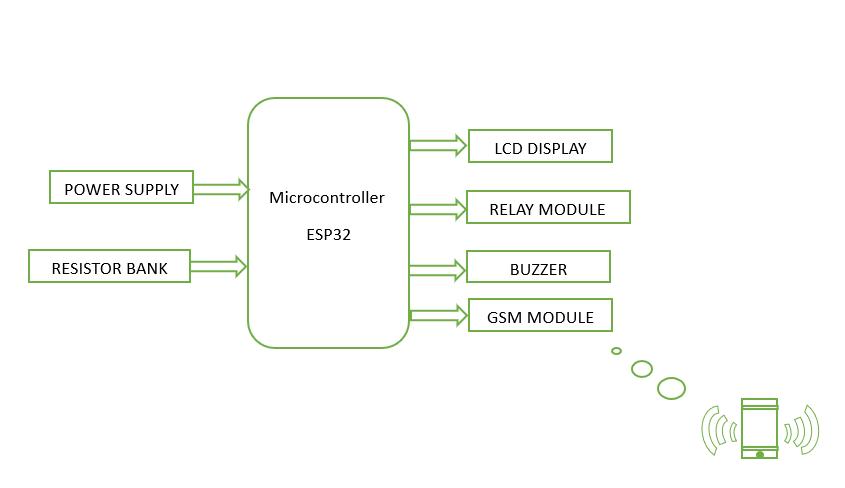
Fig -1:BlockDiagram
The hardware design of the system is divided into the followingthreemajorsubsystems:
The power supply system plays a crucial role in ensuring thereliableandefficientoperationoftheentirehardware setup. In this work, a 12V, 2A DC power supply serves as the primary source of power for all connected components.
Thepowerdistributioninthesystemisasfollows:
1.Relay Modules: Powered directly by the 12V DC supply forswitchingoperations.
2.Microcontroller(ESP32):Operatesat3.3V,derivedfrom 12Vusinganonboardregulator.
3.GSMModule:Requires5V,suppliedviaabuckconverter fromthe12Vinput.
4.Low Voltage Components: Powered through the same buckconverterforefficientsmallvoltagerequirements.
The fault isolation system is designed to detect and managefaultsbyisolatingfaultysectionsandensuringthe safe operation of the system. The components and processesinvolvedareasfollows:
1.Relays are utilized to automatically connect or disconnect resistor banks based on system conditions, allowingfordynamicfaultisolation.
2.Resistor Banks are strategically employed to control fault current by either shorting or isolating specific sectionsofthecircuit.
3.Manual Switches provide the capability for manual intervention,allowinguserstoshortorisolatetheresistor banksduringfaultconditions.
TheLocationTrackingand DisplaySystemfacilitates realtimefaultreportingandcommunication.TheGSMmodule transmits messages to the user, providing details about the fault type and its location, ensuring constant monitoring of the system’s status and allowing for quick intervention.
Locally, a 16x2 LED display is used to show critical information such as fault status, operational details, and location information directly to the user. This enables effective on-site monitoring and helps in managing the systemefficiently.
International Research Journal of Engineering and Technology (IRJET) e-ISSN: 2395-0056
Volume: 12 Issue: 04 | Apr 2025 www.irjet.net p-ISSN: 2395-0072
4. CIRCUIT DIAGRAM
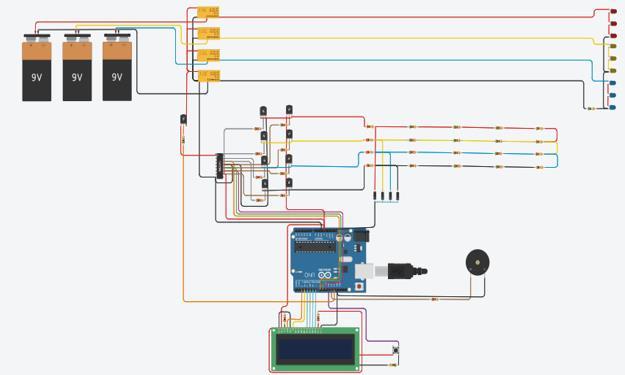
-2:Circuitdiagram
5. FLOW CHART
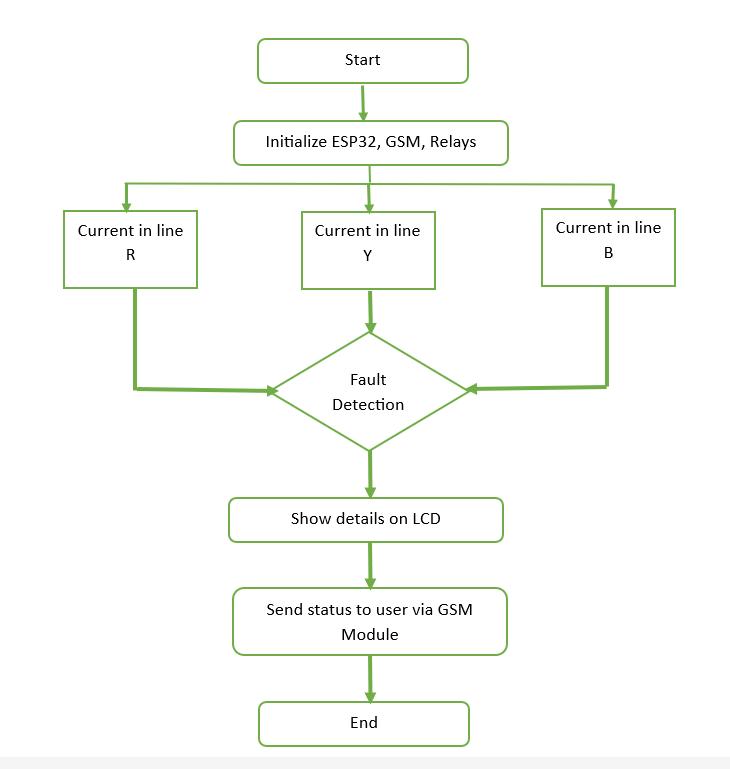
Fig -3:FlowChart
6. PERFORMANCE ANALYSIS
This system provides an efficient solution for real-time fault detection and isolation in power transmission lines. Fault conditions are identified through manual switching, with immediate isolation achieved via controlled relay activation. Upon fault detection, an automated message is sent to the user, detailing the type and location of the issue, ensuring rapid response and enhanced system safety.
Local status and fault information are displayed instantly, enablingon-sitemonitoring withouttheneedfor external tools. A regulated power supply ensures stable operation of all hardware under varying field conditions, while voltageconversionismanagedeffectivelyforcomponents requiringlowerlevels.
The system offers significant improvements over traditional fault detection methods by integrating automated isolation, instant remote fault alerts, and onsitestatusindication.Thisapproachminimizesdowntime, enhances operational reliability, and reduces the risks associated with prolonged faults in transmission networks. Its modular, energy-efficient, and scalable design makes it suitable for both urban and remote applications, ensuring reliable performance and effective faultmanagement.
Conventional transmission line protection systems often struggle with delayed fault identification and limited communication capabilities, especially in distributed or remote networks. This work addresses these challenges by developing a real-time fault monitoring and isolation system utilizing microcontroller-based control, automatic relayoperation,andwirelesscommunication.
Theproposedsystemeffectivelydetectsandisolatesfaults by manually shorting resistor banks through switches, with relay modules ensuring safe disconnection of faulty sections.Faultdetails,includingtypeandspecificlocation, are promptly transmitted to the user via GSM messaging, providing immediate remote awareness. Additionally, operational status and fault notifications are displayed locally using a 16×2character display, improving on-site responsiveness.
By integrating real-time communication, local indication, and automated isolation, this system enhances reliability, reduces downtime, and offers a cost-effective, scalable solution for improving safety in power transmission networks.
1. Cloud-Based Monitoring Dashboard: Integrate cloud storage and web dashboards to log fault history and remotely monitor system status. This allows operators to access real-time data from anywhere and analyze longtermtrendsforbetterdecision-making.
2. Voice Call or App-Based Alerts: Enhance GSM communicationtosendvoicecallalertsorintegratewitha mobile app for real-time notifications, enabling quick responsesfromanywhere.
International Research Journal of Engineering and Technology (IRJET) e-ISSN: 2395-0056
Volume: 12 Issue: 04 | Apr 2025 www.irjet.net p-ISSN: 2395-0072
3. Machine Learning for Fault Prediction: Use collected data to implement simple AI/ML models to predict potential faults and alert in advance. This proactive approach would reduce unplanned outages and allow for scheduled maintenance, improving overall grid reliability. The system could continuously learn from historical data toenhancepredictionaccuracyovertime.
4. Modular Multi-Line Monitoring: Design a scalable modular setup capable of monitoring multiple transmission lines simultaneously with one central controller. This approach would enable the system to be easily expanded to accommodate more lines as the grid grows. It would also allow for efficient management and faultdetectionacrossvarioussectionsofthenetworkfrom asingleinterface.
5. Smart Grid Integration: Future-proof the system for integration with smart grid networks for automatic load balancing and dynamic power management. This integration would enable thesystemtoadapt in real-time to fluctuating power demands and automatically isolate faults. It would enhance grid reliability and efficiency, optimizingpowerdistributionacrossvastnetworks.
1.FaultDetectionandIsolation: Detectsandisolatesfaults instantly.
2. Remote Monitoring and Control: Monitors and controls faultsviaGSM.
3.GridHealthMonitoring:Tracksgridstatuscontinuously.
4.Rural and Remote Area Monitoring: Enables fault alerts inremoteareas.
5.Energy Distribution Optimization: Balances and managespowerloads.
6.Emergency Response and Disaster Management: Assists inquickfaulthandlingduringdisasters.
7.IntegrationwithRenewableEnergyNetworks: Supports reliablerenewableenergyintegration.
[1] S. K. Satyanarayana and S. N. Chandra Shekhar, "UNDERGROUND CABLE FAULT DETECTION USING IoT," 2024 15th International Conference on Computing Communication and Networking Technologies(ICCCNT),Kamand,India,2024.
[2] A.Firos,N.Prakash,R.Gorthi,M.Soni,S.KumarandV. Balaraju, "Fault Detection in Power Transmission Lines Using AI Model," 2023 IEEE International
ConferenceonIntegratedCircuitsandCommunication Systems(ICICACS),Raichur,India,2023,pp.1-6
[3] M.T,T.M,G.T,C.R.A.Darshan,S.F.FandB.K,"Fault Detection Using IoT in Essential Power Transmission Lines," 2023 Intelligent Computing and Control for EngineeringandBusinessSystems(ICCEBS),Chennai, India,2023,pp.1-6.
[4] L. Goswami and P. Agrawal, "IOT based Diagnosing of Fault Detection in Power Line Transmission through GOOGLE Firebase database," 2020 4th International Conference on Trends in Electronics and Informatics (ICOEI)(48184),Tirunelveli,India,2020,pp.415-420
[5] A. Mukherjee, P. K. Kundu, and A. J. J. o. T. I. o. E. S. B. Das,"Transmissionlinefaultsinpowersystemandthe different algorithms for identification, classification andlocalization: a brief review of methods," vol. 102, no.4,pp.855-877,2021.