
International Research Journal of Engineering and Technology (IRJET) e-ISSN: 2395-0056
Volume: 13 Issue: 06 | Jun 2026 www.irjet.net p-ISSN: 2395-0072

International Research Journal of Engineering and Technology (IRJET) e-ISSN: 2395-0056
Volume: 13 Issue: 06 | Jun 2026 www.irjet.net p-ISSN: 2395-0072
Lingakshi Waradai 1 , Mansi R S 2 , R Sai Meghana3
1 B.Tech 2nd Year, Dept. of Electronics and Communication Engineering, Visvesvaraya Technological University, Belagavi, Karnataka, India
2 B.Tech 2nd Year, Dept. of Electronics and Communication Engineering, Visvesvaraya Technological University, Belagavi, Karnataka, India.
3 Junior Research Fellow, Dept. of Electronics and Communication Engineering, Visvesvaraya Technological University, Belagavi, Karnataka, India.
Abstract - The Smart Medicine Dispenser with Face Authentication is an automatedhealthcaresystemdesignedto improve medication safety and ensure that medicines are dispensed only to authorized users. The system integratesface recognition technology with an embedded microcontrollerbased dispensing mechanism to provide secure and reliable medicine distribution. In this project, a webcam captures the user's face, and the facial image is compared with previously stored images using a face recognition algorithmdevelopedin Python. If the face is successfullyrecognized,anauthentication signal is sent to the STM32 microcontroller, which activates a servo motor to dispense the medicine. Thesystemalsodisplays the dispensing status on an LCD screen. If the face does not match the stored database, the system denies access and activates a buzzer and warning LED to indicate unauthorized access. This feature enhances security and prevents misuse of medicines. The proposed system is especially useful for elderly patients, hospitals, clinics, and home healthcareenvironments where accurate and timely medication is important. The project demonstrates the integration of embedded systems, image processing, serial communication, and automation technologies to create a smart healthcare solution. The prototype successfully verifies users, dispenses medicine automatically, and provides visual and audio alerts, thereby reducing human errors and improving medication management. Future enhancements may include IoT connectivity, mobile notifications, multiple-user support, and scheduled medicine reminders.
KeyWords:BiometricAccessControl,FacialAuthentication, Medication Adherence, Servo Motor Automation, STM32 Microcontroller
Withtheadvancementofhealthcaretechnology,automated medicine management systems have become increasingly important.Manypatients,especiallyelderlyindividualsand thosewithchronicillnesses,oftenforgettotakemedicineson time or may consume the wrong medication. Traditional medicine storage methods do not provide security or monitoring,whichcanleadtomedicationerrorsandhealth risks.
ASmartMedicineDispenserisanautomatedsystemthat helps patients receive medicines accurately and safely. By integrating face authentication technology with embedded systems,thedispenserensuresthatmedicinesareprovided onlytoauthorizedusers.Facerecognitionoffersaconvenient and contactless method of authentication, eliminating the needforpasswordsorphysicalkeys.
This project combines image processing, embedded systems, and automation technologies to develop a secure medicinedispensingsolution.Thesystemusesawebcamand facerecognitionsoftwaretoverifytheuser'sidentity.Once authenticated,themicrocontrollercontrolsaservomotorto dispensethemedicinewhiledisplayingthestatusonanLCD screen.
Medication errors are a common issue in homes, hospitals,andhealthcarecenters.Patientsmayforgettotake medicines,takeincorrectdoses,oraccessmedicinesintended forsomeoneelse.Conventionalmedicinedispensersdonot providepropersecurityoruserverificationmechanisms.
Therefore, there is a need for a secure and automated medicine dispensing system that can authenticate users beforedispensing medicine.TheproposedSmartMedicine DispenserwithFaceAuthenticationaddressesthisproblem byensuringthatonlyauthorizedindividualscanaccessand receivemedicines.Themainobjectivesoftheprojectare:
Todevelopasmartmedicinedispensingsystemusing faceauthentication.
Toidentifyandverifyauthorizedusersthroughfacial recognitiontechnology.
Toautomatethemedicinedispensingprocessusinga servomotor.
To display system status messages using an LCD display.
ToprovidesecurityalertsusingabuzzerandLEDfor unauthorizedaccessattempts.
To reduce medication errors and improve patient safety.
Todemonstratetheapplicationofembeddedsystems inhealthcareautomation.
International Research Journal of Engineering and Technology (IRJET) e-ISSN: 2395-0056
Volume: 13 Issue: 06 | Jun 2026 www.irjet.net p-ISSN: 2395-0072
Acharyaetal.(2021)reviewedvariousmedicinedispenser mechanisms designed for elderly patients. The study analyzed different dispensing techniques, scheduling methods, and alert systems. The authors concluded that automated medicine dispensers significantly reduce medication errors and improve adherence to prescribed treatments.[1]
Premkumar et al. (2021) proposed an automated pharmacy system using face authentication. The system employedfacialrecognitiontoidentifypatientsandprovide medication-related services. Their work demonstrated the feasibility of integrating biometric authentication into healthcareautomationsystems.[2]
Garagiola (2023) conducted a systematic review of automateddrugdispensingsystemsusedinhospitals.The review highlighted the role of automation in reducing medication errors, improving dispensing efficiency, and enhancingpatientsafetyinhealthcarefacilities.[3]
Nallathambi et al. (2023) developed an intelligent medicine dispensing machine for elderly and visually impaired users. The system incorporated IoT connectivity andfingerprintauthenticationtoensuresecureandtimely medicinedelivery.Thestudyemphasizedtheimportanceof
authentication mechanisms in medication management systems.[4]
Sartajetal.(2023)introduceddigitaltwintechnologyfor medicine dispensers in Healthcare IoT applications. Their researchdemonstratedhowvirtualreplicasofdispenserscan improve testing, monitoring, and reliability of smart healthcaredevices.[5]
Gargioni et al. (2024) presented a comprehensive systematicreviewofpillandmedicationdispensersfroma human-centered perspective. The review identified facial recognition,fingerprintauthentication,LCDdisplays,buzzers, sensors, and mobile applications as important features in modernmedicinedispensingsystems.[6]
Chan et al. (2024) reviewed the applications of facial artificialintelligenceinmedicine.Theauthorsdiscussedhow AI-basedfacial recognitiontechnologiescanbeutilizedfor patient identification, healthcare monitoring, and secure accesscontrolinmedicalenvironments.[7]
Gutierrez Sandoval etal. (2025)investigated biometric authenticationtechnologiesinsmarthospitals.Theirreview highlightedfacialrecognitionasoneofthemostsecureand user-friendly authentication methods for protecting healthcaresystemsfromunauthorizedaccess.[8]
Chu et al. (2025) developed an automated medication dispensing device using face recognition and QR-code verification. The system ensured correct patient identificationbeforedispensingmedicinesanddemonstrated improved healthcare service quality through secure authentication.[9]
International Research Journal of Engineering and Technology (IRJET) e-ISSN: 2395-0056
Volume: 13 Issue: 06 | Jun 2026 www.irjet.net p-ISSN: 2395-0072
RajasNandgaonkaretal.(2024)presentedtheMedi-Cliq drug dispenser survey, which reviewed automated dispensingtechnologies,prescriptionvalidationtechniques, and secure user authentication methods. The study emphasizedtheimportanceofintegratingITsystemswith mechanical dispensing mechanisms for reliable medicine management.[10]
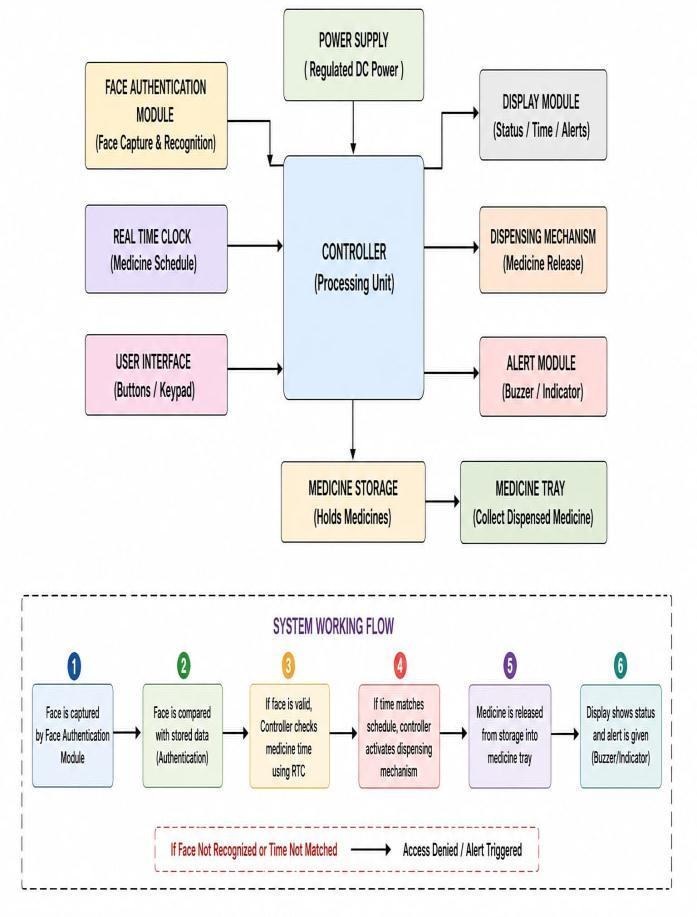
Theblock diagramof SmartMedicineDispenserwithFace Authentication is shown in Fig.1. The Smart Medicine Dispenser using Face Authentication is an intelligent healthcare system designed to ensure that medicines are dispensedonlytoauthorizedusersatthecorrecttime.The system is powered by a regulated DC power supply that provides stable power to all modules. The Face AuthenticationModulecapturestheuser'sfaceandcompares it with the stored facial data for verification. A Real-Time Clock(RTC)modulecontinuouslymaintainsthecurrentdate and time and stores the medicine schedule. The User Interface,consistingofbuttonsorakeypad,allowsusersto set medicine timings and configure system settings The Controlleractsasthecentralprocessingunitofthesystem.It receivesinputsfromtheFaceAuthenticationModule,RTC, and User Interface, processes the information, and makes decisionsbasedonauthenticationandschedulingconditions. Whenauser'sfaceissuccessfullyrecognized,thecontroller checksthecurrenttimeagainstthestoredmedicineschedule. Ifthetimematchesthescheduleddosagetime,thecontroller activates the Dispensing Mechanism, which releases the requiredmedicinefromtheMedicineStoragecompartment intotheMedicineTray.
Simultaneously, the Display Module shows the system status, medicine information, and notification messages, whiletheAlertModulegeneratesabuzzerorindicatoralert toinformtheuserthatthemedicinehasbeendispensed.The working process begins with capturing the user's face for authentication.Thesystemthenverifiestheidentityofthe userandchecksthemedicinescheduleusingtheRTC.Ifboth theuserauthenticationandtimeverificationaresuccessful, themedicineisautomaticallydispensedandanotificationis providedthroughthedisplayandalertmodules.Ifthefaceis not recognized or the current time does not match the scheduled medicine time, the controller denies access and triggersanalert.
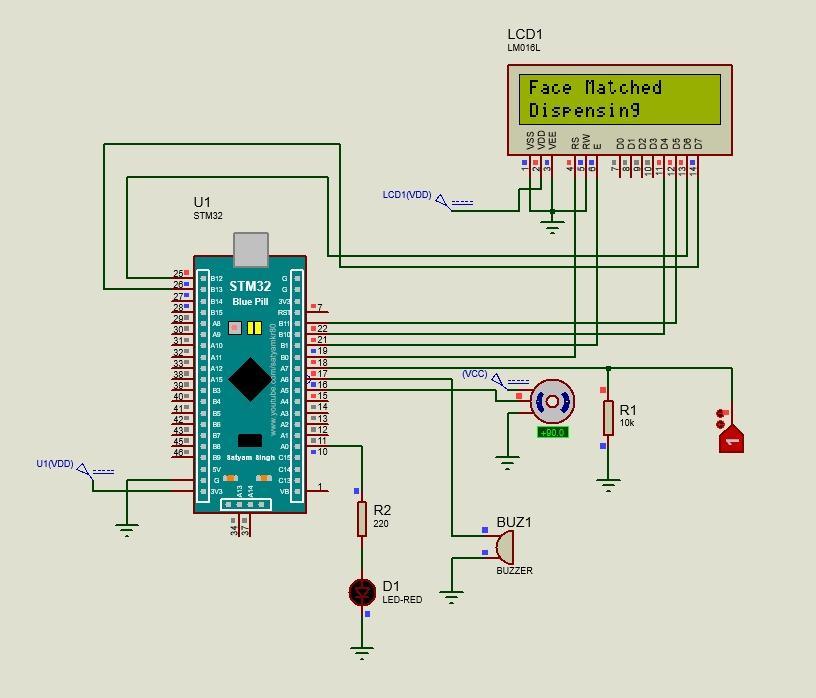
The software implementation of the Smart Medicine DispenserwithFaceAuthenticationiscarriedoutusingthe STM32 microcontroller as the main controller is shown in Fig.2. The STM32 program is written in Embedded C / Arduino IDE and uploaded to the controller using STM32CubeProgrammerorST-Link.Themainpurposeofthe software is to receive the face authentication result and controltheoutputdevicessuchasLCD,servomotor,buzzer, andLED.
In this system, the face recognition part is performed usingawebcamandPythonsoftware.Aftercheckingtheface, Python sends a signal to the STM32 through UART serial communication.Forexample,ifthefaceismatched,Python sendssignal‘1’,andifthefaceisnotmatched,itsendssignal ‘0’. The STM32 continuously checks the serial input and performsactionsbasedonthereceivedsignal.
When the STM32 receives the authorized signal, it displays “Face Matched” and “Medicine Dispensed” on the LCD.Then,itrotatestheservomotortoopenthemedicine dispensing section. After a short delay, the servo motor returns to its original position, completing the dispensing process.Thisshowsthatthemedicinehasbeensuccessfully giventothecorrectuser.
When the STM32 receives the unauthorized signal, it displays“AccessDenied”and“InvalidFace”ontheLCD.In thiscondition,theservomotordoesnotrotate,somedicineis notdispensed.
The red LED and buzzer are turned ON to indicate an unauthorizedaccessattempt.Afterafewseconds,thesystem resets and waits for the next authentication input.The program is divided into different sections such as LCD
International Research Journal of Engineering and Technology (IRJET) e-ISSN: 2395-0056
Volume: 13 Issue: 06 | Jun 2026 www.irjet.net p-ISSN: 2395-0072
initialization,UARTcommunication,servomotorcontrol,LED control, and buzzer alert. This makes the system easy to understand and test. The STM32 works as the decisionmakingunitthatconnectsthefacerecognitionsoftwarewith thehardwaredispensingmechanism.Overall,thesoftware implementation ensures secure, automatic, and reliable medicinedispensingonlyaftersuccessfulfaceauthentication.
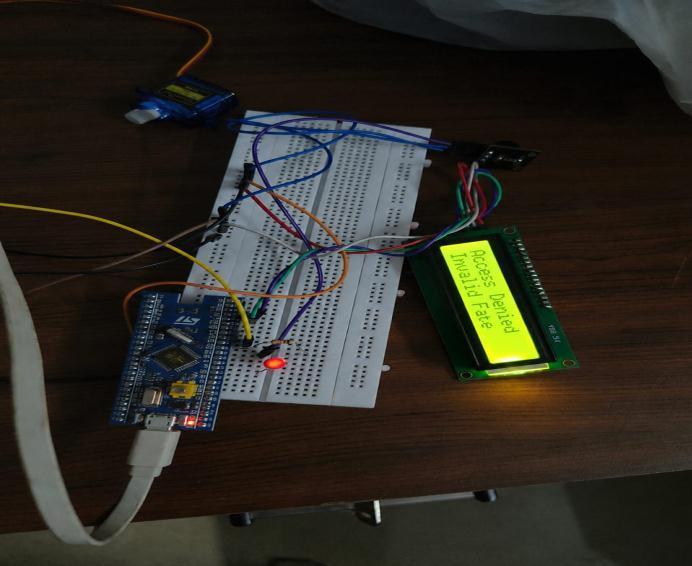
The hardware implementation of the Smart Medicine DispenserwithFaceAuthenticationwascarriedoutusingan STM32microcontroller,aservomotor,a16×2LCDdisplay,a buzzer, an LED indicator, a laptop webcam, and an FTDI moduleisshowninFig.3. TheSTM32microcontrollerserved asthecentralcontrolunitandwasresponsibleforcontrolling allhardwarecomponents.Thelaptopwebcamwasconnected to the computer and used to capture facial images for authentication.
After successful face recognition by the Python application,anauthenticationsignalwastransmittedtothe STM32throughUARTserialcommunication.Uponreceiving theauthorizedsignal,theSTM32activatedtheservomotor, whichrotatedtodispensethemedicine.Simultaneously,the LCDdisplayedthemessage"MedicineDispensed"toinform theuser.
Inthecaseofanunauthorizeduser,theSTM32activated thebuzzerandLED,whiletheLCDdisplayed"AccessDenied". All components were connected using jumper wires on a breadboardandpoweredthrougharegulatedpowersupply. Thehardwaresetupwastestedsuccessfully,demonstrating reliablecommunication,secureauthentication,andaccurate medicinedispensingfunctionality.
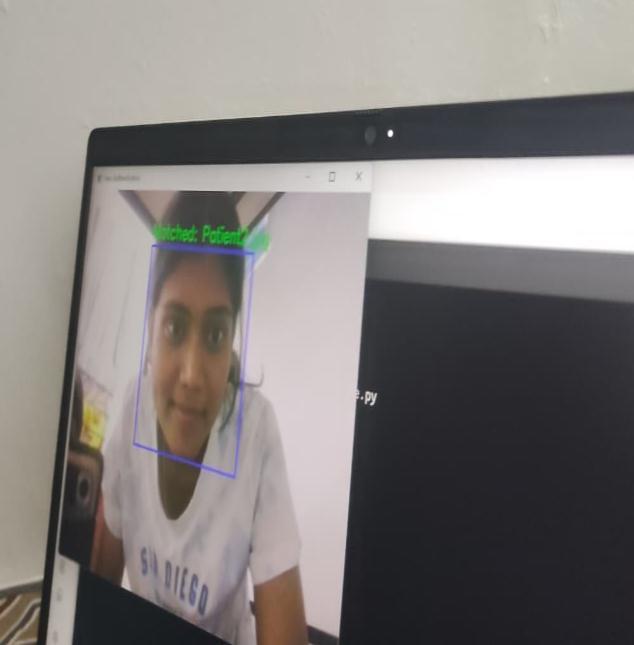
TheSmartMedicineDispenserwithFaceAuthenticationwas successfullydevelopedandtestedandisillustratedinFig.4. Thesystemwasabletocapturefacialimagesusingawebcam and accurately verify authorized users through face recognitiontechnology.Uponsuccessfulauthentication,the STM32microcontrollerreceivedtheauthorizationsignaland activated the servo motor to dispense medicine. The LCD displayed appropriate status messages, such as "Medicine Dispensed" for authorized users and "Access Denied" for unauthorized users. The buzzer andLEDalertsystemalso functioned correctly by providing audible and visual warningsduringunauthorizedaccessattempts.Theproject demonstratedthesuccessfulintegrationofimageprocessing, embedded systems, and automation technologies in a healthcareapplication.
The system consists of a microcontroller, a 16×2 LCD display, a servo motor, an LED indicator, and supporting circuit connections assembled on a breadboard. When the face recognition system identifies an authorized user, an authentication signal is sent to the microcontroller. Upon receivingthesignal,theservomotorrotatestooperatethe medicinedispensingmechanism.Atthesametime,theLCD displaysthemessage"MedicineDispensed",indicatingthat the medicine has been successfully delivered to the user showninFig.5
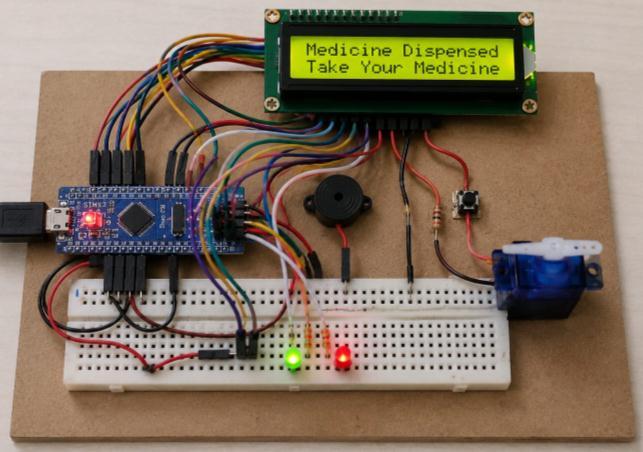
This demonstrates the proper functioning of the authentication and dispensing process. The successful operation confirms that the system can securely provide medicine only to registered users, thereby reducing the chancesofunauthorizedaccessandmedicationerrors.
TheSmartMedicineDispenserwithFaceAuthenticationwas successfully designed and implemented as a secure healthcare automation system. The project integrated face
International Research Journal of Engineering and Technology (IRJET) e-ISSN: 2395-0056
Volume: 13 Issue: 06 | Jun 2026 www.irjet.net p-ISSN: 2395-0072
recognition technology with an ESP32 microcontroller to ensure that medicines are dispensed only to authorized users.Thesystemeffectivelycapturedfacialimages,verified user identities, and controlled the dispensing mechanism through a servo motor. Additionally, the LCD display providedreal-timestatusupdates,whilethebuzzerandLED generatedalertsduringunauthorizedaccessattempts.The project demonstrated the practical application of image processing,embeddedsystems,andautomationtechnologies inimprovingmedicinemanagementandpatientsafety.
All the objectives of the project were successfully achieved.Thesystemwasabletoauthenticateusersusing facial recognition technology and automate the medicine dispensingprocess.Secureaccesscontrolwasimplemented to prevent unauthorized usage, and visual and audio indications were provided to inform users about system status.TheESP32microcontrollersuccessfullycoordinated the operation of all hardware components, including the servomotor,LCD,buzzer,andLED.
[1] S. S. Acharya, S. Kini, S. Hegde, and A. S. Kumar, “A Review on Dispenser Mechanisms of Medicine Dispenser,” International Journal of Engineering Research&Technology(IJERT),vol.10,no.3,pp.1–6, 2021.
[2] J. Premkumar, K. Sughasri, A. Preethi, and E. Kavitha, “Automized Pharmacy Using Face Authentication,” JournalofPhysics:ConferenceSeries,vol.1937,no.1, 2021,doi:10.1088/1742-6596/1937/1/012024.
[3] E.Garagiola,“AutomatedDrugsDispensingSystemsin HospitalPharmaciesandWards:ASystematicLiterature Review,” Biomedical Journal of Scientific & Technical Research,vol.53,no.5,pp.45094–45103,2023.
[4] M.Nallathambietal.,“IntelligentandAssistedMedicine DispensingMachineforElderlyVisualImpairedPeople withDeepNeuralNetworkFingerprintAuthentication System,”InternetofThings,vol.23,100821,2023.
[5] H. Sartaj, S. Ali, T. Yue, and K. Moberg, “Model-based DigitalTwinsofMedicineDispensersforHealthcareIoT Applications,”arXivpreprintarXiv:2312.04662,2023.
[6] L.Gargioni,D.Fogli,andP.Baroni,“ASystematicReview on Pill and Medication Dispensers from a HumanCenteredPerspective,”JournalofHealthcareInformatics Research,2024.
[7] J. J. H. Chan, P. W. Leung, H. Kilgour, and P. Dervenis, “Facial Artificial Intelligence in Ophthalmology and Medicine: Fundamental and Transformative Applications,”TherapeuticAdvancesinOphthalmology, 2024.
[9] T. P. Chu, M. H. Vu, Q. A. Do, and V. Tran-Quang, “AutomatedMedicationDispensingDeviceforPatients UsingFaceRecognitionandQRCodes,”SmartSystems andDevices,vol.35,no.3,2025.
[10] R.Nandgaonkar,U.Agrawal,K.Mane,A.Andhare, and S. Deshpande, “Medi-Cliq (A Drug Dispenser): A SurveyPaper,”IJSREM,2024.
[8] C.D.GutiérrezSandoval,C.A.AcuñaCisneros,andA.C. Mendoza De Los Santos, “Analyzing Key AI Attributes and Biometric Authentication Technologies in Smart Hospitals,”InnovaciónySoftware,2025.