
International Research Journal of Engineering and Technology (IRJET) e-ISSN:2395-0056

International Research Journal of Engineering and Technology (IRJET) e-ISSN:2395-0056
Mr K. GIRI [1], S.SATHIYANATHAN[2], K. ATHYADHARMA[3],A.SHANMUGAVEL[4],SURENDHAR.S[5].
Professor [1], Assistant Professor, Department of ECE, MAHENDRA ENGINEERING COLLEGE, Tamil Nadu, India
Student [2,3,4,5], Department of ECE, MAHENDRA ENGINEERING COLLEGE , Tamil Nadu, India
ABSTRACT- This paper presents the design and implementation of an IoT-based industrial protection system aimed at enhancing the safety, reliability, and operational efficiency of industrial environments. The proposed system integrates smart sensors, real-time data acquisition, and intelligent analysis to continuously monitor critical parameters such as temperature, pressure, humidity, vibration, and electrical current. The collected data is transmitted through an IoT gateway, where initial processing is performed before forwarding it to a cloud platform or local server for deeper analysis. Advanced data analytics and machine learning techniques are applied to detect anomalies, predict potential failures, and enable timely preventive actions. This proactive approach helps in minimizing equipment downtime, reducing maintenance costs, and preventing hazardous situations. Additionally, the system provides real-time alerts and remote monitoring capabilities, allowing operators to respond quickly to abnormal conditions. By leveraging IoT technology, the proposed solution offers a scalable, cost-effective, and efficient method for industrial protectionandfaultmanagement,contributingtosmarter andsaferindustrialoperations.
Keywords: Temperature, pressure, humidity, vibration and electrical current.
In recent years, industries have undergone rapid transformation with the adoption of advanced technologies aimed at improving productivity, efficiency, and safety. However, with increased automation and complexityinindustrialprocesses,theriskofequipment failure,systemmalfunction,andhazardousincidentshas alsogrownsignificantly.Traditionalindustrialprotection systems often rely on manual inspection, periodic maintenance, or standalone monitoring solutions, which may not be sufficient to detect real-time anomalies or preventunexpectedfailures.Asaresult,thereisastrong needforintelligent,automated,andreal-timemonitoring systems that can ensure the safety and reliability of industrial operations. The emergence of the Internet of Things(IoT)hasopenednewpossibilitiesfordeveloping smart industrial systems. IoT refers to a network of interconnected devices that can collect, exchange, and analyzedatawithouthumanintervention.Byintegrating IoT technology into industrial environments, it becomes possible to continuously monitor machines, environmentalconditions,andoperationalparametersin
Volume: 13 Issue: 05 | May 2026 www.irjet.net p-ISSN:2395-0072 © 2026, IRJET | Impact Factor value: 8.315 | ISO 9001:2008 Certified Journal | Page519
realtime.Thiscapabilityallowsindustriestomovefrom reactive maintenance approaches to proactive and predictive maintenance strategies, thereby reducing downtime and operational costs. An IoT-based industry protection system is designed to provide continuous surveillance of critical industrial parameters such as temperature, humidity, gas concentration, vibration, and electrical current. These parameters play a vital role in determining the health and performance of industrial equipment. For instance, an abnormal rise in temperature may indicate overheating of machinery, while excessivevibrationcansignal mechanical faultsor misalignment. Similarly, the presence of harmful gases may pose serious risks to both equipment and human workers.Therefore,real-timemonitoringofthesefactors isessentialformaintainingasafeandefficientindustrial environment.Theproposedsystemutilizesa network of sensors strategically deployed across the industrial setup. These sensors continuously collect data and send ittoacentralprocessingunit,typicallyamicrocontroller or embedded system. The collected data is then transmitted to a cloud platform or local server through an IoT gateway using communication technologies such as Wi-Fi, GSM, or Ethernet. The cloud platform acts as a central hub for data storage, processing, and analysis. One of the key features of the IoT-based industry protectionsystemisitsabilitytoperformintelligentdata analysis.Byapplyingdataanalyticsandmachinelearning algorithms, the system can identify patterns, detect anomalies, and predict potential failures before they occur. This predictive capability enables industries to take preventive actions, such as shutting down a machine,schedulingmaintenance,oradjustingoperating conditions, thereby avoiding costly breakdowns and accidents. In addition to monitoring and analysis, the system also provides real-time alert and notification mechanisms. When any parameter exceeds its predefined threshold, the system immediately generates alerts in the form of SMS, email, or mobile notifications. This ensures that operators and maintenance personnel are informed promptly and can take necessary actions withoutdelay.Insomecases,thesystemcanalsotrigger automatedresponses,suchasactivatingcoolingsystems, turning off power supply, or initiating emergency shutdown procedures. Another important aspect of the proposedsystemisremoteaccessibility.Withthehelpof web-baseddashboardsormobileapplications,userscan monitor the status of industrial systems from anywhere at any time. The user interface displays real-time data,
International Research Journal of Engineering and Technology (IRJET) e-ISSN:2395-0056
Volume: 13 Issue: 05 | May 2026 www.irjet.net p-ISSN:2395-0072
historical trends, and system alerts in an easy-tounderstand format. This not only improves decisionmaking but also enhances operational transparency and control. The implementation of an IoT-based protection system offers several advantages over traditional methods. It reduces the dependency on manual labor, minimizes human errors, and ensures continuous monitoring without interruption. Moreover, it helps in optimizing resource utilization and improving overall system efficiency. The scalability of IoT systems allows themtobeeasilyexpandedormodifiedaccordingtothe requirements of different industries. Despite its numerous benefits, the adoption of IoT in industrial protection systems also presents certain challenges. These include data security and privacy concerns, network reliability, and the need for robust hardware and software infrastructure. Ensuring secure data transmission and protecting the system from cyber threats are critical aspects that must be addressed during system design and implementation. Additionally, the system should be capable of handling large volumes ofdataandprovidingaccurateanalysisinrealtime.
In traditional industrial environments, protection and monitoring systems are primarily based on manual supervision and standalone control mechanisms. These systems are designed to ensure the safe operation of machinery and processes; however, they often lack realtimeresponsiveness,scalability,andintelligentdecisionmaking capabilities. The existing system typically relies on periodic inspection and maintenance schedules. Operators manually check the condition of machines, environmental parameters, and safety indicators at regular intervals. While this approach helps in identifying visible issues, it may fail to detect sudden faults or hidden abnormalities that occur between inspection periods. As a result, there is a higher risk of unexpected equipment failure and operational downtime. Conventional industrial protection systems also use basic sensors connected to local control units such as Programmable Logic Controllers (PLCs). These systems are capable of monitoring limited parameters like temperature, pressure, or voltage. However, they usually operate in isolation and do not provide centralized monitoring or remote accessibility. Data collectedfromthesesystemsisoftennotstoredforlongterm analysis, making it difficult to identify trends or predictfailures.
2.1DRAWBACKS:
The traditional industrial protection systems, although widely used, suffer from several limitations that affect their efficiency, reliability, and safety. These systems are primarilydesignedbasedonoldertechnologiesandlack the intelligence required to handle modern industrial complexities. The following are the major disadvantages
associatedwiththeexistingsystems.Oneoftheprimary drawbacks is the lack of real-time monitoring. In conventional systems, data is often collected and reviewed at specific intervals rather than continuously. This creates a gap between data collection and analysis, during which critical faults or abnormalities may occur unnoticed. As a result, industries may face unexpected equipment failures, leading to production losses and costly downtime. Another significant limitation is the dependency on manual inspection and human intervention. Operators are required to physically monitor machines, record readings, and identify potential issues. This manual approach is not only timeconsumingbutalsopronetohumanerrors.Factorssuch as fatigue, negligence, or lack of expertise can result in incorrect observations or delayed responses, increasing theriskofsystemfailuresandaccidents.Thelimiteddata analysis capability of traditional systems is also a major concern.Mostexistingsystemsrelyonsimplethresholdbasedmechanismswherealertsaretriggeredonlywhen a parameter exceeds a predefined limit. This approach fails to detect gradual changes, hidden patterns, or complex relationships between different parameters. Consequently, these systems are unable to predict potential failures in advance, making them reactive ratherthanproactive.
The proposed system introducesan advanced IoT-based industry protection system designed to overcome the limitations of traditional industrial monitoring methods. This system integrates smart sensors, real-time communication technologies, cloud computing, and intelligentdata analysistoprovidea comprehensive and automated solution for industrial safety and protection. The core idea of the proposed system is to enable continuous monitoring of industrial parameters and ensure immediate response to abnormal conditions. Unlike conventional systems, this approach focuses on real-time data acquisition, remote accessibility, and predictiveanalysis,makingithighlyefficientandreliable. Thesystemconsists ofmultiplesensorsdeployedacross the industrial environment to measure critical parameters such as temperature, humidity, gas concentration, vibration, and electrical current. These sensors continuously collect data and transmit it to a microcontroller, which acts as the central processing unit. The microcontroller processes the data and forwards it to the cloud or a local server throughanIoT communicationmodulesuchasWi-Fi(ESP8266).
Oneofthekeyfeaturesoftheproposedsystemisitsrealtime data transmission capability. The collected data is sentinstantlytoa cloudplatform,whereitisstoredand analyzed. This ensures that any abnormal condition is detected without delay, enabling quick action to prevent systemfailureoraccidents.Thesystemalsoincorporates
International Research Journal of Engineering and Technology (IRJET) e-ISSN:2395-0056
Volume: 13 Issue: 05 | May 2026 www.irjet.net p-ISSN:2395-0072
intelligent data analysis techniques, including machine learning algorithms, to identify patterns and detect anomalies. Instead of relying only on fixed threshold values, the system learns from historical data and predicts potential faults before they occur. This predictive capability helps in reducing downtime, improving maintenance efficiency, and extending the lifespanofindustrialequipment.
One of the most significant advantages is real-time monitoring. The system continuously tracks important industrialparameterssuchastemperature,humidity,gas levels,vibration,andelectricalcurrent.Unliketraditional systems that rely on periodic checks, this continuous monitoring ensures that any abnormal condition is detected immediately. This helps in preventing unexpected failures and maintaining smooth industrial operations. Another key benefit is early fault detection and predictive maintenance. The system uses intelligent data analysis and machine learning techniques to identify patterns and detect anomalies. It can predict potential failures before they occur, allowing industries to take preventive measures in advance. This reduces downtime, minimizes repair costs, and increases the lifespan of equipment. The proposed system also provides remote monitoring and control capabilities. Userscanaccesssystemdatafromanywhereusingaweb ormobileinterface.Thiseliminatestheneedforconstant physicalpresenceattheindustrialsiteandenablesfaster decision-making. In case of emergencies, operators can take immediate action remotely, improving overall response time. Improved safety and accident prevention is another major advantage. The system can detect hazardous conditions such as gas leaks, overheating, or electrical faults in real time. It immediately sends alerts and can also trigger automatic safety mechanisms such as shutting down machines or activating alarms. This significantly reduces the risk of accidents and ensures thesafetyofworkersandequipment.
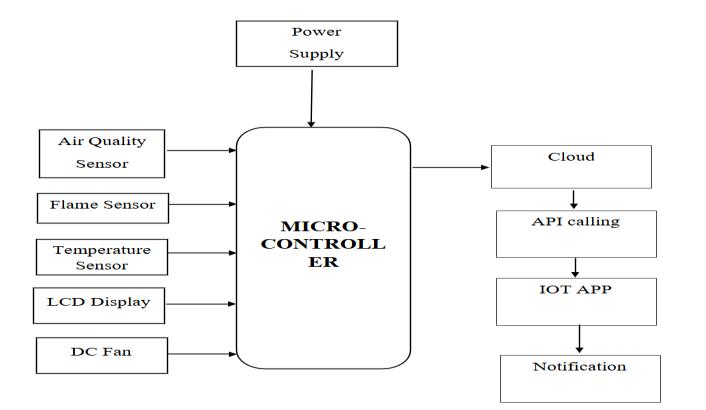
The proposed IoT-based industry protection system is designed to provide continuous monitoring and intelligent control of industrial environments. The system operates through a combination of sensors, a microcontroller, cloud connectivity, and a user interface. A regulated power supply unit provides the necessary electrical power to all components, ensuring stable and uninterrupted operation. In the input layer, various sensors such as the air quality sensor, flame sensor, and temperature sensorare deployedindifferent sectionsof the industry to monitor environmental and safety parameters.Theairqualitysensordetectsharmfulgases and pollution levels, the flame sensor identifies the presence of fire, and the temperature sensor monitors heat levels in machinery and surroundings. These sensorscontinuouslycollectreal-timedataandsenditto the microcontroller. The microcontroller acts as the central processing unit of the system. It receives the sensor data, processes it, and compares the values with predefined threshold limits. Based on the analysis, the microcontroller controls output devices such as the LCD display and DC fan. The LCD display shows real-time readings and system status for local monitoring, while the DC fan operates automatically to regulate temperature when it exceeds safe levels. In addition to local processing, the microcontroller transmits the collected data to a cloud platform through an IoT communication module. The cloud serves as a centralized system for data storage and further analysis. It enables remote monitoring and provides access to real-timeandhistoricaldatafromanylocation.Thecloud communicates with the IoT application using an API (Application Programming Interface). The IoT application, which can be accessed through a mobile or web interface, allows users to monitor system parameters, view data trends, and manage the system remotely. It enhances user interaction and provides bettercontroloverindustrialoperations.
ThehardwareimplementationoftheIoT-basedindustry protection system involves the integration of various electronic components such as sensors, a microcontroller, communication modules, and output devicestoachievereal-timemonitoringandcontrol.The systemisdesignedtocontinuouslycollectenvironmental and operational data from the industrial setup and process it efficiently. The core component of the hardware setup is the microcontroller, which acts as the central processing unit. A microcontroller such as Arduino or Raspberry Pi is used to interface with all input and output devices. It receives signals from the sensors, processes the data, and controls the system accordingly. The microcontroller is programmed to compare sensor readings with predefined threshold
International Research Journal of Engineering and Technology (IRJET) e-ISSN:2395-0056
Volume: 13 Issue: 05 | May 2026 www.irjet.net p-ISSN:2395-0072
values and take necessary actions when abnormal conditions are detected.The system uses multiple sensors to monitor different industrial parameters. An air quality sensor is used to detect harmful gases and pollution levels in the environment, helping to prevent hazardous situations. A flame sensor is included to detect fire or flame presence, enabling early fire detection. A temperature sensor monitors heat levels in machines and surroundings, ensuring that overheating conditions are identified promptly. These sensors continuously send real-time data to the microcontroller forprocessing.
The IoT-based industry protection system presented in thisprojectprovidesan effectiveandintelligentsolution forensuringsafety,reliability,andefficiencyinindustrial environments. By integrating sensors, microcontrollers, communication modules, and cloud technologies, the system enables continuous monitoring of critical parameters such as temperature, gas levels, air quality, and fire detection.Unlike traditional systems, the proposed solution offers real-time data acquisition and analysis, allowing immediate detection of abnormal conditions. The system not only alerts users through notificationsbutalsosupportsautomaticcontrolactions, reducing the risk of accidents and equipment damage. The use of IoT technology enables remote monitoring and control, making it possible to supervise industrial operations from anywhere. Furthermore, the system improves maintenance efficiency by enabling early fault detection and preventive measures. This reduces downtime, lowers maintenance costs, and enhances the overall lifespan of industrial equipment. The integration of cloud storage and data analytics also allows better decision-makingthroughhistoricaldataanalysis.
The proposed IoT-based industry protection system provides an efficient solution for real-time monitoring and safety; however, there are several opportunities for further enhancement and expansion. Future developments can focus on improving the intelligence, scalability, and security of the system to meet the evolving needs of modern industries. The system can alsobeextendedbyincorporatingadditionalsensorsand devices to monitor more parameters such as pressure, soundlevels,motion, and energy consumption. This will provide a more comprehensive view of industrial operations and improve overall system accuracy and effectiveness.
[1] L. Da Xu, W. He, and S. Li, “Internet of Things in Industries: A Survey,” IEEE Transactions on Industrial Informatics,vol.10,no.4,pp.2233–2243,Nov.2014.
[2] A. Zanella, N. Bui, A. Castellani, L. Vangelista, and M. Zorzi,“InternetofThingsforSmartCities,”IEEEInternet ofThingsJournal,vol.1,no.1,pp.22–32,Feb.2014.
[3]S.Madakam,R.Ramaswamy,andS.Tripathi,“Internet of Things (IoT): A Literature Review,” Journal of Computer and Communications, vol. 3, no. 5, pp. 164–173,2015.
[4] K. Rose, S. Eldridge, and L. Chapin, “The Internet of Things:AnOverview,”TheInternetSociety(ISOC),2015.
[5] D. Evans, “The Internet of Things: How the Next Evolution of the Internet is Changing Everything,” Cisco WhitePaper,2011.
[6]M.WeyrichandC.Ebert,“ReferenceArchitecturesfor the Internet of Things,” IEEE Software, vol. 33, no. 1, pp. 112–116,Jan.2016.
[7] A. Gubbi, R. Buyya, S. Marusic, and M. Palaniswami, “Internet of Things (IoT): A Vision, Architectural Elements, and Future Directions,” Future Generation ComputerSystems,vol.29,no.7,pp.1645–1660,2013.
[8] H. Boyes, B. Hallaq, J. Cunningham, and T. Watson, “The Industrial Internet of Things (IIoT): An Analysis Framework,” Computers in Industry, vol. 101, pp. 1–12, 2018.
[9] R. Khan, S. U. Khan, R. Zaheer, and S. Khan, “Future Internet: The Internet of Things Architecture, Possible Applications and Key Challenges,” IEEE 10th International Conference on Frontiers of Information Technology,2012.
[10] V. Gazis, “A Survey of Standards for Machine-toMachine and the Internet of Things,” IEEE Communications Surveys & Tutorials, vol. 19, no. 1, pp. 482–511,2017.