International Research Journal of Engineering and Technology (IRJET)
e-ISSN: 2395-0056
Volume: 13 Issue: 06 | Jun 2026
p-ISSN: 2395-0072
www.irjet.net
Smart IoT-Based Railway Track Fault Detection System Piyush Powar1, Paawan Javiya², Rushikesh Aher³, Prof. M. H. Ghuge4 4Professor, 123Department of Electronics & Telecommunication Engineering Sinhgad College of Engineering, Pune
----------------------------------------------------------------------------------***-----------------------------------------------------------------------------3. Sensor-based systems using IR and ultrasonic Abstract - Railway transportation is widely used for both sensors are simple and low-cost, but sometimes passenger travel and goods transport. The safety of railway affected by environmental conditions. systems depends greatly on the condition of the tracks. Even 4. Machine learning and image processing methods small cracks or obstacles can become serious problems if they provide high accuracy but require advanced are not detected at the right time. In this project, we have hardware and stable conditions. developed a smart system that continuously monitors railway tracks and detects faults such as cracks and obstacles. The Limitations: system uses an ESP32 microcontroller along with infrared (IR) and ultrasonic sensors to identify track issues. When a fault is Most existing systems are either costly, depend heavily on detected, the system sends an alert along with location details network connectivity, or are not suitable for real-time using GPS and GSM modules. The developed system helps continuous monitoring. reduce manual inspection, improves response time, and increases overall railway safety. Testing shows that the system 3. PROPOSED SYSTEM works effectively with an accuracy of around 90–95% and provides quick alerts.
3.1 System Overview
Key Words: Railway Safety, IoT, Crack Detection, ESP32, GSM, GPS, Ultrasonic Sensor
The system is designed as a portable unit mounted on a motorized trolley that moves along railway tracks. It continuously monitors the track using sensors and detects any faults.
1. INTRODUCTION Railway transportation is one of the most important modes of travel and goods movement. The safety of railway systems depends greatly on the condition of the tracks. Even small cracks or obstacles can become serious problems if they are not detected at the right time.
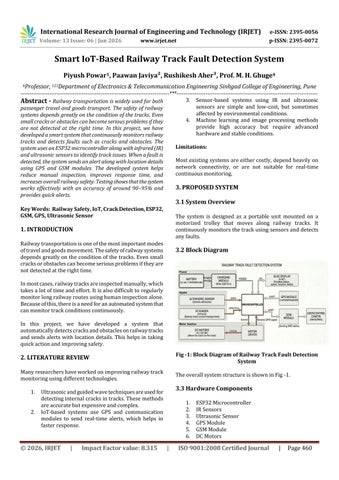
3.2 Block Diagram
In most cases, railway tracks are inspected manually, which takes a lot of time and effort. It is also difficult to regularly monitor long railway routes using human inspection alone. Because of this, there is a need for an automated system that can monitor track conditions continuously. In this project, we have developed a system that automatically detects cracks and obstacles on railway tracks and sends alerts with location details. This helps in taking quick action and improving safety.
2. LITERATURE REVIEW
Fig -1: Block Diagram of Railway Track Fault Detection System
Many researchers have worked on improving railway track monitoring using different technologies.
The overall system structure is shown in Fig -1.
1. 2.
3.3 Hardware Components
Ultrasonic and guided wave techniques are used for detecting internal cracks in tracks. These methods are accurate but expensive and complex. IoT-based systems use GPS and communication modules to send real-time alerts, which helps in faster response.
© 2026, IRJET
|
Impact Factor value: 8.315
1. 2. 3. 4. 5. 6.
|
ESP32 Microcontroller IR Sensors Ultrasonic Sensor GPS Module GSM Module DC Motors
ISO 9001:2008 Certified Journal
|
Page 460