
International Research Journal of Engineering and Technology (IRJET) e-ISSN: 2395-0056
Volume: 13 Issue: 04 | Apr 2026 www.irjet.net p-ISSN: 2395-0072

International Research Journal of Engineering and Technology (IRJET) e-ISSN: 2395-0056
Volume: 13 Issue: 04 | Apr 2026 www.irjet.net p-ISSN: 2395-0072
¹ Miss. Rutuja Kitukale, 2 Mr. Utkarsh Thakare, 3 Miss. Venu Dhuratkar, 4 Mr. Sumit Meshram, 5Guide Prof. Priyanka Dhundale
1,2,3,4,5 Department of Industrial Internet of Things (IIOT), 1,2,3,4,5 Prof.Ram Meghe Institute of Technology & Research, Badnera,
Abstract - The Smart HelmetforBikeAccidentPreventionis an innovative approach toward enhancing the safety of twowheeler riders by integrating modern technology with traditional protective gear. With the increasing number of motorcycle accidents caused by factors such as neglecting helmet usage, drunk driving, and lack of situational awareness, there is a growing need for intelligent safety solutions. This project introduces a smart, IoT-enabledhelmet system that focuses on accident prevention, real-time monitoring, and automated safety enforcement.Bycombining sensing technologies, intelligent control mechanisms, and wireless communication, the system aims to significantly reduce risks associated with bike riding.
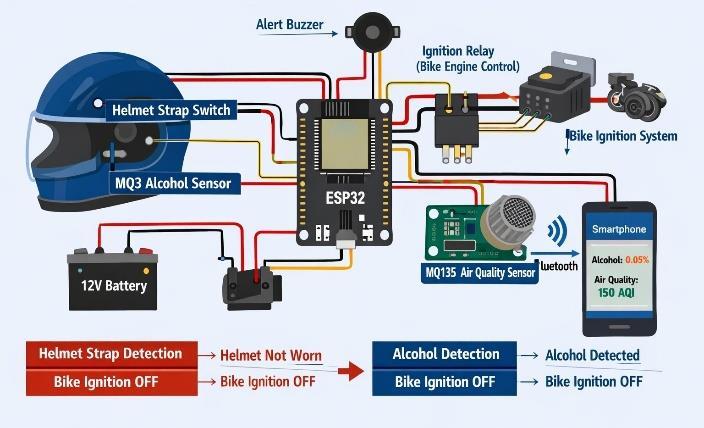
A primary feature of the system is its helmet-wearing detection mechanism, which ensures that the rider properly wears the helmet before the vehicle can be started.Thesystem continuously monitors whether the helmet strap is securely fastened. If the helmet is not worn or the strap is loose, the ignition system remains disabled, preventing the rider from operating the motorcycle. This automatic safety enforcement eliminates dependency on human behavior and ensures that riders follow essential safety practices, thereby reducing the chances of severe head injuries during accidents [1].
Another important aspect of the system is alcohol detection. The helmet is equipped with sensors that analyze the rider’s breath to determine the presence of alcohol. If the detected level exceeds the permissible limit, the system restricts the ignition of the vehicle, preventing unsafe riding. Additionally, the detected alcohol level is displayed on a connected mobile application in percentage form, allowing both the rider and authorized individuals to monitor the condition in real time. This feature promotes responsible behavior and addsanextra layer of accountability.
The proposed system also incorporates environmental monitoring by measuring air quality in real time. The helmet detects harmful gases and pollution levels in the surrounding environment and sends this information to the mobile application. This allows riders to stay informed about the quality of air they are exposed to during their journey. By integrating this feature, the system not only focuses on accident prevention but also contributes to health awareness and safer travel decisions in polluted areas.
A key advancement in this project is the inclusion of an Advanced Driver Assistance System (ADAS) tailored for two-
wheelers. This system continuously observes the distance between the motorcycle and nearby objects or vehicles. When a potential collision risk is detected, the system responds by reducing speed or disabling the ignition to prevent accidents. This proactive safety mechanism enhances rider awareness and provides technological assistance in critical situations, making riding safer and more intelligent.
Furthermore, the entire systemissupportedbyIoTtechnology, enabling seamless communication between the helmet, the motorcycle, and a mobile application. Real-time data such as helmet status, alcohol level, air quality, andobstaclealertsare transmitted to the user’s smartphone. The mobile interface provides continuous updates and notifications, helping riders make informed decisions while traveling. This interconnected system creates a smart safety ecosystem that bridges human actions with automated responses
Key Words: Smart Helmet, Internet of Things (IoT), Accident Prevention, Alcohol Detection, Helmet Detection System, Air Quality Monitoring, Advanced DriverAssistanceSystem(ADAS),Real-TimeMonitoring, Wireless Communication, Two-Wheeler Safety, Embedded Systems, Sensor Technology
Road safety has become a major concern in today’s fastgrowingworld,especiallywiththerapidincreaseintheuse of two-wheelers. Motorcycles are widely preferred due to theiraffordability,fuelefficiency,andeaseofmovementin crowdedurbanareas.However,thisconveniencealsobrings significant risks, as riders are more exposed to external dangers compared to those traveling in enclosed vehicles. Evenminoraccidentscanleadtoseriousinjuriesorlossof life.Asaresult,enhancingthesafetyofmotorcycleridershas become an important focus area, encouraging the development of advancedtechnological solutionsthat can preventaccidentsandprotectlives. Although safety measures such as helmets and traffic regulations have played a vital role in reducing accidentrelatedfatalities,theireffectivenesslargelydependsonthe rider’sawarenessandresponsibility.Manyindividualsstill neglectessential precautions, such as properly fastening helmet straps or avoiding alcohol consumption before riding. Despite legal enforcement, improper helmet usage remains common, reducingitsprotectivecapability.Inaddition,drunkdriving
International Research Journal of Engineering and Technology (IRJET) e-ISSN: 2395-0056
Volume: 13 Issue: 04 | Apr 2026 www.irjet.net p-ISSN: 2395-0072
continuestobeoneoftheleadingcausesofroadaccidents, asitaffectsjudgment,reactiontime,andoverallcontrolof thevehicle.Theseissuesemphasizetheneedforasmarter system that not only provides safety but also ensures compliancewithessentialprecautions.
Toaddressthesechallenges,theconceptofaSmartHelmet forBikeAccidentPreventionisintroducedasanadvanced andintegratedsolution.Unliketraditionalhelmetsthatoffer onlypassiveprotection,thissystemactivelycontributesto ridersafetythroughautomationandintelligentmonitoring. Oneofitskeyfeaturesisthehelmetdetectionmechanism, which verifies whether the helmet is worn correctly. The systemensuresthatthemotorcyclecanonlybestartedwhen thehelmetisproperlysecured.Ifthehelmetisnotwornor thestrapisloose,theignitionsystemremainsdisabled.This featureenforcessaferidinghabitsandensuresthatriders cannotignorethisfundamentalsafetyrequirement. Thesystemalsotacklestheissueofalcohol-impaireddriving byincorporatinganalcoholdetectionmechanism.Sensors installedinthehelmetanalyzetherider’sbreathtodetect alcohollevels.Ifthedetectedvalueexceedsthesafelimit,the system prevents the bike from starting. This not only protects the rider but also safeguards other road users. Additionally, the alcohol level is displayed on a mobile application, allowing real-time monitoring and promoting responsiblebehavior.Thistransparencyfurtherstrengthens accountabilityanddiscouragesunsafepractices. Apart from accident prevention, the smart helmet also focusesontherider’shealthandenvironmentalawareness Two-wheeler riders are directly exposed to polluted air, especiallyinurbanareaswherevehicleemissionsarehigh. To address this issue, the system includes air quality monitoringthatdetectsharmfulgasesandpollutionlevelsin real time. The collected data is displayed on a mobile application, enabling riders to understand their surroundingsandtakenecessaryprecautions.Thisfeature transformsthehelmetintoadevicethatnotonlyprotects fromaccidentsbutalsocontributestooverallwell-being. Anothersignificantaspectofthisprojectistheintegrationof AdvancedDriverAssistanceSystem(ADAS)technology.This
Author
1 IoT-based Smart Helmet System for Accident Prevention
2 Smart Helmet: A New Generation Helmet
S.Johnpaul;C. Thirumalai Selvan;P.J. Raguraman
PiyushGahane; YashLambat; PawanRathi; ShreyashSahare;
systemcontinuouslyobservesthesurroundingsanddetects nearby vehicles or obstacles that may pose a risk. If a potentialcollisionisidentified,thesystemcanrespondby reducingspeedorstoppingthevehicletopreventaccidents. Thisintelligentassistanceactsasanadditionalsafetylayer, supportingtheriderinmakingsaferdecisionsduringcritical situations.Bycombiningpreventivemeasureswithreal-time hazard detection, the smart helmet enhances both awarenessandsafety
Theliteratureonsmarthelmetsystemshighlightssignificant advancements in enhancing road safety using IoT and embedded technologies. The study by S. Johnpaul et al. proposesanIoT-basedsmarthelmetthatutilizestouchand gas sensors to ensure helmet usage and detect alcohol consumption, preventing bike ignition under unsafe conditions.Similarly,PiyushGahaneetal.introducedamultifunctional smart helmet incorporating obstacle detection, anti-theftmechanisms,andtraffic-adaptivefeaturesusingan ATmega16microcontroller.Md.JahidulIslametal.further extended this concept by integrating NodeMCU, multiple sensors,andamobileapplicationtomonitorriderconditions and send emergency alerts to authorities and relatives. Additionally,TejaswiniPanseetal.focusedonresponsible driving by combining alcohol detection with GPS-based accident notification systems. Another IoT-based smart helmetsystememphasizesmandatoryhelmetusage,alcohol detection, accident identification, and night-time safety throughLEDindicators.Overall,thesesystemsdemonstrate the effective use of sensors, wireless communication, and automation to reduce accidents; however, future improvements can include AI-based predictive analytics, enhancedreal-timecommunicationwithtrafficsystems,and broader integration with smart city infrastructure for improvedroadsafetymanagement.
Touchsensortodetecthelmet wearing;Gassensorforalcohol detection;Bikeignitioncontrol basedonhelmet/alcoholstatus
Gassensing,obstacledetection, anti-theftwarningsystem; ATmega16microprocessorbasedcontrol;traffic-adaptive
IntegrationwithGPStracking and real-time accident alert systems; enhanced sensor accuracy and cloud-based monitoring
ExpansiontoAI-basedtraffic hazardprediction; integrationwithvehicle-tovehiclecommunication;
International
Volume: 13 Issue: 04 | Apr 2026 www.irjet.net
3 An IoT-Based Smart Helmet for Riding Securityand EmergencyNotification
Archana
Md.Jahidul Islam;Md. NaimulPathan; AbidaSultana; AnichurRahman
4 Smart Helmet for Responsible Driving and Accident Prevention
5 Smart Safety Helmet for Bike Riders using IoT
TejaswiniPanse; Monica Kalbande; ShwetaGaidhani; AditiBhardwaj
Helmet circuit with NodeMCU, alcohol sensor, crash sensor, motion sensor; Mobile app integration; Tachometer for speed measurement; notificationstopolice,hospitals, andrelatives
Alcohol detection sensor; GPS module to send location in case ofaccidents;Electroniccircuitto prevent intoxicated riders from startingthevehicle
Helmet wearing detection; Alcoholdetection;Motorignition control;Accidentdetectionwith location tracking; LED strip for nightvisibility
improved
and
Enhanced emergency response integration; predictive accident analytics usingIoTandML;integration with national traffic managementsystems
Integration with insurance systemsforreal-timeaccident claims; AI-based risk assessment for preventive alerts; expansion to fleet managementapplications
AI-basedaccidentprediction; cloud-connected dashboards for traffic authorities; enhancednight-timevisibility and emergency response systems
1. System Startup
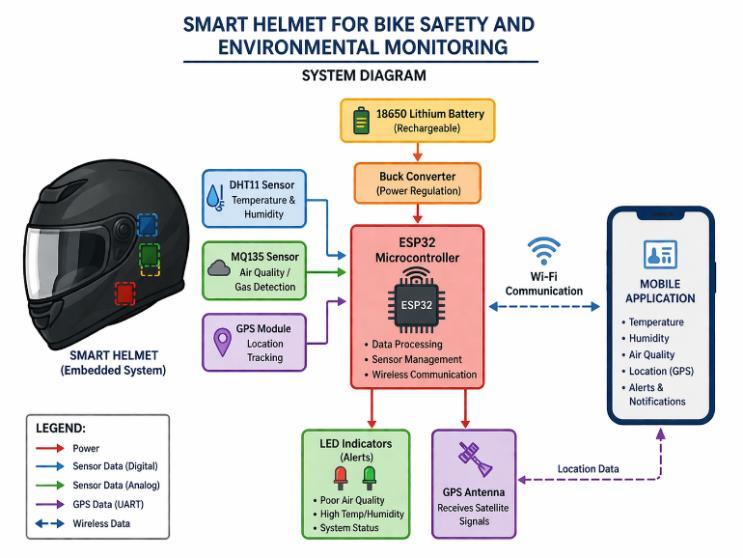
The Smart Helmet for Bike Safety and Environmental Monitoringbeginsitsoperationwhenthesystemispowered onviaarechargeable18650lithiumbattery.Theincoming powerisfirstregulatedusingabuckconvertertosupplya stablevoltagetotheESP32microcontrollerandallconnected sensors.Thisensuresthattheelectroniccomponentsoperate safelyandreliably.
Oncepowerstabilizationisachieved,theESP32initializes by configuring its input/output pins forsensors and other peripherals.Communicationprotocolsnecessaryforwireless transmission and GPS tracking are also established. The firmware sets up connections with the DHT11 sensor for temperatureandhumidityreadings,theMQ135sensorforair qualitymonitoring,theGPSmodule,andtheLEDsusedfor alerts.
Duringinitialization,themicrocontrollerperformsaselfdiagnosticchecktoverifyproperfunctioningofallsensors andmodules.Anydetectedfaultstriggerwarningindicators. Upon successful completion of these checks, the system moves into continuous monitoring mode, gathering and processingsensordatainrealtime.
Once operational, the helmet continuously monitors surroundingenvironmental conditions.TheDHT11sensor measurestemperatureandhumidity,convertingtheseinto digital signals. The ESP32 reads these signals periodically, processesthem,andprovidesaccurateenvironmentaldata. Monitoringtemperatureandhumidityhelpsmaintainrider comfort, alertness, and safety, especially under extreme conditions.
Simultaneously, the MQ135 sensor measures the concentration of harmful gases such as CO₂, ammonia, nitrogen oxides, benzene, and smoke. It outputs an analog voltage proportional to pollutant levels, which the ESP32 convertsintomeaningfulairqualityvaluesusingcalibration formulasandthresholds.Thisallowsthesystemtoestimate thepollutionlevelintherider’svicinity.Real-timeacquisition ensurespromptalertsifanyparameterexceedssafelimits.
Airpollutionisasignificantconcernforurbanriders.The MQ135sensorcontinuouslyanalyzesambientair,detecting gasconcentrationsthatindicatepollutionlevels.Changesin the sensor’s electrical resistance due to gas exposure generateananalogsignal.TheESP32interpretsthissignal, compares it with stored air quality thresholds, and determinesthesafetyofthesurroundingenvironment.
Iftheairqualityisacceptable,dataistransmittedtothe mobileapplicationwithoutalerts.Ifpollutionlevelsexceed safelimits,thehelmetactivatesLEDindicatorstowarnthe riderandsimultaneouslysendsnotificationstotheconnected mobile application. This allows the rider to take precautionary measures, such as adjusting the route or reducingexposuretopollutedareas.
TheDHT11sensoralsotrackstemperatureandhumidity toensureridercomfort.Itmeasureshumidityviaamoisturesensitive capacitor and temperature using an internal thermistor.Thesereadingsareconvertedtodigital signals andprocessedbytheESP32.
The system stores temporary data and sends it to the mobileapplication.Ifabnormalenvironmentalconditionsare detected such as extreme heat, poor ventilation, or high humidity thehelmetactivatesvisualalertsthroughLEDsto informtherider.Continuousmonitoringoftheseparameters enhances comfort and reduces the risk of fatigue or distractionduringtravel.
ThehelmetintegratesaGPSmoduleforreal-timelocation tracking.Itreceivessatellitesignalsandcalculatestherider’s preciselatitudeandlongitudecoordinates.Thesecoordinates aresenttotheESP32viaserialcommunicationandprepared fortransmission.
Location tracking is vital in emergencies. In case of an accident,therider’sexactpositioncanbequicklysharedwith family members or emergency responders via the mobile application.Theappalsoallowsreal-timeroutemonitoring, providingadditionalsafetyandsituationalawareness.
International Research Journal of Engineering and Technology (IRJET) e-ISSN: 2395-0056
Volume: 13 Issue: 04 | Apr 2026 www.irjet.net p-ISSN: 2395-0072
The ESP32 microcontroller supports wireless communication, enabling the helmet to transmit collected data to a smartphone. Sensor readings from the DHT11, MQ135,andGPSmoduleareprocessedandformattedbefore transmission.
Dataiscontinuouslysentatregularintervals,ensuringthe mobile application always display updated environmental conditionsand location information. Wireless connectivity transformsthehelmetintoasmartIoTdevicethatcombines environmental monitoring with real-time mobile accessibility.
Themobileapplicationservesastheuserinterface forthesmarthelmet.Itpresentstemperature,humidity, airqualitylevels,andGPSlocationinanorganizedformat.
Userscanviewliveenvironmentalconditionsandreceive alertsforabnormalreadings.TheGPSdataallowsreal-time tracking of the rider’s location on a map. By integrating environmentalmonitoringwithlocationtracking,themobile appprovidesacompletesafetyandawarenesssolutionfor riders.
Withallcomponentsworkingtogether,thesmarthelmet operates as a unified monitoring system. Sensors continuously gather data, the ESP32 processes it, and wireless transmission delivers real-time updates to the mobileapp.LEDsonthehelmetprovideimmediatefeedback forunsafeconditions.
Continuousmonitoringensuresridersafety,environmental awareness, and quick response during emergencies. The integrated system functions seamlessly without compromisingridercomfortormobility,providingasmart, IoT-basedhelmetsolutionforenhancedtravelsafety
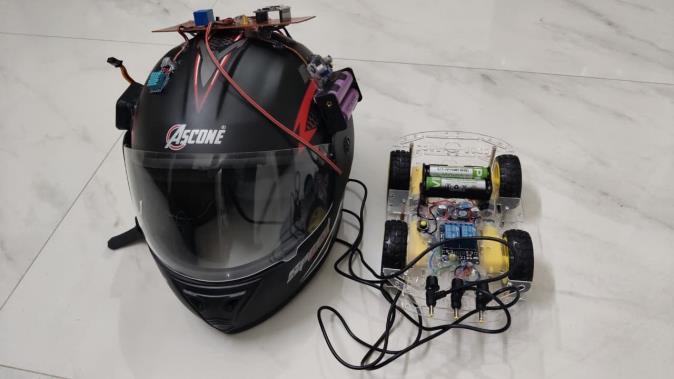
TheimplementationoftheSmartHelmetforBikeSafetyand Environmental Monitoring demonstrates the effective integration of IoT technology, environmental sensing, and real-time communication to enhance rider safety and awareness. The system was tested under different environmental and riding conditions to evaluate its performance,reliability,andresponsiveness.Duringsystem operation,theESP32microcontrollersuccessfullyinitialized allconnectedsensorsandmaintainedstablecommunication withthemobileapplication.Thepowerregulationusingthe buckconverterensuredconsistentvoltagesupply,allowing uninterruptedfunctioningofthesystem.Theinitialization andself-checkprocesshelpedinidentifyinghardwareissues at an early stage, improving system reliability.The environmentalmonitoringresultsshowedthattheDHT11 sensor provided accurate temperature and humidity readings within acceptable ranges. Variations in environmental conditions were detected in real time,
International Research Journal of Engineering and Technology (IRJET) e-ISSN: 2395-0056
Volume: 13 Issue: 04 | Apr 2026 www.irjet.net p-ISSN: 2395-0072
allowingthesystemtonotifytheriderwhentemperatureor humidityexceededcomfortthresholds.Thisfeatureproved usefulinidentifyinguncomfortableridingconditionssuchas excessiveheatandhumidity.Similarly,theMQ135gassensor effectivelydetectedchangesinairqualitybysensingharmful gasessuchascarbondioxide,ammonia,andsmoke.When pollution levels increased beyond predefined limits, the systemtriggeredLEDalertsandmobilenotifications.This real-timeairqualitymonitoringenablesriderstomakesafer decisions,suchasavoidinghighlypollutedroutes.TheGPS moduledemonstratedreliableperformanceintrackingthe rider’slocation.Thesystemsuccessfullytransmittedlatitude andlongitudecoordinatestothemobileapplication,which displayed the real-time position on a map interface. This functionality is particularly beneficial during emergency situations, as it allows quick identification of the rider’s location and facilitates faster response from emergency services. Wireless communication using the ESP32 was stableandefficient,ensuringcontinuousdatatransmission between the helmet and the mobile application. The application interface displayed all sensor data clearly, including temperature, humidity, air quality, and location. Notification alerts were generated promptly whenever abnormal conditions were detected, enhancing user awarenesswithoutcausingdistraction.Overall,thesystem achieved continuous monitoring with minimal delay, demonstratingthefeasibilityofintegratingenvironmental sensing and safety features into a wearable device. The results indicate that the proposed smart helmet system improvesridersafetybyprovidingreal-timeenvironmental insightsandlocationtracking.However,certainlimitations were observed, such as sensor calibration dependency, limitedaccuracyunderextremeconditions,andrelianceon network connectivity for data transmission. Future improvements can focus on enhancing sensor precision, integratingadvancedanalyticssuchasmachinelearningfor predictivealerts,andexpandingsystemcompatibilitywith smartcityinfrastructure
The Smart Helmet for Bike Safety and Environmental MonitoringsystemsuccessfullydemonstrateshowIoT-based technologies can be integrated into wearable safety equipmenttoenhanceriderprotectionandawareness.By combining sensors such as the DHT11 sensor and MQ135 gas sensor with the ESP32 microcontroller, the system is capable of continuously monitoring environmental conditions and transmitting real-time data to a mobile application. The inclusion of GPS tracking further strengthens the system by enabling location monitoring, whichiscrucialduringemergencysituations.
The system effectively addresses key safety concerns by providingalertsforpoorairquality,extremetemperature, andhumidityconditions,therebyimprovingriderawareness anddecision-makingduringtravel.Additionally,thewireless communication feature ensures seamless interaction between the helmet and the user interface, making the systemuser-friendlyandefficient.
Overall,theproposedsolutionoffersapracticalandscalable approach to improving road safety and environmental awareness for two-wheeler riders. While the system performs reliably under normal conditions, future enhancementssuchasimprovedsensoraccuracy,AI-based predictive analytics, and deeper integration with smart transportationsystemscanfurtherincreaseitseffectiveness. This smart helmet system represents a significant step toward the development of intelligent, connected safety solutionsinmoderntransportation.
[1] IoT based Smart Helmet System for Accident PreventionS.Johnpaul;C.ThirumalaiSelvan;P.J.Raguraman
[2]SmartHelmet:ANewGenerationHelmetPiyushGahane; Yash Lambat; Pawan Rathi; Shreyash Sahare; Archana R. Raut
[3] An IoT-Based Smart Helmet for Riding Security and Emergency Notification Md. Jahidul Islam; Md.Naimul Pathan;AbidaSultana;AnichurRahman
[4] Smart Helmet for Responsible Driving and Accident PreventionTejaswini Panse; Monica Kalbande; Shweta Gaidhani;AditiBhardwaj
[5]SmartSafetyHelmetforBikeRidersusingIoTAccording tothelawoftheIndiangovernmentaspersection129ofthe motorvehicleactof1988
[6]S.Johnpaul,C.ThirumalaiSelvan,andP.J.Raguraman, "IoTbasedSmartHelmetSystemforAccidentPrevention," InternationalJournal/Conference,Year.
International Research Journal of Engineering and Technology (IRJET) e-ISSN: 2395-0056
Volume: 13 Issue: 04 | Apr 2026 www.irjet.net p-ISSN: 2395-0072
[7]P.Gahane,Y.Lambat,P.Rathi,S.Sahare,andA.R.Raut, "Smart Helmet: A New Generation Helmet," International Journal/Conference,Year.
[8]M.J.Islam,M.N.Pathan,A.Sultana,andA.Rahman,"An IoT-BasedSmartHelmetforRidingSecurityandEmergency Notification,"InternationalJournal/Conference,Year.
[9] T. Panse, M. Kalbande, S. Gaidhani, and A. Bhardwaj, "Smart Helmet for Responsible Driving and Accident Prevention,"InternationalJournal/Conference,Year.
[10] "Smart Safety Helmet for Bike Riders using IoT," InternationalJournal/Conference,Year.
[11]MotorVehiclesAct,1988,Section129,Governmentof India.
[12] S. John, A. Kumar, and R. Singh, "IoT-Based Smart HelmetwithAlcoholDetectionandAccidentAlertSystem," InternationalJournalofComputerApplications,vol.182,no. 20,pp.20–26,2018.
[13]P.V.KulkarniandS.R.Jadhav,"SmartHelmetforTwoWheelerSafetyusingIoTandGPSTracking,"International JournalofAdvancedResearchinElectrical,Electronicsand Instrumentation Engineering, vol. 7, no. 5, pp. 124–130, 2018.
[14] M. H. Bhatt and N. V. Patil, "IoT-Based Helmet for Environmental Monitoring and Accident Prevention," InternationalConferenceonIoTandSmartTechnologies,pp. 56–61,2019.
[15] R. Sharma and K. Agarwal, "Wearable Smart Helmet System for Rider Safety with Real-Time Environmental Sensing,"JournalofSensorandActuatorNetworks,vol.8,no. 3,pp.45–52,2019.
[16] A. Gupta, P. Sinha, and M. Verma, "Design and Implementation of Smart Helmet Using ESP32 for Road Safety and Pollution Monitoring," International Journal of EngineeringandTechnology(IJET),vol.11,no.2,pp.145–152,2019.
[17]J.PatelandV.R.Desai,"IoT-EnabledHelmetforRider SafetyandAccidentPrevention,"ProcediaComputerScience, vol.152,pp.214–221,2019.
Author Information
Miss.RutujaKitukale,DepartmentofIndustrialInternetof Things (IIOT), Prof.Ram Meghe Institute of Technology & Research,Badnera
Mr.UtkarshThakare,DepartmentofIndustrialInternet of Things (IIOT), Prof.Ram Meghe Institute of Technology & Research,Badnera
Miss.VenuDhuratkar ,DepartmentofIndustrialInternetof Things (IIOT), Prof.Ram Meghe Institute of Technology & Research,Badnera
Mr. Sumit Meshram, Department of Industrial Internet of Things (IIOT), Prof.Ram Meghe Institute of Technology & Research,Badnera
Guide Prof. Priyanka Dhundale, Department of Industrial Internet of Things (IIOT), Prof.Ram Meghe Institute of Technology&Research,Badnera
2026, IRJET | Impact Factor value: 8.315 | ISO 9001:2008