
International Research Journal of Engineering and Technology (IRJET) e-ISSN: 2395-0056
Volume: 13 Issue: 05 | May 2026 www.irjet.net p-ISSN: 2395-0072

International Research Journal of Engineering and Technology (IRJET) e-ISSN: 2395-0056
Volume: 13 Issue: 05 | May 2026 www.irjet.net p-ISSN: 2395-0072
1Neha Santhosh, 2Dawn Dennis, 3Harigovind H, 4Jasmin V Jose, 5Neethan Elizabeth Abraham
Dept. of Electronics and Communication
Engineering St. Joseph’s College of Engineering and Technology Palai (Autonomous), Kerala, India
Abstract-In today’s world, ensuring the well-being of individuals with speech and mobility impairments is a significant challenge, as traditional care methods remain vulnerable to communication gaps and delayed emergency response. To address these issues, a Smart Glove System is proposed to enforce seam-less assistive communication and real-time health monitoring through affordable wearable technology. The system utilizes an ATmega328P microcontroller as the central processing unit, integrated with flexsensors for gesture-basedmessage transmission. By leveraging an MPU6050 IMU for fall detection and a MAX30102 pulse oximeter for heart rate monitoring, and providing clear Bluetooth-based audio-visual feedback, this device offers a comprehensive and cost-effective solution for elderly care and individuals with physical impair-ments, ensuringasafeandresponsivecaregivingenvironment.
Index Terms-Assistive Technology, ATmega328P, Flex Sensor, Gesture Recognition, MPU6050, MAX30102, Bluetooth Commu-nication.
I. INTRODUCTION
Speech and mobility impairment significantly affect communication and emergency response for elderly and physically challenged individuals. Many users are unable toexpresstheirneedsduringcriticalsituations,increasing their dependence on caregivers. Existing healthcare systems often lack integrated communication and healthmonitoringfeatureswithinasinglewearabledevice.
Toaddressthesechallenges,thisprojectproposesaSmart Glove System capable of gesture recognition, heart-rate monitoring, and fall detection. The system uses flex sensorsfordetectingfingergestures,anMPU6050IMUfor fall detection, and a MAX30102 pulse oximeter for heartratemonitoring. An Arduino Uno acts as the processing unit, while an HC-05 Bluetooth module enables wireless communicationwithcaregivers.
The proposed system provides a low-cost, portable, and real-time healthcare assistance solution suitable for elderly people, paralysis patients, and speech-impaired individuals.
To develop a microcontroller-based smart glove us-ing integrated sensors for empowering individualswithmovementdifficultiesbyproviding a smart, easy-to-use glove that enables communication and ensures safety through realtime health monitoring at an estimated cost of Rs.4500±10%.
1) To develop a system for translating hand gestures intospeech.
2) Tofacilitatethereal-timemonitoringofheartrate.
3) To enable the detection of falls and provide timely alerts.
4) To design a cost-effective and user-friendly assistivedevice.
5) To improve the overall quality of life of individuals withspeechandmobilityimpairments.
In view of these objectives, the proposed system is designed to deliver a comprehensive solution that improves communication and health monitoring for individuals with speech and mobility disabilities. By integrating gesture recognition, fall detection, and heart rate monitoring into one wearable device, the proposed system ensures prompt assistance and patient safety. Its affordability and ease of use make it appropriate for hospital and home care settings. Overall, the proposed Smart GloveSystemisdesignedtoenhanceindependence andqualityoflifeforindividualswithspeechandmobility disabilities.
In recent times, significant research has been conducted in the area of assistive technologies to enhance the quality of life for individuals suffering from various speech and mobility disorders. Various methods have been proposed for gesture recognition, wearable technology, fall detection sys-tems, and realtime health monitoring systems. Studies indi-cate that sensor technology and embedded systems can be combined effectively to enhance communication and
Volume: 13 Issue: 05 | May 2026 www.irjet.net p-ISSN: 2395-0072
patientcare.However,existingstudieshavefocusedon individual areas, and little emphasis has been placed on developing a comprehensive and costeffective system that integrates communication assistance and continuous health monitoring. Hence, it is important to perform a comprehensive literature reviewtounderstandvariousmethodologiesandjustify the importance of developing such a system. Various researchers have proposed wearable smart glove systems and sensor-based healthcare technologies for gesture recognition, activity monitoring, rehabilitation, and assistive communication. Smart glove systems using flex sensors, MPU6050 gyroscope sensors, MAX30100sensors,Arduinomicrocontrollers,andGSM modules have been developed for gesture recognition, fall detection, and health monitoring in paralysis patients [1]. Wearable sensing technologies involving accelerometers, gyroscopes, IMUs, EMG sensors, and force sensitive resistors have also been widely studied foractivitymonitoringand motioncontrol applications in healthcare and rehabilitation systems [2]. IoT-based smart gloves integrating Arduino, ESP8266 modules, cloud platforms, SMS alerts, and health-monitoring sensors have been proposed for elderly care and emergency communication [3]. In addition, wearable assistive gloves using flex sensors, pulse sensors, ultrasonic sensors, and ESP32 controllers have been designed for gesture based communication, obstacle detection, and patient safety [4]. Recent studies have also focused on multimodal wearable sensors, biochemical biosensors, and advanced data-processing techniques for continuous and non-invasive health monitoring applications [5]. Across the reviewed studies, various smart glove systems and wearable sensor technologies have been proposed to help individuals suffering from communication difficulties and health monitoring requirements. However, various limitations have been identified in all these studies. Some of these limitations include the requirement for communication technologies such as GSM, which increases power consumption and is not compatible with modern applications based on smartphones [1]. Challenges related to multi-modal sensor integration, reliability, and user compliance have been identified observed[2].Additionally,limitationsrelatedtosensor precision,difficultyinprecisegesturerecognition,lack ofsystemminiaturization,andsecurityconcernsrelated to data transmission and connectivity in remote areas havebeenidentified[3].Somesystemslackreliabilityin terms of fall detection and remote health monitoring, and various systems have been identified to increase hardware complexity and power consumption [4]. Furthermore, limitations related to reliability, security, user variability, and lack of standardization have been
identifiedinwearablehealthmonitoring[5].There-fore, there is a need for a comprehensive wearable system that effectively combines communication assistance with real-time health monitoring and emergency support, which motivates the development of the proposedSmartGloveSystem.
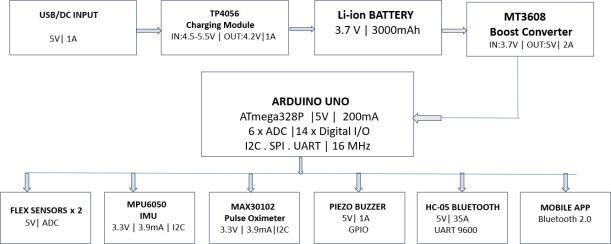
The proposed Smart Glove System is designed as a wearable assistive device that combines gesture recognition, health monitoring, and emergency alert functionalities into a single portable platform. The system integrates flex sensors, MPU6050 inertial measurement unit, MAX30102 pulse oximeter sensor, HC-05 Bluetooth module, piezoelectric buzzer, and Arduino Uno microcontroller for real-time communicationandmonitoring.
The Smart Glove System is designed by dividing the hardware architecture into multiple functional subsystemstoensureefficientsignalprocessing,reliable communication, stable power management, and continuous health monitoring. Themajorsubsystemsof theSmartGlovearedescribedbelow:
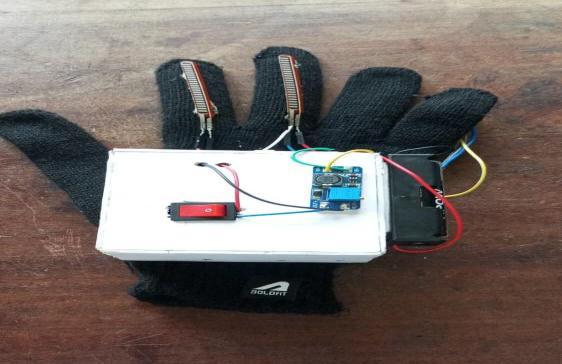
• Power Supply System: The Smart Glove is powered using a rechargeable 3.7V lithium-ion battery integrated with a TP4056 charging module for safe charging and battery protection. Since the Arduino Uno and connected peripherals require a stable 5V supply, an MT3608 boost converter is used to step up the battery voltage to a regulated 5V DC output. This subsystem ensures uninterrupted and portable operation of the wearable device.
• Processing Core Subsystem: The processing unit of the SmartGloveis builtaroundtheArduinoUno based on the ATmega328P microcontroller operating at a clock speed of 16 MHz. The microcontrollercontinuouslycollectsandprocesses sensor data from all connected modules. It also manages UART and I2C communication interfaces for wireless data transmission and sensor integration.
• Gesture Recognition Interface: The gesture recognition subsystem consists of flex sensors mounted on the fingers of the glove. The flex sensors operate as variable resis-tance sensors whose resistance changes according to the amount offingerbending.Theanalogvoltagevariationsare readbytheArduinoUnothroughanaloginputpins
Volume: 13 Issue: 05 | May 2026 www.irjet.net p-ISSN: 2395-0072
andprocessedtoidentifypredefinedhandgestures.
• Health Monitoring Subsystem: The MAX30102 pulseoximetersensorisusedforcontinuousheartrate monitoring. The sensor measures pulse signals using photo plethysmo graphy (PPG) technology and communicates with the Arduino Uno through the I2C communication protocol. This subsystem enables real-time monitoring of theuser’sphysiologicalcondition.
• Motion Detection Subsystem: The MPU6050 inertial measurement unit consists of a 3-axis accelerometer and a 3-axis gyroscope for detecting motion and orientation. The sensor continuously monitors sudden changes in acceleration and abnormal movement patterns to identify fall conditions. The MPU6050 communicates with the Arduino Uno using the I2C interface.
• Wireless Communication Interface: The HC-05 Blue-tooth module establishes wireless communication be-tween the Smart Glove and the caregiver’s mobile de-vice. The module is connected through the UART serial interface and transmits gesture messages, health data, and emergencyalertsinrealtime.
• Alert and Notification System: A piezoelectric buzzer isconnectedtothedigitaloutputpinofthe Arduino Uno to generate immediate audible alerts during emergency situations such as fall detection or abnormal health con-ditions. This subsystem providesadditionalsafetysupportfortheuser.
The integration of these functional subsystems enables the Smart Glove System to provide reliable gesture-based commu-nication, continuous health monitoring, emergency detection, and wireless caregiver assistance within a compact and wear-able embeddedplatform.
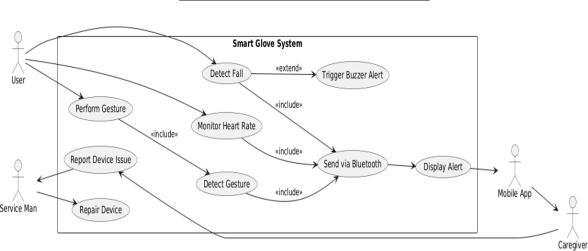
glovesystem
The Smart Glove System consists of three major actors: User, Caregiver, and Healthcare Professional. The user interacts with the system by performing hand gestures using the wearable glove. Flex sensors detect finger movements and the Arduino Uno processes the signals to identify predefined gestures suchas“NeedWater”,“NeedFood”,and“NeedHelp”.
The caregiver receives gesture messages, heart-rate data, and emergency alerts through Bluetooth communication. The caregiver can continuously monitor the user’s condition and respond quickly duringemergencies.
Healthcare professionals can use the Smart Glove System for monitoring patients during rehabilitation and recovery. The system also assists in observing health conditions and detect-ing emergency situations suchasfallsusingtheMPU6050sensor.
The use case analysis demonstrates that the Smart Glove System provides effective communication assistance, continu-ous health monitoring, and emergency support for individuals with speech and mobilityimpairments.
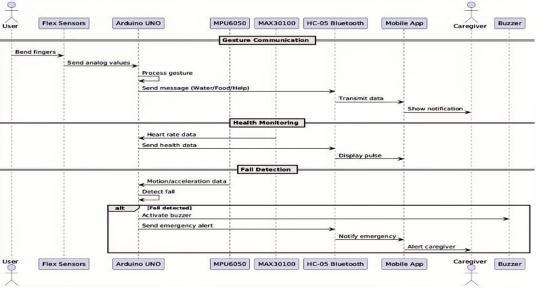
C.
• User: The primary actor who wears the Smart Glove and performs hand gestures for communication. The user also benefits from
International Research Journal of Engineering and Technology (IRJET) e-ISSN: 2395-0056
Volume: 13 Issue: 05 | May 2026 www.irjet.net p-ISSN: 2395-0072
continuous heart-rate moni-toring and fall detectionfunctionalitiesprovidedbythesystem.
• Caregiver: The caregiver receives gesture messages, health-monitoring data, and emergency alerts through Bluetooth communication. The caregiver can continuously monitor the user’s condition and provide immediate assistance duringemergencies.
• Healthcare Professional: Doctors, nurses, and re-habilitation specialists use the Smart Glove System for patient monitoring, rehabilitation support,andhealthassessmentduringtreatment andrecoveryprocesses.
• Service Technician: Theservicetechnicianisresponsible for maintaining the proper functioning of the Smart Glove System, including sensors, com-munication modules, battery system, and hardwareconnections.
Thesurveyanalysisshowedstrongacceptance of the proposed Smart Glove System among users, caregivers, and healthcare professionals.
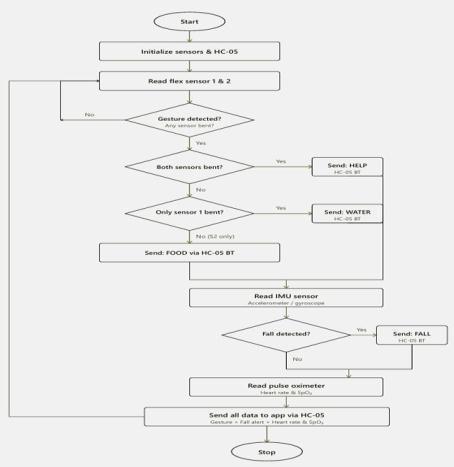
Fig. 4. SystemFlowchartrepresentingCore FirmwareLogic
• Around 60–70% of respondents prioritized gesture-based communication for improving daily indepen-dence.
• More than 90% of caregivers monitored patients daily, while over 85% showed willingness to use wearableassistivesystems.
• Safety features such as fall detection, emergency alerts, and heart-rate monitoring received the
highestpreferenceamongusers.
• Most respondents expected an emergency response time below 5 seconds and a minimum batterybackupof 6 hours
• Preferred system cost was below Rs. 5000, highlighting the need for an affordable and portable design.
• Major concerns identified were comfort, reliability, ease of use, and low power consumption
The survey responses confirmed the feasibility and practical importance of the Smart Glove System for assisting individualswithspeechandmobilityimpairments.
• Primary Users: Individuals with Paralysis, Stroke Sur-vivors,Elderlypeople
• Secondary Users: Caregivers and Family Members, Healthcare Professionals, Hospital and ClinicalStaff
• Teritiary Users: Healthcare Institutions, Researchers and Developers, Disability Advocacy Organizations
The hardware specifications and component requirements of the proposed Smart Glove System are summarizedinthefollowingconfigurationtables.
TABLE I ARDUINO UNO SPECIFICATIONS
Parameter Value
Specification
Microcontroller ATmega328P
OperatingVoltage 5VDC
ClockFrequency 16MHz
FlashMemory 32KB
SRAM 2KB
EEPROM 1KB
DigitalI/OPins 14Pins
AnalogInputPins 6Pins
Communication Protocols UART,I2C,SPI
International Research Journal of Engineering and Technology (IRJET) e-ISSN: 2395-0056
Volume: 13 Issue: 05 | May 2026 www.irjet.net p-ISSN: 2395-0072
TABLE II FLEX SENSOR SPECIFICATIONS
Parameter Value
Specification
SensorType Resistive Flex Sensor
OperatingVoltage 3.3V– 5V
Resistance (Straight) 10kΩApprox.
Resistance(Bent) 20kΩ– 30kΩ
OutputType AnalogVoltage
Application Finger Bend Detection
TABLE III MPU6050 SENSOR SPECIFICATIONS
Parameter Value Specification
SensorType 6-AxisMotionSensor
Functions Accelerometer + Gyroscope
Communication Protocol I2C
OperatingVoltage 3V– 5V
AccelerationRange ±2gto±16g
GyroscopeRange ±250◦/sto±2000◦/s
Application FallDetection
TABLE IV MAX30102 SENSOR SPECIFICATIONS
Parameter Value Specification
SensorType PulseOximeterSensor
Functions Heart-RateMonitoring
Communication Protocol I2C
OperatingVoltage 1.8V– 5V
Measurement Method Photoplethysmography (PPG)
Application HealthMonitoring
VII. RESULTS AND DISCUSSION
A. CircuitLayoutSchematicandExecutionConstraints
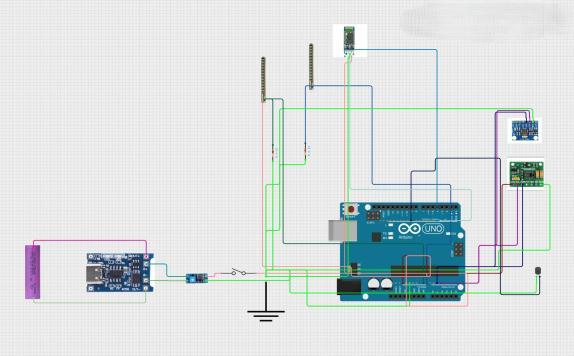
ThecircuitlayoutoftheproposedSmartGloveSystem is designed to ensure stable signal transmission, efficientpowerdistribution,andreliablecommunication between all hardware components. The system integrates flex sensors, MPU6050 motion sensor, MAX30102 pulse oximeter sensor, HC-05
V
Parameter Value Specification
ModuleType Bluetooth Communication Module
BluetoothVersion Bluetoothv2.0+EDR
Communication Interface UARTSerial
OperatingVoltage 3.6V– 6V
Communication Range Upto10meters
Application Wireless Data Transmission
Bluetooth module, piezoelectric buzzer, and Arduino Uno microcontroller into a compact wearable architecture.
The flex sensors are connected to the analog input pins of the Arduino Uno through voltage-divider circuits using 10kΩ resistors for stable analog signal generation. The MPU6050 and MAX30102 sensors communicatewiththemicrocon-trollerthroughtheI2C interfaceusingSDAandSCL com-municationlines.The HC-05 Bluetooth module is connected through UART serial communication for wireless transmission of gesturemessages,healthdata,andemergencyalerts.
The system is powered using a rechargeable 3.7V lithium-ion battery integrated with a TP4056 charging module for safe battery charging and protection. An MT3608boostconverterisusedtoregulatethebattery output and provide a stable 5V supply for the Arduino Unoandconnectedperipherals.
The executionconstraints ofthe SmartGloveSystem mainly include sensor calibration accuracy, battery backup duration, Bluetooth communication range, and real-time processing ca-pability. The flex sensors require proper threshold calibration for accurate gesture recognition. The Bluetooth communi-cation range is limited to approximately 10 meters under normal operating conditions. Continuous sensor monitoring and wireless communication also increase power consumption, affecting battery life during prolongedusage.
The system is designed to maintain low latency duringgesturedetection,heart-ratemonitoring,andfall detection to ensure immediate response and reliable operationinemer-gencysituations.
Volume: 13 Issue: 05 | May 2026
B. PCBDesignandTrackArchitectureDescription
The PCB design of the Smart Glove System was developed to provide compact hardware integration, stable signal routing, and reliable wearable operation. The printed circuit board integrates the Arduino Uno interface, flex sensor connections, MPU6050 motion sensor, MAX30102 pulse oximeter sen-sor, HC-05 Bluetooth module, buzzer interface, and powermanagementcircuitryintoasingleorganizedlayout.
The PCB track architecture was designed using separate analog and digital routing paths to minimize noise and improve sensor accuracy. The analog traces from the flex sensors were routed separately to ensure stable gesture- recognition signals, while the I2C and UARTcommunicationtrackswerekeptshorttoimprove data transmission reliability between the sensors, Bluetoothmodule,andArduinoUno.
Wider power tracks and ground planes were incorporated to support stable voltage distribution from the lithium-ion bat-tery, TP4056 charging module, and MT3608 boost converter. Proper component spacing and organized routing were main-tained to improve heat dissipation, reduce signal interference, andsimplifyhardwaremaintenance.
The PCB architecture demonstrated stable performance dur-ing real-time testing and supported reliable gesture recog-nition, heart-rate monitoring, fall detection, and Bluetooth communication while maintaining low power consumption and wearable portability.
C. Hardware Implementation and Prototype PerformanceAnalysis
The Smart Glove System was implemented by integrating flex sensors, MPU6050 motion sensor, MAX30102 pulse oximeter sensor, HC-05 Bluetooth module, buzzer, and Ar-duino Uno into a compact wearableprototype.
The prototype successfully performed gesture recognition, heart-rate monitoring, fall detection, and wireless communi-cation in real time. The system demonstrated stable Blue-tooth connectivity, reliable sensor performance, low power consumption, and efficientemergencyalertgenerationduringtesting.
The hardware implementation confirmed that the Smart Glove System is suitable for wearable assistive healthcareandcommunicationapplications.
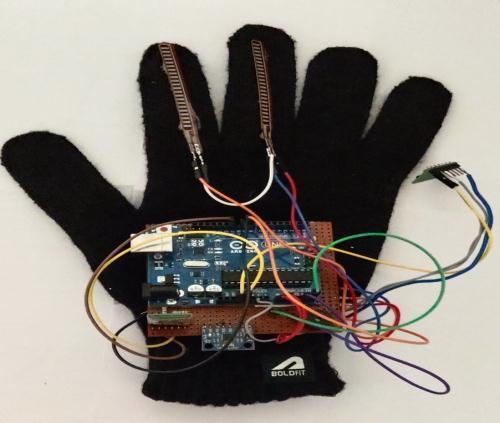
Fig. 7 HardwarePrototype
D. WebsiteInterfaceDescription
ThewebsiteinterfaceoftheSmartGloveSystemwas developed to provide centralized monitoring, real-time communication support, and emergency alert management for caregivers and healthcare
2395-0056
Volume: 13 Issue: 05 | May 2026 www.irjet.net p-ISSN: 2395-0072
professionals. The interface acts as a monitoring platform that receives gesture messages, healthmonitoring data, and emergency notifications transmittedwire-lesslyfromtheSmartGloveSystem.
The website dashboard displays predefined communication messages generated through gesture recognition using flex sensors. Messages such as “Need Water”,“NeedFood”,and“Need Help” are updated in real time to assist caregivers in responding quickly to user requirements. The interfacealsocontinuously displays heart-rate values measured using the MAX30102 pulse oximeter sensor for remote healthcaremonitoring.
The emergency monitoring section of the website providesinstantalertnotificationsduringfalldetection and abnormal health conditions identified using the MPU6050motionsensor.
Warning messages and alert indicators are displayed immediately to improve emergency response efficiency andusersafety.
The website interface was designed with a simple anduser-friendlylayouttoensureeasyaccessibilityand efficient monitoring. The integration of wireless communication, health monitoring, and emergency notification features into a single web-based platform improves the overall functionality and us-ability of the SmartGloveSystemforhospitals,rehabilitationcenters, andhome-careenvironments.
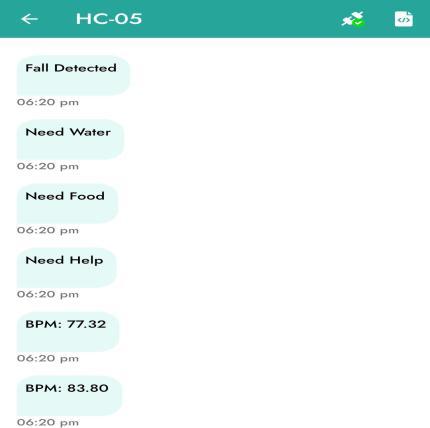
Fig. 8. WebsiteinterfaceoftheSmartGlove System
The proposed Smart Glove System was successfully designed and implemented as a wearable assistive healthcare device for individuals with speech and mobility impairments. The system integrates flex
sensors, MPU6050 motion sensor, MAX30102 pulse oximeter sensor, HC-05 Bluetooth module, and Arduino Uno to provide gesture-based communication, heartrate monitoring, fall detection, and emergency alert generation.
The prototype demonstrated reliable gesture recognition, stable wireless communication, continuous health monitoring, and effective emergency detection during real-time testing. The system also showed low power consumption, portability, and user-friendly operation, making it suitable for wearable healthcare applications.
By combining communication assistance and health mon-itoringintoasingleembeddedplatform,theSmart Glove System improves user safety, independence, and caregiver sup-port. The proposed system provides an affordable and practical solution for hospitals, rehabilitationcenters,andhome-careenvironments.
Future improvements such as artificial intelligencebasedgesturerecognition,IoTintegration,GPStracking, and mobile application support can further enhance systemperformance,accuracy,andusability.
[1]P. S. Miranda et al., ”GSM-Based Smart Glove for Gesture Recognition and Health Monitoring in ParalysisPatients,”2025 International Conference on Biomedical Engineering and Sustain-able Healthcare(ICBMESH),Manipal,India,2025,pp.1–5,doi: 10.1109/ICBMESH66209.2025.11182196.
[2]X. Wang, H. Yu, S. Kold, O. Rahbek, and S. Bai, ”Wearable sensors for activity monitoring and motioncontrol:Areview,”Biomimetic Intelligence and Robotics, vol. 3, no. 1, p. 100089, 2023, doi: 10.1016/j.birob.2023.100089.
[3]N. Hasan and M. F. Ahmed, ”Wearable Technology forElderlyCare: IntegratingHealthMonitoringand EmergencyAlerts,”Journal ofCom-puterNetworks and Communications, vol. 2024, Article ID 5593708, 16 pages, 2024, doi: 10.1155/jcnc/5593708
[4]V. A et al., ”EchoGlove: Assistive Smart Glove for Gesture-Based Com-munication and Health Monitoring,” International Journal for Research in Applied Science and Engineering Technology, vol. 13, pp. 164–167, 2025, doi: 10.22214/ijraset.2025.66821.
[5]F. Kurul et al., ”Wearable sensors for health monitoring: Current ap-plications, trends, and future directions,” Biosensors and Bioelectronics: X, vol. 28, p. 100727, 2026, doi: 10.1016/j.biosx.2025.100727.