
International Research Journal of Engineering and Technology (IRJET) e-ISSN: 2395-0056
Volume: 13 Issue: 05 | May 2026 www.irjet.net p-ISSN: 2395-0072
International Research Journal of Engineering and Technology (IRJET) e-ISSN: 2395-0056
Volume: 13 Issue: 05 | May 2026 www.irjet.net p-ISSN: 2395-0072
Prof. K. S. Shirke1, Sahiket Ghule2, Anushka Jadhav3, Abhishek Nangare4, Snehal Sasane5
2,3,4,5 Student, Department of Information Technology, SVPM’s College of Engineering, Malegaon BK, Maharashtra, India.
1Assistant Professor, Department of Information Technology, SVPM’S College of Engineering Malegaon BK, Baramati, Maharashtra, India
Abstract - The increasing complexity of financial systems has made financial literacy an essential skill, especially among students and young professionals. Many individuals lack proper knowledge of budgeting, saving, and investment planning, leading to poor financialdecisions.To addressthisissue,wedeveloped a Smart Financial Literacy Tool, an AI-based web application that helps users manage their finances efficiently.Thesystemcollectsuserdatasuchasincome, expenses, and savings, and uses machine learning algorithms like ARIMA and LSTM to predict gold and stock market trends. Based on these predictions and user financial profiles, the system provides personalized investment recommendations. Additionally, it includes an educational module to improve financial awareness and decision-making skills. The proposed system aims to bridge the gap between financial technology and financial education by combining prediction, recommendation, and learninginasingleplatform.
Key Words: Financial Literacy, Machine Learning, LSTM,ARIMA,InvestmentPrediction,AI,FinTech
In today’s rapidly evolving digital economy, financial literacy has become an essential life skill for individuals, especially students and young professionals. With the increasing use of digital payment systems, online investments, and financial applications, people are expected to make informed decisions regarding saving, budgeting, and investing. However, despite the availability of various financial platforms, many individuals lack the necessary knowledge to manage their finances effectively. This often leads to overspending, poor savings habits, and incorrectinvestmentchoices.
Existing financial applications mainly focus on
transaction management, expense tracking, or investment execution. They provide limited guidance and lack personalized recommendations basedonuser behavior. Moreover, most platforms do not integrate predictive analytics or educational content, which are crucial for improving financial understanding and decision-making.
To address these challenges, this paper proposes a Smart Financial Literacy Tool, an AI-based system designed to assist users in managing their personal financesintelligently.
Thesystemcollectsuserfinancialdatasuchasincome, expenses, and savings, and applies machine learning algorithms like ARIMA and LSTM to predict gold and stock market trends. Based on these predictions and the user’s financial profile, the system generates personalized investment recommendations. Additionally, it includes an educational module that helps users understand key financial concepts and improvetheirfinancialhabits.
Developmentofanintelligentfinancialliteracysystem that enables users to manageincome, track expenses, and make smart investment decisions using AI-based analysis. The system will predict gold and stock markettrendsusingmachinelearningalgorithms and provide personalized investment recommendations along with financial education to improve user awarenessanddecision-making.
3. Literature Survey
In recent years, the use of Artificial Intelligence (AI) and Machine Learning (ML) in financial applications has increased significantly. Many systems have been developed for expense tracking, investment analysis, and financial recommendation. Studies show that machine learning algorithms such as Linear
International Research Journal of Engineering and Technology (IRJET) e-ISSN: 2395-0056
Volume: 13 Issue: 05 | May 2026 www.irjet.net p-ISSN: 2395-0072
Regression,DecisionTrees,andRandomForestcanbe used to analyze financial data and provide useful insights. Some platforms also use time-series models like ARIMA and LSTM to predict stock and gold price trends based onhistorical data. These models help in understanding behavior and improving investment decisions. However, most existing systems focus only on prediction or transaction management and lack integration with financial education and personalized recommendations.
The rapid growth of digital financial systems has increased the need for proper financial knowledge among individuals. However, many users still lack awareness about budgeting, saving, and investment planning. Existing applications mainly focus on transactionsanddonotprovidecompleteguidanceor learning support. The proposed Smart Financial Literacy Tool is motivated by the need to create an intelligent system that combines financial prediction, personalized recommendations, and educational content
A. Improving Financial Awareness
Many students and young professionals do not have a clear understanding of basic financial concepts such as budgeting, saving, interest rates, and investment planning. This lack of knowledge often leads to poor financial decisions and financial instability. The proposed system helps users learn these concepts through simple explanations, tips, and interactive content, thereby improving their overall financial awarenessandconfidence.
Most individuals invest money without analyzing market trends or understanding risks. This can lead to losses or ineffective financial planning. By using machinelearningalgorithmssuchasARIMAandLSTM, the system predicts gold and stock price trends based on historical data. These predictions help users make informedanddata-driveninvestmentdecisionsinstead ofrelyingonguesswork.
Financial planningdiffersfrompersontopersonbased onincome,expenses,goals,andrisktolerance.Existing systems provide general suggestions that may not suit everyuser.Theproposedsystemanalyzesuser-specific data and generates personalized recommendations, suchashowmuchtosave,wheretoinvest,andhowto manageexpenseseffectively.
Most financial applications focus only on managing money but do not educate users about financial concepts. As a result, users depend on the system without understanding the reasoning behind decisions. This toolcombines bothfinancialeducation and AI-based analysis, helping users not only follow recommendationsbutalsounderstandthem.
Financial tools are often complex and difficult for beginnerstouse.Theproposedsystemisdesignedwith asimpleanduser-friendlyinterfacethatallowsusersto easily enter their data, view results, and understand recommendations. It is accessible through web and mobile platforms, making it convenient for all types of users.
Many individuals face difficulties in managing their daily expenses and maintaining consistent saving habits due to lack of proper planning and financial awareness. Uncontrolled spending and absence of budgetingoftenlead to financial instability and stress. The proposed system helps users build financial discipline by analyzing their spending patterns and providing regular insights and alerts. It encourages users to follow good financial practices such as budgeting, tracking expenses, settingsavings goals, and planning for future needs. By promoting these habits, the system helps users achieve long-term financial stability and make more responsible financial decisions.
5. System Architecture
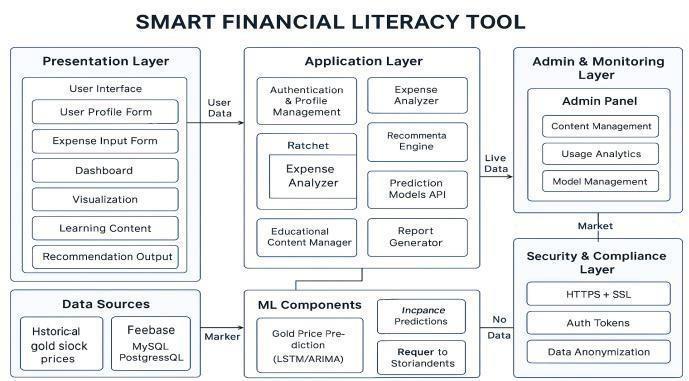
Fig1: SystemArchitecture
1. UserRegistration&Authentication:Userssecurely register and log in to access personalized financial servicesandmanagetheirdata.
2. Add Financial Data: Users input details such as
International Research Journal of Engineering and Technology (IRJET) e-ISSN: 2395-0056
Volume: 13 Issue: 05 | May 2026 www.irjet.net p-ISSN: 2395-0072
income, expenses,
and financial goals for analysis.
3. Financial Analysis: The system analyzes user data to understand spending patterns and financial behavior.
4.Recommendation to User: The system provides personalized investment suggestions and saving strategiesbasedonpredictionresults.
5. Access to Other Health Systems: The system provides educational materials to improve financial knowledgeandawareness.
6. Proposed Algorithms
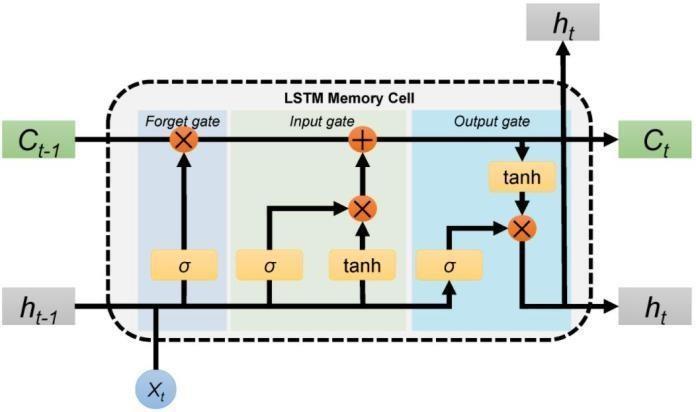
LSTM(LongShort-TermMemory)isanadvancedtype of Recurrent Neural Network (RNN) designed to process sequential and time-dependent data. Unlike traditional models, LSTM is capable of learning longterm dependencies by maintaining memory through specialunitscalledgates.Inthecontextofthisproject, LSTM is used to analyze historical financial data such as gold and stock prices to identify hidden patterns and trends overtime.
Explanation of ARIMA:
1.Input: Historical financial data such as gold prices andstockmarketvaluesiscollectedovertime
2.Dataset and preprocessing: The data is cleaned and transformed into a stationary form using differencing techniquestoremovetrendsandseasonality.
Model Training: Once parameters are selected, the ARIMA modelistrainedontheprocesseddataset.The model learns the relationship between past observations
Explanation of LSTM:
1. Input: The system collects historical financial data such as gold prices and stock market values over a
specifictimeperiod.
2.Dataset and preprocessing: The collected data is cleaned to remove missing or inconsistent values, normalized for uniform scaling, and converted into sequentialformatsuitablefortime-seriesmodeling.
3. Modelbuilding:AnLSTMneuralnetworkisdesigned with multiple hidden layers and memory cells to capturelong-termdependenciesinthedata.
4. TrainingPhase:Themodelistrainedusinghistorical datasetswhereitlearnspatterns,trends,andvariations infinancialdata.
5. Prediction Phase: The trained model processes new input data and predictsfuture valuesof gold andstock prices.
6.Output and Recommendation: Based on predicted trends, the system provides intelligent investment suggestionsandfinancialinsightstotheuser
Algorithm 2: ARIMA (Auto-Regressive Integrated Moving Average)
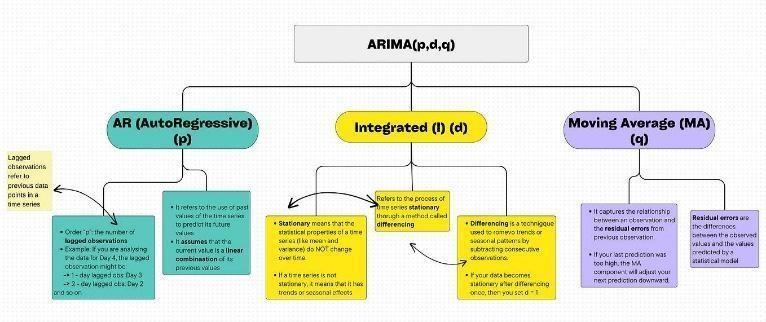
Fig3.ARIMA
Prediction process: The trained model uses learned patterns to forecast future financial values. It generatespredictionsbycombiningpast
Resultandrecommendation:Thepredictedresultsare analyzed to identify trends (increasing, decreasing, or stable). Based on these trends, the system provides investment suggestions such as whether to invest, hold,oravoidcertainassets.
International Research Journal of Engineering and Technology (IRJET) e-ISSN: 2395-0056 Volume: 13 Issue: 05 | May 2026 www.irjet.net p-ISSN: 2395-0072
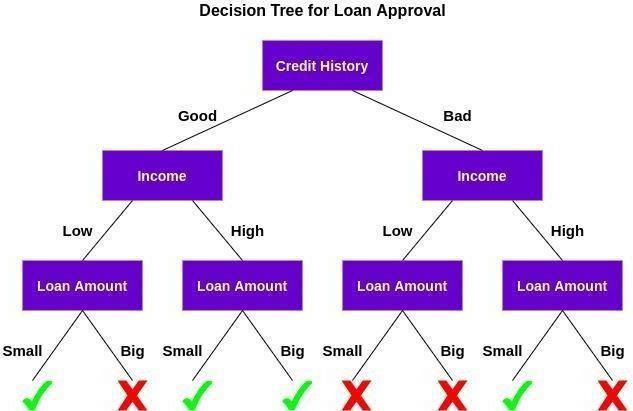
Explanation of Decision Tree:
1.Input:Thesystemcollectsuserfinancialdatasuchas income,expenses,savings,andriskpreference
2.Dataset and preprocessing: The collected data is cleaned, organized, and converted into a structured formatsuitableformodeltraining.
3. Model building: A decision tree is built by selecting thebestfeaturesforsplittingthedatabasedoncriteria likeInformationGainorGiniIndex.
4. TrainingPhase:Themodelistrainedusinghistorical data, where it learns patterns and decision rules for classifyingfinancialbehavior
5. Prediction Phase: The trained model processes new user input and classifies the user into categories such aslow-risk,medium-risk,orhigh-riskinvestor.
6. Resultandrecommendation:Basedonclassification, the system provides personalized investment suggestions such as safe investments, balanced portfolios,orhigh-returnoptions.
Algorithm
1. Input:Thesystemcollectsuserfinancialdatasuchas income,expenses,savings,andinvestmentpreferences. Thesevariablesactasinputfeaturesforthemodel.
2. Dataset and preprocessing: The collected data is cleaned by removing inconsistencies and handling missingvalues.Numericalscalingornormalizationmay be applied to ensure all features are within a comparablerange.
3. Modelbuilding:ALinearRegressionmodeliscreated by defining the relationship between input variables (independent variables) and the target variable (dependent variable such as savings or future expenses).
4.TrainingPhase: Themodel is trained usinghistorical user data. During training, the algorithm calculates coefficients (β values) by minimizing the error using methodslikeLeastSquares, ensuringthebestfitlineis obtained.
5.Prediction Phase: Once trained, the model predicts future financial values such as expected savings or expensesbasedonnewuserinputdata
6. Result and recommendation: The predicted results are analyzed to provide financial insights such as budgeting suggestions, saving strategies, and expense control recommendations to help users improve their financialplanning.
•LSTM Algorithm: LSTM provides high accuracy for time- series financial data as it captures long-term dependencies and complex patterns in stock and gold pricetrends.
• ARIMA Algorithm: ARIMA offers good accuracy for short- term forecasting and performs well on stable and linear time-series data, but may struggle with highlynon-linearpatterns
• Decision Tree Algorithm Decision Tree provides good accuracy for classification tasks and can handle complex decision-making scenarios, but may suffer fromoverfittingifnotproperlyoptimized
• Linear Regression Algorithm: Linear Regression provides moderate accuracy as it assumes a linear relationship between variables, making it suitable for basic financial predictions like income and expense analysis
• LSTM Algorithm: LSTM has high computational complexity due to its deep neural network structure, multiple hidden layers, and memory cells. It requires significantcomputationalresourcesandtrainingtime.
• ARIMA Algorithm: ARIMA has moderate computational complexity. It involves operations like differencing, parameter estimation, and iterative
International Research Journal of Engineering and Technology (IRJET) e-ISSN: 2395-0056
Volume: 13 Issue: 05 | May 2026 www.irjet.net p-ISSN: 2395-0072
model fitting. While it is less complex than deep learningmodels.
• Decision Tree Algorithm: Decision Tree has moderate computational complexity. The complexity increases with the depth of the tree and number of features, as the algorithm evaluates multiple splits to findthebestdecisionrules.
• Linear Regression Algorithm: Linear Regression has low computational complexity as it uses simple mathematicalcalculationstofindthebest-fitline.Itis fast to train and efficient even with large datasets, makingitsuitableforreal-timefinancialanalysis
• LSTM Algorithm: LSTM provides moderate realtime performance. While prediction is relatively fast after training, the training process itself is timeconsuming due to complex neural network computationsandsequentialdataprocessing.
• ARIMA Algorithm: ARIMA offers good real-time performance for short-term forecasting. Once the model is trained, it can generate predictions quickly, making it suitable for real-time financial trend analysis.
• Decision Tree Algorithm: Decision Tree provides fast real- time performance during prediction. Once the model is built, it quickly classifies input data using simple decision rules, making it efficient for real-time recommendationsystems.
• Linear Regression Algorithm: Linear Regression providesexcellentreal-timeperformancebecauseofits simple mathematical structure. It can generate predictions almost instantly, making it highly suitable for real-time financial analysis and quick decisionmaking.
• LSTM Algorithm LSTM has strong generalization ability for time-series financial data as it learns longterm dependencies and patterns. When trained on sufficientanddiversedatasets,itcanadaptwelltonew andunseenmarkettrends
• ARIMA Algorithm: ARIMA provides moderate generalization performance. It works well when future data follows similar patterns as historical data, but its performance may decrease when there are sudden changesornon-linearfluctuationsinfinancialmarkets.
• Decision Tree Algorithm: Decision Tree can generalize well if properly optimized using techniques like pruning. However, it may overfit training data and perform poorly on new data if the tree becomes too complexwithoutregularization.
• Linear Regression Algorithm: Linear Regression has limited generalization capability for complex financial data, as it assumes a linear relationship between variables. It performs well on simple and consistent data
In conclusion, the proposed Smart Financial Literacy Tool provides an intelligent and user-friendly platform for managing personal finances. It uses machine learning algorithms such as LSTM, ARIMA, Linear Regression,andDecisionTreetoanalyzefinancialdata and predict market trends. The system also offers personalized investment recommendations and financialeducationtoimproveuserawareness.Overall, it helps users make better financial decisions and promoteslong-termfinancialstability.
TheproposedSmartFinancialLiteracyToolisdesigned to analyze user financial data and provide predictions and recommendations using machine learning techniques.Thesystemfollowsastructuredprocessas describedbelow:
User health data is collected through the NaariCare interface:
• Users enter details such as age, menstrual cycle history, symptoms (acne, weight gain, irregular periods),andhormonalinformation
• Data is stored securely for further processing and analysis.
The collected financial data undergoes preprocessing toensurequalityandconsistency.
• DataCleaning:Handlingmissingorinconsistent valuesinincome,expenses,andmarketdata
• Encoding: Converting categorical data into numericalformatforprocessing
• Normalization: Scaling values to a uniform range forbettermodelperformance
Relevant financial features are selected to improve prediction.
• Important attributes like income level, expense
International Research Journal of Engineering and Technology (IRJET) e-ISSN: 2395-0056
Volume: 13 Issue: 05 | May 2026 www.irjet.net p-ISSN: 2395-0072
patterns,savingsratio,andmarkettrends
• Dataset is divided into training and testing sets
• Helpsinreducingnoiseandimprovingmodelefficiency
IV. Model Training using LSTM and ARIMA
Machine learning models are trained using prepared datasets:
• LSTM:Usedfortime-seriespredictionofstockand goldprices
• ARIMA:Usedforstatisticalforecastingofmarkettrends
• Modelslearnpatterns between user data and financialoutcomes
V. Prediction & Classification
Thetrainedmodelsareusedtopredictfinancialtrends anduser
•New user input is passed into the models
•LSTM and ARIMA predict future market prices
• RegressionandDecisionTreeanalyzefinancial patterns class.
• Outputisgeneratedaspredictedfinamcialtrends
VI. Result Generation and Recommendation
Based on prediction results, the system provides actionableinsights:
•Displays predicted stock and gold price trends
•Suggests personalized investment options.
• Provides saving strategies and expense management tips
VII. System Integration and Continuous Learning
The complete model is integrated into the NaariCare platform:
• Enables real-time prediction and user interaction
• Newuserdatacanbeaddedtoimprovemodelaccuracy overtime
• Ensuresscalabilityandcontinuoussystem enhancement
a. Stock Price Prediction Model Type Accur acy Real time capabilit y Comme nts
LSTM Recurent Neural Network 92 Medium Captures longterm trend swell
ARIMA Statisti cal Model 85 High Good for shortterm forecasti ng
Linear Regre sion Supervis ed Learning 80 High Simplebut les s accurate
Table1:StockPricePrediction
b. Gold Price Prediction Model Type Accura cy Real time capabili ty Commen ts LSTM Recurrent Neural Network 91 Medium Handles timeseries patterns well
ARIMA Statistica2 lModel 84 High Stable and efficient
Linear Regressi on Supervis ed Learning 78 High Works for basic trend analysis
Table2:GoldPricePrediction
International Research Journal of Engineering and Technology (IRJET) e-ISSN: 2395-0056
Volume: 13 Issue: 05 | May 2026 www.irjet.net p-ISSN: 2395-0072
Mode l Type Accurac y Real time capabilit y Comment s
LSTM Deep Learning Model 88 Medium Supports trendbased suggestion s
ARIM A Statistical Model 83 High Useful for short-term insights
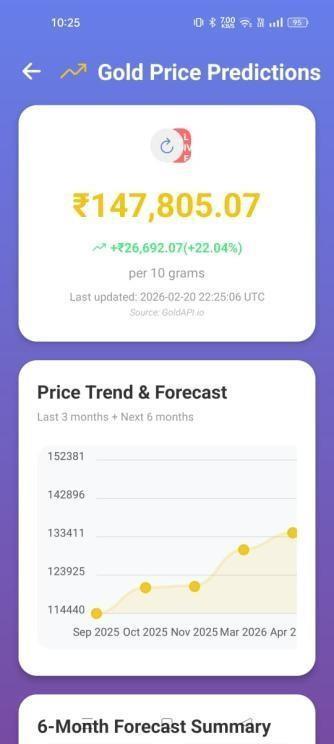
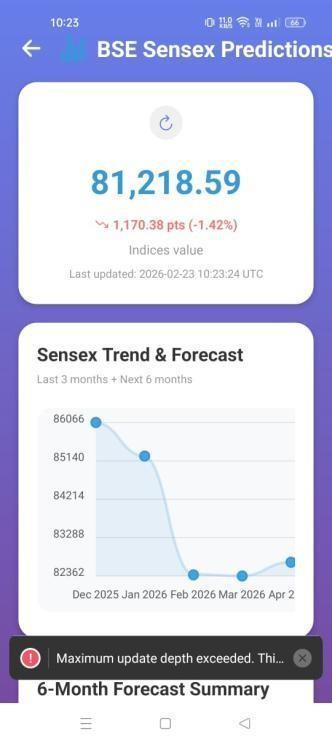
The proposed Smart Financial Literacy Tool provides an effective and intelligent solution for managing personal finances using machine learning techniques. By integrating models such as LSTM, ARIMA, Linear Regression, and Decision Tree, the system is able to analyze financial data, predict market trends, and generate personalized investment recommendations. The platform also enhances financial awareness through educational content and visualization tools. Overall, the system helps users make informed financial decisions, improves financial discipline, and supportslong-termfinancialplanning.
[1] A.LusardiandO.S.Mitchell,“Financialliteracyand planning: Implications for retirement wellbeing,” National Bureau of Economic Research (NBER), WorkingPaperNo.17078,2011.
[2] R. Thaler and S. Benartzi, “Save More Tomorrow™: Using behavioral economics to increase employee saving,” Journal of Political Economy, vol. 112, no. S1,
[3] pp.S164–S187,2004
[4] A.Jain, P.Chandra,and A.K. Jain, “Personal finance management using data analytics,” International Journal of Computer Applications, vol. 179, no. 7, pp.15–20,2018.
[5] T.Beck,A.Demirgüç-Kunt,andP.Honohan,“Access to financial services: Measurement, impact, and policies,” The World Bank Research Observer, vol. 24,no.1,pp.119–145,2009.