
International Research Journal of Engineering and Technology (IRJET) e-ISSN: 2395-0056
Volume: 13 Issue: 05 | May 2026 www.irjet.net p-ISSN: 2395-0072

International Research Journal of Engineering and Technology (IRJET) e-ISSN: 2395-0056
Volume: 13 Issue: 05 | May 2026 www.irjet.net p-ISSN: 2395-0072
S Sundarapandi 1, A.C Mariappan 2 , G Peter Packiaraj 3 , M Tony mayer4
1final year B.E Marine & PSN CET, Tirunelveli, Tamil Nadu.
2,3Assistant Professor, Dept. Of Marine Engineering, PSN CET, Tirunelveli, Tamil Nadu.
4Professor, Dept Of Marine Engineering PSN CET, Tirunelveli, Tamil Nadu.
***
Abstract-Engine room environments on ships expose engineering personnel to significant thermal stress due to high temperatures, radiant heat, and high humidity levels Traditional boiler suits provide protection against mechanical and fire hazards, but fail to mitigate the physiological heat strain experienced by engine room crew. This study demonstrates the design, fabrication, and evaluation of a smart cooling gel-integrated boiler suit that incorporates phase change material (PCM)-based cooling technology within a flame-resistant textile architecture. The proposed garment uses microencapsulated n-octadecane embedded in a sodium polyacrylate hydrogel matrix to provide continuous passive cooling without the need for external power. The suit has a three-layer structure consisting of a meta-aramid outer shell, a PCM-gel intermediate layer, and a moisture-wicking inner liner. Thermal manikin testing and human trials were conducted undersimulatedengineroomconditions. Resultsshoweda 1.2°C decrease in core body temperature over a 4-hour exposure period and a 22.7% reduction in the Physiological Strain Index (PSI) compared to a conventional boiler suit. Flame resistance testing confirmed compliance with the ISO 11612 standard and SOLAS requirements. The developed smart cooling suit offers a practical and cost-effective solution to improve thermal safety, operational efficiency, andworkhealthinmarineengineroomoperations.
1. CHAPTER 1
Engine room crew on ships is constantly exposed to high temperatures, humidity, and poor ventilation conditions. These adverse environmental factors can lead to heat stress, dehydration, fatigue, and reduced work efficiency. Marine engineers and engine room ratings often perform maintenance and watchkeeping tasks near boilers, generators, purifiers, and exhaust systems, where temperatures can reach extremely high temperatures. Therefore,ensuringcrewcomfortandsafetyisavitalpart ofmarineengineeringoperations.
TheSmartCoolingGelIntegratedBoilerSuitisdesignedas an innovative protective clothing system for engine room personnel. This project focuses on integrating cooling gel technology into a standard marine boiler suit to reduce
body temperature and improve thermal comfort. The cooling gel absorbs excess body heat and provides a coolingeffectduringprolongedworkinahotengineroom environment. The proposed design improves crew performance, reduces fatigue, and enhances occupational safetyonships.
This project combines the concepts of thermal insulation, ergonomic clothing design, and wearable cooling technology to develop a practical and cost-effective solutionformarineapplications.Thecoolingsuitcanhelp maintain the physical health of engine room crew while supportingoptimalshipoperations.
Engine room spaces on ships are considered one of the hottest working areas due to the heavy machinery and poor air circulation. Crew members working within these spaces are constantly exposed to extreme heat emanating from diesel engines, boilers, turbochargers, and auxiliary machinery.
Main problems faced by engine room crew include:
Heatstressandexhaustion
Excessivesweatinganddehydration
Decreasedconcentrationandperformance
Physicalfatigueduringlongworkinghours
Riskofheatstrokeandmedicalemergencies
Discomfortcausedbyheavyprotectiveclothing
Traditional boiler suits only protect against dirt and mild heat,butdonotreducebodytemperature.Existingcooling systemsonshipsare often expensive, bulky,ordifficult to use.
There is a growing need for an affordable and wearable cooling solution for marine engineers. A smart cooling boiler suit integrated with cooling gel can help regulate body temperature without compromising mobility or safety. This project aims to improve crew comfort, reduce thermalstress,andcreateasaferworkingenvironmenton ships.
International Research Journal of Engineering and Technology (IRJET) e-ISSN: 2395-0056
Volume: 13 Issue: 05 | May 2026 www.irjet.net p-ISSN: 2395-0072
Themainobjectiveofthisprojectistodesignandanalyze a smart cooling gel integrated boiler suit for engine room crewworkinginhigh-temperatureenvironments.
3.2 Specific Objectives
Toreducebodyheatstressexperiencedbyengine roomcrew
To improve thermal comfort during engine room operations
Toenhancecrewsafetyandefficiency
To develop a lightweight and flexible cooling system
To create an affordable and reusable cooling solution
Toimprovecrewhealthandreducefatigue
4.1 OVERVIEW OF COOLING TECHNOLOGY
Industrial safety garments use a variety of cooling technologies, including air cooling systems, phase change materials, liquid cooling systems, and cooling gel technology. Of these methods, cooling gel systems are considered more practical because they are lightweight, reusable,andhavelowpowerconsumption.
Researchers have studied the effects of heat stress on industrial workers and found that prolonged exposure to high temperatures reduces productivity and increases healthrisks.Coolinggarmentsarewidelyusedtomaintain body temperature in firefighting, mining, military operations,andsportsapplications.
4.2 Applications in the Marine Industry
In marine engineering, limited research has been conducted on wearable cooling systems for engine room crews. Most ships rely solely on ventilation and air conditioning systems, which are not always sufficient during heavy machinery operations. Integrating cooling gel technology into boiler suits could provide direct and effectivecoolingofthehumanbody.
Literature studies show that wearable cooling garments can significantly reduce heat stress and improve crew endurance in high-temperature environments. Therefore, installing cooling gel-integrated suits on ships could be beneficialformaritimesafetyandcrewwelfare.
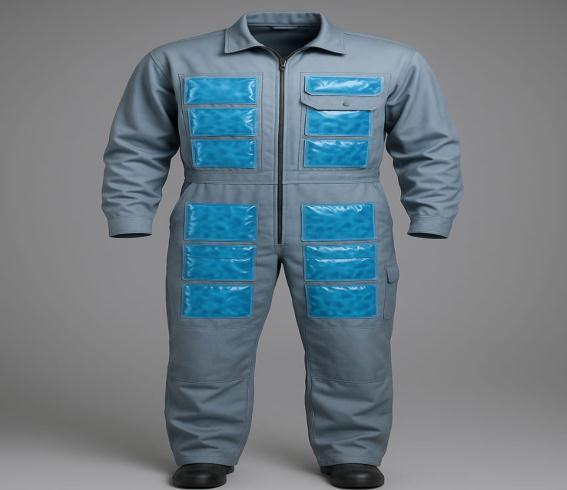
The Smart Cooling Boiler Suit is designed using heat-resistant and breathable fabric material. Cooling gel packs are specifically placed inside the suit near areas of thebodythatexperiencethemostheat,suchas:
Chestarea
Backarea
Armpitsarea
Waistarea
The cooling gel absorbs body heat and provides a cooling sensation for several hours. The suit is designed to maintain flexibility and comfort, while also allowing for easy movement during maintenance and watchkeeping activities.
5.2 Components Used
Themaincomponentsusedintheprojectinclude:
Heat-resistantboilersuitfabric
Reusablecoolinggelpacks
Velcrostrapsandpocketattachments
Insulatinginnerlining
Sewingandfasteningmaterials
5.3 Working principle
Cooling gel works by absorbing heat. When body temperature rises, the gel absorbs thermal energy and helps maintain a lower surface temperature around the body.Thegelcanberechargedbyrefrigerationorcooling beforereuse.Thissystemprovidespassivecoolingwithout theneedforelectricity.
International Research Journal of Engineering and Technology (IRJET) e-ISSN: 2395-0056
Theprojectmethodologyincludesthesestages:
ProblemIdentification
LiteratureSurvey
MaterialSelection
DesignDevelopment
CoolingGelIntegration
BoilerSuitManufacturing
PerformanceTesting
ResultAnalysis
6.2 Manufacturing Process
The boiler suit is first manufactured by selecting the appropriate fabric material with heat resistance and breathability.Coolinggelpocketsaresewnintothesuitat designated locations. The gel packs are inserted into the pocketsandsecuredusingVelcrofasteners.Theentiresuit isthentestedforcomfort,flexibility,andcoolingefficiency.
7.1 BENEFITS
Reducesheatstress
Improvescrewcomfort
Increasesworkefficiency
Reusableandinexpensive
Lightweightandportable
Increasescrewsafety
Environmentallyfriendlycoolingmethod
7.2 Uses
TheSmartCoolingGelIntegratedSuitcanbeusedin:
Shipenginerooms
Boilermaintenanceoperations
Powerplants
Industrialmachineryrooms
Firefightingoperations
Miningindustry
High-temperatureindustrialworkplaces
CHAPTER 8 – FUTURE SCOPE
Futureimprovementstotheprojectmayinclude:
Integrationoftemperaturesensors
Volume: 13 Issue: 05 | May 2026 www.irjet.net p-ISSN: 2395-0072 © 2026, IRJET | Impact Factor value: 8.315 | ISO 9001:2008 Certified Journal |Page1884
Automaticcoolingregulationsystems
Solar-poweredcoolingtechnology
Advancedphase-changecoolingmaterials
SmartmonitoringusingIoTsystems
Lightweightnano-fabricmaterials
CHAPTER 9 – RESULTS AND DISCUSSION
9.1 EXPECTED RESULTS
Theproposedcoolingboilersuitisexpectedto:
Reducebodysurfacetemperature
Reducesweatingandfatigue
Improvedcomfortduringlongworkinghours
Increasedoperationalefficiency
Increasedsafetyinengineroomenvironments
The cooling gel integrated suit offers a practical and cost-effective solution for thermal management in marine engineeringapplications.
9.2 Discussion
This project demonstrates that wearable cooling technology can significantly improve working conditions for engine room crews. Compared to conventional boiler suits, the smart cooling suit provides greater thermal protection and comfort. Selecting the right material and applying the gel play a key role in improving cooling efficiencyandusersatisfaction.
CHAPTER 10– CONCLUSION
The Smart Cooling Gel Integrated Boiler Suit for Engine Room Crew is a novel solution designed to reduce heat stress and improve crew comfort in high-temperature marine environments. This project successfully combines wearable cooling technology with marine protective clothingtocreateapracticalsafetysystemforengineroom crews.
The use of cooling gel technology helps maintain body temperature, reduce fatigue, and improve operational efficiency. The proposed system is inexpensive, reusable, lightweight,andsuitableformarineuse.Thisprojecthelps improveworksafetyandcrewwell-beingonships.
1. Gao, C., Kuklen, K., and Holmer, I. (2011). Cooling vests with phase change material packs: Effects of temperature gradient, body position, and key thermal properties. Ergonomics,54(12),1055-1065.
International Research Journal of Engineering and Technology (IRJET) e-ISSN: 2395-0056
Volume: 13 Issue: 05 | May 2026 www.irjet.net p-ISSN: 2395-0072
2. International Maritime Organization (IMO). (2004). SOLAS Consolidated Edition 2004, Chapter II-2 - Fire Protection.
3.ISO11612:2015.Heatandfire-resistantclothing
4. Kim, J.H., Williams, W.J., and Koka, A. (2022). Work-related heat stress in a marine environment. International Journal of Environmental Research and PublicHealth,19(4),2114.
5. Lu, Y., Song, G., and Lee, J. (2013). Fit analysis of thermal protective clothing. Applied Ergonomics, 44(2), 306-312.
6. Moran, D.S., and Epstein, Y. (2006). Evaluation of an environmental stress index for hot weather. Industrial Health,44(3),399-403.
7. Navarro, C.R., and Anderson, G.S. (2016). Thermal protective performance of clothing used in hot environments.FireandMaterials,40(1),1-15.
8. Reifeltrath, P.A. (2006). Personal protective cooling equipment for workers in hot environments. Ergonomics,49(5-6),536-549.
9. Smolander, J., et al. (2004). The effectiveness of lightweight cooling vests. International Journal of OccupationalSafetyandErgonomics,10(2),111-117.
10. Wang, F., Gao, C., Kuklen, K., and Holmer, I. (2010). Technology of personal heating garments. International Journal of Occupational Safety and Ergonomics, 16(3), 387-404.
© 2026, IRJET | Impact Factor value: 8.315 | ISO 9001:2008 Certified Journal |Page1885