
International Research Journal of Engineering and Technology (IRJET) e-ISSN: 2395-0056
International Research Journal of Engineering and Technology (IRJET) e-ISSN: 2395-0056
Niraj Bhurki, Hrithik Patil, Harsh Raut, Hardik Patil, Aishwarya Churi
Students, Electronics & Computer Science, St John College of Engineering and Management, Maharashtra, India
Abstract - Career guidance plays a crucial role in shaping students’ academic and professional futures, as early career decisions strongly influence long-term employability and personaldevelopment.However,asignificantgapexistsinthe availability of structured career counselling facilities in rural and semi-urban regions. Many students face difficulties in making informed academic and career choices due to limited access to professional counsellors, unreliable internet connectivity, language barriers, and lack of awareness regarding diverse and emerging career opportunities. As a result,studentsoftenselectunsuitableeducationalpathways, which may lead to academic dissatisfaction, dropouts, unemployment, or underemployment.
To address these challenges, this paper presents the Smart Career Guidance Kiosk for Rural Students, a low-cost, offline, and multilingual system designed to provide accessible and self-guidedcareercounselling.Theproposedkioskoperatesas a standalone embedded system using locally hosted software andanofflinecareerdataset,therebyeliminatingdependency on continuous internet connectivity. The system collects essentialuserinputssuchaseducationlevel,academicstream, interests, and existing skill sets, and processes them using a rule-based weighted recommendation algorithm to generate personalized career guidance.
The rule-based approach ensures transparency and explainability of recommendations, allowing students to understand the reasoning behind suggested career options. A simple and user-friendly interface is provided to support students with varying levels of digital literacy. Additionally, multilingual support and offline text-to-speech functionality enable inclusive access for students from different linguistic backgrounds and those with limited reading ability.
The kiosk is intended for deployment in rural schools, Gram Panchayat offices, NGOs, and community learning centres, where access to professional career counselling services is minimal. Experimental testing of the implemented system demonstratesreliableofflineperformance,fastresponsetime, stable operation, and effective generation of career recommendations. The results indicate that the proposed system can serve as a practical and scalable solution for improving career awareness and supporting informed educational and professional decision-making among rural students.
Key Words: Smart Career Guidance, Rural Students, Offline Kiosk System, Career Recommendation, SkillBased Analysis, Multilingual Application
Career guidance is a fundamental component of the educational ecosystem, as it supports students in understandingtheirabilities,identifyingsuitableacademic pathways,andplanninglong-termprofessionalgoals.Early career-related decisions significantly influence an individual’s future employability, job satisfaction, and personal development. Students who receive appropriate guidance are more likely to select educational programs aligned with their interests and skills, thereby improving academicperformanceandreducingthelikelihoodofcourse changesordropouts.
Despite its importance, structured career counselling services are unevenly distributed, with a pronounced shortageinruralandsemi-urbanregions.Studentsinthese areasoftenlackaccesstotrainedcareercounsellors,career assessmenttools,andupdatedinformationaboutavailable educationalandprofessionalopportunities.Inmanycases, students rely on informal advice from family members, peers, or local teachers, which may not accurately reflect current industry requirements or the student’s individual aptitude. This situation leads to uninformed career decisions, which can result in academic dissatisfaction, unemployment,orunderemployment.
Theproblemisfurtherintensifiedbytherapidexpansionof careeroptionsacrossvariousdomainssuchasinformation technology, healthcare, engineering, design, management, and emerging interdisciplinary fields. Modern career landscapesrequire students to possess not onlyacademic knowledge but also specific technical, creative, and soft skills. Without structured guidance, rural students may remain unaware of these opportunities or the pathways requiredtopursuethem.
Existing career guidance platforms are predominantly internet-basedanddesignedforurbanpopulations.These platformstypicallyrequirecontinuousnetworkconnectivity, modern computing devices, and a certain level of digital literacy. In rural areas, internet connectivity is often unreliableorunavailable,andaccesstopersonalcomputers
Volume: 13 Issue: 02 | Feb 2026 www.irjet.net p-ISSN: 2395-0072 © 2026, IRJET | Impact Factor value: 8.315 | ISO 9001:2008 Certified Journal | Page685
International Research Journal of Engineering and Technology (IRJET) e-ISSN: 2395-0056
Volume: 13 Issue: 02 | Feb 2026 www.irjet.net p-ISSN: 2395-0072
orsmartphonesmaybelimited.Additionally,manyexisting platforms are developed primarily in English, creating language barriers for students who are more comfortable usingregionallanguages.Asaresult,alargesegmentofthe rural student population is unable to benefit from these systems.
Professionalcareercounsellingservicesofferedbyprivate institutionsaregenerallyconcentratedinurbancentresand involvehighcosts,makingtheminaccessibletoeconomically disadvantagedruralstudents.Furthermore,theseservices oftenrequireappointmentsandphysicalvisits,whichmay not be feasible for students living in remote locations. Consequently, the absence of affordable, accessible, and localizedcareerguidancesolutionscontinuestowidenthe careerawarenessgapbetweenurbanandruralstudents. Toaddressthesechallenges,thispaperproposestheSmart Career Guidance Kiosk for Rural Students as an offline, multilingual,andself-guidedcareercounsellingsolution.The proposed system is designed as a standalone embedded kioskthathostsalocallyrunningapplicationandanoffline career dataset. By eliminating dependency on internet connectivity and human counsellors, the kiosk enables independent access to career guidance in rural environments.
Thesystemguidesstudentsthroughastep-by-stepprocess inwhichtheyselecttheireducationlevel,academicstream, interests,andexistingskills.Basedontheseinputs,arulebased weighted recommendation algorithm analyzes suitability and generates personalized career suggestions. The recommendations are presented through a simple graphical interface along with optional audio guidance, ensuring accessibility for students with varying levels of literacyandtechnicalproficiency.
Theprimaryobjectiveoftheproposedsystemistoimprove careerawareness,supportinformededucationalplanning, andreduceuninformedcareerchoicesamongruralstudents. Byprovidinganaffordableandscalablesolution,theSmart Career Guidance Kiosk aims to contribute to inclusive education and promote equitable access to career counsellingservices.
In recent years, there has been a growing need for personalizedcareerguidancesystemstohelpstudentsmake informed decisions, particularly in areas where access to professionalcounsellorsislimited.Withtheriseofintelligent systemsandAI,severalresearchershaveexploredmethods toprovideautomated,data-drivencareerrecommendations. Thisreviewdiscusseskeycontributionsinthisdomain.
Intelligent Career Guidance System by Mohiuddin et al. (2025)
Thisstudyintroducesanintelligentcareerguidancesystem leveraging machine learning techniques for personalized recommendations. The system analyzes students' skills, interests, and education levels to suggest suitable career paths. The focus on ML enables adaptive guidance that improves as more data is collected, making it relevant for offlinekiosksthataimtoprovidepersonalizedsuggestions.
Intelligent Career Guidance System using Machine Learning by Sneha H. S. et al. (2022)
Sneha et al. proposed a model that automates career predictions using machine learning. The system considers studentinputandevaluatespotentialcareeroptionsbasedon predictive algorithms. This approach demonstrates the effectiveness of ML in guiding students toward informed career choices and highlights the potential for offline implementationinruralareas.
Smart Career Assistance Portal Using AI by Sameeha Afrin A. et al. (2025)
This portal integrates AI with real-time industry insights, dynamicallyuploadingcareerrecommendations.Thesystem emphasizes the importance of connecting career guidance with market demands, providing students with relevant, actionableadvice.Suchreal-timeinsightscanbeadaptedto offline kiosks through preloaded datasets for rural deployment.
Design and Implementation of a Career Guidance Portal by Kritika Vishwakarma & Peeyush Kumar Pathak (2025)
Theauthorsfocusonaportalembeddedwithdigitallibraries andskillassessmenttools.Thisstudyunderscoresthevalue ofpersonalizedassessmentincareerguidance,aligningwell with the SCGK’s objective of providing step-by-step, selfguidedcounselling
Unlocking Futures: A Natural Language Driven Career Prediction System by Sakir H. Faruque et al. (2024)
This research introduces an NLP-based system for career prediction,enablingstudentstointeractinnaturallanguage toreceiveguidance.Althoughprimarilyanonlinesolution,its methodology offers insights into designing user-friendly interfacesandadaptiverecommendationalgorithmssuitable forkioskimplementation.
AI Career Guidance Tool – IEEE Conference Paper by Joshi et al. (2024)
© 2026, IRJET | Impact Factor value: 8.315 | ISO 9001:2008 Certified Journal | Page686
International Research Journal of Engineering and Technology (IRJET) e-ISSN: 2395-0056
The paper presents an AI-based career guidance platform evaluated in a controlled environment. It highlights the feasibilityofautomatedguidancesystemsandtheirpotential toscaleacrossmultiplelocations,acoreaspectofdeploying SCGKinruralregions.
AI-powered Career Guidance System – IEEE Conference Paper by El-Khalili et al. (2025)
ThisworkdiscussesrecentadvancementsinAIdrivencareer guidance systems, emphasizing structured data utilization and recommendation accuracy. The study supports the designofofflinekiosksthatrelyonwell-structureddatasets andrule-basedscoringforeffectivedecisionsupport.
Summary:
Thesestudiescollectivelyemphasizethegrowingimportance ofAIandmachinelearningincareerguidance,thevalueof structuredandadaptiverecommendationsystems,andthe needforuserfriendlyinterfaces.Theyprovideafoundation fortheSmartCareerGuidanceKiosk,whichcombinesoffline accessibility,multilingualsupport,andarule-basedweighted scoringalgorithmtodeliverpersonalizedguidanceinrural settings
3.1 Proposed System
The Smart Career Guidance Kiosk for Rural Students is proposedasanoffline,self-guidedcareercounsellingsystem specifically designed to address the limitations of existing careerguidancemechanismsinruralandsemi-urbanregions. The system is developed with the objective of providing structured,reliable,andeasilyaccessiblecareerinformation tostudentswholackaccesstoprofessionalcounsellorsand internet-basedguidanceplatforms.Bycombiningembedded hardwarewithlocallyhostedsoftware,theproposedsystem functions as a complete standalone solution that can be deployedinresource-constrainedenvironments.
Theproposedkioskisdesignedtosupportstudentsafterthe completion of their 10th and 12th standard education, a criticalstagewherestudentsarerequiredtomakeimportant academic and career-related decisions. The system assists students in exploring suitable career paths by analysing multiple parameters, including their education level, academic stream, interests, and existing skills. This multiparameteranalysisensuresthatcareerrecommendationsare personalized and relevant to individual users rather than generic or one-size-fits-all suggestions. At the core of the proposed system is a locally hosted career database that storesstructuredinformationaboutvariouscareeroptions. Eachcareerentryincludesdetailedattributessuchascareer
description, eligibility criteria, required educational qualifications, recommended courses, skill requirements, certifications,potentialjobroles,salaryranges,andrelevant institutions.Thestructurednatureofthedatasetenablesthe systemtoprovidecomprehensiveguidancethatgoesbeyond merelylistingcareernames.Studentsareinformedaboutthe academic pathways and skill development requirements associatedwitheachcareeroption,whichsupportsinformed decision-making.
The system interacts with users through a step-by-step guidance flow implemented using a simple and intuitive graphical user interface. Students are guided through a sequenceofinputscreenswheretheyselecttheireducation level,academicstream,areasofinterest,andexistingskills. Thisstructuredinteractionreducesconfusionandensures thatallrelevantinputsarecollectedbeforegeneratingcareer recommendations. The interface is intentionally designed withminimalcomplexity,largebuttons,andclearlabelsto accommodatestudentswithvaryinglevelsofdigitalliteracy.
To ensure accessibility for a diverse rural population, the proposedsystemsupportsmultipleIndianlanguages.Users canselect their preferred languageat the beginning of the interaction, and all interface elements, instructions, and outputsarepresentedaccordingly.Inadditiontotext-based interaction, the system incorporates offline text-to-speech functionality that provides audio guidance and career descriptions. This feature is particularly beneficial for studentswithlimitedreadingabilityorthosewhoaremore comfortablereceivinginformationthroughaudio.
Careerrecommendationsaregeneratedusingarule-based weightedscoringalgorithmthatevaluatesthesuitabilityof each career option based on predefined parameters. The algorithmassignsweightstofactorssuchasinterestmatch, skill match, academic eligibility, and user preference. By computing a composite score for each career, the system rankscareeroptionsandpresentsthemostsuitableonesto theuser.Thisrule-basedapproachensurestransparencyand explainability, allowing users to understand why specific careers are recommended. Unlike black-box machine learning models, the explainable nature of the algorithm enhancestrustandmakesthesystemsuitableforeducational guidance.
Theproposedsystemisdeployedasaphysicalkioskusing embeddedhardware.Theembeddedcomputingunithosts the operating system, application software, and career database, ensuring that all processing occurs locally. The kiosk includes a display unit for visual interaction and an audio output device for voice guidance. The hardware configurationisselectedtobalanceperformance,cost,and powerconsumption,makingthekiosksuitableforlong-term deploymentinruralenvironments.
Volume: 13 Issue: 02 | Feb 2026 www.irjet.net p-ISSN: 2395-0072 © 2026, IRJET | Impact Factor value: 8.315 | ISO 9001:2008 Certified Journal | Page687
International Research Journal of Engineering and Technology (IRJET) e-ISSN: 2395-0056
Volume: 13 Issue: 02 | Feb 2026 www.irjet.net p-ISSN: 2395-0072
One of the key strengths of the proposed system is its completeindependencefrominternetconnectivity.Alldata storage,processing,andrecommendationlogicarehandled locallywithinthekiosk.Thisdesignchoiceensuresreliable operationeveninareaswithpoorornonetworkcoverage. Additionally,offlineoperationimprovesdataprivacy,asno personalinformationistransmittedtoexternalservers.
Overall,theproposedSmartCareerGuidanceKioskservesas an integrated solution that combines affordability, accessibility,andintelligentdecisionsupport.Byproviding localized, multilingual, and offline career guidance, the system aims to bridge the career awareness gap between urbanandruralstudentsandpromoteinformededucational andprofessionalplanning.
Existingcareer guidancesystems available tostudentsare primarilybasedononlinecareerportals,privatecounselling services, and web-based assessment platforms. These systemsaregenerallydesignedforuserswhohavereliable internetconnectivity,accesstodigitaldevices,andsufficient digital literacy. While such platforms are widely used in urbanenvironments,theypresentseverallimitationswhen appliedtoruralandsemi-urbancontexts.
Mostexistingcareerguidanceplatformsrequirecontinuous internet connectivity to function effectively. Career assessments,interesttests,andrecommendationenginesare typicallyhostedonremoteserversandrelyonreal-timedata exchange. In rural areas, internet connectivity is often unreliable,slow,orcompletelyunavailable.Eveninlocations wherelimitedconnectivityexists,highlatencyandfrequent networkinterruptionsnegativelyaffectuserexperience.Asa result, rural students are unable to consistently access or benefitfromtheseonlinesystems.
Anothermajorlimitationofexistingsystemsistheirlanguage dependency.Themajorityofcareerguidanceplatformsare developedprimarilyinEnglish,withlimitedornosupportfor regionallanguages.Ruralstudentswhoaremorecomfortable usingtheirnativelanguagesfacedifficultiesunderstanding interfaceelements,instructions,andcareerdescriptions.This languagebarriersignificantlyreducessystemusabilityand discouragesadoptionamongruralusers.
Professional career counselling services offered byprivate institutionsrepresentanotherformofexistingsystem.These services typically involve one-on-one counselling sessions conductedbytrainedprofessionals.Althoughsuchservices can provide personalized guidance, they are usually concentratedin urbanareas andinvolve highconsultation fees.Formanyruralstudents,travelingtourbancentresand paying for counselling services is not financially feasible.
Furthermore,theseservicesoftenrequireappointmentsand scheduled visits, which may not be practical for students livinginremotelocations.
Someeducationalinstitutionsofferlimitedcareerguidance throughschoolcounsellorsorteachers.However,duetohigh student-to-teacher ratios and lack of specialized training, teachers are often unable to provide detailed and individualizedcareercounselling.Additionally,institutional guidanceistypicallylimitedtotraditionalcareerpathsand maynotcoveremergingorinterdisciplinaryfields.
Many existing systems also lack self-guided mechanisms. Students are often required to depend on external counsellorsorfacilitatorstointerpretassessmentresultsand explain career options. This dependency increases operationalcostandreducesscalability.Moreover,existing platformsrarelyprovidestandalonedeploymentoptionsthat canoperatewithoutnetworkconnectivity.
Another important drawback of current systems is the absence ofintegrated offlinesolutions.Most platformsare designedasweb-basedapplicationsandcannotbedeployed asindependentunitsinruralschools,Panchayatoffices,or community centres. Without an offline alternative, career guidanceremainsinaccessibletoalargesegmentoftherural population.
Due to these limitations, rural students frequently rely on informalsourcesofguidancesuchasfamilymembers,peers, orlocalcommunitymembers.Whilewell-intentioned,such guidance is often based on limited information, personal experiences, or societal expectations rather than objective assessment of the student’s aptitude and interests. This situationcontributestouninformedcareerchoices,academic dissatisfaction,andhigherdropoutrates.
Theshortcomingsofexistingsystemshighlighttheneedfora dedicatedcareerguidancesolutionthatisoffline,low-cost, multilingual, and self-guided. The proposed Smart Career Guidance Kiosk is designed to address these gaps by providing localized and accessible career counselling specificallytailoredforruralenvironments.
The development of the Smart Career Guidance Kiosk for Rural Students follows a structured and systematic methodologythatemphasizesofflinefunctionality,usability, reliability,andaccessibility.Themethodologyisdesignedto ensurethatthesystemmeetsfunctionalrequirementswhile remaining simple to deploy and maintain in rural environments. The overall methodology is divided into multiplestages,eachaddressingaspecificaspectofsystem development.
International Research Journal of Engineering and Technology (IRJET) e-ISSN: 2395-0056
Volume: 13 Issue: 02 | Feb 2026 www.irjet.net p-ISSN: 2395-0072
The first stage involves identifying and analysing both functional and non-functional requirements of the system. Functionalrequirementsdefinewhatthesystemshoulddo, while non-functional requirements define how the system shouldperform.
Functional requirements include collecting user inputs, processing career-related data, generating personalized recommendations, supporting multiple languages, and providing audio guidance. Non-functional requirements includeofflineoperation,lowresponsetime,reliability,ease ofuse,andlowhardwarecost. Thisstageensuresthatthe system objectives are clearly defined and aligned with the needsofruralstudents.
Based on the identified requirements, the overall system architectureisdesigned.Thesystemisconceptualizedasa self-containedkioskthatintegratesembeddedhardwarewith alocallyhostedwebapplication.Thearchitecturefollowsa modular approach, separating user interface, application logic,anddatastorage.
This modular design simplifies development, testing, and future enhancement. It also ensures that individual components can be modified without affecting the entire system.
Anembeddedcomputingplatformisselectedtoserveasthe coreprocessingunitofthekiosk.Thehardwaremustsupport stableoperation,lowpowerconsumption,andcompatibility withthechosensoftwarestack.
Peripheral components such as display and speaker are selectedtoenablevisualandaudiointeraction.Storagemedia is used to hostthe operating system,application software, andofflinedataset.
Thehardwareisconfiguredtoautomaticallybootintokiosk mode, ensuring ease of use and preventing unauthorized access.
Career-related data is collected from publicly available educational resources and institutional websites. The collected data is carefully reviewed and organized into a structuredJSON-baseddatabase.
Each career entry contains multiple attributes, including description, eligibility, required education, recommended
courses, skills, certifications, job roles, salary range, and institutions.Thedatasetisorganizedhierarchicallybasedon educationlevelanddomain,enablingefficientretrieval.
5. User Interaction Design
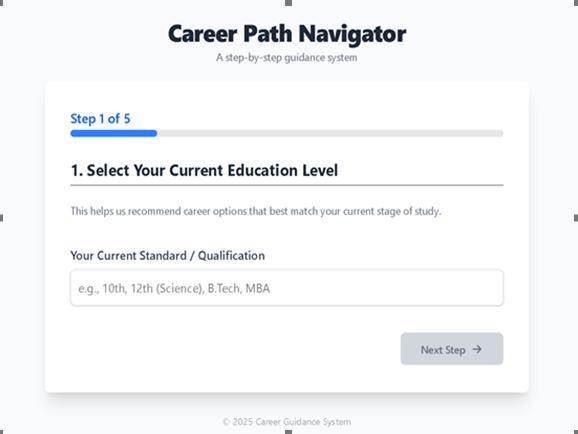
The user interaction flow is designed to be simple and intuitive. Users are guided through a sequence of steps: selecting education level, academic stream, interests, and skills.
Each step is presented on a separate screen to minimize confusion and reduce cognitive load. Large buttons, clear labels,andminimaltextareusedtoimproveusability.
6. Career Recommendation Algorithm
Arule-basedweightedscoringalgorithmisimplementedto analyze user inputs. Each parameter is assigned a weight basedonitsimportance.Suitabilityscoresarecalculatedfor eachcareeroption,andcareersarerankedaccordingly.
This approach ensures transparent and explainable recommendations.
7. Software Development
The frontend is developed using React with Vite for fast rendering and responsive design. JavaScript is used for implementing application logic. The system runs in ChromiumkioskmodeonRaspberryPiOS.
8. Multilingual and Audio Integration
Multiple Indian languages are supported. Offline text-tospeechfunctionalityprovidesvoiceguidance.
9. Testing and Validation
The system is tested under offline conditions. Functional testing verifies feature correctness, while performance testingevaluatesresponsetimeandstability.
Thekioskispreparedfordeploymentinruralschools,NGOs, andPanchayatoffices.Startupautomationensuresthatthe systemlaunchesautomaticallyonpower-up.
The Smart Career Guidance Kiosk for Rural Students is plannedasalow-cost,scalable,andself-containedsolution aimedatprovidingstructuredandaccessiblecareerguidance in rural and semi-urban environments. The project plan
2026, IRJET | Impact Factor value: 8.315 | ISO 9001:2008 Certified Journal | Page689
International Research Journal of Engineering and Technology (IRJET) e-ISSN: 2395-0056
Volume: 13 Issue: 02 | Feb 2026 www.irjet.net p-ISSN: 2395-0072
focuses on delivering a system that is technically reliable, easy to use, and independent of continuous internet connectivity. Special emphasis is placed on simplicity of deployment,affordability,andlong-termsustainability.
The project planning process begins with identifying the primary goals of the system, which include enabling independent career exploration, improving awareness of diverse career opportunities, and supporting informed educational planning. These goals are translated into functionalobjectivessuchasofflineoperation,multilingual support,user-friendlyinterfacedesign,andaccuratecareer recommendation.
The project is organized into multiple phases to ensure systematicdevelopmentandqualitycontrol.Theinitialphase involves requirement gathering and analysis, where interactionswithstudentsandeducatorshelpidentifykey challengesfacedduringcareerdecision-making.Thisphase also defines system constraints related to hardware cost, powerconsumption,andeaseofmaintenance.
The second phase focuses on system design, including the selection of hardware components, operating system, frontend framework, and data storage format. Design decisions are guided by factors such as compatibility, stability,andcommunitysupport.Thechosenarchitecture ensuresthatthesystemcanbeeasilyreplicatedanddeployed atmultiplelocations.
Thethirdphaseinvolvesdatasetpreparation.Career-related information is collected, verified, and structured into a consistentformat.Emphasisisplacedonensuringthateach career entry contains sufficient detail to guide students beyondsuperficialunderstanding.Dataconsistencychecks are performed to avoid incomplete or contradictory information.
Thefourthphasecoverssoftwaredevelopment,wherethe user interface, recommendation logic, and multilingual features are implemented. Parallel to this, hardware integration is carried out by configuring the embedded systemandconnectingperipheraldevicessuchasdisplayand speaker.
The fifth phase consists of system testing and validation. Functional testing verifies that each module operates correctly, while integration testing ensures that hardware and software components work together seamlessly. Performancetestingevaluatesresponsetime,stability,and offlinebehaviour.
Thefinalphaseincludesdocumentationandpreparationfor deployment. User manuals, installation guidelines, and maintenanceproceduresareprepared.Thisphasedproject
planensurestimelycompletion,reducesdevelopmentrisks, andimprovesoverallsystemquality.
The system architecture is designed using a modular and layeredapproachtoensurereliability,scalability,andeaseof maintenance. The architecture consists of four primary layers: user interaction layer, application logic layer, data storagelayer,andhardwarelayer.
Theuserinteractionlayerprovidesthegraphical interface throughwhichstudentsinteractwiththesystem.Itpresents input forms, navigation controls, and result displays. Multilingualsupportisimplementedatthislayer,allowing users to select their preferred language. The interface is designed to be visually simple, with large buttons and minimal text, ensuring usability for students with limited digitalliteracy.
The application logic layer contains the core processing componentsofthesystem.Itvalidatesuserinputs,manages applicationflow,andexecutesthecareerrecommendation algorithm.Thislayeractsasthecentralcoordinatorbetween the user interface and the data storage layer. All decisionmakingprocessesoccurwithinthislayer.
The data storage layer consists of an offline JSON-based database that stores structured career information. The database is stored locally on the embedded system. Data retrievaloperationsareoptimizedtoensurefastaccessand minimallatency.
Thehardwarelayerincludestheembeddedcomputingunit, displaydevice,audiooutputdevice,andstoragemedia.The embedded system hosts the operating system, application software, and database. The display enables visual interaction,whilethespeakerprovidesaudioguidance.
Whenausersubmitsinput,theuserinteractionlayersends thedatatotheapplicationlogiclayer.Theapplicationlogic layer processes the input, retrieves relevant career information from the data storage layer, and generates rankedrecommendations.Theresultsarethensentbackto theuserinteractionlayerfordisplayandaudiooutput.
This architecture ensures complete offline operation, fast responsetime,andstableperformance.Themodulardesign alsosupportsfutureenhancementssuchasdatasetexpansion and algorithm improvement without major architectural changes.
© 2026, IRJET | Impact Factor value: 8.315 | ISO 9001:2008 Certified Journal | Page690
International Research Journal of Engineering and Technology (IRJET) e-ISSN: 2395-0056
Volume: 13 Issue: 02 | Feb 2026 www.irjet.net p-ISSN: 2395-0072
The Smart Career Guidance Kiosk for Rural Students was successfully implemented and evaluated under offline operatingconditionstoverifyitsfunctionality,stability,and suitabilityforruraldeployment.Theevaluationfocusedon assessingthesystem’sabilitytocollectuserinputs,generate personalizedcareerrecommendations,supportmultilingual interaction, and operate reliably without internet connectivity.
Multipletestscenarioswerecreatedtorepresentstudents withdifferenteducationlevels,academicstreams,interests, andskillcombinations.Thesescenarioswereusedtoverify whetherthesystemproducedcareerrecommendationsthat aligned logically with the provided inputs. The system consistently generated relevant career suggestions corresponding to selected parameters, indicating correct functioningoftherule-basedrecommendationalgorithm. Thekioskwasoperatedcontinuouslyforextendeddurations toobservesystemstability.Duringtesting,thesystemdidnot exhibit crashes, unexpected behaviour, or significant performance degradation. The interface remained responsive, and transitions between screens occurred smoothly.
Languageswitchingfunctionalitywastestedbychangingthe interface language at different stages of interaction. The systemcorrectlyupdatedallinterfaceelementsandoutput textaccordingtotheselectedlanguage.Audioguidancewas synchronizedwiththedisplayedcontent,ensuringconsistent multimodalfeedback.
The system was also evaluated for offline performance by operating it in an environment without any network connection. All features, including data retrieval, recommendation generation, andaudiooutput,functioned correctly.Thisconfirmsthatthekiosk doesnotdependon externalserversoronlineservices.
Overall, the results demonstrate that the Smart Career Guidance Kiosk fulfils its intended objectives of providing accessible,reliable,andofflinecareerguidancesuitablefor ruralenvironments.
The React-based web interface plays a critical role in ensuringeffectiveuserinteraction.Theinterfaceisdesigned tobesimple,intuitive,andvisuallyuncluttered.Eachstageof the career guidance process is presented on a separate screen,allowinguserstofocusononetaskatatime.
Large buttons, clear labels, and consistent layout are used throughouttheinterfacetoreducecognitiveload.Thisdesign approachisparticularlyimportantforuserswhohavelimited experiencewithdigitalsystems.Navigationbetweenscreens isstraightforward,withminimalstepsrequiredtoprogress throughtheguidanceflow.
Multilingual support is implemented within the interface, allowing users to select their preferred language at the beginningofthesession.Allsubsequentscreens,instructions, and output results are displayed in the selected language. This feature significantly improves accessibility for rural students.
Theinterfaceloadsquicklyandrespondspromptlytouser input.Fastrenderingandsmoothtransitionsenhanceuser experienceandreducefrustrationduringinteraction.
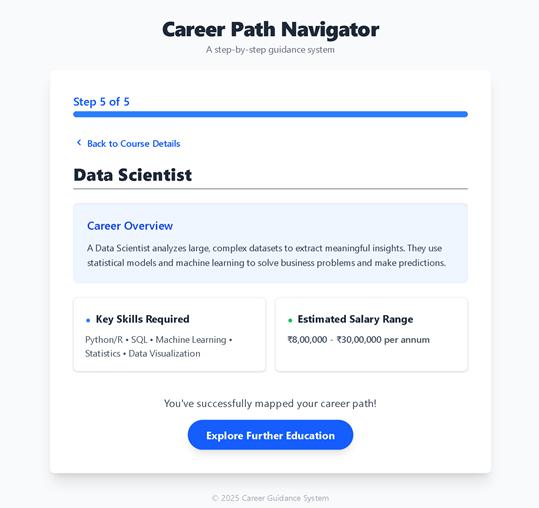
Thesystemgeneratespersonalizedcareerrecommendations immediatelyafterprocessinguserinputsthroughtherulebasedweightedscoringalgorithm.Theoutputispresentedin a structured and organized manner, making it easy for studentstounderstandandinterprettheresults.
Theoutputtypicallyincludesarankedlistofsuitablecareer options along with supporting information such as career description, required education level, and recommended courses.Insomecases,additionaldetailssuchaskeyskillsor certifications are also displayed to provide a clearer understandingofthecareerpathway.
All output data is retrieved from the offline JSON-based career database stored locally within the kiosk. Since the
2026, IRJET | Impact Factor value: 8.315 | ISO 9001:2008
International Research Journal of Engineering and Technology (IRJET) e-ISSN: 2395-0056
Volume: 13 Issue: 02 | Feb 2026 www.irjet.net p-ISSN: 2395-0072
databaseisaccessedlocally,dataretrievalandprocessingare fastandreliable.Thesystempresentsresultsinbothtextand audioformats,allowingstudentstoeitherreadorlistento theguidance.
The consistency of output across multiple test scenarios indicates correct functioning of the recommendation algorithm and dataset structure. The system avoids presenting contradictory or irrelevant career options, therebymaintainingthereliabilityofguidance.
Theoutputpresentationisdesignedtosupportindependent exploration. Students can scroll through multiple recommended careers and review information for each option at their own pace. This encourages deeper understandingandhelpsstudentsmakeinformeddecisions abouttheirfutureeducationandcareerpaths.
TheSmartCareerGuidanceKioskforRuralStudentshasbeen successfullydesignedandimplementedasalow-cost,offline, multilingual,andself-guidedcareercounsellingsystemaimed at addressing the critical shortage of structured career guidanceinruralandsemi-urbanregions.Theprojectfocuses on providing accessible and reliable career information to students who otherwise have limited exposure to professionalcounsellingservicesandonlinecareerguidance platforms.
The system integrates embedded hardware with a locally hosted web application and an offline career database to deliver personalized career recommendations based on
education level, academic stream, interests, and existing skills.Byemployingarule-basedweightedscoringalgorithm, the system generates explainable and transparent recommendations that allow students to understand the basis of suggested career options. This approach is particularly suitable for educational environments where clarityandtrustareessential.
One of the key strengths of the proposed system is its completeindependencefrominternetconnectivity.Alldata storage, processing, and recommendation logic are performed locally within the kiosk. This design choice ensures reliable operation in rural areas with poor or no network coverage and eliminates dependency on external servers.Additionally,offlineoperationimprovesdataprivacy, asnopersonalinformationistransmittedoutsidethesystem.
The inclusion of multilingual support and audio guidance significantlyenhancesaccessibility forrural studentsfrom diverse linguistic backgrounds and for those with limited reading ability. The simple and intuitive user interface furtherensuresthatstudentswithvaryinglevelsofdigital literacycaninteractwiththesystemindependently.
Experimental evaluation under offline conditions demonstratesthatthekioskoperatesreliably,providesfast response,andgeneratesrelevantcareerrecommendations. Thesystemremainsstableduringextendedoperationand supports smooth language switching and user interaction. TheseresultsindicatethattheSmartCareerGuidanceKiosk ispracticalforreal-worlddeploymentinruralschools,Gram Panchayatoffices,NGOs,andcommunitylearningcentres.
Overall,theprojectsuccessfullymeetsitsacademic,technical, andsocialobjectives.Itdemonstratesthatembeddedsystems combinedwithintelligentyetexplainablesoftwarelogiccan beeffectivelyusedtodeliveressentialeducationalservicesin underservedregions.TheSmartCareerGuidanceKioskoffers a scalable and sustainable model for extending career guidance to rural populations and has the potential to contribute significantly to improving career awareness, reducing uninformed career choices, and supporting inclusiveeducationacrossIndia.
TheSmartCareerGuidanceKioskforRuralStudentsprovides a strong foundation for delivering offline and accessible careerguidance.Severalenhancementscanbeincorporated in future work to further improve the functionality, intelligence,andimpactofthesystem.
Onemajorareaofimprovementistheexpansionofthecareer dataset. Currently, the system utilizes a structured offline database containing a limited set of representative career
© 2026, IRJET | Impact Factor value: 8.315 | ISO 9001:2008 Certified Journal | Page692
International Research Journal of Engineering and Technology (IRJET) e-ISSN: 2395-0056
Volume: 13 Issue: 02 | Feb 2026 www.irjet.net p-ISSN: 2395-0072
options.Infutureversions,thedatasetcanbeexpandedto include a larger number of careers across traditional, professional,vocational,andemergingdomains.Additional attributes such as detailed course syllabi, entrance examination information, internship opportunities, and career progression pathways can also be incorporated. A largerdatasetwillenablemorecomprehensiveguidanceand increasetherelevanceofrecommendations.
Anotherimportantenhancementinvolvestheintegrationof artificialintelligenceandmachinelearningtechniques.While thecurrentsystememploysarule-basedweightedscoring algorithm, future versions can incorporate supervised or hybridlearningmodelsthatadaptbasedonhistoricalusage patternsandfeedback.Machinelearning models canlearn relationships between user profiles and successful career outcomes,therebyimprovingrecommendationaccuracyover time. However, such models can be implemented while retainingexplainabilitytomaintainusertrust.
Periodic internet-based update mechanisms can be introduced in future versions. Although the system is designedtooperateoffline,occasionalinternetconnectivity can be used to download updated datasets, new career information, and software patches. This approach ensures that the kiosk remains current while preserving offline functionalityfordailyoperation.
Amobileapplicationversionofthesystemcanbedeveloped toextendaccessibilitybeyondphysicalkiosks.Alightweight mobileappoperatingonsimilarlogicanddatasetstructure canallowstudentstoaccesscareerguidancefrompersonal deviceswhilemaintainingofflinesupport.
Integration with government education and skill developmentschemesrepresentsanothersignificantfuture enhancement.Linkingrecommendedcareerswithrelevant government training programs, scholarships, and skill certificationschemescanprovidestudentswithactionable pathways rather than only informational guidance. This integration can strengthen the practical usefulness of the system.
Advanced voice interaction capabilities can also be introduced. Future versions may support speech-to-text input, allowing students to answer questions verbally. Natural Language Processing (NLP) techniquescan enable conversational interaction, making the system more userfriendlyandinclusive.
Additionalanalyticsfeaturescanbeincorporatedtosupport educationalplanning.Aggregatedandanonymizedusagedata canprovideinsightsintopopularcareerinterests,skillgaps, andregionaltrends.Suchinformationcanassisteducators andpolicymakersindesigningtargetedtrainingprograms.
Security and data management can also be enhanced by incorporatingencryptionforlocallystoreddataandsecure update mechanisms. While the system currently does not store personal data, future versions may include optional userprofiles,whichwouldrequirestrongerdataprotection measures.
Overall, these future enhancements will make the Smart Career Guidance Kiosk more intelligent, scalable, and impactful. By progressively incorporating advanced technologies while retaining its core offline and low-cost design philosophy, the system can evolve into a comprehensive career guidance platform for rural and underservedcommunities.
[1]Mohiuddin,M.B.,Kavya,K.,Anusha,K.,Meghamala,G.,& Shruthi,S.IntelligentCareerGuidanceSystem.International JournalofEngineeringandScienceResearch(2025).
[2]SnehaH.S.,ShreyaR.,SoumyaS.,&SahanaB.C.Intelligent Career Guidance System using Machine Learning. InternationalJournalofAdvancedResearchinComputerand CommunicationEngineering(IJARCCE,2022).
[3] Sameeha Afrin A., Rasheeda R. M., Safrin Shahana A., Revathi D., & Sugantha S. Smart Career Assistance Portal UsingAIandReal-TimeIndustryInsights.IJRASET(2025).
[4]KritikaVishwakarma &PeeyushKumarPathak.Design andImplementationofaCareerGuidancePortalEmbedded with Digital Library and Skill Assessment Tool. IJSRSET (2025).
[5]SakirH.Faruque,SharunAkterKhushbu&SharminAkter. Unlocking Futures: A Natural Language Driven Career PredictionSystemforCS&SWEStudents.arXiv(2024).
[6] Grafiati Collection: Joshi, K., Raut, A., Raut, S., et al. AI Career Guidance Tool. 2024 International Conference on Progressive Innovations in Intelligent Systems and Data Science(IEEE).
[7]GrafiatiCollection:El-Khalili,N.,Dardese,K.S.,Alotaibi,N. T., et al. AI-powered Career Guidance System. 2025 ComputationalInternationalIntelligenceApplications(IEEE)
© 2026, IRJET | Impact Factor value: 8.315 | ISO 9001:2008 Certified Journal | Page693