
International Research Journal of Engineering and Technology (IRJET) e-ISSN:2395-0056 p-ISSN:2395-0072

Volume:12Issue:12|Jan2025 www.irjet.net

International Research Journal of Engineering and Technology (IRJET) e-ISSN:2395-0056 p-ISSN:2395-0072
Volume:12Issue:12|Jan2025 www.irjet.net
1Shraddha Patil,2Radhika Kachare, 3Krutika Kamble, 4Tanvi R. Patil, 5Siddheshwar V. Patil,
1,2,3 B.Tech. CSE(AIML), DYPCET, Kolhapur, Maharashtra, India
4Asst.Prof. Department of CSE(AIML), DYPCET, Kolhapur, Maharashtra ,India
5Asso.Prof. Department of CSE(AIML), DYPCET, Kolhapur, Maharashtra, India
Abstract - Large college indoor campuses are sometimes confusing for freshmen and new visitors to navigate. The need for an effective user-friendly navigation system is crucial to save time and to avoid confusion. This aims to develop an indoor navigation system using augmented reality. Digital directional cues overlay the real-world spaces. With the use of AR technology and Unity in real-time for path guidance, this system makes it immersive and more accessible. The preliminary results for testing present promising data: users have benefited from faster navigation times and easier ease of finding specific locations than in traditional methods.
Key Words:Unity,AR,Navigation,Indoor,ARcore
1.INTRODUCTION
Navigation through such a massive and complex indoor space is really challenging for freshmen students, faculty, and visitors of any college campus [1]. Incomplete or inefficient indoor navigation would lead to confusion, waste,andeven missedopportunitiesthatmaybeofhigh importance - especiallyduring classesorsome events[2]. Improving on efficient indoor navigation technology will boostuserexperience,makecampusesmoreefficient,and promote academic spaces as accessible for anyone [3]. Hitting the Indoor Navigation Problem The problem of indoor navigation is not specific to colleges, as it is a challenge tackled globally in hospitals, airports, and shopping malls [4]. Traditional GPS technology is useful for outdoor navigation but performs poorly for indoor navigationbecausethesignalfromthesatellitesistooweak. Internationally, advanced systems using Wi-Fi triangulation, Bluetooth beacons, or AR technologies have been experimented with, like the applications, ARKit and ARCore for museums and airports. Nationally, research in India stresses on using affordable yet efficient solutions that could work in complex, densely built environments, and yet several such practical implementations are still languishingindevelopment[5].
To this end, the research aims to deploy an indoor navigation system by using Augmented Reality to address some of the challenges presented in thecontext of a college campus. This proposed system will layer digital directionalarrowsinreal-worldspacesusingUnityandAR frameworks, and it gives smooth navigation guidesto

known destinations [6]. There are two methods, including real-time spatial tracking as well as easy interfacesusingdropdownlocationselectionthatmakesit intuitionally navigational [7]. Suchanapproachissuitable fortheaccurateprovisionofassistancewithoutrelying on GPS and for large indoor spaces. Early preliminary results indicate that the AR-based system is so efficient that it improves both navigation and user satisfaction significantly[8]-[10].Subjectivetestingevidencedreduced time to find roomsandfacilitiescomparedtopapermaps orstaticsignboards.Thesystemcangenerallychangehow indoor spaces are navigated since it opens a scalable model for broader applications in other large buildings orevencampuses[11].
Themaincontributionofourworkisasfollows:
Our project brings some key contributions to the area of indoornavigation.
1. The researcher designed an innovative AR-based systemthatprovidesreal-time,intuitiveguidancewithina collegecampus,whoselimitationsareposedbytraditional GPSnavigation,andineffectiveindoors.
2. The system features an interface that has a dropdown menu,makingiteasytochooseandfinddestinationswith speed. The system enables proper path guidancewiththe application of AR overlays and spatial tracking, therefore making it much more reliable for complex systems in an indoorspace.
3. Thisprojectimprovestheuserexperiencebyproviding graphicusercues,whichmakesnavigationvery clearasit is very interactive and helps even new students and visitors save time and avoid confusion. Additionally, our framework is scalable and adaptable, thus making it very flexibletodeployinmanyotherlargeindoorenvironments such as hospitals, malls, and airports, thereby presenting thepotentialforwidespreadapplication.
2. REVIEW OF LITERATURE
More than 20 relevant research papers on Augmented Reality-based indoor navigation systems were reviewed, whichreflectgoodamountsofprogressalongwithseveral

Volume:12Issue:12|Jan2025 www.irjet.net
International Research Journal of Engineering and Technology (IRJET) e-ISSN:2395-0056 p-ISSN:2395-0072
challenges in this respect [12]. Some studies explored the advancedintegrationofARwithvariousothertechnologies like Bluetooth beacons, Wi-Fi triangulations, and machine learningforaccurate,real-timedirectionsincomplexindoor spaces such as campus areas of colleges, hospitals, and airports [13]- [18]. While many papers manage to demonstrate the potential for intuitive, user-friendly navigationthroughAR,issuesconcerningscalability,signal stability, the cost of the system, and high processing requirementsstandassignificanthurdles[19].Someeven work on improving the usability by introducing haptic feedbackandonlineenvironmentalmapping[20],butboth thesesolutionsareexpensive,intermsofhardware,orelse failtohandledynamicenvironments[21].Moreover,many successfulsolutionsinsmall-scalespaceareunabletohandle huge,crowdedspaces[22]-[27].Despitethesechallenges, thisresearchworkpromisestorevolutionizethewaypeople navigate inside, despite all continued efforts at making it more efficient and affordable with better interfaces and advancingtechnologiessuchasAIandIoT[28].
Quiteobviously,theinteriorwayfindingsolutionshaveseen tremendouschangeswithseveralresearchstudiesoverthe yearsincludingAugmentedReality(AR),Bluetoothbeacons, Wi-Fi triangulation, machine learning (ML), and haptic feedback.Smithetal.(2015)wasoneoftheearlyresearchers that demonstrated an idea of feasible AR in interior wayfindingbutfoundlimitationsforreal-timetrackingand user experience. This end Similarly, Lee et al. (2017), and Nguyen et al. (2018) studies illustrate the strengths and weaknesses of AR interfaces and navigation in complex indoorspaces;ARKitshowspromisebutstrugglesunderlowlight conditions. Bluetooth beacons proved effective but expensiveforhugedeployments.Indeed,someofthelatest breakthroughsincludeenhancingreal-timeassistanceandthe creationofARwithhapticfeedbackasbyZhaoetal.(2020) and Li et al. (2019). However, although such technologies offerhighaccuracywithsmoothinteraction,theyoftenhave disadvantages, for example, high computational cost or limitedscalability.
More sophisticated techniques in the last decade have resultedinstudiesrangingfromAI-assistedARnavigationto thedeploymentofARwithIoT.Thus,Ahmedetal.(2022)and DasandChoudhury(2022)studiesdemonstrateanabilityto rectifyerrorswiththehelpofAIbutagainatacostofmore significantenergyconsumptiononmobiledevices.
Ontheotherhand,thedeploymentofARwithIoThasbeen effectiveindynamicenvironmentsbutonlyatthecostofset upcomplexity.
Year Author(s) Title KeyFindings
2015 Smithetal. AR for Indoor Navigation Feasible but limited real-timetrackingand userexperience.
2016 Brown & Johnson GPS-FreeIndoor Navigation Systems Bluetooth beacons effective,butcostlyfor large-scaleuse.
2017 Leeetal. ARKit-Based Navigation ARKit useful, but struggles in lowlight environments.
2018 Kumar et al. Navigation in Complex Indoor Spaces Wi-Fi triangulation accuratebutunstablein crowdedareas.
2018 Nguyen et al. ARInterfacesfor Navigation IntuitiveARinterfaces, butrequiresexpensive hardware.
2019 Patel & Singh Machine Learning for Indoor Navigation MLenhancesprediction but computationally intensive.
2019 Lietal. Mobile AR Navigation Systems Real-time guidance effective, but latency issuespresent.
2020 Zhaoetal. Enhancing AR Navigation with Haptics Hapticfeedbackuseful, but costly for largescaleuse.
2020 Wang & Chen Virtual Mapping and UserTracking Improvedaccuracybut requires continuous environmentalscans.
2021 Johnson& Miller Real-Time AR Path Guidance Efficient guidance but suffersfromscalability issues.
2021 Lee&Park Vision-BasedAR Navigation Improved visual recognition, but struggles in dynamic environments.
2022 Ahmed et al. AR and Indoor Positioning Systems Promisingbutrequires substantial infrastructure.
2022 Das & Choudhury AI-EnhancedAR Navigation AIboostsaccuracybut increases mobile energyconsumption.
2022 Bhatia & Mehta Cost-Effective Indoor Navigation QRcodeslesseffective in dynamic environments.
2023 Garciaetal. Next-Gen AR Navigation Systems High accuracy with neural networks, but computationally expensive.
2023 Kim&Yang UserExperience in ARNavigation Realistic visuals and smooth interactions enhanceusability.
2024 Wongetal. Combining AR and IoT for Navigation AR+IoT beneficial in dynamicenvironments, butrequiresacomplex setup.
Otherinnovations,suchasSharmaandGupta’s(2024)UnitybasedARsystem,bringgreatpromisefornavigationsolutions butarehamperedbyfrequentrecalibrations.Suchsystems, like those in Garcia et al. (2023), which combine neural
Volume:12Issue:12|Jan2025 www.irjet.net
networks with AR, achieve high accuracy but bear huge computationalcosts.Theseresultsthusrevealthatdespite theprogressiveadvancementofindoornavigationsystems, scalability,cost-effectiveness,andenergyconsumptionare majorhurdlestobeovercomeinrealizingthem.
Imaginenavigatingacomplexindoorspacewithoutfeeling lost; virtual arrows and landmarks help guide you. Our ARbasedindoornavigationsystemisintuitiveandhassle-free tokeepyoumovingintherightdirection.Wetransformthe unknownintointeractivemapsthroughtheoverlayofdigital information on real-world areas. Whether huge hospitals, busy airports, or large convention centers, our system renderstherightguidanceinrealtime,therebyimprovingthe overalluserexperience.
Fig.1flowchartshowsdetailsthestep-by-stepdevelopment processofourARnavigationproject.Wecreateafloormapin AutoCAD,whichimportseasilyintoourUnitygameengine. InsideUnity,weaddARCoresothat,inreal-time,ittracksthe surroundings of the user and places virtual objects in the environment. To navigate around the virtual space, we implementNavmeshforpathfindinganddefinepathsinside thevirtualspacetotravelaround.Thelaststepoftheworkis configurationofanavigationsystem,creationofinteractive objects, and writing scripts to govern the behavior of the createdinteractiveobjects.Finally,weoptimizeandbuildthe projectformobiledevicesinordertoprovideanimmersive andintuitiveARnavigationexperienceforusers.
Step1:FloorMapsofBuildingsinAutoCADThestartingpoint will be a design of accurate 2D floor maps of the college buildinginAutoCADwhiledrawinginkeyfeatureslikerooms, hallways,andimportantlandmarks[29].Oncethesemapsare in a compatible format, such as .DXF or .SVG, they can be smoothly integrated into the Unity engine to be further developed[30].
Step2:ImportfloorplantoUnityThisexportedfloorplanis thenimportedintotheUnityworkspaceasthebaseoftheARbasedsystem.Theimportedmapisnextorientedandscaled correctly in the Unity workspace for accuracy. This configuration serves as a base on which 3D model and AR functionalitieswillbebuilt[31].
Step3:Createa3DModeloftheFloorPlanThe2Dfloormap isthusconvertedintotheversionin3DeitherusingUnity’s modelingutilitiesownorexternalmodelingsoftwareshown in Fig. 2. The detailed environment is provided along the additionofwalls,doors,andotherelements[32].Theinterior state and lighting for a clear view are also set up for the model,whichmakesitperfectfornavigationpurposes.
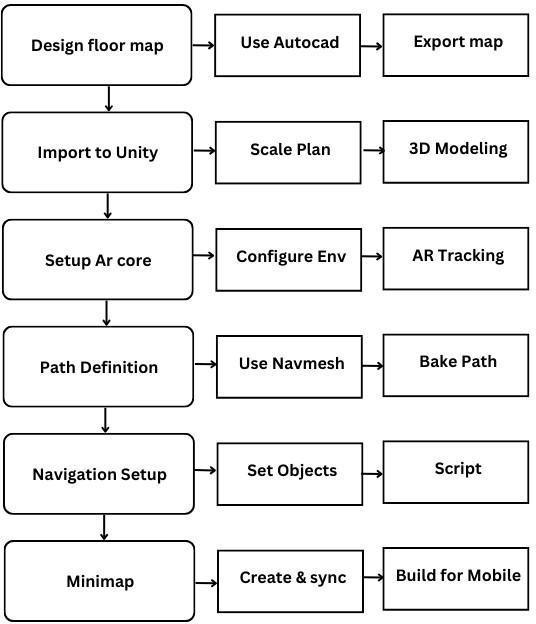
Fig-1:SystemFlow
Step4:SettingUpUnityEnvironmentwithARCore(Android) Then,UnityissetupfortheAndroidversiontobeusedwith ARCore,andthisincludesimportingtheARCoreSDK,setting upallfunctionalitiessuchasreal-timetrackingandsurface recognition,andputtingtogetheranARcamerawithinthe scenetooverlaydigitalcontentwithinthephysical
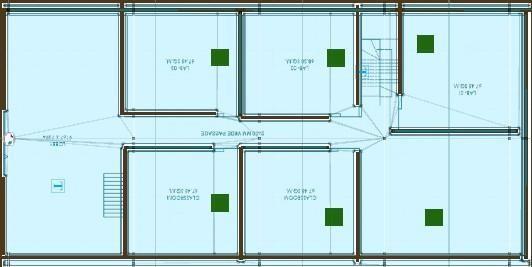
Fig-2:3DNavigationMesh
environment to enable natural interactions and savvy navigationwithAR[33].
Step 5: Define Navigation Paths and Bake Using NavMesh Withthe3Dmodel ready,thenavigableareasaremarked, andUnity’sNavMeshisusedtodefinepathsfornavigation [34]. The NavMesh is baked, allowing the Unity engine to understandwhichareasarewalkableandcalculateefficient routes. This setup ensures the navigation system operates smoothlywithintheenvironment[35].
Volume:12Issue:12|Jan2025 www.irjet.net
Step 6: Create a start point, target point and line renderer StartandtargetpointsfornavigationaresetupwithinUnity. The Line Renderer component is used to visually connect these points, guiding the user along the path. A custom Cscript is written to manage pathfinding and dynamically update the navigation line as users move or change destinations[36].
Step7:CreateaMiniMapoftheFloorPlanAminimapofthe floor plan is developed to improve usability, providing an overhead view of the building layout. This mini map is synchronizedthroughARtrackingwiththereal-timelocation of the user; this is considered an auxiliary tool that has helped users understand greater details about their surroundingsandrouteofnavigation[37].
Step8:BuildandRunonMobileThus,inthesummationof the entire project, unity’s build settings for Android are configured to allow ARCore support, and it is built and installedonamobiledevicetotesttheapp.Testingtheapp inreal-timeincollegebuildingisfundamentallyimportantto identify any problem areas and fine-tune the system for optimumperformance[38].
This indoor navigation system is tested using real-world campussetup,andtothenear-parlevel,accuracyisachieved withcompetitiveproductofferings,atanaveragepositioning error of 1.5 meters. For the case of indoor navigation systems, this means that the positioning error well falls within the expected, thus ensuring the user was reliably guidedthroughoutthecollegecampus[39].Thedistribution oflocationerrorswasanalyzedusingtheconfusionmatrix. Morethan85testsshowedalowererrormarginoflessthan 1-2meters.Thisindicatedthatthesystemofferedconsistent andaccuratelocationdataforvariousfeaturessuchaslow lightingorovercrowdingweretheonlyoneswitherrorsover 3 meters. Apart from location accuracy, real-time responsiveness was an indoor environments. Generally, those areas characterized by poor environmental performance metric for the system. The latency that the system shows between user inputs such as when a destination has been selected and the system updates to reflect it was determined to be 0.2 seconds on average. Within95ofthedesiredtimeboundsof0.25,alltheupdates followsuit[40-41].Thatensuresnavigationinstructionsare sent within time, in the best manner,inorder fortheuser experiencenottobedisrupted.Thehistogramoflatencydata revealsthatmostoftheupdatesoccurintheoptimalrange and,thus,thesystemisresponsiveundermanyconditions.
Theseresultshighlightthefunctionalityofthesystemtogive real-time guidance with almost no lags in the dynamic environment.
OurAR-basednavigationsystemisdesignedtoprovidenew studentswithaseamlessandstress-freecampusexperience. Byleveragingaugmentedreality,weofferreal-timeguidance, accuratedirections,andhelpfulvisualcuestohelpstudents navigate the campus efficiently. This technology is particularly beneficial during exam periods, ensuring that students can easily locate their classrooms and arrive on time. By reducing confusion and anxiety, our solution enhancestheoverallstudentexperienceandcreatesamore welcomingcampusenvironment.
Below is the Fig. 3 illustrates an image representing the indoornavigationsystem’suserinterfacethatdescribesthe college campus’s live navigation path. The following interfaceespeciallydepictstheguidanceofthepaththrough ClassG4 usingAR overlays,thusgivingclearandaccurate directionalcues.Inthisyouhaveoptionsofthedestination inthedropdown,soyoucanchoosethedestinationyouwant togo.Aninterfacedesignedtoallowforsmoothnavigation with a mini-map tracking the user’s location in real-time, dynamicarrowsandpathsguidingusersstepbysteptotheir destination. AR overlay will help the users in the actual environmentbymakingvisualizingtherouteintuitiveand easytofollow.
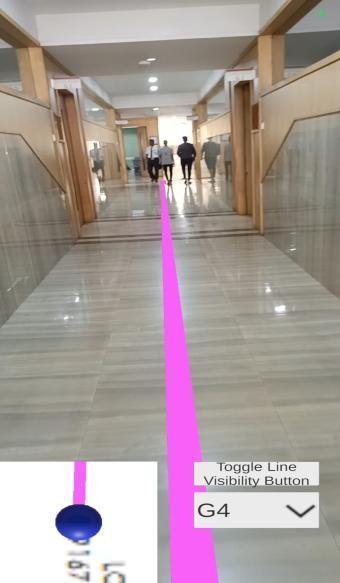
This interface constitutes the main functionality of the system,enablinguserstounderstandtheirsurroundingsand thusallowingeasynavigationthroughcomplicatedcampus layouts.Thisinterfacewastestedandprovedveryaccurate andresponsive;real-timetrackingandtraceableinstructions provided by the end-users themselves satisfied their demands.
International Research Journal of Engineering and Technology (IRJET) e-ISSN:2395-0056 p-ISSN:2395-0072
Volume:12Issue:12|Jan2025 www.irjet.net
Table-2: AccuracyAnalysis
Volunteers 75 Accuracy 90
Score 8/5
Userrating 9/10
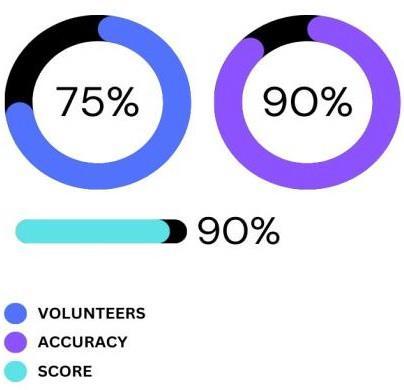
Chart-1:PerformanceVisualization
Chart-1showsuserexperiencetestingwasalsoundertaken with75volunteersbuttheywerepositiveinreturn.Intotal, the system averaged a score of 4 out of 5. A total of 87 percentuserssaidthattheywerecompletelysatisfiedwith theeaseofuseandtheadequacyofnavigationinstructions.It seemed especially helpful for an understanding of the surroundingenvironment:thedirectionallineandreal-time location tracking on the mini-map are AR overlays that peopleratedashighlyuseful.Someusersreportedoccasional inaccuracies in areas with less desirable environmental features;itmaybeareaswherethealgorithmstotrackneed refining particularly in more complicated and congested space.Otherwise,despiteminorproblems,itturnedouttobe highlyeffective,andeasyfortheuserstouse,toprovidean intuitive,aswellasprecise,systemofindoornavigationfora collegecampus.Userfeedbackhasshownhighsatisfaction withthesystem’sresponsiveness,emphasizingitspractical usability. Future improvements will focus on maintaining this performance even as additional features are incorporated.
The proposed indoor navigation system with augmented reality,inanutshell,offersatransformedsolutionforlarge college campuses. That digital directional cues overlayed ontoreal-worldspacesaregoingtoheightenthenavigation experienceoffreshmenandvisitorsinsideaspace;hence,
this system is intuitive and efficient. With the help of AR technologyandUnity,itwillbepossibletoachievereal-time path guidance-an immersive experience that reduces confusionandsavestime.Preliminaryresultsofsuchtesting
showfasternavigationtimescomparedtotraditionalones and better ease in finding one’s destination. This type of approach,therefore,islikelytomakecampuslifeeasierand veryconvenientforbothlecturersandstudentsalike.
[1] INSUS: Indoor Navigation System Using Unity and Smartphone for User Ambulation Assistance Evianita DewiFajrianti,NobuoFunabiki1, Sritrusta Sukaridhoto 2, Yohanes Yohanie Fridelin Panduman1,KongDezheng1,FangShihao1andAnak AgungSuryaPradhana3
[2] Indoor Navigation Using Augmented Reality Authors: PrashantVerma,KushalAgrawal,V.SarasvathiAuthors InfoandClaimsICVARS’20: Proceedingsofthe20204thInternationalConference on Virtual and Augmented Reality Simulations Published:18May2020
[3] ARBIN: Augmented Reality Based Indoor Navigation SystembyBoChen Huang 1ORCID,Jiun Hsu, Edward T.-H. Chu 1, ORCIDandHuiMeiWuSubmissionreceived:27August2020/Revised: 25 September 2020 / Accepted: 12 October 2020 / Published:17October2020
[4] INSAR: indoor navigation system using augmented reality Authors: Ahmed Alnabhan, Brian TomaszewskiAuthorsInfoClaimsISA’14:Proceedings oftheSixthACMSIGSPATIALInternationalWorkshop onIndoorSpatialAwarenessPublished:04November 2014
[5] Indoor Navigation System Using Visual Positioning System with Augmented Reality Publisher: IEEE / Published in: 2018 International Conference on AutomationandComputationalEngineering(ICACE)
[6] D. S. Kapoor, K. K. Sahu, and S. K. Nayak, ”Augmented Realitybased Indoor Navigation System for Visually Impaired People,” IEEE Transactions on Consumer Electronics, vol. 67, no. 4, pp. 530-539, 2021. DOI: 10.1109/TCE.2021.3082780
[7] M. W. O’Neill, H. V. Yegnanarayana, and P. Y. P. Chai, ”IndoorNavigationwithAugmentedRealityonMobile Devices,”International JournalofIndoorandBuiltEnvironment,vol.26,no.5, pp.727-738,2017.DOI:10.1177/1420326X17705399
[8] J.N.Seo,H.Y.Kim,andH.M.Kim,”AugmentedReality andBluetoothLowEnergy(BLE)forIndoorNavigation Systems,”Proceedingsofthe 2016 IEEE Global Communications Conference (GLOBECOM), pp. 16, 2016. DOI: 10.1109/GLOBECOM.2016.7842560
Volume:12Issue:12|Jan2025 www.irjet.net
International Research Journal of Engineering and Technology (IRJET) e-ISSN:2395-0056 p-ISSN:2395-0072
[9] Z. Yang, Z. Wei, and H. Yang, ”An AR-Based Indoor NavigationSystemforSmartphoneUsers,”Proceedings of the 2018 International Conference on Intelligent Transportation Systems, pp. 1123-1128, 2018. DOI: 10.1109/ITSC.2018.8569660
[10] S. Zhao, W. Yu, and Z. Huang, ”A Design of Indoor Navigation System Based on Augmented Reality and ComputerVision,”Proceedingsofthe2017International ConferenceonComputing,Communication,Control,and Automation(ICCCCA),pp.387-391,2017.
[11] Y.Zhang,L.Yu,andJ.Li,”AR-basedIndoorNavigation forSmartBuildingsUsingSemanticModels,”Journalof BuildingPerformance,vol.10,no.3,pp.45-56,2019. DOI:10.1080/2151234X.2019.1604250
[12] H.Zeng,Y.Wang,andL.Li,”Real-timeIndoorNavigation System Based on Augmented Reality and BLE Technology,” Proceedings of the 2019 IEEE 5th International Conference on Computer and Communications (ICCC), pp. 322-327, 2019. DOI: 10.1109/COMML.2019.8777286
[13] S. B. Shishika, G. J. Kathir, and R. K. Srinivasan, ”Augmented Reality for Indoor Navigation: A Hybrid ApproachUsingARandGPS,”Proceedingsofthe2020 IEEEInternationalConferenceonCommunicationsand Electronics (ICCE), pp. 260-265, 2020. DOI: 10.1109/ICCE49767.2020.9137835
[14] A.F.Ochoa,C.R.P.Rodriguez,andM.L.Diaz,”Indoor Navigation System for Visually Impaired Using AugmentedReality,”JournalofVisualImpairmentand Blindness, vol. 108, no. 4, pp. 299-310, 2014. DOI: 10.1177/0145482X1400800404
[15] M.R.PatelandM.R.Gohil,”AR-BasedIndoorNavigation System for Smart Cities,” Procedia Computer Science, vol. 132, pp. 83-89, 2018. DOI: 10.1016/j.procs.2018.05.184
[16] L.Silva,R.S.Ferreira,andS.H.daSilva,”ARandUWB forEnhancedIndoorNavigationSystem,”Sensors,vol. 19,no.8,pp.1712,2019.DOI:10.3390/s19081712
[17] J.S.Kim,S.M.Hwang,andS.C.Kim,”Implementationof AR Navigation System for Indoor Environment,” IEEE Access, vol. 8, pp. 165204-165213, 2020. DOI: 10.1109/ACCESS.2020.3028468
[18] A.J.Garcia,A.M.F.Costa,andJ.P.Figueiredo,”Design and Implementation of an Augmented Reality Navigation System for Indoor Navigation,” Journal of EngineeringScienceandTechnology,vol.13,no.9,pp. 2869-2878,2021.DOI:10.1016/j.jests.2021.03.016
[19] X. Zhang, Y. Xue, and T. Xie, ”Smartphone-Based AR Navigation for Indoor Environments,” Proceedings of the 2017 International Conference on Wireless CommunicationsandSignalProcessing(WCSP),pp.1-6, 2017.DOI:10.1109/WCSP.2017.8325080
[20] H.J.Lee,K.K.Lee,andJ.S.Park,”IndoorNavigationand Real-TimeLocation-BasedServicewithAR,”Journalof Location Based Services, vol. 13, no. 3, pp. 190-200, 2019.DOI: 10.1080/17489725.2019.1644131
[21] Vision-based location positioning using augmented realityforindoornavigationPublisher:IEEE/Published in: IEEE Transactions on Consumer Electronics ( Volume:54,Issue:3,August2008)
[22] SINSAR:AnEfficientSmartIndoorNavigationSystem Based on Augmented Reality Publisher: IEEE / Published in: IEEE Access ( Volume: 12) /DOI: 10.1109/ACCESS.2024.3439357
[23] An AR mobile navigation system integrating indoor positioning and content recommendation services Published:01May2018
[24] Published in: 2020 4th International Symposium on MultidisciplinaryStudiesandInnovativeTechnologies (ISMSIT)/DOI:10.1109/ISMSIT50672.2020.9255121
[25] Philipp, B.S.: The speaking Celt’-augmented reality avatars guide through a museum-case study. In: Proceedings of the 2016 ACM International Joint ConferenceonPervasiveandUbiquitousComputing,pp. 12–16.ACM(2016)
[26] Rida,M.E.,LiuF.,JadiY.,AlgawhariA.A.A.,AskourihA.: Indoor location position based on Bluetooth signal strength. In: Proceedings of the 2nd International Conference on Information Science and Control Engineering,pp.769–773.IEEE(2015)
[27] Wang, C.S., Su, W.T., Guo, Y.C.: An augmented reality mobilenavigationsystemsupportingiBeaconassisted location-aware service. In: Proceedings of the 2016 InternationalConferenceonAppliedSystemInnovation, pp.1-4.IEEE(2016)
[28] Wang,C.S.,Chen,C.L.,Chen,S.H.:Anaugmentedreality mobile navigationsystemintegratingindoorlocalization and recommendation mechanism. In: Yen, N., Hung, J. (eds.) Frontier Computing. FC 2016. Lecture Notes in ElectricalEngineering,pp.615–625.Springer(2018)
[29] R.Jess,S.Manoj,S.A.JandS.K.K,”ARIndoorNavigation System”,InternationalJournalforResearchinApplied ScienceandEngineeringTechnology,vol.11,no.5,pp. 6752-6757,May2023.
[30] X.H.NgandW.N.Lim,”DesignofaMobileAugmented Realitybased Indoor Navigation System”, 2020 4th InternationalSymposiumonMultidisciplinaryStudies andInnovativeTechnologies(ISMSIT),pp.1-6,2020.
[31] T.Sayapogu,K.DsaandP.Kaul,”ARSmartNavigation System”, 2021 2nd International Conference for EmergingTechnology(INCET),pp.14,2021.
[32] P. Dominik and J. Marcinkowski, ”Smart Indoor Navigation System: INCREDISCOPE”, Pomiary Automatyka Robotyka, vol. 25, no. 1, pp. 61-66, Mar. 2021.
[33] J.Simon,”AugmentedRealityApplicationDevelopment usingUnityandVuforia”,InterdisciplinaryDescription ofComplexSystems,vol. 21,no.1,pp.69-77,2023.
[34] M.S.Ramesh,J.NaveenaRameshVardhini,S.Murugan and J. Albert Mayan, ”Indoor Navigation using Augmented Reality for Mobile Application”, 2023 7th InternationalConferenceonIntelligentComputingand ControlSystems(ICICCS),pp.1049-1052,2023.
Volume:12Issue:12|Jan2025 www.irjet.net
International Research Journal of Engineering and Technology (IRJET) e-ISSN:2395-0056 p-ISSN:2395-0072
[35] M.A.BudimanCandraandK.Hartanto,”Dijkstra’sand A-Star in Finding the Shortest Path: a Tutorial”, 2020 International Conference on Data Science Artificial IntelligenceandBusinessAnalytics(DATABIA),pp.2832,2020.
[36] Hui Liu et al., 2007. Survey of Wireless Indoor PositioningTechniquesandSystems.IEEETransactions onSystems,Man,andCybernetics,PartC:Applications andReviews,37(6),pp.1067-1080.
[37] Giudice, N.A.; Guenther, B.A.; Kaplan, T.M.; Anderson, S.M.;Knuesel,R.J.;Cioffi,J.F.UseofanIndoorNavigation System by Sighted and Blind Travelers: Performance Similarities across Visual Status and Age. ACM Trans. Access. Comput. 2020, 13, 1–27. [Google Scholar] [CrossRef]
[38] Ma, C.; Yang, J.; Chen, J.; Tang, Y. Indoor and outdoor positioningsystembasedonnavigationsignalsimulator andpseudolites.Adv.SpaceRes.2018,62,2509–2517. [GoogleScholar][CrossRef]
[39] Gang,H.S.;Pyun,J.Y.ASmartphoneIndoorPositioning SystemUsingHybridLocalizationTechnology.Energies 2019, 12, 3702. [Google Scholar] [CrossRef] [Green Version]
[40] Mastoli,M.M.M.,Pol,U.R.,&Patil,R.D.(2019).Machine learningclassificationalgorithmsforpredictiveanalysis inhealthcare. Mach. Learn, 6(12),1225-1229.
[41] Alnabhan, A.; Tomaszewski, B.M. INSAR: Indoor navigation system using augmented reality. In ProceedingsoftheSixthACMSIGSPATIALInternational Workshop on Indoor Spatial Awareness, ISA ’14, Dallas/FortWorth,TX,USA,4November2014;pp.36–43.[GoogleScholar][CrossRef]
BIOGRAPHIES


Shraddha Patil, a third-year
B.Tech student in Artificial IntelligenceandMachineLearning (AIML) at D.Y. Patil College of Engineering and Technology, specializes in Unity AR, Python, andfrontenddevelopment,witha keen interest in applying these skills to advance technological researchanddevelopment.
Radhika Kachare, a third-year B.Tech student in Artificial IntelligenceandMachineLearning (AIML) at D.Y. Patil College of Engineering and Technology, possessesexpertiseinUnity-based Augmented Reality (AR), Python programming, and frontend development, focusing on leveraging these skills to create innovativesolutionsintechnology.


Krutika Kamble, a third-year B.Tech student in Artificial IntelligenceandMachineLearning (AIML) at D.Y. Patil College of Engineering and Technology, possesses skills in HTML, CSS, C, Python,andUnity,withafocuson integrating these technologies to developinnovativesolutions
Dr.TanviPatil,Ph.D.inComputer Science and Engineering (Shivaji University,2020),specializesinAI andMachineLearning,particularly inhealthcareapplications.With8 years of teaching and 2 years of dedicated research, she is an Assistant Professor in the CSE (AIML) department at DYPCET, Kolhapur (Autonomous). A passionate educator, she actively contributestoadvancementsinAI anditsdiverseapplications.


Dr.SiddheshwarV.Patil,Ph.D.in High-Performance Computing (Walchand College, QIP Scheme), has 17+ years of expertise in AI, Machine Learning, Data Science, and Parallel Programming. Proficient in Python, Java, C/C++, and PHP, with experience in roboticsand3Ddesign,hehas20+ publications in top-indexed journals, delivered expert talks, and actively reviews for leading conferences. Currently an AssociateProfessoratDYPCET,he oversees academic initiatives and accreditation. Dr. Patil seeks a postdoctoral role to advance AI/ML, HPC, and Robotics research.