
International Research Journal of Engineering and Technology (IRJET) e-ISSN: 2395-0056
Volume: 12 Issue: 04 | Apr 2025 www.irjet.net p-ISSN: 2395-0072
International Research Journal of Engineering and Technology (IRJET) e-ISSN: 2395-0056
Volume: 12 Issue: 04 | Apr 2025 www.irjet.net p-ISSN: 2395-0072
K.
Narayana Rao1, S. Sampath kumar2 , K. Mohan Kishor3 , P. Lalitha4, E. Balaram hari5 , K. Vasundhara6
1Assistant Professor, EEE, Visakha institute of engineering & technology, Visakhapatnam, Andhra Pradesh, India 2,3,4,5,6UG Student, EEE, Visakha institute of engineering & technology, Visakhapatnam, Andhra Pradesh, India ***
Abstract - A solar tracking system that is both affordable and easy to implement is detailed in this project. This project has developed a solar tracking system with two axes, allowing for greater energy harvesting from the sun. An arduino Uno has served as the central processing unit (CPU) for this endeavor. Four light-dependent resistors (LDRs) were employed to measure the sun's angular position in the sky, and two servo motors were employed to rotate the solar PV panel's orientation. Everything is in working order with the servo motor and sensors. The PV panel and the servo motor are now mechanically coupled. Everything has been put together and tested to ensure the system is working properly. When this tracker detects that the sun is directly overhead, it will adjust the solar panel's orientation accordingly. A dual-axis solar tracker increases the efficiency of the solar panel by constantly following the sun's movement across the sky.
Key Words: Arduino, LDRs, Solar PV System, Renewable energy,DCMotor.
Oneofthemostwidespreadandlong-termviableenergy options now is solar power. Nevertheless, the direction of photovoltaic(PV) panels inrelation tothe sun determines theirefficiency.Thefluctuatinganglesofthesuncausefixed solarpanelstocapturelessenergyasthedayprogresses.A solutiontothisproblemisthedevelopmentofsolartracking systems,whichaimtocollectthemaximumamountofenergy fromthesun.Bydynamicallymodifyingthepanel'sazimuth and elevation angles, dual-axis solar trackers offer the maximumefficiency.Withanemphasisoncontrolalgorithms, sensorintegration,andArduino-basedimplementations,this literature review delves into previous research on active dual-axissolartrackersthathavefocusedonsimulationand prototyping[1]
Therearetwomaincategoriesofsolartrackingsystems: passiveandactive.Motors,sensors,andcontrollersenable active trackers to follow the sun's movement, while mechanical componentsorthermal expansionareusedby passivetrackers.Whencomparingsingle-axisanddual-axis trackingsystems,itisclearthatthelatterareinferior.The formerallowformoreaccuratePVpanelorientationallday longandinallseasons[2].Severalstudieshaveshownthat,
incomparisontofixedpanels,dual-axistrackerscanenhance energycaptureby25-40%[3]
Theefficiencyofasolartrackerlargelydependsonthe control algorithm used to adjust the panel's position. Commonly employed algorithms include: Light-dependent algorithms:Theseuselightsensorssuchas LDRstodetect sunlight intensity and drive motors accordingly [4] Mathematical models: Some trackers use preprogrammed solarpositionequationstopredictthesun'strajectory [5] Hybrid methods: Combining sensors and mathematical models enhances accuracy and system robustness [6] Arduinomicrocontrollersarewidelyusedinimplementing these algorithms due to their affordability and ease of programming. Accurate tracking relies heavily on sensors. ThesimplicityandlowcostofLDRsmakethemacommon choice.Nevertheless,weatherconditionshavethepotential toimpactthem,resultingininaccuratetracking. Thereare alternative sensors that provide better accuracy, like photodiodesandpyranometers.Improvingtiltcontrolusing InertialMeasurementUnitshasbeeninvestigatedbyafew researchers[7]
Becauseofitsopen-sourcestatus,libraryavailability,and compatibilitywithawiderangeofsensorsandmotordrivers, Arduino is a favorite among prototyping solar tracking systems.Researchby[8]showsthattrackerscontrolledby Arduinocanbeeffectivelyimplementedwithservomotors, steppermotors,andDCmotors.Wi-FiandBluetooth,among other wireless communication modules, allow for remote control and monitoring [9] Solar tracker performance is typically modeled using simulation tools like PVsyst, MATLAB/Simulink,andProteusbeforephysicalprototyping. Controlstrategyoptimization,energygainassessment,and tracking accuracy validation are all aided by these simulations [10]. Researchers have recently used neural networksandotherAI-basedmethodstoenhancetracking efficiency[11]
Thispaperisstructuredasfollows:Section1introduces the concept of Dual-Axis Solar Tracking Systemsand their importance in optimizing solar energy capture. Section 2 provides an overview of solar trackers, differentiating betweenpassiveandactivesystems.Section3discussesthe methodology,includingsimulationandhardwaresetupfor the dual-axis solar trackingsystem. Section 4 presents the
International Research Journal of Engineering and Technology (IRJET) e-ISSN: 2395-0056
resultsandanalysisofsystemperformance.Finally,Section5 concludesthestudyandsuggestsfutureresearchdirections.
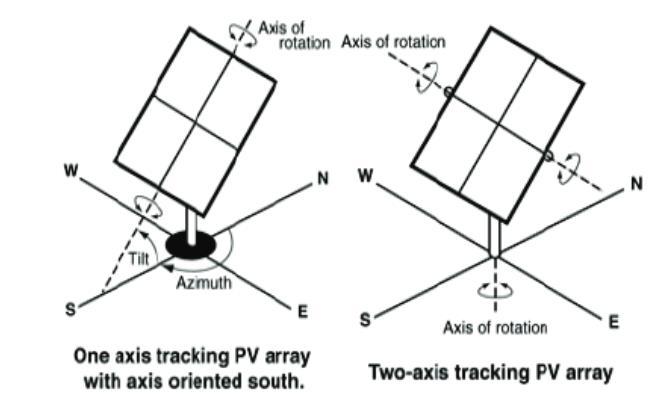
As shown in Figure 1, Static solar panels are the most commonwaytocollectsolarenergy.Theefficiencyofsolar energy harvestingcan be improved in other ways,though. The efficiency of solar trackers was found to be 30-60% higherthan that ofstatic PVpanels. Inaddition,a variable elevationsolartrackercanincreaseannualpowerproduction byover40%.Tomaintainanearlyconstantenergyoutput throughout the day, photovoltaic panels must rotate in a specificwayinresponsetothesun'sangularmotioninthe sky.Asolartrackersystemisnecessaryforthistohappen.
UsinganArduino,thisprojectaimstocreateaworking prototypeofasolartimealgorithmthatisbasedonadualaxis solar tracker. Furthermore, the outcomes were compared to the results obtained when considering the performanceofthesolarenergyharvestingdual-axissolar trackingmethodandstaticsolarpanel.
3.1 Block diagram
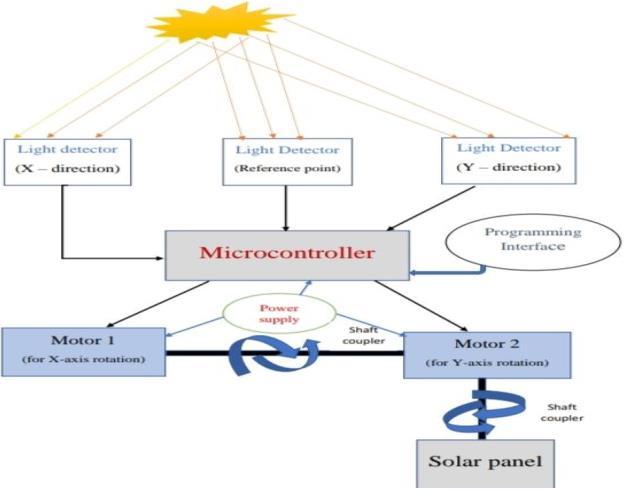
ThegivenblockdiagramasshowninFigure2represents an active dual-axis solar tracking system using a microcontroller,sensors,andmotors.Here'sabreakdownof its key components are Light Detectors (Sensors), Microcontroller, Motors for Dual-Axis Movement, Power SupplyandSolarPanel.Therearethreelightdetectors.one for the X-direction, one for the Y-direction, and one as a referencepoint.Thesesensorsdetectsunlightintensityand providesignalstothemicrocontrollerforadjustment.Itacts as the brain of the system, processing data from the light sensors.
Based on the sensor inputs, it determines the required movement of the solar panel and controls the motors accordingly.Motor1(X-axisrotation)controlsthehorizontal movement(East-Westdirection).Motor2(Y-axisrotation) controls the vertical movement (North-South direction). Shaft couplers connect the motors to the solar panel,
enablingsmoothmovement.Providesthenecessaryvoltage and current to operate the microcontroller, sensors, and motors.Thisallowsforuploadingandmodifyingthecontrol algorithminthemicrocontroller.
-
Thesolarpanelismountedonthetrackingsystemand followsthesun’spositionthroughoutthedayformaximum energy absorption. Thelight detectorscontinuouslysense the intensity of sunlight. The microcontroller processes these signals and determines whether the panel needs to move.Ifmovementisrequired,itactivatestheappropriate motortoadjustthepanel'sorientation.Thisensuresthatthe solar panel is always facing the sun for optimal energy generation.Thissystemsignificantlyenhancestheefficiency of solar panels compared to fixed systems by dynamically trackingthesun.
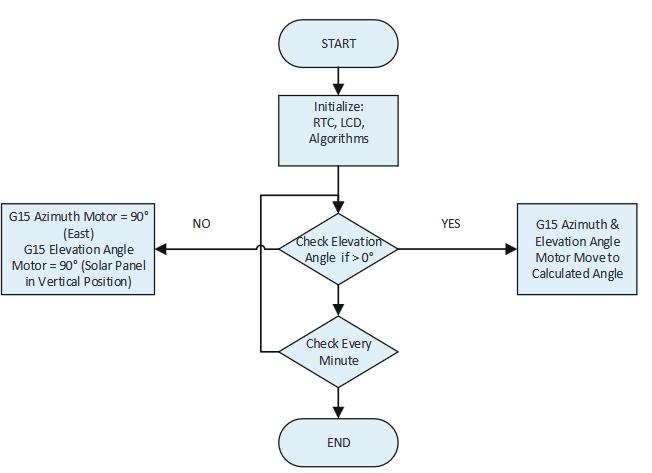
The given flowchart shown in Figure 3, outlines the workingalgorithmofasolartracker,particularlyforadualaxis system that adjusts both azimuth (horizontal) and elevation(vertical)angles.Here'sastep-by-stepbreakdown: Thealgorithmbeginsexecutionwhenthesystemispowered on. The system initializes key components such as: RTC (Real-Time Clock): Keeps track of time for sun position calculations. LCD Display Used to show system status and parameters. Algorithms Control logic for adjusting panel orientation. The system checks if the elevation angle is greater than 0° (i.e., the sun is above the horizon). If the elevation angle > 0°, The system calculates the required position and moves both the azimuth motor (East-West movement)andelevationmotor(up-downtilt)totrackthe sun accurately. If the elevation angle = 0° or lower, the systemsetsthemotorstoadefaultposition(Azimuth=90° (East),Elevation=90°(Verticalposition)).Thisensuresthat duringnighttimeorwhenthesunisbelowthehorizon,the panel is properly aligned for the next sunrise. The system
Volume: 12 Issue: 04 | Apr 2025 www.irjet.net p-ISSN: 2395-0072 © 2025, IRJET | Impact Factor value: 8.315 | ISO 9001:2008
International Research Journal of Engineering and Technology (IRJET) e-ISSN: 2395-0056
Volume: 12 Issue: 04 | Apr 2025 www.irjet.net p-ISSN: 2395-0072
checksthesun’spositioneveryminutetoensurereal-time adjustments. The system continues tracking and updating thesolarpanel’sorientationinaloopuntilpoweredoff.
3.3 Simulation study
Figure 5 shown the simulation diagram of proposed system.Thegivenimagerepresentsasolartrackingsystem simulatedinTinkercadusinganArduinoUno,lightsensors (LDRs),servomotors,andabatterypowersupply.Here’sa breakdown of the components and their roles: The main microcontroller,whichprocessessensordataandcontrols themovementofthesolarpanel bysendingsignalstothe servo motors.ItreceivesinputfromtheLDRsandadjusts thepanel'sorientationaccordingly.Thecircuitcontainsfour LDRs arranged in a voltage divider configuration. These sensors detect sunlight intensity and send signals to the Arduinotodeterminethesun’sposition.
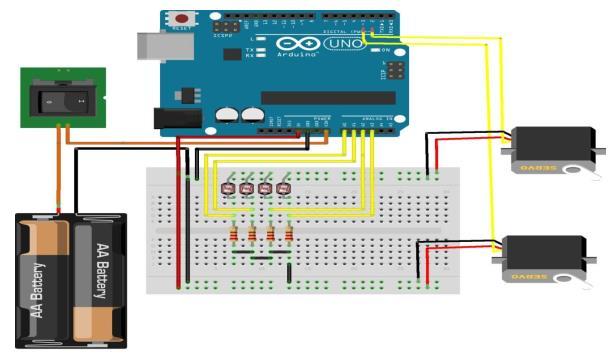
Two servo motors are used to provide dual-axis movement:Oneforhorizontal(azimuth)movement(EastWestdirection).Oneforvertical(elevation)movement(tilt up-down). The Arduino adjusts the servo angles based on theLDRreadings.BreadboardandResistorsThebreadboard
connectstheLDRstotheArduinowithpull-downresistors, ensuringstablereadings.Theresistorshelpinbalancingthe voltage from the LDRs for accurate signal processing. The systemispoweredbyaAAbatterypack,supplyingenergyto boththeArduinoandmotors.Aswitchisincludedtocontrol thecircuit’spowersupply.
Figure 5 shows the prototype of the project. The solar panel,whichisdirectlylinkedtoaload,ismountedontop. Theprecisevoltage,whichisdependentontheamount of light hitting the panel and the tracker's location, may be measuredbyconnectingavoltmeteroranLEDtotheload. Solartrackersneedtobepositionedappropriatelyinorder to gather energy from concentrated solar photovoltaics, which have optics that directly absorb sunlight. Concentrated solar systems rely on trackers to ensure proper orientation toward the sun, which is essential for energy production. The solar panel is only a device that accepts light radiation; its control is by means of lightdependentresistor(LDR)sensors,andtheloadthatmaybe connectedtoitisdeterminedbythepanel'srating.
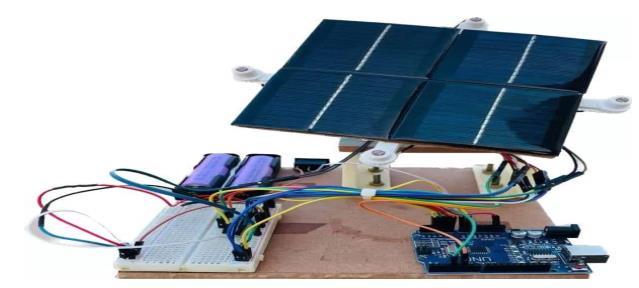
Table -1: Hardwarespecification
A gadget that detects light and moves towards the brightestspotiscalledadualaxissolartracker.Itcanfollow light from any direction because to its design. In order to mimic the overall motion of the Sun, the tracker's whole coverageinbothdirectionsistakenintoaccountas120˚.The startingpointforboththeeast-westandnorth-southservo motorsis90˚. Whenthethresholdvaluerisesbeyondthe
International Research Journal of Engineering and Technology (IRJET) e-ISSN: 2395-0056
Volume: 12 Issue: 04 | Apr 2025 www.irjet.net p-ISSN: 2395-0072
tolerance limit, the tracker's position will only go up or down.
The data collection period for the measurements was a fullday,beginningat7:11a.m.andendingat6:54p.m.The graphswerecreatedusingthemeasureddataobtainedfrom the data logger. The solar tracker was programmed to retrievedatabyfollowingthealgorithmsthatweredefined, whilethestaticsolarpanelwasinclinedata15-degreeangle towardsouth.
Boththesolartrackerandthestaticpanel'soutputvoltage vs time are displayed in Figure 7. At 1.06 p.m., with an azimuthangleof64.53°andanelevationangleof166.24°, the solar tracker reported a maximum output voltage of 5.03V. As the output voltage hovered at 8.72V, the static panelrecordedit.
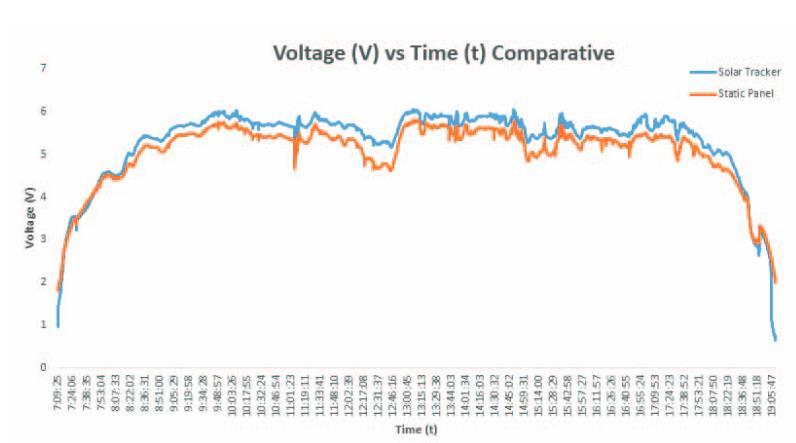
Fig -6 : Alookatthepoweroutputfrombothstationary solarpanelsandsolartrackingsystems
Solar tracking technologies and a static solar panel's output current vs time are shown in Figure 8. With an azimuthangleof63.29°andanelevationangleof218.85°, the solar tracker reached its maximum output current of 93mA at 328 p.m. At the same time, the static panel measuredanoutputcurrentofabout101mA.
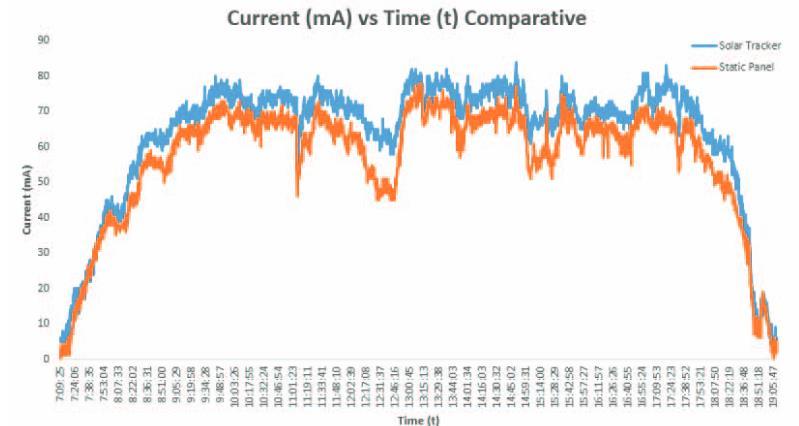
Fig-7: Thecomparisonbetweensolartrackingmethods andstaticsolarpanelsfortheoutputcurrent
Research goal in creating the Dual Axis Solar Tracker prototypewastofindtheexactspotwherethesun'sraysare strongest,sothatoursolarpanelscouldproducethehighest possiblevoltage.Wearepleasedtohavecontributedtoour community after many failed attempts at completing our project.Thereareafewkinksinthisendeavor,asthereare witheveryexperiment.
(i)Panelissensitivetolightwithinacertainrange;outside ofthisrange,itdoesnotprovideanyfeedback.
(ii)Itdeterminesthelocationofthepanelbycalculatingthe vectorsumofallthelightsources,whichitdoeswhenthe panel is illuminated by diffused light. We managed to complete this job with very few resources. Simplicity was maintainedinthecircuitry,
[1] K. Achuthan et al., "Remote Triggered Dual-Axis Solar IrradianceMeasurementSystem,"inIEEETransactions onIndustryApplications,vol.56,no.2,pp.1742-1751, March-April2020,doi:10.1109/TIA.2020.2966156.
[2] S.L.JurjandR.Rotar,"IncreasingtheSolarReliability FactorofaDual-AxisSolarTrackerUsinganImproved OnlineBuilt-InSelf-TestArchitecture,"inIEEEAccess, vol.12,pp.37715-37730,2024,doi:10.1109/ACCESS. 2024.3375333.
[3] M.SaeediandR.Effatnejad,"ANewDesignofDual-Axis SolarTrackingSystemWithLDRSensorsbyUsingthe WheatstoneBridgeCircuit,"inIEEESensorsJournal,vol. 21, no. 13, pp. 14915-14922, 1 July1, 2021, doi: 10.1109/JSEN.2021.3072876.
[4] H. Fathabadi, "Novel Online Sensorless Dual-Axis Sun Tracker,"inIEEE/ASMETransactionsonMechatronics, vol. 22, no. 1, pp. 321-328, Feb. 2017, doi: 10.1109/ TMECH.2016.2611564.
[5] S.Asapu,Y.T.R.Palleswari,P.S.Rapaka,M.C.Bade,M. Deenakonda and R. Banothu, "Design and ImplementationofHighVoltageGainDC-DCConverter for solar PV Applications," 2024 International ConferenceonComputationalIntelligenceforGreenand SustainableTechnologies(ICCIGST),Vijayawada,India, 2024,pp.1-5,doi:10.1109/ICCIGST60741.2024.10717 566.
[6] S.Asapu,N.Chilaka,N.S.Pantham,N.Sakalabattula,K.S. Tejitha and R. Lakkabattula, "High-Gain DC-DC ConverterImplementedwithanImprovedSlidingMode MPPT Control for Solar PV Applications," 2024 InternationalConferenceonInnovationandNoveltyin Engineering and Technology (INNOVA), Vijayapura,
International Research Journal of Engineering and Technology (IRJET) e-ISSN: 2395-0056
India,2024,pp.1-6,doi:10.1109/INNOVA63080.2024. 10846995.
[7] T.R.PalleswariYalla,A.Siva,K.P.Swaroopg,G.Durga Prasad,M.DeenakondaandR.Banothu,"Comprehensive AnalysisandPerformanceInvestigationofNon-Isolated DC-DCConvertersinSolarPhotovoltaicApplications," 2024 International Conference on Computational Intelligence for Green and Sustainable Technologies (ICCIGST), Vijayawada, India, 2024, pp. 1-6, doi: 10.1109/ICCIGST60741.2024.10717523.
[8] S. Asapu, L. Juttiga, D. Bhuvaneswari, S. S. Adabala, P. Apireddi and A. Bale, "Implementation of Seven-Level Asymmetrical Multilevel Inverter for Solar PV Application," 2024 International Conference on Distributed Computing and Optimization Techniques (ICDCOT), Bengaluru, India, 2024, pp. 1-5, doi: 10.1109/ICDCOT61034.2024.10516167.
[9] Y.R.Al-Saadi,M.S.Tapou,A.A.Badi,S.AbdullaandM. Diykh,"DevelopingSmartSelfOrientingSolarTracker for Mobile PV Power Generation Systems," in IEEE Access, vol. 10, pp. 79090-79099, 2022, doi: 10.1109/ACCESS.2022.3194026.
[10] C.F.Abe,J.BatistaDias,G.Notton,G.-A.Faggianelli,G. Pigelet and D. Ouvrard, "Estimation of the Effective Irradiance and Bifacial Gain for PV Arrays Using the Maximum Power Current," in IEEE Journal of Photovoltaics,vol.13,no.3,pp.432-441,May2023,doi: 10.1109/JPHOTOV.2023.3242117
[11] A.K.SuriaandR.M.Idris,"Dual-axissolartrackerbased onpredictivecontrolalgorithms,"2015IEEEConference onEnergyConversion(CENCON),JohorBahru,Malaysia, 2015, pp. 238-243, doi: 10.1109/CENCON.2015.7409 546.
Volume: 12 Issue: 04 | Apr 2025 www.irjet.net p-ISSN: 2395-0072 © 2025, IRJET | Impact Factor value: 8.315 | ISO 9001:2008