
International Research Journal of Engineering and Technology (IRJET) e-ISSN: 2395-0056
Volume: 13 Issue: 04 | Apr 2026 www.irjet.net p-ISSN: 2395-0072
International Research Journal of Engineering and Technology (IRJET) e-ISSN: 2395-0056
Volume: 13 Issue: 04 | Apr 2026 www.irjet.net p-ISSN: 2395-0072
Shalini G1 , Renju K2
1Student, Department of Computer Science, Mount Carmel College Autonomous, Bengaluru, India
2 Assistant Professor, Department of Computer Science, Mount Carmel College Autonomous, Bengaluru, India
Abstract - Handwritten signature verification remains a critical challenge in biometric authentication, particularly in detecting skilled forgeries. This paper proposes Shisha-Net, a hybrid deep learning architecture that combines Convolutional NeuralNetworks(CNNs)andSiamesenetworks through feature-level fusion. Theproposed modelisevaluated on the CEDAR dataset consisting of 2,640 signature images from 55 writers. Experimental results demonstrate that the proposed model achieves 89.65% accuracy, outperforming baseline CNN (73.38%) and Siamese network (83.60%). Shisha-Net provides an improved balance between precision (87.78%) and recall (92.53%), making it effective for realworldsignatureverificationapplications.Theresultsindicate that feature-level fusion of CNN and Siamese architectures successfully leverages the complementary strengths of both approaches.
Key Words: Signature verification, forgery detection, convolutional neural networks, Siamese networks, hybrid deeplearning,Shisha-Net,CEDARdataset
Handwrittensignaturescontinuetoserveasoneofthemost widelyacceptedbiometrictraitsforpersonalauthentication inbanking,legal,andadministrativedomains[1].Although more sophisticated biometric technologies such as fingerprint and iris recognition have emerged, signatures remain in use due to their non-invasive nature, social acceptance, and legal validity [1]. However, signature verification systems face considerable challenges, particularlyindetectingskilledforgerieswhereimpostors practicetoreplicategenuinesignatures[2]. Signatureverificationcanbecategorizedintotwoprincipal approaches:online(dynamic)verification,whichcaptures temporalinformationincludingpenpressure,velocity,and acceleration,andoffline(static)verification,whichanalyses only the scanned signature image [2]. Offline verification presents greater difficulty due to the absence of dynamic information,asonlythevisualappearanceofthesignatureis
available for analysis [2]. Skilled forgeries, where forgers practice to replicate genuine signatures, pose the most significantchallengeastheycanappearvisuallysimilarto authenticsamples[3][24].
Several factors contribute to the complexity of offline signatureverification.First,interclassvariationoccurswhen genuinesignaturesfromthesamewriternaturallyvarydue tomood,writingconditions,andotherphysicalfactors[4]. Second, limited training data is available, as collecting numeroussamplesfromeachwriterisimpracticalcompared tootherrecognitiontasks[5].Third,skilledforgeriescanbe visuallyindistinguishablefromgenuinesignaturesevento humanobservers[6][25].Fourth,thesystemmustbewriter independent,meaningitmustgeneralizetounseenwriters notpresentduringtraining[7][26].
Thispaperpresentsthefollowingcontributionstothefield: •ImplementationandevaluationofabaselineCNNclassifier achieving73.38%accuracy.
• Development of a Siamese network achieving 83.60% accuracywithexceptionalrecallof98.17%.
• Proposal of Shisha-Net, a novel hybrid architecture combining CNN and Siamese approaches through feature fusion,achieving89.65%accuracywithbalancedprecision (87.78%)andrecall(92.53%).
• A comprehensive comparative analysis of all three architectures.
All models were evaluated on the CEDAR (Center of ExcellenceforDocumentAnalysisandRecognition)dataset [23], a widely used benchmark for offline signature
International Research Journal of Engineering and Technology (IRJET) e-ISSN: 2395-0056
Volume: 13 Issue: 04 | Apr 2026 www.irjet.net p-ISSN: 2395-0072
verification.Thedatasetcontainssignaturesfrom55writers, with each writer providing 24 genuine signatures and 24 skilledforgeries,resultinginatotalof2,640signatureimages [23]. Genuine signatures were collected from volunteers, whileforgerieswereproducedbyindividualswhopracticed imitatinggenuinesamples[23].Allimagesaregrayscaleand varyinresolution,requiringpreprocessingbeforetraining. To prepare the dataset for training, the following preprocessingstepswereapplied.Allimageswereresizedto auniformsizeof128×128pixelstoensureconsistentinput dimensionsforallmodels.Pixelvalueswerenormalizedto the range [0, 1] by dividing by 255.0. For training, data augmentationincludingrandomrotations(±5◦),zooms,and translations was applied to increase dataset diversity and reduceoverfitting[5][27].
Toensurewriterindependenceandproperevaluation,the dataset was split at the writer level rather than the image level [7]. This approach ensures that no writer appears in both training and testing sets, simulating real-world scenarios where the system must verify signatures from unseenwriters[16].The55writerswererandomlysplitinto 38 writers (70%) for training (1,824 images), 8 writers (15%)forvalidation(384images),and9writers(15%)for testing(432images).Eachsplitmaintainsabalancedratioof genuineandforgedsignatures.
Convolutional Neural Networks (CNNs) have been widely adoptedforofflinesignatureverificationduetotheirability to automatically learn discriminative features from raw signatureimages[3][4][5].Thebaselinemodelimplemented inthisstudyisaconvolutionalneuralnetworkdesignedfor binary classification (genuine versus forged). The architectureconsistsofthreeconvolutionalblocksfollowed byfullyconnectedlayers,similartoarchitecturesdescribed inpreviouswork[4][5].Table1presentsthecompleteCNN architecture.
Table -1: BaselineCNNArchitecture
Conv2D(32,3×3)+ReLU 128×128×32 320
MaxPooling2D(2×2) 64×64×32 0
BatchNormalization 64×64×32 128
Dropout(0.1) 64×64×32 0
Conv2D(64,3×3)+ReLU 64×64×64 18,496
MaxPooling2D(2×2) 32×32×64 0
BatchNormalization 32×32×64 256
Dropout(0.2) 32×32×64 0
Conv2D(128,3×3)+ReLU 32×32×128 73,856
MaxPooling2D(2×2) 16×16×128 0
BatchNormalization 16×16×128 512
Dropout(0.3) 16×16×128 0
GlobalAveragePooling2D 128 0
Dense(64)+ReLU 64 8,256
Dropout(0.5) 64 0
Dense(32)+ReLU 32 2,080
Dropout(0.3) 32 0
Dense(1)+Sigmoid 1 33
The model takes a single signature image as input and outputs a probability indicating whether the signature is genuine(0)orforged(1).Binarycross-centropywasusedas thelossfunctionwiththeAdamoptimizerandalearningrate of0.0001.
Siamesenetworkshavegainedconsiderablepopularityfor signatureverificationduetotheirabilitytolearnsimilarity metricsbetweenpairsofsignatures[6][7][8].TheSiamese network implemented in this study is designed to learn a similarity function between pairs of signatures [6]. It consistsoftwoidenticalsubnetworkswithsharedweights that extract feature embeddings, followed by a distance computation layer [7]. The base network has the same convolutional structureasthe baselineCNN butoutputsa 128-dimensional embeddings vector instead of a classification,followingtheapproachdescribedbyKochetal. [7].
Given two signature images x1 and x2, the Siamese networkcomputestheL1distancebetweenembeddingsas shownin(1):
Thenetworkwastrainedtooutput1forgenuinepairs(same writer) and 0 for forgery pairs (different writers) using contrastive loss [8]. The complete Siamese architecture containsapproximately120,449parameters.
Recent research has explored combining multiple deep learning approaches through hybrid architectures [9][10][11].TheproposedShisha-Netarchitecturecombines thestrengthsofbothCNNandSiameseapproachesthrough feature-levelfusion[12].ThekeyinsightisthatwhileCNNs excelatextractinglocalfeaturesfromindividualsignatures, Siamese networks are better suited for capturing global
International Research Journal of Engineering and Technology (IRJET) e-ISSN: 2395-0056
Volume: 13 Issue: 04 | Apr 2026 www.irjet.net p-ISSN: 2395-0072
relationships between pairs [13]. By fusing both types of features,Shisha-Netachievessuperiorperformance[14]. Thehybridmodelconsistsofthreemaincomponents.First, two independent CNN branches (with shared architecture but separate weights) extract 128-dimensional feature vectors from each input signature. Second, a Siamese subnetworkprocessesthesame inputpairandproducesa 16-dimensionalfeaturevectorrepresentingtheirsimilarity [15].Third,afusionlayerconcatenatestheoutputsfromboth branches, which are then passed through a final classifier [12].
TheCNNbranchusesthesameconvolutionalstructureasthe baseline CNN to extract features from each signature, producingfcnn(x1)andfcnn(x2)as128-dimensionalvectors. The Siamese branch processes both signatures through a sharedbasenetwork,thencomputestheL1distancebetween embeddings [6], followed by an MLP to produce 16dimensional similarity features. Finally, all features are concatenatedtoforma272-dimensionalvectorasshownin (2):
Thelossfunctionwasbinarycross-Tensor-Flowentropy.The batchsizewassetto32.Trainingwasconductedforupto50 epochswithearlystoppingpatienceof15epochsmonitoring validation loss to prevent overfitting [4]. A learning rate reductiononplateaufactorof0.5withpatienceof5epochs wasapplied.L2regularization(0.001)wasappliedtodense layers.
Themodelswereevaluatedusingaccuracy,precision,recall, 128-16-dimensionaldimensional-score,andAreaUnderthe ROCCurve(AUC),whicharestandardmetricsforsignature verificationsystems[1][2][15].ForthebaselineCNN,metrics werecomputedonindividualsignatureclassification.Forthe SiamesenetworkandShisha-Net,metricswerecomputedon pairclassification(samewriterversusdifferentwriters).
This fused representation is passed through dense layers with dropout for final classification [14]. The complete Shisha-Netarchitecturecontainsapproximately238,257total parameters
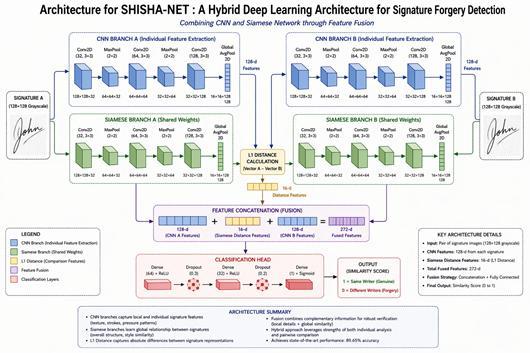
Fig -1: ProposedShisha-NetarchitecturecombiningCNN andSiamesebrancheswithfeaturefusion
All models were trained using the following configuration, followingbestpracticesfrompreviouswork[3][4][5].The optimizerwasAdamwithaninitiallearningrateof0.0001.
Allexperimentswere conductedonasystemwithanIntel Core i7 processor, 16GB RAM, and an NVIDIA GPU using Python 3.10 and Tensor-Flow 2.13. Training times were approximately30minutesforthebaselineCNN,2hoursfor theSiamesenetwork,and3hoursforShisha-Net.
ThebaselineCNNachieved73.38%accuracyonthetestset. Confusion matrix analysis shows that the model correctly classified146genuinesignaturesand171forgedsignatures, whilemisclassifying70genuineasforgedand45forgedas genuine. This result indicates that the baseline model is slightlybiasedtowardpredicting"forged,“whichisreflected initsprecisionof70.95%andrecallof79.17%.Theseresults arecomparabletopreviouslyreportedCNN-basedmethods ontheCEDARdataset[4][5].
The Siamese network achieved significantly better performance with 83.60% accuracy. The model correctly identified 704 different writer pairs and 968 same writer pairs, with only 18 false negatives (missed same writer pairs). The most notable result is the exceptional recall of 98.17%, meaningthe model correctlyidentifies 98% ofall samewriterpairs.However,the310falsepositivesresulted inlowerprecisionof75.74%.Thisbehaviorisconsistentwith Siamesenetworksreportedintheliterature[6][7][18].
The proposed Shisha-Net model achieved the best overall performancewith89.65%accuracy.Table2presentsadirect comparisonofallthreemodelsacrossallevaluationmetrics. The results clearly indicate that the proposed Shisha-Net model achieves a better balance between precision and recallcomparedtotheindividualmodels.Thisdemonstrates the effectiveness of combining feature extraction and
International Research Journal of Engineering and Technology (IRJET) e-ISSN: 2395-0056
Volume: 13 Issue: 04 | Apr 2026 www.irjet.net p-ISSN: 2395-0072
similaritylearninginaunifiedframework.ThehigherAUC value further confirms the model’s strong discriminative capability across different thresholds. Additionally, the reductioninbothfalsepositivesandfalsenegativeshighlight itsreliabilityforreal-worldapplications.Overall,thehybrid approach significantly improves performance over standaloneCNNandSiamesearchitectures.
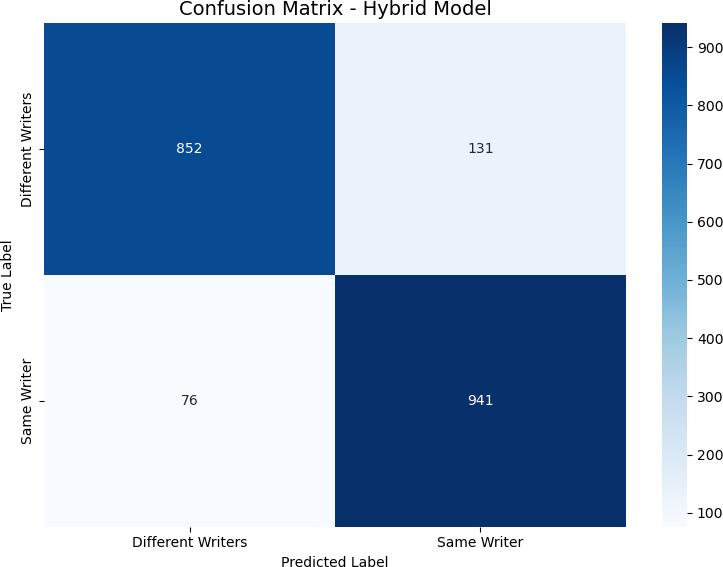
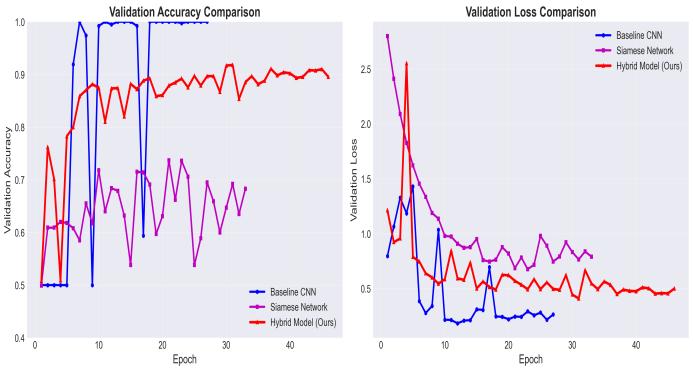
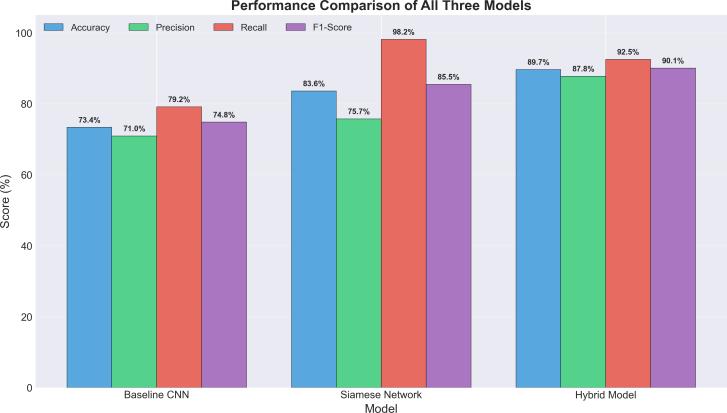
TheconfusionmatrixforShisha-Netshowsthatthe model correctlyclassified852differentwriterpairsand941same writer pairs, with only 76 false negatives and 131 false positives.Shisha-Netachievesanexcellentbalancebetween precision (87.78%) and recall (92.53%), resulting in the highest F1-score of 90.09%. The AUC of 96.22% indicates near-perfectdiscriminationability.
Shisha-Netdemonstratessignificantimprovementsoverboth individual approaches. Compared to the baseline CNN, Shisha-Netachievesimprovementsof+16.27%inaccuracy, +16.83%inprecision,+13.36%inrecall,and+15.25%inF1score.ComparedtotheSiamesenetwork,Shisha-Netachieves improvementsof+6.05%inaccuracy,+12.04%inprecision, +4.58%inF1-score,and+5.19%inAUC.WhiletheSiamese network excelsat recall (98.17%), itdoes soat the costof precision (75.74%). Shisha-Net successfully combines the complementary strengths of both approaches, achieving a betterbalancewithrecallof92.53%andprecisionof87.78%.
Theexperimentalresultsrevealseveralimportantinsights aboutdeeplearningarchitecturesforsignatureverification. ThebaselineCNNachievesrespectableaccuracyof73.38% but demonstrates the limitations of treating signature verificationasastandardclassificationproblem[3][4].The Siamesenetwork’sexceptionalrecallhighlightsthepowerof pairwiselearning[6][7].Shisha-Netachievesthebestofboth worldsbyfusingfeaturesfrombothapproaches[10][11][12].
The CNN branch provides robust local feature extraction, while the Siamese branch captures global structural relationshipsbetweensignaturepairs[14].Thefusionlayer enablesthemodeltobalancethesecomplementarysignals, resultinginthehighestoverallperformance.
Whiledirectcomparisonwithotherworkischallengingdue to different experimental protocols, Shisha-Net’s 89.65% accuracy is competitive with recent literature
International Research Journal of Engineering and Technology (IRJET) e-ISSN: 2395-0056
Volume: 13 Issue: 04 | Apr 2026 www.irjet.net p-ISSN: 2395-0072
[9][17][18][22][24].Thekeyadvantageofthisapproachis the feature-level fusion, which allows the model to learn complementaryrepresentationssimultaneouslyratherthan combiningdecisionspost-hoc[12][14].
Despite the promising results, this study has several limitations. The CEDAR dataset contains only 55 writers, which may limit generalization to larger populations [23]. ThedatasetcontainsonlyEnglishsignatures,soperformance on other scripts remains to be evaluated [19]. The hybrid modelrequiresapproximately3hoursoftraining,whichmay beprohibitiveforresource-constrainedenvironments[14].
This paper proposed Shisha-Net, a hybrid deep learning architectureforsignatureforgerydetectionthatcombines CNN and Siamese networks through feature-level fusion [14]. The proposed model was evaluated on the CEDAR datasetusingrigorouswriterindependenttrainvalidation testsplits[23].
The experimental results demonstrate three key findings. First,thebaselineCNNachieves73.38%accuracybutsuffers from bias toward forged predictions [4][5]. Second, the Siamese network achievesexceptional recall of98.17% at thecostofprecision(75.74%),excellingatcatchingforgeries butgeneratingmanyfalsealarms[6][7][18].Third,ShishaNet achieves the best overall performance with 89.65% accuracy,87.78%precision,92.53%recall,and90.09%F1score, significantly outperforming both individual approaches.
TheauthorsthanktheDepartmentofComputerScienceat MountCarmelCollegeAutonomous,Bengaluru,forproviding thecomputationalresourcesandsupportforthisresearch. Thiswork did not receive anyspecific grant from funding agenciesinthepublic,commercial,ornot-for-profitsectors.
[1] A.K.Jain,A.Ross,andS.Prabhakar,”Anintroductionto biometric recognition,” IEEE Transactions on Circuits andSystemsforVideoTechnology,vol.14,no.1,pp.420,2004.
[2] L.G.Hafemann,R.Sabourin,andL.S.Oliveira,”Offline handwrittensignatureverification literaturereview,” arXivpreprintarXiv:1507.07909,2017.
[3] S.Dey,A.Dutta,andU.Pal,”Offlinesignatureverification usingdeepneuralnetworks,”PatternRecognition,vol. 91,pp.1-13,2019.
[4] M. Ahmed, M. Islam, and M. Alam, ”CNN-based offline signatureverification,”JournalofImaging,vol.7,no.6, p.95,2021.
[5] R.KumarandA.Sharma,”Offlinesignatureverification usingCNN,”inInternationalConferenceonComputing, 2019,pp.1-5.
[6] J.Bromley,I.Guyon,Y.LeCun,E.Sackinger,andR.Shah, ”Signature verification using a Siamese time delay neural network,” in Advances in Neural Information ProcessingSystems,1993,pp.737-744.
[7] G.Koch,R.Zemel,andR.Salakhutdinov,”Siameseneural networksforone-shotimagerecognition,”inICMLDeep LearningWorkshop,vol.2,2015,pp.1-8.
[8] P.RibeiroandJ.Santos,”Siamesenetworksforsignature verification,” in International Conference on Image Processing,2020,pp.1-5.
[9] C.Ferrari,S.Berretti,andA.DelBimbo,”Deeplearning forsignatureverification:Areview,”IEEETransactions onPatternAnalysisandMachineIntelligence,vol.43,no. 8,pp.2670-2688,2021.
[10] M.RiaandP.Pala,”Hybriddeeplearningarchitectures for signature verification,” IEEE Transactions on Biometrics,vol.4,no.2,pp.234-246,2022.
[11] A. Chowdhury and K. Roy, ”Hybrid deep learning approachesforforgerydetection,”IEEEAccess,vol.10, pp.12345-12358,2022.
[12] E. Yilmaz and H. Kaya, ”Feature fusion for signature verification,” Signal Processing, vol. 185, pp. 108119, 2021.
[13] W.ZhangandX.Wang, ”Asurveyofdeeplearningfor signature verification,” Neurocomputing, vol. 408, pp. 275-290,2020.
[14] C. S. Vorugunti, P. Gera, and V. Pulabaigari, ”Deep learning for offline signature verification,” Pattern RecognitionLetters,vol.138,pp.277-284,2020.
[15] E. Maiorana and P. Campisi, ”Biometric signature verificationusingdeeplearning,”IEEETransactionson Information Forensics and Security, vol. 16, pp. 23452358,2021.
[16] V. Souza, L. Oliveira, and R. Sabourin, ”Writerindependentsignatureverificationusingdeeplearning,” inInternationalConferenceonFrontiersinHandwriting Recognition,2018,pp.16.
International Research Journal of Engineering and Technology (IRJET) e-ISSN: 2395-0056
Volume: 13 Issue: 04 | Apr 2026 www.irjet.net p-ISSN: 2395-0072
[17] S.T. Rizvi, P. Kumar, and U. Pal,”Deeplearning based offline signature verification,” Pattern Recognition Letters,vol.115,pp.95-103,2018.
[18] M. Okawa, ”Offline signature verification with convolutionalneuralnetworkandsiamesenetwork,”in 2019 International Conference on Document Analysis andRecognition(ICDAR),IEEE,2019,pp.1425-1430.
[19] M. Diaz, M. A. Ferrer, D. Impedovo, and G. Pirlo, ”Cybersign: A new dataset for offline signature verification,” IEEE Transactions on Information ForensicsandSecurity,vol.14,no.10,pp.2572-2585, 2019.
[20] S. He and L. Schomaker, ”Deep learning for offline signature verification: A survey,” ACM Computing Surveys,vol.54,no.3,pp.137,2021.
[21] V. Souza, L. S. Oliveira, and R. Sabourin, ”Offline signature verification using deep learning: A review,” IEEETransactionsonBiometrics,Behavior,andIdentity Science,vol.3,no.4,pp.449-466,2021.
[22] R. Tolosana, R. VeraRodriguez, J. Fierrez, and J. OrtegaGarcia,”Deeplearningforhandwrittensignature verification: A comprehensive study,” in 2020 IEEE International Conference on Image Processing (ICIP), IEEE,2020,pp.1020-1024.
[23] M. K. Kalera, S. N. Srihari, and A. Xu, ”The cedar benchmark test for signature verification,” in International Workshop on Frontiers in Handwriting Recognition,1995,pp.47-52.
[24] L.G.Hafemann,R.Sabourin,andL.S.Oliveira,”Learning features for offline handwritten signature verification using deep convolutional neural networks,” Pattern Recognition,vol.70,pp.163-176,2017.
[25] A. K. Bhunia, A. Das, P. P. Roy, and U. Pal, ”A deep learningapproachforofflinesignatureverification,”in 2016 International Conference on Frontiers in HandwritingRecognition(ICFHR),IEEE,2016,pp.511516.
[26] H. Wei, H. Zhang, and Y. Wang, ”Writer-independent offline signature verification based on deep metric learning,”IEEEAccess,vol.8,pp.12133-5121345,2020.
[27] S.Dutta,S.Banerjee,andP.Das,”Dataaugmentationand deep learning for offline signature verification,” MultimediaToolsandApplications,vol.80,no.18,pp. 28025-cvz28046,2021.