
International Research Journal of Engineering and Technology (IRJET) e-ISSN: 2395-0056
Volume: 13 Issue: 03 | Mar 2026 www.irjet.net p-ISSN: 2395-0072

International Research Journal of Engineering and Technology (IRJET) e-ISSN: 2395-0056
Volume: 13 Issue: 03 | Mar 2026 www.irjet.net p-ISSN: 2395-0072
¹Gokula Poul & Madhavi Rode, Mr Ananta Valekar²
¹Mr Gokula Poul and Madhavi Rode ¹, Department of Electronics & Telecommunication Engineering, Bhivrabai Sawant polytechnic, Wagholi, Pune, Maharashtra, India
² Mr Ananta Valekar ², Department of Electronics & Telecommunication Engineering, Bhivrabai Sawant polytechnic, Wagholi, Pune, Maharashtra, India
Abstract - Automation has become increasingly significant in industrial, commercial, and educational sectors to enhance efficiency, precision, and operational safety. Conventional paper cutting machines primarily rely on manual alignment and handling, which often result in uneven cutting, increased processing time, and potential safetyrisksforoperators.These limitations are particularly challenging in small-scale offices, schools, and printing environments where accurate and repetitive cutting is essential.
To overcome these issues, this paper presents the design and implementation of a sensor-operatedautomaticpapercutting machine. The proposed system utilizes an infrared (IR) or proximity sensor to detect the presence and proper alignment of the paper. The sensor output is processed by a microcontroller, which controls the cutting mechanism through a motor driver circuit. A DC motor or servo motor is employed to actuate the cutting blade, enabling automatic and precise cutting once correct positioning is achieved. After each cutting cycle, the system resets automatically, ensuring continuous operation.
The developed system significantly reduces manual effort, improves cutting accuracy, and enhances operator safety while maintaining a compact and cost-effective design. It is particularly suitable for small-scale industries, offices, and educational institutions. Future enhancements may include adjustable cutting length control, integration of a digital display, and implementation of IoT-based monitoring for remote operation and real-time performance feedback
Key Words- Automation, Sensor-Based System, Paper Cutting Machine, Safety Mechanism, Embedded Systems, Industrial Applications
Inmanyoffices,printingpresses,packagingunits,andsmallscaleindustries,papercuttingoperationsarestillperformed usingmanualorsemi-manualmachines.Theseconventional systemsrequireoperatorstomanuallyalignthepaperand initiate the cutting process, making the operation timeconsumingandlabor-intensive.Suchmethodsoftenresultin uneven edges, inaccurate dimensions, increased material wastage,andreducedproductivity.Moreover,directhuman interactionwithsharpcuttingbladesposessignificantsafety risks, particularly in the absence of proper protective
mechanisms.Humanfactorssuchasfatigue,inattention,and operationalerrorsfurtherdegradethequalityandefficiency ofthecuttingprocess.
With the rapid advancement of automation, embedded systems, and sensor technologies, there has been a significanttransitionfrommanualoperationstoautomated systems.Automationreduceshumanintervention,enhances precision, and improves overall efficiency. Embedded systems,whichintegratehardwareandsoftwareforspecific applications, play a vital role in modern industrial automation.Componentssuchassensors,microcontrollers, and motor driver circuits are widely utilized to develop intelligent systems capable of performing tasks with high accuracyandreliability.
A sensor-operated paper cutting machine represents an effective application of such automation. In this system, sensorsdetectthepresenceandproperalignmentofpaper before initiating the cutting operation. Once correct positioningisconfirmed,thesystemautomaticallyactivates thecuttingmechanism,ensuringconsistentcuttingquality whileminimizinghumanerror.Thesystemisimplemented usingkeyelectroniccomponents,includinginfrared(IR)or proximitysensors,amicrocontroller,amotordrivercircuit, andaDCorservomotorconnectedtothecuttingblade.The sensor detects the paper position, the microcontroller processestheinputsignal,andthemotordrivercontrolsthe blademovement,formingafullyautomatedcuttingsystem.
This project is particularly suitable for academic and diploma-level implementation due to its use of readily available components, simple programming logic, and a basicmechanicalstructure.Thesystemiseconomical,easy tounderstand,andpracticalforreal-worldapplications.Itis especially beneficial for small-scale industries, offices, schools,andcollegeswherelargeindustrialcuttingmachines are not required. The primary objective of this work is to demonstrate how the integration of sensors, microcontrollers,andmotorcontrolsystemscaneffectively replacemanualoperations,reducepaperwastage,improve cuttingaccuracy,andenhanceoperatorsafety.
International Research Journal of Engineering and Technology (IRJET) e-ISSN: 2395-0056
Volume: 13 Issue: 03 | Mar 2026 www.irjet.net p-ISSN: 2395-0072
Theincreasingdemandforprecision,efficiency,andsafetyin paper processing has highlighted the limitations of conventional manual and semi-manual cutting methods. These systems rely heavily on human intervention, often resulting in inconsistent cutting quality, dimensional inaccuracies, and increased material wastage. Such challengesbecomemoresignificantinapplicationsinvolving repetitiveandhigh-volumecuttingoperations.
Automationprovidesaneffectivesolutionbyreducinghuman involvement and ensuring consistent performance. The integrationofsensorsandembeddedcontrolsystemsenables accurate detection of paper alignment and controlled activation of the cutting mechanism, thereby improving cuttingprecisionandoperationalreliability.
Furthermore, automation enhances operator safety by minimizing direct interaction with cutting components. Sensor-based control ensures that the cutting process is executedonlyundersafeandpredefinedconditions.Hence, theadoptionofautomatedpapercuttingsystemsisessential forimprovingproductivity,accuracy,andsafetyinmodern applications.
Conventionalpapercuttingmachinespredominantlyrelyon manual operation for paper alignment and cutting, which often results in inconsistent output quality, dimensional inaccuracies, and increased material wastage. The dependence on human intervention not only reduces operationalefficiencybutalsointroducesvariabilitydueto humanerrors,fatigue,andlackofprecision.
In addition, direct interaction with cutting blades poses significantsafetyriskstooperators,especiallyintheabsence of adequate protective mechanisms. Existing systems lack intelligentcontrolfeaturesthatcanensureproperalignment andsafeoperationbeforeinitiatingthecuttingprocess.
Therefore,there isa needtodevelop anautomated paper cuttingsystemthatcanimprovecuttingaccuracy,enhance operational efficiency, and ensure operator safety by minimizingmanualinterventionandincorporatingsensorbasedcontrolmechanisms
2.1 Materials (Components Used)
Theproposedsensor-operatedpapercuttingmachineis developedusingthefollowingkeycomponents:
Infrared(IR)Sensor/ProximitySensor
Microcontroller(Arduinoorequivalent)
MotorDriverCircuit(L293Dorequivalent)
DCMotor/ServoMotor
CuttingBladeMechanism
PowerSupplyUnit
2.2 Methodology
Thesystemisdesignedbasedontheintegrationofsensor technology and embedded control. The sensor detects the presence and alignment of the paper and sends an input signaltothemicrocontroller.Themicrocontrollerprocesses thissignalandgeneratesanappropriateoutputtocontrolthe motordrivercircuit.
ThemotordriveractivatestheDCmotororservomotor, which drives the cutting blade to perform the cutting operation. The system is programmed to ensure that the cutting action occurs only when the paper is correctly positioned, thereby improving accuracy and safety. After completingthecuttingcycle,thesystemautomaticallyresets toitsinitialstate,readyforthenextoperation.
Theoperationofthesystemisbasedonsensordetection and controlled actuation. When paper is placed on the platform, the sensor identifies its presence and alignment. Uponreceivingavalidsignal,themicrocontrollertriggersthe motor driver, which in turn actuates the cutting blade through the motor. The process ensures precise and consistentcuttingwhileminimizinghumanintervention.
theyhavebeendefinedintheabstract.Abbreviationssuchas IEEE,SI,MKS,CGS,sc,dc,andrmsdonothavetobedefined. Donotuseabbreviationsinthetitleorheadsunlesstheyare unavoidable.
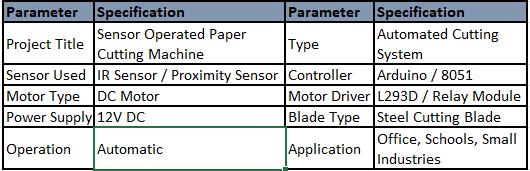
Table -1: SpecificationsofSensorOperatedPaperCutting Machine
International Research Journal of Engineering and Technology (IRJET) e-ISSN: 2395-0056
Volume: 13 Issue: 03 | Mar 2026 www.irjet.net p-ISSN: 2395-0072
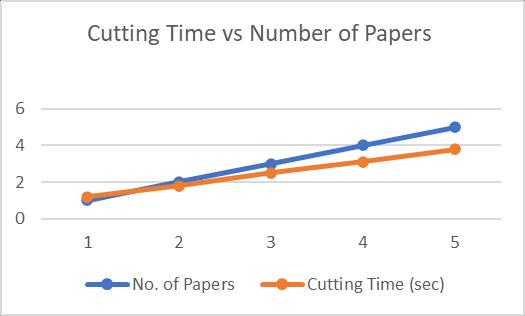
Chart -1:CuttingTimevsNumberofPapers
Thecuttingtimeincreasesasthenumberofpapersincreases due to higher load on the motor. However, the system operatessmoothlyandmaintainsconsistentperformancefor all trials. The increase in time is gradual, indicating stable operationofthemachine.Theresultsdemonstratethatthe systemisefficientandreliableforhandlingmultiplesheets. Overall, the machine provides improved performance comparedtomanualcuttingmethods.
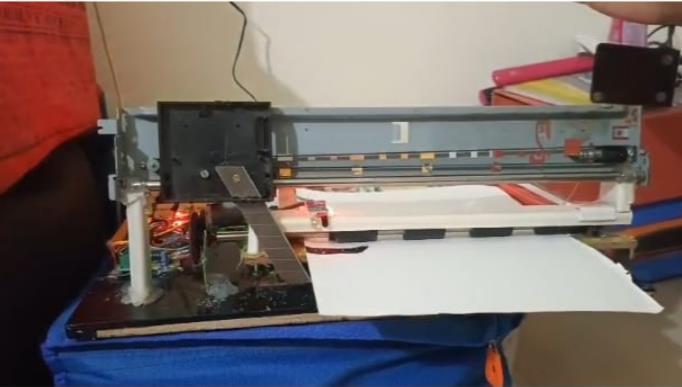
Fig -1: SensorOperatedPaperCutting Machine(Hardwareimage)
ThefigureshowsthehardwaresetupoftheSensorOperated PaperCuttingMachine.
It consists of a microcontroller, IR sensor, DC motor, and cuttingbladeassembly.
Thesensordetectsthepaperandsendsasignalto initiate thecuttingprocess.
Thissystemensuresaccurate,safe,andefficientautomatic papercutting.
3.
TheproposedSensorOperatedPaperCuttingMachineoffers asimple,cost-effective,andefficientsolutionforautomating paper cutting operations. By integrating sensors with a microcontroller-controlled motor, the system enhances operational safety, reduces manual effort, and improves
cutting accuracy and overall efficiency. Its compact and economical design makes it highly suitable for offices, educationalinstitutions,andsmall-scaleindustries,where traditionalmanualcuttingmethodsareofteninefficientand posesafetyrisks.Theautomationensuresthatthecutting bladeoperatesonlywhenthepaperisproperlypositioned, thereby minimizing the chances of accidents and human error. Furthermore, future enhancements such as motor speed control, paper thickness detection, and advanced safety mechanisms can further improve the system’s performance, reliability, and versatility, making it a more effective solution for small-scale automated paper cutting applications.
Theauthorswouldliketoexpresstheirsinceregratitudeto their projectguideandtheDepartmentofElectronicsand TelecommunicationEngineeringfortheirvaluableguidance, continuous encouragement, and support throughout the preparation of this project manuscript. Their insightful suggestions,constructivefeedback,andtechnicalexpertise have played a significant role in shaping the design, methodology, and overall development of the proposed Sensor Operated Paper Cutting Machine. The authors also extend their appreciation to all those who directly or indirectly contributed to the successful completion of this work.
[1] Khurmi RS, Gupta JK. Machine Design. New Delhi: S. ChandPublishing;2005.
[2]MehtaVK,MehtaR.PrinciplesofElectronics.NewDelhi: S.ChandPublishing;2014.
[3] Mazidi MA, Mazidi JG. The 8051 Microcontroller and EmbeddedSystems.PearsonEducation;2006.
[4] Patil S, Deshmukh R. Design and development of automatic paper cutting machine. Int J Eng Res Technol (IJERT).2019;8(6):320–323.
[5] Vishay Semiconductors. IR Sensor Module Datasheet. 2018.

Authortype:1’st
Name:GokulaVitthalpoul
EnrollmentNo:23211820651
Collage Name: Bhivrabai Sawant polytechnic, Wagholi, Pune, Maharashtra,India
International Research Journal of Engineering and Technology (IRJET) e-ISSN: 2395-0056
Volume: 13 Issue: 03 | Mar 2026 www.irjet.net p-ISSN: 2395-0072

Authortype:1’st
Name:MadhaviParmeshwarRode
EnrollmentNo:23211820631
Collage Name: Bhivrabai Sawant polytechnic, Wagholi, Pune, Maharashtra,India