

KABIR KOHLI
Instructor, Cat ‘A’ Establishment, Gujarat, India
Abstract - Optical sensors play a key role in converting light into electrical signals, allowing for precise measurements of light intensity, color, and distance. These sensors are widely used in applications such as photography, environmental monitoring, and fiber-optic communication. Their versatility makes them essential across various industries, including healthcare, automation, and security, where they support critical functions like imaging, detection, and process control. Their ability to monitor light with high accuracy is integral to innovations in diagnostics, safety, and system automation. Currently, optical sensors are highly advanced, with state-ofthe-art technologies including Fiber Bragg Gratings (FBGs), quantum dot-based sensors, and surface plasmon resonance (SPR) sensors. These sensors are capable of providing high sensitivity, precision, and reliability in fields such as healthcare, environmental monitoring, industrial automation, and defense. The integration of advanced materials like photonic crystals and nanostructures has significantly improved performance, enabling real-time monitoring and high-resolution measurements. Additionally, artificial intelligence (AI) is being incorporated to enhance data processing and decision-making, optimizing sensor responses and enabling predictive analytics. The way ahead for optical sensors lies in further miniaturization, improved energy efficiency, and expanded operational ranges, including the ability to detect a broader spectrum of wavelengths. Advancements in quantum sensing and AI integration will unlock new possibilities in autonomous systems, biomedical diagnostics, and environmental surveillance. Overcoming current challenges such as cost reduction, system integration, and environmental resilience will be essential for the widespread adoption of these technologies. As research and collaboration between academia, industry, and governments continue to progress, optical sensors will evolve into indispensable tools for addressing global challenges and driving innovation across industries.
Key Words: OpticalSensors,Lasers,MidInfrared,Specialty Fibers,Micro&NanoEngineered,PhotonicCrystal.
Sensors play a vital role in detecting, measuring, and translating magnitudes across various fields. Among these, optical sensors stand out due to theirability toexploitlight's unique properties, providing exceptional precision and adaptability. The origins of optical sensing can be traced backto the 16thcentury, where early techniques revolved aroundabsorbanceandfluorescence.Theinventionoflasers in 1960 marked a transformative moment, introducing


coherence, high intensity, and spectral purity to optical systemsand pavingtheway fornumerousadvancements. Over time, the integration of sophisticated materials, computational innovations, and nanotechnology has significantly expanded the potential of optical sensors. Today,theyareindispensableinareassuchashealthcare, environmental monitoring, defense, and telecommunications.By merginglight's inherent properties with cutting-edge engineering, optical sensors continue to solve complex challenges across scientific and industrial domains, constantly pushing the boundaries of innovation. This document provides a detailed examinationof emerging optical sensing technologies, their diverse applications, and associated challenges. Topics include,laser-based sensors, mid-infrared sensing, optical fiber sensors, specialty fibers, terahertz sensors, optical chemical sensors, biomedical applications and photonic crystal fibers and is further divided into various sub-parts followed by key considerations for advancing optical sensors and the conclusion.
Laser-based sensors are a cornerstone of modern optical sensing, harnessing the unique properties of laser light coherence, intensity and narrow spectral bandwidth to achieve unparalleled precision in measurement. Unlike conventional sensing methods, laser-based systems employ light directly, eliminating the need for intermediary transducersandenablingapplicationsacrossawiderangeof industries. The inception of laser technology marked a paradigm shift in sensing methodologies, providing unprecedented capabilities for precision measurement, analysis, and detection [1]. Lasers generate coherent, monochromatic,and highly collimated light, makingthem ideal for applications requiring extreme accuracy. These attributes set laser-based sensors apart, as they directly leveragetheinherentqualitiesoflaserlighttointeractwith and analyze their target environment. From detecting microscopic movements to analyzing chemical compositions, thesesensors have redefined the boundaries ofwhat can be measured and monitored. Laser-based sensors excel in delivering high-resolution, real-time data across diverse fields. They are integral to innovations inscientific research, healthcare diagnostics, industrial automation, and environmental monitoring. By focusing on specific wavelengths or using specialized configurations, these sensors achieve remarkable sensitivity and selectivity. Additionally, their non-invasive and remote operational capabilities make them indispensable in scenarios where

traditional sensors falter, such as harsh environments or applications requiring non-contact precision. The continued evolution of laser-based sensors is driven by advancements in quantum technologies, material sciences, and computational algorithms. These innovations aim to overcome existing challenges, including cost,scalability, and noise interference, ensuring that laser-based sensorsremain at the forefront of technological progress.
2.1
• Interferometry Interferometric sensors use the phase differences between coherent laser beams to measure minute displacements, refractive index changes, and vibrations [2]. They are essential in applications requiring sub-nanometer accuracy, such as the detection of gravitational waves in experimentslikeLIGO orin high-precisionsurface metrology for semiconductor manufacturing.
• Spectroscopy Laser-based spectroscopy encompasses Raman, Brillouin, and absorption techniques. These methods enable detailed molecular and atomic analysis [3]. Raman spectroscopy is widely used in pharmaceuticals to ensure drug purity, while Brillouin spectroscopy aids in characterizing material properties like elasticity.Environmentalsciencebenefitsfromlaser absorption spectroscopy for detecting trace gases, including greenhouse gases.
• LIDAR (Light Detection and Ranging) LIDAR systems are revolutionizing fields such as autonomous vehicle navigation, geographic mapping, and atmospheric studies. By measuring thetimeofflightoflaserpulses[4],LIDARprovides high-resolution 3D mapping and distance measurement. Its ability to operate in various environmental conditions makes it indispensable for robotics and remote sensing.
• Doppler Vibrometry Doppler vibrometersuselaserlighttomeasurevelocityand displacement in vibrating objects [5]. This technology is critical in micro-electromechanical systems (MEMS) research, structural health monitoring, and biomedical applications, such as assessing the mechanical properties of tissues.
• High Sensitivity The coherent nature of laser light allows for detecting extremely small changes in measured parameters.
• Versatility Laser-based sensors can be adaptedfordiverseenvironments,fromdeep-sea exploration to outer space.
• Non-Contact Operation These sensors provide accurate measurements without physical interaction, preserving delicate samples and enabling remote sensing.
• Cost and Complexity High-quality lasers, such as those used in LIDAR or interferometry, can be expensive to produce and maintain.
• Shot Noise Limitations Quantum noise imposesfundamental limits on sensitivity, which is particularly challenging in low-light or highspeed applications.
• Miniaturization Reducing the size of laser-basedsystems whilemaintainingperformance is essential for expanding their use in portable devices and wearables.
• Energy Efficiency Lasers often require significant power, necessitating innovations in lowpower and energy-harvesting designs.
2.4. Future Directions Advances in quantumenhanced sensing, utilizing entangled photons or squeezed light, promise breakthroughs in sensitivity and resolution. Additionally,integratingAIfordata analysis and developing compact diode and fiber lasers will enhance performance and accessibility. Laser-based sensors will continue to evolve as foundational tools in scientific research, industrial automation, healthcare diagnostics, and environmental monitoring.
Mid-infrared(MIR)sensorstargetthe3–8 μm wavelength range, where molecular absorption lines are highly pronounced. This makes them exceptionally well-suited for detecting trace gases and chemicals with remarkable sensitivity. The ability to analyze unique absorptionfeatures inthis rangeallows forprecise identification ofmolecular species, a critical factor in applications like environmental monitoring, industrial safety, and medical diagnostics. Recent technological advancements have revolutionized mid-infrared sensing, significantly improving its performance and versatility. Among these breakthroughs, dual-combspectroscopy[5]hasemergedasapowerfultool, enabling highly accurate, broadband, and time-resolved measurements.Thistechniqueexcelsinresolvingcomplex spectra with high resolution and speed. Similarly, supercontinuumlightsourceshaveexpandedthespectral coverageand brightness ofMIRlight,enhancingtheabilityto probe a wide variety of substances simultaneously.
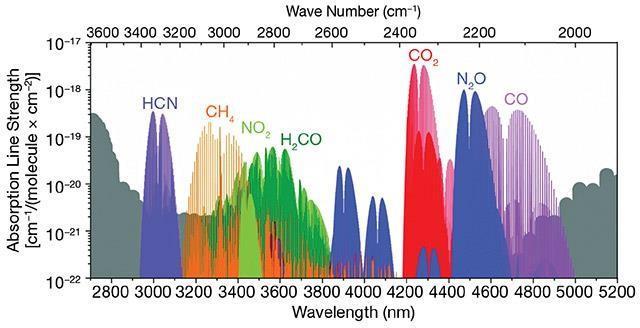
Fig-1 AbsorptionSpectraofMIRinGasSensing Applications
Another transformative innovation is the development of quantum cascade lasers (QCLs) [6], which provide tunable, coherent,and high-intensitylightinthemid-infraredregion. QCLs have become a cornerstone for MIR applications, offering compact and efficient solutions for real-time gas sensing and chemical analysis. Collectively, these advancements haveelevated thecapabilitiesofMIRsensors, enablingunparalleledsensitivityandspecificityindetecting and identifying molecules. The integration of these cuttingedge technologies continues to drive progress in fields ranging from environmental science to healthcare, where accurateandrapidchemical sensingisessential. Inmilitary applications, the utility of MIR sensors is especially noteworthy. These sensorsarecritical for detectingchemical and biological threats, such asidentifying hazardousagents in warfarescenarios. Their high sensitivity allows for early warning systems that can safeguard personnel and equipment. MIR-based sensing is also instrumental in explosives detection, where the ability to detect trace residues of volatile compounds is essential for counterterrorism and battlefield safety. These innovations haverevolutionizedMIRsensing,improvingperformance, portability, and reliability in diverse environments. From detecting hazardous substances to monitoring battlefield conditions and guiding targeted actions, MIR sensors are becoming indispensable in modern military operations, offering rapid,accurate, and robust chemical detection in critical scenarios.
3.1 Applications These sensors excel in environmental monitoring, identifying harmful pollutants, ensuring industrial safety through gas leakdetection,and conducting medical diagnostics such as analyzing breath for diseasebiomarkers. They arealso indispensableforcomplex chemical analysis and quality control processes.
3.2 Challenges Compactness andcost-efficiencyremain pressing issues. Innovations in mid-infrared sources and durablematerials, such as chalcogenideand indiumfluoride fibers,arecrucial.Reducingthermalnoiseandimproving detection mechanisms are equally important for advancing this technology.
Optical fiber sensors leverage thepropagationoflight within fiber structures to precisely measure parameters such as temperature, strain, pressure, and chemical composition. Thesesensorsstandoutfortheiraccuracy,reliability,and abilityto operate inchallenging environments,makingthem indispensable in industries such as aerospace, civil engineering,andhealthcare[7].TheintroductionofFiber Bragg Gratings (FBGs)marked a significant turning point in optical fiber sensing. FBGs allow multiple sensing points to be embedded along a single optical fiber, creating a distributed network capable of monitoring various parameters simultaneously. This multiplexing capability not only reduces system complexity but also enhances efficiency and scalability.
Inaddition to FBGs, [8] distributedsensingtechniques based on Rayleigh, Raman, and Brillouin scattering have further expanded the applications of optical fiber sensors. Rayleigh scattering enables high-resolution strain and temperature monitoring over long distances, while Raman scattering is widely used for distributed temperature sensing, particularly in fire detection and industrial processes. Brillouin scattering, on the other hand, provides detailed insightsinto bothstrainand temperature variations,making it ideal for structural health monitoring in large-scale infrastructure projects. The combination of these advancements has transformed optical fiber sensors into versatile tools capable of addressing complex monitoring needs. Their ability to deliver precise, real-time data over extendedareascontinuesto driveinnovationacrossvarious fields, ensuring theirrelevancein both current and future applications.
4.1 Applications OFS are instrumental in structural healthmonitoring,providingcritical data forthesafety of bridges,buildings,andpipelines.Theyplaya keyroleinthe oil and gas industry, monitoring downhole conditions, and in medical fields, enabling real-timediagnostics and patient monitoring. Their immunity to electromagnetic interference makes them particularly effective in high-noise environments such as industrial settings.
4.2 Challenges Ensuringreliable data transmissionover longdistances while minimizing environmental sensitivity remainsachallenge.Developingadvancedfibercoatingsand fail-safe designs is essential to improve durability and accuracy. Lowering the cost of optoelectronic components will also facilitate broader adoption.
Specialty fibers are designed with advanced material modifications and intricate microstructures, enabling them to achieve exceptional sensitivity and specificity [9]. These fibers are tailored for a wide range of applications where standard optical fibers fall short, offering enhanced
performance indemanding environments. Oneof the key strengthsofspecialtyfibersliesintheirabilitytofacilitate precise biochemical detection [10]. By integrating specialized coatings or dopants, these fibers can interact with specific chemical or biological agents, making them highly effective for applications such as medical diagnostics, environmental monitoring, and food safety. Their ability to detectminute changes inchemical composition withhigh accuracy has revolutionized biochemical sensing [11]. In industrial automation, specialty fibers play a vital role in enhancing process control and operational efficiency. Their robustnessandabilitytowithstandharshconditions,suchas extremetemperaturesorhighpressures,makethemideal for monitoring parameters in manufacturing, oil and gas exploration, and robotics. These fibers provide real-time datacrucialforoptimizingproductivityandensuringsafety. conditions, such as extreme temperatures or high pressures, make them ideal for monitoring parameters in manufacturing,oil and gas exploration,and robotics. These fibers provide real-time data crucial for optimizing productivity and ensuring safety. Defense applications also benefit significantly from the unique capabilitiesofspecialty fibersTheyareinstrumental indevelopingadvanced sensing systemsforthreatdetection,suchasidentifyingchemicalor biologicalagents,monitoringstructuralintegrityofcritical assets, and enabling secure communication systems. The versatility and precision of specialty fibers make them indispensableacrossmultipledomains,drivinginnovation and ensuring their critical role in addressing modern technological challenges. As the demand for highperformancesensing continues to grow, specialty fibers are poised to remain at the forefront of cutting-edge applications.
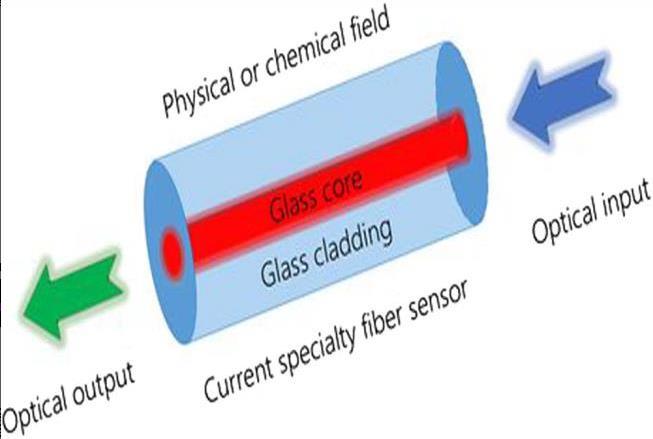
5.1 Applications Optical fiber sensors play a vital role in real-time battlefield monitoring, enabling precise detectionofchemicalagents,fuelleaks,and physiological changes in soldiers. Their high sensitivity makes them essential for military medicine, hazardous material detection, and operational safety. Beyond chemicalandbiologicalsensing,thesefibersarecrucialfor vibration monitoring, helping detect structural weaknesses in military aircraft, ships, and armored vehicles before
critical failures occur. Additionally, they are employed in detecting electromagnetic and electric field fluctuations, enhancing situational awareness in electronic warfare and secure communication systems. Designed to function reliably in extreme environments, optical fiber sensors provide accurate, real-time data for defense applications, strengthening military readiness, infrastructure security, and force protection on the battlefield.
5.2 Challenges Achieving single-molecule detection and sub-ppm sensitivity remains a major challenge in sensor technology.Theabilitytodetecttraceamountsofsubstances with extreme precision is critical for applications in healthcare, environmental monitoring, and defense. One promisingapproachinvolvesintegratingnanomaterialssuch as zinc oxide (ZnO) nanowires, which enhance sensitivity while maintaining a compact design. These nanostructures improve surface interactions, allowing for more efficient detection of minute chemical and biological changes. By leveraging nanotechnology, researchers aim to develop highly efficient, miniaturized sensorscapable ofoperating in diverse environments. Overcoming current limitations in detection sensitivity will enable breakthroughs in real-time monitoring,earlydiseasediagnostics,andadvancedthreat detection systems.
Terahertz sensors function in theelectromagnetic spectrum, operating within wavelengths of roughly 10 mm to 30 μm [12]. These sensors are highly regarded for their capacity to perform non-destructive, contactless evaluations, making them invaluable in numerous scientific and industrial applications. Their unique capabilities enable precise analysis without causing damage or requiring physical interaction with the subject, ensuring reliability and versatility.
One of the primary strengths of terahertz sensors lies in their broad range ofapplications. They are widely used to analyze the conductivity of semiconductors, providing critical insights into the electrical properties of materials essentialforadvancingelectronicdevicedevelopment.Inthe field of biomedical research, terahertz sensors are instrumental inassessingthehydration levels of biological tissues,a keyfactorindiagnosingdiseasesandevaluating tissue health. In industrial settings, these sensors excel in quality control and defect detection. They can identify structural inconsistencies, measure thickness, and evaluate materials in a non-invasive manner, ensuring product integrity and safety. Additionally, terahertz sensors are used to detect hidden substances, such as contaminants in packaging or concealed threats, further broadening their utility. Terahertz time-domain spectroscopy (THz-TDS) [13] has significantly enhanced material analysis by enabling real-time monitoring with exceptional accuracy. This technique allows for the detailed study of dynamic processes, such as protein folding and interactions,
facilitating advancements in biochemistry and pharmaceuticals. With their ability to provide precise, noninvasive analysis across diverse domains, terahertz sensors continueto driveinnovation, addressingcomplexchallenges in science, medicine, and industry.
6.1 Applications Thesesensorsarevitalforquality control in manufacturing, security screenings to detect concealed items, and advanced medical imaging for diagnosingdiseases by examiningtissuecharacteristics.
6.2 Challenges High production costs, reliance on expensive semiconductor materials, and the need for miniaturization present barriers to widespread adoption. Addressingtheseissuesisessentialforbroaderaccessibility and practicality.
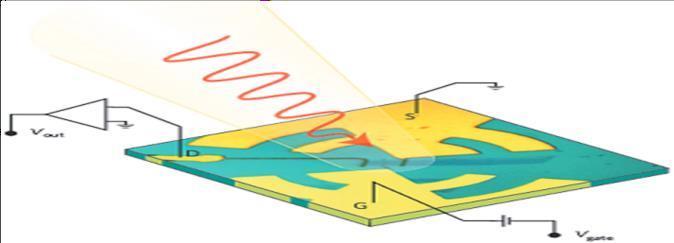
Fig-3 Graphene-basedfieldeffecttransistorusedasa sensor of terahertz radiation.
Thesesensorsutilizesubwavelengthstructurestoamplify light-matter interactions, enabling precise and highly sensitive detection capabilities. By leveraging advanced designs, such as microcavities and plasmonic nanostructures, these sensors achieve remarkable efficiency whilemaintainingacompactformfactor,makingthemideal for nanoscale detection applications. Subwavelength structures are engineered to manipulate light beyond conventional diffraction limits, enhancing its interaction with surrounding materials [14]. Microcavities, for instance, confinelightwithinatinyspace,increasingtheintensityof the electromagnetic field and enabling precise detection of evenminute changes in the environment. This makes them particularly effective in applications like optical sensing, environmental monitoring, and biochemical detection. Plasmonic nanostructures, on the other hand, exploit the resonantoscillationofelectronsinresponsetolight.These structures amplify local electromagnetic fields, significantly improving the sensitivity and specificity ofsensors. Theyare widely employed in detecting molecular binding events, monitoring chemical reactions, and analyzing biological samples at the nanoscale. The integration of these techniques has revolutionized sensor technology, enabling highlyaccuratedetection in compactand portabledevices. This advancement has profound implications for various fields, including medical diagnostics,environmental science, andnanotechnology. For example,sensors equipped with
these features can detect biomarkers at ultra-low concentrations, monitor air quality with high precision, or analyze nanoscale materials for research and development. By combining subwavelength structures with innovative light-manipulation techniques,these sensors offer efficient, scalable, and reliable solutions for addressingthe challenges of nanoscale detection in both scientific and industrial applications.
7.1 Applications Advanced optical techniques are extensively utilized in detecting environmental pollutants, enabling real-time monitoring of air and water quality. These methods provide high sensitivity, allowing for the identification of trace contaminants that pose risks to ecosystems and humanhealth. Inadditionto environmental sensing, surface-enhanced Raman spectroscopy (SERS) plays a crucial role in chemical analysis, enhancing molecular detection for forensic investigations, pharmaceutical research, and hazardous material identification. Moreover, these technologies are widely applied in biological imaging, offering high-resolution visualization of cellular structures and biomolecular interactions.Thiscapabilityisessential for medicaldiagnostics,disease research,andthedevelopment of targeted therapies, making optical sensing techniques invaluableacross scientific and industrial fields.
7.2 Challenges Achievinghighsensitivity insensorswhile maintaining cost-effective fabrication remains a critical challenge in advanced technology development. Precision detection often requires sophisticated materials and complex manufacturing processes, which can drive up production costs and limit large-scale deployment. Innovations in nanomaterials and scalable manufacturing techniques offer promising solutions, enabling enhanced performance without significantly increasing expenses. However, striking the right balance between affordability and functionality is essential forwidespread adoptionacross industriessuchashealthcare,environmental monitoring, and defense. By optimizing fabrication methods and exploringalternativematerials,researchersaimtodevelop highly sensitive yet economically viable sensors. Overcoming this challenge will pave the way for nextgeneration diagnostic tools, industrial monitoring systems, and real-time threat detection technologies.
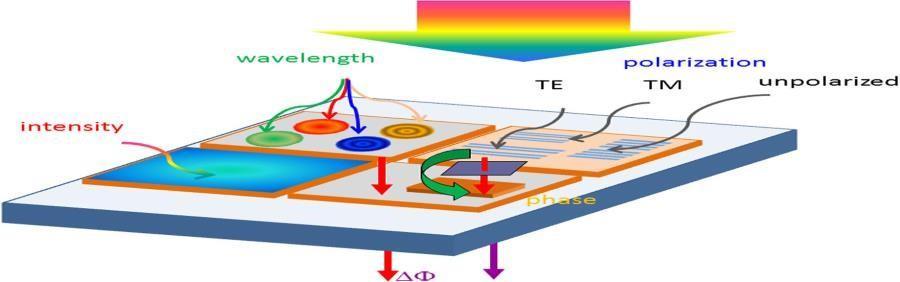
Optical chemical sensors rely on light-based techniques, such asfluorescenceandRamanscattering,todetectandquantify chemical substances with precision. These sensors are designed to harness the interaction of light with chemical compounds, enabling highly sensitive and specific measurements across a broad range of applications [15]. Fluorescence-based sensors operate by exciting molecules with light and analyzing the emitted fluorescence signals to determine the presence and concentration of specific chemicals. This method is particularly effective for detecting tracelevels ofsubstances, making it valuable infields like environmental monitoring, biomedical diagnostics [16], and industrialprocesscontrol.Ramanscattering,ontheother hand,providesdetailedmolecularinformationbymeasuring theinelastic scattering oflightasit interacts withchemical bonds. This technique enables rapid, non-invasiveanalysis, evenincomplexmixtures, and is widely used for real-time chemical identification, pharmaceutical analysis, and materialcharacterization. Thedevelopment offiber-optic technology has significantly enhanced the versatility and adaptabilityofopticalchemicalsensors.Fiber-opticsensors cantransmitlight overlong distances and into challenging environments, such as high-temperature, high-pressure, or chemicallyreactivesettings.Theircompactsize,flexibility, and immunity to electromagnetic interference make them ideal for remoteand in-situ monitoring.
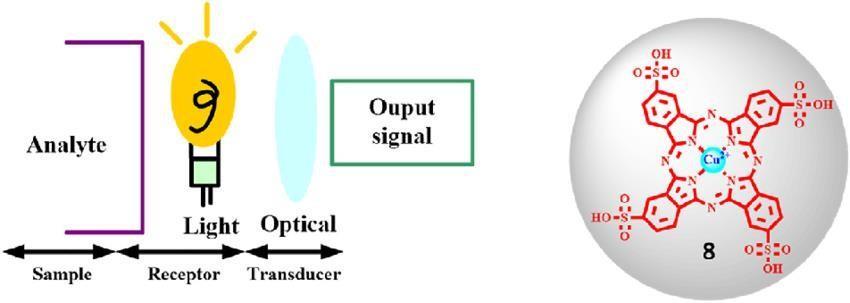
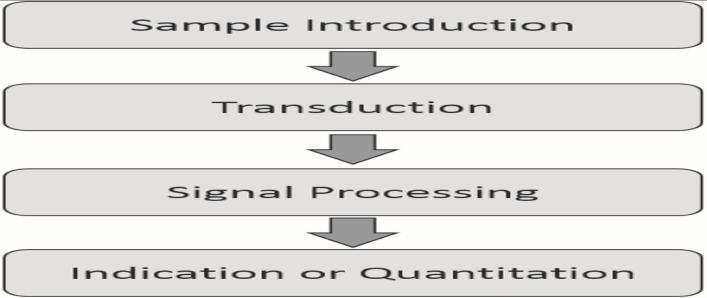
Fig-5 Methodologyforopticalchemical sensor
With continuous advancements in optical technologies and materials,thesesensorsareevolvingtomeetthedemandsof
modern applications. From detecting pollutants in water to monitoring biochemical reactions in real-time, optical chemical sensors offer powerful, scalable, and efficient solutions for addressing complex analytical challenges across diverse industries.
8.1 Applications They play a critical role in environmentalmonitoring, industrial safety,and medical diagnostics by reliably detecting volatile organic compounds and trace elements.
8.2 Challenges Bridging the gap between chemical specificity and engineering scalability isa keyobjective, with AIintegrationofferingpotentialsolutionsfordataanalysis and interpretation.
Optical sensors are transforming modern medicine by enablingnon-invasivediagnostic and monitoringsolutions. These advanced technologies offer high precision in detecting physiological changes, makingthem indispensable in contemporary healthcare [17]. Miniaturized systems, including fiber-optic probes and optical coherence tomography (OCT)devices, havedemonstrated remarkable versatility in clinical applications. Their integration into healthcare systems supports a wide range of uses, from wearablehealthmonitorsthattrackvitalsignsinrealtimeto sophisticated imaging tools that assist in early disease detection.Additionally,opticalsensors playa critical rolein robotic-assisted surgeries, improving precision and enhancingsurgical outcomes.However,several challenges must be addressed to maximize their potential. Ensuring biocompatibility is crucial to prevent adverse reactions whenusedwithinthehumanbody.Reliabilityanddurability are essential for consistent performance over time, while effective sterilization methods must be developed for medicalenvironments.Moreover,designingthesesensors to be compact and energy-efficient is vital for seamless integration into various medical devices. By overcoming these limitations, biomedical optical sensorswill continue to revolutionizehealthcare,pavingthewayformoreefficient, accurate, and patient-friendly diagnostic and therapeutic solutions.
9.1 Applications Biomedical optical sensors are increasinglyvitalinmilitarysettings,offeringadvanced,realtime health monitoring and diagnostic capabilities for soldiers in combat and remote operations. These cuttingedge sensors are integrated into wearable health monitoring systems, sophisticated diagnostic tools, and medical robotics, enhancing battlefield medical care and operational efficiency.
Wearableopticalsensorscancontinuouslytrackvitalsigns such as heart rate, oxygen saturation, and dehydrationlevels, allowing for early detection of fatigue, stress, or potential injuries.Thisreal-timehealthdataenables military medics
and commanders to assess soldiers’ conditions instantly, making informed decisions ontroopreadiness and medical interventions.Additionally, optical coherence tomography (OCT) and other imaging technologies provide rapid and non-invasivediagnosticsfor battlefield injuries. Thesetools facilitate immediate assessment of wounds, burns, and internal trauma without the need for traditional bulky medical equipment. Moreover, robotic-assisted surgeries equipped with optical sensors enhance precision in emergencymedicalprocedures,reducingcasualtiesinhighrisk combat scenarios.
For these sensors to be fully effective in military environments,they must be rugged,compact,and energyefficient whilemaintaining highreliability underextreme conditions. Overcoming these challenges will ensure that biomedical optical sensorscontinueto revolutionizemilitary medicine,enhancingsoldiersafetyandmissioneffectiveness.
9.2 Challenges While biomedical optical sensors offer numerous benefits, their widespread adoption faces several critical challenges. One primary concern is ensuring biocompatibility to prevent adverse reactions when used in direct contact with the human body. Additionally, these sensors must demonstrate long-term reliability, maintaining accuracy and performance over extended periods. Sterilization is another key factor,asmedical devicesrequire stringent hygiene standards to prevent infections and contamination. Furthermore, optimizing their design for minimal power consumption is crucial, particularly for portable and wearable medical applications. Compact sizeis equally important to allow seamlessintegration into existing healthcare technologies without adding bulk. Addressing thesechallenges will beessential foradvancing biomedical optical sensors, enabling their full potential in modern medical diagnostics and patient care.
Photonic Crystal Fibers (PCFs) are a groundbreaking innovation in optical technology, employing periodic microstructures to control and manipulate light with exceptional precision. These fibers are engineered with uniqueinternalstructures,suchasarraysofmicroscopicair holes running along their length, which give them unparalleled optical properties [18]. One of the defining characteristics of PCFs is their high nonlinearity, which enhances their ability to generate and manipulate light in novel ways. This makes them particularly valuable for advancedspectroscopyapplications,whereprecisecontrol of light is essential for analyzing materials and detecting minute changes in chemical composition. Nonlinear effects in PCFs enable processes such as supercontinuum generation and high-order harmonic generation, providing powerful tools forawiderangeofscientific andindustrial applications. Another key property of PCFs is their birefringence, which arises from asymmetries in their microstructure.ThisallowsPCFstomaintainandcontrolthe
polarization state of light, a critical feature for sensing applications that relyon polarization-based measurements. High birefringence makes them ideal for precisiontasks such as strain and temperature sensing, whereaccuratedetection is crucial.
TheuniquedesignofPCFsalsoenablestheiruseinextreme environments, such as high temperatures, high pressures, andchemicallyreactivesettings.Thisadaptability,combined with their exceptional optical performance, has made PCFs indispensable in fields ranging from biophotonics and environmental monitoring to telecommunications and industrial inspection. By leveraging their innovative structure and optical properties, Photonic Crystal Fibers continuetopushtheboundariesofspectroscopyandsensing technologies, addressing complex challenges with unmatched precision and efficiency.
10.1 Applications PCFs areutilized inhigh-resolution spectroscopy, biomedical imaging, and acoustic sensing. They are particularly valuable in extreme environments, such as space exploration and nuclear research.
10.2 Challenges Reducing optical losses and enhancing aircorefiberdesignsareongoingareasofresearchtoimprove efficiency and broaden applications.
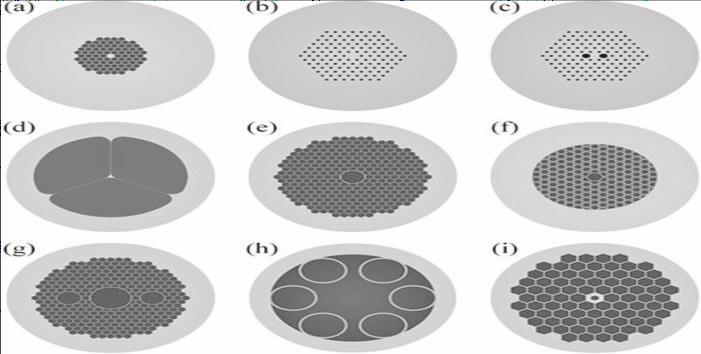
Fig-6DifferenttypesofPCFs.(a)HighlynonlinearPCF,(b) endlessly single-mode PCF, (c) Hi-Bi PCF, (d) suspended core PCF, (e) photonic bandgapHC-PCF, (f) KagoméHC-PCF, (g) polarization maintaining single-mode HC-PCF, (h) broadband single-mode HC-PCF and (i) PCF with a subwavelength air-hole in the core.
Theadvancementofoptical sensortechnologydemands a comprehensive approach that targets improved performance, enhanced versatility, and greater accessibility. By addressing these areas, optical sensors can achieve broader adoption across industries and meet the growing demands for precision, sustainability, and scalability. One of theprimarygoalsinadvancingopticalsensorsistoenhance
sensitivity. Developing materials and designs that amplify light-matter interactions is crucial for detecting minute changes in physical, chemical, or biological parameters. Techniques such as subwavelength engineering, plasmonic nanostructures, and photonic crystal integration can significantly improve detection limits, enabling sensors to operate with unprecedented accuracy in critical applications suchasenvironmentalmonitoring,healthcarediagnostics, and industrial quality control.
Broadening spectral capabilities is another vital consideration.Optical sensors must bedesigned to covera widerrangeofwavelengths,fromultraviolettoinfrared,to address diverse needs across differentdomains. Innovations in light sources, such as quantum cascade lasers and supercontinuumgenerators,aswell asadvances indetector materials, will play a pivotal role in expanding spectral sensitivity and improving overall functionality. Energy efficiency is increasingly important as sensors become more ubiquitous. Low-power designs and energy-harvesting mechanisms can reduce operational costs and environmental impact, making optical sensors more sustainableforlarge-scaledeployment inIoTsystems,smart cities, and remote applications.
The integration ofartificial intelligence (AI) and machine learning will be transformative for optical sensors. By enablingreal-timedata analysis,pattern recognition,and predictivecapabilities,AIcanenhancethe decision-making power of sensors, particularly in complex scenarios like medical diagnostics and autonomous systems. Miniaturization is another critical driver of progress, allowing optical sensors to be embedded into compact devices and portable systems without compromising performance.
To ensure widespread adoption, cost reductions and improvedaccessibilitymustbeprioritized.Innovationsin manufacturing processes, the use of affordable materials, and scalable production techniques will make highperformance optical sensors accessibleto abroaderrangeof industries and markets.
By focusing on these key considerations, optical sensor technology is poised to revolutionize diverse fields, offering sustainable, multifunctional solutions tailored to the demands of the future. These advancements will drive innovation, improve efficiency, and create opportunities across science, technology, and industry.
Opticalsensorsaredrivinginnovationacrossawiderangeof industries, from healthcare to environmental monitoring and industrial automation. By harnessing the properties oflight for accurate measurements, these sensors have unlocked groundbreaking applications, such as autonomous technologies, wearable devices, and advanced scientific
exploration. To continue this progress,future advancements in optical sensor technology must prioritizeachieving higher sensitivity, integrating AI-powered data analysis, and maintainingaffordability.Enhancingtheirability to detect smaller signals with greater precision will expand their capabilities, especially in critical fields like medical diagnostics and environmental surveillance. AI integration canfurther optimizesensor performance by enabling realtime data processing, pattern recognition, and predictive analytics, thus enhancing decision-making in complex situations.
Additionally, expanding the operational ranges of optical sensorsanddesigningmoredurable,energy-efficientmodels willbeessentialtoensuretheirwidespreadadoption.These improvements will makeoptical sensors moreversatileand accessible for use in remote locations, large-scale systems, and diverse environments. Collaboration among academia, industries,and government agencies will be crucial in
addressing the challenges that lie ahead. By pooling resources and expertise, stakeholders can accelerate the development of cutting-edge solutions that meet the demands of a rapidly evolving technological landscape. Ultimately, optical sensors are not just tools for measurement they are catalysts for technological advancement.Astheircapabilities continuetoexpand,they will play a vital role in addressing global challenges and drivingprogress innumerousfields,shapingthefuture of innovation and industry.
[1] Smullin L D and Fiocco G 1962 Optical echoes from the Moon Nature 194 1267.
[2] Butler H J et al 2016 Using Raman spectroscopy to characterize biological materials Nat. Protocols 11 664–87.
[3] Hancock S, Anderson K, Disney M and Gaston K J 2017 Measurement of fine-spatial-resolution 3D vegetation structure with airborne waveform LIDAR: calibration andvalidationwithvoxelisedterrestriallidarRemote Sens. Environ. 188 37–50.
[4] Rothberg S J et al 2017 An international review of laser Doppler vibrometry: making light work of vibrationmeasurementOpt.LasersEng.(toappear).
[5] Yu M, Okawachi Y, Griffith A G, Lipson M andGaetaAL 2016Modelockedmid-infraredfrequencycombsina siliconmicroresonator Optica 3 854–60.
[6] Yao Y, Hoffman A J and Gmachl C F 2012 Mid-infrared quantumcascadelasersNat.Photon.6432–9.
[7] ProceedingsofOFS9,Paris,France; Collected Papers of the International Conferences on OFS, 1983-1997. (http://spie.org/x648.html?product_id=316034)
[8] Lopez-Amo M and Lopez-Higuera J M 2011 MultiplexingtechniquesforFBGsensorsFiberBragg Gratings Sensors: Recent Advancements, Industrial Applications and Market Exploitation (Potomac, MD: Bentham Science) pp 99–115.
[9] UddEandSpillmanWBJr2011FiberOpticSensors: An Introduction forEngineers and Scientists 2nd edn (New York: Wiley).
[10] Willets K A and Van Duyne R P 2007 Localized surface plasmon resonance spectroscopy and sensing Annu.Rev.Phys.Chem.58267–97.
[11] MKK,HanY,KankaJ,SukhishviliSandDuH2010 Structure fits the purpose: photonic crystal fibers for evanescent-field surface-enhanced Raman spectroscopy Opt.Lett. 35 466–8.
[11] Auston D H and Smith P R 1983 Generation and detection of millimeter waves by picosecond photoconductivity Appl.Phys.Lett.43631–3.
[13] CheungKPandAustonDH A1986 Novel technique for measuring far-infrared absorption and dispersion Infrared Phys. 26 23.
[14] RaoYJ1997In-fibreBragggratingsensorsMeas.Sci. Technol. 8 355–75.
[15] McDonagh,† C, Burke,‡ CS and McCraithBD2008 OpticalchemicalsensorsChem.Rev.108400–22.
[16] WangX-DandWolfbeisOS2016Fiber-opticchemical sensors and biosensors (2013−2015) Anal. Chem. 88 203−27.
[17] Katzir A 1990 Selected Papers on Optical Fibers in Medicine (SPIE Milestone Series vol MS 11) (Bellingham,WA:SPIE).
[18] Russell P S J 2006 Photonic-crystal fibers J. Lightwave Technol. 24 4729–49.
[19] www.wikipedia.org
[20] www.researchgate.net

Kabir Kohli, earned his B.Tech. in Electronics and Communication Engineering from U.P. Technical University, India, and an MTech. in Optoelectronics & Optical Communicationfrom the esteemed Indian Institute of Technology, Delhi, in 2020. An aviation technology course qualified with over 10,000 hours of incidentaccident-freeexperienceinrotarywing maintenance, he is a seasoned aviation maintenance specialist. His expertise spans multiple disciplines, having led various projects across diverse domains. His primary areas of focus include lasers, sensors, drones, and quantum physics. Currently, he serves as an instructor at a Cat ‘A’ Establishment in Gujarat, contributing his knowledge and experiencetothefieldofaviation, opto-electronics and technology.