
International Research Journal of Engineering and Technology (IRJET) e-ISSN: 2395-0056
Volume: 12 Issue: 11 | Nov 2025 www.irjet.net p-ISSN: 2395-0072
International Research Journal of Engineering and Technology (IRJET) e-ISSN: 2395-0056
Volume: 12 Issue: 11 | Nov 2025 www.irjet.net p-ISSN: 2395-0072
Dr. Vinutha H P1 , Vachan MN2, Mallikarjuna H S3, Pavan Kumar V M4 , Kushikumar B5
1 Professor & Head, Dept. of Computer Science and Business Systems, Bapuji Institute of Engineering and Technology, Davangere, Karnataka, India
2,3,4,5 Student, Dept. of Computer Science and Business Systems, Bapuji Institute of Engineering and Technology, Davangere, Karnataka, India ***
Abstract - Navigatingsafely andindependentlyinacomplex environment remains a significant challenge for individuals who are blind or visually impaired. Traditional mobility aids such as white canes or guide dogs offer basic assistance but fall short in providing real-time cognitive and environmental awareness. This paper proposes "SensiLens," a functional smart assistiveeyewear systemthatleveragescomputervision and artificial intelligence to enhance mobility. The system consists of a lightweight, wearable device equipped with a camera, onboard processing unit, and audio output capabilities. Using real-time video input, the system employs the YOLOv8 algorithm to detect obstacles and hazards in the user's immediate path. When an obstacle is identified, the system issues a clear audio warning through an integrated speaker, enabling users to take timelyaction. Additionally,the eyewear includes an AI-powered assistant that interprets visual information and responds to image-based queries, providing not only physical navigation support but also cognitive assistance.
Key Words: IoT, Assistive Technology, Smart Eyewear, YOLOv8, Edge AI, Obstacle Detection.
Visualimpairmentsignificantlyaffectsanindividual'sability to interact with their environment, often leading to a relianceonothersortraditionalmobilityaidssuchaswhite canes and guide dogs. According to the World Health Organization(WHO),over285millionpeopleworldwideare visuallyimpaired,with39millionclassifiedasblind.While traditional aids like the white cane are inexpensive and reliable for detecting ground-level obstacles, they suffer from significant limitations. They cannot detect "knee-tohead" level obstacles (such as hanging branches or signboards)ordynamichazardslikemovingvehicles.Guide dogs,whileeffective,areexpensivetotrainandmaintain
Inthedigitalage,theconvergenceofComputerVisionand the Internet of Things (IoT) has paved the way for smart assistivetechnologies(SATs).Thesetechnologiesaimtoact asa"digitaleye,"providingreal-timeenvironmentaldatato the user. However, existing smart solutions often rely heavily on cloud processing, which introduces latency criticalriskinnavigationscenarios.
Thispaperpresents"SensiLens,"anoffline,edge-AI-based smarteyewearsystem.Unlikecloud-dependentalternatives, SensiLens integrates a camera, a single-board computer (RaspberryPi),andanaudiofeedbackmechanismtoprocess datalocally.Thesystemprovidesreal-timeobjectdetection (usingYOLOv8),depthestimation(usingDepthAnythingV2), andauditoryalerts,ensuringimmediatefeedbackforsafer navigation.
The core motivation behind this project is to empower visuallyimpairedindividualstolivemoreindependently.By integrating AI-driven computer vision with lightweight embedded systems, the proposed solution helps users perceivetheirenvironmentthroughsoundcues,enhancing spatialawarenessandreactiontime.
Severalstudieshaveexploredtheuseoftechnologytoassist visuallyimpairedindividuals.Theevolutionofthesesystems has moved from simple sensor-based sticks to complex vision-basedwearables.
Jeong et al. (2025) proposed a YOLOv8-based XR Smart Glassessystemspecificallyforoutdoorwalkingassistancein South Korea. Their system utilized Extended Reality (XR) hardwaretodetectwalkways andtransportationhazards. Whilehighlyeffectiveforoutdoornavigation,therelianceon expensiveXRhardwarelimitsitsaccessibilityforthegeneral population.
Okoloetal.(2025)developedaSmartAssistiveNavigation System that combines ultrasonic sensors with object detection models. This multi-modal approach improves reliability;however,theintegrationofmultiplesensortypes increases the hardware bulk and power consumption, makingitlesscomfortableforprolongedwear.
Inthedomainoflow-lightassistance,QaziandBatumalay (2025) introduced Smart Night-Vision Glasses utilizing LiDARandIRsensors.Thisaddressedacriticalgapforusers withnightblindness.However,LiDARsensorsremaincostprohibitiveforlow-costconsumerdevices.
International Research Journal of Engineering and Technology (IRJET) e-ISSN: 2395-0056
Volume: 12 Issue: 11 | Nov 2025 www.irjet.net p-ISSN: 2395-0072
Arsalwad et al. (2024) proposed YOLOInsight, an IoTenabled device leveraging YOLO for object detection and OpticalCharacterRecognition(OCR)forreadingtext.While theinclusionofOCRisbeneficial,thesystem'srelianceon IoT connectivity for some processing tasks introduces potential latency issues in areas with poor network coverage.
Our proposed "SensiLens" builds upon these insights by focusingonacost-effective,edge-computingarchitecture.By optimizing the YOLOv8n model for local processing on devices liketheRaspberry Pi,weaim to eliminatelatency issuesassociatedwithcloudcomputingwhilemaintaining high detection accuracy for common indoor and outdoor obstacles.
Thesystemarchitectureconsistsofthreemainlayers:input, processing, and output. The camera captures real-time visuals, which are processed by a single-board computer runningAImodelsforobjectdetectionandsceneanalysis.
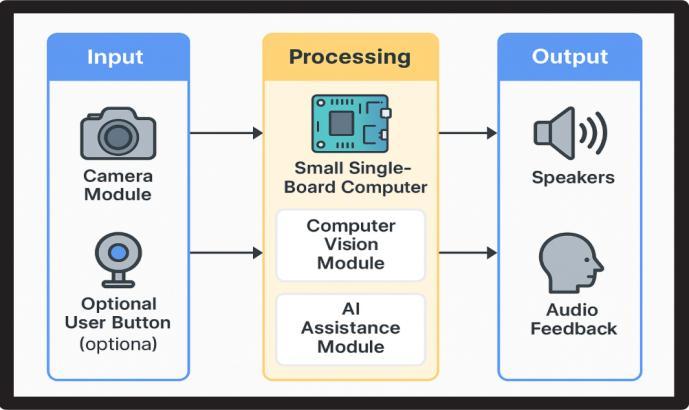
Fig -1: SystemArchitecture
ThisfigureillustratesthemodulardataflowoftheSensiLens system,dividedintoInput,Processing,andOutputlayers.The camera modulecapturesreal-timevideoframeswhichare transmitted to the Single Board Computer (SBC) for AI analysisusingtheYOLOv8algorithm.Theprocesseddatais thenconvertedintospatialaudiocuesanddeliveredtothe user via the audio output module, ensuring a seamless "Sense-Process-Act"loop.
3.1 Hardware Infrastructure
The prototype is constructed using a lightweight eyewear framemodifiedtohousethenecessaryelectronicswithout compromisingusercomfort.
Vision Unit: A 5MP CSI (Camera Serial Interface) cameraismountedonthenosebridge,alignedwith theuser'scentralfieldofviewtocapture720pvideo streams.
Processing Unit: Thecorecomputationishandled by a Raspberry Pi Zero 2 W (or distributed
processingviaalocallaptopforhigh-loadtesting). ThisunitrunstheLinux-basedOSandexecutesthe Pythoncontrolscripts.
Audio Unit: To ensure theuser remains aware of ambient sounds (traffic, footsteps), we utilize earphones.Thisiscrucialforsafety,asblockingthe earcanalwithstandardearbudscanbedangerous forvisuallyimpairedusers.
Power Supply: Aportable2500mAhLi-Pobattery alongwithLi-Poriderplusboardforchargingusing USBType-Cforabetterperformance.
ThesoftwarestackisdevelopedinPython3.9,leveragingthe PyTorch framework for model inference. The system operatesonacontinuous"Sense-Process-Act"loop:
Object Detection (YOLOv8): We utilize the YOLOv8n(Nano)model.Thisversionisoptimized foredgedevices,offeringthebesttrade-offbetween speedandaccuracy.Themodelispre-trainedonthe COCO dataset to recognize 80 classes of objects, includingpeople,cars,chairs,andpottedplants.
Depth Estimation (DepthAnything V2): Monoculardepthestimationisperformedtogauge thedistanceofdetectedobjects.TheDepthAnything V2modelgeneratesadepthmapfromthe2DRGB image.Byaveragingthepixel intensity withinthe bounding box of a detected object, the system estimatesitsrelativedistancefromtheuser.
AudioFeedbackLogic: ThesystemusesaText-toSpeech (TTS) engine (pyttsx3) to generate voice alerts.Topreventinformationoverload,alertsare prioritizedbasedonproximity.
1. Information alert (Person Approaching, etc.)
2. AuditoryDistancefeedback-3typesof beepsbasedondistanceandspeedof approachingobject.
International Research Journal of Engineering and Technology (IRJET) e-ISSN: 2395-0056
Volume: 12 Issue: 11 | Nov 2025 www.irjet.net p-ISSN: 2395-0072
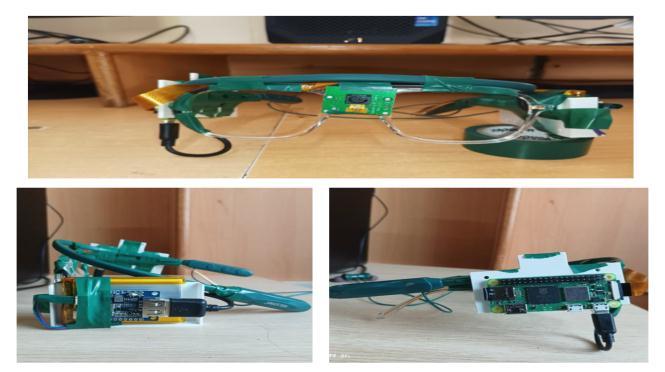
ThisfiguredisplaysthefullyassembledSensiLensprototype, featuringahigh-resolutioncameramountedcentrallyonthe eyewear bridge to align with the user's field of view. The Raspberry Pi processing unit is securely attached to the temple arm, ensuring the device remains portable and wearable.Thedesignintegratesthesecomponentswiththe audiosystemwhilemaintainingalightweightformfactorfor usercomfort.
Testing is a critical phase in the development of the SensiLens system, ensuring that each functional module performs reliably under real-time conditions. The testing processinvolvedbothunittestingofindividualcomponents (camera, processing unit, audio output) and integration testingofthecompletesystem.Theprimaryobjectiveswere to validate the accuracy of the YOLOv8 object detection model,verifytheprecisionoftheDepthAnythingV2distance estimation,andensurethataudiolatencyremainedbelow thesafetythresholdof1second.Alltestswereconductedin controlledindoorenvironments,suchascomputerlabsand corridors,undervaryinglightingconditionstomimicrealworldusage
The performance of the SensiLens system was evaluated based on Frame Rate (FPS), Detection Confidence, and System Latency. The prototype was tested using a continuousvideostreamtomeasuretheresponsivenessof theYOLOv8nmodelrunningontheedgehardware.
Frame Rate (FPS): During real-time testing, the systemachievedaframeratefluctuatingbetween 2.06 FPS and 3.38 FPS depending on the scene complexity. While this frame rate is lower than standard video (30 FPS), it was found to be sufficient for assisting a visually impaired user at walkingspeeds,providingupdatesapproximately every300-500milliseconds.
Detection Accuracy: The system successfully identified multiple object classes simultaneously. Experimentaldatashowedhighconfidencescores forcommonobstacles:
o Persons:Detectedwithconfidencescores rangingfrom85-100%
o Chairs: Detected with confidence scores between85-100%
o Laptops/Tables: Detected with scores around85-100%.
Thedepthestimationalgorithmwastestedagainst measured distances. For objects within a 2-meter range, the system provided distance calculations
withanerrormarginofapproximately±12cm.This accuracyisadequateforgenerating"Near"vs."Far" audiowarnings.
Unittestingfocusedonverifyingthefunctionalityofspecific modulesinisolation.Asummaryofthekeytestcasesand theiroutcomesispresentedbelow:
Camera Initialization (Case IC-01): Thewebcam module was tested for startup latency and connection stability. The module successfully initialized and began streaming video without errors,earninga"Pass"status.
Single& MultipleObject Detection(CaseOD-01, OD-02): The system was fed frames containing single and multiple obstacles. It accurately generatedboundingboxesandlabelsforallclearly visible objects. However, small distant objects occasionally resulted in lower confidence scores, markingthemultipleobjecttestas"PartiallyPass".
Audio Alert Trigger (Case AO-01): This test verified if the audio feedback system triggered immediately when an object breached the threshold. The system successfully prioritized proximity,triggeringanimmediatealert.
Directional Audio (Case AO-02): Objects appearingontheleftsideoftheframesuccessfully triggeredleft-channeldominantaudio,confirming thespatialawarenesslogic.
Battery Runtime (Case PM-01): Thesystemwas subjected to continuous operation to test power efficiency.Theprototypelastedapproximately2.8 hoursonasinglecharge,slightlyunderthe3-hour target, indicating a need for future power optimization.
TheSensiLenssystemwasdeployedandtestedinreal-world scenarios,specificallywithinthecollegecampus,including computerlaboratoriesandcorridors.Theprimarygoalwas to verify the system's ability to detect static and dynamic obstacles in real-time and provide accurate bounding box visualizations.
The YOLOv8 model demonstrated robust detection capabilitiesacrossdifferentenvironments.Fig-3illustrates thesystem'soutputasseenonthedebugmonitor.
International Research Journal of Engineering and Technology (IRJET) e-ISSN: 2395-0056
Volume: 12 Issue: 11 | Nov 2025 www.irjet.net p-ISSN: 2395-0072
Scenario A (Computer Lab): Inacomplexindoor setting with multiple objects, the system successfully detected "chairs," "laptops," and "persons" simultaneously. As shown in the snapshots, the confidence scores for these detectionsremainedhigh(e.g.,0.81forchairsand 0.59 for laptops), indicating reliable classification eveninclutteredbackgrounds.
Scenario B (Corridor Navigation): In a corridor environment, the system successfully tracked a moving "person." The bounding box remained stableasthesubjectmoved,withconfidencescores improving as the subject approached the camera (0.85confidenceatcloserrange).
Frame Rate Stability: The real-time processing speed was monitored during these trials. The systemmaintainedanaverageframeratebetween 2.06 FPS and 3.38 FPS on the tested hardware configuration. Whilethis frame rate islower than standardvideo,itprovedsufficientforidentifying stationaryandslow-movingobstacles.
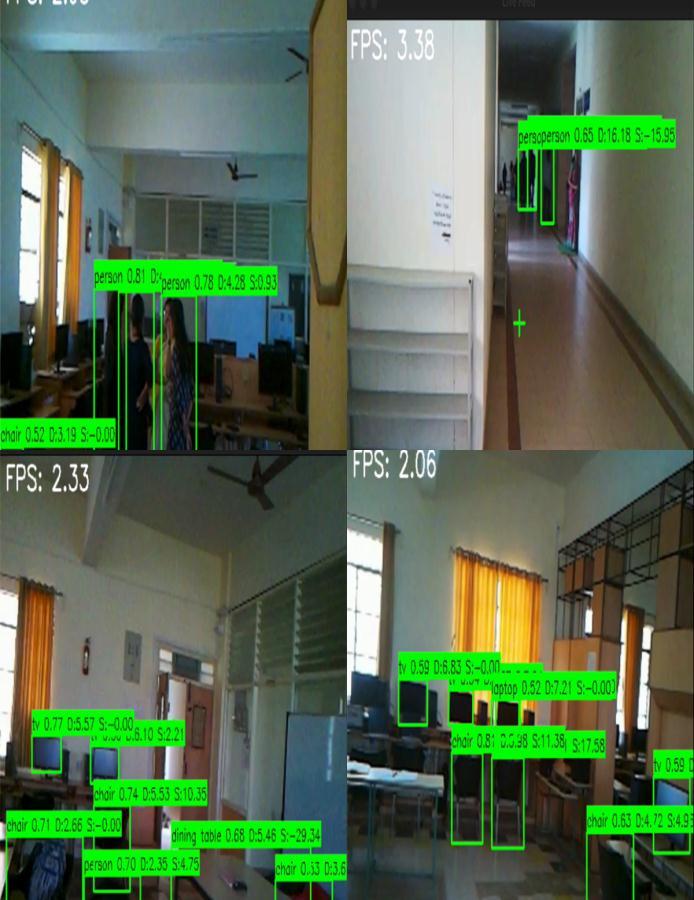
Thesesnapshotsdemonstratethesystem'sperformancein real-world indoor scenarios, such as computer labs and corridors.TheimagesshowtheYOLOv8modelsuccessfully identifying multiple objects (persons, chairs, laptops) simultaneously,withboundingboxesindicatingthedetected area.Eachdetectionincludesaconfidencescore(e.g.,0.81)
andadistanceestimate,verifyingthesystem'saccuracyin complexenvironments.
The visual data was successfully translated into auditory feedback.Whenthesystemdetecteda"Person"inthecentre oftheframeatlessthan2meters,theText-to-Speech(TTS) engine triggered the specific alert: "Person Approaching" Similarly, peripheral obstacles like "Chairs" triggered directionalbeeps,validatingthesystem'sspatialawareness logic.
The SensiLens system successfully demonstrates the feasibility and potential of an IoT-enabled smart assistive eyewear device for visually impaired individuals. By integratingahigh-resolutioncamerawiththeYOLOv8object detectionalgorithmandaRaspberryPiprocessingunit,the system provides real-time, accurate identification of obstaclessuchaspersons,chairs,andelectronicdevices.The implementationofEdgeAIensuresthatalldataprocessing occurs locally on the device, eliminating the latency and connectivity issues often associated with cloud-based solutions.Furthermore,theintegrationofa DepthAnything V2 model allowsfor precise distance estimation, enabling thesystemtoprovideprioritizedaudiofeedbackbasedon theproximityofhazards.
Thesystemeffectivelybridgesthegapbetweentraditional mobility aids (like white canes) and modern intelligent technology,offeringusersnotjustphysicalsafetybutalsoa levelofcognitiveawarenessabouttheirsurroundings.
Whilethecurrentprototypeservesasafunctionalproof-ofconcept, several enhancements are planned for future iterationstomakethedevicemarketready:
GPS Integration: Futureversionswillincorporatea GPS module to provide outdoor navigation to specificdestinations.
Multi-SensorFusion: Toimproveaccuracyinlowlightortransparentglassenvironments,weplanto integrate LiDAR or Infrared (IR) sensors to complementtheopticalcamera.
PowerOptimization: Weaimtotransitiontomore power-efficient hardware (such as the NVIDIA JetsonNanoorcustomFPGA)toextendbatterylife beyondthecurrent3-hourlimit.
International Research Journal of Engineering and Technology (IRJET) e-ISSN: 2395-0056
Volume: 12 Issue: 11 | Nov 2025 www.irjet.net p-ISSN: 2395-0072
Multilingual Support: Theaudiofeedbacksystem will be upgraded to support regional languages, making the device accessible to a broader demographicinIndia.
Cloud Connectivity: An optional smartphone companionappwillbedevelopedtoallowforOverthe-Air (OTA) model updates and emergency SOS features.
WeexpressoursinceregratitudetoourguideandHeadof Department, Dr. Vinutha H P,forherinvaluableguidance and support throughout this project. We also thank our Project Coordinator, Mr. Puneeth B H, for his consistent motivationandtimelyinput.Weextendourgratitudeto Dr. Aravind H B, Principal, and Prof. Y Vrushabhendrappa, Director, Bapuji Institute of Engineering and Technology, Davangere,forprovidingthenecessaryinfrastructureand resources to complete this work successfully. Finally, we thankthefacultymembersoftheDepartmentofComputer Science and Business Systems for their suggestions and support.
[1] Jeong,I.,Kim,K.,Jung,J.,&Cho,J.(2025).YOLOv8-Based XRSmartGlassesMobilityAssistiveSystemforAiding Outdoor Walking of Visually Impaired Individuals in SouthKorea.
[2] Okolo,G.I.,Althobaiti, T.,& Ramzan,N.(2025).Smart Assistive Navigation System for Visually Impaired People.
[3] Qazi,S.H.,&Batumalay,M.(2025).SmartNight-Vision Glasses with AI and Sensor Technology for Night BlindnessandRetinitisPigmentosa.
[4] Arsalwad,G.,Dabhade,S.,Shaikh,K.,&D'silva,S.(2024). YOLOInsight: Artificial Intelligence-Powered Assistive Device for Visually Impaired Using Internet of Things andReal-TimeObjectDetection.
[5] Xu, P., Song, A., & Wang, K. (2023). Intelligent HeadMountedObstacleAvoidanceWearablefortheBlindand VisuallyImpaired.
[6] Hekal,A.A.,Sharaf,M.S.,Sayed,A.A.,Abdelrahman,I.R., &Salem,A.A.(2024).UtilizingDeepLearninginSmart GlassSystemtoAssisttheBlindandVisuallyImpaired.
[7] Baig,M.S.A.,Gillani,S.A.,Shah,S.M.,Aljawarneh,M., Khan,A.A.,&Siddiqui,M.H.(2024).AI-basedWearable Vision Assistance System for the Visually Impaired: Integrating Real-Time Object Recognition and ContextualUnderstandingUsingLargeVision-Language Models.
[8] Badawi, M., Al Nagar, E., Mansour, R., Ibrahim, Kh., Hegazy,N.,&Elaskary,S.(2024).SmartBionicVision:
An Assistive Device System for the Visually Impaired UsingArtificialIntelligence.
[9] Brilli, D. D., Georgaras, E., Tsilivaki, S., Melanitis, N., & Nikita, K. (2024). Alris: An AI-powered Wearable AssistiveDevicefortheVisuallyImpaired.
[10] Asante,B.K.A.,&Imamura,H.(2023).TowardsRobust Obstacle Avoidance for the Visually Impaired Person UsingStereoCameras.