International Research Journal of Engineering and Technology (IRJET)
e-ISSN: 2395-0056
Volume: 13 Issue: 09 | Sep 2026
p-ISSN: 2395-0072
www.irjet.net
Seismic Analysis And Design Of Base Isolated Steel Buildings. Suyog Sadashiv Thorat1, Prof. Trupti Narkhede2, Prof. P. J. Salunkhe3 1PG student, Dept of civil engineering, Mahatma Gandhi Mission’s College of Engineering and
Technology(MGMCET), Kamothe, Navi Mumbai, Maharashtra, India,
23 Professor, Dept of civil engineering, Mahatma Gandhi Mission’s College of Engineering and
Technology(MGMCET), Kamothe, Navi Mumbai, Maharashtra, India. ---------------------------------------------------------------------***--------------------------------------------------------------------Abstract - Steel buildings often house critical infrastructure, and sensitive equipment, making their seismic resilience paramount to preventing immense economic and structural losses. Traditional fixed-base designs dissipate seismic energy through structural damage, which can risk operational continuity. Base isolation techniques offer an effective alternative by decoupling the superstructure from ground motion. This paper presents an initial review and the framework for a comprehensive comparative study focused on the seismic analysis and design of a G+10/G+20 steel building. The study evaluates and compares three distinct structural configurations: a conventional Fixed-Base system, a Lead Rubber Bearing (LRB) isolated system, and a High Damping Rubber Bearing (HDRB) isolated system. To assess their performance under varying seismic intensities, all three configurations are modeled and analyzed across Seismic Zones III, IV, and V using state-of-the-art structural analysis software (ETABS) in accordance with relevant Indian Standard (IS) codes. The primary objectives are to evaluate critical response parameters including fundamental time period, base shear, lateral displacement, and inter-story drift. This review synthesizes existing literature on Elastomeric Base Isolation systems applied to high-rise industrial frameworks, establishing the methodology for the upcoming parametric investigation. The ultimate outcome of this research aims to quantify the seismic vulnerability reduction offered by LRB and HDRB systems compared to fixed bases, providing optimal, zone-specific design recommendations for steel structures.
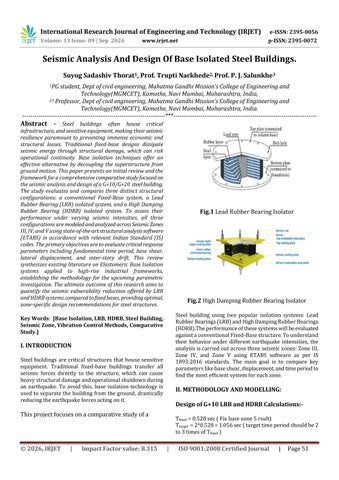
Fig.1 Lead Rubber Bearing Isolator
Fig.2 High Damping Rubber Bearing Isolator Steel building using two popular isolation systems: Lead Rubber Bearings (LRB) and High Damping Rubber Bearings (HDRB).The performance of these systems will be evaluated against a conventional Fixed-Base structure. To understand their behavior under different earthquake intensities, the analysis is carried out across three seismic zones: Zone III, Zone IV, and Zone V using ETABS software as per IS 1893:2016 standards. The main goal is to compare key parameters like base shear, displacement, and time period to find the most efficient system for each zone.
Key Words: [Base Isolation, LRB, HDRB, Steel Building, Seismic Zone, Vibration Control Methods, Comparative Study.]
I. INTRODUCTION Steel buildings are critical structures that house sensitive equipment. Traditional fixed-base buildings transfer all seismic forces directly to the structure, which can cause heavy structural damage and operational shutdown during an earthquake. To avoid this, base isolation technology is used to separate the building from the ground, drastically reducing the earthquake forces acting on it.
II. METHODOLOGY AND MODELLING: Design of G+10 LRB and HDRB Calculations:-
This project focuses on a comparative study of a
© 2026, IRJET
|
Impact Factor value: 8.315
Tfixed = 0.528 sec ( Fix base zone 5 rsult) Ttarget = 2*0.528 = 1.056 sec ( target time period should be 2 to 3 times of Tfixed )
|
ISO 9001:2008 Certified Journal
|
Page 51
International Research Journal of Engineering and Technology (IRJET)
e-ISSN: 2395-0056
Volume: 13 Issue: 09 | Sep 2026
p-ISSN: 2395-0072
www.irjet.net
(Sa/g) = 1.36 / 1.056 = 1.2879 ( 0.55sec<T< 4.0 sec) IS 1893 part 1 Dd = g.Sa.T2 / 4π2B = (9.81*1.2879*(1.056)2 ) / 4π2*1.5 = 0.2378 mm = 238 mm= 250mm Fig 5.1 Mass Summary G+10 Fixed base zone 5 Source- Etabs Software ΣMass=6779082.18Kg → W=M*g/1000 = 66502.80 kN. Weight per Isolator = 66502.80kN / 35 isolators = 1900.08 kN.
Strength (Qd) Post yield/ horizonta l stiffness (kd/kh) Effective Stiffness (keff)
=132.73kN
7.
Shape Factor (S)
8.
Compress ion Modulus (Ec)
9.
Vertical stiffness (Kv)
10 .
Effective Time period (Teff)
11 .
Energy dissipate d per cycle (WD/Eloop )
S= (Do – Di) / 4tr = (650-130) / (4˟10) = 13 Ec=(1/GS2F+4/3 Kbulk) -1 =[(1 / 6˟0.4˟132 ˟ 0.69) + (4/3˟2000)] -1 = 235.57 N/mm2 Kv = A.Ec / Tr = 0.31856˟235570 /0.22 =341105.36 kN/m Teff = 2π√W/Keff . g =2π √1900.08/1110. 12˟9.81 =2.624 Second WD = 2π.keff.β.D2 =2π ˟ 1110.12 ˟0.20˟0.252 =87.18 kN.m
12 .
Damping reduction factor (1/B)
5.
6.
Inital Input Values (G+10 Building): Building Weight per Isolator (W): 1,900.08 kN Target Design Displacement (D): 250 mm = 0.25 m Target Effective Time Period (Ttarget): 1.056 sec Outer Diameter (Do): 650 mm = 0.65 m Lead Plug Diameter (Di for LRB): 130 mm = 0.13 m Number of Rubber Layers (n): 22 layers Thickness of single Rubber Layer (tr): 10 mm = 0.01 m Thickness of Shim Plate (ts): 3 mm = 0.003 m Shear Modulus (G): LRB = 0.4 N/mm2 = 400 kN/m2 and HDRB = 1.1 N/mm2 =1100 kN/m2 Lead Yield Stress (σL): 10 N/mm2 = 10,000 kN/m2 Bulk Modulus (Kbulk) : 2,000 N/mm2 Damping Ratio ( βeff ): 20% = 0.20 Gravity Acceleration (g): 9.81 m/s2 Table 1 Steps to design LRB and HDRB Isolator for G+10 steel building
Sr . N o.
Steps
LRB (Lead Rubber Bearing)
HDRB (High Damping Rubber Bearing)
1.
Total rubber thickness (Tr) Total Bearing height (h)
Tr=n.tr = 22˟10 = 220mm
Tr=n.tr = 22˟10 = 220mm
h=n.tr-(n-1)ts = (22˟10) + (21˟3) =283mm
h=n.tr-(n-1)ts = (22˟10) + (21˟3) = 283mm
Bonded Rubber Area (A)
A=π/4[(Do)2] = π/4[(0.65)2] =0.33183 m2
A=π/4[(Do)2] = π/4[(0.65)2] =0.33183 m2
Character istic
A=π/4[(Do)2] = π/4[(0.13)2] =0.01327 m2 A=π/4[(Do-tc)2Di2] = π/4[(0.65)2(0.13)2] =0.031856 m2 Qd= σL AL = 10000˟0.01327
2.
3.
4.
© 2026, IRJET
|
Kh=kd= G.A/Tr =400˟0.31856 / 0.22 =579.20 kn/m
Kh=kd= G.A/Tr =1100˟0.33183 / 0.22 =1659.15 kN/m
Keff=Kd + Qd/Dd = 579.20 +(132.73/0.25) =1110.12 kN/m =1.1101 kN/mm
Keff=W/g (2π/Teff)2 =1900.08/9.81 ˟ (2π/2.196)2 =158 kN/m =1.5855 kN/mm S= Do / 4tr = 650 / (4˟10) = 16.25 Ec=(1/GS2F + 4/3Kbulk) -1 =[(1 / 6˟ 1.1 ˟16.252 ˟ 1.0) + (4/3˟2000)] -1 = 806.0 N/mm2 Kv = A.Ec / Tr = 0.33183˟80600 0 /0.22 =1215704.45 kN/m Teff = 2π√W/Keff . g =2π √1900.08/1585 .5˟9.81 =2.196 Second WD = 2π.keff.β.D2 =2π ˟ 1585.50 ˟0.20˟0.252 =124.52 kN.m
1/B = 0.25 (1lnβeff) =0.25(1-(1.6090)) =0.25(12.6094)= 0.65235 B = 1.533
1/B = 0.25 (1lnβeff) =0.25(1-(1.6090)) =0.25(12.6094)= 0.65235 B = 1.533
Qd=0
Impact Factor value: 8.315
|
ISO 9001:2008 Certified Journal
|
Page 52
13 .
International Research Journal of Engineering and Technology (IRJET)
e-ISSN: 2395-0056
Volume: 13 Issue: 09 | Sep 2026
p-ISSN: 2395-0072
Maximu m Displace ment (D)
D = g.(Sa/g) . Teff2/4π2B =(1.36*9.81*2.62 4) / (4π2*1.5) = 591 mm For β=20% → B=1.5 (ASCE 7) 0.55s< Teff < 4.0s → (Sa/g) = 1.36/Teff {IS 1893(1)}
www.irjet.net
Table 2 Steps to design LRB and HDRB Isolator for G+20 steel building
D = g.(Sa/g) . Teff2/4π2B =(1.36*9.81*2.1 96) / (4π2*1.5) = 495 mm For β=20% → B=1.5 (ASCE 7) 0.55s< Teff < 4.0s → (Sa/g) = 1.36/Teff {IS 1893(1)}
Design of G+20 LRB and HDRB Calculations:Tfixed = 1.098 sec ( Fix base zone 5 etabs result) Ttarget = 2*1.098 = 2.196 sec ( target time period should be 2 to 3 times of Tfixed ) (Sa/g) = 1.36 / 2.196 = 0.6193 ( 0.55sec<T< 4.0 sec) IS 1893 part 1 Dd = g.Sa.T2 / 4π2B = (9.81*0.6193*(2.196)2 ) / 4π2*1.5 = 0.0.4947 mm = 495 mm= 500mm Fig 5.2 Mass Summary G+20 Fixed base zone 5 Source- Etabs Software ΣMass=10477195.61 Kg → W=M*g/1000 = 102781.29 kN. Weight per Isolator = 102781.29kN / 35 isolators= 2936.6 kN. Inital Input Values (G+20 Building): Building Weight per Isolator (W): 2936.6 kN (From Fixed base zone 5 etabs) Target Design Displacement (D): 500 mm = 0.500 m Target Effective Time Period (Teff for HDRB): 2.196 sec Outer Diameter (Do): 650 mm = 0.65 m Lead Plug Diameter (Di for LRB): 130 mm = 0.13 m Number of Rubber Layers (n): 22 layers Thickness of single Rubber Layer (tr): 10 mm = 0.01 m Thickness of Shim Plate (ts): 3 mm = 0.003 m Shear Modulus (G): LRB = 0.4 N/mm2 = 400 kN/m2 and HDRB = 1.1 N/mm2 =1100 kN/m2 Lead Yield Stress (σL): 10 N/mm2 = 10,000 kN/m2 Bulk Modulus (Kbulk) : 2,000 N/mm2 Damping Ratio ( βeff ): 20% = 0.20 Gravity Acceleration (g): 9.81 m/s2
© 2026, IRJET
|
Impact Factor value: 8.315
Sr . N o.
Steps
LRB (Lead Rubber Bearing) Zone 5
HDRB (High Damping Rubber Bearing) Zone 5
1.
Total rubber thickness (Tr)
Tr=n.tr = 22˟10 = 220mm
Tr=n.tr = 22˟10 = 220mm
2.
Total Bearing height (h)
h=n.tr-(n-1)ts = (22˟10) + (21˟3) =283mm
h=n.tr-(n-1).ts = (22˟10) + (21˟3) = 283mm
3.
Bonded Rubber Area (A)
A=π/4[(Do)2] π/4[(0.65)2] =0.33183 m2
A=π/4[(Do)2] π/4[(0.65)2] =0.33183 m2
4.
5.
6.
|
Characteri stic Strength (Qd) Post yield/ horizontal stiffness (kd/kh) Effective Stiffness (keff)
=
A=π/4[(Do)2] = π/4[(0.13)2] =0.01327 m2 A=π/4[(Do-tc)2Di2] = π/4[(0.65)2(0.13)2] =0.031856 m2 Qd= σL AL = 10000˟0.01327 =132.73kN
=
Qd=0
Kh=kd= G.A/Tr =400˟0.31856 / 0.22 =579.20 kn/m
Kh=kd= G.A/Tr =1100˟0.33183 / 0.22 =1659.15 kN/m
Keff=Kd + Qd/Dd = 579.20 +(132.73/0.500) =844.66 kN/m =0.8446 kN/mm
Keff=W/g (2π/Teff)2 =2936.6/9.81 ˟ (2π/2.196)2 =2450.44 kN/m =2.4504 kN/mm S= Do / 4tr = 650 / (4˟10) = 16.25
7.
Shape Factor (S)
S= (Do – Di) / 4tr = (650-130) / (4˟10) = 13
8.
Compressi on Modulus (Ec)
Diameter ratio (rd)=Do/Di =650 130 =5 →central hole factor F=0.69 Ec=(1/GS2F+4/3 Kbulk) -1 =[(1 / 6˟0.4˟132 ˟ 0.69) + (4/3˟2000)] -1 = 235.57 N/mm2
ISO 9001:2008 Certified Journal
No central hole → F=1.0 Ec=(1/GS2F + 4/3Kbulk) -1 =[(1 / 6˟ 1.1 ˟16.252 ˟ 1.0) + (4/3˟2000)] -1 = 806.0 N/mm2
|
Page 53
International Research Journal of Engineering and Technology (IRJET)
e-ISSN: 2395-0056
Volume: 13 Issue: 09 | Sep 2026
p-ISSN: 2395-0072
9.
Vertical stiffness (Kv)
10 .
Effective Time period (Teff)
11 .
Energy dissipated per cycle (WD/Eloop)
12 .
Damping reduction factor (1/B)
13 .
Maximum Displacem ent (D)
Kv = A.Ec / Tr = 0.31856˟235570 /0.22 =341105.36 kN/m Teff = 2π√W/Keff .g =2π √2936.61/844.66 ˟9.81 =3.740 Second WD = 2π.keff.β.D2 =2π ˟ 844.60 ˟0.20˟0.502 =265.36 kN.m 1/B = 0.25 (1lnβeff) =0.25(1-(1.6090)) =0.25(1-2.6094)= 0.65235 B = 1.533 D = g.(Sa/g) . Teff2/4π2B =(1.36*9.81*3.74 0) / (4π2*1.5) = 591 mm For β=20% → B=1.5 (ASCE 7) 0.55s< Teff < 4.0s → (Sa/g) = 1.36/Teff {IS 1893(1)}
www.irjet.net
Kv = A.Ec / Tr = 0.33183˟806000 /0.22 =1215704.45 kN/m Teff = 2π√W/Keff . g =2π √2936.61/2450.4 4˟9.81 =2.196 Second WD = 2π.keff.β.D2 =2π ˟ 2450.44˟0.20˟0.50 2
=769.83 kN.m 1/B = 0.25 (1lnβeff) =0.25(1-(-1.6090)) =0.25(1-2.6094)= 0.65235 B = 1.533 D = g.(Sa/g) . Teff2/4π2B =(1.36*9.81*2.196 ) / (4π2*1.5) = 495 mm For β=20% → B=1.5 (ASCE 7) 0.55s< Teff < 4.0s → (Sa/g) = 1.36/Teff {IS 1893(1)}
III. RESULTS: G+10 Results: Time period comparison
© 2026, IRJET
|
Impact Factor value: 8.315
|
ISO 9001:2008 Certified Journal
|
Page 54
International Research Journal of Engineering and Technology (IRJET)
e-ISSN: 2395-0056
Volume: 13 Issue: 09 | Sep 2026
p-ISSN: 2395-0072
www.irjet.net
G+20 Results:
IV. GAPS IN LITERATURE REVIEW 1. Most existing studies focus on residential or high-rise buildings, while detailed seismic studies on steel buildings are comparatively limited 2.Many studies analyze base isolated buildings but do not provide a direct comparison between fixed base and base isolated steel structures. 3. Insufficient attention is given to the seismic response of steel buildings with base isolation systems.
IV. CONCLUSION The comparative study confirms that base isolation is an effective and reliable seismic protection technique for lowrise steel buildings, especially in moderate to high seismic zones. Overall, the base isolated G+10/G+20 steel building demonstrates superior seismic performance.
© 2026, IRJET
|
Impact Factor value: 8.315
|
ISO 9001:2008 Certified Journal
|
Page 55
International Research Journal of Engineering and Technology (IRJET)
e-ISSN: 2395-0056
Volume: 13 Issue: 09 | Sep 2026
p-ISSN: 2395-0072
www.irjet.net
REFERENCES
13) N Karimi, R Sarem.(2025).“ Seismic response of multi-storey building using different vibration technique-A review.”Journal of Building Engineering.
1) Sreeman, Dasari.(2025)“Performance evaluation of FPS and SMA-FPS isolated buildings under seismic excitations,” M.Tech Thesis, Dept. of Civil Engineering.
14) XiaoyueWang, Z Qu (2024).“ Dynamic reliabilitybased assessment for the seismic performance of semi-actively base-isolated buildings with hydraulic dampers.”Structural Safety.
2) Chikmath, Channabasaveshwar. (2025) “Seismic Fragility Analysis of LRB Base Isolated RC Building Frames using Direct Displacement Based Design Subjected to Near and Far Field Earthquakes,” International Journal of Structural Engineering. 3)
4)
5)
15) Abhishek patil, Adarsh solanke, Kuldeep Dabhekar, Isha Khedikar (2025).“Comparative seismic analysis of structures with and without seismic load.”IOP Conference Series:Materials Science and Engineering.
J Gudainiyan, P K Gupta, N Gupta (2024) “Effect of Time Period Variation of HDRB on the Response of a Base-Isolated Building Under Near Field Earthquake.” M.Tech Thesis.
16) N Cui, S Liu.(2024).“ Seismic performance analysis of braced steel structures based on vibration experiments and finite element simulation.”Journal of Constructional Steel Research.
Nawaz, Sheik Mohammed Zoheb (2025)“ Evaluation of affordable unreinforced elastomeric isolators for seismic protection of masonry buildings Experimental and numerical investigations,” Master’s Thesis.
17) Bharathi, K.M. (2023). “Experimental and numerical investigation on structural behaviour of steel winding columns.” Doctoral thesis.
Ashok Jammi (2022)“Seismic performance assessment of cold formed steel buildings using shear wall panels with reinforced sheathing.”Journal of Constructional Steel Research.
18) Podar,P.A.(2022).“Performance evaluation of coldformed and hot-rolled composite beams.” M.Tech Thesis. 19) Patil,A.N.(2024).“Parametric study on long-span steel gable frames subjected to vertical ground motion.” Doctoral Thesis, DY Patil University, Pune.
6) Gudainiyan, Jitendra (2024).“Seismic analysis of irregular buildings with and without isolation bearings.”International Journal of Earthquake Engineering.
20) Payal,Gwalani.(2023).“Seismic performance assessment of irregular RC buildings.”M.Tech Thesis.
7) Venkat Rao Badugu (2025). “Structural Optimization of High Rise Steel Buildings.”Journal of Structural Engineering.
21) Varun,J.P.(2024).“Static, dynamic and aeroelastic analysis of smart composite laminated plates under hygro-thermal effects.” Doctoral Thesis
8) Motoki Akazawa, Masahiro Kurata, Shinsuke Yamazaki, Yohsuke Kawamata, Shintaro Matsuo (2025).“Full-scale shake table testing of a baseisolated hospital building using spherical sliding bearings.” Earthquake Engineering and StructuralDynamics.
22) Dawood M. (2025). Active vibration control of cantilever beam structures using piezoelectricsensor–actuatorpairs:Aparametric study. ”JournalofIntelligentMaterial Systems and Structures.
9) Sapountzakisa (2024). “Performance evaluation of K Damper-based vibration control devices in baseisolated multistory buildings.”Engineering Structures. 10) Adnan, Ahmed.(2025).“Seismic response investigation of buildings with Base isolation and viscous dampers.”Soil Dynamics and Earthquake Engineering. 11) Saiful (2018). “Seismic response reduction of buildings using lead rubberbearings.”International Journal of Civil Engineering Structtures 12) Hongzhou Zhang, TY Yang (2018). “Seismic safety assessment of base-Isolated buildings using leadrubber bearings.” Engineering Structures.
© 2026, IRJET
|
Impact Factor value: 8.315
|
ISO 9001:2008 Certified Journal
|
Page 56