
International Research Journal of Engineering and Technology (IRJET) e-ISSN: 2395-0056
Volume: 13 Issue: 06 | Jun 2026 www.irjet.net p-ISSN: 2395-0072

International Research Journal of Engineering and Technology (IRJET) e-ISSN: 2395-0056
Volume: 13 Issue: 06 | Jun 2026 www.irjet.net p-ISSN: 2395-0072
Nawaf Abdullah Alrayes
College of Computing, Fahad Bin Sultan University, AIMD Lab, KSA, Tabuk
Abstract - This paper presents an overview of cyber security and privacy issues in modern connected environments, with special focus on location-based services, software agents, and deep learning applications in the medical sector. It first explains cyber security as a core requirement for protecting digital systems, networks, software, and data from unauthorized access, disruption, damage, and theft. The paper also discusses the importance ofcybersecurity functionssuchasidentification,protection, detection, response, and recovery. In addition, it highlights privacy protection in location-based services, where repeated and accurate location data may reveal sensitive personal information, user behavior, and movement patterns. Several privacy-preserving methods are discussed, including obfuscation, anonymity, dummy locations, and differential privacy. Furthermore, the paper introduces agent-based systems as flexible and distributed software solutions that support cooperation, adaptability, and intelligent decision-making, while also emphasizing their securitychallenges.Therole ofdeep learninginthe medical sector is also reviewed, particularly in medical image processing and diagnosis. Finally, the paper explains that the integration of cyber security, privacy protection, agentbased systems, and deep learning requires responsible design, secure data handling, and continuous protection mechanismstoensuretrust,safety,andreliability.
Key Words: Cyber security, CIA Triad, Location-Based Services, Privacy Protection, Agent-Based Systems, Deep Learning, Medical Sector, Artificial Intelligence.
Cyber security is the practice of protecting digital systems,networks,software,anddata fromunauthorized access, disruption, damage, or theft. In simple terms, it is what helps modern digital life run safely. Today, governments, hospitals, businesses, and universities all depend on connected technologies, so cyber security is no longer just a technical issue. It has become a practical requirement for protecting information, keeping services available,andmaintainingtrustindigitalsystems[1].
TheCIATriadisoneofthemostimportantmodelsused to explain the main goals of cyber security. It consists of Confidentiality, Integrity, and Availability. Confidentiality means ensuring that information is accessed only by authorizedusers,usuallythroughpasswords,encryption,authentication, and access control. Integrity means protecting data from unauthorized modification, so that information remains accurate, complete, and trustworthy. Availabilitymeansensuringthatsystems,services,anddata remain accessible whenever authorized users need them.Together,thesethreeprinciplesformthefoundation of cyber security because they help organizations protect sensitive data, maintain reliable services, and reduce the impactofcyberthreats.
Inpractice,cybersecurityalsodependsonacontinuous processthatincludesidentifyingrisks,protectingsystems, detecting suspicious activities, responding to incidents, andrecoveringafterattacks.Thisshowsthatcybersecurity is not only about preventing cyber-attacks, but also about preparing organizations to manage threats before, during,andafterincidents.Strongcybersecuritytherefore requires technical tools, clear policies, regular updates, staffawareness,andcontinuousmonitoring.
Cyber security matters because the effects of an attack gofarbeyondcomputers.A cyber-attackcaninterruptessential services, expose personal data, damage an institution’s reputation, and lead to serious financial loss. In highly connected environments, one weakness can affect manyothersystems.Thisiswhycyber securityshould be understoodnotonlyasanITconcern,butalsoasanissue ofgovernance,planning,andriskmanagement[1].
Ausefulwaytounderstandcybersecurityisthroughits main functions: identify, protect, detect, respond, and recover. First, organizations need to identify important assets, risks, and responsibilities. Then they must protect systems through access control, data security, and maintenance. After that comes detection, which involves monitoringforsuspiciousbehaviorandpossibleincidents. Ifanattackoccurs,theorganizationmustrespondquickly and clearly, and finally recover services while improving futurereadiness. Thisstep-by-step viewshowsthat cyber security is not only about preventing attacks, but also
International Research Journal of Engineering and Technology (IRJET) e-ISSN: 2395-0056
Volume: 13 Issue: 06 | Jun 2026 www.irjet.net p-ISSN: 2395-0072
about being prepared before, during, and after them [1]. As shown in Fig. 1, cyber security is commonly organized intofivemainfunctions:identify,protect,detect, respond, andrecover.
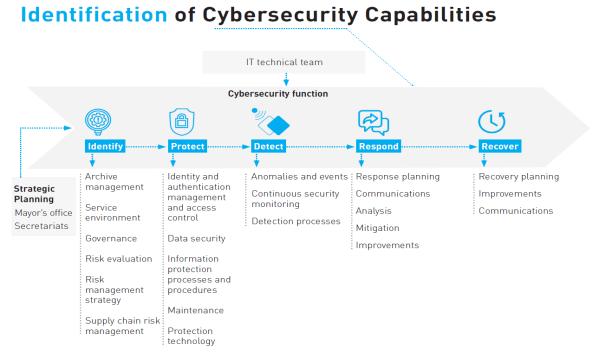
Fig -1: Maincybersecuritycapabilities,fromidentifying riskstorecoveryafterincidents[1].
A practical view
In real life, many cyber incidents happen because of simple weaknesses such as poor passwords, outdated software, weak access control, or low user awareness. So, strong cybersecurity isnotbasedonlyonadvancedtools. Italsodependsonroutinegoodpractice,stafftraining,and clear policies. In that sense, cyber security is not just a technicalshield;itisahabitofresponsibledigitalbehavior [1].
What location-based services are:
Location-Based Services, or LBS, are services that use the location of a device to provide useful information or assistance. Common examples include navigation apps, nearby restaurant search, weather updates, emergency help, and friend-finder services. These services are popularbecausetheyareconvenientandoftenhighlyaccurate. Bettini explains that LBS can generally be grouped into personal services and social network services, depending onwhetherthelocationismainlysharedwiththeprovideroralsowithotherusers[2].
Theprivacyproblemappearsbecauselocationdatacan reveal much more than a person’s current position. Over time, it may show where someone lives, works, shops, travels, or whom they meet. Bettini defines a privacy threat as a situation in which an unauthorized entity can connect a person’s identity with private information. This means that a location history can reveal habits, routines, andevensensitivepersonaldetails.Theriskbecomeseven greater when many location points are collected and analyzedtogetherinsteadofbeingviewedseparately[2].
PrivacyrisksinLBSdo not comefromonlyonesource. Theserviceprovideritselfmaybecomeariskifitusesdata in unexpected ways. An outside attacker may try to intercept or steal the information. In some social-location systems, even other users may become privacy threats. Bettini also shows that the precision of location data and the frequency of requests are very important, because highly precise and repeated data make re-identification mucheasier[2].
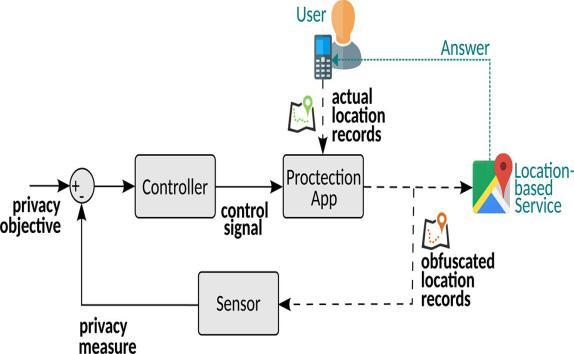
Several methods have been proposed to reduce these risks. One common approach is to lower the precision of the shared location instead of sending the exact position. Othermethodsincludeanonymitytechniques,obfuscation, dummy locations, and differential privacy approaches suchasgeo-indistinguishability,wherecontrollednoiseis added to protect the real position. However, stronger privacyoftenreducesserviceaccuracy,soprivacyprotection in LBS is usually a balance between safety and utility ratherthanaperfectsolution[2].AsshowninFig.2,privacy protection in location-based services can be achieved by transformingactual locationrecordsinto obfuscatedlocationrecordsbeforetheyaresenttotheserviceprovider.
Agent-based systems are software systems made up of autonomous agents that interact with one another and withtheirenvironment.Eachagenthasarole,makesdecisions,andperformsactionsthatcontributetoalargersystem goal. This approach is especially useful when the problem is distributed, dynamic, or difficult to manage fromonecentralcontroller.Bothclassicalandrecentwork showthatagent-basedsystemsarewellsuitedtocomplex problems where communication, cooperation, and adaptabilityareimportant[3],[4].
Volume: 13 Issue: 06 | Jun 2026 www.irjet.net p-ISSN: 2395-0072
The main strength of agent-based systems is that they reflecthowmanyreal-worldsystemsactuallywork.Applications such as traffic control, healthcare support, logistics,andautonomous environments involve many entities actingatthesametime.Insteadofforcingeverythinginto onerigidprogram,agent-baseddesignallowseachpartof thesystemtooperate with someindependence while still cooperating with the others. This often makes the overall system more flexible, scalable, and responsive to change [3],[4].
A classical design method is the UML-based process proposed by Cossentino and colleagues. In this method, use-case diagrams help identify agents and their roles, class diagrams describe their structure, and sequence or activitydiagramsexplainbehaviorandcommunication.An importantideainthisprocessisiteration:agentstructure and agent behavior are refined together until the system requirements are properly implemented. This makes agent-based design a structured engineering process ratherthananinformalidea[3].
Amorerecentdevelopment istheintegrationofAIand machine learning into agent-based systems. Abu Maria and AlKhatib propose an AI-Driven Agent-Based System DevelopmentFrameworkinwhichAIandMLareincorporated into the full lifecycle of the system. This allows agents to learn from data, adapt to changing conditions, andimprovedecision-making.Atthesametime,thepaper notes that challenges still remain, including complexity, the need for good-quality data, and the lack of unified standards [4]. As shown in Fig. 3, an agent-based system works through continuous interaction between the agent and its environment, where actions produce new states andfeedback.
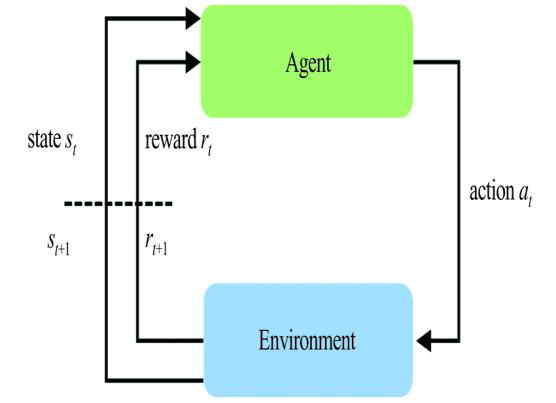
Fig -3: Basicinteractionloopbetweenanagentandits environmentinanagent-basedsystem.
Deep learning has become one of the most influential technologies in the medical sector because it can learn useful patterns from large and complex datasets. In healthcare,thesedatasetsmayincludemedicalimages,pathology slides, biosignals, and clinical records. One of the strongest areas of progress has been medical imaging, where deep learning is now widely studied for classification,detection,segmentation,anddecisionsupport.Thisis whytheselectedfigurefitsthetopicverywell,especiallyif the section focuses on image-based medical applications [5],[6].
Deep learning has shown value in many medical tasks, including diabetic retinopathy detection, tumor analysis, lungnoduleclassification,thyroiddiagnosis,fetallocalization, and other imaging-based applications. Its main advantage is that it can identify subtle visual patterns that maybedifficulttocapturethroughtraditionalmethods.At thesametime,theliteratureshowsthatthesesystemsare most helpful when they support clinicians rather than replace them, especially in tasks involving screening, triage, andimageinterpretation[5],[6].
Even though deep learning is powerful, strong performanceinresearchdoesnotautomaticallymeansafeusein real healthcare settings. The WHO guidance on AI for health stresses that safety, transparency, accountability, andhumanoversightareessential.Inaddition,medicalAI systemscansufferfrombiasiftrainingdataarelimitedor unbalanced, which may affect fairness and reliability acrosspatientgroups.Sothekeyissueisnotonlybuilding accurate models, but also making sure they are ethical, well-evaluated,andusedresponsibly[7].
Deep learning is already part of the broader regulatory conversationaroundAI-enabledmedicaldevices.TheFDA notes that AI-enabled medical devices are an active and growingareaofoversight,whichshowsthatthistechnology is moving from research into real clinical use. Even so, clinical deployment still requires careful validation, regulation,andmonitoring.Forthatreason,thefutureofdeep learninginmedicineispromising,butitssuccessdepends oncombiningtechnicalprogresswithsafeandresponsible practice [8]. As shown in Fig. 4, deep learning has been appliedtoawiderangeofmedicalimagingtasks,including diabeticretinopathydetection,braintumordetection,lung noduleclassification,andthyroiddiagnosis.
International Research Journal of Engineering and Technology (IRJET) e-ISSN: 2395-0056
Volume: 13 Issue: 06 | Jun 2026 www.irjet.net p-ISSN: 2395-0072
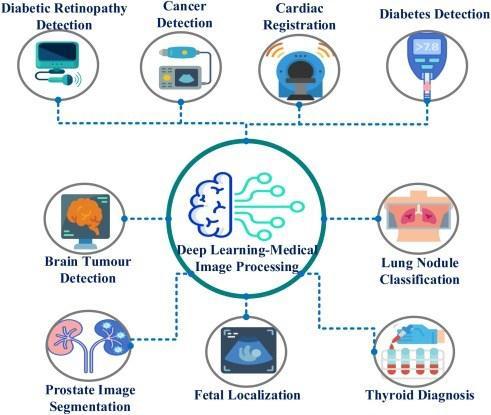
Examplesofdeeplearningapplicationsinmedical imageprocessinganddiagnosis.
Inregardingtointegrationwithlocationbasedservices, agents can be integrated to enable users to search for nearest points of interests. However, privacy of users can be attached, by external intruders, especially if they have experience in applying advanced attacks such as location homogeneityandsemanticlocationattacksaswellasqueryanalyzingattacks [9,10, 11,12,13] Inaddition,power consumption of mobile device battery comes to the top whentrying to ensure high level of privacyaswell aslow complexity of privacy protection method to ensure continuity of using location based services applications [14]. Moving towards agents, they can be attacked by destinationmachinestochangethecodeofthemissioncarriedby theagent,theparametersofthetipofthemobileagent,or theresultsoftheexecutedtaskcarriedbytheagent.Actually, many works studied the security of agents [15, 16, 17]. In case of not taking into consideration such issue, systemsarefailed.
Moreover,whenintegrating of systemsthatensureprivacy protection in IoT-based infrastructures, big data, usingdataminingmethods,andsecurityofwebapplications mustbetakenintoaccount [18,19].Otherwise,muchvulnerabilitywillbearisen.
As a special case in medical sector, using deep learning isrankedonthetopduringtheCOVID-19years[20].This means that ensuring good training with security of trainingdatasetandotherdatasetsusedtodevelopdiagnostic systems[21,22]mustbeconsideredtogaintrustofusers inmedicalcompanies(privateofgovernmental).
Cybersecurity,privacyprotection,software-agentsecurity, and deep learning are strongly connected in modern digital systems. Cyber security is essential because digital servicesnowsupportmanycriticalsectors,includingeducation, healthcare, transportation, business, and public
services.Anyweaknessinthesesystemsmayleadtodata leakage,servicedisruption,financialloss,andreduceduser trust. Privacy protection is also highly important in location-based services because users’ location records can revealprivatehabits,dailyroutines,andsensitivepersonal information. Agent-based systems provide useful solutions for distributed and dynamic environments, but they must be protected against attacks that may modify their code, data, parameters, or mission results. Deep learning offers strong benefits in the medical sector, especially for diagnosis and image analysis, but it also requires secure datasets, ethical use, transparency, validation, and human oversight. Therefore, successful integration of these technologies depends not only on technical performance, but also on secure design, privacy-aware processing, governance, and continuous monitoring. Overall, responsible cyber security practices are necessary to ensure safe, trusted,andreliabledigitaltransformation.
The author take help of ChatGPT to present illustrative figures as well as for proof reading. However, the basic scientificcontentispresentedbytheauthor.
1) L.CotinoandM.Sánchez,ACybersecurityGuidefor Smart Cities. Inter-American Development Bank, 2021.
2) C. Bettini, “Privacy Protection in Location-Based Services: A Survey,” in Handbook of Mobile Data Privacy.Springer,2018.
3) M.Cossentino,A.Chella,andU.LoFaso,“Designing agent-basedsystemswithUML.”
4) K.Abu Maria and A.A.AlKhatib, “Bridging the Gap: AI-Driven Agent-Based Systems in Modern Software Engineering,” Journal of Information Systems EngineeringandManagement,vol.10,2025.
5) Esteva, A., Chou, K., Yeung, S. et al. Deep learningenabled medical computer vision. npj Digit. Med. 4, 5 (2021). https://doi.org/10.1038/s41746-02000376-2
6) Aggarwal, Ravi, Viknesh Sounderajah, Guy Martin, Daniel SW Ting, Alan Karthikesalingam, Dominic King, Hutan Ashrafian, and Ara Darzi. "Diagnostic accuracyofdeeplearninginmedicalimaging:asystematicreviewandmeta-analysis."NPJdigitalmedicine4,no.1(2021):65.
7) World Health Organization, Ethics and Governance of Artificial Intelligence for Health, 2021. (World HealthOrganization)
International Research Journal of Engineering and Technology (IRJET) e-ISSN: 2395-0056
Volume: 13 Issue: 06 | Jun 2026 www.irjet.net p-ISSN: 2395-0072
8) U.S.FoodandDrugAdministration,“ArtificialIntelligence-Enabled Medical Devices,” 2025. (U.S. Food andDrugAdministration)
9) Mohamad Shady Alrahhal, Maher Khemakhem and Kamal Jambi, "A Survey on Privacy of LocationBased Services: Classification, Inference Attacks, andChallenges,"JournalofTheoreticalandApplied InformationTechnology,vol.95,no.24,2017.
10) Mohamad Shady Alrahhal, Maher Khemakhem and Kamal Jambi, "Agent-Based System for Efficient kNNQueryProcessingwithComprehensivePrivacy Protection," International Journal of Advanced Computer Science and Applications, vol. 9, no. 1, 2018.
11) Mohamad Shady Alrahhal,Muhammad Usman Ashraf,AdnanAbesenandSabahArif,"AES-RouteServer Model for Location Based Services in Road Networks,"International Journal ofAdvancedComputerScienceandApplications,vol.8,no.8,2017.
12) Hosam Alrahhal et al., "A symbiotic relationship based leader approach for privacy protection in location based services," ISPRS International Journal ofGeo-Information,vol.9,no.6,p.408,2020.
13) Abdullah S. Alyousef, Karthik Srinivasan, Mohamad ShadyAlrahhal,MajdahAlshammariandMousa AlAkhras, "Preserving Location Privacy in the IoT againstAdvancedAttacksusingDeepLearning,"International Journal of Advanced Computer Science andApplications,vol.13,no.1,2022.
14) Mohamad Shady Alrahhal, Maher Khemekhem and Kamal Jambi, "Achieving load balancing between privacyprotectionlevel and powerconsumptionin location based services," International Research JournalofEngineeringandTechnology,vol.5,no.3, pp.619-625,2018.
15) Bandar Alluhaybi, Mohamad Shady Alrahhal, Ahmed Alzhrani and Vijey Thayananthan, "A Survey: Agent-based Software Technology Under the Eyes of Cyber Security, Security Controls, Attacks and Challenges," International Journal of Advanced Computer Science and Applications, vol. 10, no. 8, 2019.
16) Bandar Alluhaybi, Mohamad Shady Alrahhal, Ahmed Alzhrani and Vijey Thayananthan, "Dummybased approach for protecting mobile agents against malicious destination machines," IEEE Access,vol.8,pp.129320-129337,2020.
17) Bandar Alluhaybi, Mohamad Shady Alrahhal, Ahmed Alzhrani and Vijey Thayananthan, "Achieving self-protectionandself-communicationfeaturesfor securityofagent-basedsystems,"2020.
18) Majed Abdullah Albarrk and Mohamad Shady Alrahhal, "Web Applications Security: More Collaboration,"2020.
19) MohamadShadyAlrahhalandAdnanAbiSen,"Data mining,bigdata,andartificialintelligence:Anoverview,challenges,andresearchquestions,"2018.
20) Mohamad Shady Alrahhal and Majed Abdullah Albarrk, "A Survey of the COVID-19 Epidemic ThroughtheEyesofArtificialIntelligenceandDeep Learning: Challenges and Research Questions," 2020.
21) Mona Alfifi, Mohamad Shady Alrahhal, Samir Bataineh and Mohammad Mezher, "Enhanced ArtificialIntelligenceSystemforDiagnosingandPredicting Breast Cancer using Deep Learning," International Journal of Advanced Computer Science and Applications,vol.11,no.7,2020.
22) Mohamad Shady Alrahhal and Eftkhar Alqhtani, "Deep learning-based system for detection of lung cancerusingfusionoffeatures,"International JournalofComputerScienceandMobileComputing,vol. 10,no.2,pp.57-67,2021.