
International Research Journal of Engineering and Technology (IRJET) e-ISSN: 2395-0056
Volume: 13 Issue: 04 | Apr 2026 www.irjet.net p-ISSN: 2395-0072
International Research Journal of Engineering and Technology (IRJET) e-ISSN: 2395-0056
Volume: 13 Issue: 04 | Apr 2026 www.irjet.net p-ISSN: 2395-0072
Prof. R. K. Nale1 , Vaishnavi Dhumal2 , Vaishnavi Jagtap3 , Shantanoo Karad4 , Rohan Kambale5
2,3,4,5 Student, Department of IT Engineering, SVPM’s College of Engineering, Malegaon BK, Maharashtra, India.
1 Assistant Professor, Department of IT Engineering, SVPM’S College of Engineering Malegaon BK, Baramati, Maharashtra, India ***
Abstract - Securecommunicationoverdigitalnetworksisa majorconcernduetoincreasingcyberthreats,databreaches, and unauthorized access. Traditional methods like cryptographyprotectthecontentofmessagesbutdonothide theirexistence,whilesingle-imagesteganographysystemsare vulnerable to detection and data loss. To address these limitations, we developed a secure communication system using multi-image steganography, AES encryption, and face recognition authentication. The system first encrypts the secret message using AES and then divides it into multiple parts for improved security. Each part is embedded into different images using the Least Significant Bit (LSB) technique, ensuring minimal visual distortion. The stegoimages are transmitted securely through email communication.Atthereceiverside,facerecognitionisusedto verify user identity before extracting the hidden data. The systemthenreconstructs and decryptsthe message to obtain the original information. This approach improves confidentiality, reduces the risk of complete data exposure, and prevents unauthorized access. The system is efficient, secure,andsuitableforapplicationssuchasmilitary,banking, and confidential data sharing.
Key Words: Multi-ImageSteganography,FaceRecognition, BiometricAuthentication,LeastSignificantBit(LSB).
Securecommunicationhasbecomeanessentialrequirement intoday’sdigitalworldduetotherapidgrowthofinternet usage and online data exchange. Many organizations and individualsregularlyshareconfidentialinformationthrough digitalplatforms,whichincreasestheriskofcyber-attacks, databreaches,andunauthorizedaccess.Traditionalsecurity methods such as cryptography protect the content of the messagebyconvertingitintounreadableformat,buttheydo not hide the existence of communication. As a result, encrypted messages can still attract attackers. Similarly, traditionalsingle-imagesteganographysystemshidesecret information inside images, but they are vulnerable to steganalysisattacksandcompletedatalossifasingleimage iscompromised.
Asdigitalcommunicationcontinuestogrow,thereisaneed foramoresecureandreliablecommunicationsystemthat can protect both the content and existence of sensitive
information.Tosolvethisproblem,wedevelopedasecure communication system using multi-image steganography, AES encryption, and face recognition authentication. The system first encrypts the secret message using AES and dividesitinto multiple partsforenhancedsecurity.These messagesegmentsarehiddeninmultipleimagesusingthe LeastSignificantBit(LSB)technique.Thegeneratedstegoimagesaresecurelysharedthroughemailcommunication. Atthereceiverside,facerecognitionauthenticationverifies the identity of the user before extracting the hidden message. This system improves confidentiality, prevents unauthorized access, and provides a secure and efficient solutionformilitary,banking,healthcare,andgovernment communicationsystems.
The development of secure communication systems is essentialduetoincreasingcyberthreatsanddatabreaches. Traditional cryptography protects message content but cannot hide the existence of communication. Single-image steganographyisvulnerabletodetectionandcompletedata exposure.Thisprojectdevelopsasecuresystemusingmultiimagesteganography,AESencryption,andfacerecognition authentication.Thesystemensuressecuredatatransmission and prevents unauthorized access to confidential information.
In recent years, secure communication has become an important research area due to increasing cyber threats, data breaches, and unauthorized access. Traditional cryptographyprotectsmessagecontentbutcannothidethe existence of communication. Similarly, single-image steganographyisvulnerabletodetectionandcompletedata exposure.Researchershaveintroducedadvancedtechniques such as multi-image steganography, AES encryption, and biometric authentication to improve security. Face recognition has also been widely used to restrict unauthorizedaccess.Thesestudiesprovidethefoundation fordevelopingtheproposedsecurecommunicationsystem.
International Research Journal of Engineering and Technology (IRJET) e-ISSN: 2395-0056
Volume: 13 Issue: 04 | Apr 2026 www.irjet.net p-ISSN: 2395-0072
Therapidgrowthofinternetcommunicationanddigitaldata exchange has increased the demand for secure communication systems. Sensitive information shared throughonlineplatformsisoftenexposedtocyber-attacks, hacking, and unauthorized access. Traditional security methods such as cryptography and single-image steganography provide limited protection and may fail againstmodernattacks.Theproposedsystemismotivated by the need to develop a more secure and reliable communicationplatformusingmulti-imagesteganography, AESencryption,andfacerecognitionauthentication.
A. Preventing Cyber Threats and Data Breaches
Withtheincreasinguseofdigitalcommunicationplatforms, confidential information is frequently transmitted over public networks. Hackers and attackers can intercept messages,leadingtodatabreachesandmisuseofsensitive information.Traditionalcommunicationsystemsoftenlack strongprotectionmechanisms.Thisprojectaimstoreduce cyberrisksbyimplementingmultiplesecuritylayersforsafe communication.
B. Enhancing Data Confidentiality
Traditionalencryptiontechniquesprotectmessagecontent butcannothidetheexistenceofcommunication.Similarly, single-image steganography may expose the complete messageifoneimageiscompromised.Theproposedsystem uses multi-image steganography to divide and hide the secretmessageacrossmultipleimages,reducingthechances ofcompletedataexposureandimprovingconfidentiality.
C. Preventing Unauthorized Access
Many existing communication systems do not verify the identityofusersbeforeallowingaccesstoconfidentialdata. Thiscreatesahighriskofunauthorizedmessageextraction. To solve this issue, the proposed system integrates face recognition authentication, ensuring that only authorized users can access and retrieve hidden information. The system verifies the receiver’s identity before message extraction,addinganextralayerofbiometricsecurity.This helpspreventunauthorizedusersfromaccessingsensitive dataandimprovesoverallsystemprotection.
Transmitting confidential data through normal communicationchannelscanattractattackers.Theproposed system securely sends stego-images through email communication,wherehiddenmessagesremaininvisibleto third parties. This ensures safe and reliable data transfer betweensenderandreceiver.Sincethemessageishidden insideimages,attackerscannoteasilydetectthepresenceof confidentialinformationduringtransmission.Thisapproach
improves communication security and reduces the risk of datainterceptionorunauthorizedaccess.
Moderncommunicationsystemsrequiremultiplelayersof protectiontoensurecompletesecurity.BycombiningAES encryption,LSBsteganography,multi-imagesegmentation, andbiometricauthentication,theproposedsystemimproves reliability, reducessecurity risks,and providesa practical solutionformilitary,banking,healthcare,andgovernment communication applications. The integration of multiple securitytechniquesmakesthesystemmorerobustagainst cyber-attacksandsteganalysisthreats.Italsoensuressecure communicationwhilemaintainingefficiency,scalability,and easeofimplementation.
5. System Architecture
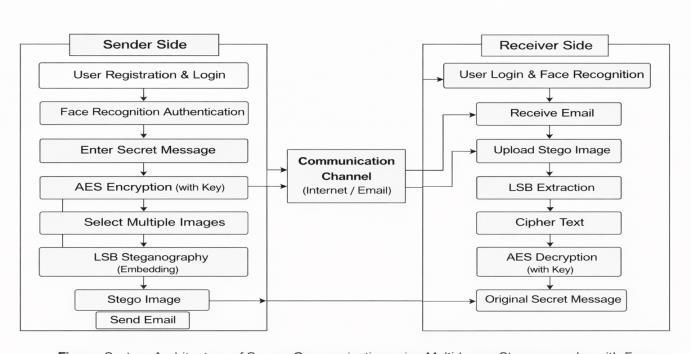
Fig1: SystemArchitecture
1.UserRegistration&Authentication:Userssecurelyregister and log in using email, password, and face recognition to accessthecommunicationsystem.
2. Enter Secret Message: The sender enters confidential information that needs to be transmitted securely to the receiver
3.AESEncryption&Multi-ImageSteganography:Thesecret messageisencryptedusingAESandhiddeninsidemultiple selectedimagesusingtheLSBtechnique.
4. SecureTransmission:Thegeneratedstego-imagesaresent throughemailorinternetcommunicationchannelsforsecure datatransfer.
5.MessageExtraction&Decryption:Thereceiveruploadsthe stego-image,extractshiddendatausingLSBextraction,and decryptsitusingAEStoretrievetheoriginalsecretmessage.
6.Proposed Algorithms
AES (Advanced Encryption Standard) is a widely used symmetric key encryption algorithm designed to secure sensitive information during digital communication. It convertsreadableplaintextintounreadableciphertextusing a secret encryption key, ensuring that unauthorized users cannotunderstandthemessageevenifitisintercepted.AES
International Research Journal of Engineering and Technology (IRJET) e-ISSN: 2395-0056
Volume: 13 Issue: 04 | Apr 2026 www.irjet.net p-ISSN: 2395-0072
performsmultipleroundsofsubstitution,permutation,and key transformation to provide strong protection against cyber-attacks such as brute-force attacks and data interception.Intheproposedsystem,thesenderfirstenters thesecretmessage,whichisencryptedusingAESbeforethe steganographyprocessbegins.Theencryptedciphertextis thendividedandembeddedintomultipleimagesusingLSB steganography.Atthe receiverside,thesamesecretkeyis requiredforAESdecryptiontorecovertheoriginalmessage. Thisalgorithmaddsanextralayerofsecurityandimproves confidentialityinsecurecommunication.
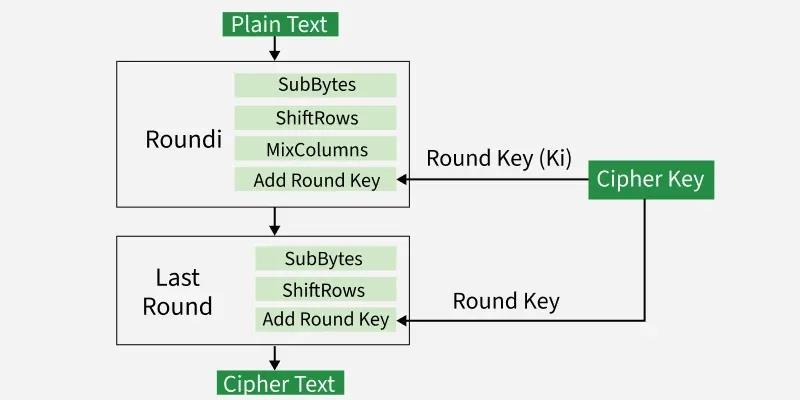
Fig-2:AESEncryptionAlgorithm
Explanation of AES Encryption Algorithm:
1.InputPlainText:
The sender enters the original secret message (plain text) thatneedstobeprotected.
2.RoundKeyGeneration:
A secret encryption key is generated and divided into multipleroundkeysforencryption.
3.SubBytesOperation:
Inthisstep,eachbyteofplaintextisreplacedwithanother byteusingsubstitutiontoincreasesecurity.
4.ShiftRowsandMixColumns:
Therowsareshiftedandcolumnsaremixedtorearrangethe dataandmakeencryptionstronger.
5.AddRoundKey:
Thetransformeddataiscombinedwiththegeneratedround keyduringeachroundofencryption.
6.GenerateCipherText:
After completing all rounds, the final encrypted output is produced as cipher text, which is used for secure communication.
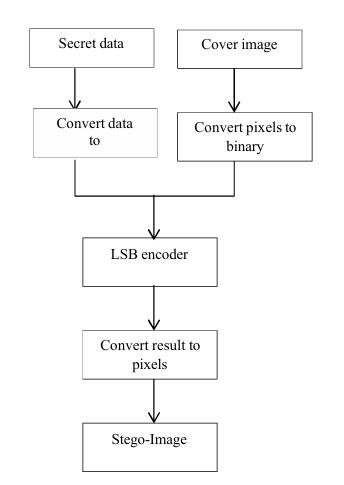
Fig-3:LSBSteganographyAlgorithm
1.InputSecretData: Thesecretmessageorencryptedciphertextistakenasinput forhiding.
2.ConvertDatatoBinary: The secret message is converted into binary format for embedding.
3.SelectCoverImage: Acoverimageisselectedtohidethesecretdata.
4.ConvertPixelstoBinary: Thepixelvaluesofthecoverimageareconvertedintobinary form.
5.LSBEncodingProcess: Thebinarysecretdataisembeddedintotheleastsignificant bitsofimagepixels.
6.GenerateStegoImage: Themodifiedpixelsareconvertedbackintoimageformat, producingthefinalstego-imagecontaininghiddendata.
:
1.Input Face Image: The user uploads a face image or capturesaliveimageusingawebcam.
2.Face Detection: The system detects the face from the uploadedimageusingimageprocessingtechniques.
3.Image Preprocessing: The detected face is resized, normalized,andcleanedforbetterrecognitionaccuracy.
4.FeatureExtraction:Importantfacialfeaturesareextracted usingfacerecognitionmodelssuchasDeepFace/CNN.
5.FaceMatching:Theextractedfeaturesarecomparedwith storeduserfacedatainthedatabase.
International Research Journal of Engineering and Technology (IRJET) e-ISSN: 2395-0056
Volume: 13 Issue: 04 | Apr 2026 www.irjet.net p-ISSN: 2395-0072
6.AuthenticationResult:Ifthefacematchessuccessfully,the user is authenticated and allowed to access message extraction.Otherwise,accessisdenied.
Algorithm 4: Data Extraction and Message Reconstruction Algorithm
1.UploadStegoImage:Thereceiveruploadsthestego-image thatcontainsthehiddenencryptedmessage.
2. LSB Extraction: The system reads the image pixels and extracts the hidden binary data from the least significant bits.
3. Recover Cipher Text: The extracted binary data is convertedbackintoencryptedciphertextformat.
4. Message Reconstruction: If the message is divided into multiple images, all extracted parts are combined to reconstructthecompleteciphertext.
5. AES Decryption: The reconstructed cipher text is decryptedusingthecorrectsecretkey.
6. Display Original Message: The system retrieves and displays the original secret message to the authorized receiver.
• AES Algorithm: AES provides very high encryption accuracy by converting plain text into secure cipher text using multiple encryption rounds. It ensures strong confidentiality and protects sensitive information from unauthorized access, brute-force attacks, and data interception.
•LSBSteganographyAlgorithm:LSBoffershighaccuracyin hiding encrypted data inside image pixels without significantlyaffectingimagequality.Itensuresthathidden messagesremaininvisibletohumaneyeswhilemaintaining properembeddingefficiency.
• Face Recognition Algorithm: Face recognition provides highauthenticationaccuracybydetectingfacialfeaturesand matching them with stored user data. It reduces unauthorized access and improves biometric security for securemessageextraction.
• Data Extraction and Message Reconstruction Algorithm: Thisalgorithmensuresaccurateextractionofhiddencipher text from stego-images and successfully reconstructs the original message without data corruption. It improves reliabilityduringthedecryptionprocess.
• AES Algorithm: AES has moderate computational complexity because it performs multiple rounds of encryptionoperationssuchassubstitution,shifting,mixing,
and key generation. However, it provides strong security withefficientperformance.
•LSBSteganographyAlgorithm: LSBhaslowcomputational complexitybecauseitonlymodifiestheleastsignificantbits ofimagepixels.Itrequiresminimalprocessingtimeandis easytoimplement.
• Face Recognition Algorithm: Face recognition has moderate to high computational complexity due to face detection,featureextraction,andmatchingprocesses.The complexityincreaseswhenlargefacialdatabasesareused.
• Data Extraction and Message Reconstruction Algorithm: This algorithm has moderate computational complexity because it involves extracting hidden data from multiple images,reconstructingmessagesegments,andperforming AESdecryptiontorecovertheoriginalmessage.
•AESAlgorithm:AESprovideshighreal-timeperformance becauseencryptionanddecryptionprocessesarecompleted quickly, making it suitable for secure communication applications.
•LSBSteganographyAlgorithm:LSBoffersgoodreal-time performancesinceembeddingsecretdataintoimagepixels requires less processing time and generates stego-images efficiently.
• Face Recognition Algorithm: Face recognition provides moderate real-time performance as face detection and authentication may require additional processing time dependingonimagequalityandsystemhardware.
• Data Extraction and Message Reconstruction Algorithm: This algorithm offers moderate real-time performance because it involves extracting hidden data from multiple imagesandreconstructingtheoriginalmessage,whichmay takeadditionaltimeforlargerfiles.
•AESAlgorithm:AESgeneralizeswellfordifferenttypesof text data and can securely encrypt various confidential messagesregardlessofmessagesize.
•LSBSteganographyAlgorithm:LSBcanworkwithdifferent image formats such as PNG, JPG, and BMP, making it adaptableforvariousimage-basedcommunicationsystems.
•FaceRecognitionAlgorithm:Facerecognitiongeneralizes welltomultipleusersbyidentifyingdifferentfacialfeatures, butperformancemayvaryunderpoorlightingconditionsor differentfacialangles.
• Data Extraction and Message Reconstruction Algorithm: Thisalgorithmcanefficientlyextractandreconstructhidden messagesfromdifferentstego-imagesandsupportsvarious messagesizeswithoutaffectingaccuracy.
Conclusion: AES provides strong encryption security, LSB ensuressecuredatahidingwithminimalimagedistortion,
International Research Journal of Engineering and Technology (IRJET) e-ISSN: 2395-0056
Volume: 13 Issue: 04 | Apr 2026 www.irjet.net p-ISSN: 2395-0072
face recognition enhances authentication, and message reconstruction guarantees accurate recovery of hidden information.Thecombinationofthesealgorithmsimproves overallsystemsecurity,reliability,andefficiencyforsecure communicationapplications.
Thisresearchpresentsasecurecommunicationsystemthat integrates multi-image steganography, AES cryptographic encryption, and face recognition-based biometric authentication to protect confidential information transmittedoveropennetworks.Theproposedmethodology follows a structured system architecture to perform user authentication, message encryption, segmentation, data embedding,securetransmission,biometricverification,data extraction,andmessagereconstructioninanefficientand reliablemanner.
I. System Overview:
Thesystembeginswiththesenderregisteringandlogging into the application using email credentials and face authentication. After successful login, the sender enters a secret message that needs to be transmitted securely. To ensureconfidentiality,themessageisfirstencryptedusing theAdvancedEncryptionStandard(AES)algorithmwitha secret key. The encrypted message is then divided into multiple segments to improve security. Multiple cover images are selected, and each encrypted segment is embeddedintodifferentimagesusingtheLeastSignificant Bit (LSB) steganography technique. The generated stegoimages are visually similar to original images and are transmittedthroughemailcommunicationchannels.
II. Message Encryption and Segmentation:
Before data hiding, the secret message undergoes AES encryption to prevent unauthorized access. The AES algorithm converts readable plain text into unreadable ciphertextusingasecretkey.Theencryptedmessageisthen segmented into multiple parts so that no single image contains the complete message. This significantly reduces the risk of complete data exposure if one image is compromised.
III. Multi-Image LSB-Based Data Embedding:
Eachencryptedmessagesegmentisembeddedintoseparate cover images using the LSB embedding technique. The algorithm modifies only the least significant bits of image pixels,whichcausesminimalvisualdistortion.Thisensures that the hidden data remains invisible to attackers while maintaining image quality. The multi-image approach improvesresistanceagainststeganalysisattacks.
IV. Secure Transmission of Stego-Images:
After embedding, the generated stego-images are transmitted through email or internet communication
channels.Sincetheimagesappearnormalanddonotreveal the existence of hidden information, the communication remainssecureandcovert.Thisstageensuressafetransfer ofconfidentialinformationbetweensenderandreceiver.
V. Face Recognition-Based Authentication:
Atthe receiverside,thesystemperformsfacerecognition authentication before allowing message extraction. The receiver’s face is captured using a webcam or uploaded imageandprocessedusingfacerecognitionmodelssuchas CNNorFaceNet.Facialfeaturesareextractedandcompared withstoreduserdata.Onlyauthenticatedusersareallowed toproceedfurther.
VI. Data Extraction and Message Reconstruction:
After successful authentication, the receiver uploads the stego-imagesintothesystem.LSBextractionisperformedto retrieve hidden encrypted message segments from each image. The extracted segments are combined in proper sequence to reconstruct the complete cipher text. Finally, AESdecryptionisappliedusingthesecretkeytorecoverthe original secret message. The reconstructed message is displayedsecurelytotheauthorizedreceiver.
8. Results:
Encryption High High Strong security
Recovery
Medium Accurate output
13 Issue: 04 | Apr 2026 www.irjet.net p-ISSN: 2395-0072
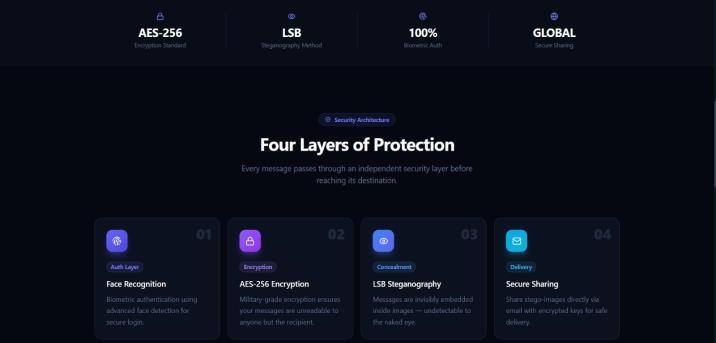
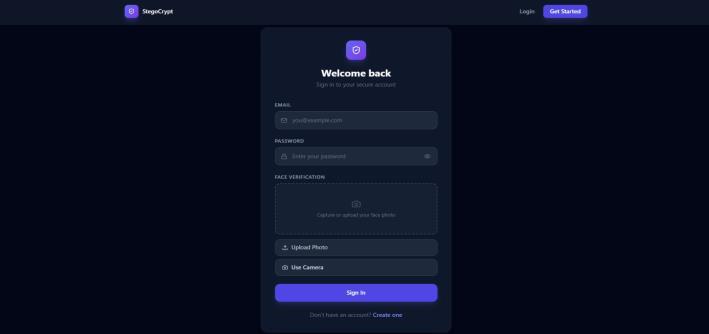
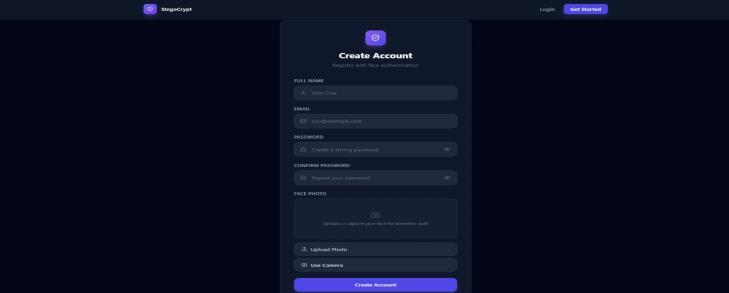
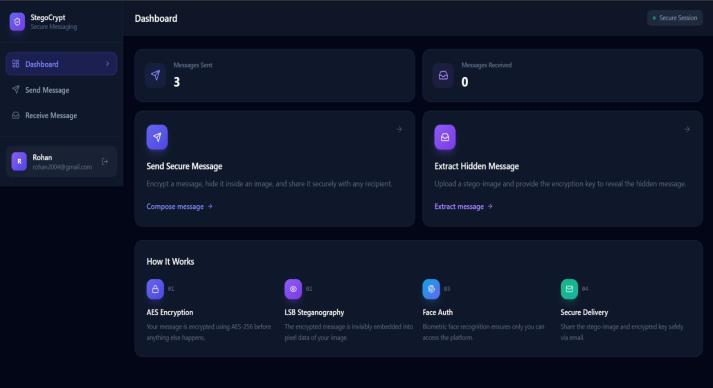
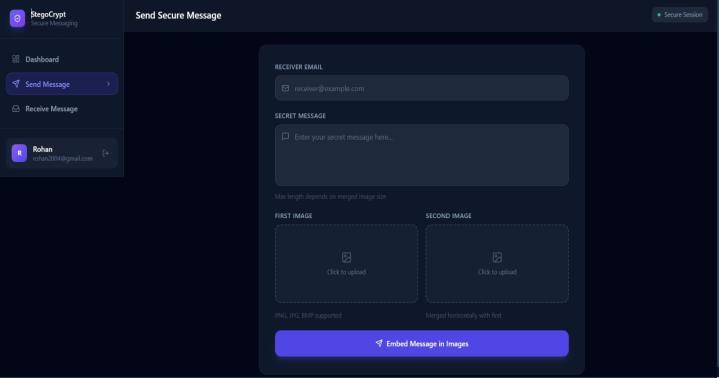
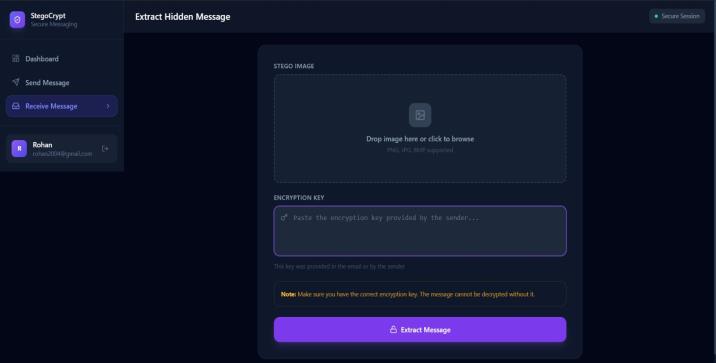
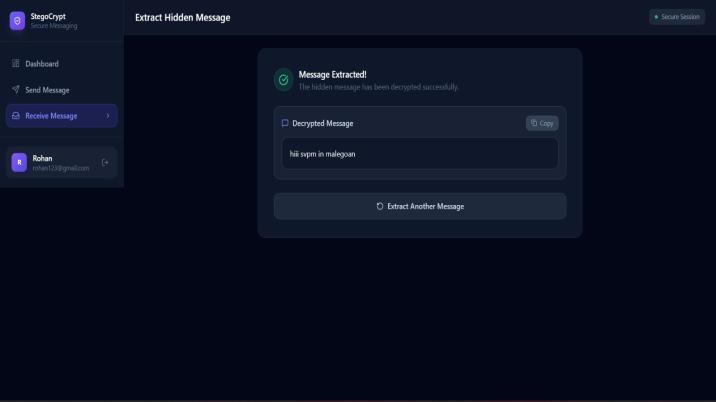
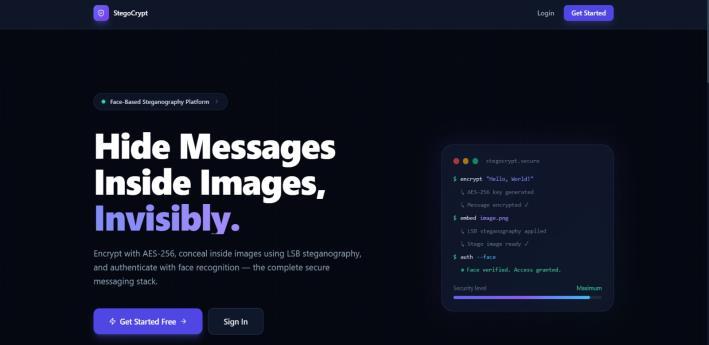
Thisproject presentsa securecommunicationframework thatintegratesmulti-imagesteganography,AESencryption, and face recognition–based biometric authentication to protect sensitive information transmitted over open networks. By dividing the secret message into multiple segmentsandembeddingthemacrossdifferentimagesusing theLSBtechnique,thesystemsignificantlyreducestherisk of complete data exposure. The use of AES encryption ensures strong confidentiality, while face recognition authenticationrestrictsmessageaccesstoauthorizedusers only. The combined approach provides a multi-layered securitymechanismthatenhancesconfidentiality,integrity, andaccesscontrol.Experimentalresultsdemonstratethat the system produces minimal visual distortion in stego imagesandisrobustagainstbasicsteganalysisattacks.The proposed solution is cost-effective, efficient, and easy to implement using standard software tools. Overall, the system offers a reliable and practical solution for secure communication in applications such as military, banking, government,andconfidentialdataexchange.
International Research Journal of Engineering and Technology (IRJET) e-ISSN: 2395-0056
Volume: 13 Issue: 04 | Apr 2026 www.irjet.net p-ISSN: 2395-0072
[1] A Hybrid Approach for Image Security Using Steganography and Encryption,” Rehana Saheb, International Journal of Scientific Research in Computer ScienceandEngineeringandInformationTechnology,vol. 10,no.3,pp.68–74,May2024.
[2] R.ChandramouliandN.Memon,“AnalysisofLSBBased Image Steganography Techniques,” IEEE International Conference on Image Processing,pp.1019–1022,2021.
[3] S.Lee,J.Park,andH.Kim,“Multi-ImageSteganography for Improved Data Security,” Computer Standards & Interfaces,vol.74,pp.103–111,2021.
[4] S.Song,A.Alenizi,andR.A.Alhajj, “A Review of Image Steganography Based on Multiple Methods and Latest Approaches,” Computers, Materials & Continua (CMC), vol.80,no.2,pp.1235–1260,2024.
[5] ImageSteganography:SecureCommunicationApproach,” International Journal of Creative Research Thoughts (IJCRT),vol.13,no.4,pp.1–10,April2025.