
International Research Journal of Engineering and Technology (IRJET) e-ISSN: 2395-0056
Volume: 13 Issue: 06 | Jun 2026 www.irjet.net p-ISSN: 2395-0072
International Research Journal of Engineering and Technology (IRJET) e-ISSN: 2395-0056
Volume: 13 Issue: 06 | Jun 2026 www.irjet.net p-ISSN: 2395-0072
Ravina Suresh Edake1 , Dr. Niranjan Tukaram Kulkarni2
1Student, Alamuri Ratnamala Institute of Engineering and Technology (ARMIET), Maharashtra, India
2Associate Professor, New Horizon Institute of Technology and Management (NHITM)
Abstract - Ensuring worker safety in construction and industrial settings always comes down to proper monitoring, and making sure everyone actually wears their safety helmets is a huge part of that. But traditional manual supervision is not only exhausting for the people stuck watching footage all day; it’s also error-prone and just not practical when it comes to large-scale, round-the-clock monitoring. Deep learning and object detection have changed the game for real-time safety monitoring. YOLO’s speed and accuracy set a standard, but tracking small, far-off, or partly hidden helmets on chaotic work sites? That still remains a significant challenge for existing systems. This research introduces an upgraded safety helmet detection system built on a customized YOLOv8 base called YOLOv8n-SLIM-CA. Here’s what makes it tick: we use mosaic data augmentation to boost the network’s sensitivity to small objects and make it generalize better, even if the work site always looks different. Coordinate Attention (CA) gets baked into the backbone network, sharpening the model’s focus on helmet regions and dampening visual distractions in the background. We slim down the neck architecture for lean, speedy multi-scale feature fusion ideal for lower-power, realtime applications. On top of that, we drop in a dedicated small target detection layer to crank up accuracy for far-off workers; you spot more helmets, even at a distance or in a crowd. We test the model with all the standard metrics: precision, recall, and mean Average Precision (mAP). Results show pretty clearly detection improves for helmets, even in complicated, high-clutter environments, all while keeping things fast enough for live deployment. Since this build has a tight computational footprint, it plays well with edge devices and embedded hardware. With YOLOv8n-SLIM-CA, we offer a smarter, lighter way to automate safety checks, so compliance goes up and risk goes down.
Key Words: Safety Helmet Detection, YOLOv8, Deep Learning,ObjectDetection,CoordinateAttention,Small Target Detection, Computer Vision, Real-Time Monitoring, Industrial Safety, Edge Computing
Workersafetyforindustrieslikeconstructionandmining usually centers around rigid rules for wearing protective gearespeciallyhelmets.Headinjuriesarenojoke;they’rea leadingcauseofseriousaccidentsmostlybecausepeoplecut cornersorthebossmissessomeonenotfollowingprotocol. Thestandardway?Watchingsecurityvideosmanually.That justsetsupabunchofpredictableproblems:supervisorsget
tired,responsestoviolationsareslow,andyou’restuckwith subjectiveerror-proneassessments.
As artificial intelligence pushes deeper into safety solutions,computervisionmodelsespeciallydeeplearningbasedobjectdetectorsaremakingitpossibletokeepeyeson everyworkeratalltimes,withouthumanfatigue.TheYOLO architecture has built a reputation for balancing high accuracyandspeed,andthelatestiteration,YOLOv8,adds evenbetterfeatureextractionandfastinference.Eventhen, recognizinghelmetsoutinthewildistricky.
Open construction zones look nothing like clean test imagestherearemessybackgrounds,weirdlighting,andtoo manypeopleinframe.Helmetsendupsmallorblurredby distance,andoverlappingworkersorequipmenthidethem further.AllthismeansYOLOmodels(andtheircompetitors) often call out helmets where there are none, or worse, completelymissrealones.
To solve these issues, simply stacking more layers or makingthenetworkdeeperdoesn’tcutitmodelsgrowtoo bulkyandslowforedgedevices.Instead,injectingsmarter moduleslikechannelandspatialattention,plusstreamlining multi-scale feature fusion, can make a model sharper and morerobustwithoutboggingdownprocessing.
That’s where YOLOv8n-SLIM-CA comes in. By adding mosaicaugmentation,coordinateattention,aslimmed-down neck,and a small-object detection layer, thisversion nails down the details that legacy systems miss and runs light enoughforreal-time,on-sitedeployment.
N. Fatima and her team (2025) [1] bolstered YOLOv8n with Coordinate Attention and a Slim-Neck structure. By highlightingmeaningfulimageregionsanddiscardingnoisy features,theymadethedetectionoftiny,far-awayhelmets more reliable. Slim-Neck stitched together multi-scale featureswithoutfluff,but,admittedly,theupgradesaddedto modelcomplexitypossiblymakinglightweightdeployment moredifficult.
Then there’s the FGP-YOLOv8n model from L. Zhang (2025) [2], which swapped out the usual backbone for FasterNet and slotted in lightweight attention layers. The result?Themodelnotonlytrimmeddownresourcedemands butstillliftedmAP.Thecatchis,byalteringthebackboneso
International Research Journal of Engineering and Technology (IRJET) e-ISSN: 2395-0056
Volume: 13 Issue: 06 | Jun 2026 www.irjet.net p-ISSN: 2395-0072
drastically,yousometimessacrificeflexibilityforotherobject detectiontasks.
C.SongandY.Li(2025)[3]tunedYOLOv8withbeefed-up featureaggregationandbetterupsampling,lettingdataflow smoothlyacrossscales.Theseimprovementsletthemodel digdeeperforspatialandsemanticcues,evenwhenobjects overlapped. Still, feature aggregation upped the average inferencetimes,whichisn’tidealforrapid-responsesettings.
S.J.Li’sMH-YOLO(2024)[4]builtonYOLOv8byweaving inCBAM,targetingimprovedfeatureextraction.Further,with special modules for tiny, far-off, or overlapping helmets detectionratessoared.Butwithalltheseadd-ons,runtime andedgeperformancedidtakeahit.
X.Wuandcolleagues(2023)[5]offeredCC-YOLOv8,using theC2fcc block forextractionandEMAforstrongerobject focus. While detection accuracy went up, their evaluation didn’tputenoughemphasisonmodelspeedanddeployment onlow-powergearleavingsomeopenquestionsaboutrealworldviability.
Despite leaps in deep learning for vision, pinpointing helmetsreliablyonbusyconstructionsitesisfarfromsolved. ModelslikeYOLOstumblewhenhelmetsaresmall,faroff,or hiddenevenforthelatestreleases.Mosthelmetscoverfew pixelsinsurveillancefootage,makingittrickyfornetworksto extract clean features, which translates to more false negatives.
What makes matters worse? Complicated backgrounds crammedwithmachinery,scaffolding,andchangingpatterns confusethesystem,promptingmistakeswhileidentifyingor classifyinghelmets.Factorinawiderangeofweirdlighting shadowsonemoment,harshreflectionsthenextandeventhe topmodelslosesteam.
And then there’sthe accuracy vs.speed trade-off.Most approachesdialupaccuracyonlybymakingnetworksdeeper ortossinginnewlayers,whichisaproblemwhenyouwant torunthesemodelsonedgedevicesandnotinaserverroom withunlimitedcompute.
Finally,withoutspecificmodulesforignoringbackground clutterandspotlightinghelmetregions,falsepositivesspike especiallyincrowdedframes.
So,yougetthattherealneedisobvious:amodelthatcanfind safetyhelmetsfast,accurately,andefficiently.Itshouldwork withsmall,hard-to-seehelmets,handlenoisybackgrounds, andbeleanenoughtorunon-siteinrealtime
We’re building our solution around a souped-up YOLOv8 architecturetailoredtohuntforhelmets,eveninthemessiest environments, and without wasting resources. Everything starts at the source: we process video or images from site cameras,preppingthedatathroughresizing,normalization, andaggressiveaugmentation.
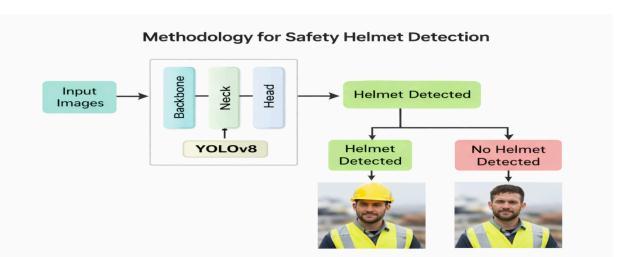
Fig -1:MethodologyforSafetyHelmetDetection
Mosaic augmentation sits at the core of our pipeline. By mixingandmatchingimagestoformnewtrainingcollages, we force the network to see more small helmets in more scenarios. This simple trick pays dividends in real-world variation.
For feature extraction, we retrofit the backbone with CoordinateAttention.Nowthenetworkcanfigureoutboth the“where”andthe“what,”focusingenergyonhelmetsand diallingdowndistractionswithoutlosingthebigpicture.
To keep things lightweight, we use a Slim-Neck. It ties togetherinformationfromdifferentscales,keepingthebest ofeachlayerwithoutbloatingcomputation.Efficiencystays high,whilethemodeldoesn’tmisssubtle,smalldetails.
Weinstalladedicateddetectionlayerfortinytargets.This meansthesystemiswaymorelikelytopickupworkersata distanceorindensecrowds.
Oncethefeaturesareprocessed,thedetectionheaddoesits thing:itdraws bounding boxes, hands out “helmet”or “no helmet”tags,andranksitsconfidence.WithNon-Maximum Suppression(NMS),wecleanupduplicates,leavingonlythe mostprobabledetections.
Tosumupresults,weuseprecision,recall,andmAPstandard tools,makingitclearwherethemodelwinsorneedswork.
Here’s how it plays out on site: cameras feed video to the system.Eachframeistunedforsizeandquality,thenpiped throughthenetwork.
International Research Journal of Engineering and Technology (IRJET) e-ISSN: 2395-0056
Volume: 13 Issue: 06 | Jun 2026 www.irjet.net p-ISSN: 2395-0072
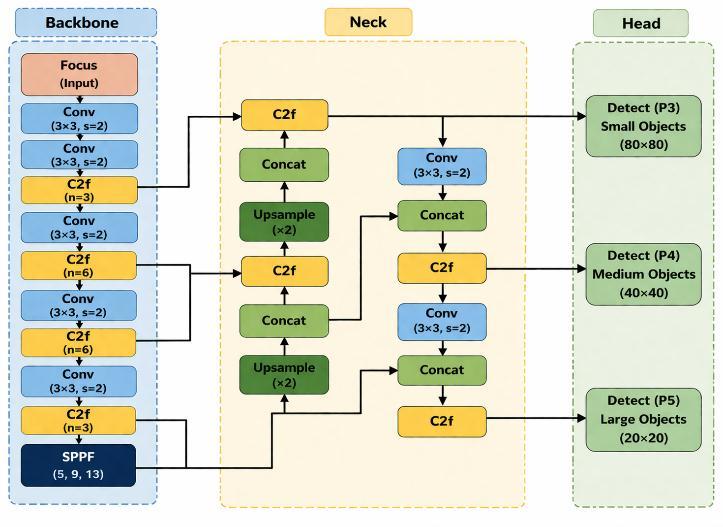
YOLOv8’s backbone, charged with Coordinate Attention, breaks the image into features and selectively shines a spotlightonhelmet-likeareas.Thesefeaturespassthrough theefficientSlim-Neck,gettingcombinedandrefinedacross scales.Thespecialsmall-targetlayercatchesthoseeasy-tomisshelmetsatthebackoftheshotorinacrowd.
After this, the detection head marks up bounding boxes around helmets and gives each a confidence rating. NMS cleansupoverlap,soyou’releftwithsharp,non-redundant predictions.
Allthishappenslive.Ifthesystemnoticessomeonewithouta helmet,instantalertscanbetriggered,promptingsite-wide ortargetedwarnings.Sincethemodelislightweight,youcan runitonastandardedgedevicekeepingdelaysminimaland resourcecostsdown.BuildingoursolutionaroundasoupedupYOLOv8architecturetailored
All combined YOLOv8n-SLIM-CA steps up to the plate for helmet detection on busy, unpredictable sites. With clever datahandling,smarterfeaturefocusing,streamlinedfusion, andtargetedsmall-objectmodules,you’relookingatasystem that does what prior solutions struggled with: catching helmets under challenging conditions, without lugging aroundheavyweighthardware.
Thisapproachbalancesspeedandsmartsyoucanactually deploy this on-site, not just in an ideal lab. Cameras keep rolling, safety managers get reliable alerts, and you don’t need to babysit the system or do manual spotchecks. The resultissimple:loweraccidentriskandstrongerworkplace compliance,allthroughautomation.
Nextstepslookpromising.Tacklingthehardestcasesreally lowlight,thickocclusionscouldpushthemodelevenfurther, perhapsbyshiftingtowardtransformer-basedarchitectures thatexcelatcontextunderstanding.
Integrating the solution into larger IoT safety frameworks opens upcentralizedcontrol and analyticsacross multiple sites.Beyondhelmets,itmakessensetotrainthemodelfor vests,gloves,andothersafetywear,creatingfullerprotection suites.
Hardware-wise, refining the model via quantization and leaningintohardwareacceleration(usingchipstunedforAI inferencing)willmakerolloutsevensmootherandcheaper. Adaptive or continual learning, where the model keeps training after deployment, could drive cross-site generalizationandperformanceupasconditionschange.
[1] N. Fatima et al., “Safety Helmet Detection Based on ImprovedYOLOv8,”2025.
[2]L.Zhangetal.,“AnImprovedLightweightSafetyHelmet DetectionAlgorithmforYOLOv8,”2025.
[3]C.SongandY.Li,“YOLOv8AlgorithmforSafetyHelmet DetectioninComplexEnvironments,”2025.
[4] S. J. Li et al., “Real-time Helmet Detection Based on ImprovedYOLOv8,”2024.
[5] X. Wu et al., “Improved Safety Helmet Detection Using YOLOv8,”2023.