International Research Journal of Engineering and Technology (IRJET) Volume: 13 Issue: 06 | Jun 2026
www.irjet.net
e-ISSN: 2395-0056 p-ISSN: 2395-0072
ROOT BENDING STRESS IN CYLINDRICAL WORM GEARS 1Edward E. Osakue, 2Boma Afiesimama 12Department of Aerospace and Mechanical Engineering, Texas Southern University, Houston, Texas, USA
-----------------------------------------------------------------------------***----------------------------------------------------------------------------
ABSTRACT-A model for estimating the root bending stress
of cylindrical worm gears, which are special types of cylindrical helical gears, is presented. The formulation of the model started with the root bending stress formula for cylindrical helical gears that was modified by making adjustments for some of the unique features of worm gears. Based on the geometry of a throated worm gear, some stress modification factors were defined, estimated and applied to the stress model of cylindrical helical gears. The outcome is a new cylindrical worm root bending stress model which suggests that worm gears potentially have 34% higher root bending stress capacity than equivalent cylindrical helical gears. The gain in strength is largely due to the throating of the worm gear. The bending stress model is used to estimate the root bending stress of five wormsets from references of varied backgrounds, and the results are compared with the previous solutions. The variances between stresses from the current and previous solutions when all basic design parameters are matched are in the range of -32.3 to -3.8% indicating that the previous solutions seem conservative relative to the new model solutions. This is not unexpected since the models in the references do not incorporate all the design parameters of a wormset as the new model. When the new model approach is used without matching the estimated service load factors with the values in the references, the variances between the current and previous results are between -13.3% and 2.4%, which seems very reasonable. Considering the diverseness of the sources of the references, such variances seem remarkable. Hence, the new root bending stress model appears sufficiently accurate to be an attractive option in the design analysis of cylindrical worm gears.
a) Cylindrical
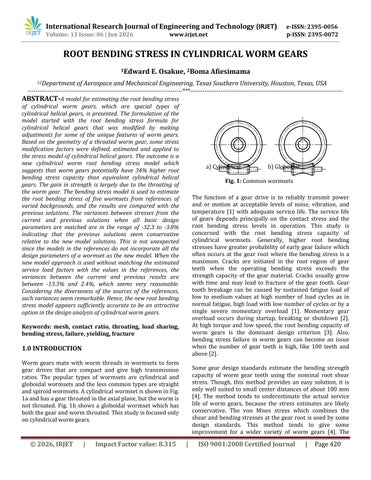
Fig. 1: Common wormsets The function of a gear drive is to reliably transmit power and or motion at acceptable levels of noise, vibration, and temperature [1] with adequate service life. The service life of gears depends principally on the contact stress and the root bending stress levels in operation. This study is concerned with the root bending stress capacity of cylindrical wormsets. Generally, higher root bending stresses have greater probability of early gear failure which often occurs at the gear root where the bending stress is a maximum. Cracks are initiated in the root region of gear teeth when the operating bending stress exceeds the strength capacity of the gear material. Cracks usually grow with time and may lead to fracture of the gear tooth. Gear tooth breakage can be caused by sustained fatigue load of low to medium values at high number of load cycles as in normal fatigue, high load with low number of cycles or by a single severe momentary overload [1]. Momentary gear overload occurs during startup, breaking or shutdown [2]. At high torque and low speed, the root bending capacity of worm gears is the dominant design criterion [3]. Also, bending stress failure in worm gears can become an issue when the number of gear teeth is high, like 100 teeth and above [2].
Keywords: mesh, contact ratio, throating, load sharing, bending stress, failure, yielding, fracture
1.0 INTRODUCTION Worm gears mate with worm threads in wormsets to form gear drives that are compact and give high transmission ratios. The popular types of wormsets are cylindrical and globoidal wormsets and the less common types are straight and spiroid wormsets. A cylindrical wormset is shown in Fig. 1a and has a gear throated in the axial plane, but the worm is not throated. Fig. 1b shows a globoidal wormset which has both the gear and worm throated. This study is focused only on cylindrical worm gears.
© 2026, IRJET
|
Impact Factor value: 8.315
b) Globoidal
Some gear design standards estimate the bending strength capacity of worm gear teeth using the nominal root shear stress. Though, this method provides an easy solution, it is only well suited to small center distances of about 100 mm [4]. The method tends to underestimate the actual service life of worm gears, because the stress estimates are likely conservative. The von Mises stress which combines the shear and bending stresses at the gear root is used by some design standards. This method tends to give some improvement for a wider variety of worm gears [4]. The
|
ISO 9001:2008 Certified Journal
|
Page 420