International Research Journal of Engineering and Technology (IRJET)
e-ISSN: 2395-0056
Volume: 13 Issue: 05 | May 2026
p-ISSN: 23950072
www.irjet.net
Role of Digital Twin Technology of in enhancing Construction Project Lifecycle Management Ar. Sainthavi1, Ar. V. Vidya2, Ar. Z. Fathima Taskeen3 1Post Graduate Student, M.Arch - Construction project management student, Faculty of Architecture,
Dr. M.G.R Educational and Research Institution, Chennai, India.
2Associate Professor, Faculty of Architecture, Dr .M.G.R Educational and Research Institution, Chennai, India. 3Additional HOD, Faculty of Architecture, Dr .M.G.R Educational and Research Institution, Chennai, India. -----------------------------------------------------------------***---------------------------------------------------------------
Abstract - The construction industry is undergoing a
improving coordination, decision-making, and operational efficiency across different project phases.
significant transformation with the adoption of advanced digital technologies. Among these, Digital Twin technology has emerged as a powerful tool for improving project lifecycle management. A Digital Twin represents a dynamic virtual model of a physical asset, integrating real-time data, design information, and operational parameters. This study explores the role of Digital Twin technology in enhancing various stages of the construction lifecycle, including planning, design, execution, and operation. The research highlights key benefits such as improved decision-making, real-time monitoring, enhanced collaboration, and optimized resource utilization. Additionally, challenges such as high implementation cost, data integration issues, and lack of standardization are discussed. The study concludes that Digital Twin technology has the potential to significantly improve construction efficiency, reduce risks, and support sustainable project delivery when effectively integrated with existing systems.
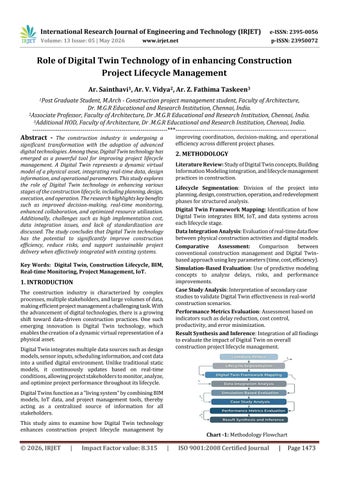
2. METHODOLOGY Literature Review: Study of Digital Twin concepts, Building Information Modeling integration, and lifecycle management practices in construction. Lifecycle Segmentation: Division of the project into planning, design, construction, operation, and redevelopment phases for structured analysis. Digital Twin Framework Mapping: Identification of how Digital Twin integrates BIM, IoT, and data systems across each lifecycle stage. Data Integration Analysis: Evaluation of real-time data flow between physical construction activities and digital models. Comparative Assessment: Comparison between conventional construction management and Digital Twinbased approach using key parameters (time, cost, efficiency). Simulation-Based Evaluation: Use of predictive modeling concepts to analyze delays, risks, and performance improvements. Case Study Analysis: Interpretation of secondary case studies to validate Digital Twin effectiveness in real-world construction scenarios. Performance Metrics Evaluation: Assessment based on indicators such as delay reduction, cost control, productivity, and error minimization. Result Synthesis and Inference: Integration of all findings to evaluate the impact of Digital Twin on overall construction project lifecycle management.
Key Words: Digital Twin, Construction Lifecycle, BIM, Real-time Monitoring, Project Management, IoT.
1. INTRODUCTION The construction industry is characterized by complex processes, multiple stakeholders, and large volumes of data, making efficient project management a challenging task. With the advancement of digital technologies, there is a growing shift toward data-driven construction practices. One such emerging innovation is Digital Twin technology, which enables the creation of a dynamic virtual representation of a physical asset. Digital Twin integrates multiple data sources such as design models, sensor inputs, scheduling information, and cost data into a unified digital environment. Unlike traditional static models, it continuously updates based on real-time conditions, allowing project stakeholders to monitor, analyze, and optimize project performance throughout its lifecycle. Digital Twins function as a “living system” by combining BIM models, IoT data, and project management tools, thereby acting as a centralized source of information for all stakeholders. This study aims to examine how Digital Twin technology enhances construction project lifecycle management by
© 2026, IRJET
|
Impact Factor value: 8.315
Chart -1: Methodology Flowchart
|
ISO 9001:2008 Certified Journal
|
Page 1473