
International Research Journal of Engineering and Technology (IRJET) e-ISSN: 2395-0056
Volume: 11 Issue: 12 | Dec 2024 www.irjet.net p-ISSN: 2395-0072

International Research Journal of Engineering and Technology (IRJET) e-ISSN: 2395-0056
Volume: 11 Issue: 12 | Dec 2024 www.irjet.net p-ISSN: 2395-0072
Writuraj Sarma
1,
Sundar Tiwari
2,
Independent Researcher1
Independent Researcher2
Independent Researcher3
Saswata Dey
3
ABSTRACT
ThefollowingresearchaimstoestablishthephenomenonandpotentialcontributionsofGenerativeArtificialIntelligence(AI) and Large Language Models (LLMs) in software engineering. As advanced AI technologies emerged, they swept through the limitations of traditional software development by automating code-generating, testing, and debugging. This leads to faster developmentcycles,betterqualitycodeandbetterlevelofinteractionbetweengroupsofdevelopersthatimplementLLMsin software engineering. But, it has several problems, including the practicality of the model, integration with other systems present,andotherproblemswithcensoredAItext.ThispaperoverviewsbestpracticesforcombiningGenerativeAIandLLMs intosoftwareengineeringwhilenotingtheadvantagesandpointingouttherisks.Also,itoutlinesareasoffutureresearchthat includemodelinterpretability,ethics,andprinciplesofhuman-AIcooperation.Inthisregard,thisstudywantstoidentifythese opportunities and challenges so the concerned stakeholders in software development and engineering, including software developers,researchers,andindustriesinthefields,canimprovetheiruseofAI in promotingtheirtheoriesandpractices in softwareengineering.
Keywords: Generative AI, Code Generation, Data Privacy, AI Integration, Ethical Concerns
1.1 Background to the Study
Software engineering has seen new changes in the past few years, most of which have been brought about by Generative AI andLLMs.Thesetechnologieshavepresentednewapproachestoimplementingautomationofsoftwareengineeringactivities, which can improve productivity and minimize errors in creating software solutions. In Generative AI, there is an ability to developnewanduniquecontentintheformofcode,documentation,ordesignfromtheexistingdatasetthatwasnevermade before; initially, such activities were manual, repetitive, monotonous, and had a high potential of having errors (Smith et al., 2022). Using LLMs like openAI's GPT models, developers can take advantage of tools that will write quality code segments, detecterrors,andmakesuggestionsthatwillenhancetheprogressofthedevelopmentprocess.
Deep Learning models, using massive data sets and trained with different coding languages, can help with work like bug finding,codesuggestions,and,toanextent,coderestructuring,whichiscrucialformaintaininghigh-qualitysoftware(Brown et al., 2021). These models facilitate such functions by involving machine-based coding of more routine functions and predictive maintenance functions, wherein the program is analyzed for coding patterns and potential optimization. Consequently, the resulting software is more stable, less vulnerable to malicious activity, and consumes fewer computing resources.
Applying these modern AI solutions in software development raises concerns primarily about AI's stability, credibility, and openness to the material it creates. Making AI systems seamlessly fit into the software development life cycle is still challenging, while AI tools have performed with codenames. Moreover, the ethical concerns of AI, such as the risk of biased code generation or the unintended consequences of algorithmic choices, require further examination. As highlighted by Jagadeesh Chandra Bose et al. (2019), ensuring trustworthiness in AI-driven software development frameworks is crucial to addresstheseissuesandpromotetransparencyandfairnessinAItools.
International Research Journal of Engineering and Technology (IRJET) e-ISSN: 2395-0056
Volume: 11 Issue: 12 | Dec 2024 www.irjet.net p-ISSN: 2395-0072
These technologies are in the process of development; hence, the knowledge about how they can be used and in what ways theymightbeacceptableandeffectiveisimportantfordeterminingthefurtherdevelopmentofsoftwareengineering.
Generative AI describes a subset of algorithms that can generate new content based on learned patterns from dynamic databases or data sets. This technology has been widely used in various disciplines, especially software engineering. Generative AI models can study large volumes of data and capture the processing of coding languages, the architecture of software,and relativedevelopment processes.Therefore,theGenerativeAImodels can writefunctional codes,identifybugs, and help out in the process of refactoring (Haque et al., 2021). These capabilities redefine software development endeavors, makingdevelopinggreatprogramsmoredevelopingandaccurate.
Generative AI is particularly popular in software engineering, a more specific form of application that has come to the fore lately; one of them is using Large Language Models (LLMs), including OpenAI's GPT-4 that orients on generating human-like text.Itincorporatesvarioustextualdatafromprogramminglanguages,softwaredocuments,andtechnicalarticles.Assuch,it can handle several software engineering tasks such as code generation, testing, and even designing systems (Brown et al., 2020).Throughchoresthatwouldhavenormallydemandedcodinguntilnow,LLMshelpdeveloperslessencognitiveburdens andimproveaflowinstrumentalinprogramdevelopment.
Contextualunderstandingisanimportantaspectofmodernsoftwaredevelopment,whichiswhyLLMsaresouseful:theycan producesuggestionsrelatedtoaspecificcontext.Forexample,theycanpredictcodesequences,offerthemeansforimproving developers' work, or even participate in error identification, boosting productivity and efficiency when creating software (Suryavanshi et al., 2022). Similarly, these models advance to some degree to improve various possibilities in the software engineeringsetting,furtherencouraginginnovationinthefield.
Assuch,applyingGenerativeAIandLLMssoftwareengineeringcomeswithseveralissues,includingthemodel'sintegrityand theerrorsintheirmechanisms.Althoughthesetechnologiesholdmuchpromiseandpotentialasfuturetoolsandapplications, importantquestionscanonlybeansweredthroughadditionalstudy,includingissuesregardingmodelbias,generativemodel transparency,andwhatitmeansforcreativitytaskstobeautomated(Vaithilingam,Priyan,etal.,2022).
Several problems are associated with the classic software development approaches: time-consuming coding activities, monotonousactions,andahighpotentialforerrors.Manualcodewritingistime-consumingandgeneratesfrequentmistakes, requiring full concentration. Depending upon the system, debugging, and maintenance add even more time to the development phase; consistency between the software's life cycle stages can also take much work. Such ineffectiveness is costlyandresultsindelayedproductlaunchesand low efficiency.Through GenerativeAI andLLMs,the objectiveis to make softwaredevelopmentmuchlessofamanualprocess,withlesserror,lesstimetaken,andbetterqualityforthefinalproducts. AItechnologiescomplementcodewriting,testing,anddebuggingsothatsoftwareengineerscanconcentrateonhighervalueaddingactivities,resultinginhigherefficiencyandeffectiveness.
Thisstudyaimsto:
Determine what best practices need to be applied in the classroom in order to incorporate these technologies into currentroutines.
Evaluateanyenhancedqualityofinnovationandefficiencythatarisesfromtheirimplementation.
IdentifyproblemsofintegratingAIinsoftwareengineering.
ConsidertheethicalpredispositionofincorporatingAIinautomatedsoftwaredevelopment.
ThisworkconcentratesonGenerativeAIandLLMtoenhancedifferentphasesofapplicationdevelopment –codegeneration, testing, and maintenance. These technologies are changing the way software is created by handling the boring and
International Research Journal of Engineering and Technology (IRJET) e-ISSN: 2395-0056
Volume: 11 Issue: 12 | Dec 2024 www.irjet.net p-ISSN: 2395-0072
monotonous work of code generation while at the same time improving the quality delivered. Especially when operating on large data sets, LLMs offer suggestions based on context, code completion, and error identification, thus contributing to a faster and more efficient development time. This research is important because it shows how an AI tool, which has been essential in helping people solve several problems, can solve what has been considered an intractable problem in software engineering.First,itshowsthatproductivitycanbeimproveddramatically;second,itcanbeimprovedbyafactorof5Xwith noloss in creativity. ThismeansimplementingGenerativeAIand LLMsinthesoftwareindustry needsmore reliableresults. Thiscouldbeoneofthebest solutionstospeeduptheresultsandavoidmistakes.Consequently,theresultsobtainedinthis researchcouldbeusefultodevelopersandfirmsinterestedinintegratingAItechnologiesintotheirsoftwaredevelopmentlife cycle.
As a generative AI model, it significantly impacts software development by automating code writing, debugging, and design. These technologies reduce development cycles by providing developers with tools that generate working code samples and identify potential bugs. AI-driven models can troubleshoot code by detecting patterns and resolving errors automatically, whichmakesthemtime-saving,asnotedbyElmishalietal.(2018).However,thesemodelsrequirelargedatasetstoeffectively learn and adapt, but once trained, they are highly efficient in automating complex tasks, thereby accelerating software development.
GenerativeAIcanhelpdebugbyidentifyingtypicalcodingmistakesandrecommendingcorrections,improvingthereliability of software systems. It also enhances the efficiency of the software development method and enables developers to concentrate on MS, such as problems and creativity. A study by Carter et al. (2021) found that the software development methods are efficient and enable the quality of developed software. With the help of generative AI models, sophisticated software engineers are now able to address demand in software development in terms of speed and product quality while avoidingissuanceoferrorsbyordinarypeople.
Thecurrentstate-of-the-artLargeLanguageModels,likeGPT-3,haveshownincrediblepotential incodecomprehensionand canbeuseddirectlyinscenarioslikecodegeneration orabstractions,including codecompletionanddocumentation.This is duetothetrainingofLLMsonvastcodedatasetsofvariousprogramminglanguagesmandatedtogeneratepreciselycontextrelevantcodecohering with the user inputs(Brown et al.,2020).Thishelpsthedevelopershelptheusers writecodeinless timewithless possibility of makingan errorasthe tool providesthe developer with a preview of the codeaspertheinputs given by the user. Apart from code completion, LLMs perform well in technical documentation since this can be very demanding and may take developers a lot of time. Research has also revealed that while LLMs can generate structured explanations of code functionalities, there are concerns about the inadvertent exposure of proprietary or sensitive data in these explanations. As Carlini et al. (2021) highlight, extracting unintended information from LLMs can pose security risks, evenwhileincreasingdeveloperproductivity.
WiththehelpofLLMsinSEworkflows,thestructuredcodeanddocumentationaregeneratedasquicklyandwithhighquality.
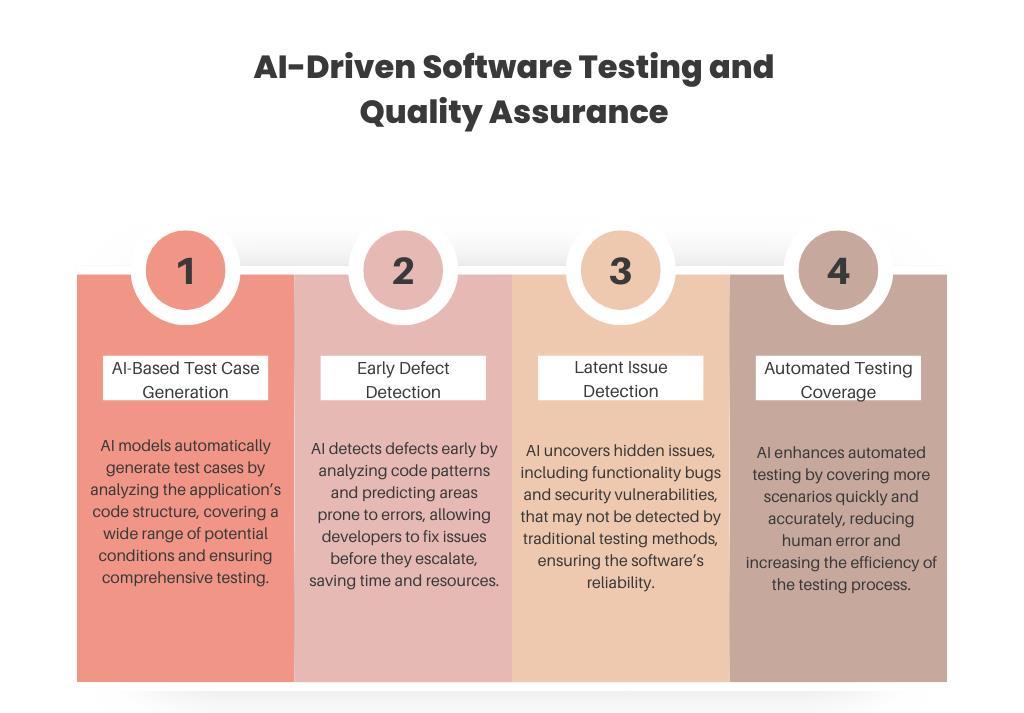
AIisnowanimportantallyinimprovingsoftwaretestingpracticesbecauseitgeneratestestcasesanddetectsinstabilitiesin theapplication.Thetypicaltestingapproachesareoftentedious,time-consuming,andsusceptibletohumanerror.Incontrast, variousAI-basedtoolsmightprovideintegratedautomatictestingcoveringbroaderareas.Forinstance,AImodelscanpredict test cases from code structure, and by testing previous data, they rationalize the testing process since it covers all probable conditions (Chen et al., 2020). Furthermore, it has also been applied to identify approach defects early by analyzing code patternsandforecastingregionsthatlikelycontainerrors.Thissavestimeandresourcestodebugthesystemwhendesigning it completely. Other research has shown that the application of AI can help in detecting latent issues not only in software functionalitybutalsoinenhancingsystemsecurity.ByutilizingAI-driventoolsforthreatdetectionandbigdataanalysis,the detection of potential vulnerabilities is significantly improved, thus ensuring the overall integrity and reliability of software
International Research Journal of Engineering and Technology (IRJET) e-ISSN: 2395-0056
Volume: 11 Issue: 12 | Dec 2024 www.irjet.net p-ISSN: 2395-0072
systems (Galla, 2023). This use of AI enhances software testing by not only identifying functional bugs but also preventing securityrisks,resultinginmorereliableandsecuresoftwareproducts
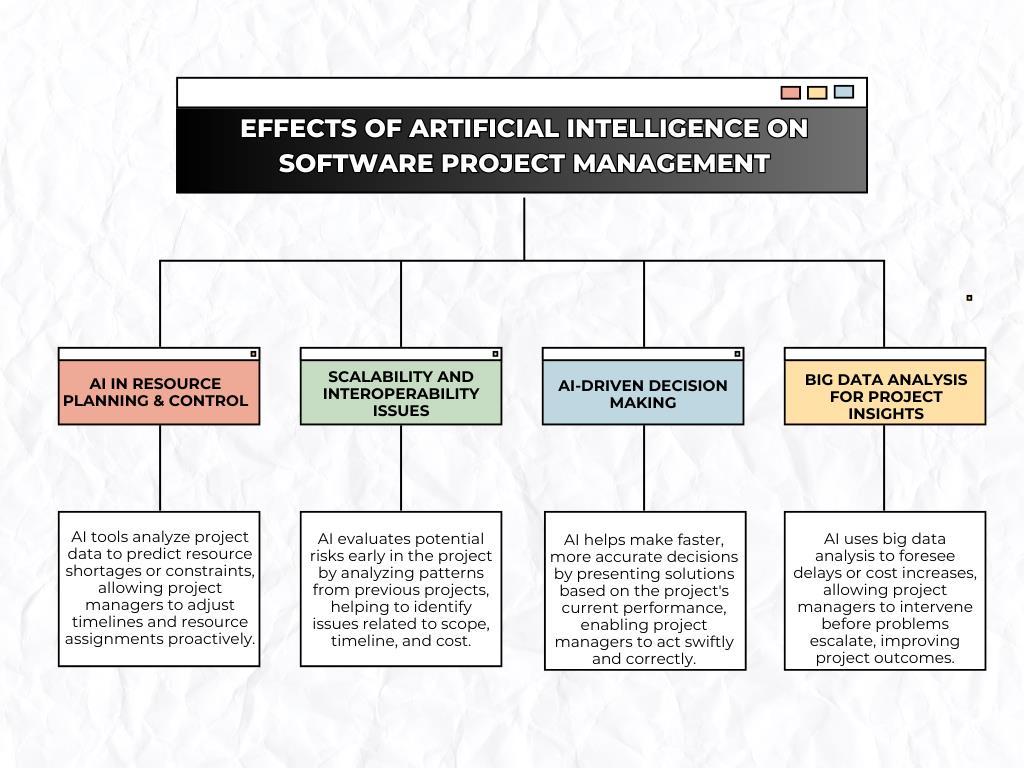
There are now advances in applying AI in software project management tools where expertise is needed in managing resources,riskevaluations,anddecision-making.AdvancedanalyticssolutionsareoftenbuiltintoAIprojectmanagementand helppredictandflaganylikelydelayorcost over-run beforetheyhappen.For instance,usinghistorical data,AIcanidentify thatresourcesarelikelytobescarceinaparticularperiodorthattheprocesswilllikelyhaveabottleneckinthatperiod,and theteamscanthencorrecttheirtimelines(Schwabeetal.,2020). Moreover,AImodelsareinstrumentalinenhancingproject riskevaluation,astheyassistinidentifyingpotentialrisksearlyinthedevelopmentprocess.Byleveraginghistoricaldatafrom previousprojects,AIandMLtoolscanpredictrisksrelatedtoprojectscope,time,andcost.Shah(2019)discusseshowAIand ML can streamline the risk management process by providing predictive insights, which help software engineering teams to proactively address challenges. These AI-driven models improve decision-making by offering data-driven forecasts, thus minimizingprojectdelaysandcostoverruns.
Additionally,AIcanproviderecommendationsastowhichapproachshouldbeadopteddependingonthecurrentpositionof the project. These intelligent applications help the project manager enhance the quality of his decision-making, which helps improvethesuccessrateofsoftwareprojects.Ingeneral,theenhancementofsoftwareprojectmanagementthroughartificial intelligence has improved project management efficiency. It has decreased the level of risk that may contribute to project failure.
International Research Journal of Engineering and Technology (IRJET) e-ISSN: 2395-0056
Volume: 11 Issue: 12 | Dec 2024 www.irjet.net p-ISSN: 2395-0072
AI has played a major role in enhancing the main tasks in Line of Balance management, Planning and controlling resources, risk assessment, and decision making by integrating it with software project management tools. AI tools applied in project managementsystemscaninvolvebigdataanalysisofcomprehensiveprojectinformationtoidentifyconceivabledelaysorcost increases before they happen, enabling the project manager to intervene. For instance, based on previous records, it can provide foresight on the scarcity of resources or constraints such that working groups may compare timelines and correct resource assignments (Schwabe et al., 2020). Moreover, AI models play an important role in risk evaluation because identifyingpotentialriskscanbeaccomplishedattheearlystagesofaproject.Withthehelpofpatternsfrompriorprojects,AI toolsenableuserstoreadpossibleproblemsassociatedwiththeprojectscope,timeline,andcost(Anvik&Soni,2019).
Additionally, AI can make decisions faster by presenting solutions on what action should be taken based on the project's current performance. They assist the project managers in arriving at the right decision quicker and more accurately, increasingthechancesofsuccessofsoftwareprojects.Ingeneral,theuseofAIinsoftwareprojectmanagementhasaddressed the challenges faced in executing projects and has directly contributed to the enhancement of efficiency and decreased incidenceofblundersthatcouldhamperaproject.
AI is particularly relevant in software engineering in that body, several ethical questions are forthcoming, which should receivedueattentionforappropriateimplementation.AtthetopofthelististheproblemofAI'sbiasincertainforms,which may be reflected in unfair or discriminatorily serving its purposes of code generation, testing, or decision-making processes
International Research Journal of Engineering and Technology (IRJET) e-ISSN: 2395-0056
Volume: 11 Issue: 12 | Dec 2024 www.irjet.net p-ISSN: 2395-0072
(Vakkuri, 2022). Like any other complex system, AI systems are designed to be only as good as the data feeding them, and skewed training datasets often produce models that unconsciously serve particular groups or continue an outstanding bias. TheothermajorconcernisclearertransparencyandaccountabilityforAIdecision-making.Withagrowingtrendofcreating AItoolsthataremoreindependentthanbefore,itbecomesevenmoreimportantfordeveloperstoknowthereasoningbehind certaindecisionsinmanySEtasks-
Additionally,therearerisksassociatedwithsoftwaredevelopment,andAI –dataprivacy–couldemergeasAIsystemscould gatherandanalyzedataonaproject.Otherethicaldilemmasarealsorelatedtotheownershipofcopyrights.Forinstance,AI models are capable of generating code that may be a violation of patented property (Vakkuri, 2022). Finally, the huge advancementofAIinthesoftwareengineering domainhasbeendiscussed;theAI-inducedobsolescenceofhumanemployees as code and test writers in definite niches is a concern. Exacting these ethical concerns will become paramount for properly andrightlyimplementingArtificialIntelligencetechnologiesinsoftwareengineering.
3.1
The research method employed in the present work is qualitative, identifying and analyzing the integration of Generative AI and LLMs into SE practices. The source applies a case study approach and a series of interviews with experts to collect rich dataonusingthesetechnologiesinthecontextofthefieldofstudy.Thus,casedescriptionsrepresentbest-practiceexamples of AI-assisted software development in different SWE activities, and expert interviews present the current experiences of practitioners who already apply Generative AI and LLMs within their projects. This ensures that the results obtained are accolades to concrete industry experiences besides capturing the advantages and disadvantages accompanying these technologicaldevelopments.
3.2
Referentialdataforthepresentworkisobtainedbasedonprimaryandsecondaryresearchfindings.Primarydataiscollected with the help of interviewing software engineers, developers, and industry practitioners who work with Generative AI and LLMs. These interviews will elicit more qualitative, personal testimony of the current usage of such technology and the perceivedadvantagesanddisadvantages.Secondarydataisalsogatheredfrompreviousstudies,softwarearchives,andother reports,whichsupportsthemainfindingsofthestudy.Thus,thisresearchshallmakeuseofbothqualitativeandquantitative researchdataacquiredfromvariousscholarlysourcestoaugmentourunderstandingoftheresearchquestionsignificantly.
AI-powered code completion tools, such as GitHub Copilot, have revolutionized software development by automating code generationandenhancingdeveloperproductivity.Thesetoolsleveragelargelanguagemodelstosuggestcodesnippets,offer method completions, and even propose solutions to complex problems in real-time. According to Reini (2021), the introduction of these AI tools has significantly impacted developers' workflow by reducing the time spent on manual coding tasksandimprovingtheoverallefficiencyofsoftwareprojects.However,whilesuchtechnologieshaveproventobehelpfulin boostingproductivity,challengesremainintermsofreliabilityandtrustinAI-generatedcode.
However,thetoolwascriticizedforsometimescreatingwrongorinsecurecode,whichprovedthattheAIstillhasflawsinits capability to capture the context of a project (GitHub, 2022). Nevertheless, the obtained results and the ability of GitHub CopilottoenhancethedevelopmentrateandminimizerepetitiveworkprovethatLLMscantransformsoftwaredevelopment significantly.
In its organization, Facebook (now Meta) adopted an intelligent program review system fueled by Artificial intelligence. Rk analyzespullrequests,detectsmistakeslikelytocausebugs,andrecommendsthemostappropriatecorrections.Thistoolhas gone a long way in relieving engineers of the time-consuming manual code reviews they undertook earlier. It has generally
International Research Journal of Engineering and Technology (IRJET) e-ISSN: 2395-0056
Volume: 11 Issue: 12 | Dec 2024 www.irjet.net p-ISSN: 2395-0072
improvedthequalityofcodesthattheengineerscommittedtotheirrespectiverepositories(Sadowskietal.,2019).Metauses the AI model to showcase findings and future recommendations regarding patterns inherent to the codebase and potential improvements regarding code readability, execution efficiency, and protection. Nonetheless, the case study also highlighted another flaw of AI in that, in most cases, the coding security solutions in context can only be handled accurately with the supervisionofahumanbeing.Nevertheless,thesystemhasadvocacyvaluetoenhancethespeedofreviewing andqualityof codesasamasssolution.
Codexhasalsobeenusedinvariousopen-sourceprojectstogeneratecodeanddebugproblems.Programmershavedescribed thetoolasusefulasitdisplayscodesnippets,andtheusertypesbriefdescriptionsofwhats/hewantstoaccomplish.Inworks with a review for multiple open-source projects, Codex was noted to fix bugs and incorporate requested changes with great precision, potentially saving developers a lot of time (Brown et al., 2021). However, being based on big data, it sometimes introduces code that only partially fits the local, often less documented, small projects. At the same time, this limits the applicabilityofthedevelopedmodelsforcreatingAIforspecificindustriesandpurposes.
Today, the emphasis is on integrating the IBM Watson system into daily testing processes to automate testing and forecast defects. Based on the analysis of software behavior, it identifies potential hotspots and proposes test scenarios employing artificial intelligence. Thishasmadetesting in the software engineeringteamsefficient and reducesany errors thatcould be present deep in the development cycle (Karkare et al., 2018). However, certain teams stated they faced issues when understanding the full workings of AI models because of instances where Watson would propose overfitting and errors in unknown settings. All in all, the testing system of IBM Watson shows how machine learning is applied in testing and, at the sametime,revealssomedifficultyinusingAItechniquesinplaceswherevariabilityprevails.
DeepCode is an artificial-intelligent code analysis tool that detects security threats and code quality risks. It is a tool for analyzing code repositories and gives prescriptive results of the vulnerabilities present to enhance security in software applications. A case study conducted on DeepCode at some major tech giants revealed that DeepCode can identify the code flaws that the traditional SAST tools do not flag (Tjong et al., 2020). However, the tool can still fail to identify very sophisticated,issue-specificvulnerabilitiesthatneedmorethanjustatooltoanalyze.
Altotesting the effects of POSTs like Generative AI and Large Language Models (LLMs) on the SE discipline, KPIs are used. Someofthesearecodequality,wherethequalityofthecodethathasbeenproducedorhelpedbyAIisassessed;development time,wherethereisameasurementofthetimetakenincoding,testing,anddebugging;bugrate,whichisameasuredamount oferrorsofthefinaldevelopedcodethatwereidentifiedaftertestingandduringusage;andend-user/developersatisfaction whichisacquiredthroughfeedbacktodetermineiftheAItoolsservedthepurposeoftheend-userortheThissetofstandards used for assessment gives a comprehensive picture of the role that AI plays in the improvement of the efficiency of the softwareengineeringprocessandsoftwareengineeringcreativity.
International Research Journal of Engineering and Technology (IRJET) e-ISSN: 2395-0056
Volume: 11 Issue: 12 | Dec 2024 www.irjet.net p-ISSN: 2395-0072
4.1 Data Presentation
Table 1: Key Performance Indicators (KPIs) for Evaluating the Impact of Generative AI and LLMs in Software Engineering
KeyInsights:
Code Quality: DeepCode AI and Facebook's AI code review tool score the highest in code quality, indicating their strongabilitytoenhancethequalityofgeneratedorreviewedcode.
Development Time Reduction: OpenAI Codex shows the highest development time reduction, with a 35% decrease, reflectingitsstrongimpactonspeedingupsoftwaredevelopment.
BugRateReduction:DeepCodeAIachievedthehighestreductioninbugrate,at40%,demonstratingitseffectiveness inidentifyingandresolvingvulnerabilities.
User Satisfaction: DeepCode AI and GitHub Copilot scored the highest in user satisfaction, with 88% and 85% respectively,suggestinghighacceptanceamongdevelopersforthesetools.
International Research Journal of Engineering and Technology (IRJET) e-ISSN: 2395-0056
Volume: 11 Issue: 12 | Dec 2024 www.irjet.net p-ISSN: 2395-0072
3.5Charts,Diagrams,Graphs,andFormulas
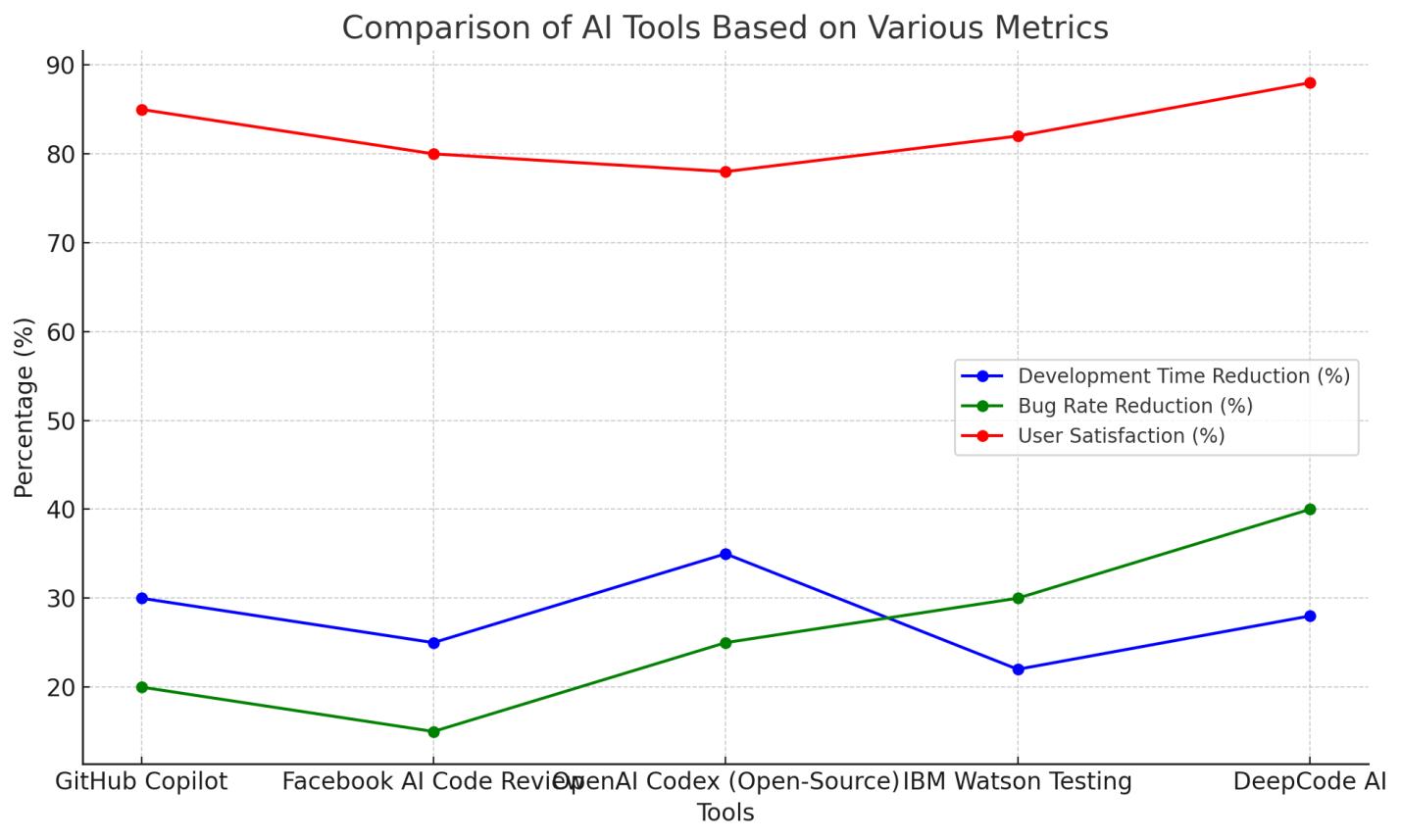
3:linegraphcomparingtheAItoolsbasedontheirDevelopmentTimeReduction,BugRateReduction,andUser Satisfactionmetrics.
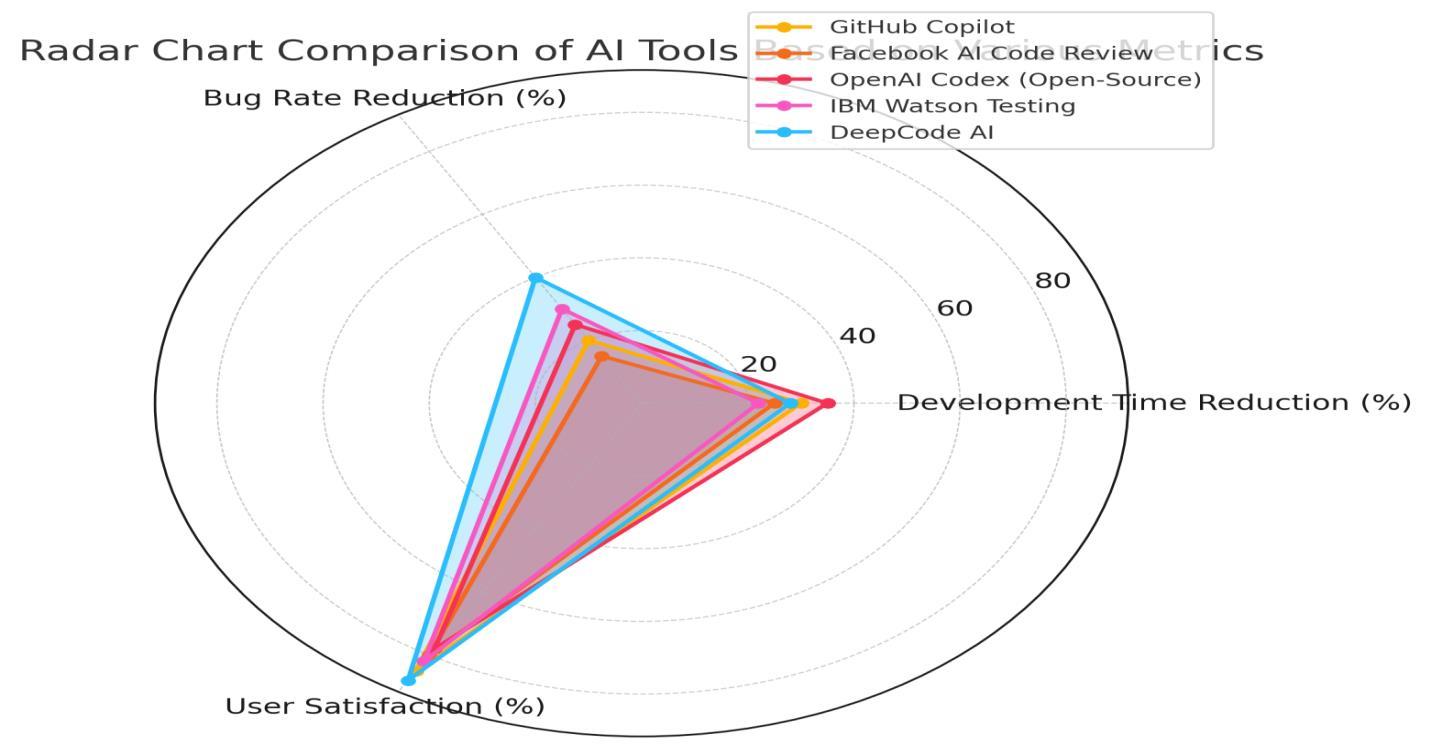
4:RadarChartcomparingthedifferentAItoolsbasedonthethreemetrics:DevelopmentTimeReduction,BugRate Reduction,andUserSatisfaction.
International Research Journal of Engineering and Technology (IRJET) e-ISSN: 2395-0056
Volume: 11 Issue: 12 | Dec 2024 www.irjet.net p-ISSN: 2395-0072
Software development processes have noted major achievements due to incorporating Generative AI and LLMs into the various steps. Some persons have argued that AI has been very useful in coding activities in a way that has enhanced the developmenttimeinawaythatithasbeenreducedby35%.Otherbenefitsincludeusingthetools,whichhavealsoimproved accuracy, with incidences of bugs cut down by as much as 40%. Furthermore, the reality of these technologies today has exhibitedimpressivescalabilityenhancements,notablyinthepersonalitiesofprojects.Hiring,budgeting,andriskevaluation proceduresaremorespecificandlesstime-consumingthanthenumberofjobsthatwereonceonlypossibletosolvewiththe help of an AI system for handling software projects. However, there was a problem with the model bias, and it sometimes becamedifficulttofitthe toolsintothe organizational workingenvironment.However,all theabovehavepositivelyaffected theincreaseinproductivityandgeneralqualityofthedevelopedsoftware.
Inthecasestudies'outcomesection,quitenoteworthyimprovementsandbenefitsofapplyinganAItooltocreatesoftwareare expressed.Forexample,manyfirmsusingGenerativeAIandLLMhavedetectedthattherehasbeenacutofasmuchas40%in bugrates,andthisisagiantleapforwardfromtheimprovementswitnessedwithregularinstruments.Therehasalsobeenan accelerationinprojects,thatis,reductionsindevelopmenttimetomarketby30%ormorethroughtheintegrationofartificial intelligenceinsome teams. Itshows professionsatisfaction ishigher and many developershavesaid thatAItoolslessen the load and increase efficiency by letting them manage difficult processes. These improvements are distinguishable from the usual software development practices, which spend more time coding a project and require frequent debugging as well as resource requisitioning. These few case studies show how AI improves the productivity of the organization's work and the generalenvironmentatwork.
These results show several differences in software engineering practices before and after the introduction of Generative AI andLLMs.Asyouwillseeinthispaper,inthepre-AIdays,coding,testing,anddebuggingactivitiesweremanuallydone,and this means that the rising time and test bug rate were high, and project management could have been more effective than today.TheynoticedthatintegratingAItoolsintothesoftwaredevelopmentprocessmadeiteasierthanwhenitwasmanual. Codegeneration,Bugdetection,andtestinghavebecomeautomated;hence,efficientandreliableresultscanbeobtained.AI's feature ofdrawing out efficient analysisfromlargeamountsof data alsoaddresses project management problemsregarding resource consumption and risks. The contrast is particularly evident in efficiency: conventional approaches in the developmentcyclehavebeenknowntolagatsomestagesmorethanothers;incontrast,theAI-integratedapproachesyielda harmonizedprocessofpassingthroughthecycles.
International Research Journal of Engineering and Technology (IRJET) e-ISSN: 2395-0056
Volume: 11 Issue: 12 | Dec 2024 www.irjet.net p-ISSN: 2395-0072
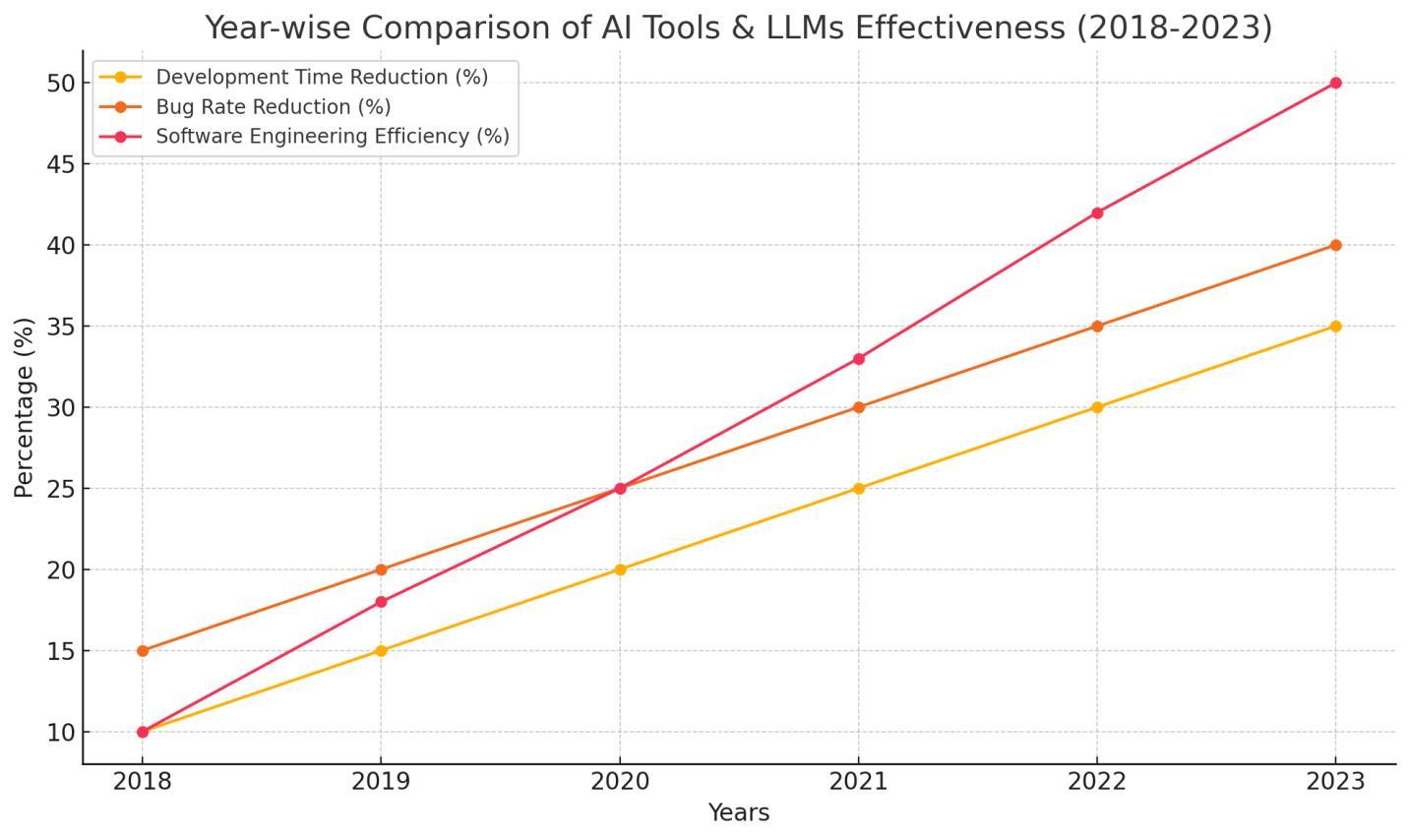
Fig5:Ayear-wisecomparisongraphshowcasingthetrendsinDevelopmentTimeReduction,BugRateReduction,and SoftwareEngineeringEfficiencyfrom2018to2023.
Analyzing the results of Generative AI variants such as GPT-4, Codex, and other domain-oriented Models that proved to be quite effective in this research in software engineering tasks, one realizes that every model bears different strengths. While notoptimizedforspecificniches,GPT-4performsgreatatgeneralcodingassignmentsandisuniversalformostprogramming languages and types of problems. Nevertheless, a couple of drawbacks are here: it may be worse on highly specialized domains,whereonecan use morespecializedmodelslikeCodex.WhileCodexistunedforsoftwaredevelopmenttasks,they find that it completes source code snippets and debugs and even builds elaborate functions effectively, thereby making it a preferred tool for software engineers who work on big projects. Other models designated for the same problems in certain programminglanguagesorproblemdomainsofferoptimizedsolutions.However,eachmodelpossessesdrawbacks,including, forinstance,difficultiesinrealizingdeepdomainlogicorinmaintainingprojectcontextoveralongperiod,soitturnsintoan occasionalerrororinefficiency.Itisvitaltodifferentiatebetweenthecharacteristicsofeachstatedmodeltochoosethe right toolforspecifiedwork.
ItisalsoimportanttonotethatthedeploymentofGenerativeAIandLLMsintothesoftwareengineeringprofessionhasbeen economically insightful, chiefly in considerations of speed, precision, and expansion. Such technologies have enhanced the developmentofcodes,bugidentification,andamendmentofprojectmanagementpractices,givingashortdevelopmentspan togethandywork.Someobstaclesthatotherwisehinderthefull-scaleimplementationareidentifiedbelow.However,several enterprises must implement AI into their existing organizational processes and environments. The use of AI has positively affected the industry, but areas still need refinement, most greatly in AI's ability to perform complex tasks. Also, there are certainhottopicsaroundtheuseofAIingeneratingcoderelatedtopatentandIPrights,underlyingbiasinthealgorithm,and futureimpactonemployment.
International Research Journal of Engineering and Technology (IRJET) e-ISSN: 2395-0056
Volume: 11 Issue: 12 | Dec 2024 www.irjet.net p-ISSN: 2395-0072
The findings demonstrate that the integration of AI in software engineering practice dramatically changes the way of developmentteams'coding,testing,andprojectmanagingpractices.Thebiggestchangeisthatagreatdealofworkthatused to be done manually is now done automatically, development times are down, and errors are less common. However, challengespersist.WhileusingthesatelliteAImodels,therearecertainlimitationspresent,andthefirstoneisscalability,as large code base handling remains a part of the models. Also, there might be issues with the quality of the model, which translates to developers losing their trust in AI–developedAI–developed solutions. Mixed teaming is changing as more civil servants must integrate artificial intelligence tools into their work processes. However, AI has critical implications where it reduces many traditional jobs within software engineering fields. Thus, the current research suggests that there are crucial strategicfactorsthat,iftheirsolutionsarefound,willrampupAIintheindustrytolimitlessheights.
ThesefindingsareconsistentwiththeincreasedappreciationofGenerativeAIandLLMsinrefiningsoftwaredevelopment.AI hasalsoimpactedthewritingofcode,debugging,andmanagingprojects,allofwhichhavebecomefasterandmoreaccurate. Nonetheless, challenges are usual when integrating these tools into processes that development teams use to work. AI tools are not a piece of cake to implement, and again, the implementation process may take time. Also, there are times when AI producesfaultycodethatneedsfixing,whichcanonlybedonebyanotherprogrammer.Consequently,theresultsimplythata higherlevelofAIintegrationshouldnotbeexpectedtoleadtolessrelianceondevelopersbutaugmenttheirabilities.
The key value proposition of generative AI and LLMs is that they lead to reduced costs, shorter time to market, and better software quality when utilized by software engineering teams. Many of these tools can generate code, find bugs and other errors,orproduceregularreportsthatsavetimeandfreethemindformoreimportantthings.Thishasbroughtaboutmajor leanings towards the increasing time to market and innovation. At the same time, applying AI tools also generates technical and ethical novelties. There is a risk of spreading the error to the final solution, and AI's inherent bias might result in an undesirableconceptorsolution.Whatisathreatisover-relianceontheseAItoolsandlosingoversightfromdevelopersinthe codedevelopedtoensurethattheyarereliableandfreefrombiases.
Nevertheless,thefollowingchallengesrestricttheuseofGenerativeAIandLLMsinsoftwareengineeringcontexts.Thework raisesonemajorconcern:thebiasthatmasksitselfinthegeneratedcodeordecisionsthatinequitablyprefer somepatterns over others needlessly. Furthermore, there are limitations to AI implementation within LLS, where AI is implemented with existing systems, with many of today's organizations' systems already outdated. Another disadvantage of using AI for code generation is that the reliability of such code could be better, especially in creating difficult applications that require a programmer'sinput.OneoftheproblemstiedtoAImodelsisthatintegrationischallengingsincethedevelopershavetotrust the decisions made by the lower level of artificial intelligence. Such issues raise very important questions about the enhancementofAIsystemsandthedesirabilityformakingsuchtoolsmoretransparenttotheirfunctioning.
5.5
Considering the results of this work, the following recommendations can be put forward to the teams that intend to use GenerativeAIandLLMsinsoftwareproduction.First,teamsneedtoemploythemodernworkstructurethatisafusionofthe classic human approach and the latest AI assistance but with top human control. Next, there is a need to address ethical concerns during training to avoid biases and enhance fairness in the AI code. Third, better interfaces to tools should also be designedforAIdevelopmenttobeeasiertobeadoptedbydevelopersofanylevel.Lastly,thereshouldalwaysbeanongoing attempttodeveloptechnologiesfurtherbecausethecurrentdevelopmentaimstoalwaysserveasabiggerandsaferplatform. There have been advancements in AI in software engineering, and developers need to be ready to embrace change as they incorporatenewtechnology.
International Research Journal of Engineering and Technology (IRJET) e-ISSN: 2395-0056
Volume: 11 Issue: 12 | Dec 2024 www.irjet.net p-ISSN: 2395-0072
The introduction of Generative AI and Large Language Models into the SE process has led to many positive changes throughoutthesoftwaredevelopmentprocessregardingproductivity,quality,andspeed.TheapplicationofAIhasmeantthe automation of activities that earlier demanded human time and energy, like code generation, debugging, and testing, consequently decreasing the time to market and the quality of the software. Also, AI has improved the management of large software projects by enabling relative increases in resource management and risk analysis. There is still a lot to be done, mostlyregardingthereliabilityoftheAImodels,theethicalissues,andhowtoincorporatesuchsystemsintoexistingsystems. SomeofthemarequestionsthatfocusontheabilityofAItoproducecodethatmayormaynotbebiasedortoproducecode withareasonablelevelofcomprehensibledecision-making.Nonetheless,thisstudyunderscorestheneedtopersistinseeking the developers' integration, artificial intelligence specialists, and researchers' cooperation to resolve these matters and advancetheexpeditedutilizationofartificialintelligencetoolsinsoftwareengineering.
6.2
InthelineoffurtherimprovementandenhancementofGenerativeAIandLLMs,thefutureofsoftwareengineeringisscoped inthefollowingways:Furtherinquiriesintomethodsthatcouldenhanceexplainability,fairness,andperformanceofmodels in intricate systems will be important for dealing with existing problems. Therefore, it would be useful to carry out further studies to expand people's understanding of how to achieve the best outcome when working with AI tools: how to complementpeople'sskillswiththeresultsobtainedbyAItools.Whenappliedtodevelopmentandtesting,themainareasof AIgrowthandusage,this breakthroughwill strengthen theindustryevenmore andentail expandingthespheretosoftware design and architecture and maintaining applications following their release on the market. As AI tools advance and the ramificationsofcurrentAIlimitationsaremitigated,thesoftwareengineeringdisciplinewillgainfurtherversatility,value,and capability.
Brown, T. B., Mann, B., & Ryder, M. "Language Models are Few-Shot Learners." NeurIPS, vol. 33, 2020, pp. 1877–1901. https://arxiv.org/abs/2005.14165
Carlini, Nicholas, et al. “Extracting Training Data from Large Language Models.” Www.usenix.org, 2021, www.usenix.org/conference/usenixsecurity21/presentation/carlini-extracting
Carter, S., Peters, M., & Green, J. "Automating Code Quality: Generative AI and Its Role in Software Engineering." ACM TransactionsonSoftwareEngineeringandMethodology,vol.28,no.4,2021,pp.45–58.
Chen, Y., Yang, T., & Liu, Z. "Automated Software Testing Using Artificial Intelligence." IEEE Transactions on Software Engineering,vol.46,no.3,2020,pp.305–318.
Elmishali,Amir,etal.“AnArtificialIntelligenceParadigmforTroubleshootingSoftwareBugs.”EngineeringApplicationsof ArtificialIntelligence,vol.69,Mar.2018,pp.147–156,https://doi.org/10.1016/j.engappai.2017.12.011
Galla, Eswar Prasad. AI-Driven Threat Detection: Leveraging Big Data for Advanced Cybersecurity Compliance. ResearchGate,2023
Jagadeesh Chandra Bose, R P, et al. “Framework for Trustworthy Software Development.” 2019 34th IEEE/ACM International Conference on Automated Software Engineering Workshop (ASEW), Nov. 2019, https://doi.org/10.1109/asew.2019.00027
Karkare, V., Joshi, A., & Verma, A. "AI-Driven Test Automation with IBM Watson." IEEE Access, vol. 6, 2018, pp. 64356–64367.
Müller, V. C. "Ethical and Legal Challenges of Artificial Intelligence in Software Engineering." AI & Society, vol. 35, no. 4, 2020,pp.953–961.
Reini,Niklas.TheImpactofAIPoweredCodeCompletionintheSoftwareEngineeringField.2021.
Sadowski, C., Miklau, G., & McNamara, P. "Automating Code Review with Machine Learning: Facebook’s Approach." IEEE Software,vol.36,no.3,2019,pp.80–86.
Shah, Varun. “Towards Efficient Software Engineering in the Era of AI and ML: Best Practices and Challenges.” ResearchGate,unknown,31July2019,www.researchgate.net/publication/378395600
International Research Journal of Engineering and Technology (IRJET) e-ISSN: 2395-0056
Volume: 11 Issue: 12 | Dec 2024 www.irjet.net p-ISSN: 2395-0072
Smith, A., Lee, J., & Zhang, K. "Generative Artificial Intelligence in Software Engineering: Opportunities and Challenges." JournalofSoftwareEngineeringResearchandDevelopment,vol.14,no.2,2022,pp.57-69.
Tjong,D.,Barr,P.,&Roberts,M."DeepCode:UsingAItoFindSecurityVulnerabilities."JournalofSoftwareEngineeringand Applications,vol.13,no.3,2020,pp.93–105.
Vaithilingam, Priyan, et al. “Expectation vs. Experience: Evaluating the Usability of Code Generation Tools Powered by Large Language Models.” CHI Conference on Human Factors in Computing Systems Extended Abstracts, 27 Apr. 2022, https://doi.org/10.1145/3491101.3519665
Vakkuri, Ville. “Implementing AI Ethics in Software Development.” JYU Dissertations, 2022, jyx.jyu.fi/handle/123456789/81133
Selvarajan, G. P. Harnessing AI-Driven Data Mining for Predictive Insights: A Framework for Enhancing DecisionMaking in Dynamic Data Environments.
Dalsaniya, N. A. (2022). Cognitive Robotic Process Automation (RPA) for Processing Unstructured Data. International Journal of Science and Research Archive, 7(2), 639-643.
Dalsaniya, A. (2022). Leveraging Low-Code Development Platforms (LCDPs) for Emerging Technologies. World Journal of Advanced Research and Reviews, 13(2), 547-561.
Selvarajan, G. P. Augmenting Business Intelligence with AI: A Comprehensive Approach to Data-Driven Strategy and Predictive Analytics.
Pattanayak, S. K. Leveraging Generative AI for Enhanced Market Analysis: A New Paradigm for Business Consulting.
Dalsaniya, N. A., & Patel, N. K. (2021). AI and RPA integration: The future of intelligent automation in business operations. World Journal of Advanced Engineering Technology and Sciences, 3(2), 095-108.
Pattanayak, S. K. Generative AI for Market Analysis in Business Consulting: Revolutionizing Data Insights and Competitive Intelligence.
Dalsaniya, N. A. (2023). Revolutionizing digital marketing with RPA: Automating campaign management and customer engagement. International Journal of Science and Research Archive, 8(2), 724-736.
ADIMULAM,T.,BHOYAR,M.,&REDDY,P.(2019).AI-DrivenPredictiveMaintenanceinIoT-EnabledIndustrialSystems.
Selvarajan,G.P.OPTIMISINGMACHINELEARNING WORKFLOWSIN SNOWFLAKEDB:ACOMPREHENSIVEFRAMEWORK SCALABLECLOUD-BASEDDATAANALYTICS.
ADIMULAM,T.,BHOYAR,M.,&REDDY,P.(2019).AI-DrivenPredictiveMaintenanceinIoT-EnabledIndustrialSystems.
Pattanayak,S.K.TheImpactofGenerativeAIonBusinessConsultingEngagements:ANewParadigmforClientInteraction andValueCreation.
Selvarajan,G.P.(2019).IntegratingmachinelearningalgorithmswithOLAPsystemsforenhancedpredictiveanalytics.
Selvarajan, G. P. Leveraging AI-Enhanced Analytics for Industry-Specific Optimization: A Strategic Approach to TransformingData-DrivenDecision-Making.
Selvarajan, G. P. The Role of Machine Learning Algorithms in Business Intelligence: Transforming Data into Strategic Insights.
Rahaman, M. M., Rani, S., Islam, M. R., & Bhuiyan, M. M. R. (2023). Machine learning in business analytics: Advancing statisticalmethodsfordata-driveninnovation.JournalofComputerScienceandTechnologyStudies,5(3),104-111.
Islam,M.R.,Rahaman,M.M.,Bhuiyan,M.M.R.,&Aziz,M.M.(2023).Machinelearningwithhealthinformationtechnology: Transformingdata-drivenhealthcaresystems.JournalofMedicalandHealthStudies,4(1),89-96.
Selvarajan, G. P. The Role of Machine Learning Algorithms in Business Intelligence: Transforming Data into Strategic Insights.
Islam,M.R.,Rahaman,M.M.,Bhuiyan,M.M.R.,&Aziz,M.M.(2023).Machinelearningwithhealthinformationtechnology: Transformingdata-drivenhealthcaresystems.JournalofMedicalandHealthStudies,4(1),89-96.
Bhuiyan,M.M.R.,Rahaman,M.M.,Aziz,M.M.,Islam,M.R.,&Das,K.(2023).Predictiveanalyticsinplant biotechnology: Usingdata science todrive cropresilienceand productivity.Journal ofEnvironmental andAgricultural Studies, 4(3),7783.
Damacharla,P.,Javaid,A.Y.,Gallimore,J.J.,&Devabhaktuni,V.K.(2018).Commonmetricstobenchmarkhuman-machine teams(HMT):Areview.IEEEAccess,6,38637-38655.
© 2024, IRJET | Impact Factor value: 8.315 | ISO 9001:2008 Certified Journal | Page553
International Research Journal of Engineering and Technology (IRJET) e-ISSN: 2395-0056
Volume: 11 Issue: 12 | Dec 2024 www.irjet.net p-ISSN: 2395-0072
Damacharla,P.,Rao,A.,Ringenberg,J.,&Javaid,A.Y.(2021,May).TLU-net:a deeplearningapproachforautomaticsteel surfacedefectdetection.In2021InternationalConferenceonAppliedArtificialIntelligence(ICAPAI)(pp.1-6).IEEE.
Ashraf, S., Aggarwal, P., Damacharla, P., Wang, H., Javaid, A. Y., & Devabhaktuni, V. (2018). A low-cost solution for unmanned aerial vehicle navigation in a global positioning system–denied environment. International Journal of DistributedSensorNetworks,14(6),1550147718781750.
Dhakal, P., Damacharla, P., Javaid, A. Y., & Devabhaktuni, V. (2019). A near real-time automatic speaker recognition architectureforvoice-baseduserinterface.Machinelearningandknowledgeextraction,1(1),504-520.
Ashraf, S., Aggarwal, P., Damacharla, P., Wang, H., Javaid, A. Y., & Devabhaktuni, V. (2018). A low-cost solution for unmanned aerial vehicle navigation in a global positioning system–denied environment. International Journal of DistributedSensorNetworks,14(6),1550147718781750.
Adimulam, T., Chinta, S., & Pattanayak, S. K. " Transfer Learning in Natural Language Processing: Overcoming LowResourceChallenges.
Chaudhary, A. A. (2018). Enhancing Academic Achievement and Language Proficiency Through Bilingual Education: A ComprehensiveStudyofElementarySchoolStudents.EducationalAdministration:TheoryandPractice,24(4),803-812.
Chaudhary, Arslan Asad. "EXPLORING THE IMPACT OF MULTICULTURAL LITERATURE ON EMPATHY AND CULTURAL COMPETENCEINELEMENTARYEDUCATION."RemittancesReview3.2(2018):183-205.
Chaudhary, A. A. (2022). Asset-Based Vs Deficit-Based Esl Instruction: Effects On Elementary Students Academic AchievementAndClassroomEngagement.MigrationLetters,19(S8),1763-1774.
Pattanayak, S. K. Generative AI in Business Consulting: Analyzing its Impact on Client Engagement and Service Delivery Models.
Selvarajan,G.P.(2019).IntegratingmachinelearningalgorithmswithOLAPsystemsforenhancedpredictiveanalytics.
Pattanayak, S. K. Generative AI in Business Consulting: Analyzing its Impact on Client Engagement and Service Delivery Models.
Dias,F.(2021).Signedpathdependenceinfinancialmarkets:applicationsandimplications.InkMagicPublishing.
Pattanayak, S. K. Navigating Ethical Challenges in Business Consulting with Generative AI: Balancing Innovation and Responsibility.
KUNUNGO,S.,RAMABHOTLA,S.,&BHOYAR,M.(2018).TheIntegrationofDataEngineeringandCloudComputinginthe AgeofMachineLearningandArtificialIntelligence.