
International Research Journal of Engineering and Technology (IRJET) e-ISSN: 2395-0056
Volume: 13 Issue: 04 | Apr 2026 www.irjet.net p-ISSN: 2395-0072
International Research Journal of Engineering and Technology (IRJET) e-ISSN: 2395-0056
Volume: 13 Issue: 04 | Apr 2026 www.irjet.net p-ISSN: 2395-0072
Pooja Masaji Kamble1
Prof. S.S. Kamble2
,
1M. Tech Student, Department of Electrical Engineering, PES College of Engineering, Nagsenvana, Chhatrapati Sambhaji Nagar (Aurangabad) Maharashtra, India
2Professor, Department of Electrical Engineering, PES College of Engineering, Nagsenvana, Chhatrapati Sambhaji Nagar (Aurangabad) Maharashtra, India
Abstract - The growing demand for renewable energy solutions has intensified the need for efficient solar power generation systems. Conventional fixed solar panels are limited in their ability to capture maximum sunlight throughout the day due to the continuous movement of the sun. This study presents the design and implementation of a dual axis solar tracking system using an Arduino-based control mechanism to enhance energy harvesting efficiency. Theproposedsystememployslight-dependentresistors(LDRs) to detect the intensity of sunlight and dynamically adjust the position of the solar panel along both horizontal and vertical axes. Servo motors are integrated to provide precise movement, ensuring optimal alignment with the sun at all times.
The Arduino microcontroller processes real-time sensor data andgenerates controlsignalstodrivethe motors accordingly. Compared to single-axis and stationary systems, the dual axis tracker significantly improves solar energy capture by maintainingperpendicular alignment tosunlight throughout the day and across seasons. The system is designed to be costeffective, energy-efficient, and easy to implement, making it suitable for both small-scale and large-scale applications. Experimental results demonstrate a noticeable increase in power output and overall system efficiency. This research highlights thepotentialofembeddedsystemsandautomation in advancing solar energy technologies, contributing to sustainable energy solutions and reducing dependency on conventional power sources.
Key Words: ArduinoMicrocontroller,LDR,Single-axis,Dual AxisTracker,StationarySystem,Energy-Efficient,Embedded System,Automation,SolarEnergyTechnology,Sunlight
Theincreasingglobaldemandforenergy,coupledwiththe rapid depletion of conventional fossil fuel resources, has driven significant attention toward renewable energy systems. Among various renewable sources, solar energy stands out as one of the most abundant, sustainable, and environmentallyfriendlyoptions.Itisfreelyavailable,nonpolluting,andcapableofmeetingasubstantialportionofthe world's energy requirements. However, despite its vast potential,theefficiencyofsolarenergysystemsremainsa
criticalchallenge,primarilyduetothevaryingpositionofthe sunthroughoutthedayandacrossdifferentseasons.
In conventional solar energy systems, photovoltaic (PV) panelsaretypicallyinstalledatafixedtiltangle.Whilesuch installations are simple and cost-effective, they are inherentlyinefficientincapturingmaximumsolarradiation. Thisisbecausetheangleofincidencebetweensunlightand the panel surface continuously changes as the sun moves across the sky. As a result, fixed solar panels can only operateatpeakefficiencyforalimitedperiodduringtheday, leadingtosignificantenergylossesovertime.
Toaddressthislimitation,solartrackingsystemshavebeen developed to dynamically adjust the orientation of solar panels in accordance with the sun's movement. These systemsensurethatsunlightstrikesthepanelsurfaceatan optimalangle,therebymaximizingenergyabsorption.Solar trackerscanbebroadlyclassifiedintosingle-axisanddual axis systems. Single-axis trackers follow the sun in one direction, typically from east to west, improving energy efficiencycomparedtofixedsystems.However,theyfailto account for the seasonal variation in the sun's elevation angle.
Dualaxissolartrackingsystems,ontheotherhand,provide a more advanced and efficient solution by enabling movementalongtwoaxes:horizontal(azimuth)andvertical (elevation). This dual movement allows the solar panel to maintain a nearly perpendicular orientation to sunlight throughoutthedayandyear,significantlyenhancingenergy capture. As a result, dual axis trackers can achieve considerablyhigherefficiencycomparedtobothfixedand single-axis systems, making them highly suitable for applicationswheremaximumenergyoutputisdesired.
With the advancement of embedded systems and microcontroller technologies, the implementation of solar tracking systems has become more accessible and costeffective.Inthiscontext,theuseofArduinoasacontrolunit has gained widespread popularity due to its simplicity, flexibility,andaffordability.Arduino-basedsystemsenable real-timedataprocessingandprecisecontrolofactuators, makingthemidealforautomationapplicationssuchassolar tracking.
International Research Journal of Engineering and Technology (IRJET) e-ISSN: 2395-0056
Volume: 13 Issue: 04 | Apr 2026 www.irjet.net p-ISSN: 2395-0072
Thedesignandimplementationofadualaxissolartracker using Arduino typically involve the integration of light sensors,suchasLightDependentResistors(LDRs),todetect the intensity of sunlight from different directions. These sensors provide input signals to the Arduino microcontroller,whichprocessesthedataanddetermines the optimal direction for panel movement. Based on this analysis, the controller sends commands to servo or DC motors,whichadjustthepanel'spositionaccordingly.This continuous feedback mechanism ensures that the panel remains aligned with the sun, thereby maximizing energy generationefficiency.
Inadditiontoimprovingefficiency,Arduino-baseddualaxis solartrackersofferseveralpracticaladvantages,including easeofprogramming,lowpowerconsumption,scalability, andadaptabilitytovariousenvironmentalconditions.These featuresmakethemsuitableforawiderangeofapplications, from small-scale residential systems to large-scale solar farms. Furthermore, the integration of such systems contributestothebroadergoalofsustainabledevelopment by promoting the use of clean energy technologies and reducingdependenceonnon-renewableresources.
This review focuses on the design and implementation aspects of dual axis solar tracking systems using Arduino, highlighting their working principles, components, advantages, and performance improvements. It aims to provideacomprehensiveunderstandingofhowautomation and intelligent control can significantly enhance the effectivenessofsolarenergysystems.Byanalyzingexisting approaches and technologies, this study underscores the importanceofinnovationinrenewableenergysolutionsand the role of embedded systems in shaping the future of energygeneration.
The increasing demand for renewable energy and the limitations of conventional fossil fuels have accelerated researchinsolarenergyharvestingsystems.Amongvarious advancements,dual-axissolartrackingsystemshavegained significant attention due to their ability to maximize solar energy absorption by continuously aligning photovoltaic (PV)panelswiththesun'sposition.Numerousresearchers have contributed to the design and implementation of Arduino-based dual-axis solar trackers, focusing on efficiency,cost-effectiveness,andautomation.
Early studies on solar tracking systems emphasized the importanceofdynamicpanelorientationtoimproveenergy output. A study conducted in 2016 proposed a dual-axis solar tracker using an Arduino Uno microcontroller, highlightingthatfixedsolarpanelsfailtocapturemaximum sunlight due to the continuous movement of the sun. The proposedsystemusedservomotorsandbasiccontrollogic
toalign the panel,resulting inimproved energy efficiency comparedtostaticsystems.
Subsequentresearchfocusedonenhancingsystemaccuracy usinglight-dependentresistors(LDRs).AstudyonArduinobased dual-axis tracking systems demonstrated that LDR sensorscouldeffectivelydetectvariationsinlightintensity andguidethepanelaccordingly.Theintegrationofstepper motorsenabledprecisecontroloverazimuthandelevation angles, thereby optimizing solar radiation capture throughouttheday.Experimentalresultsshowedthatsuch systemscouldincreasepoweroutputbyapproximately3035%comparedtofixedinstallations.
Furtheradvancementsintroducedcost-effectivedesignsto makesolartrackingsystemsmoreaccessible.In2021,alowcost Arduino-based dual-axis tracker was developed to address the high implementation cost of solar tracking technologies.Thestudyemphasizedthatalthoughtrackers improve efficiency, their adoption is often limited due to additionalhardwareandmaintenancecosts.Theproposed system utilized affordable components while maintaining acceptableperformancelevels,makingitsuitableforsmallscaleapplications.
Researchershavealsoexploredtheintegrationofadditional sensorsand monitoringsystems.Adual-axissolartracker with IoT capabilities was introduced to enable real-time monitoring of system performance. This system used Arduino as the core controller along with internet connectivitytotransmit data suchaspanel position,solar intensity, and power output. Such integration enhances systemreliabilityandenablesremotediagnostics,whichis particularlyusefulinlarge-scalesolarinstallations.
Another significant contribution involves the use of temperatureandenvironmentalsensorstoimprovesystem efficiency.AstudyincorporatingLM35temperaturesensors alongside LDRs demonstrated that controlling panel temperaturecanfurtherenhanceenergyoutput.Thesystem usedArduinoUnoR3alongwithrelaymodulesandmotors to achieve accurate positioning and thermal monitoring, ensuringoptimalworkingconditionsforthePVpanels.
In addition to hardware improvements, researchers have investigated control algorithms for better tracking performance.TraditionalsystemsrelyonsimplethresholdbasedcontrolusingLDRs,butmodernapproachesinclude sensor-less tracking and predictive algorithms based on solarpositionequations.Thesemethodsreducedependency onsensorsandimprove reliabilityundervarying weather conditions. A control-based solar tracking system demonstrated that advanced algorithms could increase energy output by over 40%, especially in large-scale applications.
International Research Journal of Engineering and Technology (IRJET) e-ISSN: 2395-0056
Volume: 13 Issue: 04 | Apr 2026 www.irjet.net p-ISSN: 2395-0072
Recent studies have also emphasized real-time data acquisition and display systems. Some Arduino-based trackersincludeLCDinterfacestodisplaysolarirradiance, tilt angle, and system status. These features enhance user interaction and allow for easier system analysis and maintenance.
Moreover, modern research trends are shifting towards hybrid systems combining solar tracking with energy storageandsmartapplications.Forinstance,Arduino-based solar trackers have been integrated with water pumping systems and automated irrigation, demonstrating the versatilityofsuchsystemsinpractical applications.These systems utilize multiple sensors and embedded control techniques to optimize both energy generation and utilizationsimultaneously.
Despite these advancements, several challenges remain. Mechanical complexity, increased maintenance requirements,andhigherinitialcostsarekeylimitationsof dual-axis tracking systems. Additionally, environmental factorssuchaswindloadandcloudcovercanaffectsystem performance.Researcherscontinueto explorelightweight structures,efficientmotorcontrol,andintelligentalgorithms toovercomethesechallenges.
In summary, the literature indicates that Arduino-based dual-axissolartrackerssignificantlyimprovetheefficiency of solar energy systems compared to fixed panels. The integration of sensors, microcontrollers, and control algorithmshasevolvedfromsimpleLDR-basedsystemsto advancedIoT-enabledandpredictivetrackingmodels.While costandcomplexityremainconcerns,ongoingresearchaims todevelopmoreefficient,reliable,andeconomicallyviable solutionsforwidespreadadoption.
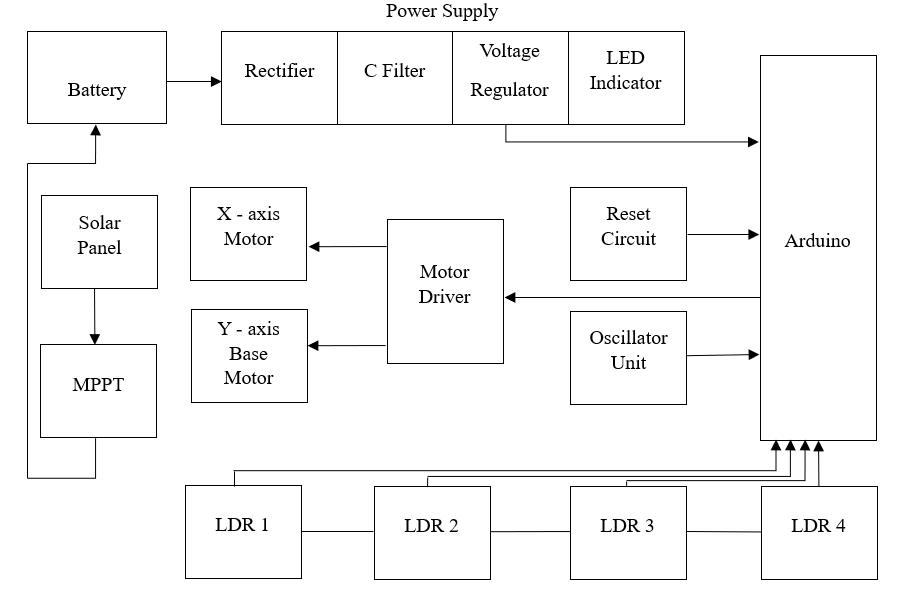
Thesolarpanelistheprimaryenergysourceofthesystem.It converts solar radiation into electrical energy using photovoltaiccells.Inthissystem,a10-wattpanelisusednot only to demonstrate the tracking mechanism but also to supplyenergyforchargingthebattery.Theefficiencyofthe panelissignificantlyimprovedbymaintainingitsorientation towardthesunusingdual-axistracking.
The batteryservesasan energystorageunit.Itstoresthe electricalenergygeneratedbythesolarpanelandsupplies powertotheentiresystemduringlowsunlightornighttime conditions. A 12V battery configuration ensures stable operationofmotors,microcontroller,andotherelectronic components.
3.3
TheMPPTunitisresponsibleforextractingmaximumpower from thesolar panel.Itcontinuouslymonitorsthe voltage andcurrentoutputandadjuststheoperatingpointtoensure optimal efficiency. This enhances overall system performancebyminimizingenergylosses.
3.4
The rectifier converts any alternating current (if present) intodirectcurrent(DC).AlthoughsolarpanelsproduceDC, this block ensures compatibility if any AC source is integrated. It also protects downstream components from reversepolarity.
3.5 Microcontroller (Arduino)
Themicrocontrolleristhebrainofthesystem.AnArduino boardisusedtoprocessinputsignalsfromLDRsensorsand generate control signals for motor movement. It continuouslycompareslightintensityvaluesanddetermines the direction in which the solar panel should rotate for maximumsunlightexposure.
3.6
LDR3, LDR4)
Four Light Dependent Resistors (LDRs) are used as light sensorstodetectsunlightintensityfromdifferentdirections. These sensors are placed in a specific arrangement to identify variations in light. Based on the difference in intensity,themicrocontrollerdecidesthemovementofthe panelalongbothaxes.
The L298 motor driver acts as an interface between the microcontroller and motors. Since the Arduino cannot
International Research Journal of Engineering and Technology (IRJET) e-ISSN: 2395-0056
Volume: 13 Issue: 04 | Apr 2026 www.irjet.net p-ISSN: 2395-0072
supplysufficientcurrenttodrivemotorsdirectly,themotor driver amplifies the control signals and provides the requiredpowertooperatethemotorsefficiently.
3.8 Oscillator Unit
Theoscillatorunitgeneratesclocksignalsrequiredforthe proper functioning of the microcontroller. It ensures synchronizedoperationandaccuratetimingforprocessing sensorinputsandcontrollingmotoroutputs.
3.9 Reset Circuit
Theresetcircuitisusedtorestartthemicrocontrollerwhen required.Itensuresthatthesystemcanrecoverfromerrors orinitializeproperlyduringstartup.
3.10 Voltage Regulator
Thevoltageregulatormaintainsaconstantoutputvoltage regardless of input fluctuations. It ensures that the microcontrollerandsensorsreceiveasteadyvoltagesupply, preventingmalfunctionordamageduetovoltagevariations.
3.11 LED Indicator
TheLEDindicatorprovidesvisualfeedbackaboutthesystem status. It indicates whether the system is powered ON, charging, or functioning properly. This helps in easy monitoringandtroubleshooting.
4. CONCLUSIONS
This Dual Axis Solar Tracker using Arduino presents an effectivesolutiontoimprovetheefficiencyofsolarenergy systems bycontinuouslyaligningthe panel withthesun's position.Byutilizingsimplesensorsandautomatedcontrol, the system enhances energy capture compared to conventionalfixedpanels.Itscost-effectiveness,adaptability, andimprovedperformancemakeitapracticalapproachfor modern renewable energy applications. Overall, this technology plays an important role in maximizing solar utilizationandsupportingsustainableenergydevelopment.
[1]D.L.Dhanalakshmi,H.N.LakshmiPrasanna,V.Priyanka, andK.J.Rani,“DualAxisSolarTrackerUsingArduinoUno,” International Journal on Recent and Innovation Trends in ComputingandCommunication,vol.4,no.6,pp.386–388, 2016.
[2]C.H.Pardosi,M.Siregar, andL.W.Pandjaitan,“Design and Implementation of a Dual-Axis Solar Tracking System usingArduinoUnoMicrocontroller,”JurnalELTIKOM,vol.8, no.1,2023.
[3] Y. O. Udoakah and E. Chukwu, “Design and ImplementationofaDualAxisSolarTrackerUsingArduino Microcontroller,” ELEKTRIKA Journal of Electrical Engineering,vol.17,no.3,pp.1–6,2017.
[4] S. Swami, R. Kumar, and N. Kumar, “Dual Axis Solar TrackingSystemUsingArduino,”PeriodicalsofEngineering andNaturalSciences,vol.4,no.1,pp.34–36,2020.
[5]S.AmelyJumaat,M.N.A.MohdSaid,andC.Rimong,“Dual Axis Solar Tracker with IoT Monitoring System Using Arduino,” International Journal of Power Electronics and DriveSystems,vol.11,no.1,pp.451–458,2020.
[6] S. Ahmad, A. N. Razali, and M. I. Misrun, “Effective and Low-CostArduinoBasedDual-AxisSolarTracker,”Journalof Physics:ConferenceSeries,vol.1878,no.1,2021.
[7]K.S.Gaeid,M.N.Uddin,andM.K.Mohamed,“Designand Implementation of Dual Axis Solar Tracker System Based Arduino,”TikritJournalofEngineeringSciences,vol.24,no. 2,2017.
[8] H. Asyari and A. W. Aji, “Design of Dual Axis Solar TrackingSystemBasedonArduinoandLDRSensors,”Jurnal TeknikElektro,vol.7,no.2,pp.101–107,2023.
[9]K.Chenchireddy,G.B.Mulla,andS.A.Sydu,“Dual-Axis SolarTrackerUsingArduinoandLDRs,”in Proceedingsof International Conference on Communications and Cyber PhysicalEngineering,2025.
[10]K.Chenchireddy,G.B.Mulla,V.Jagan,andW.Sultana, “Solar Tracker Using Arduino Microcontroller and Light Dependent Resistor,” International Journal of Power Electronics and Drive Systems, vol. 16, no. 1, pp. 70–75, 2025.
© 2026, IRJET | Impact Factor value: 8.315 | ISO 9001:2008 Certified Journal | Page1957