
International Research Journal of Engineering and Technology (IRJET) e-ISSN: 2395-0056 p-ISSN: 2395-0072

Volume:13Issue:06|Jun 2026 www.irjet.net


International Research Journal of Engineering and Technology (IRJET) e-ISSN: 2395-0056 p-ISSN: 2395-0072
Volume:13Issue:06|Jun 2026 www.irjet.net
1Jasleen Kaur Palaya, 2Kumkum Chavan C, 3 Sanjana Kulkarni P, 4Pisal Shravani A, 5Dipak Kandare P
1,2,3,4 Student, Artificial Intelligence & Data Science Guru Gobind Singh College of Engineering and Research Centre, Nashik.
5 Professor- Artificial Intelligence and Data Science, GCOERC, Nashik. ***
Abstract - Cardiacarrestremainsamajorcauseofsudden death worldwide, where immediate and effective Cardiopulmonary Resuscitation (CPR) is essential for improving survival rates. The proposed project, “ResQ –Automated CPR Wearable for Cardiac Arrest Emergencies,” introduces a compact, affordable, and wearable automated CPRsystemdesignedtoprovideconsistentchestcompressions during emergency situations. By integrating wearable technologywithIoT-basedmonitoringandalertfeatures,the device enables real-time patient status tracking and faster emergencyresponse.Thesystemisdesignedforeaseofusein homes, workplaces, and public spaces, reducing reliance on trained medical personnel during critical moments. Furthermore, the project establishes a foundation for future integration of Artificial Intelligence to support predictive health monitoringand intelligent emergency decision-making, ultimately aiming to make life-sav ing CPR assistance more accessibleandeffective.
KeyWords: Automated CPR,Cardiac Arrest, Wearable Device, IoT, Emergency Healthcare, Real-Time Monitoring,SmartMedical System,PortableHealthcare Device
1.INTRODUCTION
In recent years, cardiac arrest cases have increased significantly, making immediate medical response more importantthanever.CardiopulmonaryResuscitation(CPR) isoneofthemosteffectiveemergencyproceduresusedto restorebloodcirculationandimprovethesurvivalchances of a patient during cardiac arrest. However, timely CPR support is often unavailable due to delayed medical assistance, lack of trained personnel, or limited access to emergency healthcare devices. The project “ResQ –AutomatedCPR WearableforCardiacArrestEmergencies”is designedtoaddressthisproblembydevelopingawearable andautomatedCPRassistancesystem.Thedeviceiscapable ofprovidingcontrolledchestcompressionsandemergency monitoring support during critical situations. It combines healthcare technology with IoT-based communication featurestoimproveemergencyresponseandpatientsafety. The system aims to provide an affordable, portable, and user-friendly solution that can be used in homes,
Workplaces,ambulances,andpublicplaces.Byintegrating automationwithhealthcare,theprojectcontributestowards smarterandfasteremergencymedicalsupportsystems.
Several researchers and healthcare organizations have focused on improving emergency cardiac care through automatedsystems,wearablehealthcaretechnologies,and intelligent monitoring solutions. Cardiopulmonary Resuscitation(CPR)isrecognizedasoneofthemosteffective emergency procedures for maintaining blood circulation duringsuddencardiacarrest[1].Variousstudiesindicatethat immediateCPRsignificantlyincreasesthesurvivalchancesof patients before professional medical assistance becomes available[2].
Traditional CPR procedures are generally performed manually by trained medical personnel or bystanders. However, manual chest compressions require physical strength, proper technique, and continuous effort, making them difficult to maintain for long durations. In many emergencysituations,delaysinmedicalresponseandlackof CPR-trained individuals reduce the effectiveness of emergencytreatment[3].
Toovercometheselimitations,researchershavedeveloped automated CPR devices capable of delivering continuous chestcompressionsmechanically[4].ExistingautomatedCPR systems are commonly used in hospitals and ambulances where medical infrastructure is available [5]. These systems provide accurate compression depth and compressionrate,reducinghumanerrorduringemergency treatment. Despite their effectiveness, many commercially available systems are expensive, bulky, and unsuitable for personalorwearablehealthcareapplications[6].
In recent years, wearable healthcare technologies have gainedpopularityduetotheirportability,compactdesign, andabilitytocontinuouslymonitorpatienthealthconditions. Smart wearable systems integrated with IoT technology enablereal-timemonitoringofvitalsignssuchaspulserate, oxygen level, and heart activity [7]. These systems also support remote healthcare management by transmitting patientdatatocaregiversorhealthcareprofessionalsthrough cloudcommunicationplatforms.
IoT-basedhealthcaremonitoringsystemshave become an important part of modern smart healthcare applications. Cloud-connectedmonitoringplatformsallowcontinuousdata
International Research Journal of Engineering and Technology (IRJET) e-ISSN: 2395-0056 p-ISSN: 2395-0072
Volume:13Issue:06|Jun 2026 www.irjet.net
Collection,emergencyalertgeneration,andremotepatient supervision. Many healthcare researchers are focusing on combiningwearabletechnologywithemergencyresponse systems to improve treatment accessibility and reduce medicalresponsetime[8].
ArtificialIntelligenceisalsoemergingasamajortechnology in healthcare applications. AI-based predictive analysis systems can identify abnormal patient conditions, detect earlysymptomsofdiseases,andsupportintelligentmedical decision-making [9]. Integration of AI with wearable healthcaresystemscanfurtherimproveemergencyresponse efficiencyandpredictivehealthcaremanagement[10].
Basedontheanalysisofcurrenttechnologiesandresearch gaps,theproposedResQsystemfocusesondevelopingan affordable,wearable,portable,andIoT-enabledautomated CPRdevicecapableofdeliveringimmediateassistanceduring cardiacemergencieswhileprovidingreal-timemonitoring andemergencycommunication[11].
ThearchitectureoftheproposedResQ–AutomatedCPR WearableforCardiacArrestEmergenciessystemisdesigned toprovideautomatedemergencycardiacsupportthrough wearablehealthcaretechnology,IoTcommunication,cloud monitoring,andreal-timeemergencyalertmechanisms.The overallarchitectureintegratessensingdevices,processing units, cloud services, monitoring dashboards, and communicationmodulestoensurerapidresponse.
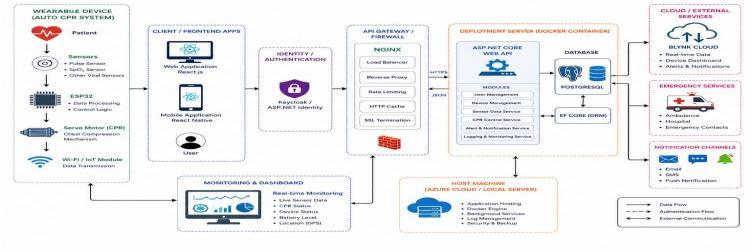
Fig1 –SystemArchitectureofAutoCPRDevice.
Thesystembeginswiththe wearablehealthcaredevice, whichisattachedtothepatientandcontinuouslymonitors physiological parameters such as pulse rate, oxygen saturation level, and other vital signs using health monitoringsensors.Thesesensorreadingsaretransferred to the ESP32 microcontroller, which acts as the central processing and control unit of the system. The ESP32 processesincominghealthdataandanalyzesthereadingsto Detect abnormal cardiac conditions or possible cardiac arrestsituations.
Whenemergencyconditionsareidentified,thecontroller activates the servo motor-based CPR mechanism that performs automated chest compressions according to medicallyrecommendedcompressionrates.Theautomated CPR mechanism ensures continuous and consistent chest compressions until the patient stabilizes or professional medicalsupportbecomesavailable.
Simultaneously, the ESP32 transmits real-time patient data to the IoT communication module using Wi-Fi connectivity. The transmitted information is stored and managed through cloud services and monitoring servers. The architecture includes a secure API gateway, authentication services, backend processing modules, and database management systems for handling patient monitoringdataefficiently.
Theproposedarchitecturealsosupports webandmobile dashboardapplications thatallowcaregivers,medicalstaff, or emergency responders to monitor the patient’s health condition remotely. The dashboard displays live sensor readings,CPRactivitystatus,batterycondition,emergency alerts,andlocationinformationinrealtime.
Additionally, the system architecture integrates emergency communication services capable of sending notifications through SMS, email, or push alerts to emergencycontactsandhealthcareprovidersduringcritical situations.Thisfeatureimprovesemergencyresponsetime andenhancespatientsafety.
The proposed typical system architecture combines wearable healthcare technology, automated CPR support, cloudcommunication,andsmartmonitoringfeaturesintoa singleintegratedplatform.Thearchitectureisdesignedtobe portable,scalable,cost-effective,andsuitablefordeployment in homes, ambulances, workplaces, hospitals, and public emergencyenvironments.
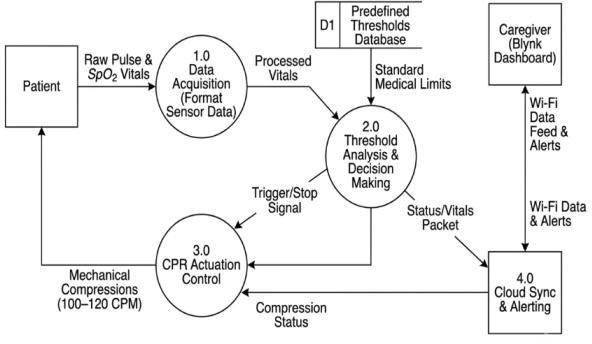
The Data Flow Architecture of the proposed ResQ –Automated CPR Wearable for Cardiac Arrest Emergenciessystemillustratesthemovementofpatient healthdatathroughdifferentprocessinganddecisionmakingmodules.Thearchitectureisdesignedtoprovide continuous patient monitoring, automated CPR activation, and real-time emergency communication during cardiac arrest situations. The workflow begins with the patient monitoring stage, where wearable sensors continuously collect physiological parameters suchaspulserateandoxygensaturation(SpO₂).These raw sensor readings are forwarded to the Data Acquisitionmodule,wheretheincomingsensorsignals are formatted, filtered, and converted into processed vitaldatasuitableforanalysis.
International Research Journal of Engineering and Technology (IRJET) e-ISSN: 2395-0056 p-ISSN: 2395-0072
Volume:13Issue:06|Jun 2026 www.irjet.net
The processed patient vitals are then transferred to the Threshold Analysis and Decision-Making module. This module compares the received health readings with predefinedmedicalthresholdvaluesstoredinthethreshold database. The database contains standard medical limits usedto identifyabnormal cardiac conditionsandpossible cardiacarrestsituations.
If the patient’s health parameters remain within normal ranges,thesystemcontinuesreal-timemonitoringwithout activatingemergencyprocedures.However,whenabnormal conditions are detected, the decision-making module generates a trigger signal to activate the CPR Actuation Control module. The CPR mechanism then performs automated chest compressions at the medically recommendedrateofapproximately100–120compressions per minute to maintain blood circulation during emergencies.
Simultaneously,thesystemsendspatientstatusinformation, compression activity details, and emergency alerts to the Cloud Sync and Alerting module through Wi-Fi communication. The cloud platform enables remote monitoring and stores real-time patient information for emergencymanagementpurposes.
The transmitted data is displayed on the Caregiver Monitoring Dashboard, developed using the Blynk IoT platform. The dashboard allows caregivers, healthcare professionals,oremergencyresponderstomonitorpatient conditions remotely and receive emergency notifications instantly.
The proposed data flow architecture ensures efficient communicationbetweensensing,processing,CPRexecution, cloud synchronization, and monitoring modules. The architectureimprovesemergencyresponsetime,supports automated healthcare assistance, and enhances the reliabilityofwearableCPRsystemsforcardiacemergency management
TheclassdiagramoftheResQ–AutomatedCPRWearable forCardiacArrestEmergenciessystemrepresentsthestatic structureofthesystembyshowingdifferentclasses,their attributes, methods, and relationships. The Patient class interacts with sensors that continuously collect physiological data. The Sensor class transfers the acquired data totheESP32 Controller,whichprocessesthe readingsand determineswhetherCPRactivationisrequired.
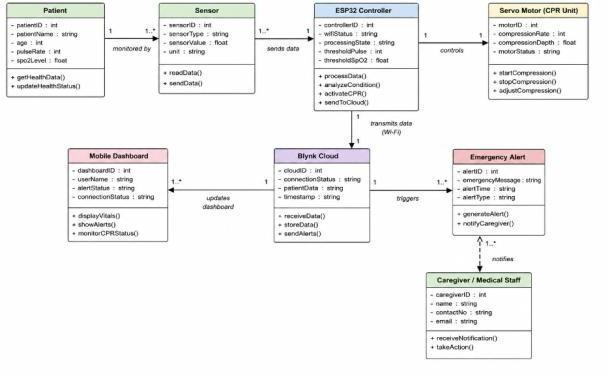
Fig3: ClassDiagram.
If abnormal conditions are detected, the ESP32 Controller activates the Servo Motor class to perform automated chest compressions. Simultaneously, the processed data is transmitted to the Blynk Cloud platform for storage and remote monitoring. The Mobile Dashboard displays real-time patient health status and CPR activity, while the Emergency Alert class generatesnotificationsduringcriticalsituations.This class diagram explains the interaction and communication between hardware, software, cloud, and monitoring moduleswithintheproposedsystem.
If the Patient Monitor system operates as a continuous surveillanceloopfocusedondataacquisitionandanomaly detection.IttransitionsfromaninitialStandbystateintoa Monitoring Vitals state as soon as the wear-able sensors begincollectingreal-timephysiologicaldata.Whiletracking metrics like heart rate and oxygen levels, the system evaluatesthedatastream;ifthereadingsremainwithinsafe thresholds,itloopsthroughaNormalVitalsvalidationstate and maintains routine tracking. However, if the data processinglayerflagsaseverearrhythmiaorcardiacarrest pattern, the system enters a high-priority Life Threat Detectedstate,whichimmediatelytriggersaCPRActivation Requesttopromptphysicalintervention.
TheCPRActuatorsystemgovernsthephysicalexecutionand continuous adjustment of the mechanical resuscitation process.ItrestsinaWaitingforActivationCommandstate until a critical alert is received, at which point it passes through a brief Calibration phase to ensure precise positioningandforcemetrics.
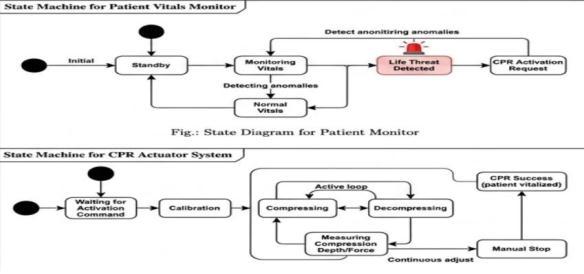
Fig4: StateMachineDiagram.
International Research Journal of Engineering and Technology (IRJET) e-ISSN: 2395-0056 p-ISSN: 2395-0072
Volume:13Issue:06|Jun 2026 www.irjet.net
Oncecalibrated,thedeviceentersacontinuousactiveloop alternating rapidly between mechanical Compressing and Decompressing states, while concurrently executing a Measuring Compression Depth/Force state to maintain adherencetomedicalguidelines.Thissynchronizedfeedback loopdynamicallyself-adjustsuntilitmeetsadesignatedstop condition either achieving a CPR Success (Patient Vitalized)stateorbeingmanuallyoverriddenviaaManual Stopcommanduponthearrivalofemergencypersonnel.
Table-1: ImplementationPlan




StudyofESP32,Sensors,Servo Motor,andBlynkPlatform.
HardwareComponentSelection andSystemSetup.
SensorIntegrationandHealth DataAcquisition.
DevelopmentofESP32 MonitoringandProcessing Module.
ServoMotorCPRCompression MechanismImplementation.
Wi-FiandBlynkCloud ConnectivityIntegration.
MobileDashboardDesignfor Real-TimeMonitoring.

The proposed system provides several opportunities for future enhancement and research development. Artificial Intelligence algorithms can be integrated for predictive cardiacanalysisandintelligentemergencydecision-making. Additionalsensorscanbeincorporatedtoimprovepatient healthassessmentandmonitoringaccuracy.
FutureversionsoftheprojectmayincludeGPStrackingfor faster emergency response, machine learning-based abnormality prediction, advanced cloud databases for medicalrecordstorage,andmobileapplicationintegration forremotehealthcaremanagement.TheCPRmechanismcan also be improved using advanced actuators capable of providingmoreprecisecompressioncontrol.
The integration of smart healthcare technologies and wearable medical devices has the potential to transform emergency cardiac care by making life-saving treatment moreaccessibleandefficient.
Hardware Assembly and Calibration: Securely integrate thebiosensorsintothewearablecasingtoensurestableskin contact, and calibrate the actuator/motor system to consistentlydeliverchestcompressionsatadepthof5–6cm andarateof100–120compressionsperminute.
Power and IC Configuration: Connect and fully charge the rechargeable Li-ion battery, verifying that the power managementICcorrectlybalancesandregulatesvoltageto prevent high-torque motor demands from disrupting the ESP32/Arduinomicrocontroller.
Software Flashing and Backend Setup: Flash the final EmbeddedC/Arduinocodeontothemicrocontroller,deploy thePythondatahandlingscriptstothecloud,andinitialize thedatabasetoreceivelivevitalsandsystemlogs.
EmergencyAlertandNotification SystemDevelopment.
SystemTestingandCPR CompressionValidation.

DocumentationandReport Preparation.
MaintenanceandFuture EnhancementPlanning.

Application and Network Rollout: Launch the mobile/web interface,ensuringitslivevitalsdisplayfunctionscorrectly andthatthepush,SMS,orcallprotocolsareproperlyrouted to trigger immediate alerts to emergency contacts and hospitals.
Manikin and Safety Validation: Mount the assembled prototypeontostandardCPRmanikinstorigorouslyvalidate compression accuracy, device stability, and to ensure the hardware emergency stop and overload protection mechanismsworkflawlessly.
MAINTAINANCE:
1. Mechanical and Gear Inspection: Conduct monthly physical inspections of the actuator, motor driver circuit, and gear mechanismstolookforwear,strainfractures,or lubrication breakdown caused by repeating high-torque compressions.
International Research Journal of Engineering and Technology (IRJET) e-ISSN: 2395-0056 p-ISSN: 2395-0072
Volume:13Issue:06|Jun 2026 www.irjet.net
2.Casing and Strap Upkeep: Quarterly check the structural integrity of the wearable casing, fastening straps, and buckles to make sure the device can be secured tightly to a patient without slipping during activeoperation.
3.Sensor Calibration and Cleaning: Perform bi-weekly cleaning and diagnostic tests on the sensors using base simulators to prevent data drift and ensure accurate cardiacarrestdetection.
4.Battery Lifecycle Management: Execute monthly discharge and recharge cycles on the Li-ion battery to prevent capacity degradation, verifying that it retains enough power to run automated compressions continuouslyforatleast30minutes.
5.Software Updates and Connectivity Audits: Deploy periodic over-the-air firmware updates to optimize the decision algorithm, and conduct weekly network ”ping” teststoconfirmtheIoTmodulescantransmitemergency logsandalertswithoutlatency.
5. CONCLUSIONS
The ResQ project presents an affordable, portable, and automated solution for managing sudden cardiac arrest emergencies outside hospital environments. The system is designed to deliver immediate and consistent chest compressions using a servo motor mechanism that followsmedicalstandardsof100–120compressionsper minute with a compression depth of 5–6 cm, helping maintain blood circulation and improving the patient’s survival chances until professional medical assistance arrives. By reducing human dependency, fatigue, and errorsassociatedwithmanualCPR,thedeviceprovidesa more reliable emergency response system. The integration of IoT technology through ESP32 and Blynk enables real-time monitoring of patient health parameterssuchaspulserate,ECGreadings,andoxygen levelswhilealsosending emergencyalerts tocaregivers ormedicalservicesduringcriticalsituations.Inaddition, the project demonstrates that effective automated CPR and health monitoring can be achieved using costeffective and easily available components, making the systemsuitableforhomes,workplaces,ambulances,and public areas. Overall, the project successfully combines automation, wearable technology, and IoT-based healthcare monitoring to create a practical and accessiblelife-savingsolutionforsociety.
REFERENCES
[1] American Heart Association, “Highlights of the 2020 American Heart Association Guidelines for CPR and ECC,”AHAJournal,2020.
[2] World Health Organization, “Cardiovascular Diseases (CVDs)Report,”WHOPublications,2023.
[3] J. Perkins, G. D. Perkins, and T. Olasveengen, “European Resuscitation Council Guidelines for Resuscitation,” Resuscitation Journal, vol. 161, pp. 1–60,2021.
[4] S. Kumar and R. Sharma, “IoT Based Smart HealthcareMonitoring System,”International Journal ofEngineeringResearchandTechnology,vol.11,no. 5,pp.125–130,2022.
[5] P.VermaandA.Singh,“WearableHealthcareDevices for Emergency Monitoring Applications,” International Journal of Advanced Research in ComputerEngineering,vol.9,no.3,pp.55–61,2023.
[6] M. Patel and K. Shah, “Automated CPR Compression System Using Embedded Technology,” International Conference on Smart Healthcare Systems, pp. 120–126,2022.
[7] H. Lee, J. Kim, and S. Park, “Mechanical CPR Devices and Their Clinical Applications,” Journal of Medical Devices,vol.14,no.2,pp.45–53,2021.
[8] A. Gupta and S. Mishra, “Real-Time Patient Monitoring Using ESP32 and IoT,” International Journal of Scientific Research in Engineering and Management,vol.7,no.4,pp.87–92,2023.
[9] R. Karthik and P. Arun, “Cloud-Based Emergency Alert System for Smart Healthcare,” International Journal of Computer Applications, vol. 183, no. 12, pp.10–15,2022.
[10] Blynk Inc., “Blynk IoT Platform Documentation,” 2024.
[11] Espressif Systems, “ESP32 Series Datasheet,” EspressifOfficialDocumentation,2024.
[12] M.AhmedandS.Rahman,“ArtificialIntelligencein HealthcareMonitoringSystems,”IEEEAccess,vol.10, pp.45670–45682,2022.
[13] R. Smith and T. Johnson, “Automated Emergency Medical Support Systems,” International Journal of Biomedical Engineering, vol. 15, no. 1, pp. 21–30, 2021.
[14] N.Patel, “SmartWearable MedicalDevicesforRealTime Monitoring,” Journal of HealthcareEngineering, vol.2022,ArticleID5523147,2022.
[15] A. Fernandes and M. Costa, “IoT Enabled Smart Healthcare Framework for Emergency Response,” Procedia Computer Science, vol. 165, pp. 622–629, 2020.
[16] S. Ravi and D. Kumar, “Embedded Systems for Medical Emergency Applications,” International Journal of Electronics and Communication Engineering,vol.8,no.6,pp.44–50,2021.
[17] K. Wang and Y. Zhao, “Wearable Sensor Technologies for Cardiac Monitoring,” Sensors Journal,vol.21,no.14,pp.1–18,2021.
[18] A. Brown et al., “Evaluation of CPR Compression Quality in Automated Systems,” Resuscitation Science,vol.9,no.3,pp.140–148,2022.
[19] S. Chatterjee and R. Das, “Emergency Notification Systems Using IoT and Cloud Computing,” International Journal of Advanced Networking Applications,vol.13,no.2,pp.5021–5028,2021.
[20] P. Singh and V. Mehta, “Smart Healthcare and Predictive Analysis Using Artificial Intelligence,” International Journal ofInnovative Technologyand ExploringEngineering,vol.11,no.5,pp.75–81,2022.