
International Research Journal of Engineering and Technology (IRJET) e-ISSN:2395-0056
Volume: 13 Issue: 05 | May 2026 www.irjet.net p-ISSN:2395-0072

International Research Journal of Engineering and Technology (IRJET) e-ISSN:2395-0056
Volume: 13 Issue: 05 | May 2026 www.irjet.net p-ISSN:2395-0072
Ar. E. Vishwajith Raj1, Ar. Z. Fathima Taskeen2, Ar. V. Vidya3
1Post Graduate Student, M. Arch - Construction project management student, Faculty of Architecture, Dr .M.G.R Educational and Research Institution, Chennai, India.
2Additional HOD, Faculty of Architecture, Dr. M.G.R Educational and Research Institution, Chennai, India.
3Associate Professor, Faculty of Architecture, Dr. M.G.R Educational and Research Institution, Chennai, India.
Abstract - Public-Private Partnership (PPP) has emerged as a crucial mechanism for infrastructure development, especially in countries facing fiscal constraints and increasing demand for high-quality infrastructure. India’s current infrastructure pipeline, including large-scale initiativessuchastheNationalInfrastructurePipeline(NIP) and PM Gati Shakti, highlights the growing importance of PPP models in bridging investment gaps and enhancing efficiency. This study examines the relevance of PPP in the current infrastructure ecosystem by analyzing its role in financing, risk-sharing, and project execution. The paper adopts a qualitative research approach through literature review, policy analysis, and case-based observations. It identifies key challenges such as regulatory bottlenecks, financial risks, and stakeholder conflicts while highlighting best practices for effective implementation. The findings suggest that PPP remains highly relevant but requires institutional strengthening, policy reforms, and improved governancemechanismstomaximizeitspotential.
Key Words: Public Private Partnership (PPP)1, Infrastructure Development2, Project Management3, etc.
Infrastructure development is a key driver of economic growth,urbanization,andsocialdevelopment.InIndia,the demand for infrastructure investment has increased significantly due to rapid urban expansion, industrialization, and population growth. However, government resources alone are insufficient to meet this demand.PublicPrivatePartnership(PPP)hasemergedas an alternative model that combines the efficiency of the private sector with the regulatory oversight of the public sector. The current infrastructure pipeline, particularly under initiatives like NIP, emphasizes sectors such as transportation, energy, urban infrastructure, and digital connectivity.Inthiscontext,PPPplaysacriticalrolein: Mobilizing private investment,Enhancing project efficiency Sharing risks between stakeholders.This paper aims to evaluate the relevance of PPP in the present infrastructure landscape and assess its effectiveness in addressingcurrentchallenges.
Over the last three decades, PPPs have gained global significanceacrosssectorsincludingtransportation,ports, renewable energy, airports, healthcare, education, urban infrastructure, and affordable housing. Countries such as the United Kingdom, Canada, Australia, India, Brazil, Malaysia, and theUnited ArabEmirates have increasingly adoptedPPPframeworkstoaddressinfrastructuredeficits and improve service delivery outcomes. In India, PPPs became particularly important after economic liberalization reforms and the subsequent increase in infrastructure demand associated with industrialization andurbangrowth.
This study aims to critically analyze the role of project management in delivering Energy Positive Buildings within cost, time, and quality constraints. By examining existing literature, case studies, and practical approaches, the research seeks to identify key success factors, challenges, and best practices that can support the effective implementation of EPBs. Ultimately, the study contributes to the growing body of knowledge on sustainable construction by emphasizing the importance of integrating project management principles with advancedenergy-efficientbuildingstrategies.
Despite their growing popularity, PPPs remain highly complex, especially in social infrastructure sectors where public welfare objectives, social equity concerns, affordability considerations, and long-term operational accountabilitybecomecentralissues.
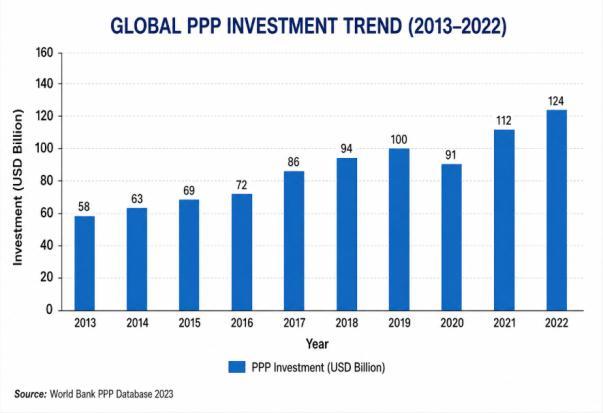
International Research Journal of Engineering and Technology (IRJET) e-ISSN:2395-0056
Volume: 13 Issue: 05 | May 2026 www.irjet.net p-ISSN:2395-0072
The study adopts a qualitative, analytical, and descriptive research methodology to examine the functioning, performance, and governance mechanisms associated with Public–Private Partnerships in social infrastructure.Theresearchprimarilyreliesonsecondary datasourcescollectedfromgovernmentreports,academic journals, policy documents, institutional publications, infrastructure databases, international development agencies,andproject-specificcasestudies.
The research methodology is designed to provide a comprehensive understanding of PPP frameworks through comparative analysis and thematic evaluation. Literature review forms an important component of the methodology, enabling the study to examine existing theoretical perspectives, governance models, risk allocation systems, and operational practices associated with PPP implementation across different sectors and countries.
Case-study analysis has also been adopted as a major methodological tool for evaluating the practical functioning of PPP projects. Selected national and international case studies have been analyzed based on project structure, governance systems, financial mechanisms, operational performance, stakeholder coordination, risk-sharing practices, sustainability outcomes, and implementation challenges. Comparative analysis allows the study to identify similarities, differences, success factors, and governance gaps across projects.
The study additionally incorporates policy analysis and institutional evaluation to understand the broader governanceenvironmentinfluencingPPPimplementation. ReportsfromorganizationssuchastheWorldBank,Asian Development Bank, NITI Aayog, and government ministrieswerereviewedtoexamineinfrastructurepolicy frameworks,regulatorymechanisms,financingstructures, andinstitutionalpracticesrelatedtoPPPgovernance.
The qualitative and analytical nature of the methodology enables the study to critically evaluate not onlythetechnicalandfinancialdimensionsofPPPprojects but also theirsocial, institutional, and governance-related implications.
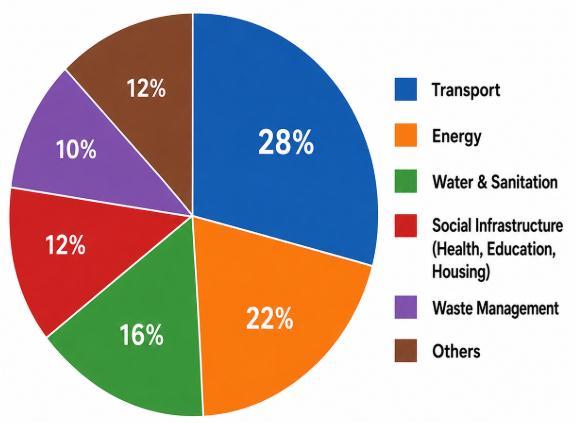
The transport sector accounts for the largest share of Public–Private Partnership (PPP) projects globally, representing approximately 28% of the total distribution. This dominance reflects the increasing importance of transportation infrastructure in supporting economic growth, regional connectivity, industrial expansion, and urban mobility. Governments across the world have extensively adopted PPP models in highways, expressways, metro rail systems, airports, ports, and
urban transportation corridors because these projects require enormous capital investment, long-term maintenance, and advanced operational management. Private-sector participation in transportation infrastructure helps improve construction efficiency, introduce modern technologies, reduce implementation delays, and enhance long-term asset performance. Transportation PPPs also generate relatively stable revenue streams through toll systems, freight movement, passengerservices, and logistics operations, making them attractiveforprivateinvestors.
3.1. Key Points
1. The transport sector holds the largest share of PPP projectsglobally.
2. The energy sector has becomea majorarea forPPP investment
3. The growing diversification of PPP projects across wastemanagement
4. Social infrastructure projects, including healthcare, education,andaffordablehousing.
Project management plays a critical role in the successful planning, execution, monitoring, and operation of Public–Private Partnership (PPP) infrastructure projects. Since PPP projects involve long-term contractual arrangements between public authorities and private organizations, effectiveprojectmanagementisessentialforcoordinating stakeholders, managing risks, controlling finances, ensuring quality, and achieving project objectives within theplannedscheduleandbudget.
4.1. Key Points
1. Project management ensures effective coordination between government agencies, private investors, contractors,consultants,andstakeholders
2. Efficient project management helps control project timelines, construction quality, financial performance,
International Research Journal of Engineering and Technology (IRJET) e-ISSN:2395-0056
Volume: 13 Issue: 05 | May 2026 www.irjet.net p-ISSN:2395-0072
andoperationalefficiency,therebyreducingdelaysand costoverruns.
3.Insectorssuchastransportation,energy,healthcare, and water infrastructure, project management supportsproperriskallocation,resourceplanning,and regulatorycompliance.
4. Project management improves long-term asset maintenance and lifecycle management by integrating monitoring systems, quality control measures, and sustainabilitypracticesintoinfrastructureoperations.
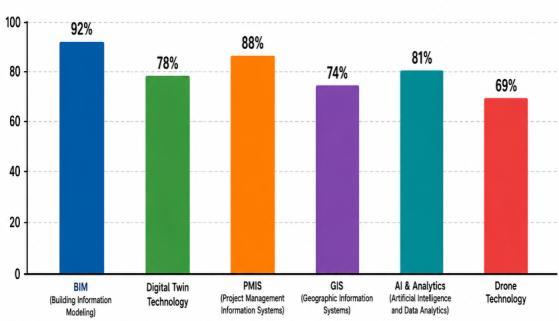
DigitalTwintechnologyhasemergedasanotheradvanced toolforPPPinfrastructuremanagement.Adigitaltwinisa real-time virtual replica of a physical infrastructure asset that continuously receives operational data through sensors and monitoring systems. In sectors such as transportation, energy, airports, and smart cities, digital twins support predictive maintenance, operational optimization, performance monitoring, and infrastructure sustainability. PPP operators use digital twins to improve long-termassetmanagementandreduceoperationalrisks. Project Management Information Systems (PMIS) are widelyusedinPPPprojectstomanageschedules,budgets, procurement systems, documentation, contracts, communications, and reporting. PMIS platforms improve coordination among stakeholders and allow real-time monitoring of project performance. These systems also help public authorities maintain transparency and accountabilityininfrastructuregovernance.
GeographicInformationSystems(GIS)playamajorrolein transportation, urban planning, utility management, and environmentalinfrastructurePPPprojects.GIStechnology supports site analysis, route optimization, environmental impact assessment, land acquisition planning, and infrastructure mapping. Governments and private developers use GIS tools to improve decision-making and infrastructureplanningefficiency.
5.1.
1. Building Information Modeling (BIM) helps improve design accuracy, project coordination, scheduling, cost control, and lifecycle management in PPP infrastructure projects.
2.DigitalTwintechnologyenablesreal-timeinfrastructure monitoring, predictive maintenance, and operational performance optimization through virtual asset simulation.
3. Project Management Information Systems (PMIS) support efficient planning, budgeting, procurement, reporting,andstakeholdercommunicationthroughoutthe projectlifecycle.
4. Geographic Information Systems (GIS) assist in site analysis, route planning, environmental assessment, land management, and infrastructure mapping for large-scale PPPprojects.
The Kuthambakkam Bus Terminus project represents an important urban transportation infrastructure initiative aimed at improving regional connectivity and reducing congestion within Chennai’s metropolitan transportation network. The project reflects the growing use of PPP principles in urban mobility planning and transportation infrastructuredevelopmentinTamilNadu.
Urban transportation systems are increasingly challenged by rising population density, traffic congestion, environmental concerns, and inadequate public transport infrastructure. The Kuthambakkam Bus Terminus project was planned as an integrated transportation hub capable of supporting efficient passenger movement, regional transportation coordination, and urban infrastructure expansion.
The project includes passenger terminals, commercial facilities, mobility infrastructure, and supporting civic amenities. Through collaborative planning and infrastructure financing mechanisms, the project seeks to improve transportation efficiency whilesupporting urban decentralizationandregionaleconomicdevelopment.
One of the major strengths of the project lies in its strategic location and integrated planning approach. The project is expected to reduce pressure on existing city transportation infrastructure while improving passenger convenience and regional connectivity. However, the project also faced several implementation challenges, including land acquisition delays, stakeholder coordination complexities, funding concerns, and operationalplanningissues.

International Research Journal of Engineering and Technology (IRJET) e-ISSN:2395-0056
Volume: 13 Issue: 05 | May 2026 www.irjet.net p-ISSN:2395-0072
The Kuthambakkam Bus Terminus project demonstrates how PPP-oriented transportation planning can contribute toward improving urban mobility systems and regional infrastructureintegration.
6.1.1
TheKuthambakkamBusTerminusprojecthighlighted theimportanceofPPP-orientedplanninginimproving urban transportation infrastructure and regional connectivity. The project demonstrated how integrated transportation infrastructure can reduce congestion pressure within metropolitan regions whilesupportingefficientpassengermobilitysystems. One of the major observations was the role of infrastructure decentralization in improving urban transportation management and reducing traffic concentrationwithincitycenters.
6.1.2
The Kuthambakkam Bus Terminus case study infers that PPP frameworks can significantly improve urban transportation infrastructure when integrated with longterm urban planning and mobility strategies. The project highlights that efficient stakeholder coordination, land management systems, and institutional planning are essential for avoiding implementation delays. It also demonstrates that transportation PPP projects require a balance between operational efficiency, financial sustainability, and public accessibility to achieve successfullong-termperformance.
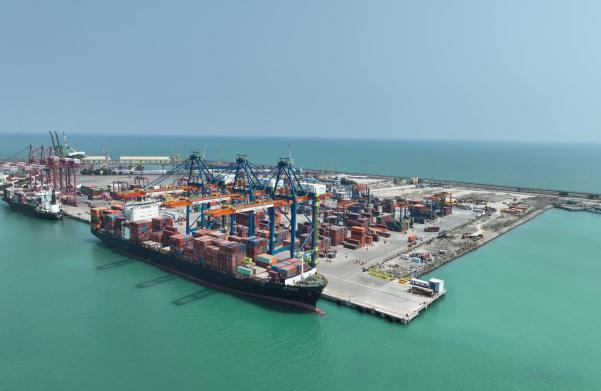
TheDevelopmentofNorthCargoBerthIIatTuticorinPort represents one of the important examples of PPP implementation within India’s maritime infrastructure sector. TheprojectwasdevelopedunderaBuild-OperateTransfer (BOT) concession framework with the objective of enhancing cargo handling capacity, improving operational efficiency, and strengthening regional trade infrastructure. The partnership involved collaboration between the V.O. Chidambaranar Port Authority and private-sector stakeholders responsible for financing, constructing, operating, and maintaining the infrastructurefacilityforaspecifiedconcessionperiod.
The project gained strategic significance due to the increasing demand for efficient maritime logistics and cargomanagementsystemsinsouthernIndia.Portsplaya critical role in facilitating international trade, industrial growth, and economic development. However, publicsector limitations in financing and operational efficiency oftenhinderthemodernizationofmaritimeinfrastructure. Through the PPP model, the Tuticorin Port project succeeded in attracting private investment and introducing advanced operational practices into port managementsystems.
The project demonstrated several positive outcomes including increased cargo handling productivity, reduced vessel turnaround time, improved infrastructure modernization, and enhanced operational efficiency. The involvement of private stakeholders contributed toward better maintenance practices, technological integration, and long-term asset management. At the same time, the project also faced challenges related to revenue uncertainty, contractual coordination complexities, tradevolumedependency,andoperationalriskmanagement.
The Tuticorin Port PPP project illustrates how collaborative infrastructure governance can improve logistics infrastructure and economic competitiveness whensupported by balancedcontractualframeworksand effectiveoperationalmanagement.
6.2.1 Key Observations:
TheTuticorinPortPPPprojectdemonstratedhowprivatesector participation can significantly improve operational efficiency and infrastructure modernization within the maritime sector. The BOT-based concession framework enabled the project to attract private investment while reducingthefinancialburdenonthepublicauthority.The projectshowednoticeableimprovementincargo-handling productivity, vessel turnaround time, and logistics management efficiency. The integration of modern equipment and operational practices contributed toward increasing the competitiveness of the port and strengtheningregionaltradeactivities.
6.2.2 Inference:
The Tuticorin Port case study infers that PPP models are highly effective in infrastructure sectors where operational efficiency, technological modernization, and long-term asset maintenance are essential for economic competitiveness.Theprojecthighlightsthatbalancedrisksharing mechanisms and strong concession agreements are critical for ensuring sustainable operational performance. It also demonstrates that PPP frameworks can accelerate infrastructure modernization when
International Research Journal of Engineering and Technology (IRJET) e-ISSN:2395-0056
Volume: 13 Issue: 05 | May 2026 www.irjet.net p-ISSN:2395-0072
supportedbytransparentgovernanceandefficientproject managementsystems.
The Mohammed bin Rashid Al Maktoum Solar Park in Dubairepresentsoneofthelargestrenewable-energyPPP initiatives in the world. Developed under an Independent Power Producer (IPP) framework, the project demonstrates how PPP models can effectively support sustainable energy infrastructure development through large-scaleprivateinvestmentandadvancedtechnological integration.
The solar park was initiated as part of Dubai’s long-term energy diversification strategy aimed at reducing dependence on fossil fuels and promoting environmental sustainability. Renewable energy infrastructure requires enormouscapitalinvestment,technologicalexpertise,and long-term operational planning. Through PPP mechanisms, the government successfully mobilized private-sector financing and international technological expertisetoacceleraterenewable-energydevelopment.
The project has contributed significantly toward increasing clean energy production, reducing carbon emissions,improvingenergysustainability,andpromoting environmental responsibility. Competitive bidding processes and long-term power purchase agreements enabled efficient financial structuring and investor participation. The project also demonstrates the growing importance of PPPs in supporting climate-responsive infrastructure systems and sustainable urban development.
The project demonstrated strong coordination between government policy initiatives and private-sector operational capability. Long-term power purchase agreements provided financial stability and investor confidence, while competitive bidding systems improved transparencyandcostefficiency.

The Mohammed bin Rashid Al Maktoum Solar Park project illustrated the growing importance of PPP frameworks in renewable-energy infrastructure development.Theprojectsuccessfullyattractedlargescale private investment into sustainable energy systems while supporting long-term environmental objectives. One of the major observations from the projectwastheabilityofPPPmechanismstointegrate advanced technologies, international expertise, and competitive financing structures into renewableenergyinfrastructure.
6.3.2
The solar park project infers that PPP frameworks can become powerful tools for achieving sustainable infrastructure development and clean-energy transitions. The project demonstrates that renewable-energy infrastructure benefits significantly from collaborative financing and technological integration. It also highlights the importance of stable policy frameworks, investor confidence, and long-term operational planning in ensuringthesuccessoflarge-scaleenergyPPPprojects.
The overall analysis of the Tuticorin Port PPP Project, Mohammed bin Rashid Al Maktoum Solar Park, and Kuthambakkam Bus Terminus project demonstrates that Public–Private Partnerships (PPPs) have become highly effective mechanisms for improving infrastructure delivery, operational efficiency, technological advancement, and long-term asset management across multiple infrastructure sectors. These case studies collectively highlight the growing importance of collaborativegovernancemodels inaddressing increasing infrastructure demands and public-sector financial limitations.
The projects reveal that PPP frameworks are particularly successful when they combine public-sector oversight with private-sector expertise, investment capability, innovation, and operational efficiency. In the Tuticorin Port project, private participation significantly improved cargo-handling productivity, logistics efficiency, and infrastructure modernization. Similarly, the Mohammed bin Rashid Solar Park project demonstrated how PPP models can support sustainable energy infrastructure through large-scale private investment, technological integration, and long-term environmental planning. The Kuthambakkam Bus Terminus project further illustrated theimportanceofPPP-orientedtransportationplanningin improving urban mobility, regional connectivity, and integratedinfrastructuredevelopment.
International Research Journal of Engineering and Technology (IRJET) e-ISSN:2395-0056
The case studies also emphasize the critical role of governance systems, stakeholder coordination, and institutional efficiency in determining PPP success. Projects with transparent contractual frameworks, balanced risk-sharing mechanisms, stable policy environments, and effective communication between stakeholders achieved better implementation outcomes. At the same time, recurring challenges such as land acquisition delays, regulatory complexity, financial uncertainty, and coordination difficulties indicate that infrastructure success depends heavily on strong institutional capacity and strategic project management practices.
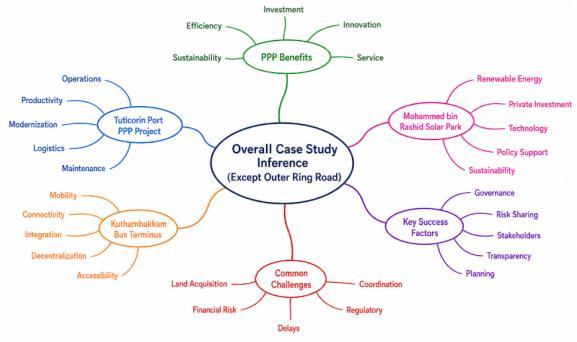
Public–Private Partnerships significantly improve infrastructure efficiency, service quality, and long-term assetmanagementacrossmultipleinfrastructuresectors.
Private-sector participation helps reduce the financial burden on governments by introducing investment, technology, operational expertise, and innovative managementpractices.
Strong governance systems, transparent contracts, balanced risk-sharing mechanisms, and stakeholder coordination are the most important factors influencing PPPsuccess.
Transportation, renewable energy, and urban infrastructure sectors demonstrate high potential for successful PPP implementation due to strong operational demandandlong-termsustainabilitybenefits.
Common challenges affecting PPP projects include land acquisition delays, regulatory complexity, financial uncertainty, coordination issues, and dependence on policystability.
Modern project management tools such as BIM, Digital Twin technology, GIS, PMIS, AI, and drone systems significantly improve project monitoring, planning accuracy, operational efficiency, and lifecycle management.
PPP projects are more successful when integrated with long-term sustainability goals, technological innovation, andcitizen-centricinfrastructureplanning.
Effective lifecycle maintenance and operational accountability under PPP frameworks contribute toward better infrastructure durability and service performance comparedtotraditionalprocurementsystems.
Institutional capacity and efficient project management practices play a crucial role in minimizing delays, resolving disputes, and ensuring smooth project execution.
Overall,PPPframeworkshavestrongpotentialtosupport sustainable, inclusive, and economically efficient infrastructure development when supported by transparentgovernanceandstrategicplanning.
Public–Private Partnerships (PPPs) have emerged as one of the most effective infrastructure development approachesinmoderngovernancesystems,particularlyin sectors where governments face increasing financial limitations,rapidurbanizationpressures,andrisingpublic demand for quality infrastructure services. The study revealsthatPPPframeworkssuccessfullycombinepublicsector accountability with private-sector efficiency, investment capability, technological innovation, and operational expertise, thereby improving infrastructure deliveryandlong-termassetperformance.
The analysis of various infrastructure sectors and case studies demonstrates that PPPs contribute significantly toward enhancing project efficiency, reducing implementation delays, improving operational sustainability, and strengthening lifecycle asset management. Transportation infrastructure, renewableenergy systems, urban mobility projects, ports, and social infrastructure facilities particularly benefit from collaborative governance models because these projects require long-term investment, advanced technology integration,andcontinuousmaintenancesystems.
The study further concludes that strong governance structures, transparent contractual frameworks, balanced risk-sharing mechanisms, efficient stakeholder coordination,andstablepolicyenvironmentsarethemost critical determinants of PPP success. Projects supported by effective project management systems and modern digital technologies such as BIM, GIS, Digital Twin technology, AI-based monitoring systems, and PMIS platforms demonstrated better operational performance, planningaccuracy,andinfrastructuresustainability.
The study recommends that governments and infrastructure agencies should strengthen regulatory and institutional frameworks for Public–Private Partnership (PPP) projects to ensure greater transparency, accountability, and long-term operational efficiency. Clear
Volume: 13 Issue: 05 | May 2026 www.irjet.net p-ISSN:2395-0072 © 2026, IRJET | Impact Factor value: 8.315 | ISO 9001:2008 Certified Journal | Page 1414
International Research Journal of Engineering and Technology (IRJET) e-ISSN:2395-0056
Volume: 13 Issue: 05 | May 2026 www.irjet.net p-ISSN:2395-0072
policy guidelines, standardized contractual procedures, and effective monitoring mechanisms are essential for reducing disputes and improving investor confidence in infrastructureprojects.
Itisrecommendedthatbalancedrisk-sharingmechanisms should be incorporated into PPP agreements so that financial, operational, construction, and market-related risks are allocated to the stakeholders most capable of managingthemefficiently.Properriskallocationimproves project stability, reduces financial uncertainty, and enhanceslong-terminfrastructuresustainability.
The study further recommends improving institutional capacity and technical expertise within public-sector organizations. Government agencies responsible for PPP implementation should strengthen their capabilities in projectplanning,contractmanagement,financialanalysis, legal coordination, and operational monitoring. CapacitybuildingprogramsandspecializedPPPmanagementunits can significantly improve decision-making and project executionefficiency.
The integration of modern project management tools and digital technologies should also be encouraged in PPP infrastructure projects. Technologies such as Building Information Modeling (BIM), Digital Twin systems, Geographic Information Systems (GIS), Artificial Intelligence (AI), drone monitoring, and Project Management Information Systems (PMIS) can improve planning accuracy, real-time monitoring, lifecycle asset management,transparency,andoperationalefficiency.
[1] World Bank. Public-Private Partnerships Reference Guide Version 3.0. Washington, D.C.: World Bank Group,2017.
[2] Asian Development Bank. Public–Private Partnership Handbook.Manila:AsianDevelopmentBank,2008.
[3] NITI Aayog. Public Private Partnership Models in Infrastructure Development. Government of India Publications,2021.
[4] MinistryofFinance,GovernmentofIndia.PPPToolkit for Improving PPP Decision-Making Processes DepartmentofEconomicAffairs,GovernmentofIndia, 2019.
[5] Grimsey, D., and Lewis, M.K. Public Private Partnerships: The Worldwide Revolution in Infrastructure Provision and Project Finance Cheltenham:EdwardElgarPublishing,2004.
[6] Yescombe,E.R.Public-PrivatePartnerships:Principles of Policy and Finance. Oxford: ButterworthHeinemann,2018.
[8] Ke,Y.,Wang,S.,Chan,A.P.C.,andLam,P.T.I.“Preferred Risk Allocation in China’s Public–Private Partnership Projects.” International Journal of Project Management,Vol.28,No.5,2010,pp.482–492.
[9] Zhang, X. “Critical Success Factors for Public–Private Partnerships in Infrastructure Development.” Journal of Construction Engineering and Management, Vol. 131,No.1,2005,pp.3–14.
[10] Osei-Kyei, R., and Chan, A.P.C. “Review of Studies on the Critical Success Factors for Public–Private Partnership Projects from 1990 to 2013.” International Journal of Project Management, Vol. 33, No.6,2015,pp.1335–1346.
[11] International Monetary Fund. Public-Private Partnerships. Fiscal Affairs Department, IMF Publications,2020.
[12] Organisation for Economic Co-operation and Development. Principles for Public Governance of Public–PrivatePartnerships.OECDPublishing,2012.
[13] Li, B., Akintoye, A., Edwards, P.J., and Hardcastle, C. “Critical Success Factors for PPP/PFI Projects in the UKConstructionIndustry.” ConstructionManagement andEconomics,Vol.23,No.5,2005,pp.459–471.
[14] Kumaraswamy, M.M., and Zhang, X.Q. “Governmental Role in BOT-Led Infrastructure Development.” International Journal of Project Management, Vol. 19, No.4,2001,pp.195–205.
[7] Hodge, G.A., and Greve, C. “Public–Private Partnerships: An International Performance Review.” PublicAdministrationReview,Vol.67,No.3,2007,pp. 545–558.