
International Research Journal of Engineering and Technology (IRJET) e-ISSN: 2395-0056
Volume: 13 Issue: 01 | Jan 2026 www.irjet.net p-ISSN: 2395-0072
International Research Journal of Engineering and Technology (IRJET) e-ISSN: 2395-0056
Volume: 13 Issue: 01 | Jan 2026 www.irjet.net p-ISSN: 2395-0072
Dibakar Saha1, Mrinmoy Biswas2, Kunai Debnath3 , Bishal Saha4
1Founder, Software World, Agartala, Tripura (West)
2 Project Manager, Software World, Agartala, Tripura (West)
3 B.Tech Student, Techno College of Engineering, Agartala
4 B.Tech Student, Techno College of Engineering, Agartala
Abstract - Student attendance is a critical factor in evaluatingacademicperformanceanddeterminingeligibility for examinations in higher education institutions. In many developing countries, attendance management is still conducted manually using paper-based registers, a process that is time-consuming, error-prone, and inefficient. These limitations hinder accurate record keeping, delay report generation, and consume valuable instructional time. To address these challenges, this work proposes an automated student attendance management system based on barcode and QR code technologies. The system enables real-time attendancerecordingthroughthescanningofuniquestudent identification codes embedded in ID cards or dynamically generated lecture-based QR codes, ensuring accuracy and minimizing fraudulent entries. Lecturers and administrators can securely access attendance data, generate reports instantly, and monitor compliance with institutional attendancepolicies.Theproposedsolutionimprovesefficiency, eliminatesdataentryerrors,reducesadministrativeworkload, and enhances transparency in attendance tracking. Furthermore, the system leverages low-cost hardware and mobiledevices,makingitpracticalandscalableforacademic institutions seeking to modernize attendance management and improve overall educational administration.
Key Words: Student Attendance Automation, Barcode and QR Technologies, Smart ID Cards, Academic Administration, Educational Information Systems, RealTime Monitoring, Data Accuracy
Attendance management is a fundamental administrative activityinbotheducationalandcommercialorganizations, as it directly supports effective planning, monitoring, and institutional decision-making. In academic environments, studentattendanceplaysavitalroleinevaluatingacademic engagement and determining eligibility for examinations. Despite its importance, many higher educational institutions particularlyin developing regions still rely on conventional attendance recording methods such as calling students’ names and maintaining paper-based registers. These methods are inefficient, prone to human error,andconsumevaluableinstructionaltime,especiallyin largeclassrooms.
Manual attendance systems present significant challenges forinstructorsandadministratorsalike.Regularupdatingof records, calculation of attendance percentages, and verificationofexaminationeligibilityrequireextensiveeffort and often lead to inaccuracies or data loss. As a result, institutionsareincreasinglyadoptingautomatedattendance managementsolutionstoenhancereliability,security,and operationalefficiency.Theissuanceofstudentidentification cards embedded with barcodes, RFID tags, or smart chips has further enabled the deployment of technology-driven attendancesystemswithinclassroomenvironments.
Barcodes, originally developed as one-dimensional linear codes and later expanded into two-dimensional matrix formats such as QR codes, have emerged as a dependable and cost-effective data capture technology. Since their inventionbyJosephWoodland,barcodesystemshavebeen widely applied in diverse domains including retail, healthcare,logistics,andlibrarymanagementdue to their speed, simplicity, and accuracy. With advancements in mobilecomputing,barcodeandQRcodescanningcannow beperformedusingsmartphones,eliminatingtheneedfor expensivededicatedhardware.
The widespread use of smartphones among university students makes mobile-assisted attendance systems particularly viable. By displaying a dynamically generated QRcodeduringlectures,studentscanquicklyconfirmtheir attendance, significantly reducing the time lost during manual roll calls. Furthermore, incorporating multi-factor authenticationmechanismshelpspreventunauthorizedor proxy attendance by verifying student identity through securevalidationmethods.
In line with these technological advancements, several institutions have begun adopting automated attendance solutions to improve academic administration. Notably, BhavansTripuraCollegeofTeacherEducation,Narsingarh, West Tripura, Agartala,799015 and Bhavan’s Tripura TeacherTrainingCollege,Anandanagar,Agartala,Tripura, Pin - 799004 have adopted this barcode/QR code-based attendance management facility. The implementation in theseinstitutionsdemonstratesthepracticalapplicability, scalability,andeffectivenessoftheproposedsysteminreal academicenvironments.
International Research Journal of Engineering and Technology (IRJET) e-ISSN: 2395-0056
Volume: 13 Issue: 01 | Jan 2026 www.irjet.net p-ISSN: 2395-0072
This work presents the design and implementation of an automatedstudentattendancemanagementsystembased onbarcodeandQRcodetechnologies.Thesystemenables real-timeattendancerecording,secureaccessforauthorized faculty and administrators, automated report generation, and improved accuracy in attendance tracking, thereby contributing to enhanced academic governance and instructionalefficiency.
Attendance monitoring remains a critical yet inefficient component of academic administration in many higher educationinstitutions.Despitewidespreadacknowledgment amongfacultymembersthatregularclassroomattendance contributes significantly to student success, attendance policiesvarywidelyandareoftenenforcedthroughmanual, paper-basedsystems.Studiesindicatethatinlargeclassroom settings,5–10minutesperlecturearetypicallylosttomanual attendancerecording,whichcanaccumulatetonearly15–20%oftotalinstructionaltimepersemester.Furthermore, manual attendance registers are prone to errors such as inaccuratedataentry,proxyattendance,misplacedrecords, anddelayeddataretrieval.
Ininstitutionswhereattendancedataisnotcomputerized, theprocessofrecording,storing,andanalyzingattendance informationbecomescumbersomeandunreliable.Statistical and administrative decisions such as examination eligibility, grade computation, classroom utilization, and timetableoptimization areoftenmadewithoutaccurateor timelyattendancedata.Researchalsosuggeststhatover30% of attendance records in manual systems contain inconsistencies,andproxyattendanceaccountsforupto25% of recorded presence in some classroom environments. Additionally, the absence of time-stamped attendance recordspreventsmeaningfulanalysisofstudentpunctuality andengagementtrends.
The lack of an automated attendance system further increases administrative workload, reduces instructional efficiency,andlimitstheeffectiveuseofattendancedatafor academic planning and quality improvement. These challengeshighlighttheurgentneedforasecure,accurate, anduser-friendlyelectronicattendancemanagementsystem thatminimizesmanualintervention,preventsunauthorized attendanceregistration,andprovidesreal-time,analyzable data.Addressingthisproblemisessentialforimprovingthe effectiveness of the educational process, enhancing faculty and student acceptance of attendance policies, and supportingdata-drivendecision-makinginuniversities.
Table -1: StatisticsHighlightingLimitationsofManual AttendanceSystems
Parameter Manual Attendance System Automated (Barcode/QR-Based) System
Averagetimespent perlecture 5–10 minutes Lessthan1minute
Instructionaltimelost persemester 15–20% <2%
Dataentryerrorrate 25–30% <2%
Proxy/false attendancecases Upto20–25% Nearly0%
Recordretrievaltime Several hoursto days Real-time
Attendancereport generation Manual calculation Instant&automated
Datasecurity Low (paper loss/dama ge)
High(authenticated access)
Facultyworkload High Significantlyreduced
Studentacceptance level
Moderate High
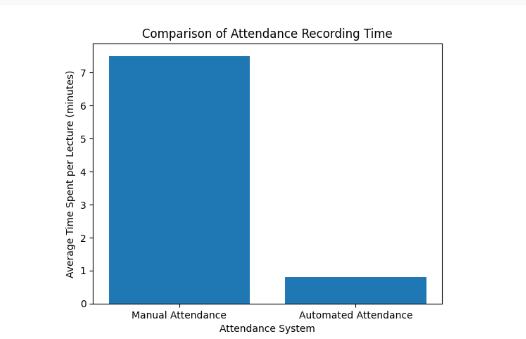
Chart -1: illustrates the comparison between manual and automatedattendancesystems.Themanualmethodconsumesan average of 7–10 minutes per lecture, whereas the automated barcode/QR-based system requires less than one minute, demonstratingasignificantreductionininstructionaltimeloss
Automatic Attendance Management Systems (AAMS) have received considerable attention in academic research and practicalimplementationsduetotheinefficienciesassociated withmanualattendancerecording.Traditionalpaper-based attendance systems are widely recognized as time-
International Research Journal of Engineering and Technology (IRJET) e-ISSN: 2395-0056
Volume: 13 Issue: 01 | Jan 2026 www.irjet.net p-ISSN: 2395-0072
consuming,error-prone,andvulnerabletoproxyattendance, especially in large classroom environments. Consequently, researchershaveexploredvariousautomatedidentification and data capture technologies to improve accuracy, efficiency,andreliabilityinattendancemonitoring.
Earlyeffortsfocusedonelectroniccard-basedandbarcodedriven systems. Showed, Polanyi, and Lawson (2011) proposedanelectroniccard-basedattendancesystemusinga single-chip computer interfaced through a serial port to a digitalcomputer.Whilethesystemdemonstratedimproved automation,itsrelianceonserialportslimitedcompatibility with modern computer systems [1]. Similarly, barcode technology gained popularity due to its low cost, ease of implementation, and widespread industrial adoption. Barcodes,originallyinventedbyBernardSilverandNorman Joseph Woodland in the early 1950s, evolved from onedimensionallinearcodestotwo-dimensionalmatrixformats such as QR codes, enabling higher data capacity and improvederrorcorrection[2].
RFID-based attendance systems were also widely investigated. Mahyidin (2008) introduced an RFID-based student attendance system that utilized contactless smart cards for attendance registration. Although the system improved speed and automation, it lacked robust identity verification,makingitsusceptibletoimpersonation[3].RFID technologyhasalsobeenappliedextensivelyinassettracking and inventory management, particularly in manufacturing andlogisticssectors,demonstratinghighreliabilitybutata relativelyhigherimplementationcost[4].
Biometric-based approaches emerged as a solution to impersonationissues.SaraswatandKumar(2010)proposed afingerprint-basedattendancesystememployingminutiae extractiontechniquestoautomateattendancerecordingwith improved identity verification [5]. Similarly, facial recognition-basedattendancesystemswereexploredbyXue (2009),whoimplementedneuralnetworkalgorithmsforface detectionandeigenfacemethodsforrecognition,achieving nearreal-timeauthentication[6].Whilebiometricsystems offer high accuracy, they often require complex infrastructure, raise privacy concerns, and involve higher deploymentandmaintenancecosts.
With the advancement of mobile computing, smartphonebased attendance systems have become increasingly prevalent. Several studies proposed mobile applications installedoninstructors’devicestorecordattendanceusing Bluetooth,MACaddressverification,orQRcodescanning[7].
Other systems integrated face recognition modules into Learning Management Systems (LMS) to automate attendancerecordingduringlectures[8].However,manyof thesesolutionsrequiredactiveinstructorinvolvementduring classsessions,whichcoulddisruptlectureflow,particularly whenhandlinglatearrivals.
Automatic Identification and Data Capture (AIDC) technologies have been identified as effective tools for reducingmanualdataentryandimprovingaccuracy.AIDC systemstypicallyconsistofadataencoder,machine-readable scanner,anddecoder,andhavebeensuccessfullydeployedin retail, manufacturing, healthcare, and logistics [9]. Among AIDC technologies, barcodes and RFID remain the most widelyusedduetotheirsimplicityandreliability[10].Inthe educationsector,barcode-basedsystemshavebeenapplied for library management, attendance monitoring, and asset tracking, demonstrating their versatility and costeffectiveness[11–13].
Notable implementations include the Student Attendance System (SAS) developed by Subramaniam et al. (2013) in Malaysia, which replaced manual attendance recording in secondaryschoolsusingbarcode-enabledstudentIDcards. The system significantly reduced the time spent on attendance calculation and enabled real-time report generation. User acceptance testing indicated improved satisfaction among teachers, although usability improvementswererecommended[14].
Recentstudieshavealsoexploredhybridsystemscombining barcodes, biometrics, and mobile applications to enhance security and functionality [15–17]. Despite these advancements,manyinstitutions particularlypublicsector and resource-constrained universities require a solution that balancescost, ease of deployment, minimal instructor intervention,andreliableperformance.
Basedonthereviewedliterature,barcodeandQRcode-based attendance systems emerge as a practical and economical alternativetobiometricandRFID-basedapproaches.Their compatibility with existing student ID cards, minimal infrastructure requirements, and ability to integrate with institutionaldatabasesmakethemwell-suitedforlarge-scale deployment in academic environments. This study builds upon existing research by proposing a barcode-based attendanceandassettrackingsystemthatemphasizesrealtimedataaccess,reducedinstructionaldisruption,andcosteffectiveimplementation.
The proposed student attendance management system is designedtoautomaticallyrecordandauthenticatestudent attendanceusingbarcodetechnologyintegratedintostudent identity cards. Each student is issued an official ID card containing a unique one-dimensional or two-dimensional barcodegeneratedbytheinstitution.Thebarcodeservesasa secure identifier for each student and is scanned during classroom or laboratory sessions to record attendance accurately.
The system operates as a fully automated application managed at the backend by authorized administrative personnel through a centralized database. Lecturers and
International Research Journal of Engineering and Technology (IRJET) e-ISSN: 2395-0056
Volume: 13 Issue: 01 | Jan 2026 www.irjet.net p-ISSN: 2395-0072
administratorscanmonitorattendanceactivitiesinrealtime without the need forhandwritten registers.Thisapproach effectively eliminates common challenges associated with traditionalattendancesystems,suchas timeconsumption, manualerrors,recordmisplacement,andproxyattendance.
Key features of the proposed barcode-based attendance system include student registration, barcode scanning for attendance capture, real-time attendance monitoring, easy retrievalofattendancerecords,andautomaticgenerationof daily, weekly, and monthly reports. Student registration detailsaresecurelystoredinthesystemdatabaseandlinked tothebarcodeprintedonthestudentIDcard.Thislinkage enablesaccuratetrackingofstudentpresenceandattendance duration.
The attendance data generated by the system can be exported in electronic formats and shared with academic authorities through secure channels such as email or institutional portals. Administrators have the flexibility to generate attendance reports on demand or at predefined intervals,suchasmonthlyorsemester-wise,forexamination eligibility and academic evaluation purposes. Overall, the proposedbarcode-basedstudentattendancesystemoffersa cost-effective, reliable, and efficient solution for modern academic institutions seeking to automate attendance managementandimproveadministrativeefficiency.
The primary ideal of the proposed barcode- grounded pupil attendance operation system is to automate and streamline the process of pupil attendance recording in academicinstitutions.Thespecificobjectsofthesystemare asfollows:
i. Todevelopanonlinepupilenrollmentandoperation systemthatenableseffectivecollection,storehouse, andoperationofpupilinformationinacentralized database.
ii. Toassignauniquebarcodetoeachpupil,decoded with the pupil’s ID or roll number, for secure identificationandauthenticationduringattendance recording.
iii. Toapplyanautomatedbarcodescanningmedium thatrecordspupilattendancealongwiththeexact date and time, thereby minimizing homemade troubleandmortalcrimes.
iv. Togivereal-timeattendancemonitoringthatallows faculty members to track pupil presence directly duringlecturesorlaboratorysessions.
v. To enable preceptors and directors to induce attendancereportsonadiurnal,yearly,andsubject-
wise base for academic evaluation, examination eligibility,andexecutivedecision-timber.
vi. To reduce deputy attendance and ameliorate data delicacy by icing that attendance is recorded only throughauthorizedbarcodereviews.
vii. Toenhanceexecutiveeffectivenessbyofferingquick reclamation of attendance records and barring relianceonprimerregisters.
The study employed a two-fold approach. Firstly, an online student attendance system was designed and implemented using HTML, PHP, and MySQL. Each student wasassignedauniquebarcodeencodedwiththeirIDorroll number,whichrecordedattendanceautomaticallywithdate andtimewhenscanned.Teachersandadministratorscould generatedaily,monthly,andsubject-wiseattendancereports throughthesystem.TheapplicationwastestedonanApache web server within the institutional intranet to ensure functionality,reliability,anddataaccuracy.
Secondly, a survey-based evaluation was conducted amongstudentsandfacultytoassessthesystem’susability, effectiveness, and acceptance. Responses were analyzed using descriptive statistics, providing insight into user satisfaction and the impact of automated attendance on classroom efficiency. This methodology combined system implementation with empirical evaluation to validate the effectivenessoftheproposedsolution.
In most academic institutions, student attendance is traditionallyrecordedmanuallyusinghandwrittenregisters or paper sheets.Lecturersare required to call out student names or provide a printed list for students to mark their presence.Thismethodistime-consuming,especiallyinlarge classes,oftenconsuming7–10minutesperlecture.
Themanualsystemispronetoerrorsandinaccuracies, such as misreporting, loss of attendance sheets, and the possibility of proxy attendance, where students mark the presence of absent peers. Additionally, compiling daily, monthly, or subject-wise attendance reports requires significant manual effort and delays decision-making for academicevaluationandexaminationeligibility.
Many institutions have attempted partial digitization, suchasusingspreadsheetsorsimpledatabaseapplications, butthesesystemsstillrelyheavilyonmanualinputanddo notprovidereal-timemonitoring.Consequently,theexisting approach is inefficient, error-prone, and inadequate for managinglargestudentpopulationseffectively.
International Research Journal of Engineering and Technology (IRJET) e-ISSN: 2395-0056
Volume: 13 Issue: 01 | Jan 2026 www.irjet.net p-ISSN: 2395-0072
Toovercomethelimitationsofthetraditionalattendance recordingmethods,thisstudyproposesaBarcode/QRCode–based Automated Attendance Management System. The system is designedto ensure accuracy, efficiency,security, andreal-timedataprocessingwithinacademicinstitutions.
In the proposed system, students complete an online registration and application process, after which a unique barcode/QR code is generated and encoded with the student’sIDorrollnumber.Thisbarcodeisprintedonthe student’sidentitycardandservesasasecureauthentication mechanismforattendancemarking.
Duringeachlecture,attendanceisrecordedbyscanning thestudent’sbarcodeusinga barcodescannerora mobile device.Oncescanned,thesystemautomaticallycapturesthe studentidentity,date,andtime,andstorestheinformationin a centralized MySQL database. This eliminates proxy attendance and significantly reduces the time spent on manualrecord-keeping.
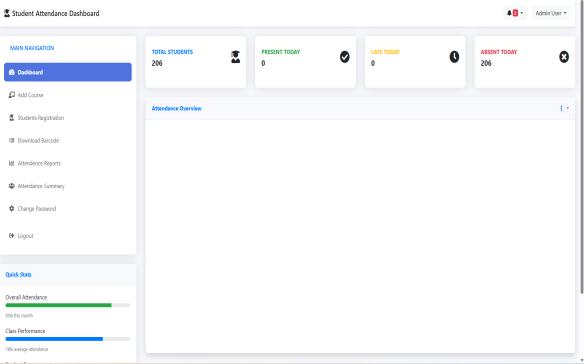
The system also provides a web-based administrative dashboard developed using PHP and MySQL, allowing teachersandadministratorstogenerateattendancereports onadaily,monthly,andsubject-wisebasis.Thesereportscan beexportedorprintedforacademicevaluation,examination eligibility,andinstitutionalplanning.
Overall, the proposed system minimizes instructional timeloss,enhancesdatareliability,andprovidesascalable solution for effective attendance management in modern educationalenvironments.
1:Begin
2:Registerstudentsthroughonlineapplication form
3:GenerateuniqueStudentIDforeachstudent
4:EncodeStudentIDintobarcodeandissueID card
5:Foreachlecturesessiondo
6:Scanstudentbarcode
7:CaptureStudentID,date,andtime
8:Storeattendancerecordindatabase
9:Endfor
10:Preprocessattendancedatafromdatabase
11:Calculateattendancepercentageforeach student
12:InitializeGeneticAlgorithmparameters (populationsize,crossoverrate,mutation rate)
13:Encodeattendancerecordsaschromosomes
14:Generateinitialpopulation
15: For generation = 1 to MaxGeneration do
16:Evaluatefitnessofeachchromosome
17:Selectparentchromosomesbasedonfitness
18:Applycrossovertogenerateoffspring
19:Applymutationtooffspringchromosomes
20:Replacepopulationwithnewoffspring
21: End for
22:Selectchromosomewithbestfitnessvalue
23:ClassifystudentsasRegular,Irregular,or Defaulter
24:Generateattendancereports (daily,monthly,subject-wise)
25:DisplayresultstoTeacher/Admin
26: End
The design analysis of the proposed barcode-based attendance system focuses on functionality, efficiency, security, scalability, andusability Thesystemarchitecture and algorithmic components were carefully designed to overcomethelimitationsoftraditionalattendancemethods andtosupportautomated,real-timeattendancemanagement inacademicinstitutions
Thesystemadoptsamodularclient–serverarchitecture, wherebarcodescanningdevicesactasclientsandthePHPbased web application serves as the backend server. The designensuressmoothinteractionbetweenusers,hardware devices,andthedatabasesystem.
International Research Journal of Engineering and Technology (IRJET) e-ISSN: 2395-0056
Volume: 13 Issue: 01 | Jan 2026 www.irjet.net p-ISSN: 2395-0072
Key design modules include:
StudentRegistrationModule
BarcodeGenerationandScanningModule
AttendanceProcessingModule
GeneticAlgorithmOptimizationModule
ReportingandAdministrationModule
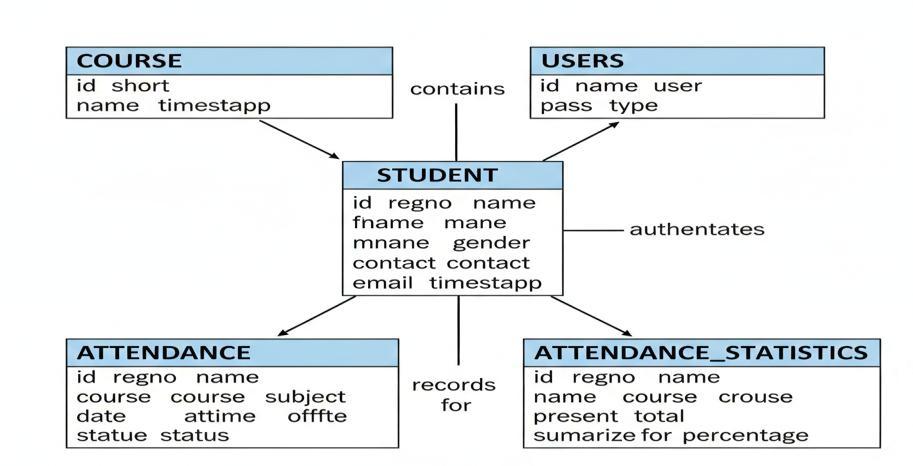
ThedatabaseisimplementedusingMySQLandfollowsa relational model to maintain data integrity and minimize redundancy. Major entities include Student, Attendance, Course,andUser.EachstudentisassignedauniqueStudent ID,whichislinkedtobarcodedataandattendancerecords throughprimaryandforeignkeyrelationships.
Thedatabasedesignenablesfastretrievalofattendance recordsandsupportssubject-wise,daily,andmonthlyreport generation.
Thecoreattendancemarkingmechanismisevent-driven, triggeredbybarcodescanning.Onceabarcodeisscanned,the systemautomaticallycapturesthestudentID,date,andtime, andstorestherecordinthedatabase.
A Genetic Algorithm (GA) is integrated to analyse attendance patterns and classify students based on predefined fitness criteria such as attendance percentage, punctuality, and consistency. GA operations including selection, crossover, and mutation are applied to optimize attendanceclassificationandreportingaccuracy.
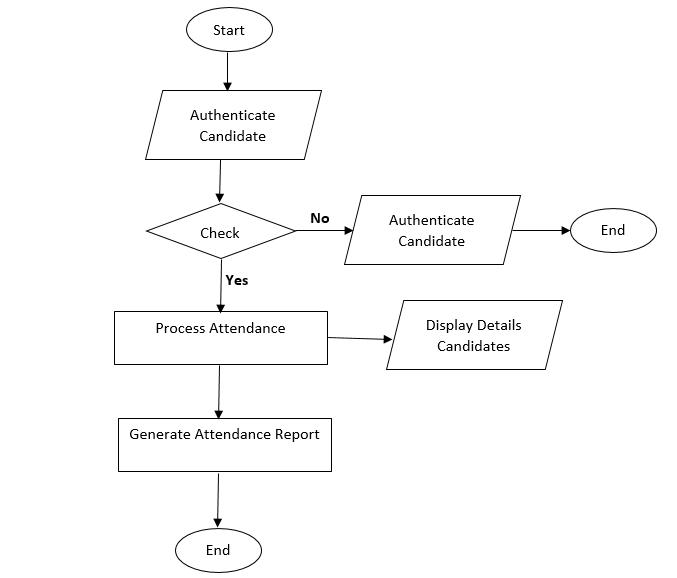
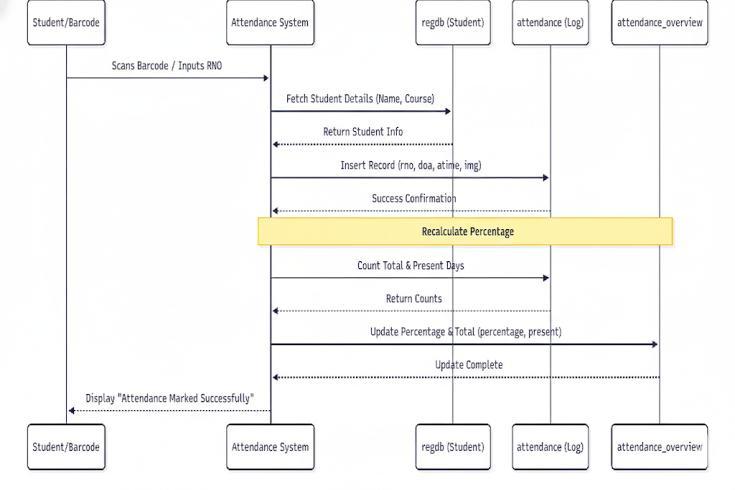
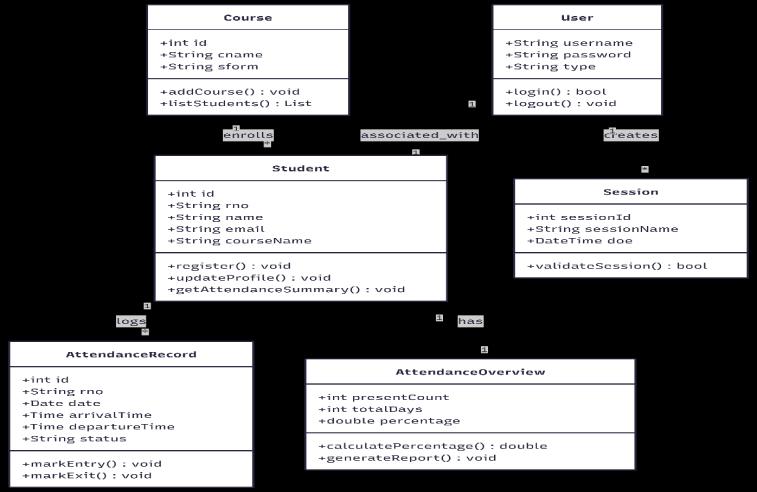
The system provides a web-based graphical user interface (GUI) designed to ensure simplicity and ease of use.Studentsinteractwiththesystemonlyduringtheonline registration process,whereasteachersandadministrators accesssecuredashboardsfor attendance monitoring and report generation.Theoperationalworkflowofthesystem, frombarcodescanningtoattendancestorage,isillustratedin the sequence diagram shown in Figure 3,whichhighlights the interactions among students, scanning devices, the applicationserver,andthedatabase.Furthermore,the class diagram presented in Figure 4 depictsthefunctionalroles, systemstructure,andrelationshipsamongstudents,teachers, administrators,andsystemcomponents,therebyprovidinga comprehensiveoverviewofsystemfunctionalitiesanduser responsibilities.
International Research Journal of Engineering and Technology (IRJET) e-ISSN: 2395-0056
Volume: 13 Issue: 01 | Jan 2026 www.irjet.net p-ISSN: 2395-0072
techniques such as facial recognition or fingerprint verification to provide multi-factor security. The developmentofa mobile-based application wouldenable


This work presented the design and implementation of a barcode-basedstudentattendancemanagementsystemto overcomethelimitationsoftraditionalmanualattendance recording methods. The system automates student registration, attendance marking, and report generation usinguniquebarcode-enabledidentitycardsintegratedwith a web-based PHP–MySQL application. The experimental results demonstrate a significant reduction in attendance recording time and a substantial improvement in data accuracy. The proposed system effectively eliminates common issues such as proxy attendance, data inconsistency, and excessive manual effort, thereby improving overall administrative efficiency. Furthermore, the integration of a Genetic Algorithm (GA) enables intelligent analysis and classification of attendance data, supportinginformedacademicdecision-making.
8. FUTURE SCOPE
Althoughtheproposedsystemhasproveneffective,several enhancementscanbeexploredinfuturework.Thesystem canbeextendedbyintegrating biometric authentication
real-timeattendancetracking andinstantnotificationsfor students and administrators. Additionally, advanced machine learning and predictive analytics can be incorporatedtoforecastabsenteeismpatternsandimprove studentperformancemonitoring.Futureimplementations mayalsoconsider cloud-based deployment andintegration with existing Learning Management Systems (LMS) to enhancescalability,accessibility,andinteroperabilityacross institutions.
[1] O. Shoewu, O. M. Olaniyi, and A. Lawson, “Embedded computer-based lecture attendance management system,”AfricanJournalofComputing&ICT,vol.4,no. 3,pp.27–36,2011.
[2] C.Palmer,TheBarCodeBook:AComprehensiveGuide toReading,Printing,Specifying,andApplyingBarCode andOtherMachine-ReadableSymbols,5thed.,Trafford Publishing,2001.
[3] F. Mahyidin, “Student attendance system using RFID technology,”InternationalJournalofComputerScience andNetworkSecurity,vol.8,no.10,pp.273–278,2008.
[4] K. Finkenzeller, RFID Handbook: Fundamentals and Applications in Contactless Smart Cards and Identification,2nded.,Wiley,2003.
[5] P. Saraswat and A. Kumar, “An efficient automatic attendance system using fingerprint verification technique,”InternationalJournalonComputerScience andEngineering,vol.2,no.2,pp.264–269,2010.
[6] Y. Xue, “A prototype system for classroom attendance using face recognition,” International Journal of ComputerApplications,vol.1,no.1,pp.15–20,2009.
[7] A.Victor,J.Jonathan,R.Reece,andD.Lemire,“Student trackingsystemforeventmanagement,”Proceedingsof IEEE International Conference on Information Technology,pp.115–120,2003.
[8] R. Chintalapudi, M. Raghunadh, and P. Reddy, “Automatedattendancesystemusingfacerecognition,” International Journal of Engineering Research & Technology(IJERT),vol.2,no.11,pp.333–336,2013.
[9] A. G. Eydgahi, “Using RFID technology for student attendance management,” Journal of Engineering Education,vol.98,no.4,pp.367–371,2009.
[10] A. Rădulescu and D. Popescu, “Library management systemusingbarcodetechnology,”InternationalJournal ofComputerApplications,vol.45,no.5,pp.25–30,2012.
International Research Journal of Engineering and Technology (IRJET) e-ISSN: 2395-0056
Volume: 13 Issue: 01 | Jan 2026 www.irjet.net p-ISSN: 2395-0072
[11] P. Singh, “NFC based library management system,” InternationalJournalofAdvancedResearchinComputer Science,vol.4,no.6,pp.45–49,2013.
[12] C.Rios-Aguilar,M.D.Deil-Amen,andP.T.Gonzalez, “Using NFC mobile technology for classroom attendance,”Computers&Education,vol.67,pp.158–168,2013.
[13] M.Chew, R.H. Teo,andA.Rahman,“Barcode-based maintenance management system,” International Journal of Production Economics, vol. 133, no. 1, pp. 293–301,2011.
[14] H.Subramaniam,M.Hassan,andS.Widyarto,“Student attendance system (SAS) using barcode technology,” TICOM Journal of Technology, vol. 1, no. 2, pp. 35–41, 2013.
[15] N.Hajri,A.B.Rahman,andM.Nordin,“Android-based smart attendance system using face recognition and RFID,”InternationalJournalofComputerScienceIssues, vol.11,no.4,pp.56–62,2014.
[16] S.NordinandM.Fauzi,“Web-basedmobileattendance system with integrated facial recognition,” Journal of Information Systems Research, vol. 6, no. 2, pp. 101–109,2015.
[17] J. B. Rao, K. R. Prasad, and S. Kumar, “Automated attendancesystemusingfacerecognition,”International Journal of Emerging Technologies in Engineering Research,vol.4,no.3,pp.112–118,2016.