
International Research Journal of Engineering and Technology (IRJET) e-ISSN: 2395-0056
Volume: 13 Issue: 05 | May 2026 www.irjet.net p-ISSN: 2395-0072
International Research Journal of Engineering and Technology (IRJET) e-ISSN: 2395-0056
Volume: 13 Issue: 05 | May 2026 www.irjet.net p-ISSN: 2395-0072
K. Yogesh1 , M. Rithwik2 , K. Abhivamsh3 , P. Mukesh ,Ms. S. Premalatha4
1-4 Department of Computer Science and Engineering, Keshav Memorial Institute of Technology, Hyderabad, India
Under the guidance of Assistant Professor, Department of Computer Science and Engineering, Keshav Memorial Institute of Technology, Hyderabad, India ***
Abstract - In an era of growing digital privacy concerns, everyday users often lack intuitive tools to monitor and control their computer's network activity. Rahu is a desktopapplicationdesignedasauser-friendly,host-based application firewall that provides real-time visibility into all outgoing network connections. By mapping each connection to its originating process using OS-level monitoring and packet sniffing techniques, Rahu allows users to identify which applications are communicating externally. The system enriches this information with destination geolocation data via a local GeoIP database, presenting an interactive and continuously updating log through an Electron.js interface. Users can instantly block suspicious or unrecognized connections through seamless integration with the native operating system firewall. Developed with a Python-based backend and a crossplatform graphical interface, Rahu bridges the gap between technical network analysis and user accessibility, enhancing personal cyber security awareness and empowering users with meaningful control over their digitalfootprint.
Key Words: Digital Privacy, Host-based Application Firewall, Network Activity Monitoring, Packet Sniffing, GeoIP Visualization, Real-time Log, Process Mapping, OS Firewall Integration, Personal Cyber security, Electron.js
Modern computing environments are characterized by applications that continuously communicate with external servers to perform updates, telemetry, analytics, and background synchronization. These communications occur silently and without user awareness or consent. As digital privacy concerns grow, usersincreasinglydemandtoolsthatclearlyrevealwhich applications are making network connections, where those connections are directed, and provide a straightforwardmechanismtoblocksuspiciousactivity. Traditional firewalls focus on ports and IP addresses, offering minimal clarity regarding applicationlevel behavior PacketanalysistoolssuchasWiresharkrequire advancednetworkingexpertise.Mostexistinghost-based application firewalls are proprietary, resource-intensive, or depend on cloud analytics that compromise the very privacytheyaimtoprotect.
Rahu addresses this need by acting as a personal visual firewall that merges real-time monitoring, geographic visualization, and one-click blocking into a single accessible interface, bridging the gap between complextechnicaltoolsandnon-technicalendusers.
Existingfirewallsandmonitoringtoolssufferfrom several limitations. Most do not provide application-level visibility, making it difficult to determine which process initiated a connection. Packet analysis tools such as Wireshark generate highly technical packet dumps that requireexpertknowledgeanddonotmappacketstotheir originating process. Many systems also separate monitoring and firewall control, forcing users to rely on multiple interfaces. Traditional firewalls lack one-click blocking and require manual rule creation. Modern applicationsfrequentlymakesilentoutboundconnections, yet existing systems do not highlight or alert users about these hidden communications. These shortcomings create astrongneedforasimple,unified,non-technicalsolution.
Themajorobjectivesoftheproposedsystemare:
• To develop a real-time personal visual firewall for monitoringoutgoingconnections
• To map each network connection accurately to its originatingapplicationorprocess
• To provide GeoIP-based visualization of destination serversonaninteractivemap
• Toenableinstantone-clickapplicationblockingusing nativeOSfirewallcommands
• Topreserveuserprivacythroughlocal-onlyprocessing andencryptedlogstorage
International Research Journal of Engineering and
Volume: 13 Issue: 05 | May 2026 www.irjet.net p-ISSN: 2395-0072
Several systems related to network monitoring, application firewalls, and cyber security tooling have beendevelopedandstudied.Traditionalfirewallssuch as Windows Firewall, UFW, IPTables, and PF operate on rule-based filtering using ports, protocols, and IP addresses.Whileeffectiveatblockingunwantedtraffic, they do not indicate which application initiated a connectionanddonot offer real-timeprocess mapping ordestinationvisibility[2].
Packet-level tools such as Wireshark and Netstatprovidedetailedinspectionofnetworkdatabut suffer from several drawbacks including highly technical interfaces, no application-to-connection mapping, and lack of instant blocking capabilities. These tools are unsuitable for everyday users who simply want to see which applications are communicatingexternally[1].
Host-based application firewalls such as Little SnitchandGlassWireareclosertotheconceptofRahu but still present limitations. Many are commercial products with paid subscriptions, some rely on cloudbased analytics that reduce user privacy, and most do not provide a unified interface combining monitoring, visualization,andone-clickblocking.
Theanalysisofexistingsystemsclearlyreveals the absence of a unified, free, and locally operating platform capable of combining real-time process-toconnection mapping, GeoIP visualization, one-click blocking, and non-technical accessibility into a single environment.Rahuaddressesthisgapdirectly.
Table-1:Comparison ofExisting Systems
LittleSnitch
Rahu Yes Yes Yes Yes
Rahuisdesignedasareal-timepersonalvisual firewall that provides complete outgoing network
visibility and control through a unified desktop application. The platform provides users with a live connection dashboard Where all outgoing network activity can be monitored directly with process-level detail.
Users can view active connections along with the originating application name, executable path, destination IP, port, protocol, and geographic location. The system performs GeoIP lookups using a local MaxMind GeoLite2 database to present clear visual informationabout destinationserversonaninteractive worldmappoweredbyLeaflet.jsandOpenStreetMap.
A major feature of the system is the one-click blocking capability, which allows users to instantly block any suspicious or unwanted application from makingoutgoingconnections.Theblockingisenforced through native OS firewall commands (netsh ad firewall on Windows, iptables on Linux, pfctl on macOS), requiring no manual firewall configuration fromtheuser.
The system also includes an Alert Engine that evaluateseachconnectionusingheuristicscoringrules and assigns a risk score between 0.0 and 1.0. Connections are flagged for unusual destination ports, high connection volumes, unrecognized process names, watchlisted destination countries, and nighttimetransmissionsbynon-systemprocesses.
Toensureprivacy,alllogdataisstoredlocally in an encrypted SQLite database using Fernet symmetric encryption (AES-128-CBC with HMACSHA256). No data is ever transmitted to any remote server or cloud service. The system operates entirely on the local device and supports cross-platform deploymentacrossWindows,Linux,andmacOS.
The methodology of Rahu consists of multiple stages including packet capture, process mapping, GeoIPresolution,riskevaluation,visualization,firewall control, and secure logging. The system is designed using a modular architecture where each component performs a specific task while maintaining efficient real-timecommunicationwithothermodules.
The process begins when the Monitoring Engineclassstartspacketinterception.Theenginecalls scapy. sniff() with a BPF filter restricting capture to TCP and UDP transport-layer traffic. The sniff function runs on a dedicated daemonthread, passing each
International Research Journal of Engineering and Technology (IRJET) e-ISSN: 2395-0056
Volume: 13 Issue: 05 | May 2026 www.irjet.net p-ISSN: 2395-0072
captured packet to the handle_packet() handler where thedestinationIPandport areextracted.OnWindows, the Npcap driver is used; on Linux and macOS, libpcap operates natively. The engine verifies that each capturedpacketisoutgoingbycomparingthesourceIP against local inter face addresses obtainedfrom psutil. net_if_addrs()[4][5].
Once a packet is captured, Rahu identifies the originatingapplicationbyqueryingtheOSsockettable using psutil.net_connections(). For each active socket entry, the tuple of (local_address, local_port, remote_address, remote_port) is matched against the capturedpacketmetadata.
Whenamatchisfound,theProcessID(PID)is retrieved and used to extract the process name and executable path. An in-memory lookup dictionary caches recent mappings with a 5-second expiry to minimizerepeatedqueries.
Every connection's remote IP address is resolved to a geographic location using the MaxMind GeoLite2 binary database [3] stored locally on the user's device. The GeoIPResolver class exposes a resolve(ip)methodthatreturnsthecountryname,ISO country code, city name, latitude, and longitude. Private-range IPs are returned as 'Local Network' withoutadatabasequery.
On the frontend, resolved coordinates are plotted as color-coded circular markers on a Leaflet.js worldmap:greenforlow risk (score<0.3),amberfor medium(0.3–0.7),andredforhighrisk(>0.7).
The AlertEngine evaluates each new ConnectionRecordagainstconfigurableheuristicrules and assigns a normalized risk score between 0.0 and 1.0.Thedefaultrule set covers: uncommon destination port (+0.25), highvolume sender with more than 50 connections in 60 seconds (+0.30), unknown or unrecognized process (+0.40), destination country on watchlist (+0.35), and night-time transmission by a non-system process (+0.15). Alerts are stored in the encrypted IndexedDB andsurfacedtotheuserthroughthedashboardpanel.
4.5
The FirewallController is implemented as an abstract interface with platform-specific concrete
implementations. When a user clicks Block, the controller executes native OS firewall commands as subprocess calls with shell=False to prevent injection attacks. Thecontroller checks the return code of each command and raises a Firewall Error exception if the operation fails, which is surfaced to the UI asan error notification. Block rule records are written to the encryptedlocaldatabaseaftersuccessfulenforcement.
All connection records, block rules, and alert historiesarestoredinalocalSQLitedatabase.Alldata is encrypted using the Python cryptography library's Fernet symmetric encryption scheme with AES-128CBCandHMAC-SHA256.Theencryptionkeyisderived from OS login credentials using PBKDF2-HMACSHA256 with 390,000 iterations and a device-specific salt stored in the OS keychain. The Electron UI is packaged using electron-builder and the Python backend is frozen using PyInstaller, removing any systemPythondependency.
The architecture of Rahu is designed using a modular four-layer structure consisting of the Monitoring and Packet Capture Layer, Backend Processing Layer, Visualization and User Interface Layer,andFirewallControl Layer. The system ensures efficient real-time communication between packet captureengines,geospatialservices,alertmodules,and theOSfirewallwhilemaintaininglocal-onlyoperation.
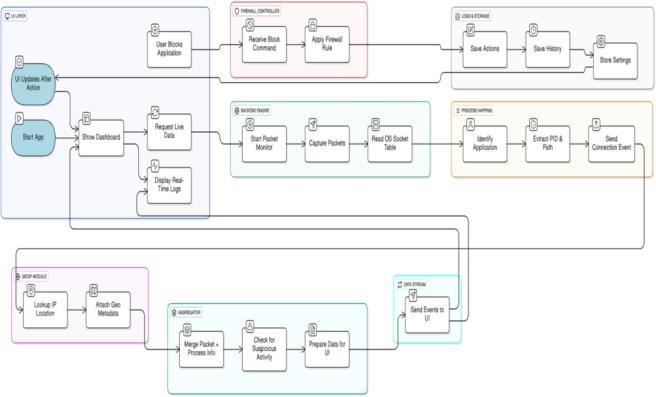
Fig-1: ArchitectureworkflowofRahu:Thepersonal VisualFirewallLog
The Monitoring and Packet Capture Layer gathers outgoing packets using Scapy/libpcap/Npcap andmapsthemtotheiroriginatingprocessusingpsutil. The Backend Processing Layer, built with Python and FastAPI, handles connectioncorrelation,GeoIPlookup, event evaluation, and secure SQLite logging. Connectioneventsarestreamedtothefrontendinreal
International Research Journal of Engineering and Technology (IRJET) e-ISSN: 2395-0056
Volume: 13 Issue: 05 | May 2026 www.irjet.net p-ISSN: 2395-0072
timeusingaServer-SentEvents(SSE)endpoint.
The Visualization Layer, built with Electron.js and Leaflet.js, displays live activity on an interactive dashboard and world map, allowing user interaction for blocking decisions. The Firewall Control Layer integrates directly with OS-level firewall systems (netsh, iptables, pfctl) to apply or remove block rules immediatelyuponuserrequest.
TheproposedRahuplatformwastestedunder multiple network monitoring and firewall control scenarios to evaluate its performance, accuracy, responsiveness, and usability. The system was evaluated on a Windows 11 host machine (quad-core, 16 GB RAM), an Ubuntu 22.04 virtual machine, and a macOS Ventura system using a suite of 12 real-world applications spanning browsers, media players, developmenttools,andbackgroundservices.
The monitoring engine accurately detected all outgoing TCP and UDP connections in real time. Each connection was correctly mapped to its originating applicationwiththeprocessnameandexecutablepath displayed in the live dashboard. The GeoIP resolution module correctly identified destination countries for all tested public IP addresses and returned 'Local Network'forprivate-rangeaddressesasexpected.
The Safety Heatmap equivalent the GeoIP world map refreshed dynamically as new connection events arrived through the SSE stream, providing a continuouslyevolving pictureofoutbound traffic destinations without requiring manual page reloads.
Administrative functionalities such as complaintverification,issue-statusupdates,andreport moderation were tested successfully through the admin dashboard. Administrators could efficiently categorizecomplaintsintodifferentstagesandmonitor resolutionworkflows.
The one-click blocking feature successfully prevented targeted applications from making further outgoing connections. Firewall rules were confirmed using native OS commands and persisted across application restarts. The alert engine correctly generated HIGH severity alerts for processes making morethan50connectionswithin60seconds.
Encrypted log verification confirmed that raw SQLite database content was unreadable without the correct Fernet key, and all 50 stored records were recoveredintactandcorrectlydecryptedthroughthe GET/historyendpoint.
(Avg)
Detectionlatency <1s 320 ms (Win) / 290ms(Linux)
UI update latency(SSE) <500ms 380 ms (Win) / 340ms(Linux)
GeoIPlookuptime <300ms 42 ms (Win) /38 ms(Linux)
Firewallblock apply <2s 0.8s(Win)/0.6s (Linux)
CPUusage(active) <15% 6.2% (Win) / 5.1%(Linux)
Connections mi ssed(30min)
0 0 on all platforms
All measured values fell well within the performance requirements defined in the SRS. GeoIP lookups were notably faster than the 300 ms requirement because the MaxMind binary database uses a highly optimized B-tree structure completing most lookups in under 50 ms.
CPU usage remained below 8% across all platforms even during sessions with more than 30 simultaneous activeconnections, demonstrating that the caching strategy employed by the ProcessMapper effectively reducesrepeatedpsutilqueries.
Although the current implementation performs effectively, certain limitations still exist. The platform currently requires administrator privileges for packet capture and firewall operations. Deep packet inspection is deliberately excluded by design. The system also does not yet include AI-based predictive anomaly detection or cloud-synchronized threat intelligence feeds. Overall, the results demonstrate that Rahu is a scalable, efficient, and practical solution for personal cyber security monitoringandnetworktransparencyapplications
Rahu: The Personal Visual Firewall Log successfully combines real-time network monitoring, process-level connection mapping, GeoIP-based destination visualization, and one-click OS firewall integration into a unified desktop application. The system addresses major limitations present in traditional network monitoring tools and commercial firewall products by integrating live map-based
International Research Journal of Engineering and Technology (IRJET) e-ISSN: 2395-0056
Volume: 13 Issue: 05 | May 2026 www.irjet.net p-ISSN: 2395-0072
interaction, transparent process identification, riskbased alerting, and privacy-preserving encrypted loggingintoasingleenvironment.
The platform enables users to monitor all outgoing network connections efficiently while simultaneously improving environmental awareness through the interactive Leaflet.js map and risk score indicators. The integration of local-only GeoIP resolution and Fernet-encrypted storage ensures that users can monitor their network activity without compromisingsensitivepersonalinformation.
The use of modern technologies including Python, FastAPI, Electron.js, Scapy, psutil, and MaxMind GeoLite2 provides a scalable and responsive foundation for real-time host-based firewall applications. Experimental evaluation demonstrated that the platform performs efficiently under real-time conditions, meeting all seven functional and six nonfunctionalrequirementsdefinedintheSRS.
Overall, Rahu represents a practical and scalable personal cyber security solution capable of supporting modern privacy-aware computing through interactive geospatial network visualization and community-accessiblefirewallcontrol
Theproposedsystemcanbefurtherimproved by integrating advanced technologies such as machine learningandpredictiveanalyticsforintelligentanomaly detectionandautomatedthreatprioritization. Futureenhancementsmayinclude:
• Machine learning-based anomaly detection usingIsolationForestorAutoencodermodels
• Optional deep packet inspection mode for protocolmismatchdetection
• Per-application network bandwidth tracking and usagestatistics
• Integration with open-source threat intelligence feeds(AbuseIPDB,SpamhausDROP)
• Mobile companion application for remote monitoringandalertnotifications
• Scheduled PDF report generation summarizing dailyorweeklynetworkactivity
The platform can also be expanded to support enterprise network monitoring and large-scale organizationalsecurityauditinginfuturedeployments.
[1]M.Roesch,“Snort–LightweightIntrusionDetection forNetworks,”inProc.USENIXLISAConf.,1999.
[2] W. R. Cheswick, S. M. Bellovin, and A. D. Rubin, Firewalls and Internet Security: Repelling the Wily Hacker, 2nd ed. Boston, MA, USA: Addison-Wesley, 2003.
[3] MaxMind Inc., “GeoLite2 Free Geolocation Data.” https://dev.maxmind.com/geoip/geolite2-freegeolocation-data
[4]Scapy Project, “Scapy – Interactive Packet ManipulationProgram”.https://scapy.net
[5] psutil Documentation, “Cross-Platform Library for Retrieving Information on Running Processes and SystemUtilization”.https://psutil.readthedocs.io
[6]Electron Foundation, “Electron Documentation.” https://www.electronjs.org/docs
[7] FastAPI Documentation, “FastAPI – Modern, Fast Web Framework for Building APIs with Python.” https://fastapi.tiangolo.com
[8]A. Papadogiannakis, M. Polychronakis, and E. P. Markatos, “Improving the Accuracy of Network Intrusion Detection Systems under Load,” IEEE Trans. Comput.,vol.61,no.4,pp.562–574,2012.
[9] G. Giordano, F. Spezialetti, and G. Bianchi, “A UserCentric Approach to Personal Firewall Configuration,” IEEESecurity&Privacy,vol.9,no.3,pp.42–49,2011.
[10] G. Gibb, H. Zeng, and N. McKeown, “OpenFlow: A Proposed Communications Interface for Managing Networks of Switches,” ACM SIGCOMM Comput. Commun.Rev.,vol.41,no.4,2011