International Research Journal of Engineering and Technology (IRJET)
e-ISSN: 2395-0056
Volume: 13 Issue: 05 | May 2026
p-ISSN: 2395-0072
www.irjet.net
Process Simulation and Optimization of CO2 Capture Using Amine Absorption Apoorva Soni1, Dr. Nitesh Parmar1* 1 Student, Department of Chemical Engineering, IPS Academy, Institute of Engineering and science, Indore,
Madhya Pradesh
2 Professor, Department of Chemical Engineering, IPS Academy, Institute of Engineering and science, Indore,
Madhya Pradesh ---------------------------------------------------------------------***--------------------------------------------------------------------Key Words: Carbon Capture, Optimization, Aspen Hysys Abstract - The study investigates the post-combustion Simulation, Amine Absorption, absorber-stripper optimization, reboiler duty, thermodynamic modeling
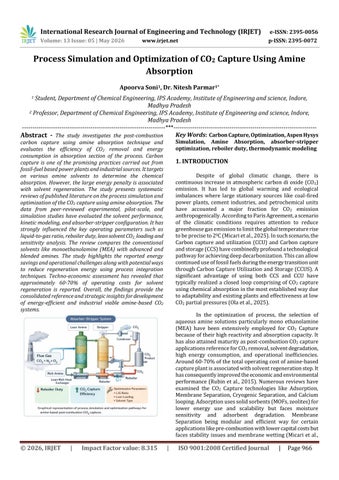
carbon capture using amine absorption technique and evaluates the efficiency of CO2 removal and energy consumption in absorption section of the process. Carbon capture is one of the promising practices carried out from fossil-fuel based power plants and industrial sources. It targets on various amine solvents to determine the chemical absorption. However, the large energy penalty is associated with solvent regeneration. The study presents systematic reviews of published literature on the process simulation and optimization of the CO2 capture using amine absorption. The data from peer-reviewed experimental, pilot-scale, and simulation studies have evaluated the solvent performance, kinetic modeling, and absorber-stripper configuration. It has strongly influenced the key operating parameters such as liquid-to-gas ratio, reboiler duty, lean solvent CO2_ loading and sensitivity analysis. The review compares the conventional solvents like monoethanolamine (MEA) with advanced and blended amines. The study highlights the reported energy savings and operational challenges along with potential ways to reduce regeneration energy using process integration techniques. Techno-economic assessment has revealed that approximately 60-70% of operating costs for solvent regeneration is reported. Overall, the findings provide the consolidated reference and strategic insights for development of energy-efficient and industrial viable amine-based CO2 systems.
© 2026, IRJET
|
Impact Factor value: 8.315
1. INTRODUCTION Despite of global climatic change, there is continuous increase in atmospheric carbon di oxide (CO 2) emission. It has led to global warming and ecological imbalances where large stationary sources like coal-fired power plants, cement industries, and petrochemical units have accounted a major fraction for CO2 emission anthropogenically. According to Paris Agreement, a scenario of the climatic conditions requires attention to reduce greenhouse gas emission to limit the global temperature rise to be precise to 20C (Micari et al., 2025). In such scenario, the Carbon capture and utilization (CCU) and Carbon capture and storage (CCS) have combinedly profound a technological pathway for achieving deep decarbonization. This can allow continued use of fossil fuels during the energy transition unit through Carbon Capture Utilization and Storage (CCUS). A significant advantage of using both CCS and CCU have typically realized a closed loop comprising of CO2 capture using chemical absorption in the most established way due to adaptability and existing plants and effectiveness at low CO2 partial pressures (Ola et al., 2025). In the optimization of process, the selection of aqueous amine solutions particularly mono ethanolamine (MEA) have been extensively employed for CO2 Capture because of their high reactivity and absorption capacity. It has also attained maturity as post-combustion CO2 capture applications reference for CO2 removal, solvent degradation, high energy consumption, and operational inefficiencies. Around 60-70% of the total operating cost of amine-based capture plant is associated with solvent regeneration step. It has consequently improved the economic and environmental performance (Rubin et al., 2015). Numerous reviews have examined the CO2 Capture technologies like Adsorption, Membrane Separation, Cryogenic Separation, and Calcium looping. Adsorption uses solid sorbents (MOFs, zeolites) for lower energy use and scalability but faces moisture sensitivity and adsorbent degradation. Membrane Separation being modular and efficient way for certain applications like pre-combustion with lower capital costs but faces stability issues and membrane wetting (Micari et al.,
|
ISO 9001:2008 Certified Journal
|
Page 966