
International Research Journal of Engineering and Technology (IRJET) e-ISSN: 2395-0056
Volume: 13 Issue: 04 | Apr 2026 www.irjet.net p-ISSN: 2395-0072

International Research Journal of Engineering and Technology (IRJET) e-ISSN: 2395-0056
Volume: 13 Issue: 04 | Apr 2026 www.irjet.net p-ISSN: 2395-0072
Pavithran M, Nitin B, Praveen Kumar B, Balaji M
UG, Mechanical Engineering Scholar Kumaraguru College of Technology Coimbatore, Tamil Nadu
Associate Professor, Mechanical Engineering Kumaraguru College of Technology Coimbatore, Tamil Nadu
Abstract The coir industry plays a significant role in contributing to sustainable agriculture and economic development in the rural sector, especially in coconutgrowing areas of India. Many of the coir pith manufacturing industries are functioning in a very inefficient manner, resulting in a loss of productivity and increased cost of operations. This research aims at improving the process in a coir pith manufacturing unit by conducting a scientific study of time and motion, layout optimization, and validation through simulation techniques.
An in-depth industrial study was conducted in a reputed coir manufacturing company in Coimbatore. The main aim was to study the existing process of fiber extraction and block manufacturing. Information was gathered regarding machinecycletimes,motorpowerratingsofmachinesused in the production line, daily intake of raw materials, and drying times. For the first process, it was noted that on an average,itwastaking2.15minutes,whereasforthesecond process, it was taking 3.47 minutes. For drying and retting, it was taking 4–5 days. Based on workflow, bottlenecks were identified.
An optimized layout was created with the help of SmartDraw and was validated through simulation using Siemens Tecnomatix[12], which helped in the assessment of the improvement in the efficiency of the material flow and productivity. The new layout has reduced the amount of materialhandling,optimizedtheutilizationoftheavailable space, and increased the safety of the workers, thereby improving the efficiency of the processes. This paper has establishedaframeworkforthelean-basedimprovementin the processes of small- and medium-scale coir industries, which also considers the sustainable practices in the processes.
Keywords Coir Pith, Process Improvement, Lean Manufacturing, Layout Optimization, Time Study, TecnomatixSimulation.
The coir industry has a major role to play in the development of the country’s agro-based economy, especially in the coconut-growing areas of Tamil Nadu,
Kerala,and Karnataka statesinIndia.Coirfiberand coir pith are used in the fields of agriculture, geotextiles, erosion control, horticulture, and composite materials due to their biodegradable properties, high water retention capacity, and suitable mechanical properties [3,6,13]. Despite the growing demand for coir products worldwide, the conventional processing techniques followedinmostofthecoirmanufacturingplantsarestill in the state of traditional or semi-mechanized processes that involve lengthy processing and poor working practices.
Theconventionalcoirfiberprocessingtechniqueinvolves the steps of collection and sorting of husk, washing, retting, drying, defibering, sieving, destoning, grading, andbaling[2,4,5].Ofthetotalprocessingsteps,thesteps of retting and drying take the longest time, usually five days or longer in total processing time. Though the mechanical processing steps of defibering and sieving takeonlya fewminutesinprocessingtherawmaterials, thelackofsynchronizingthestepsofprocessing,thehigh amount of manual handling, and the poor working practices in layout planning contribute to the longer processingtime.
Thecurrent manufacturing systemsstresslean concepts that highlight waste elimination, non-value-added activities reduction, and material flow optimization. Techniquessuchastimeandmotionstudies,ValueStream Mapping,andsimulation-basedlayoutplanning[12]help various industries identify bottlenecks and check improvements virtually before actual implementation. Digital manufacturing techniques such as simulation software like Siemens' Tecnomatix [12] help engineers check the efficiency of workflow, resource optimization, andspaceoptimizationvirtuallywithoutanyrisks.
The present study aims at exploring the manufacturing process of a reputed coir manufacturing company in Coimbatore with the aim of reducing the total lead time andenhancingproductivitythroughprocessanalysisand improvement. By incorporating mechanical
International Research Journal of Engineering and Technology (IRJET) e-ISSN: 2395-0056
Volume: 13 Issue: 04 | Apr 2026 www.irjet.net p-ISSN: 2395-0072
improvementsandleantoolswithsimulationvalidation[ 12], the study aims at transforming a traditionally timeconsuming process into a streamlined process.
The industry involved in the manufacturing of coir pith blocks also has certain operational issues to tackle in ordertoenhanceitsefficiency.Oneofthekeyissuesinthe industry is the long processing time required to manufacturetheblocksduetoinefficientdryingmethods. The drying process also depends on the weather conditions in the region. Most industries are using sun drying methods, which require sufficient open space to accommodatetherawmaterialsfordrying[7].
Anotherkeyissueintheindustryistheinefficientplant layout design, which results in excessive movement of raw materials from one stage to another. Machines are also not arranged in a sequence, resulting in more movementofrawmaterials,whichinturnincreasesthe labor required to move these raw materials.
The lack of synchronization in the washing, drying, sieving, and compression processes also results in bottlenecks in the system. Some machines are left idle, while others are overworked, resulting in an imbalance intheworkflow.
Hence, there is a need to develop a methodology for improving the process to reduce the non-value-added activities in the existing system. This study aims to identify the inefficiencies in the existing system and improve the process using the concept of lean manufacturing[8,9,10,11,12]toincreasetheproductivity rate and reduce the overall production time.
Theobjectiveofthisprojectistoanalyzetheexistingcoir fiberproductionprocessofareputedcoirmanufacturing company in Coimbatore, India, by conducting a detailed time and motion study, and evaluate the factors that influence lead time and productivity. The study aims to identify inefficiencies in the current machine layout and workflow, introduce suitable improvements in the productionprocesstoimproveefficiency,minimizewaste, and improve quality, benchmark best practices from globalcoir-producingregionsforadaptationinIndia,and finallydevelopanoptimizedproduction process.Layout,
andanenhancedconceptofmachinestoreduceleadtime, enhanceworkersafety,increaseprofitability,and ensure long-term sustainable growth in the coir industry. Moreover,theprojectalsofocusesonimprovingtheuseof resources and reducing non-value-added activities through the application of the principles of lean manufacturing. The aim is to transform the traditional manufacturing process into a more streamlined, competitive, and sustainable manufacturing process.
Theproductionofcoirproductsbeginswiththecollection of coconut husks obtained from coconut farms and markets.Thesecoconuthusksarethenfedintoahopper. Aconveyorbeltisusedtomovethecoconuthusksintoa machine used for defibering. During this step, long and shortfibersareseparated.Thisisdoneusingamechanical screener and a siever. These two machines help in the separationofshortandlongfibers.
Theobtainedlongfibersareprocessedfurther.Rettingis doneto removeexcessmoisture.Excessmoistureisalso removed using a dryer. Beating is also done to make the fibers flexible. Grading is done according to length and color. Finally, the obtained grade-one fibers are compressedusingahydraulicbalingpress.
1. Collectionofcoconuthusk
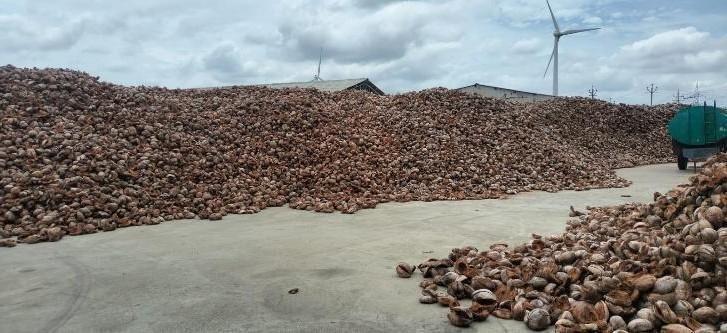
Fig4.1:
Theprocessstartswiththecollectionofmaturecoconut husks as shown in fig 4.1 from the coconut farms and processingunits.Itisnecessarytochoosetherightones becausethequalityofthefiberdependsonthematurity and condition of the husk. After collecting the matured husk,theyaretransportedtothemanufacturingunit.
International Research Journal of Engineering and Technology (IRJET) e-ISSN: 2395-0056
Volume: 13 Issue: 04 | Apr 2026 www.irjet.net p-ISSN: 2395-0072
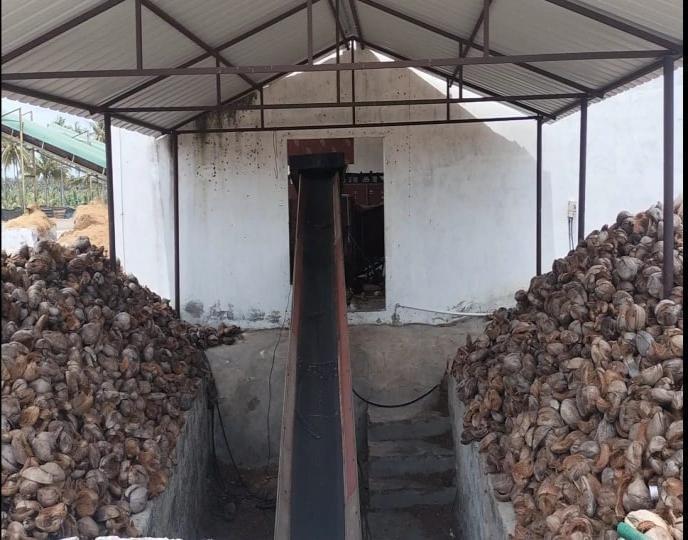
Fig 4.2: Hopper
Thecoconuthusksobtainedaremanuallyloadedandpushed into a large open hopper located at the initial stage of the processingline,asdepictedinfig4.2.Fromthishopper,the coconut husks are gradually fed into the processing system usingaconveyormachine
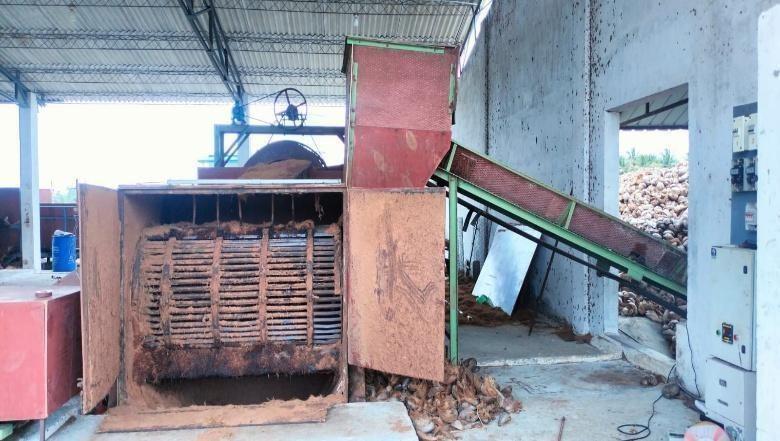
Fig 4.3: Conveyor
The conveyor ensures the free flow of materials and controlledfeedingasdepictedinFig.4.3.
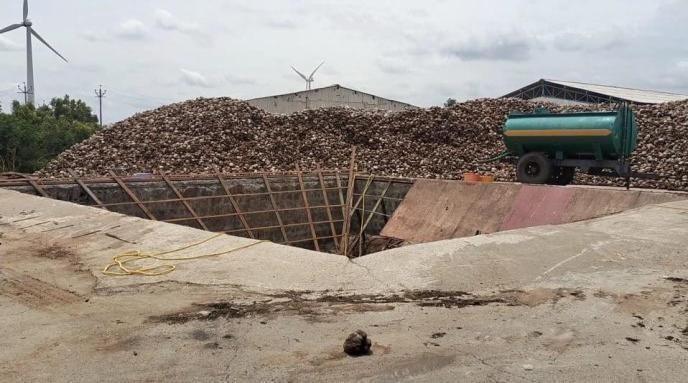
Fig4.4:Defiberingmachine
Themechanicalseparationoflongfibersfromthehuskis termed Defibering. Defibering is an important factor in determining the quality of fibers. The retted and dried husks are subjected to a machine called Defibering or Decorticator as depicted in Fig. 4.4. The rotating blades separatelongcoirfibersfromcoirpith(dust).Thisisone of the most critical mechanical operations in the entire coirprocessing.
4.Siever
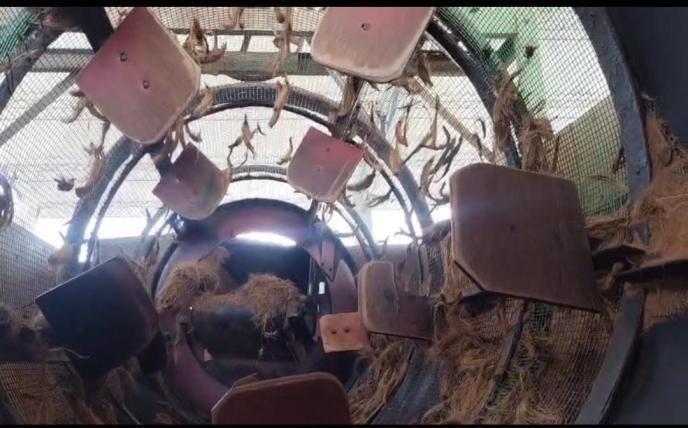
Fig 4.5: Seivering machine
Themixtureoffibersandpith,afterdefibering,issieved orpassedthroughvibratingscreensasdepictedinfig4.5. Duringsieving,longfibersareseparatedfromshortfibers andpith.Thisprocessensurespropergradingaswellas thequalityofbothcoirfibersandcoirpith.
International Research Journal of Engineering and Technology (IRJET) e-ISSN: 2395-0056
Volume: 13 Issue: 04 | Apr 2026 www.irjet.net p-ISSN: 2395-0072
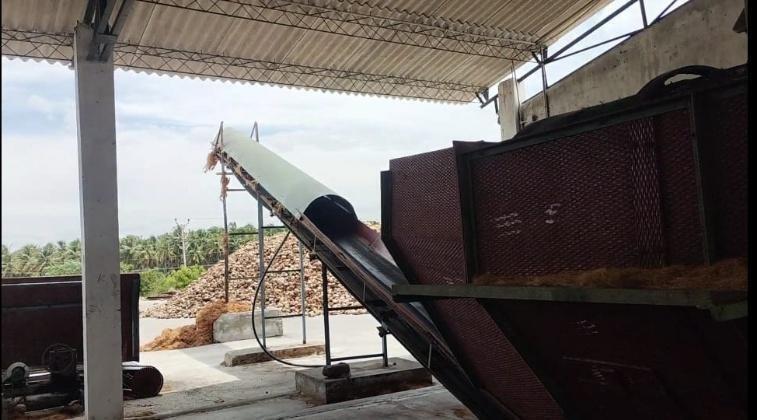
Aftersieving,classificationoffibersisdoneonthebasisof their lengths and quality. Shorter and relatively lowergradefibers,afterthisstage,areclassifiedasthird-grade fibers, as depicted in fig 4.6. These fibers are used for mattress filling, rope manufacturing, cushioning, etc., where high tensile strength is not a requirement. Thirdgradefibersaredepictedinfig4.7.
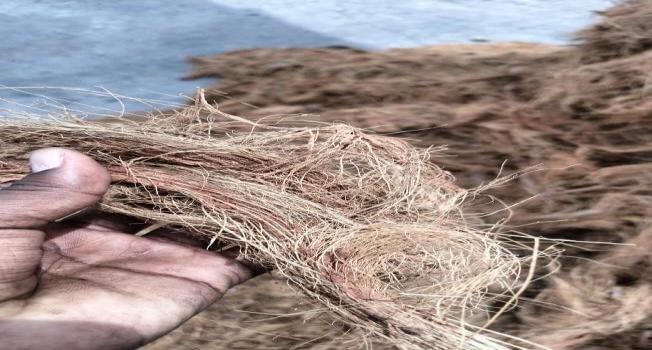
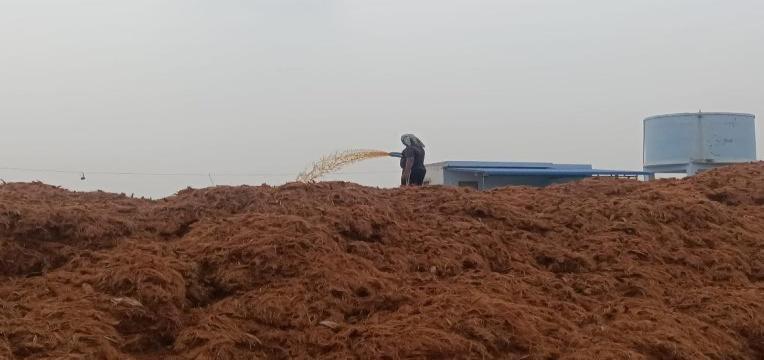
The collected third-grade fiber is temporarily stored beforeretting and drying [1,15]asshownin fig 4.8.Itis vitaltomaintainthemoisturelevelintheprocesstoavoid the formation of fungi. This process is referred to as storagemanagement.
Intheconventionalprocess,thefibersarekeptinanopen areaforsundryingandretting.Thisprocessisweatherdependent and may require 4-5 days. This is the most time-consumingprocessintheentireproductionprocess and contributes almost 99% of the total lead time. Inconsistent sun exposure may cause uneven moisture removal.
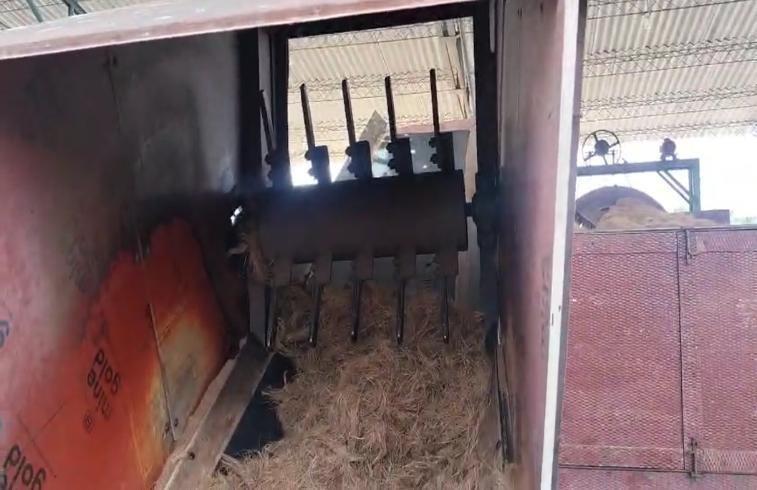
After the process of drying and retting, the third-grade fiber is subjected to secondary processing in order to enhancethequalityofthefiber.Afterthemoisturecontent isreducedandthefiberbecomessofterinstructure,the processof redefiberingand cleaningiscarriedoutagain asshowninfig4.9.
Furtherbeatingandsievingofthefibersarecarriedoutin order to remove the pith and other unwanted materials. This process of reprocessing the third-grade fibers is carriedoutaftertherettinganddryingprocessinorderto improve the usage of the materials and minimize the waste generated in the process. This process upgrades someof thethird-grade fibersintofirst-gradefibersand is then directed towards the hydraulic compression processfortheformationofblocks.
International Research Journal of Engineering and Technology (IRJET) e-ISSN: 2395-0056
Volume: 13 Issue: 04 | Apr 2026 www.irjet.net p-ISSN: 2395-0072
8. Collection of first grade coir fiber
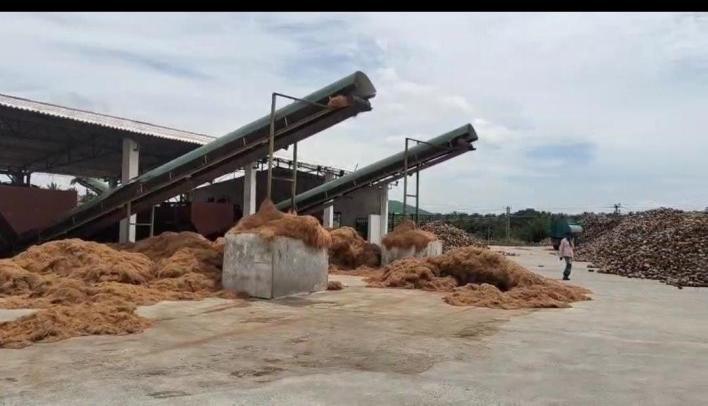
Fig4.10: collection of first grade fiber
Thefibersobtainedthroughdefiberingandsievingareof high length and quality and are termed first-grade coir fibers, as depicted in fig 4.10. These fibers are of high qualityandstrength.Theyareseparatedandcollectedto meetpremiumqualityrequirementsforexportandblock manufacture.
9.Hydraulic compressing of the first-grade fiber
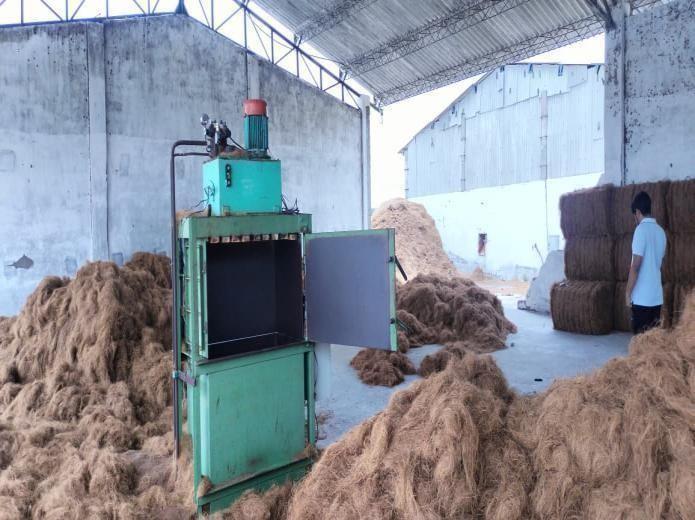
Fig 4.11: Hydraulic compressing of the first-grade fiber
Thefirst-gradefibersarefedintoahydrauliccompression machine,asdepictedinfig4.11,forblockformation.Highpressurecompressionisusedtocompressthefibers,thus reducing their volume and creating compact blocks for easytransportationandexport.
The high-pressure compression ensures that all blocks areofuniformweight,about30kgeach.
10. Fiber block
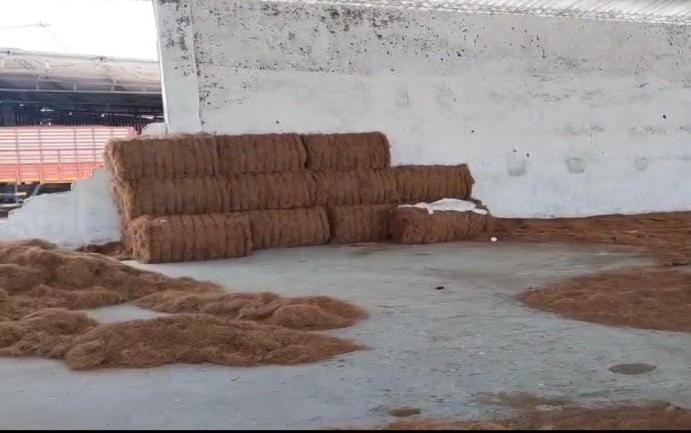
Fig4.12:fiberblocks
Thefinalproductisintheformofcompressedfiberblocks as in fig 4.12. These blocks are packed and sent for dispatchtolocal/international markets. The fiberblocks have various applications in horticulture, geotextiles, erosion control, and agriculture because they are biodegradable and have high water retention capacity [6,14].
Themethodologyusedconsistedofconductingastudyof the existing process flow, obtaining operational information, conducting time analysis, and conducting moistureabsorptionanalysis.Theexistingmachinelayout wasstudied,andareasofinefficiencywerenoted.Anew layout was designed using smart draw and technomatix simens software to optimize the layout for smoother materialflowandtoreduceleadtimes[12].
1. ProcessBottleneckidentification:
The time and motion study conducted on the existing process flow revealed that the major bottle necks were associated with the drying process, retting process, and thetransferbetweenthefirstandsecondprocess.These werecausingunnecessarydelaysduetomanualhandling andnon-linearlayoutarrangements.Inaddition,thelong retting time of 4 to 5 days contributed to longer lead times.
International Research Journal of Engineering and Technology (IRJET) e-ISSN: 2395-0056
Volume: 13 Issue: 04 | Apr 2026 www.irjet.net p-ISSN: 2395-0072
Theindustryprocessesaround60,000husksineachshift, with a daily intake of 1,00,000 husks. The first process usesa45HPmotor,whereasthesecondprocessusesa25 HPmotor.Thecostincurredoneachhuskrangesbetween ₹3-5,whereasthecostincurredoneachfiberblockranges between₹500-600, with eachblock weighingaround 30 kg.
Thetimeanalysisshowedthatthefirstprocesstook2.15 minutes, whereas drying and retting took 4-5 days, and thesecondprocesstook3.47minutes.Themoistureand temperature analysis showed the key quality factors affectingthegradeofthefiber.
The detailed lead time analysis showed that the mechanical processing took only 5.62 minutes in total, whereasdryingtookaround7,200minutesor120hours. Thisshowsthataround99.92%ofthetotalleadtimewas spentonthedryingprocess.
The present layout was designed using smartdraw softwareasshowninfig5.1.Tochecktheeffectivenessof the designed layout, simulation was done using siemens tecnomatixasshowninfig5.2andfig5.3[12].
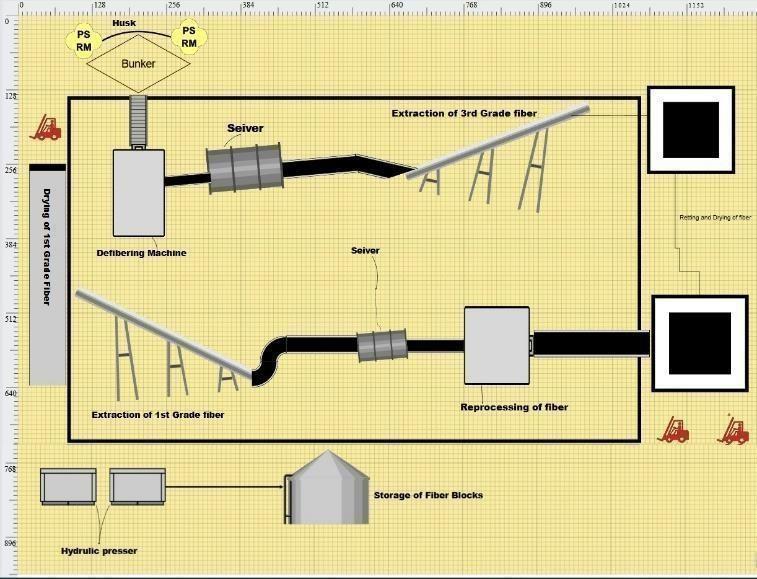
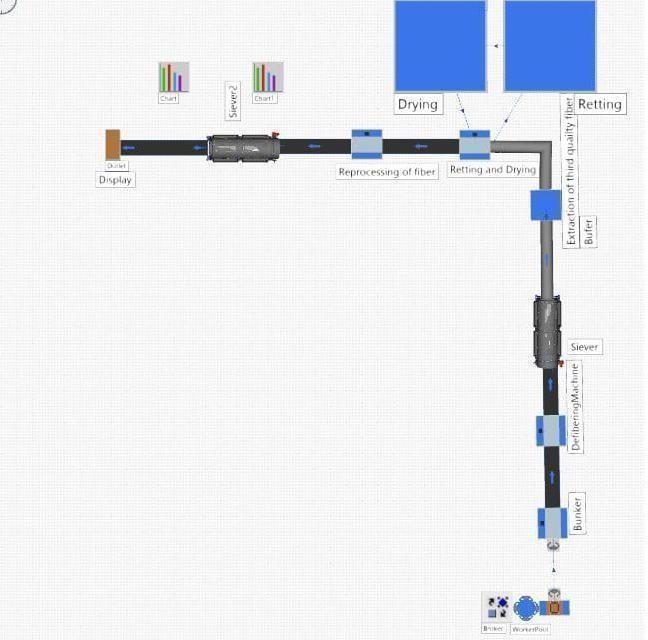
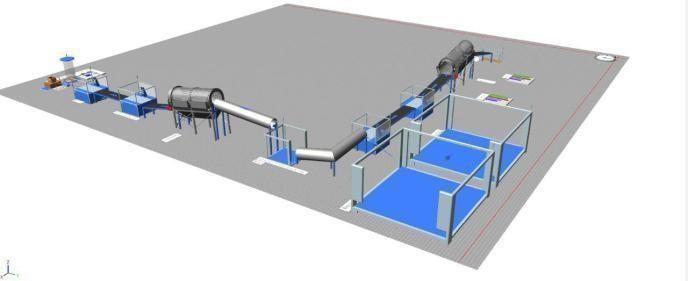
Table5.1:TimeAnalysisSummary(currentlayout)
Process Time
Duration
Remarks
FirstProcess 2.15min Fiberextraction
Drying&Retting 4–5days Majorbottleneck
SecondProcess 3.47min Finalprocessing
International Research Journal of Engineering and Technology (IRJET) e-ISSN: 2395-0056
Volume: 13 Issue: 04 | Apr 2026 www.irjet.net p-ISSN: 2395-0072
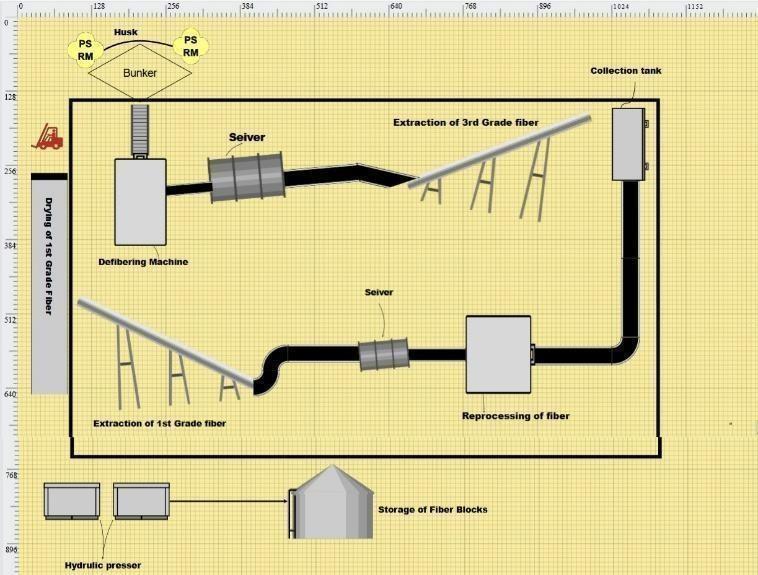
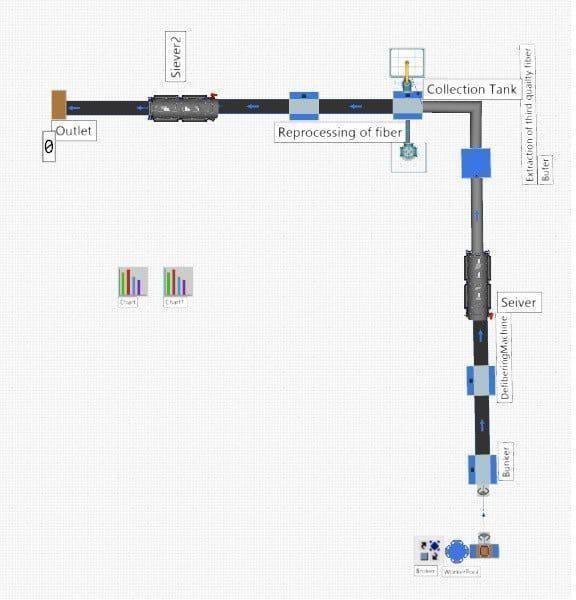
Based on the identified problem areas in the existing system,anewoptimizedmachinelayouthasbeencreated using the SmartDraw software as shown in fig 5.4. This new layout has been created in such a way that the processes are arranged sequentially, and the materials canbemovedmoresmoothlybetweentheprocesses.
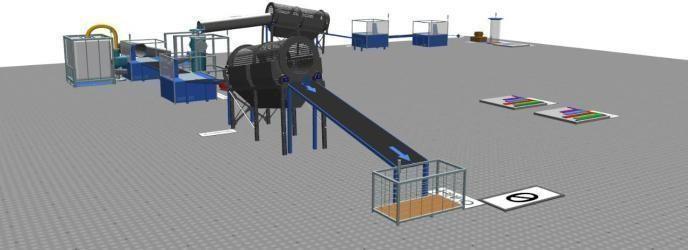
Totesttheeffectivenessofthenewlayoutcreatedinthe existingsystem,thesimulationhasbeencarriedoutusing theSiemensTecnomatixsoftwareasshowninfig5.5and fig5.6.Byusingtheabove-mentionedtoolsandmethods, the effectiveness ofthe existingandnew systemscan be testedintermsoftimeefficiency[12].
Theproposedlayoutandimprovementstrategyhavebeen documented and presented to the industry for future implementation. This methodology ensures that the improvements recommended are feasible and beneficial in terms of cost and other factors for future industrial applications[12].
Process Time Duration
Remarks
FirstProcess 2.15min Fiberextraction
Drying&Retting 7–10min Major bottleneck(solved)
SecondProcess 3.47min Finalprocessing
Toachievethis,anoptimizedlayouthasbeenproposedusing SmartDrawandsimulatedusingSiemensTecnomatix[12].
The optimized layout has achieved reductions in materialhandlingdistances,idletime,andsynchronization. In addition, the proposed hot air rotating drum dryer has
International Research Journal of Engineering and Technology (IRJET) e-ISSN: 2395-0056
Volume: 13 Issue: 04 | Apr 2026 www.irjet.net p-ISSN: 2395-0072
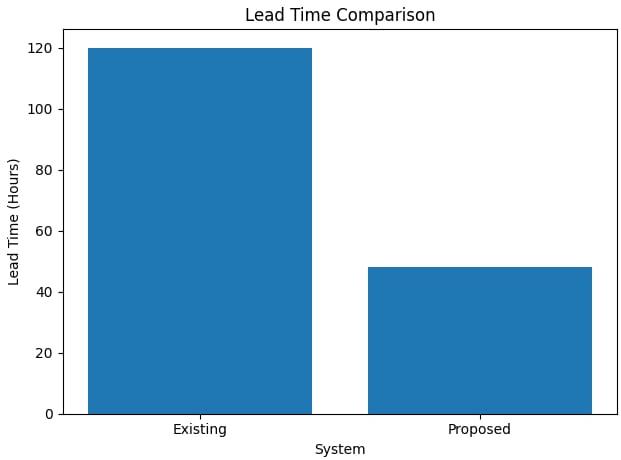
replacedsundrying.Ifthetimetakenfordryingisreduced from 5 days (120 hours) to 2 days (48 hours), then the improvementintimetakenfordryingiscalculatedas:
Performance Enhancement Analysis
PercentageImprovement=((OldTime NewTime)/Old Time)×100
=((120−48)/120)×100 =60%
Ifoptimizedfurtherto36hours,improvementbecomes:
=((120−36)/120)×100 =70%
Thus, drying time reduction ranges between 60–70%, dependingonoperatingconditions.
Throughput Improvement Calculation
I. ExistingSystem:
Dryingtime=5days
Batchesper5days=1
If150blocksaredispatchedperbatch:
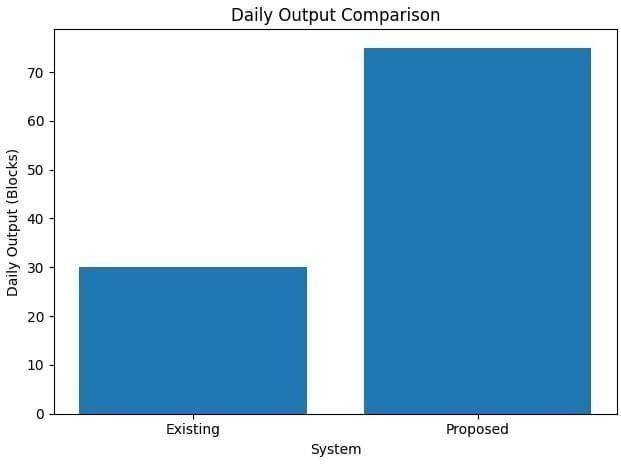
Throughputperday=150/5=30blocks
II. ProposedSystem:
Dryingtime=2days
Batchesper5days=2.5batches
Totalblocksin5days=150×2.5=375blocks
Throughputperday=375/5=75blocks/day
Layout Efficiency Improvement
SimulationresultsfromSiemensTecnomatixindicated:
• 25–30%reductioninmachineidletime
• 20–25%reductionininternalmaterial handlingmovement
• Improvedworkersafetyduetoreducedcongestion
• Morelinearmaterialflow
Overall Productivity Improvement
Considering:
• 60%reductionindryingtime
• 150%increaseinthroughput
• 25%reductioninidletime
• 20%reductioninhandlingwaste
Theoverall productivity improvement is estimated between 40–65%, depending on plant operating conditions.
From the below graphs as shown in fig 6.1, 6.2, 6.3, improvementsindryingtime,leadtime,anddailyoutput are more significant than that of the existing. “The implementation of layout optimization and mechanical improvementsachievedasignificantreductioninoverall leadtime.Whiletraditionalsystemsrequiredfivetoeight days to complete the entire production cycle, the redesignedworkflowreducedthenumberofmechanical extraction stages to within a single working shift. Simulation results revealed smoother flow of materials, elimination ofcongestionpoints, and a better balancein theflowofsuccessivestagesoftheprocess.”
The optimized feeding system has minimized machine idle times. There was a significant improvement in the moisture control of fibers, resulting in a lower rate of rejection in grading. There was a reduction in internal transportation distance, thus minimizing labor and enhancingworkersafety.Therewasasignificantincrease in productivity due to a better synchronization of operationsandareductioninnon-value-addedactivities.
In terms of sustainability, the optimized system reduced water usage, minimized rework, and improved energy utilization. By using the lean principles and simulation validation, the manufacturing process has moved away from the traditional time-consuming process and into a morestreamlinedandscalableprocess.
International Research Journal of Engineering and Technology (IRJET) e-ISSN: 2395-0056
Volume: 13 Issue: 04 | Apr 2026 www.irjet.net p-ISSN: 2395-0072
This research proves the potential for significant improvement in the efficiency of the coir fiber and pith manufacturing process through systematic process improvement using time analysis, lean principles, mechanical optimization, and simulation-based layout validation. The integration of the optimized feeding mechanisms, buster design, sieving operations, and workflowimprovementsresultedinthereductionofthe total lead time and the increase in the overall plant productivity.
The use of digital validation by Siemens Tecnomatix ensured the technical viability of the improvements before actual implementation. The proposed framework outlinestheroadmapforthemodernizationof thesmall and medium-scale coir industries, making it sustainable andeconomicallyviable.Futureimprovementscouldalso include the use of sensor-based automation, real-time moisturecontrol,andadvanceddryingtechnologies.
Thescopeoffurtherresearchinthefuturewouldbethe improvement of the efficiency and sustainability of the coir pith production process through the integration of modern automation systems and smart monitoring systems in the production process [1,15]. Moreover, the adoption of enzyme retting and mechanical retting can improve the overall lead time of the production process. Inaddition,theadoptionofcontrolledmechanicaldryers can reduce the weather dependence of the production process. In the future, the scope of further research can also include the economic feasibility analysis of the productionprocessand the developmentofvalue-added productssuchasbiofertilizersandbiocomposites.
1. Fernando,J.A.K.M.&Amarasinghe,A.D.U.S.– Effects of retting and drying on quality of coir pith and coco discs, JournaloftheNationalScienceFoundationof Sri Lanka, 2017 (quality of coir pith & drying techniques).
2. Jose, Stephy & Beevi, Sajeena B. – Optimization of ultrasonication assisted alkaline delignification of coir pith using response surface methodology, Bioresource Technology Reports, 2023 (chemical processingofcoirpith).
3. Chemical treatments of coir pith: Morphology, chemicalcomposition,thermalandwaterretention behavior, Composites Part B: Engineering, 2014 (coirpithtreatmenteffects).
4. Review of Coir Pith as Agro-industrial Waste: Environmental Challenges and Management Approaches, Journal of Agriculture and Ecology Research International, 2025 (coir pith waste management&sustainability).
5. Optimization of Particle Size Distribution of Coco Pith, Asian Journal of Agriculture and Husbandry Research, 2024 (influenceof processing factors on coirpithparticledistribution).
6. Coir-Pith Export Report – Coir Board India (technicalpropertiesandusesofcoirpith).
7. Process Improvement using Drying Technique in Coir Pith Industry – IRJET, April 2025 (process improvement & drying inefficiencies in coir pith blockproduction).
8. Implementation of Lean Manufacturing Tools on a Coir Product Manufacturing Industry – IJSET, 2017 (useofleantoolslikeVSM,Kaizentoreducewastein coirmanufacturing).
9. Lean Manufacturing and Process Optimization: Enhancing Efficiency in Modern Production, International Journal of Scientific Research in Computer Science Engineering and IT, 2024 (lean principlesforimprovingmanufacturingefficiency).
International Research Journal of Engineering and Technology (IRJET) e-ISSN: 2395-0056
Volume: 13 Issue: 04 | Apr 2026 www.irjet.net p-ISSN: 2395-0072
10. Productivity Improvement of an Industry by Implementing Lean Manufacturing Principles,RROIJ Journal(casestudyonleaninsmallindustries).
11. ExaminingtheRoleofProcessImprovementandLean Six Sigma on Quality Performance,DecisionMaking: ApplicationsinManagementandEngineering,2025 (leansixsigmaimpactonproductionquality).
12. Lean Optimization Techniques for Improvement of Production Flows,MDPIProcesses,2022(leantools appliedinproductionflowoptimization).
13. A state-of-the-art review on coir fiber-reinforced biocomposites, RSC Advances (review of coir fiber extraction,rettingandapplications).
14. Design and Fabrication of Coir Pith Briquetting Machine, IJREAM (briquetting & utilization of coir pith).
15. Effectsofrettinganddryingoncoirpithquality (flash drying method alternative), existing research abstract.