
International Research Journal of Engineering and Technology (IRJET) e-ISSN: 2395-0056
Volume: 13 Issue: 04 | Apr 2026 www.irjet.net p-ISSN: 2395-0072
International Research Journal of Engineering and Technology (IRJET) e-ISSN: 2395-0056
Volume: 13 Issue: 04 | Apr 2026 www.irjet.net p-ISSN: 2395-0072
Dr. L. Rasikannan
1 , B.
Priyanka
2 , M.
Murugeswari
3 , S.
Saranya
4 , P.
Yazhini
5
1Associate Professor, Department of CSE, Government College of Engineering, Srirangam, Tamilnadu, India 2,3,4,5UG student, Department of CSE, Government College of Engineering, Srirangam, Tamilnadu, India
Abstract - Electric Vehicles (EVs) rely on lithium-ion batteries as their primary energy source, making battery health monitoring a critical aspect of vehicle performance, safety, and longevity. Conventional battery management systemsarelimitedtothreshold-basedmonitoringandfailto providepredictiveinsightsintopotential failures.Thispaper proposes a machine learning-based predictive maintenance framework for EV battery health analysis using a Random Forest classifier. The system integrates battery dataset acquisition, preprocessing, feature selection, and classification to detect early-stage faults and categorize battery conditions into normal, warning, and critical states. KeyparameterssuchasStateofCharge(SOC),StateofHealth (SOH), temperature, voltage, and current are utilized for prediction. The proposed model enhances fault detection accuracy and enables proactive maintenance through automatedemailalerts.Furthermore,aStreamlit-basedweb dashboard provides real-time visualization and user interaction. Experimental results demonstrate that the proposed approach significantly improves prediction accuracyandreducestheriskof unexpected battery failures, therebyenhancingthereliabilityandefficiencyofEVsystems.
Keywords: Electric Vehicles, Battery Health Monitoring, Predictive Maintenance, Random Forest, Fault Detection, Streamlit, Machine Learning
The global transition towards sustainable and ecofriendly transportation has significantly accelerated the adoption of Electric Vehicles (EVs) in recent years. As governments and industries aim to reduce carbon emissions and dependency on fossil fuels, EVs have emerged as a promising alternative to conventional internalcombustionenginevehicles.AtthecoreofeveryEV lies the lithium-ion battery, which plays a crucial role in determining the vehicle’s performance, efficiency, safety, andoveralllifespan.
Despite the rapid advancements in battery technology, battery degradation remains a major challenge in EV systems. The performance of lithium-ion batteries is influenced by multiple factors such as charging cycles, temperature variations, depth of discharge, and current
fluctuations. Over time, these factors lead to capacity fading, internal resistance increase, and eventual battery failure. Therefore, accurate monitoring and timely prediction of battery health have become essential to ensurereliabilityandpreventunexpectedbreakdowns.
Traditional Battery Management Systems (BMS) are primarily designed to monitor basic parameters such as voltage, current, and temperature. These systems rely on predefined threshold values to detect abnormalities. However, such rule-based approaches are reactive in nature and fail to provide early warnings about potential failures. As a result, faults are often detected only after significant degradation has occurred, leading to reduced battery lifespan, increased maintenance costs, and potentialsafetyrisks.
Inrecentyears,theemergenceofdata-driventechniques and machine learning has opened new possibilities for predictive maintenance in EV systems. Machine learning models have the ability to analyze large volumes of historicalandreal-timedata,identifyhiddenpatterns,and makeintelligentpredictionsaboutfuturesystembehavior. These capabilities make them highly suitable for battery health monitoring applications, where the relationship betweenparametersiscomplexandnonlinear.
To address these challenges, this paper proposes a predictive maintenance framework for EV battery health monitoringusingaRandomForest-basedmachinelearning model.RandomForest,anensemblelearningtechnique,is known for its high accuracy, robustness, and ability to handle high-dimensional data. By combining multiple decision trees, it reduces overfitting and improves generalization performance. The proposed system integrates multiple modules, including data acquisition, preprocessing,featureselection,faultprediction,andalert generation.KeybatteryparameterssuchasStateofCharge (SOC), State of Health (SOH), temperature, voltage, and current are analysed to classify battery conditions into normal, warning, and critical states. In addition, an automatedemailalertmechanismisincorporatedtonotify
International Research Journal of Engineering and Technology (IRJET) e-ISSN: 2395-0056
Volume: 13 Issue: 04 | Apr 2026 www.irjet.net p-ISSN: 2395-0072
administrators when critical conditions are detected, enablingtimelyintervention.
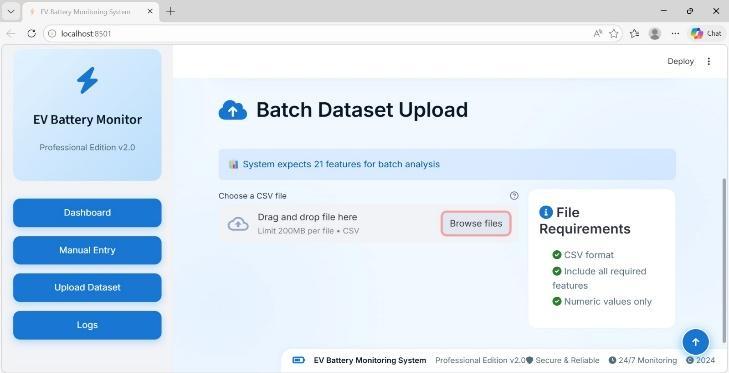
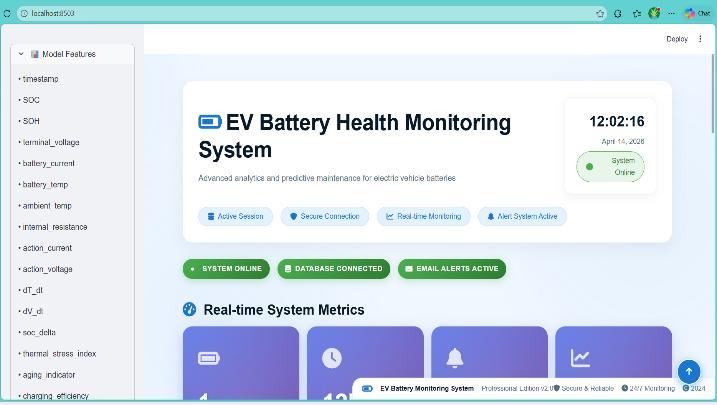
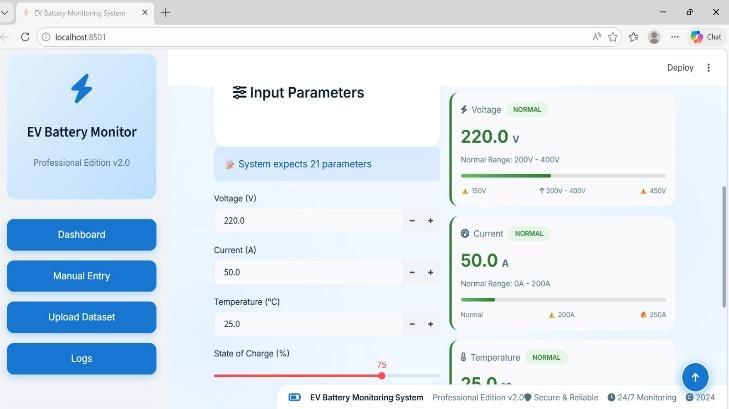
Furthermore, a Streamlit-based web dashboard is developed to provide real-time visualization and user interaction.Thedashboardallowsuserstouploaddatasets, inputparametersmanually,andviewpredictionresultsin an intuitive manner. This enhances the usability and practicalapplicabilityofthesysteminreal-worldscenarios.
The main objective of this research is to develop an intelligent and scalable system capable of predicting batteryfaultsatanearlystage,therebyimprovingbattery lifespan, reducing maintenance costs, and ensuring operational safety. By integrating machine learning with real-timemonitoring and alertmechanisms, the proposed systemcontributestotheadvancementofsmartEVbattery managementsolutions.
The remainder of this paper is organized as follows: Section 2 presents the related work in battery health prediction. Section 3 describes the proposed system architecture and methodology. Section 4 discusses the experimental evaluation and results. Finally, Section 5 concludes the paper and outlines future research directions.
Researchers Battery health monitoring and predictivemaintenancehavegainedsignificantattentionin recent years due to the rapid growth of Electric Vehicles (EVs).Variousresearcheffortshavebeenmadetoestimate battery degradation and predict failures using both traditionalanddata-drivenapproaches.
Early studies primarily relied on electrochemical models and equivalent circuit models, which require precise domain knowledge and are computationally expensive. These models, although accurate, are not scalableforreal-timeapplicationsduetotheircomplexity.
With the advancement of machine learning, researchers have explored regression-based and classification-based techniques for battery health prediction.Linearregressionandsupportvectormachines (SVM)havebeenusedtoestimateStateofHealth(SOH),but these models often fail to capture nonlinear relationships presentinbatterydata.
Deep learning approaches such as Long ShortTerm Memory (LSTM) and Recurrent Neural Networks (RNN) have demonstrated strong performance in modelling time-series battery data. These models can capture temporal dependencies and degradation trends.
However,theyrequirelargedatasets,longertrainingtimes, and high computational resources, which limit their practicaldeploymentinreal-timesystems.
Recent studies have also investigated hybrid models thatcombinestatisticalandmachinelearningtechniquesto improve prediction accuracy. While these approaches providebetterresults,theyincreasesystemcomplexityand are difficult to implement in lightweight environments. Ensemble learning methods, particularly Random Forest, haveshownpromisingresultsinclassificationtasksdueto their ability to handle high-dimensional data and reduce overfitting. Random Forest models are less sensitive to noise and provide stable predictions compared to single models.
However, most existing works focus only on prediction accuracy and lack integration with real-time monitoring systems, automated alert mechanisms, and user-friendlyinterfaces.Thereisacleargapindeveloping acompletesystemthatcombinesprediction,visualization, and alerting. To overcome these limitations, this paper proposes a comprehensive predictive maintenance framework that integrates Random Forest-based classification with real-time alert generation and an interactivedashboardforEVbatteryhealthmonitoring.
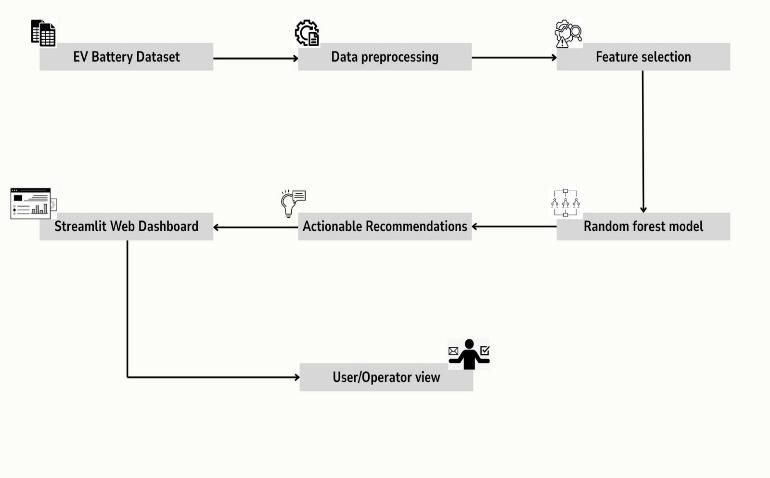
The proposed system is designed as a modular and scalable framework that enables efficient monitoring and predictionofEVbatteryhealth.Thearchitectureconsistsof multipleinterconnectedcomponentsthatworktogetherto processdata and generate predictions. The system begins withdataacquisition,wherebatterydataiscollectedeither throughdatasetuploadormanualinput.Thecollecteddata isthenpassedthroughapreprocessingmoduletoremove inconsistenciesandimprovequality.
Next, the feature selection module identifies the most relevant parameters affecting battery health. These features are then used to train the Random Forest model, whichperformsclassificationofbatteryconditions.
The prediction output is further analyzed to generate recommendations and trigger alerts in case of criticalconditions.Finally,allresultsaredisplayedthrough a Streamlit-based dashboard for user interaction. This architecture ensures efficient data flow, scalability, and real-timedecision-makingcapability.
International Research Journal of Engineering and Technology (IRJET) e-ISSN: 2395-0056
Volume: 13 Issue: 04 | Apr 2026 www.irjet.net p-ISSN: 2395-0072
Methodology
3.2.1
The data acquisition module is responsible for collecting and managing the battery-related data used for analysis and model training. This module allows users to either upload historical battery data in CSV format or provide real-time input manually through the dashboard. Thedatasetconsistsofcriticalbatteryparameterssuchas voltage, current, temperature, State of Charge (SOC), and State of Health (SOH), which play a significant role in determiningbatteryperformance.Themoduleensuresthat the collected data is structured properly and made ready for further processing. By supporting both real-time and historical data input, the system provides flexibility and adaptabilityfordifferentusagescenarios.
TheDataPreprocessingModuleplaysacrucialrole in improving the quality and reliability of the data input Raw battery data often contains missing values, inconsistencies, noise, and duplicate records, which can negatively impact the performance of machine learning models. This module applies various preprocessing techniquessuchashandlingmissingvaluesusingstatistical methods, removing duplicate entries, and converting data into a consistent format. Additionally, normalization and scalingtechniquesareappliedtoensureuniformityacross all features. Outlier detection mechanisms are also implementedtoeliminateabnormalvaluesthatmaydistort the analysis. These preprocessing steps ensure that the dataset is clean, accurate, and suitable for effective model training.
The Feature Selection Module is designed to identify the most relevant parameters that significantly influence battery health.Since notall featurescontribute equally to prediction accuracy, this module helps in reducing dimensionalityandimprovingmodelefficiencybyselecting only the important attributes. The key features identified includeStateofCharge(SOC),StateofHealth(SOH),battery temperature, voltage, and current. These parameters are selected based on their direct impact on battery degradationandperformance.Byeliminatingredundantor less significant features, this module enhances computational efficiency, reduces model complexity, and improvespredictionaccuracy.
The Random Forest Model Module is the core component of the proposed system, responsible for predicting battery health conditions. Random Forest is an ensemble machine learning algorithm that constructs multiple decision trees and combines their outputs to produce accurate predictions. This model is particularly effective in handling complex and nonlinear relationships among battery parameters. It is also robust against noise andoverfitting,making itsuitable for real-worlddatasets. The model is trained using the processed dataset and classifiesbatteryconditionsintothreecategories:Normal, Warning,andCritical.Duetoitshighaccuracyandstability, RandomForestischosenastheprimarypredictionmodel inthissystem.
3.2.5
The Fault Prediction Module analyzes the output generatedbythe machinelearningmodel anddetermines thehealthconditionofthebattery.Thismoduleusesboth model predictions and predefined threshold rules to identify abnormal battery behavior. For instance, conditions such as low State of Charge (SOC), high temperature,orreducedStateofHealth(SOH)areusedas indicators of potential faults. The module categorizes battery conditions into Normal, Warning, and Critical levels, enabling early detection of issues. This proactive approach helps in preventing severe battery damage and ensuressafeoperationoftheelectricvehicle
3.2.6
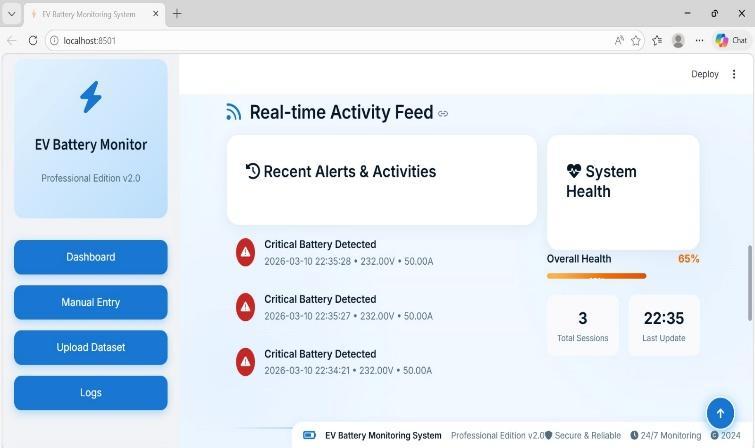
The Email Alert Module is designed to provide real-time notificationswhencriticalbatteryconditionsaredetected. ThismoduleisimplementedusingPython’sSMTPprotocol, which enables automatic email generation and transmission. When the system identifies a critical condition, an alert message is sent to the administrator containingdetailssuchasbatterystatus,parametervalues,
International Research Journal of Engineering and Technology (IRJET) e-ISSN: 2395-0056
Volume: 13 Issue: 04 | Apr 2026 www.irjet.net p-ISSN: 2395-0072
andwarningmessages.Thisensuresthatimmediateaction can be taken to prevent further damage. The alert system enhances the responsiveness and reliability of the overall monitoringframework.
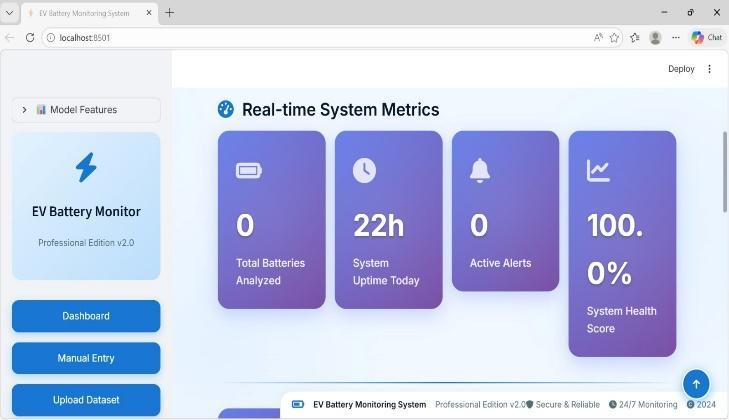
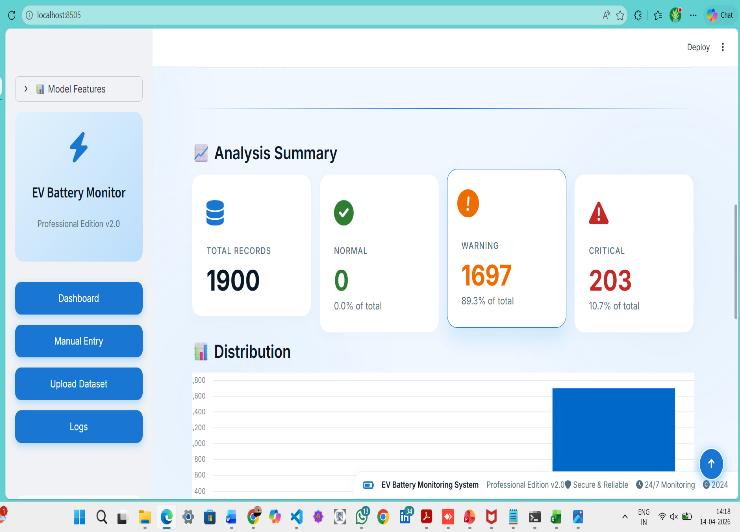
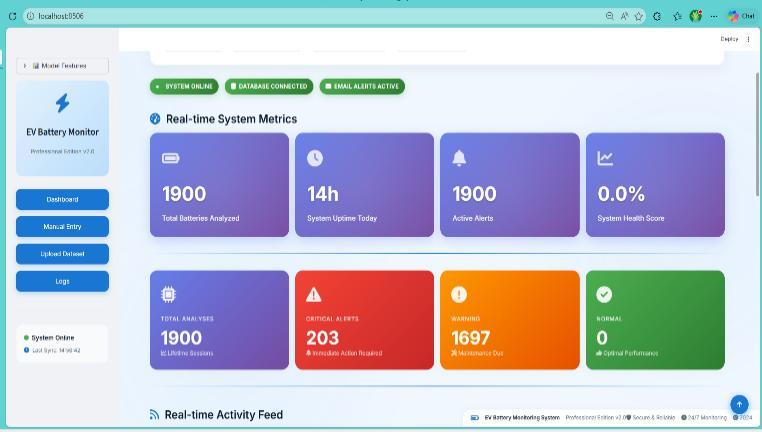
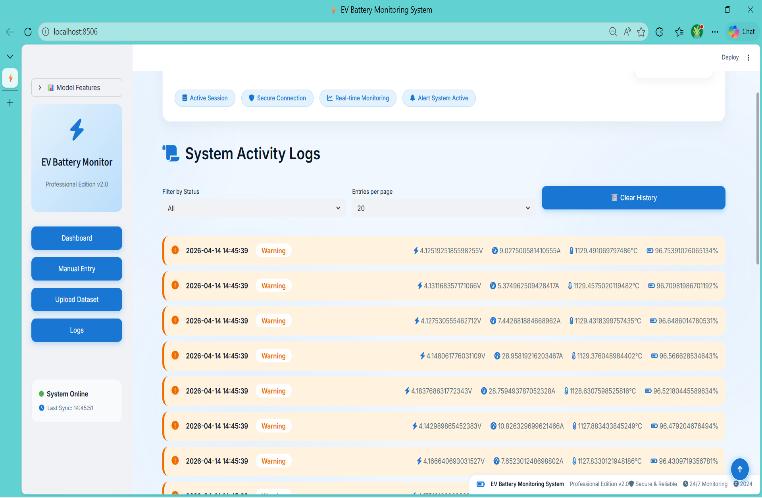
The Streamlit Web Dashboard Module provides an interactive and user-friendly interface for monitoring batteryhealthandviewingpredictionresults.Thismodule allowsusersto uploaddatasets,input battery parameters manually,andvisualizeresultsinrealtime.Thedashboard displays key information such as battery condition, parameter values, alerts, and recommendations in a clear andorganizedmanner.Graphicalrepresentationsarealso usedtoenhanceunderstandingandanalysis.Byintegrating all functionalities into a single interface, this module improves usability and enables efficient decision-making forusersandoperators.
4.1
The proposed system is implemented in a Pythonbased development environment on a system equipped with an Intel x86 processor, 8GB of RAM, and 1TB of storage. Python 3.x is used as the primary programming languageduetoitsflexibilityandextensivelibrarysupport. Data processing is performed using Pandas and NumPy, while Scikit-learn is utilized for building and training the machine learning model. The user interface is developed using Streamlit, which enables real-time interaction and visualization. Additionally, the Simple Mail Transfer Protocol (SMTP) is integrated into the system to send automated alerts during critical battery conditions. This combination of tools ensures efficient processing, scalability,andreal-timemonitoringcapability.
4.2 Dataset
The dataset used in this study consists of electric vehicle battery parameters collected from historical data sources and simulated inputs. The dataset includes importantattributessuchasvoltage,current,temperature, State of Charge (SOC), and State of Health (SOH). These parametersareessentialforanalyzingbatteryperformance and detecting anomalies. The dataset is preprocessed to remove noise and inconsistencies before being used for model training. For evaluation purposes, the dataset is divided into training and testing sets in an 80:20 ratio, ensuringthatthemodelistrainedeffectivelyandvalidated accurately.
The experimental setup defines the workflow and configuration used to train and evaluate the model. It includes data collection, preprocessing, feature selection, modeltraining,andpredictionstages.
Table -1: Experimental
ProcessStage Description
Input EVbatterydataset(CSV/manualinput)
Data
Preprocessing
Cleaning, normalization, missing value handling
FeatureSelection SOC,SOH,Temperature,Voltage,Current
ModelUsed Random Forest Classifier
TrainingRatio 80%Training,20%Testing
Output Normal/Warning/Critical
4.4
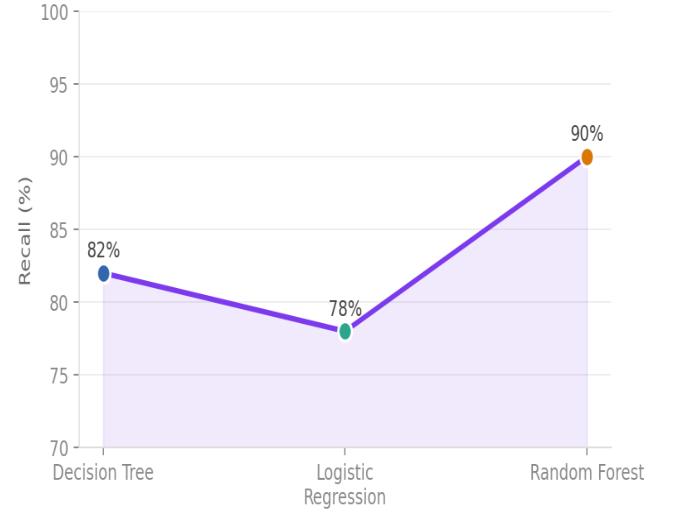
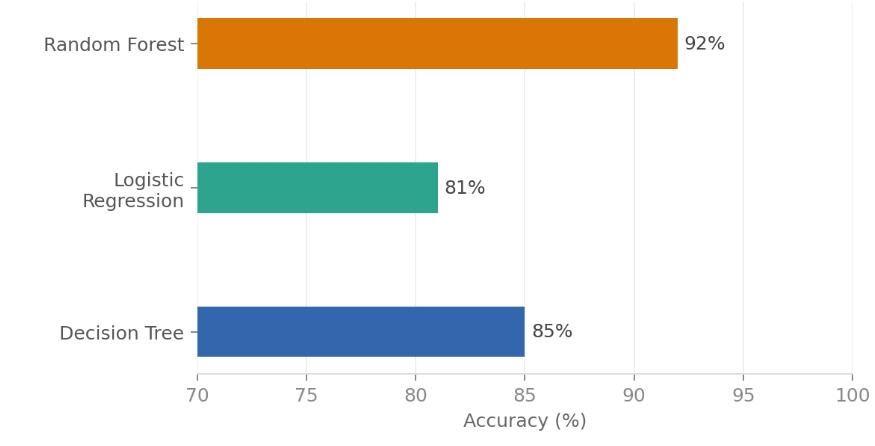
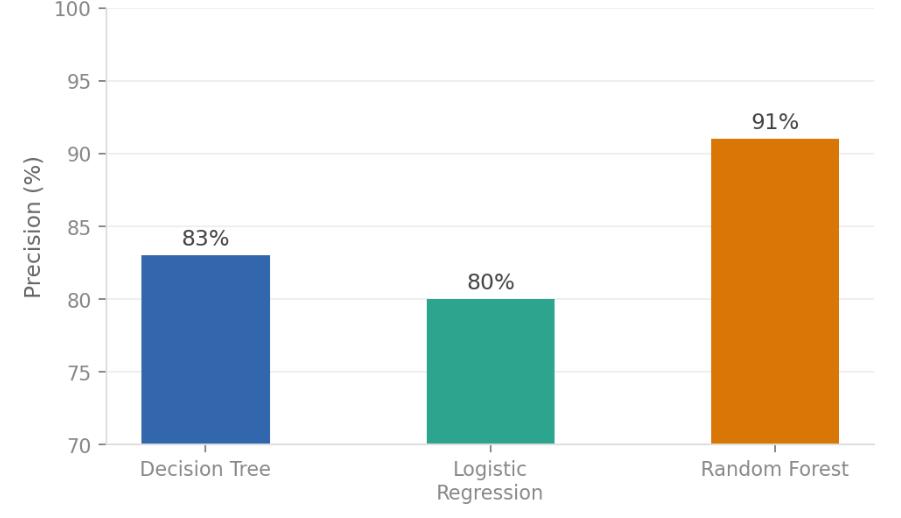
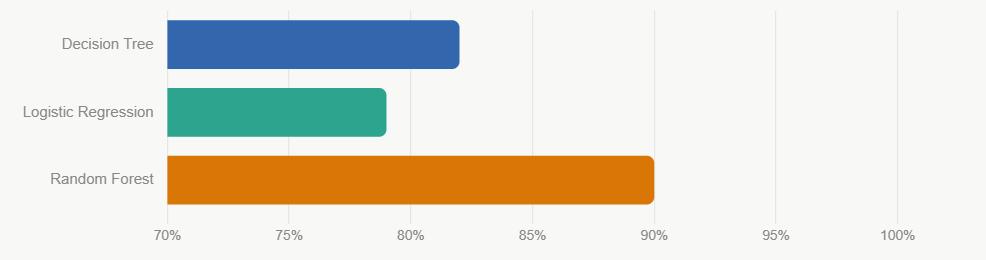
Theperformanceoftheproposedmodelisevaluated using standard classification metrics such as accuracy, precision, recall, and F1-score. Accuracy measures the overallcorrectnessofthemodel,whileprecisionandrecall evaluate the model’s ability to correctly identify positive cases.The F1-score providesa balance between precision and recall, making it a reliable performance indicator. Thesemetricsensurethatthemodel’spredictioncapability isthoroughlyassessed.
TheRandomForestmodelistrainedandevaluated using the prepared dataset. The results indicate that the model achieves high accuracy and performs better compared to traditional classification models. The model effectively captures nonlinear relationships between battery parameters and accurately classifies battery conditions.
International Research Journal of Engineering and Technology (IRJET) e-ISSN: 2395-0056
Volume: 13 Issue: 04 | Apr 2026 www.irjet.net p-ISSN: 2395-0072
Table -2: Model Performance Comparison
c)Recall Graph
a)Accuracy Graph
b) Precision Graph
d)F1-score Graph
The proposed system was implemented using a Random Forest model and a Streamlit dashboard to monitorEVbatteryhealth.Themodelanalyzesparameters such as voltage, current, temperature, SOC, and SOH to classify battery conditions into Normal, Warning, and Critical states.The results show that the model achieves highaccuracywithbalancedprecisionandrecall,indicating reliable prediction performance. It effectively identifies abnormal conditions and supports early fault detection. Compared to traditional methods, the system provides
International Research Journal of Engineering and Technology (IRJET) e-ISSN: 2395-0056
Volume: 13 Issue: 04 | Apr 2026 www.irjet.net p-ISSN: 2395-0072
better accuracy and reduces the chances of unexpected batteryfailure.
TheStreamlitdashboardenablesreal-timedatainputand displays prediction results instantly, improving usability. Graphical outputs further help in understanding model performanceandbatterybehavior.Additionally,theemail alert system ensures timely notification during critical conditions.Overall, the system demonstrates an efficient and practical approach for predictive maintenance, improvingbatterysafetyandlifespan.
International Research Journal of Engineering and Technology (IRJET) e-ISSN: 2395-0056
Volume: 13 Issue: 04 | Apr 2026 www.irjet.net p-ISSN: 2395-0072
7.
Thisstudyintroducesamachinelearning-drivenapproach for monitoring and maintaining the health of electric vehicle batteries. By utilizing key operational parameters such as voltage, current, temperature, State of Charge (SOC),and State of Health(SOH), the system is capable of identifying battery conditions and categorizing them into Normal, Warning, and Critical levels. The use of data preprocessing and feature optimization techniques enhancesthequalityofinputdata,whichinturnimproves theoverallpredictioncapabilityofthemodel.TheRandom Forestalgorithmprovestobeeffectiveinhandlingcomplex relationships among battery parameters, resulting in consistent and dependable classification outcomes. The integration of a Streamlit-based dashboard further strengthens the system by enabling real-time interaction andeasyvisualizationofresults.
In addition, the implementation of an automated alert mechanism ensures that critical battery conditions are communicatedpromptly,allowingnecessaryactionstobe takenattherighttime.Thisproactiveapproachcontributes to minimizing sudden failures and supports better
maintenanceplanning.Theoutcomesofthisworkindicate that the proposed system offers a practical and efficient solution for battery health monitoring when compared to conventional methods. It not only improves prediction reliabilitybutalsocontributestoextendingbatterylifeand enhancing operational safety. Future enhancements can include the incorporation of live sensor data through IoT technologies, as well as the application of advanced learning models to further increase system accuracy and adaptability.
[1]L.Breiman,“Randomforests,”Mach.Learn.,vol.45,no. 1,pp.5–32,2001.
[2]A.Barré,B.Deguilhem,S.Grolleau,M.Gérard,F.Suard, and D. Riu, “Review of lithium-ion battery ageing mechanisms and estimation techniques for automotive applications,” J. Power Sources, vol. 241, pp. 680–689, 2013.
[3] M. Berecibar, I. Gandiaga, I. Villarreal, N. Omar, J. Van Mierlo,andP.VandenBossche,“State-of-healthestimation methodsforlithium-ionbatteries:Acomprehensivereview forpracticalapplications,”Renew.Sustain.EnergyRev.,vol. 56,pp.572–587,2016.
[4] G. L. Plett, “Extended Kalman filtering techniques for batterymanagementsystemsinhybridelectricvehicles,”J. PowerSources,vol.134,no.2,pp.252–261,2004.
[5] H. He, R. Xiong, J. Fan, and X. Li, “An adaptive Kalman filtering approach for estimating the state of charge in lithium-ion batteries using a modified Thevenin model,” IEEE Trans. Veh. Technol., vol. 60, no. 4, pp. 1461–1469, 2011.
[6] S. Saxena, C. Le Floch, J. MacDonald, and S. Moura, “Evaluation of electric vehicle battery end-of-life using travelpatternanalysisandpowertrainmodelling,”J.Power Sources,vol.282,pp.265–276,2015.
[7]J.ZhangandJ.Lee,“Areviewofprognosticsandhealth monitoringapproachesforlithium-ionbatteries,”J.Power Sources,vol.196,no.15,pp.6007–6014,2011.
[8] X. Hu, F. Feng, K. Liu, L. Zhang, and S. Xie, “Machine learning-based state-of-health estimation methods for lithium-ion batteries: A review,” Energy Rep., vol. 6, pp. 120–131,2020.
International Research Journal of Engineering and Technology (IRJET) e-ISSN: 2395-0056
Volume: 13 Issue: 04 | Apr 2026 www.irjet.net p-ISSN: 2395-0072
[9]Y.Li,K.Liu,X.Hu,andF.Sun,“Data-drivenapproaches for remaining useful life prediction of lithium-ion batteries,”IEEEAccess,vol.7,pp.8281–8290,2019.
[10]F.Yang,X.Song,F.Xu,andK.Tsui,“Machinelearning and big data approaches for lithium-ion battery state-ofhealthestimation,”Appl.Energy,vol.256,2019.