
International Research Journal of Engineering and Technology (IRJET) e-ISSN: 2395-0056
Volume: 13 Issue: 04 | Apr 2026 www.irjet.net p-ISSN: 2395-0072
International Research Journal of Engineering and Technology (IRJET) e-ISSN: 2395-0056
Volume: 13 Issue: 04 | Apr 2026 www.irjet.net p-ISSN: 2395-0072
Priyanshi Sunil Saparia1
1Student, Dept. of Computer Engineering, Vidyavardhini College of Engineering and Technology, Mumbai, Maharashtra, India
Abstract - Employee attrition continues to be one of the most pressing operational issues in modern organizations, leading to great financial losses as organizations have to spendmoney onrecruiting newstaffandtrainingthem.The current paper proposes an evidence-based approach towards identifying potential attrition factors and estimating employee turnover with the help of data analytics based on a database provided by IBM containing information about 1,470 employees described in 35 variables.Specifically,RandomForestalgorithmwasusedto predict whether employees will leave their positions or not using ROC-AUCscore, while Kaplan-Meieranalysishelpedto visualize differences in attrition among different departments withinthecompany.CoxProportionalHazards regression was implemented in order to calculate the effect ofindependentvariablesontime-to-eventinquestion.Itwas established that overtime, level of satisfaction with the position, average salary per month, and proximity to a workplace were among the key factors determining the likelihood of employee attrition. Using those variables identified as attrition factors, the cost-benefit analysis was conducted in order to assess the ROI of implementing a retentionstrategy.
Key Words: Employee Attrition, People Analytics, Random Forest, Survival Analysis, Kaplan Meier, Cox Regression, Human Resource Analytics, Predictive Modelling, Workforce Retention, Cost-Benefit Analysis
1.INTRODUCTION
Employee turnover is an ever-present concern in businessesworldwide,leadingtohugefinancial lossesfor companies. Studies confirm that replacement costs associated with one employee vary from 50% to 200% of their annual income, which includes expenditures on recruitment,training,andlostproductivityovertheperiod oftransition[1].Thelosscausedbyattritionreachesmany crore per annum for big corporations having several hundredemployees.
The development of people analytics has helped HR departments overcome their limited capabilities to deal
Studies using statistical methods in modeling attrition behavior have traditionally used logistic regression andsurvival analysis. In an empirical study using
withattritionbyofferingwaystopreventitusingmachine learning algorithms to recognize the signs of potential resignationsandundertakepreventiveactions.
The research focuses on the following hypotheses. First, what are the strongest predictors of employee attrition? Second,howdoemployeesurvivalchancesdifferbetween departments depending on their seniority in an organization? Third, what is the return on investment (ROI)onemployeeretentionactivities?
The restofthe paper isstructured asfollows. Section 2 is devotedtoliteraturereview.Insection3,wedescribedata and methods used. Results are presented in section 4, followed by policy recommendations in section 5. Section 6 contains conclusions and recommendations for future work.
While there is data related to HR available in most firms,itiscommon practice forattrition-relateddecisions tobebasedonintuitioninsteadofanalytics.Itisclearthat through the use of publicly available data and the built-in functionalities in Python, an entire analytics pipeline can be created, making such a process feasible even for SMEs thatdonothavedatascientistsworkingforthem..
Previous studies in employee turnover can be classified into three categories: theories of turnover, statistical methods,andmachinelearning.
Oneofthepioneeringtheoriesonvoluntaryturnover was put forth by Mobley (1977). According to his model, voluntary turnover results from a cognitive process beginningwithjobdissatisfaction,followedbyresignation [2].Thetheoryhasbeeninstrumentalinmotivatingfuture studies to examine factors related to satisfaction, such as jobengagement,work-lifebalance,andremuneration.
Coxregression to estimate the hazards ratios of employee retention in terms of position and pay grade, Taplin & Winterton (2007) found that both factors significantly
International Research Journal of Engineering and Technology (IRJET) e-ISSN: 2395-0056
Volume: 13 Issue: 04 | Apr 2026 www.irjet.net p-ISSN: 2395-0072
predicted employee turnover [3]. Survival analysis has been advantageous in human resource management research due to its ability to handle censored cases employees who have not yet left the organization whenthedataiscollected.
However, the use of machine learning algorithms for HR analyticshasseenasignificantincreaseinthelastdecade. For example, Alao and Adeyemo (2013) tested decision treeandnaiveBayesalgorithmsforemployeeattritionand foundthatensemblemodelsoutperformedindealingwith the skewed nature of attrition data sets [4]. In a more recent study, Fallucchi et al. (2020) used Random Forest and gradient boosting algorithms on the IBM HR data set and obtained ROC-AUC scores higher than 0.80, where overtime hours and job level were identified as key features[5].
On the other hand, the connection between machine learningalgorithmresultsandthebusinesscostmodelhas not been well-explored in previous studies. This research aimstoaddressthisgapbyincorporatingpredictivemodel resultsintoawell-formulatedcost-benefitmodel.
3.1
TheIBMHRAnalyticsEmployeeAttritionandPerformance datasetwhichispubliclyaccessibleonKagglewasutilized in this project. The dataset consists of employee data comprising 1,470 observations with 35 variables which includedemographicfeatures(age,gender,maritalstatus), employment features (department, job role, job level), compensation features (monthly income, stock option level), and job satisfaction features (job satisfaction, work-life balance, environmental satisfaction). Target variableofthestudyisbinomialattrition(Yes/No)having class distribution of about 16.1% attrition and 83.9% retention. There are no missing values within the dataset foranyvariable.
Data analysis started with calculations of attrition ratios based on department, overtime working status, and job satisfactionlevels.Correlationwascalculatedbasedon all numeric variables against binary target attrition variable. Thiswastoassessthepresenceofanylinearrelationship. Positive correlations show association with higher likelihoodofattrition.
3.4
Tenure of employees (YearsAtCompany) was considered thetime-dependentvariablewhileemployeeattritionisan event. Survival analysis techniques were implemented using non-parametric estimator - the Kaplan-Meier method. Non-parametric survival curve was constructed
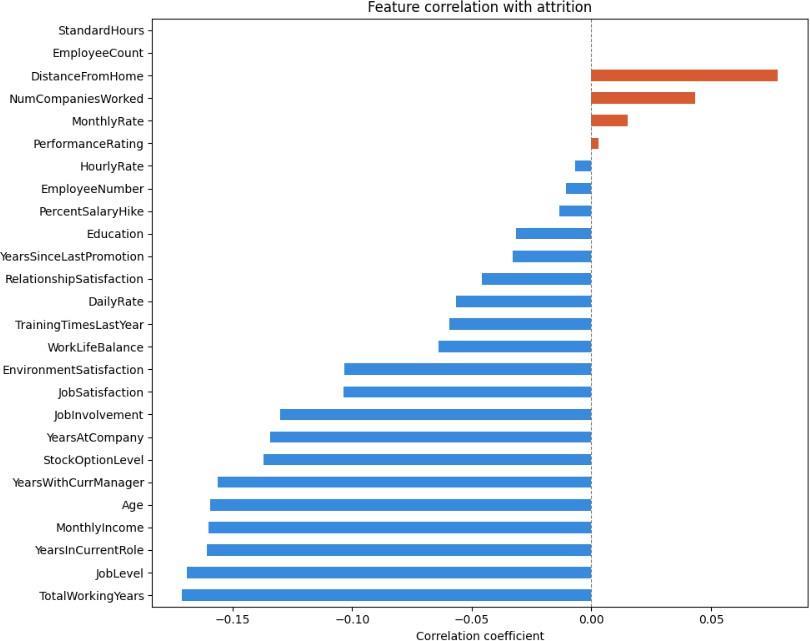
Figure1:Featurecorrelationwithattrition
3.3
For predicting attrition rate, a Random Forest classifier was trained. Prior to training, categorical features were encoded using label encoding technique. In order to solve the problem of imbalance in classes, class_weight was set equal to "balanced", thus, sample weights were determined inversely proportional to class frequency withoutperformingoversampling.Data weresplitinto 80 percent training and 20 percent testing sets based on stratified random sampling with the same seed. Model performance was assessed using ROC-AUC score, classificationreport,andconfusionmatrix.
for each department to demonstrate the probability of remainingemployedinthecompanywithrespecttotime. Log-rank test was conducted to test the null hypothesis that no difference exists between survival functions. Cox proportional hazards regression model was developed to determine the impact of multiple covariates on hazard
International Research Journal of Engineering and Technology (IRJET) e-ISSN: 2395-0056
Volume: 13 Issue: 04 | Apr 2026 www.irjet.net p-ISSN: 2395-0072
rate.
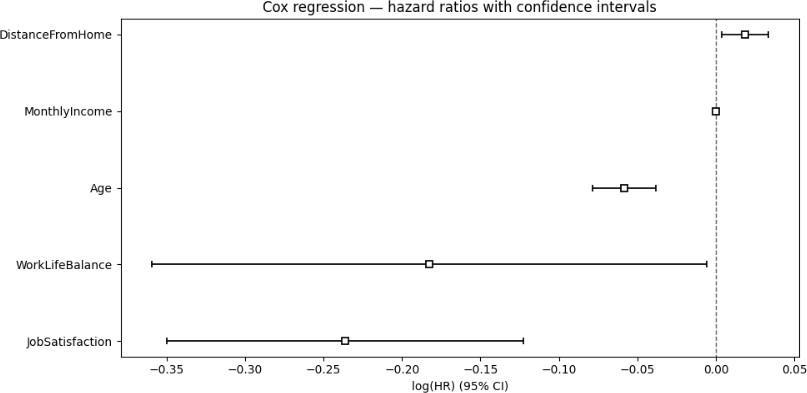
regression hazardratioswithconfidence intervals
AttritionCostEstimation:
The financial effects of attrition were analyzed using the cost model approach. The cost associated with filling the vacant position due to attrition is assumed to be 75% of annual salary as recommended by studies [6]. Annual attrition cost = (Number of departing employees) * (Average salary) * (Replacement cost). The expected saving due to 25% reduction in attrition, which can be obtained through specific retention strategies identified from the model’s results, was estimated and compared againstthecostofimplementationtodeterminetheROI.
4.1
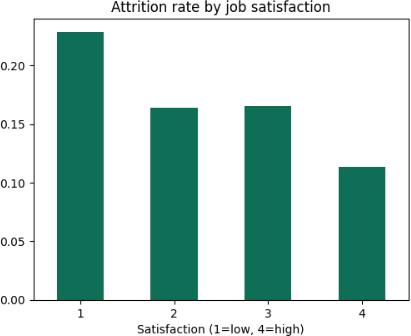
A study on attrition rate by departments showed notable differences between departments. Employees who were required to do overtime had a much higher attrition rate than other employees, which is consistent with the assumption that workload was the major reason for employees leaving the job voluntarily. Job satisfaction proved to be negatively correlated with attrition, and employees with lower levels of job satisfaction had much higherattritionrates.
The study found that monthly income, work tenure, and job status had the most significant negative correlation with attrition; therefore, employees who earned more money,hadmanymoreyearsofexperience,andworkedin senior positions left the company at a smaller rate than others.
Distance and overtime had the most significant positive correlationswithattrition.
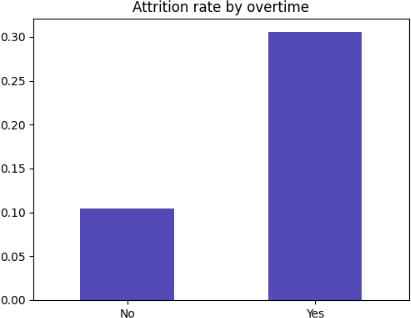
Figure4:AttritionRatebydepartment
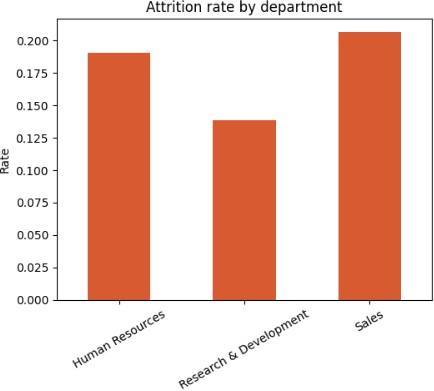
Figure5:AttritionRatebyovertime
International Research Journal of Engineering and Technology (IRJET) e-ISSN: 2395-0056
Volume: 13 Issue: 04 | Apr 2026 www.irjet.net p-ISSN: 2395-0072
4.2 Classification Model Performance
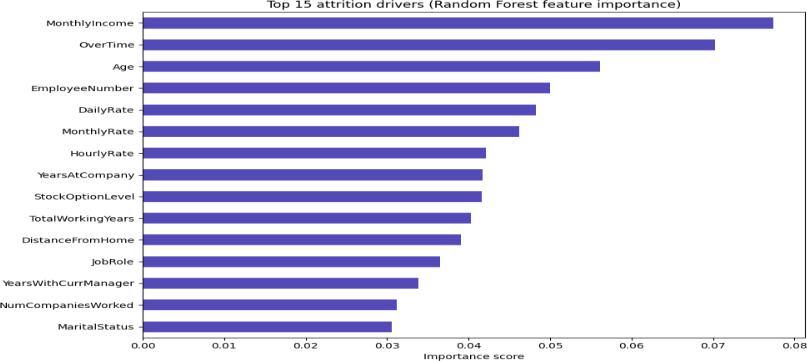
In this context, the ROC-AUC for the Random Forest classifier was 0.763, which suggests that this model has high discrimination capacity to distinguish between employees who are at risk of leaving and those who are not.Fromthefeatureimportanceplot,thethreeimportant attritionfactorswere:
1.MonthlyIncome(importance=0.077)
2.OverTime(importance=0.070)
3.Age(importance=0.056)
These results are supported by existing literature where remuneration and work overload have been found to be theprimarypredictorsofattrition.
Inanotheraspect,theKaplan-Meiersurvivalplotindicates that the probability of survival (employee staying within the organization) is sharply declining in the first three years of tenure regardless of department. Department-specific survival functions suggest significant differences, with the Sales department experiencing the sharpest drop-off in survival probability. Cox regression revealsthatthevariablewiththemaximumhazardratiois JobSatisfaction(hazardratio=-0.236),implyingthatevery increment in job satisfaction significantly decreases the hazardofattrition.
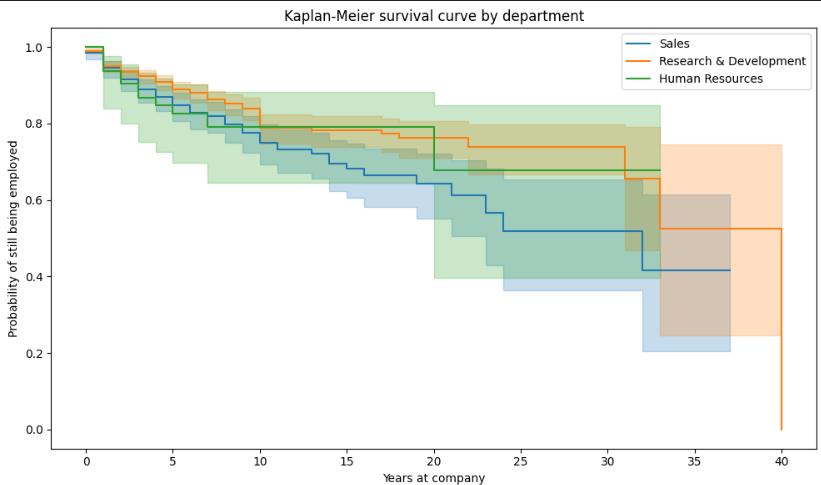
Figure7:Kaplan-Meiersurvivalcurvebydepartme
On the basis of the organizational variables modeled in thisresearchpaper,theannualcostincurredbyemployee turnover is estimated to be Rs. 10,62,00,000. With a retention program focused on the major factors driving turnover, which includes managing overtime, compensation, and job satisfaction, turnover can be decreased by 25 percent, thereby saving an additional 59 employees per year. The gross savings from the above interventionwouldbeRs.2,65,50,000,whereasthecostof implementation would be Rs. 15,00,000, providing a net profitofRs.2,50,50,000.
Table1:Cost-BenefitSummary
Parameter
Value
NumberofEmployees 1470
AttritionRateatPresent 16.10%
NumberofEmployeesWhoLeave 336
AttritionCostperEmployee 75%ofYearlyPay
TotalAnnualAttritionCost Rs.10,62,00,000
ExpectedAttritionReduction 25%
No.ofEmployeestobeSaved 59
GrossSavings Rs.1,85,50,000
International Research Journal of Engineering and Technology (IRJET) e-ISSN: 2395-0056
Volume: 13 Issue: 04 | Apr 2026 www.irjet.net p-ISSN: 2395-0072
The research findings have numerous practical implications for HR policies. Three evidence-based recommendations are suggested based on the model outputs.
Firstly, monthly income was determined to be the most important predictor with a score of 0.077. Organizations are advised to engage in continuous monitoring of the salary trends within the company compared to market averages and develop clear salary advancement models. Furthermore, the survival analysis showed that the first three years of the working relationship pose the highest risk of departure and that attractive initial salaries are essential.
Secondly, overtime commitment was found to be the second most important variable (importance: 0.070). Companies should analyze those departments with high levels of overtime – in particular, the Sales department withthehighestlevelofemployeeattrition(20.6%)–and establishsomemechanismsforcompensatingtheworkers through more flexible work schedules, extra days off, or even transferring part of the responsibility to other employees.
Thirdly, job satisfaction was discovered to be the best individualindicatorthatpreventsemployeesfromleaving with a hazard ratio of -0.236. Relatively cheap solutions likeregularperformancefeedbackandrewardingsystems cangreatlyincreaseemployees'jobsatisfactionrates.
Even a conservative decrease in turnover rate by 25 percent yields a net ROI of Rs. 2,50,50,000, which is approximatelyseventeentimestheinvestmentrequiredto implement the project, thus rendering the proactive infrastructureofpeopleanalyticseconomicallysound.
This paper provides a comprehensive approach involving machine learning classification, survival analysis, and financialmodelingtotackletheorganizationalchallengeof attrition. The results of training the Random Forest classifierbased ontheIBM HR analyticsdatasetindicated ahighdegreeofpredictabilityinterms ofahighROC-AUC value.Furthermore,ithasbeenshownthattheproblemof employee attrition is highly correlated with the first year of employment, being associated with overtime hours worked, pay, and job satisfaction. Finally, the financial modelshowsthatretentioninitiativeshavethepotentialto produceapositiveROI.
Themostsignificantlimitationassociatedwiththisworkis basedonthefactthattheemployeddatasetisnotrealbut rather hypothetical and developed by IBM. In spite of the realistic nature of the dataset and its popularity in academic research, its application to solving the problem in real organizational settings needs to be further validated using proprietary HR datasets. Future research directions may involve investigating the performance of more advanced deep learning models such as LSTM networksandemployingNLP-basedsentimentanalysisof exitinterviews.
TheauthorthanksVidyavardhiniCollegeofEngineering& Technology, Mumbai for offering an academic setting whereinthisstudywascarriedout.TheIBMHR Analytics dataset used in this study is from Kaggle’s open data repository.
[1] Society for Human Resource Management, Retaining Talent: A Guide to Analyzing and Managing Employee Turnover,SHRMFoundation,Alexandria,VA,2008.
[2]W.H.Mobley,"Intermediatelinkagesintherelationship between job satisfaction and employee turnover," Journal ofAppliedPsychology,vol.62,no.2,pp.237-240,1977.
[3] I. Taplin and J. Winterton, "Understanding Labour Turnover in a Labour Intensive Industry," Journal of ManagementStudies,vol.44,no.7,pp.1132-1150,2007.
[4] D. Alao and A. B. Adeyemo, "Analysing Employee Attrition Using Decision Tree Algorithms," Computing, Information Systems, Development Informatics and Allied ResearchJournal,vol.4,no.1,pp.17-28,2013.
[5] F. Fallucchi, M. Coladangelo, R. Giuliano, and E. W. De Luca, "Predicting Employee Attrition Using Machine LearningTechniques,"Computers,vol.9,no.4,p.86,2020.