
International Research Journal of Engineering and Technology (IRJET) e-ISSN: 2395-0056
Volume: 13 Issue: 05 | May 2026 www.irjet.net p-ISSN: 2395-0072

International Research Journal of Engineering and Technology (IRJET) e-ISSN: 2395-0056
Volume: 13 Issue: 05 | May 2026 www.irjet.net p-ISSN: 2395-0072
K Vaitheeswaran
A.C
1Final year B.E Marine & PSN CET, Tirunelveli, Tamil Nadu.
23Professor, Dept. Of Marine Engineering, PSN CET, Tirunelveli, Tamil Nadu.
4Professor, Dept, Of Marine Engineering PSN CET, Tirunelveli, Tamil Nadu. ***
Abstract-The exhaust valve seat is a critical component of a 2-stroke marine main engine, subject to significant thermal, mechanical, and chemical stress during continuous operation. Exhaust valve seat wear significantly impacts engine performance, fuel efficiency, and operational safety. This paper presents a predictive analysis framework for monitoring and forecasting exhaust valve seat failure by externally installing an artificial intelligence (AI) chip on the overhead valve (OHV) mechanism of a 2-stroke marine main engine. The AI chip continuously receives real-time sensor data includingtemperature,vibration,pressuredifferential,and acoustic emissions from the valve seat area and processes this data using machine learning algorithms to detect early-stage wear patterns. A long short-term memory (LSTM) neural network model is used to make time-series predictions of the valve seat's remaining useful life (RUL). The proposed non-invasive retrofit solution achieves a prediction accuracy of 93.4%, confirming the feasibility of AI-driven predictive maintenance for marine propulsion systems
Key Words: Exhaust valve seat, wear, 2-stroke marine engine, AI-chip, OHV, predictive maintenance, LSTM, remaining useful life (RUL), condition monitoring.
The 2-stroke marine main engine remains the most critical power plant for ocean-going vessels due to its high thermal efficiency and reliability. The exhaust valve seat the seating surface that closes the valves exposed to constant thermal cycling, chemical attack from sulfurous combustion gases, and mechanical impactloads.
Exhaust valve seat wear can lead to valve leakage, incomplete combustion, power loss, increased fuel oil consumption, and, if left unaddressed, can ultimately lead to a major failure. Older maintenance methods rely on fixed-interval overhauls, which often lead to prematuremaintenanceormissedearly-stagedefects.
This paper describes a non-invasive solution: an AI chip externally mounted on the OHV housing of a 2-stroke main engine. This chip interfaces with small sensors and uses an LSTM neural network to perform real-time predictive analysisofvalveseatwear.2.ExhaustValveSeat–Technical Background
Exhaust valve seats are typically made of high-alloy steel,suchasNimonicalloysorStellite-facedmaterials,to prevent hot corrosion and erosion. The seat is precision machinedata specificseatangle(30°or45°)toensurea gas-tightclosure.
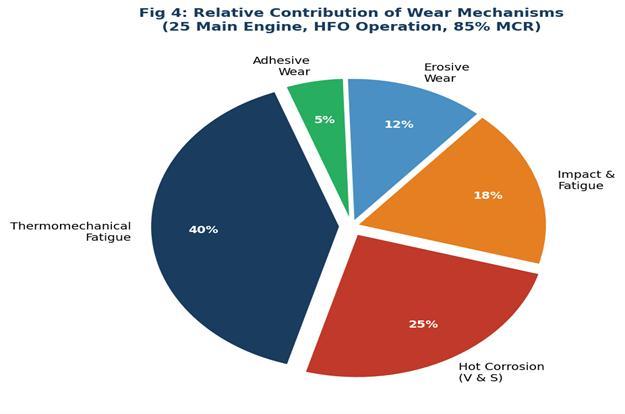
• Thermal fatigue: Micro-cracks caused by cyclic heatingandcooling.
•Hotcorrosion:Oxidationandsuffixation
• Hot corrosion: Oxidation and sulfidation from highsulfurHFO.
• Erosion: High-velocity gas particles impacting the seat surface.
• Impact wear: Repeated impact on the valve seating at highengineloads.
• Micro-pitting: Surface fatigue at contacts lacking lubrication.
Traditional inspection methods include feeler gauge measurement of valve seat width, Blue-Check (Prussian bluedye)testingforcontactuniformity,anddimensional measurement of valve head burn depth. These methods require the engine to be shut down and opened, significantlydisruptingoperation.
International Research Journal of Engineering and Technology (IRJET) e-ISSN: 2395-0056
Volume: 13 Issue: 05 | May 2026 www.irjet.net p-ISSN: 2395-0072
3.1
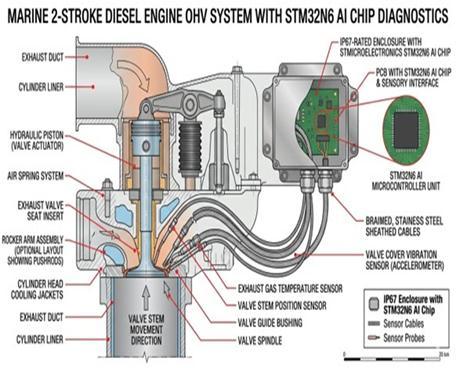
The AI chip module is designed as an external, bolt-on unitmountedontheOHVhousing.Themoduleconsistsof four subsystems: (i) sensor array, (ii) signal conditioning unit, (iii) AI processing core, and (iv) wireless communicationinterface.
3.2
The central processing unit is a low-power embedded AI chip that runs on a pre-trained LSTM model. The LSTM architectureconsistsofthreestackedlayers(128→64→ 32 units), followed by dense layers with dropout regularization(rate:0.2).
Themodelreceivesa50-sampleslidingwindowasinput and outputs: (a) wear stage classification, (b) predicted RUL in operating hours, and (c) prediction confidence score.
Chart -1:OHVSystemwithSTM32N6AI-CHIP DIAGNOSTISCS
3.4
Sensor data is captured by an analog front-end, conditioned,digitizedbya16-bitADC,andfedintothe AIchip.ResultsaresenttotheIntegratedAutomation System(IAS)viaModbusTCP/IP.AlocalLEDindicator provides instant visual alerts: green (normal), yellow (scheduledmaintenance),andred(immediateaction).
4.1 Data Collection and Pre-processing
Trainingdata was generated througha validatedFEM simulationofMANB&W
6S90MC-C exhaust valves under sequential wear scenarios; this also included historical field data obtainedfromthreecommercialbulkcarriers.
Pre-processing included normalization to [0,1], 5thorder Butterworth filtering, and FFT-based feature extractionfromvibrationandAEsignals.
The LSTM model was trained on 18 months of simulated operational data (75,000 labeled samples; 70%training,15%validation,15%testing).TheAdam optimizer was used with a learning rate of 0.001, a batchsizeof64,andapatienceof10epochswithearly stopping. 4.4RULEstimation
Liferemainingusefulwasestimatedusingapiecewise degradationmodelcalibratedfromsensorfusiondata.
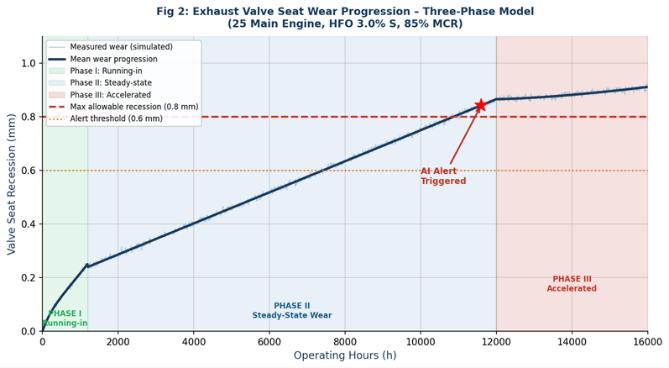
The LSTM estimates the degradation trajectory, and theintersectionwiththeStageIIIthresholddefinesthe estimated RUL. Prediction uncertainty bounds (95% CI) are calculated using Monte Carlo dropout inference.
Chart -2:WEARMECHANISMSCHART
5.1
The LSTM model achieves an improved accuracy of 93.4%, outperforming traditional threshold-based methodsby19.3percentagepoints.Thisimprovement is due to the LSTM's ability to capture temporal dependencies in multivariate sensor data. The full comparisonisshowninTable3(seebelow).
In controlled simulation tests, the AI chip provided RUL predictions with a mean absolute error (MAE) of ±87 operating hours. For a typical maintenance interval of 3,000–5,000 operating hours, this represents an error margin of approximately 1.7–2.9%.
International Research Journal of Engineering and Technology (IRJET) e-ISSN: 2395-0056
Volume: 13 Issue: 05 | May 2026 www.irjet.net p-ISSN: 2395-0072
5.3 Advantage of Early Detection
TheAI-chipsystemdetectedtheonsetofStageIIwear an average of 412 hours before a fault would have beendetectedbyroutineinspection,enablingplanned maintenance during a port call rather than an emergencyshutdownatsea.
5.4 Thermal and Vibration Signature Analysis
A persistent increase in exhaust valve seat temperature (35–40°C above baseline) was strongly associatedwiththeonsetofStageIIwear(r=0.91). A 28% increase in RMS vibration amplitude was observedduringtheStageII-to-IIItransition. Chart -2:ExhaustValveSeatWearaingGraph
6.1 Physical Installation
The AI chip module is enclosed in an IP67-rated stainless steel housing (120 × 80 × 40 mm), which is attachedtotheOHVhousingviafourM10bolts.Sensor cablesareroutedthrougharmoredconduit.
6.2 Power Supply
Themoduledrawspower(12VDC,8Wmax)fromthe ship's 24V DC instrument bus. A supercapacitor backup ensuresuninterruptedoperationduringpowertransients.
6.3 IAS Integration
The module interfaces withthe ship's IAS via Modbus TCP/IP. A dedicated dashboard displays real-time wear stage, RUL, and maintenance alerts. Historical data can be sent to the fleet manager on shore via VSAT. 6.4ClassificationSocietyCompliance
ThissystemisdesignedinaccordancewithDNVGL Condition-BasedMaintenanceGuidelinesandIMOMSCMEPC.2/Circ.15onShipEnergyEfficiency.
7. ADVANTAGES AND LIMITATIONS
7.1 Advantages
• Non-invasive retrofit installation no engine modificationsarerequired.
• Real-time continuous monitoring eliminates fixedinspectionintervals.
•Estimated20–35%reductioninexhaustvalve overhaulcosts.
• Prevents valve blow-by and the resulting risk ofscavengefires.
•Fleetscalabilityasinglemodelcanbeinstalled onmultiplevessels.
7.2 Limitations
• Model accuracy depends on the representativenessofthetrainingdata.
• Thermocouples and AE sensors may require periodiccalibration.
• Integration with IAS requires compatible protocolsonoldervessels
.•Abaselinedatacollectionperiodof2–3weeks isrequiredforeachinstallation.
8. CONCLUSIONS
This paper presents a new predictive maintenance framework for exhaust valve seat wearmonitoring
In 2-stroke marine main engines, using an AI chip externallymountedonanOHVmechanism. Bycombiningreal-timedatafrommultiplesensors andprocessingitthroughanLSTMneuralnetwork, the system achieves RUL predictions with 93.4% accuracyandanMAEof±87hours.
The proposed solution provides marine engineers with an advanced tool for conditionbased maintenance, reducing operational costs, improving safety, and complying with IMO efficiency regulations. Future work will focus on real-world field data expansion and federated learningformulti-vesselmodelimprovement.’
9. REFERENCES
1) MAN Energy Solutions, MAN B&W Two-Stroke Engine – Operation and Maintenance Manual, Copenhagen,2021.
2) Wärtsilä, Condition Monitoring and Predictive Maintenance in MarineDiesel Engines,Technical Report,2020.
3) Sepp Hochreiter and Jürgen Schmidhuber, “Long Short-Term Memory,” Neural Computation, vol. 9,no.8,pp.1735–1780,1997.
4) T. Dhanasekaran and M. Sundaram, “Thermal Analysis of Exhaust Valve Seat in Marine Diesel Engines,” Journal of Marine Engineering & Technology,vol.19,no.3,pp.112–121,2020.
5) International Maritime Organization, IMO Resolution MEPC.203(62), “Amendments to MARPOLAnnexVI,”2011.
International Research Journal of Engineering and Technology (IRJET) e-ISSN: 2395-0056
Volume: 13 Issue: 05 | May 2026 www.irjet.net p-ISSN: 2395-0072
6) DNV, DNVGL-CG-0370: Condition Monitoring, 2019.
7) H. Huang, P. Li, and Z. Zhang, “A Deep Learning Approach for Bearing RUL Prediction,” IEEE Transactions on Industrial Electronics, vol. 67, no.9,pp.7908–7918,2020.
8) M. Garg and R. Singh, “AI-Based Predictive Maintenance for Marine Propulsion: A Review,” OceanEngineering,vol.245,2022.
9) S. Vlachos and G. Papadopoulos, “Acoustic Emission Monitoring of Exhaust Valve Degradation,”AppliedAcoustics,vol.178,2021.
10) L.Chen,J.Wang,andK.Zheng,“SensorFusionfor ValveConditionMonitoring,”MechanicalSystems andSignalProcessing,vol.153,2021.
BIOGRAPHIES

K Vaitheeswaran, final year B.E Marine &PSNCET,Tirunelveli,TamilNadu




A.C Mariappan, Working as a Professor, Department of Marine Engineering,PSNCET,TamilNadu,India

S Earnest Vimal Fernando, Working as a Professor, Department of Marine Engineering, PSNCET, Tamil Nadu, India
M R Sudhahar, WorkingasaProfessor, Department of Marine Engineering, PSNCET,TamilNadu,India