
International Research Journal of Engineering and Technology (IRJET) e-ISSN: 2395-0056
Volume: 13 Issue: 05 | May 2026 www.irjet.net p-ISSN: 2395-0072
International Research Journal of Engineering and Technology (IRJET) e-ISSN: 2395-0056
Volume: 13 Issue: 05 | May 2026 www.irjet.net p-ISSN: 2395-0072
Hira Zohra1, Dr.B. Rajesh Kamath2
1PG student, Dept of EEE(CAID)Sri Siddharatha Institute of Technology, Tumakuru, Karnataka, India. hirazohra29@gmail.com
2Professor, Dept of EEE (CAID) Sri Siddharatha Institute of Technology, Tumakuru, Karnataka, India. rajeshkamathb@ssit.edu.in
Abstract - Poor quality of electric supply is normally caused by power line disturbances such as transients, notches, momentary interruptions, voltage sag and swell, over-voltage, under-voltages and harmonic distortions. Filters are used for improving the power quality. Active and Passive filters eliminate major fluctuating factors. Hybrid filters are the combination of active and passive filters. Conventional Active Filtering using PLL also reduces the harmonics. Total Harmonic Distortion (THD) can be reduced by implementing combination of active and passive filters. To design a hybrid power filter to reduce the harmonics for enhancing the quality of power. Also compare various topologies of filters to evaluate the best filter for power quality enhancement using MATLAB.
Key Words: Harmonics; Hybrid Topology; Nonlinear Load; Power Quality (PQ);
1. INTRODUCTION
NONLINEARloadscausesignificantharmoniccurrents with poor input power factor (PF), which create serious problems at the power supply system. Traditionally, passive filters have been used to eliminate current harmonics of the supply network. However, these devices suffer from resonance. Recently, thyristor-switched filters (TSFs), which contain several groups of passive filters, have been usedtocompensatereactivepower.Thecompensation amountofTSFscanbeadjustedwiththevariationof load power . However, the parallel and the series resonance could occur between TSF and grid impedance.Activefiltersweredevelopedtomitigate problemsofpassivefilters.Theyaremoreeffectivein harmoniccompensationandhavegoodperformance. However,thecostsofactivefiltersarerelativelyhigh for large scale system and require high power converterratings.Hybridfilterseffectivelysoftenthe
problems of the passive filter and an active filter solution and provide cost-effective harmonic compensation, particularlyfor high-power nonlinear loads. In proposed work a new combination of a passivefiltersandactivefiltersisproposedtosuppress currentharmonicsandcompensatethereactivepower generatedfromtheload.Thehybridfilterconsistsofa series connection of a small-rated active filter and a fifth-tunedLCpassivefilter.bythiswecanimprovethe filtercharacteristic
Thereareseveralpowerqualitydifficultiesintoday's electricalsystems,whichareundergoingrapidchange. Theprincipaloriginsofthesepowerqualityissuescan becategorizedaseithernaturalorartificialdepending on whether they are measured in terms of current, voltage, frequency, etc. Weather factors, such as interference, lightning, and storms, and equipment failuresarethemostcommonnaturalcausesofpoor power quality. However, the majority of human reasons are due to load or system operation. Nonlinearloads,suchassaturatedtransformersandother types of electrical equipment, as well as loads with solid-statecontrols,suchassteamlamp-basedlighting systems, ASDs, UPS, arc furnaces, computer power supplies,andtelevisions,canbenon-linearloadsthat contributetoload-relatedissues.Televisionsandarc furnaces are two other common instances of loadrelatedcausesofpoweroutages.Powerqualityissues thatarecausedbytheoperationofthesystemcanbe tracedbacktoitstransformers,capacitors,feeders,and switching at high loads. Typically, transitory power qualityconcernsarecausedbynaturalfactors,suchas:
B.Transientphenomenaofvoltagedrop(dip),voltage distortion, expansion, and shock and vibration.
International Research Journal of Engineering and Technology (IRJET) e-ISSN: 2395-0056
Volume: 13 Issue: 05 | May 2026 www.irjet.net p-ISSN: 2395-0072
However, human causes are responsible for both temporary and permanent power quality problems. However, harmonics are one of the most significant powerqualityconcerns.Thiscanbecaused byloads thatdonotoperatelinearly,includingclassicloadslike transformers,electricmachines,andfurnaces,aswell as innovative loads like rectifiers and steam lamps. Switchmode power supply(SMPS), ASD with AC-DC converter,cycloconverter,ACvoltageregulator,HVDC transmission, VAR static compensator, and other similar devices. All affected utilities, customers, and manufacturers incur considerable economic losses owing to process interruptions and damaged equipmentasaresultofpowerqualityconcerns.The lossofproduction,thesquanderingofrawmaterials, theerasureofcriticaldata,andotherassociatedcosts. Even a momentary drop or sag in voltage can cause significant problems in a number of contexts and applications,suchasautomatedindustrialprocesses, theproductionofsemiconductors,thepharmaceutical industry,andbanking,whereitcandisruptoperations for several hours and result in the waste of raw materialsandotherresources.
Some power quality issues impact the protection systems and lead to malfunctioning protective equipment.Thesedisruptseveralindustrialoperations andproceduresandotherorganizations.Additionally, these attributes have an impact on a diverse set of measuringequipment,inadditiontothemeteringof quantitieslikevoltage,current,power,andenergy.In addition, the monitoring systems of a significant quantity of major, critical, emergency, vital, and expensiveequipmentareimpactedasadirectresultof theseproblems.
Due to increasing problems associated with poor power quality, such as financial loss, lost output, wastedrawmaterials,andsoon,numerousmitigation strategies have emerged in the previous quarter centurytotrytofixtheproblem.Capacitors,reactors, andotherspecializedpowerdevicesareexamplesof passive components. Power filters, better power qualityAC–DCconverters,andmatrixconvertersare
further examples of passive components. In many cases,however,suchasindistributionsystems,when problems with voltage regulation, low power factor, loadunbalancing,excessiveneutralcurrent,andsoon are found, it is possible that harmonics are not the primarycauseofthepowerqualityconcerns.
Thisisbecauseharmonicsareafrequency-dependent phenomenon.Bydecreasingproblemslikelowpower factorresultingfromreactivepowerdemands,lossless passive devices like capacitors and reactors can improvepowerquality.Specializedpowerdevicessuch asDSTATCOMs,DVRs,andUPQCscanalsobeusedto improvepowerqualitybyreducingcurrent,voltage,or both.Insingle-phasetwo-wire,andthree-phasethreewire,andthree-phasefour-wiresystems,itiscommon practicetoretrofitpowerfiltersofvarioustypes,such asshunt,series,oracombinationofboth,inorderto mitigatepowerqualityconcernscausedbyharmonics andother powerqualityissues.There arenumerous filtercircuits,andthebestfilterconfigurationdepends on the type of load being fed electricity: voltage-fed, current-fed, or a hybrid of the two. The use of PFC converters,alsoreferredtoasIPQCs,Multi-pulseACDCconverters,matrixconvertersforAC-DCorAC-AC conversion, and others in the input stage of newly designed and developed equipment is the basis for powerqualityimprovementtechniques.Byreceiving clean power from the utility, PFC converters automatically alleviate some of the power quality disturbances that exist within them and across the supplysystem.Numerouscircuitsoftheboost,buck, buck-boost,multilayer,andmulti-pulseconvertersorts areavailableforunidirectionalandbidirectionalpower flow with and without isolation in single-phase and three-phasesupplysystems.Thesecircuitscanbeused forextremelyspecificapplications.Theseareusedas input stage front-end converters and, in many circumstances,protectequipmentfrompowerquality concernsinthegrid
Harmonicsuppressionisthe processof reductionor elimination or mitigation of the harmonics in power systemnetworks
International Research Journal of Engineering and Technology (IRJET) e-ISSN: 2395-0056
Volume: 13 Issue: 05 | May 2026 www.irjet.net p-ISSN: 2395-0072
Thiscanbedonethroughthebasicfilteringtechniques namely,
Passivepowerfilter
Activepowerfilter
Thetwomainapproachesforreductionofharmonics inthepowersystemnetworksandhencereducethe power quality problems related to it, are, active filteringapproachandpassivefilteringapproach. The passive filtering approach deals with the introductionoffiltersinthepowersystemnetworks, soastoreducethenumberofharmonicsproducedby the non-linear load, from entering the grid. Advancementinpassive filteringmethodologyis the Selective Harmonic Filtering technique (SHF), which helps in reduction of a particular band of harmonics fromenteringthegrid.TheActivefilterapproachisa process ofreducingthe amountofharmoniccontent producedbythenon-linearloadusage,whichnotonly reducestheamountofunnecessaryharmoniccurrent drawnfromthegrid,butalsoreducestheamountof reactivepowerdrawn.Thisisacomparativelyefficient approach of reducing harmonics in power system networksandhenceimprovepowerfactoraswellas thequalityofpowerdrawnthenon-linearloadsused. Thesefilteringtechniquesarediscussedindetailinthe followingsections
PassiveFilteringtechniqueisthesimplestconventional technique for reducing harmonics and is least expensive.Itusespassiveelementssuchasinductor, capacitorandresistor.Theyaretunedtoaparticular frequency to suppress the harmonic current of that frequency.
Basically, lower order harmonics will have a greater effectmorepowersystemsbecausetheseharmonics have higher current rating compared to the other higherorderharmonics.Eventhoughitisthesimplest technique, it fails when the load is dynamically/randomly varying. Ex: Electric arc furnace,adjustablespeeddrivemotorsetc.
Thecomplexityofthefilteringcircuitwillincreaseas thesizeofthenon-linearloadincreasesandalso,huge
losses may be produced in case of the conventional passivefilters. Thepassivefiltersalsohavearestricted capability to eliminate inter-harmonics and noncharacteristic harmonics. These restrictions and drawbacks of passive filtering technique have encouraged the development of harmonic compensationbymeansofpowerelectronic devices. This method of harmonic suppression is commonly referredtoasActiveFilters.Theprinciplebehindthis harmonicmitigationtechniqueistogenerateequaland opposite current signals, that cancel the harmonic currentproducedbythenon-linearloadbyutilizing theadvancedpowerelectronicswitches,whichfinally leads to a sinusoidal source current with reduced amountofTHD.Theactivepowerfilterisbasicallya Voltage Source Inverter (VSI) along with a DC sided Capacitor.Theactivepowerfilter(APF)isconnectedto thesupplylineatthepointofcommoncoupling(PCC), where the filtering action happens, according to the principleofoperation.TheAPFhencehasanabilityto activelycompensate the randomlyvaryingharmonic currents.
TheActivePowerFilter(APF)hasseveralfunctionsin asinglecircuitwhichincludes: Active compensation of the randomly varying harmoniccurrents.
It works effectively at low to medium voltage distributionlevelorathighvoltagedistributionlevel. It has a special feature to measure harmonics and reactivepowercomponentsofnon-linearloadandwill takesuitableactions.
PI Controllers provide control actions in terms of compensation based on present error input (proportionalcontrol)aswellasdependingonthepast errorsignal(integralcontrol).
AsthetermPIsuggests,itcomprisesoftwoseparate constant parameters, i.e. proportional constant and integral constant which are adjusted in order to get ideal, steady and faster response and to reduce the steady state error to zero or at least to a very small tolerance limit. Some of the disadvantages of PI Controllersareasmentionedbelow:Integratorwind
International Research Journal of Engineering and Technology (IRJET) e-ISSN: 2395-0056
Volume: 13 Issue: 05 | May 2026 www.irjet.net p-ISSN: 2395-0072
up phenomenon: Integral or Proportional + Integral controllersarenotstable.Whenthereisalimitonthe actuation capability, the controller output saturates leadingtonon-decayingerrors.Theintegratorblindly accumulatestheerroranditsoutputcangrowtolarge values. Leads of Instability: Integral control leads to sluggishclosed-loopresponseforafirstordersystem. IntegralPIcontrolofhigherorderplantsusuallyleads toinstabilityofthesystems.
HysteresisCurrentControl(HCC)Technique
Current Control (CC) makes it possible to produce harmonic currents of Non-Linear Loads through inverters,soastokeeptheGridSupplysinusoidal.
1.VariousCurrentControltechniquesinclude:
2.AverageCurrentModeControl(ACMC)
3.SystemManagementControl(SMC)
4.HysteresisCurrentController(HCC)
The Hysteresis Current Control method allows non linearity,parametervariations,loaddisturbances,etc. foranalysis.Thismethodalsoprovestobesuitablefor VSIstructureforSTATCOMapplications.
The required VSI switching frequency anddc source voltage are highly relevant to the current tracking methodused.Henceinordertokeephighsafetyand efficiency in APF operation, these aspects should be possibly low. However, switching frequency might fluctuategreatly.
Hysteresis Band (HB) is to provide lower and upper boundaryforrandomlyvaryingcurrent.Itsmagnitude shouldvarywithinthishysteresisband.
InHCCtechnique,theONandOFFbecomewell-known to force the current to stay inside a HB. ON/OFF conditionoccurwhentheerrorvaluegobeyondtheset magnitudeofHB.
Thischapterinvestigatestheperformanceoftheshunt active power filter by employing vector control techniqueandHCCtechnique.Theshuntactivepower filter consists of reference current extraction and PWM-VSI current controller. In chapter 4 and 5 reference current extraction methods and PWM-VSI currentcontroltechniquesarediscussed.Thissection
is focused on simulation studies and analysis of the three-phaseshuntactivepowerfilter.
Case 1:ThreePhaseGridFeedingaNon-Linearload
TheblockdiagramofaGridfeedingNon-LinearLoadis asshownbelowinfigure
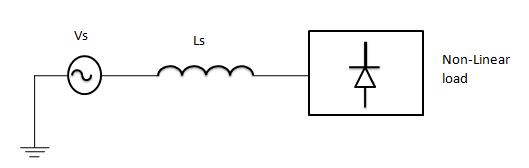
Fig. 3.1:BlockDiagramofThreePhaseGridFeeding aNon-LinearLoad
Here,Vsisthevoltageorthegrid, Lsisthesourceimpedance. thevoltagesourcehereis athree-phasegrid,whilethelinearloadisaresistive load. The source impedance is the total impedance offeredbythecircuitelements,suchas,transmission anddistributionlines.
Based on the above block diagram, a circuit is simulatedintheMATLABSimulinkPlatform,asshown inthefigure3.2
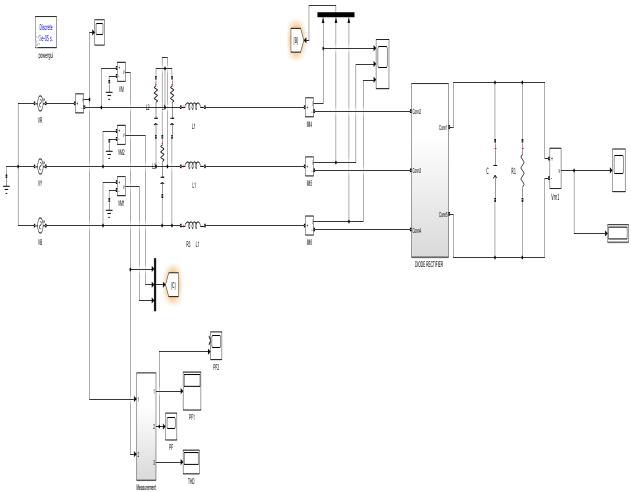
Fig. 3.2: SimulinkModelofThreePhaseGridFeeding aNon-LinearLoad.
TheMeasurementblockisusedtomeasurethevalues of active power supplied to the load, reactive power drawnfromtheloadandthepowerfactor
International Research Journal of Engineering and Technology (IRJET) e-ISSN: 2395-0056
Volume: 13 Issue: 05 | May 2026 www.irjet.net p-ISSN: 2395-0072
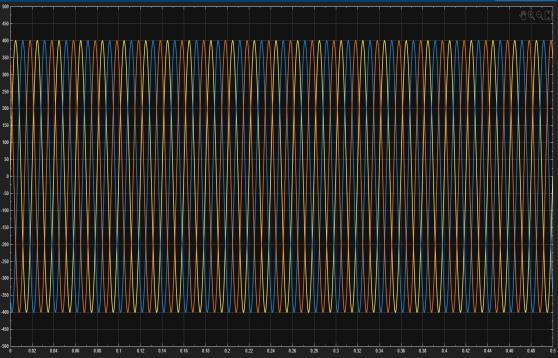
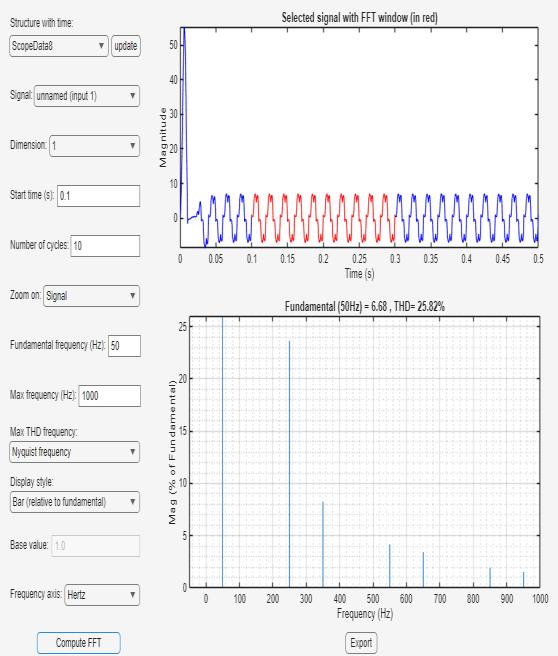
Fig. 3.4: HarmonicSpectrumofSourceCurrentdue tononlinearload
The output window for FFT analysis with the Bar Graphrepresentationcorrespondingtothemaximum frequency,atthesourceendisshowninthefigures3.4 TotalHarmonicDistortionattheSourceEnd:25.82%.
Case2:ThreePhaseGridFeedingaNon-LinearLoad withShuntPassiveFilterandShuntActivePowerFilter (SAPF)withHysteresisCurrentController(HCC):
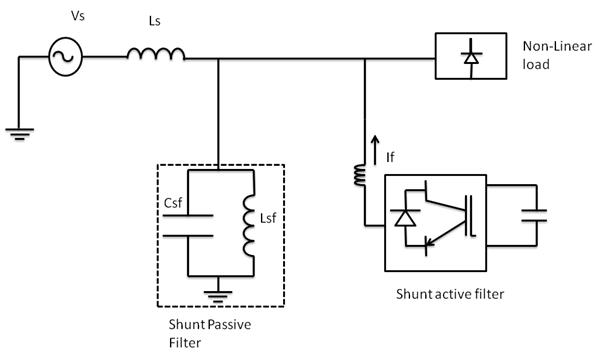
Fig. 3.5: BlockDiagramofGridFeedingaNon-Linear LoadwithShuntPassiveFilterandShuntActive PowerFilter(SAPF)withHysteresisCurrentControl (HCC).
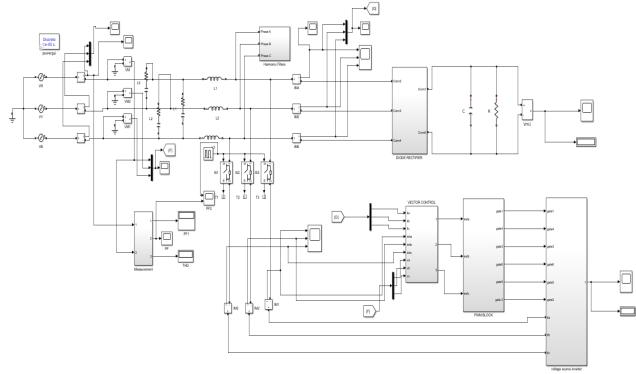
Fig. 3.5:SimulinkModelofThreePhaseGridFeeding aNon-LinearLoadWithactiveandpassivefilters.
The block diagram and simulated circuit of Grid FeedingaNon-LinearLoadwithShuntPassiveFilter andShuntActivePowerFilter(SAPF)withHysteresis CurrentControl(HCC)isshowninfigure 3.4and3.5 respectively.
Thebeneficialfeatureofactiveandpassiveshuntfilter iscombinedtodevelopahybridfilterwhereboththe compensator function in tandem to eliminate the distortionissueduetoharmonics
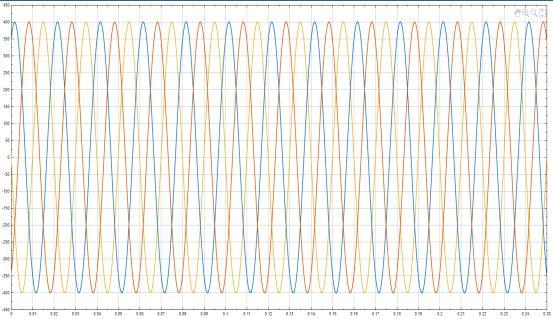
Fig:3.6 SourceVoltagewaveform
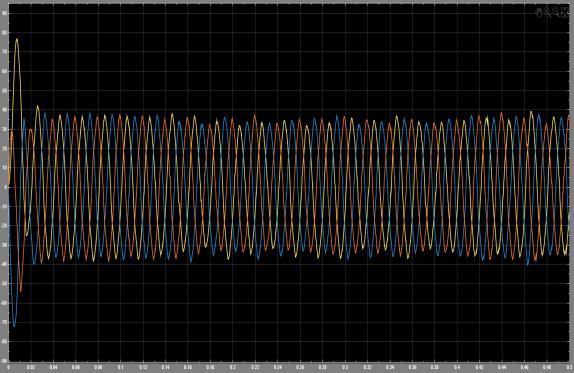
Fig:3.7 SourceCurrentwaveform
International Research Journal of Engineering and Technology (IRJET) e-ISSN: 2395-0056
Volume: 13 Issue: 05 | May 2026 www.irjet.net p-ISSN: 2395-0072
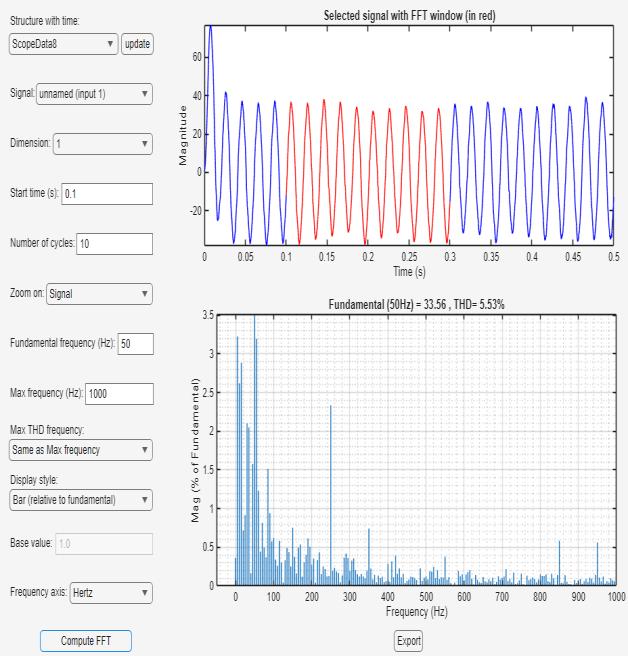
:3.8 Harmonicspectrumofwaveform
Thecombinedresultsofactiveandpassiveshuntfilter isdisplayedinthefigure4.20,TheFFTanalysiscarried outonthesourcecurrentisasdisplayedinthefigure 4.20, the results obtained revealed the reduction of currentTHDformabout28%to5.53%,alsotheeffect of lower order harmonics is reduced showing the effectivenessoftunedshuntactivefilterinmitigation oftheLOHsignificantlyandreducingtheTHDasper theprescribedIEEEstandardlimits.alsoitisobserved thattheperformanceofhybridfilterisslightlysuperior incomparisonwithpassivefilterastheTHDisreduced to 5.53% in comparison of 8.53% in passive filter. however, the performance of hybrid filter is slightly inferiorincomparisonwithactivefilterastheTHDis increasedto5.53%incomparison.
This thesis presents the performance evaluation of differentfiltertopologiesclearlyhighlightsthecritical roleoffilteringtechniquesinimprovingpowerquality inelectricalsystems.Withoutanyfiltering,thesystem suffersfromextremelyhighTotalHarmonicDistortion (THD) of 25.82%, indicating severe waveform distortion caused by nonlinear loads. This not only reducessystemefficiencybutalsoposesriskssuchas overheating, equipment malfunction, and increased losses.Additionally,thepowerfactorof0.9311reflects suboptimalutilizationofelectricalpower.
The hybrid filter, which combines both passive and active filtering approaches, offers the most balanced andoptimizedperformance.ItreducesTHDto5.53%, whichissignificantlylowerthanthepassivefilterand close to the active filter’s performance. More importantly, it achieves the highest power factor of 0.9971, nearly unity, indicating excellent reactive powercompensationandmaximumenergyutilization. This combination leverages the strengths of both filtering methods while minimizing their individual limitations.
[1]A.Hamadi,S.Rahmani,andK.Al-Haddad,“Ahybrid passive filter configuration for VAR control and harmonic compensation,” IEEE Trans. Ind. Electron., vol.57,no.7,pp.2419–2434.
[2] A. Luo, Z. Shuai, W. Zhu, and Z. John Shen, “Combined system for harmonic suppression and reactive power compensation,” IEEE Trans. Ind. Electron.,vol.56,no.2,pp.418–428.
[3]A.Luo,S.Peng,C.Wu,J.Wu,andZ.Shuai,“Power electronic hybrid system for load balancing compensation and frequency-selective harmonic suppression,”IEEETrans.Ind.Electron.,vol.59,no.2, pp.723–732.
[4]M.I.Milanés-Montero, E.Romero-Cadaval,andF. Barrero-González,“HybridMultconverterconditioner topologyforhigh-powerapplications,”IEEETrans.Ind. Electron.,vol.58,no.6,pp.2283–2292.
[5] S. Rahmani, A. Hamadi, and K. Al-Haddad, “A Lyapunov-function-based control for a three-phase shunthybridactivefilter,”IEEETrans.Ind.Electron., vol.59,no.3,pp.1418–1429.
[6] A. Bhattacharya, C. Chakraborty, and S. Bhattacharya,“Parallelconnectedshunthybridactive power filters operating at different switching frequencies for improved performance,” IEEE Trans. Ind.Electron.,vol.59,no.11,pp.4007–4019.