
International Research Journal of Engineering and Technology (IRJET) e-ISSN: 2395-0056
Volume: 12 Issue: 04 | Apr 2025 www.irjet.net p-ISSN: 2395-0072
International Research Journal of Engineering and Technology (IRJET) e-ISSN: 2395-0056
Volume: 12 Issue: 04 | Apr 2025 www.irjet.net p-ISSN: 2395-0072
Madupu Hema1, Madeshi Keerthana2, Ragam Ajay3 Dr. S. Sreekanth4
1B-Tech 4th year, Dept. of CSE(DS), Institute of Aeronautical Engineering
2 B-Tech 4th year, Dept. of CSE(DS), Institute of Aeronautical Engineering
3 B-Tech 4th year, Dept. of CSE(DS), Institute of Aeronautical Engineering
4Associate Professor, Dept. of CSE(DS), Institute of Aeronautical Engineering
Abstract - In response to escalating environmental pollutionconcerns,thisabstractpresentsanadvancedsensorbased system integrated with machine learning for real-time pollutant detection and analysis. The system employs a network of strategically positioned sensors to monitor pollutants, including nitrogen dioxide (NO₂), ozone (O₃), particulate matter (PM2.5 and PM10), and volatile organic compounds (VOCs). Sensor data is transmitted to a central unit, where machine learning algorithms like SVM and CNN analyzepatterns,trends,andanomaliesforaccuratepollutant characterization. Advanced data analysis techniques identify pollutant sources and assess risks, while adaptive learning enhances accuracy and predictive capabilities over time, optimizing pollution monitoring and management efforts.
Key Words: Sensor-based system, pollutants detection, Machine learning algorithms, Data analysis techniques, Environmental monitoring, Real- time analysis, public health, Adaptive learning
Therapidgrowthofurbanizationandindustrializationhas significantly increased air pollution, posing severe health andenvironmentalchallenges.Addressingtheseissues.Air pollution is a critical global issue, requiring advanced research on its causes, impacts, and mitigation strategies. This literature survey highlights key studies focusing on concept of eco-friendly or smart cities has emerged, emphasizing technology integration to promote healthier urbanenvironments.Acorecomponentofsuchcitiesisrealtimepollutantdetectionsystemsusingadvancedsensors.
These sensors monitor pollutants like nitrogen dioxide (NO₂),sulfurdioxide(SO₂),particulatematter (PM2.5and PM10), carbon monoxide (CO), and volatile organic compounds (VOCs), which are linked to respiratory and cardiovasculardiseasesandenvironmentaldegradation.By collecting real-time data, cities can identify pollution hotspots, predict trends, and implement preventive measures.Smartsensors,beingcompact,cost-effective,and easytodeploy,offerscalablesolutionsforurbanmonitoring.
Machinelearninganddatavisualizationplayacriticalrole, enabling data analysis, trend prediction, and actionable
insights. Tools like heat maps and dashboards make pollutiondataaccessible,empoweringcitizensandfostering civicengagement.IntegrationwithtechnologieslikeIoTand cloud computing enhances data sharing and crossdepartmentalcollaboration,enablingadynamicresponseto pollutionchallenges.
Airpollutionhasemergedasasignificantenvironmentaland public health issue globally, necessitating comprehensive research to understand its causes, effects, and mitigation strategies. In this literaturesurvey, we review key studies relatedtoairpollutionmonitoring,forecasting,andcontrol, with a focus on the application of machine learning techniquesforairqualityprediction.
Zhang et al. (2021) explored the application of machine learningtechniquesinairpollutionprediction,particularly using Random Forest and Support Vector Machines to analyzedatafromsmartsensors[2].Theirstudyshowedthat thesemodelscanaccuratelypredictshort-termfluctuations in pollution levels based on historical data, improving the capacity for real-time decision-making. This research highlights the potential of machine learning models in enhancingtheaccuracyandefficiencyofpollutantdetection systemsinsmartcities.
Chengetal.(2020)focusedonthespatialdistributionofair pollution and proposed a Geographic Information System (GIS)-based approach to map pollution hotspots in urban areasusingdatafromairqualitysensors[4].Theirfindings demonstratedthatcombiningsensordatawithGIStoolscan helpcityplannersandpolicymakersidentifyhigh-riskareas andprioritizeinterventions.Thisstudyunderscorestheneed forspatialdataanalysisinmanagingpollutionineco-friendly cities.
Thesestudiesunderlineadvancementsinsensortechnology, data analysis, and predictive modeling as essential components for eco-friendly cities, enabling real time monitoring and targeted solutions for sustainable urban living.
International Research Journal of Engineering and Technology (IRJET) e-ISSN: 2395-0056
Volume: 12 Issue: 04 | Apr 2025 www.irjet.net p-ISSN: 2395-0072
3.1
Theproposedsystemaimstoaddressthegrowingneedfor real-time,affordableairqualitymonitoringineco-friendly cities by leveraging sensor networks and advanced data analysistechniques.Thecoreofthissystemisbuiltaround the Arduino Uno board, which serves as the platform for integratingvariouspollutant-detectingsensors,suchasthe MQ135forgaseslikeCO2andammonia,theMQ7forcarbon monoxide,andtheMQ2fordetectingsmokeandflammable gases. These sensors, combined with the DHT11 for monitoringenvironmentalparametersliketemperatureand humidity,formacomprehensivesetupcapableofcapturing awiderangeofpollutantdata.Thehardwaresetupensures thatallkeyairpollutants,criticaltourbanenvironments,are continuouslymonitoredinreal-time,allowingcitiestoassess andrespondtopollutionlevelsdynamically.
Thesystemprocessesthecollectedsensordatausingdata analysistechniquestocalculatetheAirQualityIndex(AQI),a widely used standard for quantifying air quality based on pollutantconcentrations.TheAQIiscalculatedbyapplying pre-establishedformulas,transformingrawsensorreadings intoaunifiedindexthatsimplifiestheunderstandingofair pollutionlevels.ThissystemthencategorizestheAQIinto various health risk levels, such as "Good," "Moderate," or "Unhealthy,"basedonthresholdsdefinedbyenvironmental agencies.
3.2 Hardware Setup:
ThecorecomponentsofthesystemincludetheArduinoUno, MQ135(generalairqualitysensor),MQ7(carbonmonoxide sensor), MQ8 (hydrogen gas sensor), and DHT11 (temperature and humidity sensor). These sensors are connectedtotheanaloganddigitalpinsoftheArduinoUno tocapturereal-timeenvironmentaldata.
3.3 Data Acquisition:
Sensor readings are collected at regular intervals using ArduinoIDE.TheArduinoboardreadsanalogvaluesfrom thegassensorsanddigitalvaluesfromDHT11andsendsthe dataviaUSBtoacomputerusingserialcommunication.
3.4 Data Logging:
The data transmitted by Arduino is captured using CoolTerm,a serial communicationterminal.Thereal-time sensor data is saved in .txt or .csv format, which is later convertedintoExcelformatforprocessingandanalysis.
3.5 Data Preprocessing:
Preprocessingisperformedtocleanandformatthedataset. This includes removing incomplete or noisy entries, convertingrawsensorvaluesintogasconcentrationvalues
(ppm)usingcalibrationcurves,interpolatingmissingvalues, and normalizing data where necessary. Timestamping is usedtoalignreadingsforaccuratetime-seriesanalysis
3.6 Sensor Calibration:
Each sensor was calibrated based on reference data provided in the sensor datasheets. Baseline values were establishedincleanairconditionstodetermineoffsetvalues, and calibration formulas were applied to map raw analog readingstoreal-worldpollutantconcentrations.
3.7 AQI Computation:
TheAirQualityIndex(AQI)iscomputedforeachpollutant using standardized breakpoint tables and linear interpolation formulas. The highest individual AQI value amongallpollutantsisconsideredtheoverallAQIforthat reading. This AQI is then categorized into levels such as Good, Moderate, and Unhealthy to help interpret environmentalconditions.
3.8 Data Analysis and Visualization:
Theprocesseddataisanalyzedusingstatisticalmethodsto understand pollution trends. Visualization is done using Excelchartssuchaslinegraphs,barcharts,andscatterplots todisplayfluctuationsinpollutantlevelsovertimeandtheir relationshipwithtemperatureandhumidity.
4. SYSTEM ARCHITECTURE:
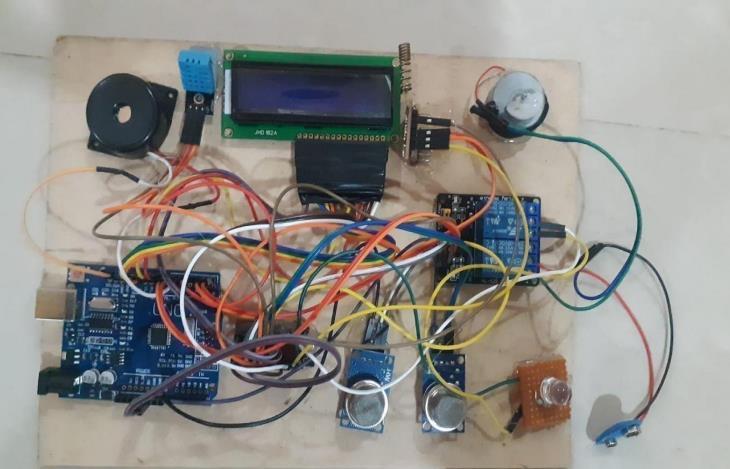
Fig-1: ProposedArchitecture
The system architecture for air quality prediction encompassesseveralkeycomponentstoeffectivelyprocess, train,andevaluatepredictivemodels.
4.1 Hardware Setup:
The system uses an Arduino Uno board to interface with various gas sensors and environmental sensors: MQ135: Detects gases like ammonia, benzene, alcohol, and carbon dioxide,crucialforidentifyingairquality.DHT11:Measures
International Research Journal of Engineering and Technology (IRJET) e-ISSN: 2395-0056
temperatureandhumidity,whichareimportantparameters for adjusting sensor readings. MQ7: Monitors carbon monoxide(CO)levels,asignificantpollutantinurbanareas. MQ2:DetectssmokeandflammablegasessuchasLPGand methane, providing an additional layer of pollutant detection. MQ8: Measures hydrogen concentration, which canbeafactorincertainindustrialareas.Breadboard:Acts as the connection point for all sensor components. LED Light:Usedtoprovidevisualfeedbackofairqualitylevels based on the AQI (e.g., Green for "Good," Yellow for "Moderate,"Redfor"Unhealthy").
4.2 Data Collection:
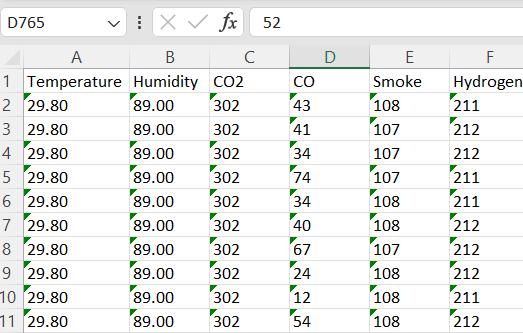
The sensors capture real-time data on pollutants, temperature,andhumidity.Thisdataistransmittedfromthe Arduino Uno to a laptop using CoolTerm, a serial communicationsoftwarethatallowsthedatatobecaptured andstored.ThecollecteddataisthenexportedintoanExcel sheetforfurtherprocessingandanalysis.
4.3 Data Processing:
TherawdataobtainedfromMQ135,MQ7,MQ8,andDHT11 sensors through the Arduino Uno was collected using CoolTerm and converted into Excel format for further processing.Datapreprocessinginvolvedcleaningnoisyand incomplete entries, assigning accurate timestamps, and calibratingsensoroutputsusingstandardreferencevalues fromdatasheets.Missingoranomalousvalueswereeither removedorinterpolatedtomaintainconsistency.Relevant featuressuchaspollutantconcentrations,temperature,and humidity were selected, and new columns were added to computetheAirQualityIndex(AQI).Thefinaldatasetwas structured and normalized to ensure accuracy in analysis andvisualizationofairqualitytrends.
4.4
Dataanalysiswascarriedoutonthepreprocesseddatasetto identify trends, correlations, and variations in pollutant levelswithrespecttoenvironmentalconditions.Time-series plots were generated to visualize fluctuations in gas concentrations (CO, H₂, and general air quality) alongside
temperature and humidity. Statistical analysis was performed to observe the relationship between environmental factors and pollutant behavior. The Air QualityIndex(AQI)wascomputedforeachdatapointusing standardguidelines,andtheresultswerecategorizedinto different air quality levels such as Good, Moderate, and Unhealthy.Theseinsightshelpedinunderstandingpollution patterns and evaluating the overall air quality in the monitoredarea.
Calibrationofsensor readingswasessential toensurethe accuracy and reliability of the data collected from the MQ135,MQ7,andMQ8gassensors.Eachsensorproduces analog output values that were converted into corresponding gas concentration levels (in ppm) using calibrationcurvesprovidedintheirrespectivedatasheets. Baseline readings were first recorded in a clean air environment to determine the reference voltage levels. These values were then used to adjust the raw data, compensatingforenvironmentalnoiseandsensordrift.The DHT11 sensor, which provides digital readings for temperatureandhumidity,requiredminimalcalibrationbut wasverifiedusingastandardthermometerandhygrometer to ensure consistency. Overall, proper calibration enabled the conversion of raw sensor outputs into meaningful environmentalpollutantindicators.
The Air Quality Index (AQI) was calculated to provide a standardizedrepresentationofairpollutionlevelsbasedon the sensor data collected. Concentrations of individual pollutants such as carbon monoxide (CO) from the MQ7 sensor, hydrogen (H₂) from MQ8, and general air quality indicators from MQ135 were converted into sub-indices using established breakpoint tables provided by environmentalregulatorybodies.TheAQIforeachpollutant wascomputedusingalinearinterpolationformula,andthe highest sub-index value among the pollutants was consideredthefinalAQIforagiventimeinterval.Thisindex wasthenclassifiedintocategoriessuchasGood,Moderate, orUnhealthytohelpinterpretthepollutionseverityinan easily understandable format. The AQI values were also visualizedtoidentifytrendsandhighlightperiodsofpoorair quality.
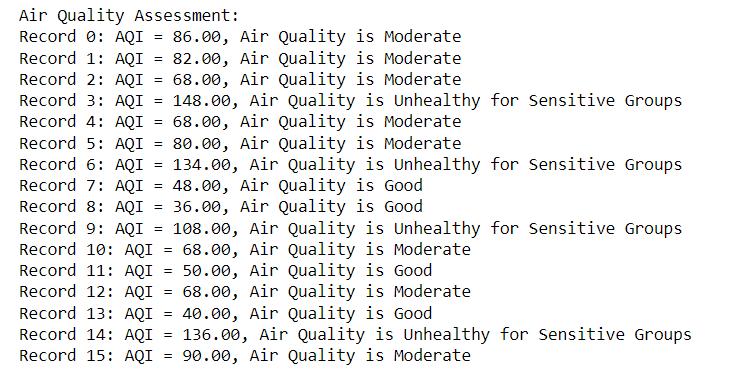
ThecategorizationofairqualityisbasedonthecalculatedAir Quality Index (AQI), which provides a simplified representationofpollutionlevelstoassesspotentialhealth impacts. Once the AQI is computed for each pollutant, the highestvalueisselectedastheoverallAQIandismappedto standardcategoriessuchasGood(0–50),Moderate(51–100), UnhealthyforSensitiveGroups(101–150),Unhealthy(151–200),VeryUnhealthy(201–300),andHazardous(301–500).
Volume: 12 Issue: 04 | Apr 2025 www.irjet.net p-ISSN: 2395-0072 © 2025, IRJET | Impact Factor value: 8.315 | ISO 9001:2008 Certified Journal | Page800
International Research Journal of Engineering and Technology (IRJET) e-ISSN: 2395-0056
Volume: 12 Issue: 04 | Apr 2025 www.irjet.net p-ISSN: 2395-0072
Eachcategorycorrespondstoaspecificcolorcodeandhealth advisory,makingiteasierforthepublicandcityplannersto interpret environmental conditions. This classification enablestimelyactionstobetakenduringperiodsofpoorair qualityandsupportseffortstomaintaineco-friendlyurban environments.
Data visualization and reporting played a crucial role in understandingandinterpretingtheenvironmentalconditions recorded by the sensors.After preprocessing thecollected datainExcel,variouschartswerecreatedtovisualizetrends andpatternsinpollutantlevels,temperature,andhumidity. Linegraphswereusedtorepresentreal-timefluctuationsin gas concentrations detected by MQ135, MQ7, and MQ8 sensors,whilebarchartscomparedaveragepollutantlevels overdifferenttimeperiods.ThecomputedAirQualityIndex (AQI)valueswerecolor-codedbasedonstandardcategories to clearly indicate air quality status. These visualizations were compiled into a comprehensive report, highlighting pollutionspikes,correlationsbetweentemperatureandgas levels, and areas requiring environmental attention. This reporting framework supports both analysis and effective communication of the findings for eco-friendly urban planning.
4.9 Performance Evaluation:
Theperformanceevaluationofthepollutantdetectionsystem wasconductedbyanalyzingtheaccuracy,consistency,and responsivenessofthesensordataovermultipletestcycles. Sensor readings were compared with standard reference valuesandmanual observationsto validatethecalibration accuracy. The system consistently detected variations in pollutantlevels,temperature,andhumidity,demonstrating reliableperformanceinreal-timeenvironmentalmonitoring. ThecalculatedAQIvaluescloselymatchedexpectedpollution categories based on ambient conditions, confirming the effectiveness of the AQI computation logic. Overall, the system showed stable operation, minimal data loss, and accurate representation of air quality trends, making it suitable for integration into eco-friendly city monitoring frameworks.
5. EXPERIMENTAL RESULTS:
Sensors(MQ135,MQ2,MQ7,DHT11)withanArduinoUno detectairquality,providingpollutantdataforAQIcalculation andanalysis.
5.1 Hardware:
MQ135:Detectsharmfulgaseslikeammonia,benzene,and smokeforoverallairqualitymeasurement.MQ2:Sensitiveto combustiblegases(e.g.,methane,propane,hydrogen)forgas leak detection.MQ7:Detectscarbonmonoxide(CO)levels. DHT11: Measures temperature and humidity for
environmental context. MQ8: Measures hydrogen concentrations,relevantinindustrialareas.ArduinoUno:The microcontroller used to process sensor data and communicate with external systems (e.g., data storage/displayunits).
Thedatacollectionprocessinvolvedcontinuousmonitoring of environmental parameters using a sensor-integrated systembuiltontheArduinoUnomicrocontroller.Thesensors used include MQ135 for detecting multiple harmful gases, MQ7forcarbonmonoxide(CO),MQ8forhydrogen(H₂),and DHT11fortemperatureandhumidity.Thesesensorswere interfaced with the Arduino, and real-time readings were transmittedtoacomputerusingserialcommunication.Data wascapturedusingtheCoolTermsoftware,whichloggedthe sensoroutputsinarawformat.Thisdatawaslaterexported to Excel for preprocessing and analysis. Regular readings were taken at consistent time intervals to ensure the collectionofatime-seriesdatasetsuitablefortrendanalysis andAQIcomputation.
Calibration was a critical step to ensure the accuracy and reliabilityofthesensorreadings.Eachgassensorwasfirst exposedtocleanairtorecordbaselinevalues,whichhelped establishreferencevoltages.Calibrationcurves,asprovided inthesensordatasheets,wereusedtoconvertrawanalog valuesintocorrespondinggasconcentrationlevelsinparts permillion(ppm).Theseformulaswereimplementedduring preprocessingtotranslatesensorvoltagesintomeaningful environmentalmetrics.TheDHT11sensorprovideddigital outputs and was cross-verified with standard measuring instrumentstovalidatetemperatureandhumidityreadings. This calibration process was essential to reduce error, improvedataquality,andensurethattheAQIderivedfrom the data accurately represented the real-world air quality conditions.
Step1:NormalizingEachPollutant'sContributionPollutants were scaled relative to their safety thresholds: CO₂: 5000 ppmCO:50ppmSmoke(PM2.5/PM10):300µg/m³H₂:1000 ppmTemperature(15–30°C)&Humidity(30–60%):Indirect impactonAQI.
Step2:ScalingtoAQIPollutantvalueswerescaledtoa0–100 rangebasedonsafelimits.
Step 3: Optional Temperature and Humidity Impact Flags weresetforextremeconditions:Temperature>30°Cor70% or<60%.
Step 4: Aggregating AQI Values Two methods were used: Max-Based AQI: Total AQI = max(AQI for all pollutants) Weighted Average AQI: Total AQI = (Sum of AQI for all pollutants) / 4 AQI Classification: 0–50: Good 51–100:
International Research Journal of Engineering and Technology (IRJET) e-ISSN: 2395-0056
Volume: 12 Issue: 04 | Apr 2025 www.irjet.net p-ISSN: 2395-0072

FinalOutcome
Thisprojectsuccessfullydemonstratesalow-cost,real-time airqualitymonitoringsystemusingArduinoUnointegrated withMQ135,MQ7,MQ8,andDHT11sensors.Bycollecting environmental data such as pollutant gas concentrations, temperature,andhumidity,thesystemprovidescontinuous insights into air quality levels. The use of serial communicationandCoolTermsoftwareallowedforefficient and structured data logging, which was further enhanced through preprocessing and visualization in Excel. The project emphasizes the importance of real-time data acquisitioninunderstandingenvironmentalconditionsand promotingeco-friendlyurbanliving.
A critical aspect of the system’s effectiveness lies in the calibration of sensors, which ensured that the raw analog outputs were accurately mapped to real-world pollutant concentrationlevels.Calibrationusingbaselinereadingsand datasheet reference curves significantly improved the reliability of the collected data. The calculated Air Quality Index(AQI)basedonstandardguidelinesofferedaclearand understandablerepresentationofpollutionseverity,enabling categorization into levels such as Good, Moderate, or Unhealthy. This standardization not only improves readability for users but also supports public health advisoriesandurbanplanningdecisions.
Thevisualizationandreportingaspectsoftheprojectplayed akeyroleininterpretingthedataandidentifyingpollution trends.Linegraphs,barcharts,andcolor-codedAQItables provideda comprehensive view of environmental changes over time. The reporting framework allowed for the clear presentation of findings, making the system suitable for deploymentinsmartcities,educationalenvironments,and community-driven environmental initiatives. The system’s performancewasevaluatedbasedonaccuracy,consistency, andresponsiveness,withresultsconfirmingitsstabilityand practicalapplicabilityinreal-worldconditions.
Inconclusion,low-costsensorslikeMQ135,MQ2,andMQ7, whenintegratedwithanArduinoUnoboard,caneffectively monitorairqualityandcontributetoAQIcalculations.The data provided real-time insights into urban air quality, identifyingkeypollutionsourcessuchasvehicularemissions (CO)andconstruction-relatedparticulatematter.Whilethe sensorarraywassensitiveenoughtodetectchangesinair quality, the environmental conditions (temperature, humidity)measuredbytheDHT11sensorplayedacritical roleininterpretinggasconcentrationsaccurately.Thestudy confirmed that such sensor-based systems can serve as effective, affordable alternatives for localized air quality monitoring in environments where official monitoring stationsmaybesparse.
ThefuturescopeofairqualitydetectionusingMQ135,MQ2, MQ7,DHT11sensors,andArduinoUnoboardsispromising, particularlyinenhancingurbanairqualitymonitoringand public health initiatives. One potential direction is the development of more advanced sensor networks that incorporate additional parameters such as particulate matter(PM2.5and PM10) sensors forcomprehensive air quality assessments. This expansion would enable more accurateAQIcalculationsandprovideaholisticviewofair pollutionsourcesandtheirimpactonhealth.Furthermore, integrating IoT technologies can facilitate real-time data transmission to cloud platforms, enabling remote monitoring,dataanalysis,andalertsforhazardouspollution levels.
Incorporating machine learning algorithms for predictive analytics could also enhance the system's capabilities, allowingfortheforecastingofairqualitytrendsbasedon historicaldataandenvironmentalfactors.Additionally,the visualizationtoolscanbeupgradedtoprovideinteractive dashboards that offer detailed insights into pollution patterns, enabling policymakers and the public to make informeddecisions.Collaborationswithlocalgovernments andenvironmentalorganizationscouldleadtocommunitybasedinitiativesthatleveragethistechnologyforawareness campaignsandtargetedinterventionstoreducepollution. Overall,theongoingdevelopmentandintegrationofthese sensor technologies present significant opportunities for
International Research Journal of Engineering and Technology (IRJET) e-ISSN: 2395-0056
Volume: 12 Issue: 04 | Apr 2025 www.irjet.net p-ISSN: 2395-0072
improvingairqualitymanagementandenhancingthewellbeingofurbanpopulations.
[1] Bade, A. and Ghosh, A. (2022). "Design and Implementation of an IoT-Based Air Quality Monitoring System." Journal of Ambient Intelligence and Humanized Computing,13(5),pp.2501-2512.
[2] López, M., et al. (2023). "Low-Cost IoT Sensors for Air QualityMonitoring:AReview."Sensors,23(2),739.
[3]Khan,M.A.,etal.(2023)."SmartAirQualityMonitoring SystemUsingArduinoandIoT."IEEEAccess,11,pp.1456714578.
[4] Patil, P. and Jadhav, P. (2023). "Air Quality Monitoring Using Arduino and MQ Sensors: A Comparative Study." International Journal of Electronics and Communication Engineering,10(1),pp.20-27.
[5]Singh,R.andKumar,V.(2022)."Real-TimeAirQuality Monitoring System Using MQ Sensors and Arduino with Visualization." Materials Today: Proceedings, 70, pp. 908912.
[6] Guan, X., et al. (2023). "Real-Time Monitoring of Air QualityinSmartCities:AnIntegratedFramework."Journalof UrbanTechnology,30(1),pp.75-93.
[7]Adhikari,A.,etal.(2023)."DevelopmentofanAutomated AirQualityMonitoringSystemUsingArduino."International Journal of Environmental Science and Technology, 20, pp. 1567-1582.
[8]X.Li,L.Jin,andH.Kan,‘‘Airpollution:Aglobalproblem needslocalfixes,’’ Nature, vol. 570, no. 7762, pp. 437–439,Jun.2019.
[9]Y. Han, J. C. K. Lam, and V. O. K. Li,‘‘ABayesianLSTM model to evaluate the effects of air pollution control regulationsinChina,’’inProc.IEEEBigDataWorkshop(Big Data),Dec.2018,pp.4465–4468.
[10]L.Bai,J.Wang,X.Ma,andH.Lu,‘‘Airpollutionforecasts: Anoverview,’’Int.J.Environ. Res. Public Health, vol. 15, no. 4,p.780,2018.
[11]Y.DingandY.Xue,‘‘Adeeplearningapproachtowriter identificationusinginertialsensordataofair-handwriting,’’ IEICETrans.Inf.Syst.,vol.E102-D,no.10,pp.2059–2063, 2019.
[12] S.-Q. Dotse, M. I. Petra, L. Dagar, and L.C. De Silva, ‘‘Application of computational intelligence techniques to forecast daily PM10 exceedances in Brunei Darussalam,’’ Atmos. Pollut. Res., vol. 9, no. 2, pp. 358–368,Mar.2018