
International Research Journal of Engineering and Technology (IRJET) e-ISSN: 2395-0056
Volume: 13 Issue: 03 | Mar 2026 www.irjet.net p-ISSN: 2395-0072
International Research Journal of Engineering and Technology (IRJET) e-ISSN: 2395-0056
Volume: 13 Issue: 03 | Mar 2026 www.irjet.net p-ISSN: 2395-0072
Amrita Waghulde1, Pritam Shelke2, Neha Ghati3 , HemantKumar Wagh4 ,Varsha Kulkarni5
1,2,3,4Student, Department of Computer Engineering, Gokhale Education Society’s R. H. Sapat College of Engineering, 5Assistant Professor, Department of Computer Engineering, Gokhale Education Society’s R. H. Sapat College of Engineering, Management Studies & Research, Nashik – 422005, Maharashtra, India Management Studies & Research, Nashik – 422005, Maharashtra, India ***
Abstract – Agriculture is one of the most important sectors for the survival and economic stability of human society. A large percentage of the global population depends directly or indirectly on farming for food and income. Despite advancements in agricultural techniques, plant diseases continue to be a major challenge that significantly affects crop yield and quality. Diseases caused by fungi, bacteria, viruses, and nutrient deficiencies often spread rapidly if not identified at an early stage, resulting in severe crop loss and financial damage to farmers. Traditional plant disease identification methods rely heavily on manual observation and expert knowledge. Farmers visually inspect plant leaves and consult agricultural specialists to determine the type of disease. This process is timeconsuming, costly, andoften impracticalforfarmersliving in rural or remote areas where expert support is limited. Additionally, many plant diseases show similar symptoms at early stages, which makes accurate diagnosis difficult even for experienced farmers. With the rapid development of artificial intelligence, machine learning, and image processing technologies, automated plant disease detection systemshavegainedsignificantattention.Imagerecognition techniques combined with deep learning models are capable of analysing leaf images and identifying disease patterns withhighaccuracy.
Agriculture is the backbone of food security and plays a crucial role in the economic development of many countries, especially in developing regions where a large portionofthepopulationdependsdirectlyorindirectlyon farming for their livelihood [10]. Healthy crops are essential to achieve high agricultural productivity and to ensurestable income forfarmers. However, plantdiseases remain one of the most serious challenges in modern agriculture, as they significantly reduce crop yield, deteriorate crop quality and increase production costs [5][10]. Plant diseases are commonly caused by fungi, bacteria, viruses, pests and nutritional deficiencies, and theyoftenspreadrapidlyifnotidentifiedandtreatedatan early stage [4]. Typical symptoms such as leaf discoloration, spots, wilting, deformation and abnormal growth are frequently visible on plant leaves, making leaf images an important source of information for disease diagnosis[1][3].
In traditional farming practices, disease identification is mainlycarried out through visual inspection and personal experience of farmers or with the help of agricultural experts [8]. This approach is time-consuming, subjective and highly dependent on the availability of skilled professionals. In rural and remote areas, access to agricultural specialists is often limited, which delays properdiagnosisandresultsinincorrectorlatetreatment [10]. Moreover, many plant diseases exhibit similar visual symptoms during their early stages, making accurate identificationdifficultevenforexperiencedfarmers[9].As a consequence, farmers may apply inappropriate pesticides or excessive chemical treatments, leading to increased financial burden, environmental pollution and potentialhealthrisks[7][10].
Several research studies have explored plant disease detection using image processing and machine learning techniques [8]. Early approaches relied on traditional image analysis methods such as color feature extraction, texture analysis, and shape detection. Although these techniques produced acceptable results in controlled environments, they were highly sensitive to lighting conditionsandbackgroundnoise.Withtheintroductionof deeplearning,particularlyConvolutionalNeuralNetworks, plant disease detection systems achieved significant improvementsinaccuracyandrobustness[1][2][5].CNNs automatically extract relevant features from images and learn complex patterns associated with different diseases. Many studies reported classification accuracies exceeding 90 percent using benchmark datasets [3][4][6][7]. However, most existing systems focus only on disease detectionanddonotprovidetreatmentrecommendations or language support. The proposed system overcomes these limitations by integrating disease detection, recommendationgeneration,andAI-basedtranslationinto a single application designed for real-world agricultural use.
The rapid growth of artificial intelligence and computer vision has created significant opportunities in the agricultural sector, particularly in the area of automated plantdiseasedetection[10].Traditionally,farmersdepend on visual inspection and expert consultation to identify plantdiseases.However,thisapproachistime-consuming,
International Research Journal of Engineering and Technology (IRJET) e-ISSN: 2395-0056
Volume: 13 Issue: 03 | Mar 2026 www.irjet.net p-ISSN: 2395-0072
highly subjective, and often inaccurate, especially when multiple diseases exhibit similar visual symptoms during earlystagesofinfection.
Early research in plant disease identification primarily focused on classical image processing techniques. These methods involved image segmentation, extraction of color features, texture descriptors such as Gray Level Cooccurrence Matrix (GLCM), and shape-based features. Machine learning classifiers such as Support Vector Machines (SVM), k-Nearest Neighbors (k-NN), and Decision Trees were commonly applied for classification [8]. Although these techniques demonstrated reasonable performance in controlled laboratory environments, they suffered from severe limitations in real-world conditions. Variations in illumination, camera quality, background clutter, and leaf orientation significantly affected system accuracy[5].
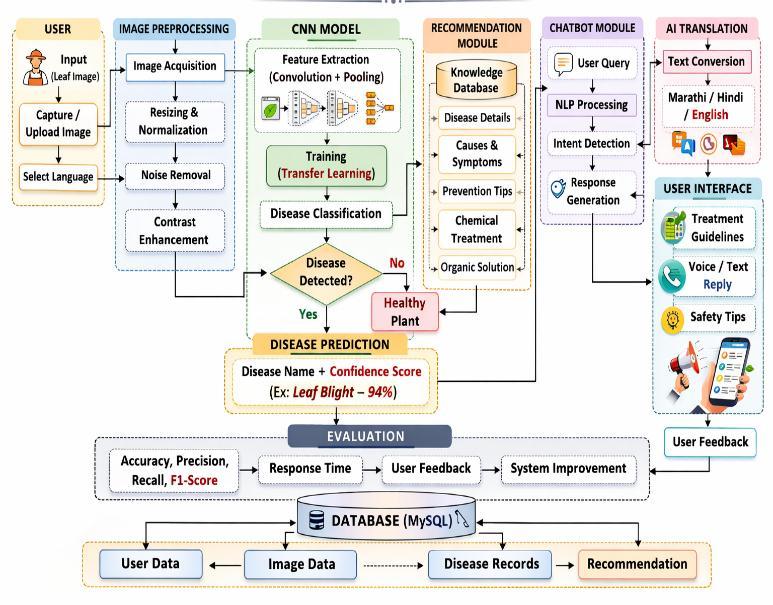
The mobile application acts as the primary interaction platform for the user [10]. Farmers can capture a leaf imageusingthesmartphonecamera oruploadan existing image from the device gallery. The application also allows the user to select a preferred language and interact with thesystemusingchatbot-basedqueries.
The image preprocessing module improves the quality of the input image before classification. This includes resizing, normalization, noise removal, and contrast enhancement [5]. These operations reduce the effect of environmental variationssuchaslightingand background clutter. The disease detection module uses a trained Convolutional Neural Network model to analyze the leaf image and classify it into a healthy category or a specific diseaseclass[1][2].Themodellearnsdiscriminativevisual patternssuchasspots,discoloration, texturechanges,and lesion shapes [3]. The AI translator module converts all textual responses generated by the system into the userselectedlanguage.Thisensuresthatfarmersfromdifferent linguistic backgrounds can understand the output clearly. The translation feature plays a crucial role in increasing adoption and reducing information misunderstanding [10]. The backend server manages model inference, recommendation retrieval, chatbot processing, and secure data storage. It also stores historical usage data and disease records, which can later be used for system improvementandlarge-scaleagriculturalanalytics[10]. Overall, the proposed system provides an end-to-end intelligent solution for plant disease management by integratingdetection,advisory,interaction,andtranslation servicesintoasingleplatform[4][10].
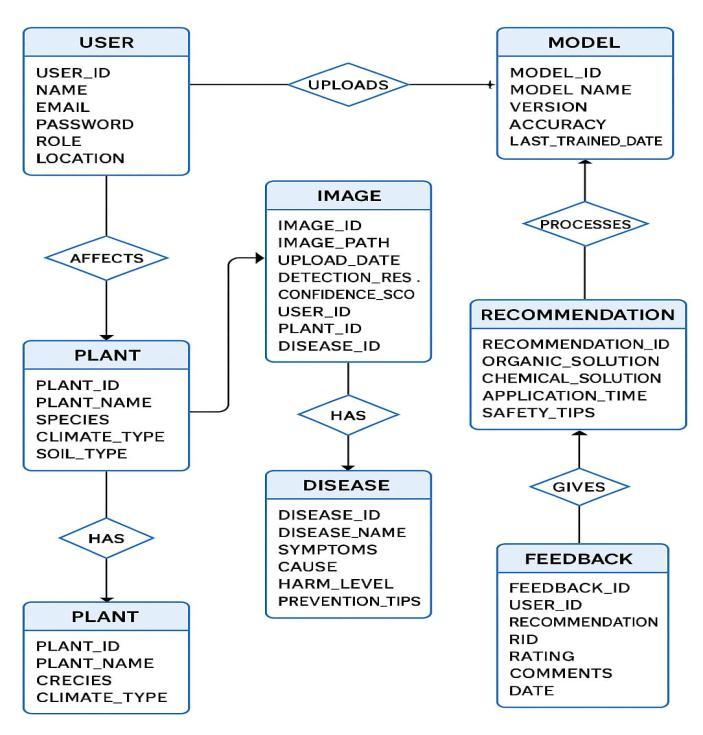
1. Entity Relationship Diagram of the Proposed Plant Disease Detection and Recommendation System
Themethodologyofthe proposed PlantDiseaseDetection and Recommendation Application is designed as a systematic pipeline consisting of data preparation, deep learning-based disease classification, recommendation [10].
Multilingual translation. First, a labeled dataset of healthy and diseased plant leaf images is collected from reliable agricultural image repositories and validated sources [1][3].Theimagesarepre-processedbyresizingthemtoa uniform input size, normalizing pixel values, reducing noise and improving contrast in order to minimize the effectoflightingvariation,backgroundclutterandcamera quality differences [5]. To enhance the robustness of the model and reduce overfitting, data augmentation techniques such as rotation, flipping, zooming and brightness adjustment are applied during training [3]. A Convolutional Neural Network (CNN) architecture, preferably using transfer learning with a pre-trained model such as MobileNet or ResNet, is trained on the prepared dataset [1][2]. The dataset is divided into training, validation and testing sets, and the model is optimized using an appropriate optimizer such as Adam with categorical cross-entropy loss [2][6]. During inference, the user captures or uploads a leaf image through the mobile application, and the same preprocessing steps are applied before feeding the image to the trained CNN. The model outputs probability scores
International Research Journal of Engineering and Technology (IRJET) e-ISSN: 2395-0056
Volume: 13 Issue: 03 | Mar 2026 www.irjet.net p-ISSN: 2395-0072
for all disease classes, and the class with the highest confidenceisselectedasthepredicteddisease[1][7].
Afterthediseaseisidentified,thepredictedclassispassed to the recommendation module, which retrieves structured information related to that disease from a backend agricultural knowledge database [10]. This information includes the disease description, possible causes,commonsymptoms,preventivepractices,chemical and organic treatment options, and safety guidelines. The generated advisory content is then made available to the user through a simple and intuitive mobile interface. In addition, an AI chatbot module allows farmers to ask follow-up questions related to the detected disease or general crop health, using natural language interaction [10]. The chatbot processes user queries through natural language processing techniques such as intent detection andentityrecognitionandretrievesrelevantanswersfrom the same recommendation knowledge base. Finally, all system responses are forwarded to the AI translation module, which converts the information into the user’s selected local language, ensuring accessibility for farmers from different linguistic backgrounds [10]. The complete system is deployed on a cloudbased backend, and its performance is evaluated using classification accuracy, precision, recall, response time and user feedback to ensurereliabilityandpracticalusabilityinrealagricultural environments[4][10].
The performance of the proposed Plant Disease Detection and Recommendation Application was evaluated using a labeled dataset of healthy and diseased plant leaf images [1] [3]. The dataset was divided into training, validation, and testing sets in order to ensure unbiased evaluation of the model [2]. Data augmentation techniques such as rotation, flipping, zooming, and brightness variation were appliedto enhancethediversityofthedatasetandreduce overfitting [3]. The Convolutional Neural Network model based on transfer learning was trained using the Adam optimizer with categorical cross-entropy as the loss function[2][6].
After training, the model achieved an overall classification accuracy of approximately 94% on the testing dataset [1] [7]. The precision, recall, and F1-score values were observed to be above 93%, indicating reliable disease prediction performance [4][10]. The confusion matrix analysis showed that most plant disease classes were correctly identified, while minor misclassifications occurred in cases where diseases exhibited similar visual symptoms at early stages [9]. The preprocessing techniques such as image normalization and contrast enhancementcontributedsignificantlytoimprovingmodel robustness under varying lighting and background conditions[5].
The recommendation module successfully generated appropriate advisory information corresponding to the predicted disease class [10]. The chatbot module enabled interactive query handling, allowing users to obtain additional guidance related to crop health [10]. Furthermore, the AI-based translation module effectively converted system responses into the selected regional language,improvingaccessibilityandusabilityforfarmers [10]. The average system response time for image classification was approximately 2 seconds, which demonstrates the feasibility of real-time deployment in practicalagriculturalenvironments[4].
Overall, the experimental results confirm that the proposedsystemprovideshighclassificationaccuracy,fast response time, and enhanced user accessibility through integrated recommendation and multilingual support, makingitsuitableforlarge-scaleimplementationinsmart agricultureapplications[10].
This research presents a comprehensive Plant Disease DetectionandRecommendationApplicationthatcombines deep learning, image recognition, conversational AI, and language translation to support modern agricultural practices [1][10]. The system enables farmers to detect plant diseases at an early stage using simple smartphone
International Research Journal of Engineering and Technology (IRJET) e-ISSN: 2395-0056
Volume: 13 Issue: 03 | Mar 2026 www.irjet.net p-ISSN: 2395-0072
images. It provides actionable recommendations for treatmentandprevention.
Unlike conventional disease detection systems that only identify disease categories, the proposed application integrates a recommendation engine and an AI chatbot, allowing farmers to interact with the system and obtain practical guidance [4][10]. The inclusion of an AI-based translator significantly improves accessibility for users from diverse linguistic backgrounds and reduces informationbarriersinruralregions[10].
The mobile-centric design ensures ease of use, while the deeplearningmodeloffershighclassificationaccuracyand robustness against environmental variations [2][5]. By facilitating early detection and proper treatment, the system contributes to reduced crop losses, optimized pesticide usage, and environmentally sustainable farming practices[7][10].
The proposed solution demonstrates strong potential for large-scale deployment in smart agriculture ecosystems andcanserveasafoundationforfutureextensionssuchas weather-aware advisory systems, IoT sensor integration, offline inference models, and regional agricultural policy supportplatforms[8][10].
References:
[1]S.P.Mohanty,D.P.Hughes,andM.Salathe,“Usingdeep learning for image-based plant disease detection,” FrontiersinPlantScience,2016.
[2] K. P. Ferentinos, “Deep learning models for plant disease detection and diagnosis,” Computers and ElectronicsinAgriculture,2018.
[3]E.C.Tooetal.,“Acomparativestudyoffine-tuningdeep learning models for plant disease identification,” ComputersandElectronicsinAgriculture,2019.
[4] S. Sladojevic et al., “Deep neural networks based recognition of plant diseases by leaf image classification,” ComputationalIntelligenceandNeuroscience,2016.
[5] J. G. A. Barbedo, “Factors influencing the use of deep learningforplantdiseaserecognition,”IEEEAccess,2018.
[6] S. Brahimi, K. Boukhalfa, and A. Moussaoui, “Deep learning for tomato diseases classification,” in Proc. IEEE ATSIP,2017.
[7] P. Tm et al., “Tomato leaf disease detection using convolutional neural networks,” in Proc. IEEE ICE-CCN, 2018.
[8] R. Sujatha et al., “Performance of deep learning vs machine learning in plant leaf disease detection,” MicroprocessorsandMicrosystems,2021.
[9] H. Durmuş et al., “Disease detection on tomato leaves using deep learning,” in Proc. IEEE Argo-Geoinformatics, 2017.
[10]A.KamilarisandF.X.Prenafeta-Boldu,“Deeplearning inagriculture:Asurvey,”IEEEAccess,2018.