
International Research Journal of Engineering and Technology (IRJET) e-ISSN: 2395-0056
International Research Journal of Engineering and Technology (IRJET) e-ISSN: 2395-0056
R. S. Ganorkar1, Dr. M. L. Gulhane2
1PG student, Department of Civil Engineering, Government College of Engineering, Amravati (M. S.), 444604, India
2Adjunct Professor, Department of Civil Engineering, Government College of Engineering, Amravati (M. S.), 444604, India
Abstract - Vermicomposting is a sustainable and environment friendly method of convertingorganicwasteinto a nutrient rich bio-fertilizer by the action of earthworms and microorganisms. The present study evaluatestheeffectiveness of vermicomposting with natural additives in enhancement of compost quality, nutrient content, rate of decomposition and microbial activity. A field scale vermicomposting model was setup at Govt. College of Engineering, Amravati to study the practical feasibility and efficiency of the process under real environmental conditions with earthwormEisenia Fetida. The various Natural additives, suchas Jeevamrutha, Panchagavya, and neem cake powder were introducedintothegardenwaste material at different concentrations and their effects on the process of vermicomposting wereevaluated. Physico-chemical properties were determined at regular intervals to assess the impact of these additives during the entire duration of the trial. The physico- chemical parameters studied were; pH, temperature, moisture, organic carbon, nitrogen, phosphorus, potassium and carbon: nitrogen ratio. Among all treatment highest nutrient content was observedwhenthevermicompost unit was added with 4% neem cake powder additive N(2.21%),P(2.19%),K(2.60%) followed by 4% jeevamrytha additive N(1.96%), p(1.56%), k(2.25%), 4% panchagavya additive N(1.85%), P(1.72%), K(2.15%) compared with the NPK values of control unit as N(1.35%), P(1.28%),K(1.35%). The results show that addition of natural additives in vermicomposting will make the process more efficient and ensure production of good quality organic fertilizer.
Key Words: Vermicomposting, Vermicompost, Earthworm, Eisenia Fetida, Additives, jeevamrutha , panchagavya, neemcakepowder
1.INTRODUCTION
The rapid urbanization, population growth and landscapingactivitieshaveresultedinasignificantincrease inthegenerationoforganicsolidwaste,especiallygarden waste. Garden waste is mainly comprised of fallen leaves, grass clippings, weeds, twigs, branches and other biodegradable materials from gardens, parks, educational institutionsandresidentialareas.Suchwasteifimproperly
disposed by open dumping and burning, causes environmentalproblemssuchasairpollution,greenhouse gas emission, foul odour and land degradation [1]. Vermicomposting is an inexpensive process by which earthworms convert organic wastes into nutrient rich organicfertilizer[9].Vermicomposthasmanyadvantages over chemical fertilizers and is beneficial for crops. It supplies nutrients in addition to humic acids and growth promoting hormones. Therefore it is widely used as an organicfertilizerinlargescaleorganicfarming[10].Therise infertilizerpricesandscarcityoforganicmanureshasmade recycling of organic waste an important alternative for improvingsoilfertility[11].Thereareseveraladditiveswhich canbeusedalongwiththecattledunginvermibed.Theuse ofsuchadditivesimprovesthevermicompostingprocesses andprovidesquickdegradationofgardenwastes.
The experimental research was conducted using natural additives namely jeevamrutha, panchagavya and neemcakepowder.Jeevamruthaisanaturalplantgrowth promoterwhichisrichinbeneficialmicrobesthatarekeyto providing the essential nutrients required to grow and developplants.Thefollowingtypesofhelpfulmicrobeshave been found to be present in the dung used in making Jeevamrutha: nitrogen-fixing (azotobacter, acetobacter, azospirillum)andphosphorussolubilizing(pseudomonas) aswellaspotashsolubilizing(bacillussilicus)bacteria[4] Panchagavyaisabiopromotermadefromfivedifferentcowderived products - dung,urine, milk,curdandghee. From the Biochemical composition of Panchagavya (of which macro and micronutrients [N,P,K] and [Fe,Mn,Zn], respectively)areincludedinitsingredients[5]Itcanserveas a natural fertilizer to enhance soil fertility, improve earthwormqualityandpromotecrophealth[6].Jeevamrit and Panchgavya are found to increase the microbial communitiesandearthwormactivitysignificantlywhichin turnimprovesthenutrientavailabilityinthesoil,resistance mechanismsandcropyields[7].Theneemseedcakepowder isaby-productobtainedaftertheextractionofneemseedoil and contains nutrients like nitrogen, phosphorus and potassiumwithslowreleaseandbioactivecompoundsthat actasanitrificationinhibitorandnaturalpestsuppressant [8].Theaimof thestudyistoevaluatetheperformance of vermicomposting assisted with natural additives and to studytheireffectsondecompositionrate,qualityofcompost andnutrientenrichment.
Volume: 13Issue: 05| May 2026 www.irjet.net p-ISSN: 2395-0072 ©2026,IRJET
International Research Journal of Engineering and Technology (IRJET) e-ISSN: 2395-0056
Volume: 13Issue: 05| May 2026 www.irjet.net p-ISSN: 2395-0072
Vermicomposting is an organic waste stabilizing biologicalprocesswhereepigeicearthwormspeciessuchas EiseniaFetidaeatanddigesttheorganicwastetoconvertit tonutrient-densevermicompost(wormcastings)usinggut digestion and microbial activity. This process involves microbialaerobicdecompositionandearthwormmetabolic activity,whichtogethercreateastable,humus-likematerial that improves soil quality[12,13].. When the biomass decomposes and is broken down completely to single moleculescalledmonomers,ithasbeenbrokendownandits nutrients and energy released through the activity of earthworms and their endosymbiotic microorganisms withintheir gut thatsecrete hydrolytic digestive enzymes [26].Furthermore,vermicompostingimprovesthestructure of the soil, increases the amount of water that can be retained, stimulates the activity of microorganisms, increases the yield of crops, and decreases reliance on synthetic fertilisers. Eisenia fetida, Eudrilus eugeniae, and Perionyxexcavatusarecommonlyusedearthwormspecies forvermicompostingbecauseoftheirabilitytobreakdown organicwasteatahighrate[27].
2.MATERIALANDMETHODOLOGY
2.1CollectionandShreddingofGardenWaste
Thegardencaretakercollectedgardenwastefrom the Government College of Engineering, Amravati campus for the purpose of research. The gathered garden waste involvedfallenleavesfrommanydifferenttypesofplants, alongwithsmallbranchesandtwigsthatarehighinlignin, cellulose and hemicelluloses, which don’t decompose as quicklyinthevermicompostingprocess[2][3];therefore,to facilitate microbial and earthworm activity, garden waste must be shredded to reduce particle size and increase surfacearea.Agardenwasteshreddermachinewasusedto shredthegardenwaste.
2.2Experimentalsetup
Thevermibedisakeyfactorinthesuccessandefficiencyof the vermicomposting process. For vermicomposting treatmenthighdensitypolyethylenebagsofsize12ftlong, 4ftwideand2ftdeepwere selected.Thesebagsarefitted withaerationnetstoallowoptimumoxygenflowandoffer drainage to collect vermiwash. They are a sustainable, reusablealternativetothetraditionalconcretetank.Athin layerofgardensoil(1inch)atthebottomofthebedwhich providesnaturalhabitatforearthworms.Wellseasonedcow dungof15to20daysoldwascollectedfromnearbydairy farmandairdriedfor8daystoremoveheatandunwanted gasesfromitwhichmaystressearthworms.Theshredded wasteandcowdungslurrywereplacedinalternatelayers overthesoillayerandwaterwassprinkledoverthebedto keepitmoist.Thenaturaladditivesusedintheexperimental workarejeevamrutha,panchagavyaandneemcakepowder. Eachadditivewasaddedinfourdifferentproportions(i.e.
1%,2%,3%and4%).Thewastewaspre-decomposedfor1 week to stabilize the organic waste, reduce toxicity and temperatureandto makeit suitableforacclimatizationof earthwormsandefficientvermicompostingtreatment.The experimentalworkwascarriedoutinnineHDPEbags.Five equal compartments were made in each of the nine bags witha 2.4ftlength.Eachcompartmentwasaddedwitha differentconcentration(1%,2%,3%and4%)additivewith onecontrolunitwheretherewasnoadditiveadded.
Physico-chemical analysis is important for evaluationofthequality,stabilityandmaturityofcompost during vermicomposting process. Temperature was measured by 4 in 1 soil tester. The moisture content was determinedbyusinganalogmoisturemeter.ForpHandEC analysis,5gramoffinelygroundcompostsamplewasmixed with50mlofdistilledwaterandallowedtostandforabout 30minutes.Thesolutionwasproperlymixedandallowedto settle. The pH and EC of the solution was measured using HANNA pH and EC meter. Using standard laboratory methods,theessentialnutrientsnitrogen(N),phosphorus (P) and potassium (K), as well organic carbon (OC), were analysed attheKrishiVigyanKendra (KVK)Durgapur. All measurementswerereplicatedthreetimesandtheiraverage calculatedusingMSExcel.ThealterationsinpH,moisture, temperature,electricalconductivity,nitrogen,phosphorus andpotassiumhavebeenplottedgraphically
Theshreddedgardenwastewastestedtofindtheinitial readings of the chemical parameters, including pH, EC, moisture,OC,NPK,andC/Nratio.Theresultsrelatedwith valuesofchemicalparametersofrawwastearetabulatedin table1.
Table-1: Chemicalcharacterizationofshreddedgarden rawwaste
International Research Journal of Engineering and Technology (IRJET) e-ISSN: 2395-0056
Volume: 13Issue: 05| May 2026 www.irjet.net p-ISSN: 2395-0072
Theshreddedgardenwastewasallowedtodecompose through vermin compost unit for the period of 60 days duringwhichthewastecharacteristicswereanalyzed.The resultsobtainedarepresentedinresultsanddiscussion.
3.1 Analysis of vermin compost assisted with Jeevamrutha
Analysis of vermicomposting plant assisted with jeevamruthaintheratioof1%,2%,3%and4%withcontrol unit was carried out. The result obtained during analysis compared to control unit. The 4% Jeevamrutha additive treatment was the most effective among all treatments. It showeda significant improvement inthe nutrientcontent and the overall quality of the compost compared to the control unit. The nitrogen content increased by 45%, phosphorus content increased by 86% and potassium content increased by30%,slighttemperature decrease in jeevamrutha assisted vermin compost (25.80°C) as comparedtocontrol(26.18°C),Moisturecontentincreased in jeevamrutha assisted vermin compost (64.86%) as comparedtocontrol(60.67%),indicatingimprovedwater retentioncapacity.Theelectricalconductivity(EC)slightly increasedinjeevamruthaassistedvermincompost1005.7 μS/cm as compared to control 942.6 μS/cm. while the pH decreasedinjeevamruthaassistedvermincompost7.79as comparedtocontrol7.90.Theresultsofvermicomposting assisted with 4% jeevamrutha and control unit are presentedinTableNo.2
Table 2.Theresultsofvermicompostingassistedwith4% jeevamruthaandcontrolunit
with the control unit was carried out. The result obtained duringtheanalysisiscomparedwiththecontrolunit.Among alltreatments,4%Panchagavyatreatmentprovedtobethe most effective in improving the quality and efficiency of vermicompost. Intake of nitrogen from 4% of the Panchagavya treated compost was increased by 40%, phosphorus60%,andpotassium35%incomparisontothe control treatment unit. This decline in temperature from 26.07°C in the control to 25.10°C in the treated unit indicatedastablevermicompostingenvironment.Moisture contentincreasedinpanchagavyatreatedcompost64.86% ascomparedtocontrol60.41%,henceenhancingtheactivity ofearthwormsandmicrobes.Electricalconductivity(EC)of compost treated with Panchagavya recorded a slight increase920.8μS/cmascomparedtocontrol890.5μS/cm, tendingtowardsbettermineralavailability.Therewasalso a slight decrease in pH in panchagavya treated vermicompost7.84ascomparedtocontrol7.91,suggesting that conditions were still being established towards a favorable medium for nutrient stabilization. Results of vermicompostingassistedwith4%panchagavyaandcontrol unitarepresentedinTableNo.3
Table 3. Theresultsofvermicompostingassistedwith 4%panchagavyaandcontrolunit
Sr. No. Physico-Chemical Parameter
Note:Theresultsinthetableabovearetheaverageofthree readings.
3.2 Analysis of vermicompost assisted with Panchagavya
Analysis of vermicomposting plant assisted with panchagavyaintheproportionof1%,2%,3%,and4%along
Note:Theresultsinthetableabovearetheaverageofthree readings.
Analysis of vermicomposting plant assisted with neemcakepowderintheproportionof1%,2%,3%and4 % with control unit was carried out. Among all the treatments,applicationof4%neemcakepowderwasfound mosteffective.Nitrogenincreasedby68%,phosphorusby 78%andpotassiumby91%.Temperaturedecreasedslightly in neemcake powder assisted vermicompost 25.83°C as comparedtocontrol26.86°C,moisturecontentincreasedin
International Research Journal of Engineering and Technology (IRJET) e-ISSN: 2395-0056
Volume: 13Issue: 05| May 2026 www.irjet.net p-ISSN: 2395-0072
neemcake powder assisted vermicompost 61.32% as comparedtocontrol56.73%andElectricalconductivity(EC) increased slightly in neemcake powder treated vermicompost1175.7μS/cmascomparedtocontrol1034.6 μS/cm. On the other hand, pH decreased slightly in neemcakepowdertreatedvermicompost7.66ascompared as compared to control 7.93, indicating a shift towards neutral conditions suitable for vermicompost maturity. Results of vermicomposting assisted with 4% neemcake powderandcontrolunitarepresentedinTableNo.4
Table 4.Finalresultsofvermicompostingassistedwith 4%NeemcakePowderandcontrolunit
Sr. No.
1
2
3
4
5
7
Note:Theresultsinthetableabovearetheaverageofthree readings.
3.4 Change in Temperature during vermicomposting
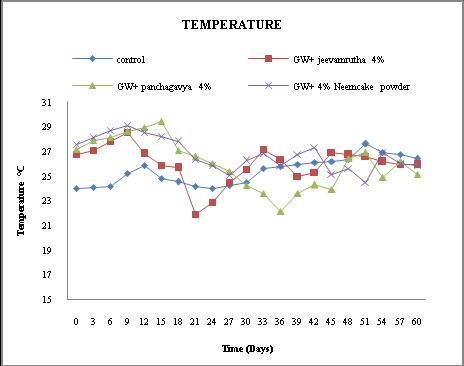
Thetemperatureincreasedinitiallyupto12-15days in all treatments, this is due to microbial activity and decompositionofreadilybiodegradablesubstratesresulting in heat generation. After this phase the temperature gradually decreased or stabilised due to consumption of readily degradable organic substrates reducing microbial respirationandheatproduction.Duringvermicomposting, theearthwormactivityalsohelpsincoolingandstabilization of the substrate by aeration and conversion of organic matter to stabilized vermin compost. The lowest temperaturewasrecordedinpanchagavya(25.10)followed by neemcake powder (25.83), jeevamrutha (25.88) and control(26.83)However,thetemperaturewasinamoderate range of 20–30 ℃ which was suitable for earthworm survival and efficient vermicomposting [15]. Change in temperatureduringvermicompostingisshowninChart1.
Chart-1:ChangeinTemperatureduringvermicomposting
3.5
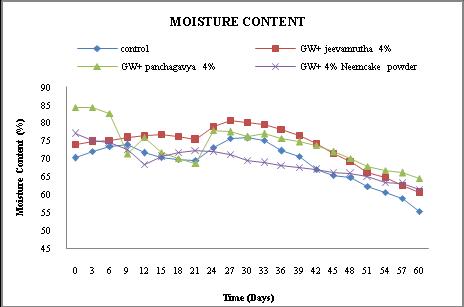
The optimum moisture content is essential for vermicomposting and earthworm activity. Maximum moisture content was observed in jeevamrutha (64.86) followedbypanchagavya(64.54),neemcakepowder(61.32). Themoisturecontentinthecontrolunitwasslightlylower thanalladditivetreatmentunits.Moistureisimportantfor the optimal activity of earthworms and other microorganismsinthevermicompostingsystem.Theremust beenoughmoisturetomaintaintheiractivity.Earthworms breathethroughtheirskin,sothesystemmustbekeptatthe right moisture level. The desirable moisture content in vermicompostingis60%-80%[16].Theearthwormsneeda moistenvironmentforrespiration,locomotion,feedingand reproduction, so that the vermicomposting process is adverselyaffectedbytheinsufficientmoisturecontents.An earthworm will experience dehydration due to loss of moisturefromitsskinwhenthemoisturecontentofthesoil is below optimal levels. As a result of dehydration, the earthworm will have decreased metabolic activity, lower growth rates, fewer cocoons produced, and overall decreased likelihood of survival [17]. The variation in moisturecontentduringvermicompostingisshowninchart 2.
Chart-2: ChangeinMoistureContentduring vermicomposting
3.6 Change in pH during vermicomposting in additivestreatment
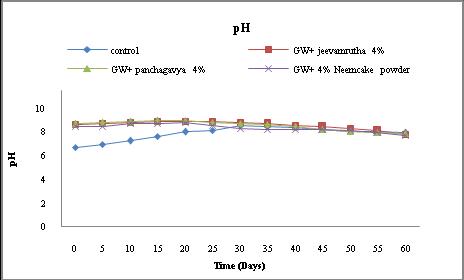
ThepHof5to9issuitableforthesurvivalofepigeic worms[13].AllthetreatmentshadpHvaluesintherange acceptable for the growth and survival of Eisenia fetida.
International Research Journal of Engineering and Technology (IRJET) e-ISSN: 2395-0056
Volume: 13Issue: 05| May 2026 www.irjet.net p-ISSN: 2395-0072
Amongtheadditives,thehighestfinalpHvaluewasrecorded incontrolunit(7.91)followedby4%Panchagavya(7.84),4 % Jeevamrutha (7.79) and 4 % Neemcake powder (7.66). The pH values obtained in all the treatments were near neutral indicating stabilization and maturity of vermicompost. pH Decrease might occur due to mineralization of nitrogen and phosphorus to nitrites/nitratesandorthophosphatesandbioconversionof organicmattertointermediatespeciesoforganicacids[21].
The variation in pH during vermicomposting is shown in chart3.
Chart -3: ChangeinpHduringvermicompostingin additivestreatment
3.7 Change in Electric Conductivity during vermicomposting
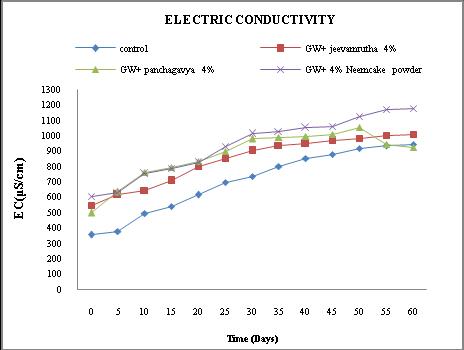
In all three treatments the electrical conductivity (EC) value increased gradually. Maximum value was recorded in 4 per cent neemcake powder (1175.7 μS/cm) followed by jeevamrutha (1005.7 μS/cm), control (942.6 μS/cm)andpanchagavya(920.8μS/cm).TheincreaseinEC (electrical conductivity) during the vermicomposting processwaslikelyduetothedegradationoforganicmatter releasingmineralslikeexchangeableCa,Mg,KandPinthe available forms, i.e., in the form of cations in the vermicompost[20].Theelectricalconductivityvaluesofall treatmentswere withinthe upperrecommended range of 500–2000 µS/cm [24]. Change in EC During VermicompostingisshowninChart4.
Chart -4: ChangeinECDuringVermicomposting
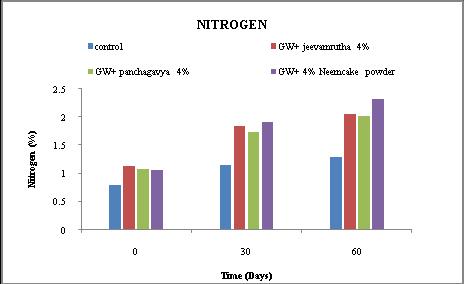
Totalnitrogenvaluesshowedanincreasingtrendin the vermicomposting period. Maximum value of nitrogen wasobservedin4%neemcakepowder(2.21%)followedby 4% jeevamrutha (1.96%) and 4% panchagavya (1.85%) amongallthetreatments.Therelativeincreaseinnitrogen contentinsubstrateduringvermicompostingmayhavebeen determinedbythelossofdryorganiccarbonasCO2andthe loss of water by evaporation during mineralization of organic matter [19]. Change in Nitrogen during vermicompostingisshowninchart5.
Chart-5:ChangeinNitrogenduringvermicomposting
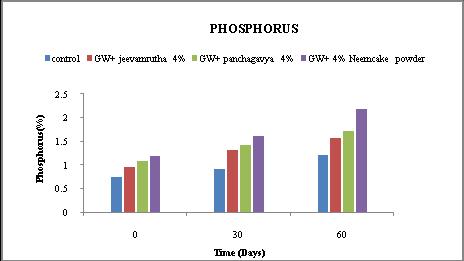
Highphosphorusinthematurecompostisindicativeof better plant growth for sustainable crop production. The phosphate mobilization and mineralization is due to gut phosphatesofearthwormandtheadditionalreleaseofPby themicrobiotaassociatedwithearthwormcasts.Moreover the fungus has the ability of P solubilization creating a favorable environment to microbes solubilizing P during compostingprocess[25].Vermicompostpreparedwith4% neemcake powder showed highest phosphorous (2.19%) followedbypanchagavya(1.72%),jeevamrutha(1.56%)and control unit (1.28%). Change in Phosphorus during vermicompostingisshowninchart6.
Chart-6: ChangeinPhosphorusduringvermicomposting
International Research Journal of Engineering and Technology (IRJET) e-ISSN: 2395-0056
Volume: 13Issue: 05| May 2026 www.irjet.net p-ISSN: 2395-0072
3.10 Change in Potassium (K) during vermicomposting
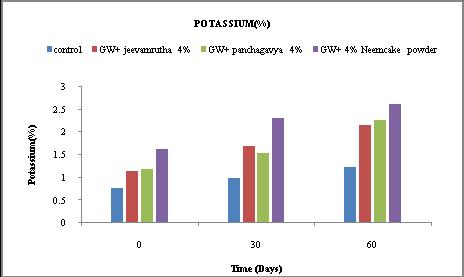
Potassiumisanimportantelementforplantgrowth. Itshighpresenceinreadycompostindicatesthesuitability ofpreparedcomposttocropgrowthinfields.Thedifferent endogenic and exogenic enzymes of the gut of the earthwormsconvertthenon-availableorganicmineralsinto available soluble form. Fungal hyphae bind the available potassium with cellulose-rich material due to their absorptivenatureandthuscontributetotheincreaseofthe Potasium contents in the composting mixtures [25]. 4% neemcake powder among all treatments was the most efficientinincreasingpotassiumcontent(2.60%)followed by 4% jeevamrutha (2.25%), panchagavya (2.15%) and control (1.35%). Change in Potassium during vermicompostingisshowninchart7.
Chart -7:ChangeinPotassiumduringvermicomposting
3.11 Change in organic carbon and C/N ratio during vermicomposting
The organic carbon content of all treatments of jeevamrutha, panchgavya and neem cake assisted vermicomposting in the range of25–30 % waswithin the acceptablelimitofmatureandgoodqualityvermicompost. Thesimilarrangesoforganiccarbonhavebeenreportedin the previous studies on quality assessment and characterization of vermicompost [23]. The C/N ratio between12-20inalltreatmentsofjeevamrutha,panchgavya and neem cake powder indicates the production of stable andmaturevermicompost.Previousstudiesindicatedthata C/Nratiolowerthan20,especiallyaround10–20,indicates well stabilized compost and suitable maturity for agricultural application [22]. A C/N ratio less than 20 indicates that the organic waste has reached a sufficient maturity[18].
Thepresentstudyevaluatedtheeffectofdifferent naturaladditiveslikeneemcakepowder,jeevamruthaand panchgavyaonthevermicompostingofgardenwaste.The results showed that all the additives were effective in vermicomposting process in comparison to control
treatment by increasing the rate of decomposition and qualityofcompost.Amongthetreatments,4% neemcake powder was found to be more effective than other treatmentsfollowedby4%jeevamruthaand4%panchgavya treatments.Theuseofneemcakepowdershowedsignificant effect on physiochemical properties of vermicompost by increasingthenitrogen,phosphorusandpotassium(NPK) content. On the other hand Jeevamrutha treatment was found useful for vermicomposting as it contained microorganisms and nutrients which helped in decomposition. Similarly, the panchgavya treatment also helped in the process of vermicomposting. The study concludes that the use of natural additives can play an importantroleinimprovingtheprocessofvermicomposting alongwiththeprovisionofrichorganicfertilizer.
[1] Kaza, S., Yao, L., Bhada-Tata, P., & Van Woerden, F. (2018).Whatawaste2.0:Aglobalsnapshotofsolidwaste managementto2050.WorldBank
[2]HrishikeshShivam,DayanandSharma,et.al.,(2025)“InVesselbioconversionofgardenwasteintocompostwithan emphasis on process efficiency and compost quality”, EngineeringandAppliedScienceResearch2025;52(1):105111.,doi:10.14456/easr.2025.9
[3]Arun Kumar Jha and IngleSagar Nandulal,.“Unlocking The Value from Waste Approaches in Bio-resource Management chapter 8 Vermicomposting: A Sustainable SolutionforAgriculturalWasteManagement.”
[4]santhebennur jayappa veeresh, jogattappa nayrayana,JaimeA.teixeira da silva,.(2010),“Influence Of Jeevamrutha (biodynamic formulation) on agro-industrial wastevermicomposting”dynamicsoil,dynamicplant2010 globalsciencebooks
[5] Shashank Kumar Jaiswal, Vikram Singh and Shruti G George,.(2024)“Effectofvermicompostandpanchagavyaon growth and yield of pearl millet”, International Journal of Research in Agronomy, DOI:https://doi.org/10.33545/2618060X.2024.v7.i8a.1184
[6]KomalK.Bajaja,VishalChavhan,et.al,.“Panchgavya:A precious gift to humankind”, (2021), Journal of Ayurveda and Integrative Medicine, DOI: https://doi.org/10.1016/j.jaim.2021.09.003
[7]Saharan,B.S.;Tyagi,S.;Kumar,R.;Vijay;Om,H.;Mandal, B.S.; Duhan, J.S. Application of Jeevamrit Improves Soil Properties in Zero Budget Natural Farming Fields. Agriculture 2023, 13, 196. https:// doi.org/10.3390/ agriculture13010196
[8]Arun–Kumar1,MadasamyPetchiammal2,Ammaiyappan Selvam1(2025),“Influenceofneemcakeoncompostingof
International Research Journal of Engineering and Technology (IRJET) e-ISSN: 2395-0056
Volume: 13Issue: 05| May 2026 www.irjet.net p-ISSN: 2395-0072
foodwasteMadasamy”,AnInternationalQuarterlyJouralof LifeScience.,DOI:10.63001/tbs.2025.v20.i02.S2.pp584-589
[9] Garg P, Gupta A, Satya S (2006) Vermicomposting of differenttypesofwasteusingEiseniafoetida:acomparative study.BioresourTechnol97:391–395.https://doi.org/10. 1016/j.biortech.2005.03.009
[10] Dominguez J, Edwards CA, “Biology and ecology of earthworm species used for vermicomposting. In: Vermiculturetechnology-earthworms,organicwastes,and environmental management,” Boca Raton, FL: CRC Press; 2011.p.27e40.
[11] Dr. Rosaline Mary , Kalaimathi, A , Namratha Parthasarathy, “Comparative Analysis Of Mixed Vegetable WastesAndLeafLitterVermicompostUsingTheEarthworm Perionyx Excavatus,” International Journal of Current ResearchinMultidisciplinary(IJCRM)ISSN:2456-0979Vol. 4,No.3,(March’19),pp.01-06.
[12] PRATIBHA VYAS, SANDEEP SHARMA, JEENA GUPTA, “Vermicompostingwithmicrobialamendment:implications for bioremediation of industrial and agricultural waste”, Journal of Biotechnology, Computational Biology and Bionanotechnology vol. 103 (2) C pp. 203–215 C 2022 http://doi.org/10.5114/bta.2022.116213
[13]PankajKumarSingh*|AnjaliSingh*||NishatFatima*| Keshav Singh, (2024) “VERMICOMPOSTING: AN ECOFRIENDLY APPROACH TOWARDS SOLID WASTE MANAGEMENT” Munis Entomology & Zoology 749 https://www.munisentzool.org/ISSN1306-3022
[14] Edwards, C. A., & Arancon, N. Q. (2004). The use of earthwormsinthebreakdownandmanagementoforganic wastes.InC.A.Edwards(Ed.),EarthwormEcology(2nded., pp.345–438).CRCPress.
[15] Edwards, C. A., Arancon, N. Q., & Sherman, R. (2011). Vermiculturetechnology:Earthworms,organicwastes,and environmentalmanagement.CRC Press.
[16] Dr. Seema Dixit and Ishita Chourasia., “VERMICOMPOSTING: A COMPREHENSIVE GUIDE FOR TURNING WASTE TO WEALTH”., International Journal of Research and Analytical Reviews (IJRAR)., E-ISSN 23481269.,March2024.
[17] Kundan Samal , Alakh Raj Mohan, Nabin Chaudhary, SanjibMoulick,(2019) “Applicationofvermitechnologyin waste management: A review on mechanism and performance,” Journal of Environmental Chemical Engineering7(2019)103392
[18]M.E.El-Haddada,MonaS.Zayed,et.al.,“Evaluationof compost,vermicompostandtheirteasproducedfromrice straw as affected by addition of different supplements”,
Annals of Agricultural Science (2014) ,DOI http://dx.doi.org/10.1016/j.aoas.2014.11.013
[19] kaviraj singh, satyavati Sharma, et.al., “Vermicomposting of municipal Solid Waste Empoying Eisenia Fetida together with Penicillium spp. And AzotobacterBioinoculants,”(2011), Dynamicsoil,Dynamic Plants2012GlobalScienceBooks
[20] Wako RE (2021) Preparation and characterization of vermicompost made from different sources of materials. Open J Plant Sci 6(1): 042-048. DOI: https://dx.doi.org/10.17352/ojps.000031
[21]AmrutaChandrakantNimbalkar,SamikshaSunilPisal, et.al., “Bioconversion of Garbage: Garden Waste (GW); Kitchen Waste (KW) and Combination of Both Garbage: Garden WasteandKitchen(GW+KW) intoVermicompost through the use of earthworm, Eisenia fetida (L)”,(2018), International Journal of Scientific Research in Chemistry (IJSRCH)|OnlineISSN:2456-8457
[22]Majlessietal.IranianJournalofEnvironmentalHealth Science & Engineering 2012, 9:25 http://www.ijehse.com/content/9/1/25
[23] Vinay Kumar Badhwar a,*, Sukhwinderpal Singhb, Balihar Singh (2020)., “Biotransformation of paper mill sludge and tea waste with cow dung using vermicomposting”.,2020publishedbyElsevier
[24] Saba, Z.; Magwaza, L.S.; Sithole, N.J.; Mditshwa, A.; Odindo, A.O. Physico-Chemical Analysis of Vermicompost Mixtures. Agronomy 2023, 13, 1056. https://doi.org/ 10.3390/agronomy13041056
[25]Sharma,N.;Singh,J.;Singh,B.;Malik,V.Improvingthe Agronomic Value of Paddy Straw Using Trichoderma harzianum, Eisenia fetida and Cow Dung. Fermentation 2023, 9, 671. https://doi.org/ 10.3390/fermentation9070671
[26] v Kureljuši´c, J.M.; Veskovi´c Moraˇcanin, S.M.; Ðuki´c, D.A.;Mandi´c,L.;Ðurovi´c,V.;Kureljuši´c,B.I.;Stojanova,M.T. Comparative Study of Vermicomposting: Apple Pomace Aloneand inCombination with Wheat StrawandManure. Agronomy 2024, 14, 1189. https://doi.org/ 10.3390/agronomy14061189
[27]Vukovi´c,A.;Velki,M.;Eˇcimovi´c,S.;Vukovi´c,R.;Štolfaˇ Camagajevac, I.; Lonˇcari´c, Z. Vermicomposting Facts, Benefits and Knowledge Gaps. Agronomy 2021, 11, 1952. https://doi.org/10.3390/agronomy111019