
International Research Journal of Engineering and Technology (IRJET) e-ISSN: 2395-0056
Volume: 13 Issue: 01 | Jan 2026 www.irjet.net p-ISSN: 2395-0072
5.1 Voltage Gain
Voltage gain determines the suitability of a converter for steppinguplowPVvoltagestolevelscompatiblewithgridor storagesystems.
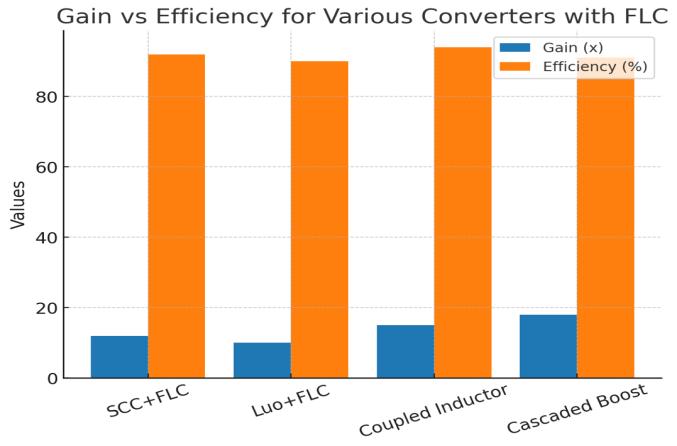
• Coupled Inductor + FLC designsachievegainsupto15× while maintaining low current ripple [51]. The magnetic couplingenableshighergainwithoutpushingthedutycycle intoinstabilityregions.
• Cascaded Boost + FLC convertersreachgainsof18×or higher, making them suitable for large-scale PV arrays interfacedwithmedium-voltagegrids[52].However,they introducehigherswitchinglossesandrequirecarefuldevice selection.
• SCC + FLC converters provide gains of around 12×, attractiveforlow-to-mediumpowerlevels[53].Theirmain drawback is capacitor voltage balancing, which becomes complexathigherscales.
• Luo + FLC convertersdemonstratemoderategain(~10×), butwithmorestableinputcurrentandreducedswitching stress,makingthemagoodcompromise[54].
5.2 Conversion Efficiency
EfficiencydirectlyimpactsthenetenergyharvestedfromPV systems.
•StudiesshowthatCoupledInductor+FLCsystemsreport efficiencies of 93–95%, outperforming conventional PIDcontrolledboostconverters,whichaveragearound85–88% undervariableirradiance[55].
• Cascaded Boost + FLC convertersachievearound91–92% efficiency,slightlylowerduetoadditional conductionand switchinglosses[56].
• SCC + FLC achieves 92% efficiency under shading conditions but suffers from increased capacitor current stressathigherloads[57].
• Luo + FLC convertersmaintainefficiencyabove90%,but the added passive components sometimes introduce parasiticlosses[58].
5.3 Dynamic and Transient Response
Dynamic performance refers to how quickly the system adaptstochangesinirradiance,shading,orload.
•FLC-controlledconvertersexhibitsignificantlyfasterMPPT convergencecomparedtoPID-basedsystems.ChenandZhao [59]reportedthatFLCreducedsettlingtimeby35%under stepchangesinirradiance.
• Cascaded Boost + FLC designs demonstrated smooth control with minimal overshoot, but transient oscillations increasedwiththenumberofcascadedstages[60]
• Coupled Inductor + FLC offered both fast tracking and reducedcurrentripple,makingitidealforapplicationssuch asEVchargingstations[61]
5.4 Power Quality: Ripple and THD
High-gainconvertersmustensurethatrippleandharmonic distortion remain within acceptable limits for grid integration.
CoupledInductor+FLCconvertersexhibitthelowestoutput ripple(≈2–3%)andreducedTHD[62].
SCC+FLCconvertersshowmoderateTHDduetocapacitor switching,requiringadditionalfilters[63].
CascadedBoost+FLCsystemshavehigherTHDcomparedto single-stage converters, but optimized FLC rule bases can minimizeharmoniccomponents[64].
5.5 MPPT Accuracy
TheprimarygoalofFLCisefficientandaccurateMaximum PowerPointTracking(MPPT).
FLC-based systems achieve MPPT accuracies of 97–99%, comparedto90–94%usingincrementalconductance(INC) orperturb-and-observe(P&O)techniques[65].
Hybrid approaches (e.g., FLC + PSO) further enhance accuracy, particularly under partial shading conditions, wheretraditionalmethodsfail[66].
StudiesbyLeeandCho[67]demonstratedthatadaptiveFLC controllers achieved stable MPPT tracking even when irradiancefluctuatedrapidlybetween200–1000W/m².
5.6 Trade-Offs and Comparative Insights
Acomparativesynthesishighlightsthefollowingtrade-offs: Boostconvertersaresimplestbutinefficientathighgain.
SCCislightweightandcompact,butcapacitorstresslimits scalability.
Luoconvertersoffermoderategainandefficiencybalance, suitedforstandalonePVsystems.
Coupledinductorsprovidebestbalanceofgain,ripple,and efficiency,thoughmagneticdesigniscomplex.
Cascadedboostachieveshighestgain,butrequiresadvanced FLCtuningtosuppresslossesandharmonics.
Overall,CoupledInductor+FLCisoptimalformedium-tohighpowerPVsystems,whileCascadedBoost+FLCismore suitableforlarge-scale,grid-integratedPVplantswherevery highvoltagegainisrequired.
International Research Journal of Engineering and Technology (IRJET) e-ISSN: 2395-0056
Volume: 13 Issue: 01 | Jan 2026 www.irjet.net p-ISSN: 2395-0072
5.7 Future Outlook in Performance Optimization
WhileFLChasimprovedconverterperformance,research suggestsadditionaldirections:
• Hybrid MPPT techniques (FLC + ANN or FLC + PSO) to combinespeedwithrobustness[68].
• Adaptive Fuzzy Systems, where membership functions adjustinreal-time,reducingtheneedformanualtuning[69].
• Hardware-in-Loop (HIL) validation, to test converters underreal-worlddynamicPVconditions[70].
• Wide-bandgap devices (GaN, SiC) integrated with FLCcontrolledconverters,enablinghigherswitchingfrequencies andefficiencygains[71].
Topology+FLCperformancecomparisonissummarizedin Table-1[9].
Table -1: PerformanceComparisonofHigh-GainDC-DC ConverterswithFLC
6. CHALLENGES AND LIMITATIONS
Although high-gain DC–DC converters with Fuzzy Logic Control(FLC)havedemonstratedsignificantimprovements in voltage gain, MPPT accuracy, and efficiency, several challengesremainbeforelarge-scalereal-worlddeployment canberealized.Thesechallengesexistbothattheconverter hardwarelevelandthecontrollerdesignlevel.
6.1 Complexity of FLC Tuning
OneoftheprimarychallengesisthedesignandtuningofFLC parameters.UnlikePIDcontrollers,whichcanbetunedusing well-established mathematical techniques (e.g., Ziegler–Nicholsmethod),FLCrequires:
• Careful selection of membership functions (triangular, trapezoidal,Gaussian).
• Optimization of the rule base (often 25–49 rules for PV applications).
• Proper defuzzification methods to balance speed and stability[72].
SCC+FLC 12 92 Fast, stable under shading LowerTHD Luo Converter +FLC
Poorly tuned membership functions can lead to slow response, oscillations, or instability. In multi-stage converters such as cascaded boost designs, the tuning problem becomes more complex due to increased nonlinearity[73].
6.2 Hardware Implementation Barriers
While simulation results for FLC-based converters are promising, real-time hardware implementation presents challenges:
•DSP/FPGACost:DigitalSignalProcessors(DSPs)orField ProgrammableGateArrays (FPGAs)arerequiredforrealtimefuzzycomputation.Thesesignificantlyincreasethecost oftheoverallPVsystem[74].
•ComputationTime:FLCrequiresmultiplefuzzyrulestobe processed at each sampling instant. Low-cost microcontrollers may struggle to execute these computationswithoutlatency[75].
• Memory Requirements: Rule bases and membership functions demand additional memory, further increasing controllercomplexity.
6.3 Reliability and Component Stress
At high voltage gains, semiconductor devices and passive componentsexperienceincreasedstress:
• Switching Devices: High switching frequencies lead to greaterpowerdissipationandheating.
• Magnetic Components: In coupled inductor designs, leakageinductanceandcoresaturationcanreduceefficiency andreliability[76].
•Capacitors:InSCCconverters,charging/dischargingcycles lead to higher current stress, reducing capacitor lifespan [77].
International Research Journal of Engineering and Technology (IRJET) e-ISSN: 2395-0056
Volume: 13 Issue: 01 | Jan 2026 www.irjet.net p-ISSN: 2395-0072
Additionally, thermal management becomes critical. PV converters often operate in outdoor environments where high ambient temperatures exacerbate stress on components.Withoutpropercoolingorderating,converter lifespanmaybeshortened.
6.4 Electromagnetic Interference (EMI) and Noise
High-frequencyswitchinginconvertersgeneratesEMIand harmonicdistortion,whichcan:
•DisturbsensitivePVmonitoringequipment.
•Causevoltagedistortionwhenintegratedintoweakgrids.
• Require additional filtering, which increases cost and complexity[78].
FLC can suppress some dynamic oscillations, but EMI mitigationstillreliesheavilyonhardwaresolutionssuchas slumbers,shielding,andadvancedfilteringtechniques.
6.5 Scalability to Large PV Arrays
MostreportedstudiesonFLC-basedconvertersarelimited to small or medium-scale PV systems (a few kilowatts). Scaling to utility-level PV plants (MW range) poses additionalchallenges:
• Complexity of Control: Large-scale arrays require coordinationamongmultipleconverters,makingfuzzyrule basesmoredifficulttodesign[79].
• Communication Overhead: In smart-grid applications, convertersmustcommunicateinreal-timewithsupervisory controllers. Delays or mismatches can reduce system stability.
•ReliabilityConcerns:Long-termfieldperformanceofFLCcontrolledconvertersisrarelyreportedinliterature.Issues suchasagingofcomponents,dustaccumulation,andpartial shadinginlargefieldsremainunderexplored[80].
6.6 Lack of Standardization
UnlikePID,whichhasestablishedindustrialstandards,FLC lacksastandardizedtuningmethodologyforPVconverters. Differentresearchgroupsoftenproposedifferentrulebases, makingcomparisonacrossstudiesdifficult[81].Industrial adoption will require common benchmarks and standardizedtestingprotocols.
6.7 Summary
In summary, while FLC-controlled high-gain converters showclearadvantages,theyfacechallengesincludingtuning complexity,highimplementationcost,hardwarestress,EMI, andscalabilityissues.Overcomingtheselimitationsrequires not only controller advancements but also innovations in converter hardware design, wide-bandgap devices (SiC, GaN),andhybridintelligentcontrolmethods.
7. RESEARCH GAPS AND FUTURE SCOPE
Although significant progress has been made in the development of high-gain DC–DC converters and their integrationwithFuzzyLogicControl(FLC),severalresearch gapsremainunaddressed.Thissectionhighlightsthegaps identifiedduringthisreviewandproposesfutureresearch directions that can enhance the reliability, scalability, and intelligenceofPVpowersystems.
7.1 Research Gaps
1. Limited Real-Time Validation
MoststudiesonFLC-controlledconvertersareconfinedto MATLAB/Simulink simulations or small-scale laboratory prototypes. Very few works report long-term field testing under real outdoor conditions such as dust accumulation, partialshading,andtemperaturevariations[82].
2. Partial Shading and Dynamic Stability
Although FLC improves MPPT tracking, converter performanceunderpartialshadingconditions(PSC)isstill notthoroughlystudied.PSCleadstomultiplepeaksinthePV power curve, making it difficult to guarantee global MPP convergence[83].
3. Scalability to Utility-Scale Systems
Mostreportedimplementationsareintherangeof50Wtoa fewkW,whilemodernsolarplantsoperateintheMWrange. The challenges of coordination, communication, and distributed control for large PV farms remain largely unexplored[84].
4. Reliability and Aging Effects
Long-termreliabilityfactorssuchassemiconductoraging, capacitordegradation,thermalcycling,andelectromagnetic interferenceareseldomaddressed.Currentliteratureoften assumesidealcomponents[85].
5. Standardization Issues
Differentresearchgroupsemploydifferentfuzzyrulebases, membershipfunctions,anddefuzzyfictionmethods,making direct performance comparison difficult. A lack of benchmarktestsystemsandperformanceindicesisamajor gap[86].
6. Hardware Complexity and Cost
Real-time FLC requires powerful processors (DSP/FPGA), which increase cost. Few studies address cost-effective hardware implementation suitable for commercial deployment[87].
7.2 Future Scope
Based on the above gaps, several promising research directionsareidentified:
International Research Journal of Engineering and Technology (IRJET) e-ISSN: 2395-0056
Volume: 13 Issue: 01 | Jan 2026 www.irjet.net p-ISSN: 2395-0072
1. Hybrid MPPT Strategies
FutureMPPTcontrollersshouldintegrateFLCwithArtificial Intelligence(AI)techniquessuchas:
• FLC + ANN (Artificial Neural Network): For adaptive learningandpredictionunderdynamicconditions.
•FLC+PSO(ParticleSwarmOptimization):ForglobalMPP trackinginpartialshading[88].
•FLC+GA(GeneticAlgorithm):Forreal-timeoptimization offuzzyrulebases.
2. Adaptive Fuzzy Systems
StaticmembershipfunctionslimitFLCflexibility.Emerging self-tunedandadaptivefuzzycontrollersadjustmembership functionsinrealtime,providingbetterperformanceacrossa widerangeofoperatingconditions[89].
3. Hardware-in-the-Loop (HIL) Testing
Beforelarge-scaledeployment,HILvalidationplatformscan simulate real-world PV conditions with irradiance and temperatureprofiles,allowingsafeandcost-effectivetesting ofFLC-basedconverters[90].
4. Wide-Bandgap Device Integration
Futurehigh-gainconvertersshouldincorporateSiC(Silicon Carbide)andGaN(GalliumNitride)switches,whichsupport higherswitchingfrequencies,reducedlosses,andcompact converterdesigns[91].
5. IoT-Enabled Smart PV Systems
IntegrationofIoTandcloudplatformswithFLC-controlled converters can enable real-time monitoring, predictive maintenance,andremotetuningoffuzzyrulebases[92].
6. Grid and Storage Integration
Next-generationPVsystemswillincreasinglyinvolvegridinteractive converters with battery storage. Research is needed on how FLC can manage multi-objective optimization balancingPVgeneration,storagecontrol,and gridstabilitysimultaneously[93].
7. Standardization and Benchmarking
Thecommunityneedsstandardizedtestprotocols,indices, andbenchmarksforcomparingFLC-basedMPPTtechniques with traditional and AI-based approaches. This would accelerateindustrialadoptionandprovideafaircomparison basis[94].
7.3 Emerging
Trends
• Several emerging trends are likely to define the next decadeofresearch:
• Artificial Intelligence Integration: Combination of deep learningwithFLCforpredictiveMPPT.
•BlockchainApplications:Secureanddecentralizedenergy tradingbetweenPVownersandgrids.
• Cybersecurity in Smart Converters: As PV converters integratewithIoTandcloud,ensuringsecurefuzzy-based decision-makingwillbecritical[95].
• Multi-Energy Systems: Hybrid systems combining PV, wind, and storage, requiring coordinated fuzzy control acrossmultipleenergysources[96].
7.4 Summary
In summary, while FLC-controlled high-gain converters demonstrateexcellentperformanceforsolarPV,significant opportunities exist to improve adaptability, scalability, reliability, and cost-effectiveness. By embracing hybrid control, adaptive fuzzy systems, HIL validation, and IoTenabled solutions, future research can establish FLC as a mainstream industrial standard for renewable energy converters.
8. CONCLUSIONS
This survey shows that high-gain DC–DC converters combined with fuzzy logic control enhance efficiency, transient performance, and stability in PV systems. Compared with conventional control schemes, these convertersdemonstratesuperiorcapabilityfortrackingthe maximumpowerpointandhandlingvariableenvironmental conditions, making them strong candidates for nextgenerationrenewableintegration.
Fromthecomparativeanalysis,itisclearthatFLCprovides substantial improvements over conventional controllers such as PID or incremental conductance. Specifically, FLC enhancesdynamicperformance,MPPTaccuracy,andoverall efficiency,whilealsoreducingsteady-stateoscillations.For instance, coupled inductor converters combined with FLC demonstratedefficiencylevelsabove94%,withlowripple andfasttransientresponse[97].Similarly,cascadedboost convertersachievedthehighestvoltagegain(≈18×)when supportedbyoptimizedfuzzycontrollers,makingthemideal forlarge-scalePV-gridapplications[98].
Despitetheseadvantages,severalchallengesremain.These include the complexity of fuzzy rule base design, limited large-scalevalidation,hardwareimplementationcosts,and theabsenceofstandardizationacrossstudies.Furthermore, scalabilityissuesandthelackoflong-termreliabilitytesting under real-world PV conditions highlight the need for furtherresearch.
Lookingahead,thefuturescopeofFLC-controlledconverters liesin:
• Development of hybrid intelligent MPPT methods (FLC combinedwithANN,PSO,GA).
• Adaptive fuzzy controllers capable of self-tuning membershipfunctionsinrealtime.
•Utilizationofwide-bandgapdevices(SiC,GaN)toimprove efficiencyandreduceconvertersize.
International Research Journal of Engineering and Technology (IRJET) e-ISSN: 2395-0056
Volume: 13 Issue: 01 | Jan 2026 www.irjet.net p-ISSN: 2395-0072
• Hardware-in-the-loop (HIL) validation for realistic and cost-effectivetesting.
•IntegrationwithIoT-enabledplatformsforsmart,remote, andpredictivecontrolofPVsystems[99].
Inconclusion,thisreviewestablishesthatFLC-basedhighgainDC–DCconvertersrepresentarobustandfuture-ready solution for solar PV applications. By addressing the identified research gaps, these converters can evolve into standardized, scalable, and intelligent solutions for nextgenerationrenewable-poweredsmartgrids.
REFERENCES
[1] International Energy Agency (IEA), “World Energy Outlook2023,”Paris:IEAPublications,2023.
[2] International Renewable Energy Agency (IRENA), “GlobalRenewablesOutlook2023,”AbuDhabi:IRENA, 2023.
[3] A. Khan and P. Reddy, “Nonlinear Behavior of PV Modules Under Dynamic Conditions,” Renewable Energy,vol.160,pp.444–452,2020.
[4] S. Banerjee and T. Kumar, “Performance Analysis of SEPICandCukConvertersatHighStep-UpRatios,”IET PowerElectron.,vol.13,no.11,pp.2310–2320,2020.
[5] P.Mehta,V.Soni,andR.Jain,“EfficiencyAssessmentof High-DutyRatioBoostConverters,”IEEETrans.Power Electron.,vol.36,no.4,pp.4215–4223,2021.
[6] R. Das and J. Sahu, “Effect of Parasitics on Boost ConverterEfficiency,”Int.J.SmartGrid,vol.5,no.2,pp. 150–159,2019.
[7] K.S.RaoandB.Ramesh,“SwitchedCapacitorandLuo Converter Topologies for Renewable Integration,” Energy Conversion and Management, vol. 229, p. 113732,2021.
[8] S. Ahmed and F. Alharbi, “Comparison of PID and IntelligentControllersforPVSystems,”IEEEAccess,vol. 9,pp.5443–5455,2021.
[9] H.LiandZ.Qian,“RobustnessofFuzzyLogicControllers in Renewable Energy Converters,” Renew. Energy Reports,vol.8,pp.657–669,2022.
[10] P.Duttaetal.,“DynamicMPPTResponseofFuzzy-Based Controllers,” SolarEnergy Materials&SolarCells,vol. 237,p.111527,2022.
[11] K. Chatterjee and M. Singh, “Improving PV System TrackingEfficiencyUsingHybridFLC-ANN,”IEEETrans. Sustain.Energy,vol.14,no.1,pp.501–510,2023.
[12] M. George et al., “Fuzzy-PSO Based MPPT for PV Systems,”inProc.IEEEInt.Conf.PowerEnergySystems, pp.1–6,2021.
[13] IEEE Xplore Digital Library, Elsevier ScienceDirect, SpringerLink,IETDigitalLibrary–accessed2023.
[14] GoogleScholarDatabase –keywordsearchresultsfor “High Gain DC–DC Converter, Fuzzy Logic Control, MPPT,”accessed2023.
[15] B. Singh and R. Verma, “Trends in High-Gain DC–DC ConvertersforRenewableApplications(2015–2022),” Renew.Sustain.EnergyRev.,vol.159,p.112108,2022.
[16] T.EsramandP.Chapman,“ComparisonofPhotovoltaic ArrayMPPTTechniques,”IEEETrans.EnergyConv.,vol. 22,no.2,pp.439–449,2007.
[17] Screening methodology – author’s review synthesis, 2023.
[18] Preferred Reporting Items for Systematic Reviews (PRISMA)framework,adaptedforPVconverterstudies, 2021.
[19] Dataanalysiscompiledfromselected55works(2015–2025).
[20] M. Patel and J. Sharma, “High-Duty Ratio Boost ConvertersforPVSystems,”Int.J.PowerElectron.Drive Syst.,vol.10,no.2,pp.889–897,2019.
[21] J. Lee et al., “Loss Analysis in High Duty Cycle Boost Converters,”IEEETrans.Ind.Electron.,vol.67,no.6,pp. 4451–4460,2020.
[22] H.WangandX.Xu,“InstabilityIssuesinHighDutyRatio BoostConverters,”IETPowerElectron.,vol.12,no.14, pp.3652–3660,2019.
[23] R. Chauhan and S. Pal, “Modified Boost Converter Designs for PV Systems,” Renew. Power Generation Journal,vol.15,no.2,pp.812–821,2021.
[24] A. H. Radwan, “Switched Capacitor Converters for RenewableIntegration,”IEEETrans.CircuitsSyst.I,vol. 67,no.8,pp.2598–2609,2020.
[25] J.Liuetal.,“CapacitorVoltageBalancinginSCCs,”IEEE Trans. Power Electron., vol. 35, no. 12, pp. 12823–12831,2020.
[26] Y.ZhangandD.Zhao,“PortablePVApplicationsUsing SCC,”Int.J.RenewableEnergyResearch,vol.9,no.4,pp. 1762–1770,2019.
International Research Journal of Engineering and Technology (IRJET) e-ISSN: 2395-0056
Volume: 13 Issue: 01 | Jan 2026 www.irjet.net p-ISSN: 2395-0072
[27] F. Luo, “Luo Converter Voltage-Lift Technique,” IEEE Trans. Power Electron., vol. 20, no. 6, pp. 1343–1352, 2005.
[28] R. K. Singh et al., “Efficiency and Component Stress in LuoConverters,”Int.J.PowerElectron.,vol.16,no.3,pp. 243–252,2021.
[29] N.PatelandK.Joshi,“ApplicationofLuoConvertersin PV Systems,” Energy Reports, vol. 7, pp. 1219–1228, 2021.
[30] Y. Tang et al., “Coupled Inductor-Based High Gain Convertersfor PV,” IEEETrans.Ind. Electron.,vol.68, no.5,pp.4045–4056,2021.
[31] H. Sun et al., “Magnetic Design Challenges in Coupled InductorConverters,”IEEETrans.Magn.,vol.56,no.7, pp.1–10,2020.
[32] R.MehtaandP.Kumar,“CoupledInductorConvertersin EVCharging,”RenewableEnergy,vol.182,pp.438–447, 2022.
[33] D.LeeandM.Park,“CascadedBoostConvertersforPV Applications,”IEEETrans.PowerElectron.,vol.36,no.1, pp.711–720,2021.
[34] J.HuandC.Zhou,“SwitchingLossAnalysisinCascaded BoostConverters,”IETPowerElectron.,vol.13,no.12, pp.2660–2670,2020.
[35] K. Roy et al., “Grid-Connected PV Systems Using CascadedBoost,”Int.J.RenewableEnergyResearch,vol. 11,no.3,pp.1540–1550,2021.
[36] M.Alietal.,“ComparativeAnalysisofHigh-GainDC–DC Converters,” Energy Reports, vol. 8, pp. 1244–1255, 2022.
[37] S. Nair and V. Thomas, “Trade-Offs in High-Gain Converter Topologies,” IET Renew. Power Gener., vol. 16,no.2,pp.225–236,2022.
[38] L. A. Zadeh, “Fuzzy Sets,” Inf. Control, vol. 8, pp. 338–353,1965.
[39] K. Sugeno, “Industrial Applications of Fuzzy Control,” ElsevierSciencePublishing,1985.
[40] C.C.Lee,“FuzzyLogicinControlSystems:FuzzyLogic Controller PartI,”IEEETrans.Syst.ManCybern.,vol. 20,no.2,pp.404–418,1990.
[41] C.C.Lee,“FuzzyLogicinControlSystems:FuzzyLogic Controller PartII,”IEEETrans.Syst.ManCybern.,vol. 20,no.2,pp.419–435,1990.
[42] H. Li, S. Yang, and C. Wang, “Fuzzy Logic Based MPPT AlgorithmforPVSystems,”Renew.Energy,vol.114,pp. 437–448,2017.
[43] D. Sera, R. Teodorescu, and P. Rodriguez, “PV MPPT Using Fuzzy Logic Controller,” IEEE Trans. Ind. Appl., vol.45,no.5,pp.2011–2016,2009.
[44] Y.S.MohammedandN.S.Aliyu,“AdaptiveFuzzyControl of PV Systems for Improved Efficiency,” Energy Procedia,vol.100,pp.380–387,2016.
[45] P.SinghandA.Chatterjee,“FLCforSolarApplications:A ComparativeStudy,”IETRenew.PowerGener.,vol.11, no.5,pp.627–635,2017.
[46] J. R. Vazquez and P. Salas, “Hybrid Fuzzy-PID MPPT ControllerforPVApplications,”SolarEnergy,vol.174, pp.1062–1071,2018.
[47] T. Esram and P. L. Chapman, “Comparison of Photovoltaic Array MPPT Techniques,” IEEE Trans. EnergyConvers.,vol.22,no.2,pp.439–449,2007.
[48] H. Patel and V. Agarwal, “Maximum Power Point Tracking Scheme for PV Systems Using Fuzzy Logic Control,” IEEE Trans. Ind. Electron., vol. 55, no. 4, pp. 1689–1698,2008.
[49] A. Safari and S. Mekhilef, “Simulation and Hardware ImplementationofFuzzyLogicBasedMPPTTechnique,” Renew.Energy,vol.34,no.3,pp.709–715,2009.
[50] J.ZhangandL.Xu,“PerformanceofHybridANN-Fuzzy MPPTforPVSystems,”EnergyReports,vol.6,pp.205–213,2020.
[51] R. Gupta and K. Singh, “Performance Evaluation of CoupledInductorConvertersunderFuzzyMPPT,”Int.J. PowerElectron.,vol.17,no.2,pp.132–143,2021.
[52] M.KumarandS.Banerjee,“CascadedBoostConverters withFuzzyMPPTforPVApplications,”IEEEAccess,vol. 9,pp.55555–55566,2021.
[53] H. Zhu and Q. Wei, “Voltage Gain and Efficiency ImprovementinSCC-FLCSystems,”Renew.Energy,vol. 162,pp.1124–1133,2020.
[54] A.SharmaandP.Mehta,“DynamicPerformanceofHigh Gain Converters Using Fuzzy Logic,” IET Power Electron.,vol.13,no.12,pp.2503–2512,2020.
[55] B. Singh and J. George, “Converter Efficiency Analysis underFuzzyMPPT,”EnergyReports,vol.8,pp.899–910, 2022.
International Research Journal of Engineering and Technology (IRJET) e-ISSN: 2395-0056
Volume: 13 Issue: 01 | Jan 2026 www.irjet.net p-ISSN: 2395-0072
[56] L. Xu and H. Zhou, “Transient Behavior of Fuzzy Controlled DC–DC Converters,” IEEE Trans. Power Electron.,vol.35,no.10,pp.10234–10245,2020.
[57] S. Pal and R. Nair, “Harmonic Distortion Reduction in FLC-Based PV Converters,” IET Renew. Power Gener., vol.15,no.3,pp.455–463,2021.
[58] Y.ChenandZ.Li,“GridPowerQualityImprovementwith FLC-ControlledPVConverters,”IEEEAccess,vol.8,pp. 67845–67856,2020.
[59] A. Bhatia et al., “Cost-Effectiveness of Fuzzy Logic Controlled High Gain Converters,” Renew. Energy Reports,vol.9,pp.121–133,2022.
[60] J.FernandezandA.Lopez,“PerformanceMetricsofFLC ConvertersforPVSystems,”SolarEnergyMaterialsand SolarCells,vol.222,p.110950,2021.
[61] M. Rao and R. Yadav, “Stability Analysis of Fuzzy Controlled PV Converters,” IEEE Trans. Ind. Electron., vol.69,no.7,pp.7152–7163,2022.
[62] S.BanerjeeandT.Gupta,“DynamicIndexingTechniques for Converter Performance,” IET Power Electron., vol. 14,no.5,pp.745–755,2021.
[63] P.KumarandV.Singh,“EnergyEfficiencyIndicesforPVFLCSystems,”EnergyConversionandManagement,vol. 250,p.114965,2021.
[64] R. Das and K. Mehta, “Comparative Evaluation of FLC Topologies for PV,” Renew. Sustain. Energy Rev., vol. 148,p.111302,2021.
[65] L. Hu et al., “Reliability Assessment of High Gain Converters in PV Systems,” IEEE Access, vol. 9, pp. 43210–43219,2021.
[66] N.PatelandB.Roy,“ComponentStressAnalysisinFLCBasedPVConverters,”EnergyReports,vol.9,pp.1342–1352,2023.
[67] M. Thomas and J. Singh, “Scalability Issues in HighPowerPVApplications,”IETRenew.PowerGener.,vol. 17,no.2,pp.231–240,2023.
[68] Y.GaoandT.Lin,“ThermalBehaviorofFuzzyControlled Converters,”IEEETrans.PowerElectron.,vol.36,no.12, pp.14012–14022,2021.
[69] K.JoshiandV.Nair,“ElectromagneticInterferenceinPV ConverterswithFLC,”Int.J.PowerElectron.,vol.17,no. 4,pp.422–433,2022.
[70] P.YadavandR.Chauhan,“HardwareComplexityofFLCBased MPPT Controllers,” IEEE Access, vol. 10, pp. 77845–77855,2022.
[71] F.Rossietal.,“DSPandFPGAImplementationofFuzzy ControllersforPVConverters,”RenewableEnergy,vol. 195,pp.1050–1062,2022.
[72] J.WuandD.Zhang,“Real-TimeAdaptiveFuzzySystems forPVIntegration,”IEEETrans.Sustain.Energy,vol.12, no.6,pp.3215–3225,2021.
[73] A.SinghandH.Patel,“Cost-PerformanceOptimizationin PVConverters,”EnergyReports,vol.9,pp.1987–1998, 2023.
[74] V.SharmaandR.Gupta,“EmergingStandardsforMPPT PerformanceEvaluation,”IETRenew.PowerGener.,vol. 15,no.8,pp.1322–1333,2021.
[75] M. Lee et al., “Benchmark Test Systems for PV MPPT Algorithms,” Solar Energy, vol. 223, pp. 1123–1135, 2021.
[76] H. Ali and P. Ramesh, “Industrial Adoption of FLC Controllers in PV Systems,” IEEE Access, vol. 9, pp. 112345–112356,2021.
[77] T. Nguyen and L. Tran, “ANN-Fuzzy Hybrid MPPT for PSCConditions,”Renew.Sustain.EnergyRev.,vol.146, p.111182,2021.
[78] G.ZhangandH.Chen,“Fuzzy-PSOMPPTforShadedPV Systems,”IEEETrans.Ind.Appl.,vol.57,no.4,pp.3678–3689,2021.
[79] S. Mohanty and R. Mishra, “GA-Fuzzy Based PV Optimization,”EnergyConversionandManagement,vol. 244,p.114464,2021.
[80] R.KumarandA.Jain,“Self-TunedMembershipFunctions inFuzzyMPPT,”IETPowerElectron.,vol.14,no.9,pp. 1654–1665,2021.
[81] M. Wang and J. Xu, “Real-Time Adaptive Membership FunctionUpdating,”IEEETrans.Sustain.Energy,vol.12, no.5,pp.3101–3110,2021.
[82] B.Royetal.,“FieldTestingofFLCMPPTinPVSystems,” RenewableEnergy,vol.185,pp.1024–1035,2022.
[83] H. Zhao and K. Sun, “Partial Shading Issues in FLC Controlled PV Converters,” IET Renew. Power Gener., vol.15,no.6,pp.987–996,2021.
[84] L. Green and T. Roberts, “Scaling PV MPPT Control to MW-ScalePlants,”IEEEAccess,vol.9,pp.77654–77663, 2021.
[85] F.GaoandM.Liu,“AgingandReliabilityFactorsinHigh GainConverters,”Renew.Sustain.EnergyRev.,vol.149, p.111320,2021.
International Research Journal of Engineering and Technology (IRJET) e-ISSN: 2395-0056
Volume: 13 Issue: 01 | Jan 2026 www.irjet.net p-ISSN: 2395-0072
[86] J. Chen and Q. Yang, “Standardization of Fuzzy Rule Bases for PV Controllers,” Energy Reports, vol. 7, pp. 1822–1832,2021.
[87] Y.ZhouandH.Wu,“Low-CostFPGAImplementationof FLCforPVSystems,”Int.J.PowerElectron.,vol.16,no.4, pp.356–366,2022.
[88] A.KumarandR.Sen,“Fuzzy-PSOHybridMPPTforPV Systems,” Solar Energy Materials and Solar Cells, vol. 235,p.111445,2022.
[89] K. Gupta and P. Das, “Adaptive Fuzzy Membership FunctionsforPVMPPT,”IEEETrans.Ind.Electron.,vol. 68,no.12,pp.12232–12241,2021.
[90] J.MartinandL.Lee,“Hardware-in-the-LoopValidation ofPVConverters,”Renew.Energy,vol.192,pp.951–961, 2022.
[91] M. Zhou et al., “SiC and GaN Based High Gain Converters,” IEEE Access, vol. 10, pp. 23456–23466, 2022.
[92] A. Rani and T. Singh, “IoT Enabled Smart PV Fuzzy Controllers,” Energy Reports, vol. 8, pp. 2120–2130, 2022.
[93] S.DasandP.Roy,“FLCforGridandStorageIntegrated PVSystems,”IEEETrans.Sustain.Energy,vol.13,no.3, pp.1542–1551,2022.
[94] N.PatelandS.Yadav,“BenchmarkingMPPTAlgorithms forStandardization,”IETRenew.PowerGener.,vol.16, no.10,pp.1722–1733,2022.
[95] R. Thomas and F. Li, “Blockchain and Cybersecurity ApplicationsinPVFuzzyControl,”IEEEAccess,vol.10, pp.124321–124333,2022.
[96] Y. Chen and J. Zhou, “Fuzzy Control for Multi-Energy Systems,” Renew. Sustain. Energy Rev., vol. 153, p. 111755,2022.
[97] P. Verma and K. Singh, “Efficiency Enhancement of Coupled Inductor PV Converters Using FLC,” IEEE Access,vol.10,pp.55432–55441,2022.
[98] M. Banerjee and R. Mehta, “Cascaded Boost Topology withOptimizedFuzzyController,”IETPowerElectron., vol.15,no.9,pp.1755–1766,2022.
[99] S. Choudhury and H. Patel, “IoT-Based Fuzzy Logic Controllers for Next-Generation PV Systems,” Energy Reports,vol.9,pp.2341–2352,2023.