International Research Journal of Engineering and Technology (IRJET)
e-ISSN: 2395-0056
Volume: 13 Issue: 05 | May 2026
p-ISSN: 2395-0072
www.irjet.net
Performance Evaluation of a Framework for Internetworking Bluetooth Scatternets with Internet Chorng-Horng Yang1, Chun-Chieh Ling2 1Assistant Professor, Dept. of Information Management, I-Shou University, Taiwan R.O.C. 2 Graduate Student, Dept. of Information Management, I-Shou University, Taiwan R.O.C.
---------------------------------------------------------------------***---------------------------------------------------------------------
Abstract – This paper evaluates the performance of a
of the Base Station Bridge (BSB), the Base Station Leader (BSL) and the Base Station Controller (BSC). The second level is the access network, which consists of APs. The AP receives data packets from the mobile host and forwards them to BSC through BSB and BSL.
proposed framework that inter connect Bluetooth scatter net and Internet. The proposed framework consists of the core network and the access network, and several possible structures are considered for the core network. These structures include single-star, multi-star, binary tree, master/slave ring (MSR), slave/slave ring-even (SSRe), and slave/slave ring-odd (SSRo). The performance for the framework was analyzed and evaluated. The results of the performance evaluation show that the core networks for the framework have almost the same number of BSLs and BSBs except for the SSRo and SSRe. However, the numbers of hops for these infrastructures are diverse. And the SSRe and SSRo could balance the traffic load well. The future work may include developing an approach to choosing the BSL and BSB nodes and refining the proposed two-level framework.
This paper evaluates the performance of the proposed framework which adopts various types of core networks. The rest of the paper is organized as follows. Section 2 introduces the proposed framework. Section 3 presents the analysis of the framework. Section 4 addresses the performance evaluation, and Section 5 concludes the paper.
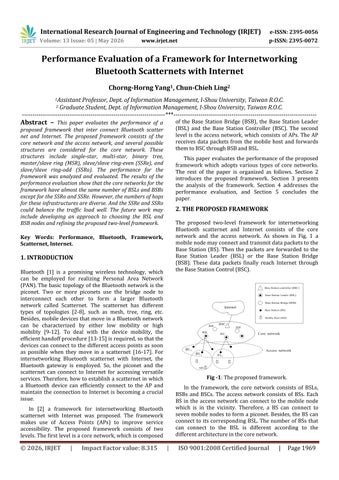
2. THE PROPOSED FRAMEWORK The proposed two-level framework for internetworking Bluetooth scatternet and Internet consists of the core network and the access network. As shown in Fig. 1 a mobile node may connect and transmit data packets to the Base Station (BS). Then the packets are forwarded to the Base Station Leader (BSL) or the Base Station Bridge (BSB). These data packets finally reach Internet through the Base Station Control (BSC).
Key Words: Performance, Bluetooth, Framework, Scatternet, Internet.
1. INTRODUCTION Bluetooth [1] is a promising wireless technology, which can be employed for realizing Personal Area Network (PAN). The basic topology of the Bluetooth network is the piconet. Two or more piconets use the bridge node to interconnect each other to form a larger Bluetooth network called Scatternet. The scatternet has different types of topologies [2-8], such as mesh, tree, ring, etc. Besides, mobile devices that move in a Bluetooth network can be characterized by either low mobility or high mobility [9-12]. To deal with the device mobility, the efficient handoff procedure [13-15] is required, so that the devices can connect to the different access points as soon as possible when they move in a scatternet [16-17]. For internetworking Bluetooth scatternet with Internet, the Bluetooth gateway is employed. So, the piconet and the scatternet can connect to Internet for accessing versatile services. Therefore, how to establish a scatternet in which a Bluetooth device can efficiently connect to the AP and maintain the connection to Internet is becoming a crucial issue.
Fig -1: The proposed framework. In the framework, the core network consists of BSLs, BSBs and BSCs. The access network consists of BSs. Each BS in the access network can connect to the mobile node which is in the vicinity. Therefore, a BS can connect to seven mobile nodes to form a piconet. Besides, the BS can connect to its corresponding BSL. The number of BSs that can connect to the BSL is different according to the different architecture in the core network.
In [2] a framework for internetworking Bluetooth scatternet with Internet was proposed. The framework makes use of Access Points (APs) to improve service accessibility. The proposed framework consists of two levels. The first level is a core network, which is composed
© 2026, IRJET
|
Impact Factor value: 8.315
|
ISO 9001:2008 Certified Journal
|
Page 1969