
International Research Journal of Engineering and Technology (IRJET) e-ISSN: 2395-0056
Volume: 13 Issue: 03 | Mar 2026 www.irjet.net p-ISSN: 2395-0072
International Research Journal of Engineering and Technology (IRJET) e-ISSN: 2395-0056
Volume: 13 Issue: 03 | Mar 2026 www.irjet.net p-ISSN: 2395-0072
Vinesh P1 , Tharun M2 , Sujan R3 , Mohammed Raashidh S4 , Dr. G. Suresh Kannan5
1,2,3,4 B. E Mechanical Engineering, Coimbatore Institute of Technology, Coimbatore, India
5 Associate Professor, Dept of Mechanical Engineering, Coimbatore Institute of Technology, Coimbatore, India
Abstract - Solar photovoltaic (PV) systems suffer significant efficiency losses when installed under fixed mounting conditions due to the continuous variation of solar incidence angle throughout the day. Dual-axis solar tracking systems provide a practical solution by maintainingoptimalalignmentbetweenthePVsurfaceand incoming solar radiation. This study presents the design evolution, modeling, analysis, and performance evaluation of a dual-axis solar tracking system developed through three mechanical configurations. Model I utilizes a Quad RackLinear ElevationTracker (QRLET) based onrack-andpinionactuation. Model II introduces a Hinge-Assisted Rack Tilt Tracker (HARTT) enabling controlled angular motion. Model III proposes a Pneumatic Dual-Axis Solar Tracker (PDST) using four double-acting cylinders for distributed load actuation. Detailed load calculations, torque estimation, wind force modeling, and CAD-based motion simulations were conducted to validate mechanical feasibility. Energy yield comparison demonstrates a 38.2% improvement in daily energy output compared to a fixed panel configuration. Battery sizing using lithium iron phosphate (LiFePO₄) technology is also presented to ensure autonomous operation. The results indicate that pneumatic actuation offers superior angular flexibility, load distribution, and mechanical reliability for scalable solar trackingapplications.
The increasing global demand for electrical energy has placed enormous pressure on conventional fossil-fuelbasedpowergenerationsystems.Environmentalconcerns suchasgreenhousegasemissions,globalwarming,andair pollution have accelerated the transition toward renewable energy resources. Among various renewable energytechnologies,solarphotovoltaic(PV)systemshave emerged as one of the most promising solutions due to their modularity, scalability, and decreasing installation cost.
Despite technological advancements in PV cell materials suchasmonocrystallinesilicon,polycrystallinesilicon,and thin-film technologies, the overall system efficiency remains constrained by geometric and environmental limitations.Oneofthemostcriticalparametersinfluencing PVperformanceistheangleofsolarincidence.
In fixed solar panel installations, the tilt angle is chosen based on geographical latitude to optimize annual energy production.However,thepositionofthesuncontinuously changesdueto:
Earth’saxialtilt
Earth’srotation
Seasonalvariation
Solardeclinationshift
As a result, the angle between incoming solar radiation andthepanelnormal(θ)changesthroughouttheday.This variation directly affects the effective irradiance received bythepanel.
The instantaneous power generated by a PV module can beexpressedas:
Where:
P=Outputpower(W)
P=AG ηcos(θ)
A=Surfacearea(m²)
G=Solarirradiance(W/m²)
η=Moduleefficiency
θ=Angleofincidence
As θ increases, cos(θ) decreases, thereby reducing effectiveirradiance.
Forexample:
Atθ=0°,cos(θ)=1(maximumpower)
Atθ=60°,cos(θ)=0.5(50%effectiveirradiance)
Thus, fixed systems lose substantial energy during early morningandlateeveninghours.
Solartrackingsystemsaredesignedtomaintainthepanel surface perpendicular to the sun’s rays. They are categorizedas:
Single-axistrackingsystems
Dual-axistrackingsystems
Single-axis trackers adjust along one axis, typically eastwest.
Dual-axis trackers adjust both azimuth and elevation, allowingfullsun-followingcapability.
Research studies report energy gains of 30–40% using dual-axis systems compared to fixed panels. However, conventional motor-driven dual-axis trackers introduce mechanicalandcontrolcomplexities.
International Research Journal of Engineering and Technology (IRJET) e-ISSN: 2395-0056
Volume: 13 Issue: 03 | Mar 2026 www.irjet.net p-ISSN: 2395-0072
This study proposes a novel mechanical evolution leading toaPneumaticDual-AxisSolarTracker(PDST)toenhance reliabilityandperformance.
2.1 Solar Position Angles
ThepositionofthesunrelativetoEarthisdefinedby:
Solardeclination(δ)
Hourangle(H)
Latitude(φ)
Solaraltitudeangle(α)
Solarazimuthangle(γ)
Solaraltitudeangleisgivenby: sin(α)=sin(ϕ)sin(δ)+cos(ϕ)cos(δ)cos(H)
Declinationangle:
δ=23.45∘sin( (284+n))
Wheren=dayoftheyear.
Hourangle: H=15∘(t 12)
Wheret=solartimeinhours.
These continuously varying angles justify real-time dualaxistracking.
3. DESIGN EVOLUTION
3.1 Model I – Quad Rack Linear Elevation Tracker (QRLET)
3.1.1 Mechanical Configuration
The QRLET design employs four rack-and-pinion assembliespositionedverticallyateachcornerofthesolar panel support frame. Each rack converts rotary motor motionintolinearverticaldisplacement.
3.1.2ForceandTorqueAnalysis
TotalMass(panel+frame)=15kg
Loadperrack:
Pinionradius=0.016m
Including30%safetyfactor:
3.1.3 Limitations
Noazimuthtracking
Synchronizationcomplexityamongfourmotors
Gearbacklash
Structuralmisalignmentunderwindload
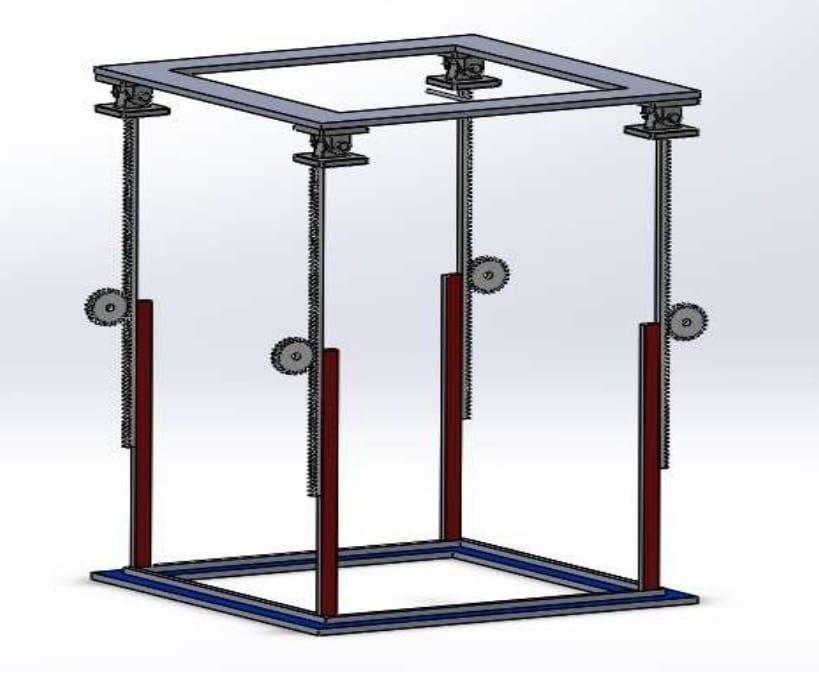
Fig -1: QuadRackLinearElevationTracker
3.2 Model II – Hinge-Assisted Rack Tilt Tracker (HARTT)
3.2.1 Structural Modification
A rear hinge axis is introduced to allow tilting motion. A front rack-and-pinion assembly drives angular displacementupto±20°.
3.2.2 Moment Calculation
Distancefromhingetopanelcentroid=0.5m
Requiredforceatracklocation(0.7mfromhinge):
Torque≈0.75Nm
3.2.3 Observed Issues
Gearwearoverrepeatedcycles
Motorsynchronizationerrors
Increasedcontrollogiccomplexity
International Research Journal of Engineering and Technology (IRJET) e-ISSN: 2395-0056
Volume: 13 Issue: 03 | Mar 2026 www.irjet.net p-ISSN: 2395-0072
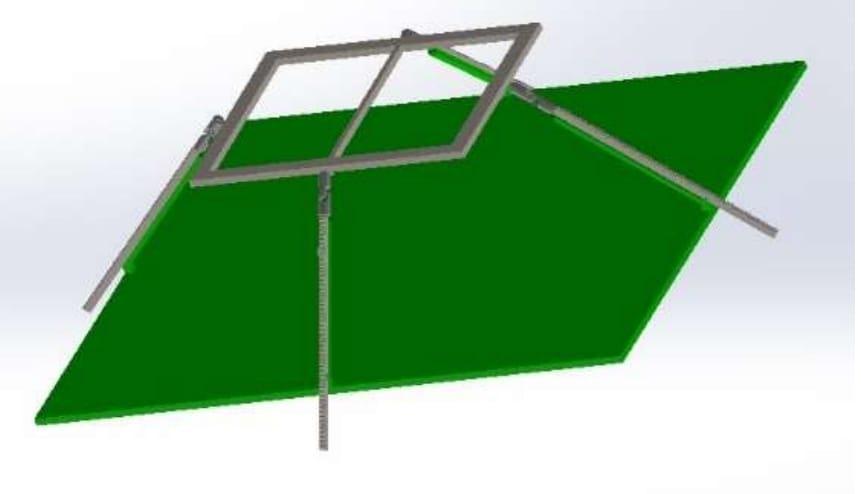
3.3 Model III – Pneumatic Dual-Axis Solar Tracker (PDST)
3.3.1 System Architecture
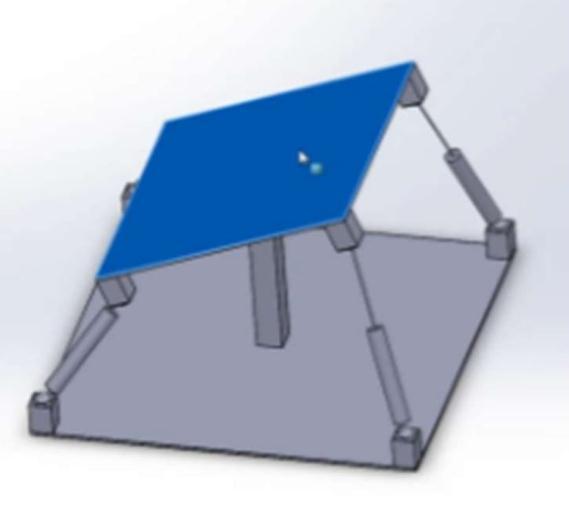
The final design uses four double-acting pneumatic cylindersmountedateachcornerofthepanelframe. Selectiveextensionandretractionproduce:
Verticalelevation
X-axistilt
Y-axistilt
4. PNEUMATIC SYSTEM ANALYSIS
4.1 Pneumatic Force Generation
Cylinderforce:
Where:
P=Pressure
A=Pistonarea
Designloadperactuator≈40N
At4barpressure(400kPa):
Cylinderdiameter:
4.2 Wind Load Analysis
Windforceequation:
For:
ρ=1.225kg/m³
V=10m/s
A=0.245m²
Cd=1.28
Includinggustfactor,maximumdesignloadincreases.
4.3 Structural Stability
Momentduetowind:
Whereh=centroidheight. Distributed pneumatic support reduces stress concentration.
5. CONTROL SYSTEM DESIGN
5.1 Open Loop Control
Astronomical algorithm-based tracking using solar positionequations.
5.2 Closed Loop Control
LightDependentResistor(LDR)sensorsdetectdifferential illumination.
5.3 PID Control Frame work
Ensuressmoothmotionwithoutoscillation.
6. ENERGY PERFORMANCE ANALYSIS
FixedPanelOutput=170Wh/day PDSTOutput=235Wh/day
EfficiencyGain
International Research Journal of Engineering and Technology (IRJET) e-ISSN: 2395-0056
Volume: 13 Issue: 03 | Mar 2026 www.irjet.net p-ISSN: 2395-0072
Parameter
DegreesofFreedom 1 1.5 2
ActuationType Rack Rack+ Hinge Pneumatic
AngularRange Limited ±20° Full2DOF
Synchronization
Energy
Maintenance
8. BATTERY SIZING
Dailyenergy=340Wh Autonomy=2days
Considering80%DoD: With15%margin:
Selectedbattery: 12V,100AhLiFePO₄ Capacity=1200Wh
9. ECONOMIC ANALYSIS
InitialCostComponents:
Framefabrication
Pneumaticcylinders
Compressor
Battery
Controller
Paybackperiod:
10. RELIABILITY ANALYSIS
Mechanicalrackssufferfrom:
Toothwear
Lubricationdependency
Backlash
Pneumaticsystemsoffer:
Fewerrotatingcomponents
Reducedfriction
Smootherloadtransfer
11. FUTURE WORK
IoTintegration
AI-basedpredictivetracking
Hybridelectro-pneumaticsystems
ThePneumaticDual-AxisSolarTracker(PDST)achieveda 38.2% improvement in daily energy output compared to fixed installations. Mechanical optimization through distributed pneumatic actuation significantly enhanced reliabilityandperformance.
The authors would like to express their sincere gratitude to the Department of Mechanical Engineering, VIT Pune, for providing the necessary facilities and academic environmenttocarryoutthiswork.Weextendourthanks to our project supervisor, Dr. G. Suresh Kannan, for his valuable guidance, constructive feedback, and continuous support throughout the project. We also thank the faculty members and laboratory staff for their assistance during the design, modeling, and analysis stages, and we acknowledge our classmates and friends for their cooperationandsupport.
1. S. Kumar et al., “Design and Analysis of Dual Axis SolarTrackerSystem,”IJERA,2014.irjet
2. Khalid and M. T. Iqbal, “Low-Cost Dual-Axis Solar TrackerUsingArduino,”IEEECCECE,2018.scribd
3. M.Mekhilefetal.,“PerformanceComparisonofPV Systems,”RenewableEnergyReviews,2011.irjet
4. P.SinghandS.Raghav,“OptimizationofDual-Axis Solar Tracking Using PID Control,” IJITEE, 2019.irjiet
5. K. Narendran and J. Venkatesan, “Energy Yield Analysisofa2DOFSolarTracker,”IJRER,2018.