
International Research Journal of Engineering and Technology (IRJET) e-ISSN: 2395-0056
Volume: 13 Issue: 05 | May 2026 www.irjet.net p-ISSN: 2395-0072
International Research Journal of Engineering and Technology (IRJET) e-ISSN: 2395-0056
Volume: 13 Issue: 05 | May 2026 www.irjet.net p-ISSN: 2395-0072
Dr. Mayura M. Yeole1 , Anuj S. Deshmukh2 , Janhavi V. Nawale3 , Kshitija S. Kadam4 , Mayuri K. Nimbalkar5
1,2,3,4,5Department of Civil Engineering, PCET’s Pimpri Chinchwad College of Engineering and Research, Ravet, Pune, Maharashtra, India ***
Abstract - A well-developed transportation system plays a vital role in the economic development of a country. However, continuous growth in vehicular population and axle loads leads to accelerated pavement deterioration on major highways. The Pune to Satara section of NH-48, with an approximate length of 110 km, experiences significant distress in the form of rutting, cracking, and surface deformation due to heavy traffic movement. Therefore, timely assessment and maintenance planning are essential to ensure serviceability and safety of the pavement. The present study focuses on evaluating pavement deterioration and its impact on performance and economic feasibility of maintenance strategies. The analysis is carried out using HDM-4 software to assess deterioration trends, predict future conditions, and determine cost-effective rehabilitation measures. The economic evaluation is based on parameters such as vehicle operating cost, travel time savings, and Economic Internal Rate of Return (EIRR). The results indicate that appropriate maintenance and strengthening alternatives significantly reduce deterioration rate and are economically viable, ensuring improved riding quality and extended pavement life.
Keywords - Pavement deterioration; NH-48; HDM-4; Economic Internal Rate of Return (EIRR); Flexible pavement; Maintenance strategies; Highway performance; Economic viability.
Highways are the dominant mode of transportation in India and play a crucial role in supporting economic growth and regional connectivity. The Pune to Satara section of NH-48, spanning approximately 110 km, is one of the important corridors that carries heavy traffic including commercial vehicles. Due to continuous increasein traffic volumeand axle loads,thishighway section is increasingly subjected to pavement deterioration in the form of cracking, rutting, potholes, and surface irregularities. Improvement and proper maintenance of highway infrastructure lead to reduction in travel time,decreaseinvehicleoperatingcosts,enhancedsafety,andminimizationofenvironmentalimpacts.Iftimelymeasures are not taken, pavement deterioration can significantly affect ride quality, increase maintenance costs, and reduce the overall efficiency ofthe transportation network.Therefore,systematic evaluationofpavement condition and planning of appropriate maintenance strategies are essential for sustainable highway performance. The decision-making process for selecting the most suitable maintenance and rehabilitation strategy often faces challenges due to the lack of reliable and customizedeconomicevaluationtools.
To Carry out an economic analysis using HDM – 4 software to identify economicconditions.
ToStudythepavementDeteriorationanalysisusingHDM-4software.
To calculate important pavement performance metrics undervarious circumstances,suchasrutting,cracking, androughness
HDM-4 is a computer-based tool used for highway development and maintenance management. It supports decisionmaking by evaluating both engineering performance and economic feasibility of road investment projects. The software was developed for global application with support from the World Bank.HDM-4 helps in analyzing pavement condition, predicting deterioration, estimating costs, and comparing different improvement alternatives. It mainly includes three typesofanalysis:
Project Analysis:
Usedtoassessindividualroadprojectsbycomparingdifferentalternativeswithabasecase(do-nothingscenario).Ithelps inselectingthemostsuitableoptionfor maintenance,rehabilitation,orconstruction.
ProgrammeAnalysis:
Focusesonprioritizingmultipleroadprojectswithinalimitedbudget.Itselectsthebestcombinationofprojectsby
International Research Journal of Engineering and Technology (IRJET) e-ISSN: 2395-0056
Volume: 13 Issue: 05 | May 2026 www.irjet.net p-ISSN: 2395-0072
maximizingeconomicbenefitssuchasNPVorcost-effectiveness.
Strategic Analysis:
Involves long-termevaluationoftheentireroadnetworkunderdifferentbudgetscenarios.
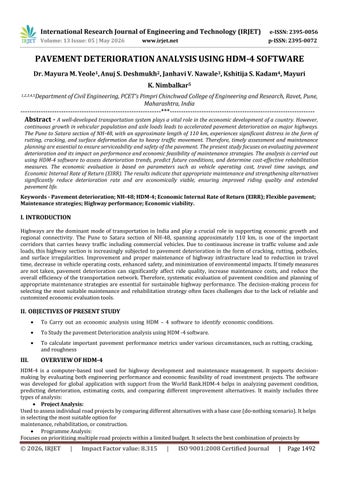
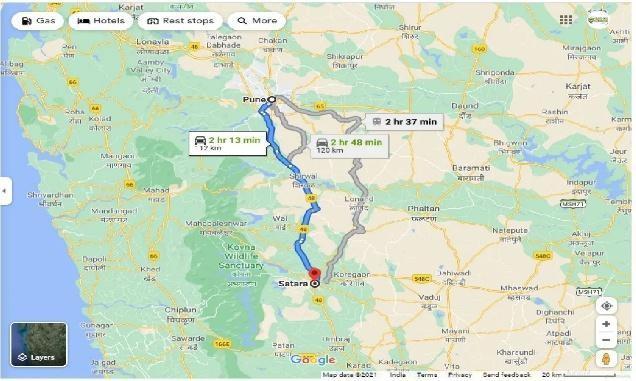
ThePunetoSatarasectionislocatedinwesternMaharashtraandformspartofNH-48.Thestudystretchisapproximately 110kmlongandcarriesheavytraffic. Theprojectroadliesbetweenabout18°31'to17°41'Northlatitudeand73°51'to74°00'Eastlongitude.
TheinputdataforHDM-4Modelconsistsofvariousparameterswhichareclassifiedasbelow
Road Network
DataTheroadnetworkdataincludedroadInventorydata,roadgeometricdetails,structural evaluation,pavement conditionandevaluationofpavementmaterialasgiveninTableI
Table 1. RoadNetwork
Parameter Data
SectionID
NH48
SectionName PunetoSatara
SectionLength 110Km
TerrianType Rolling(Mostly)
No.ofLanes 6Lanes
CarriagewayWidth 21m(6*3.5)
ShoulderType Paved+Earthen
ShoulderWidth
2.5–4.5m
PavementType Bituminous
Pavement Condition and Traffic Data
Table 2 PavementConditionandTrafficData
Pavementcondition(Initial) Roughness 3m/km
RutDepth 5–8mm
Cracking(%) 5%
EdgeBreak Negligible SkidResistance Good
International Research Journal of Engineering and Technology (IRJET) e-ISSN: 2395-0056
Volume: 13 Issue: 05 | May 2026 www.irjet.net p-ISSN: 2395-0072
Ravelling(%) Low Potholes(No/km 1-2perkm
Deflection
TrafficData
AADT 60,000PCU/day
HeavyVehicle(%) 40%
AxleLoad 3
GrowthRate 6%
DirectionalSpilt 0.5
SpeedFlowType 2
TrafficFlowPattern ContinuousFlow
MTAADT(2024) 60,000PCU/day
NMTAADT(2025) 63,000PCU/day
In this study, pavement deterioration analysis is carried out using the HDM-4 model. The required road data such as traffic, pavement condition, and structural details are collected and prepared for analysis. Traffic data includes volume, composition,andgrowthrate,whilepavementconditiondataincludesroughness,cracking,andrutting.
ThecollecteddataisinputintoHDM-4afterproperprocessingandcalibrationtosuitlocalconditions.Themodelusesits built-in deterioration models to predict yearly changes in pavement condition over the analysis period. Different maintenance and rehabilitation strategies, such as routine maintenance and overlays, are defined and analyzed in the model. HDM-4 evaluates these alternatives based on technical performance and economic parameters like vehicle operatingcostandmaintenancecost.
RESULT OF PAVEMENT DETERIORATION
International Research Journal of Engineering and Technology (IRJET) e-ISSN: 2395-0056
Volume: 13 Issue: 05 | May 2026 www.irjet.net p-ISSN: 2395-0072
Volume: 13 Issue: 05 | May 2026 www.irjet.net
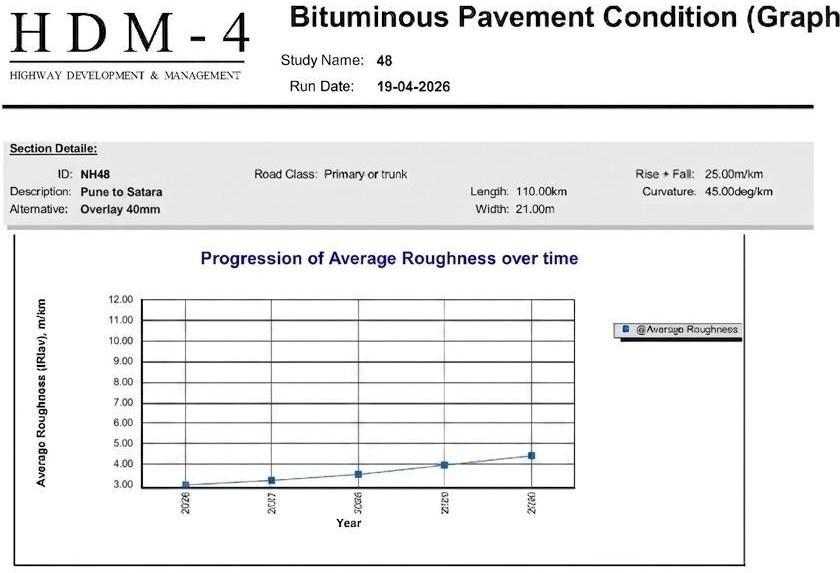
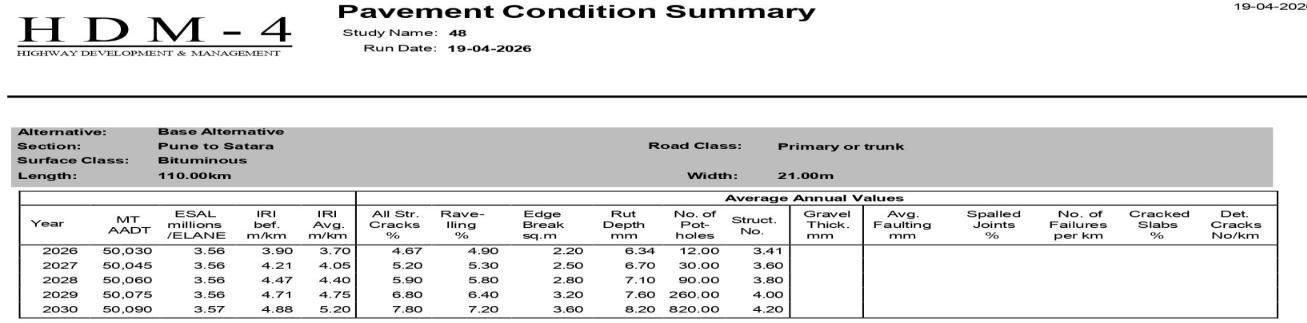
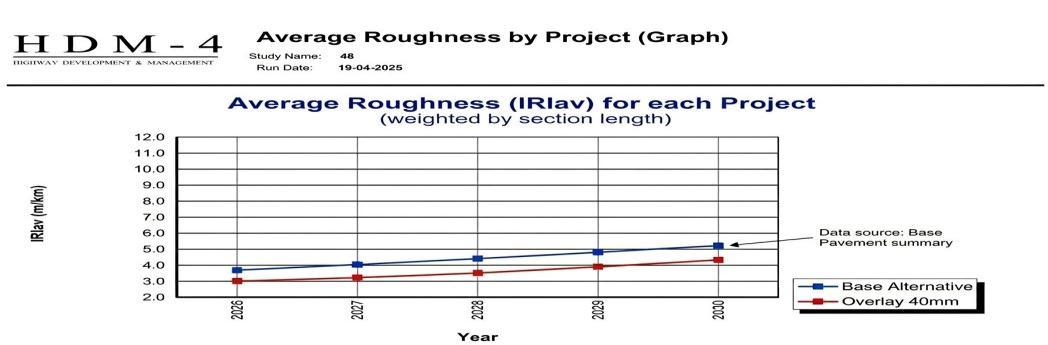
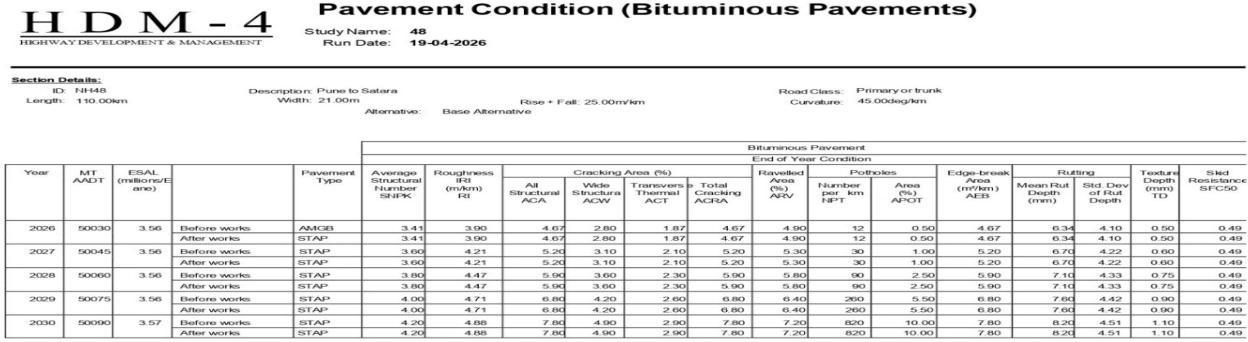
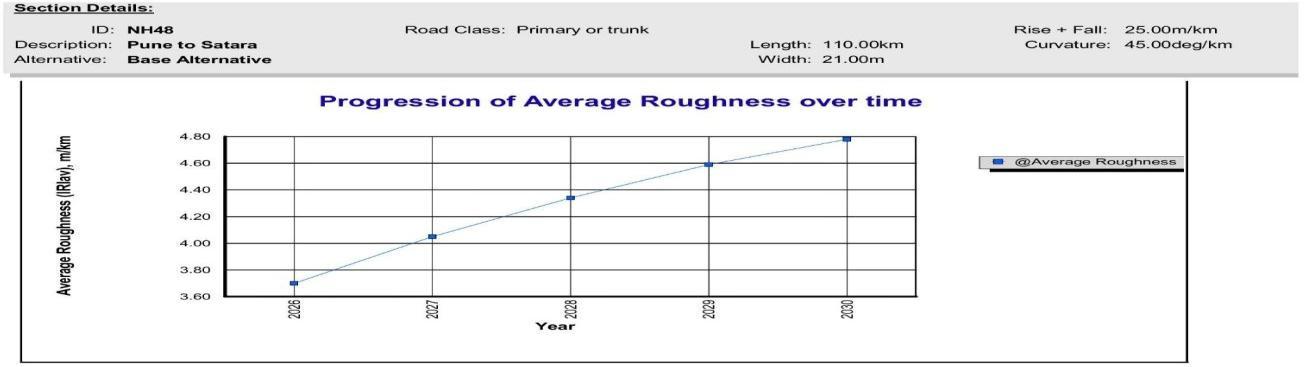
ThepavementconditionanalysisofNH48(Pune–Satara)fortheperiod2026to2030indicates a consistent deterioration trendunderthebasescenario.KeyparameterssuchasInternationalRoughnessIndex(IRI),cracking,potholes,andrutting show gradual increase due to heavy traffic loading(AADTandESAL) and continuous usage.Thisdeterioration results in reduced riding comfort,increased vehicleoperatingcosts,anddeclineinoverall pavement performance and safety. If no majormaintenanceinterventionisapplied,thepavementconditionisexpectedtoworsensignificantlyovertime.
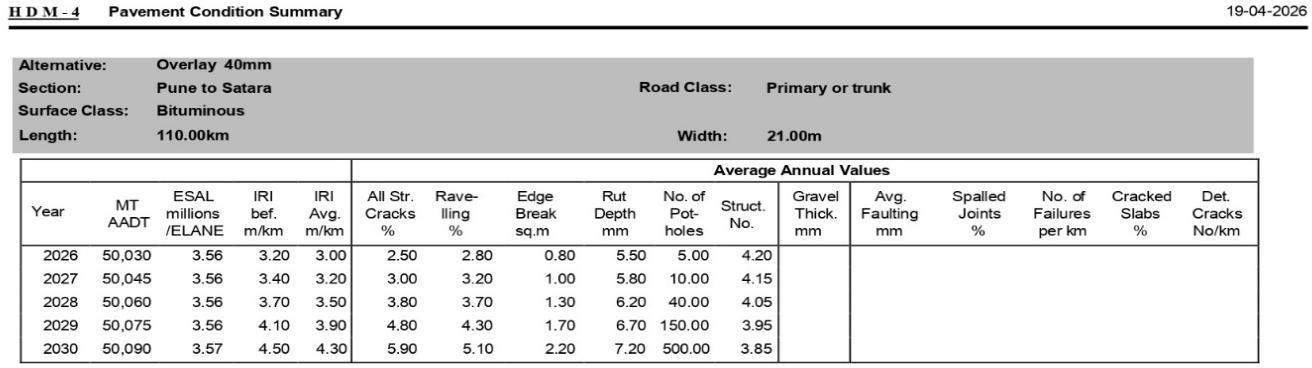
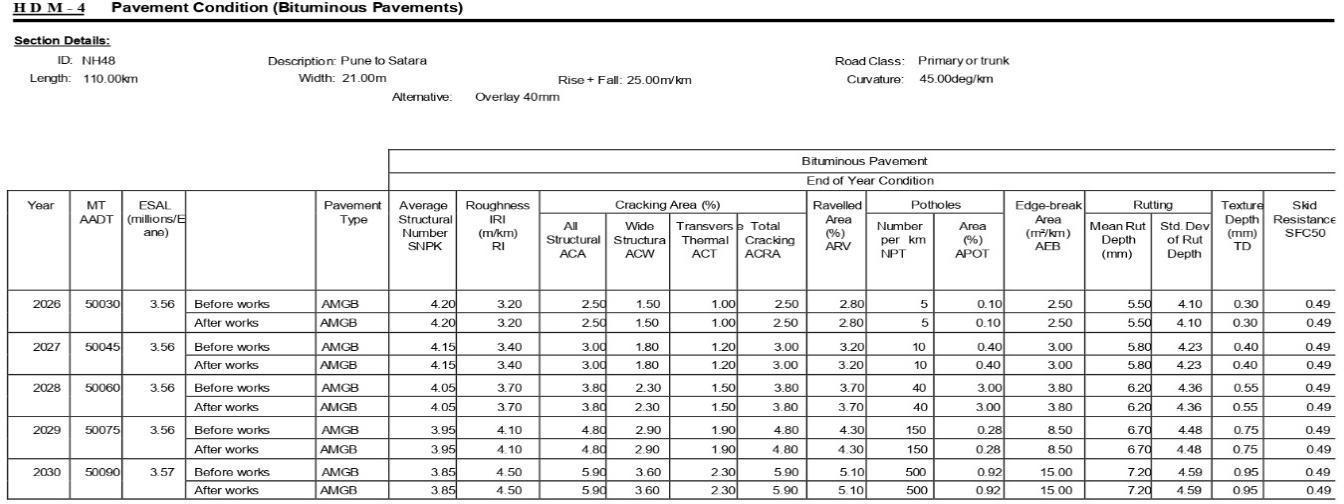
In contrast, the improvement alternative involving a 40 mm bituminous overlay shows noticeable enhancement in pavement condition. The overlay reduces surface roughness, controls the development of cracks and potholes, and improves ride quality. It also helps in better load distribution, thereby reducing stress on underlying layers and slowing therateofdeterioration.
Overall,thecomparativeresultssuggestthattheoverlayoptionismoreeffectiveinmaintainingbothfunctionalperformance and structural integrity of the pavement. It ensures better serviceability, extends pavement life, and proves to be a practicalandefficientmaintenancestrategyfortheNH48(Pune–Satara)section.
International Research Journal of Engineering and Technology (IRJET) e-ISSN: 2395-0056
Volume: 13 Issue: 05 | May 2026 www.irjet.net p-ISSN: 2395-0072
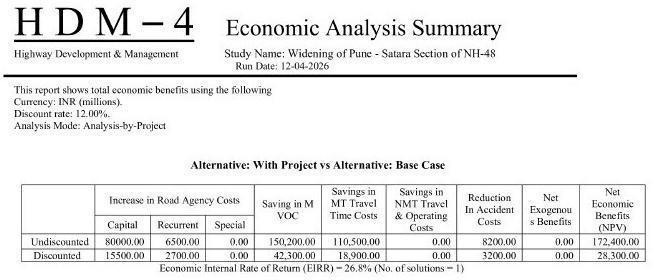
As per the generated results, the economic returns for the selected road section are satisfactory and indicate strong feasibility.ThePune–SatarasectionofNH-48showsaNetEconomicBenefitof28,300.00ata12%discountrate,reflecting the project’s positive economic performance. The calculated Economic Internal Rate of Return (EIRR) is 26%, which is considerably higher than the standard benchmark value of 12%, confirming that the proposed improvement is economicallyviableandbeneficial.
Inadditiontothedirecteconomicgains,theprojectalsocontributestoreducedvehicleoperatingcosts,savingsintravel time,andimprovedridingcomfortforroadusers.Betterpavementconditionleadstolowerfuelconsumptionandreduced wear and tear of vehicles, which further enhances user benefits. The improvement in road quality also supports safer travelandincreasesoverallefficiencyoftransportationalongthisimportantcorridor.
Furthermore, the HDM-4 (Highway Development and Management) tool plays an important roleinevaluatinglong-term pavement performance and estimating future budget requirements. It supports the selection of optimal maintenance strategies and ensures effective allocation of resources under budget constraints. Thus, the use of HDM-4 enables better decision-making, enhances sustainability, and ensures that the pavement remains in good condition throughout the analysisperiod
WetakethisopportunitytothankourresearchguideProf.MayuraYeolefortheirvaluableguidanceandforprovidingall necessaryfacilitieswhichwereindispensableinthe completionofthisresearchwork.
1) Pavan R. Vyas, “Project level analysis using development and management model (hdm-4): A case study,” Conferencepaper,2016.
2) R. Tomek and S. Vit´asek, “Improvement of economic effectiveness of road highway projects,” Procedia engineering, 2016, vol. 164, pp. 395–401. [3] U. S.Yogesh, S. Jain, and T. Devesh, “Adaptation of hdm-4 tool for strategicanalysisofurbanroadsnetwork,”TransportationResearchProcedia,2016,vol.17,pp.71–80.
3) Mit Patel, Prof. N. D. Hajiani, “Economic Analysis of Transportation Project using HDM-4 Model,” International JournalforScientificResearch&Development,2015,Vol.3,Issue02.
4) Dr.DiptiRanjanMohapatra,“AnEconomicAnalysisofImprovementofRoadInfrastructure:ACaseStudy,”
5) Sood, V. K., & Sharma, B. M. (1996, November). Development of pavement deterioration models for Indian conditions.InJournaloftheIndianRoadsCongress(Vol.57,No.3)
6) Jain, S. S.,Aggarwal, S., & Parida, M. (2005). HDM-4 pavement deterioration models for Indian national highway network.JournalofTransportationEngineering,131(8),623-631
7) Veeraragavan, A., & Reddy, K. R. (2003). Application of highway development and management tool for lowvolumeroads.Transportationresearchrecord,1819(1),24-29.
International Research Journal of Engineering and Technology (IRJET) e-ISSN: 2395-0056
Volume: 13 Issue: 05 | May 2026 www.irjet.net p-ISSN: 2395-0072
[1] Morosiuk,G.,Toole,T.,Mahmud,S.,&Dachlan,T.(1999).Modellingthedeteriorationofbituminouspavementsin indonesiawithinahdm-4framework.InThe21stWorldRoadCongress,PIARC,KualaLumpur,Malaysia.
[2] Gedafa,D.S.(2006).PresentPavementMaintenancePractice:ACaseStudyforIndianConditionsUsingHDM-4. In2006TransportationScholarsConferenceIowaStateUniversity,Ames.
[10]R. B. Corotis, “Highway user travel time evaluation,” Journal of TransportationEngineering,2007,vol.133, no.12,pp.663669.
[11] Henry Kerali, “Economic appraisal of road projects in countries with developing and transition economies,” TransportReviews,2003,VOL.23,NO.3,249–262
[12] Kerali,H.R.,Robinson,R.,andPaterson,W.D.O.,1998.“RoleoftheNewHDM-4inHighwayManagement.”4th Int.Conf.onManagingPavements.
[13] Kerali, H. R., Odoki, J. B., Wightman, D. C., and Stannard, E. E., 1998. “Structure of the new Highway DevelopmentandManagementTools(HDM-4).”4thInt.Conf.onManagingPavements.
[14] Bennett,C.R.,andPaterson,W.D.O.,2000.AGuidetoCalibrationandAdaptation,HighwayDevelopmentand Management Series, Vol. 5, International Study of Highway Development and Management, World Roads Association, Paris.
[15] IRC:SP:30,“ManualoneconomicevaluationofhighwayprojectinIndia’sincivilEngineering2009
© 2026, IRJET | Impact Factor value: 8.315 | ISO 9001:2008 Certified Journal | Page1498