
International Research Journal of Engineering and Technology (IRJET) e-ISSN: 2395-0056
Volume: 13 Issue: 02 | Feb 2026 www.irjet.net p-ISSN: 2395-0072
International Research Journal of Engineering and Technology (IRJET) e-ISSN: 2395-0056
Volume: 13 Issue: 02 | Feb 2026 www.irjet.net p-ISSN: 2395-0072
CHAUDHARI1 , ANUJA CHAVAN2 , KOMAL GHUNAWAT3 , PROF. ANIL NAIK4
1,2,3 (Students, Department of Computer Engineering), S.Y.P Shreeyash College Of Engineeringand Technology (Polytechnic), Chh.Sambhajinagar , India 4(Hod, Dept. Of Computer Engineering), S.Y.P Shreeyash College Of Engineeringand Technology (Polytechnic), Chh.Sambhajinagar , India ***
Abstract - Healthcare institutions continuously generate large volumes of sensitive patient information that must be managed efficiently and securely. Traditional record management approaches, such as paper-based files or unstructured digitalstorage,areinadequatetomeetmodernhealthcarerequirements.Thesemethodsoftenresultindelayedaccessto patient history, data inconsistency, and serious privacy concerns. This research paper presents a comprehensive Patient Record Management System (PRMS) that digitally manages patient information using a role-based architecture. The system is divided into three primary modules: Administrator, Doctor, and Patient. Each module is designed with specific access rights to ensuresecureand controlled interaction with medical data. The proposed system improves data accuracy, enhances security through role-based access control, and streamlines healthcare operations. Experimental observationsindicateimprovedsystemefficiency,reducedmanualworkload,andbetterpatientengagement.
Key Words: Patient Record Management System, Healthcare Information System, Role-Based Access Control, Medical Data Security, Digital Healthcare
The healthcare sector is highly data-driven, relying on accurate and timely patient information to deliver effective treatment.Patientdataincludespersonal details,medicalhistory,diagnosticreports,prescriptions,andfollow-uprecords. Traditionally, hospitals and clinics have maintained these records manually, which leads to inefficiencies and increased chancesoferror.
Manualrecordhandlingconsumessignificanttimeandresources,especiallyinlargehealthcarefacilitieswithhighpatient inflow. Retrieving old patient records during emergencies becomes difficult, which may affect clinical decisions. Additionally, paper-based records are vulnerable to physical damage, loss, and unauthorized access, raising serious concerns about data confidentiality. With advancements in information technology, digital healthcare systems have emergedasanecessityratherthanachoice.APatientRecordManagementSystemprovidesacentralizeddigitalplatform thatstoresandmanagespatientinformationsecurely.By implementingrole-basedaccess.
The system ensures that only authorized users can view or modify sensitive data, thereby improving overall healthcare servicequality.
The motivation for developing the proposed PRMS arisesfromreal-worldchallengesfacedbyhealthcareorganizations:
Increasingpatientpopulationanddatavolume
Demandforquickandaccuratemedicaldecisions
Growingconcernsaboutpatientdataprivacy
Inefficient coordination between administrative andclinicaldepartments
Limited access for patients to their own medical information
Adigitalandrole-basedsystemisessentialtoaddresstheseissuesandsupportmodernhealthcareworkflows.
International Research Journal of Engineering and Technology (IRJET) e-ISSN: 2395-0056
Volume: 13 Issue: 02 | Feb 2026 www.irjet.net p-ISSN: 2395-0072
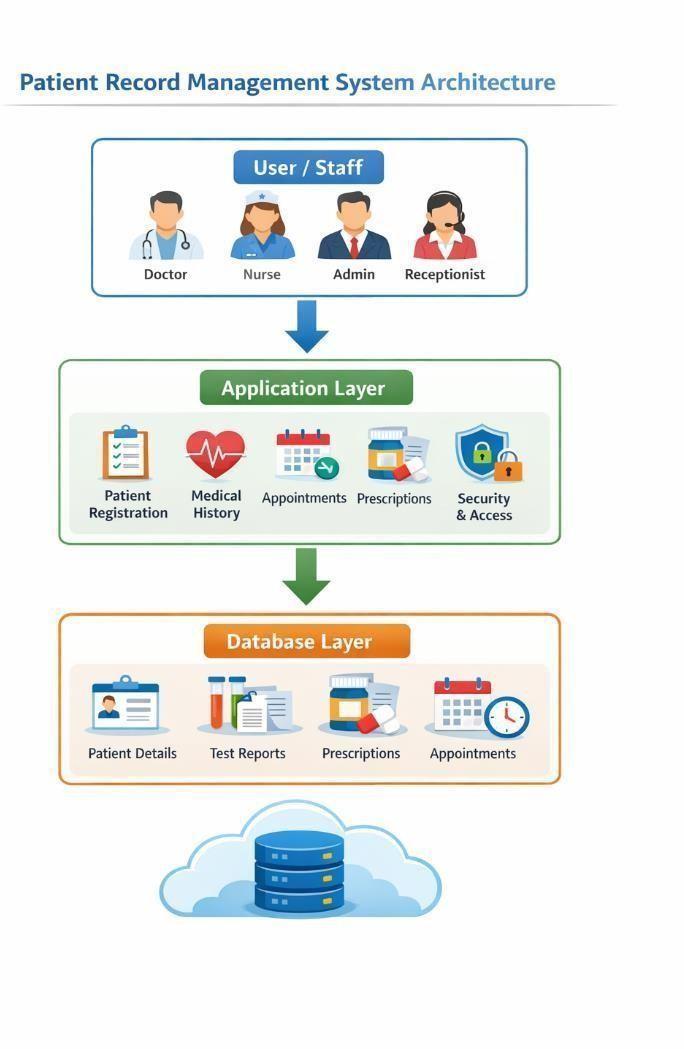
System Architecture
1.Presentation Layer
Provides user-specific interfaces for Administrator, Doctor, and Patient. Each interface is designed according to the responsibilitiesoftheuser.
2.Application Layer
Implementsbusinesslogic,includingauthentication,authorization,validation,andrecordprocessing.
3. Database Layer
Storespatientrecords,usercredentials,prescriptions,reports,andauditlogsinastructuredformat. Thislayeredapproachenhancesscalability,maintainability,andsystemsecurity.
The research methodology adopted for the proposed Patient Record Management System (PRMS) is designed to ensure systematic development, secure data handling, and efficient healthcare record management. The methodology integrates software engineering principles with healthcare data management requirements. The complete process is divided into well-definedphases,eachcontributingtothereliabilityandeffectivenessofthesystem.
1. Problem Identification and Requirement Gathering
The first phase involved identifying limitations in existing patient record handling methods. Manual systems were analyzedtounderstandissuessuchasdelayeddataretrieval,lackofdatasecurity,andhighdependencyonhumaneffort. Functional requirements such aspatientregistration,medicalrecordmanagement, and role-based access were collected. Non-functional requirements including data confidentiality, system scalability, availability, and performance were also considered.
2395-0056
Volume: 13 Issue: 02 | Feb 2026 www.irjet.net p-ISSN: 2395-0072
2.Feasibility Study
Afeasibilityanalysiswasconductedtoevaluatethetechnical,economic,andoperationalviabilityoftheproposedsystem. The study confirmed that a web-based role-oriented architecture could be implemented using commonly available technologieswithminimalcost.Thesystemwasfoundsuitableforsmallandmedium-scalehealthcareinstitutionswithout requiringadvancedinfrastructure.
3. System Modeling and Design
Based on the gathered requirements, the system was modeled using architectural and data design techniques. A layered architecture was selected to separate user interface, application logic, and data storage. UML diagrams such as use case diagrams, data flow diagrams, and entity relationship diagrams were prepared to visualize system behavior and data interactions.Thisdesignapproachensuresmodularity,maintainability,andeaseoffutureenhancement.
4. Role-Based Access Control Strategy
Thesystemimplementsarole-basedaccesscontrolmechanismtoenforcedatasecurity.UserrolessuchasAdministrator, Doctor, and Patient were defined with distinct access privileges. Administrators are authorized to manage system users and configurations, doctors can access and update patient medical records, and patients are allowed only to view their ownhealthinformation. Thisstrategypreventsunauthorizedaccessandensuresethicalhandlingofmedicaldata.
5. Database Design and Normalization
A relational database design was adopted to store patient records and system data efficiently. Database tables were createdforusers,patients,doctors,medicalrecords,prescriptions,andreports.Normalizationtechniqueswereappliedto eliminate redundancy and maintain data consistency. Primary and foreign key constraints were used to establish relationshipsbetweenentitiesandsupportefficientquerying.
6. Security Mechanism Integration
Securityconsiderations were integrated throughout the development process.User authentication, password encryption, secure session handling, and access logging were implemented to protect sensitive patient data. Audit trails were maintained to track user activities and ensure accountability. These measures align with healthcare data privacy standards.
7. Performance and Reliability Evaluation
Thesystemperformancewasevaluatedbasedonresponsetime,dataretrievalspeed,andsystemreliabilityundermultiple user access conditions. The evaluation demonstrated that the proposed system provides faster access to patient records andmaintainsdataaccuracyevenwithincreasedworkload.
8. Result Interpretation
Theresultsobtainedfromtestingandevaluationswereanalyzedtoassesssystemeffectiveness.Thefindingsindicatethat the role-based Patient Record Management System significantly reduces manual effort, improves data accessibility, and enhancesdatasecurity.
Thesystemsuccessfullymeetsthedefinedfunctionalandnon-functionalrequirements.
Healthcare institutions manage large volumes of patient- related information, including personal details, medical history, diagnosticreports,prescriptions,andfollow-uprecords.Inmanyhospitalsandclinics,thisinformationis stillmaintained usingmanualorpartiallydigitizedsystems.Suchapproachesareinefficient,error-prone,andunabletomeetthegrowing demandsofmodernhealthcareservices.
Manualpatientrecordmanagementleadstodelayedaccessto criticalmedicaldata, especiallyduringemergencies,which can negatively impact clinical decision-making. Paper-based records are vulnerable to loss, physical damage, and unauthorized access, raising serious concerns about data security and patient privacy. Additionally, the absence of centralizedstorageresultsindataduplication,inconsistency,andincreasedadministrativeworkload.
Existingdigitalsystemsoftenlackproperrole-basedaccesscontrol,allowingeitherexcessiveorinsufficientdataaccessfor userssuchasadministrators,doctors,andpatients.Thisimbalancecompromisesdataconfidentialityandsystemusability. Furthermore, patientsusuallyhavelimitedor no accesstotheir ownmedical records,reducing transparencyandpatient engagement.
International Research Journal of Engineering and Technology (IRJET) e-ISSN: 2395-0056
Volume: 13 Issue: 02 | Feb 2026 www.irjet.net p-ISSN: 2395-0072
Therefore,thereisaneedforasecure,centralized,androle-basedPatientRecordManagementSystemthatcan efficiently store, manage, and retrieve patient information. The system must ensure controlled access for administrators, doctors, andpatientswhilemaintainingdataaccuracy,privacy,andoperationalefficiencywithinhealthcare institutions.
The proposed Patient Record Management System (PRMS) is a centralized, role-based digital platform designed to efficiently manage patient-related information within healthcare institutions. The system aims to replace traditional manualandfragmentedrecord-keepingmethodswithasecure,structured,andeasilyaccessibleelectronicsolution.
The proposedsystem isdeveloped witha modular architecture thatseparatesadministrativecontrol,clinical operations, and patient interaction. It supports controlled access through predefined user roles such as Administrator, Doctor, and Patient,ensuringthatsensitivemedicaldataisaccessedonlybyauthorizedusers.
The system follows a layered architecture consisting of
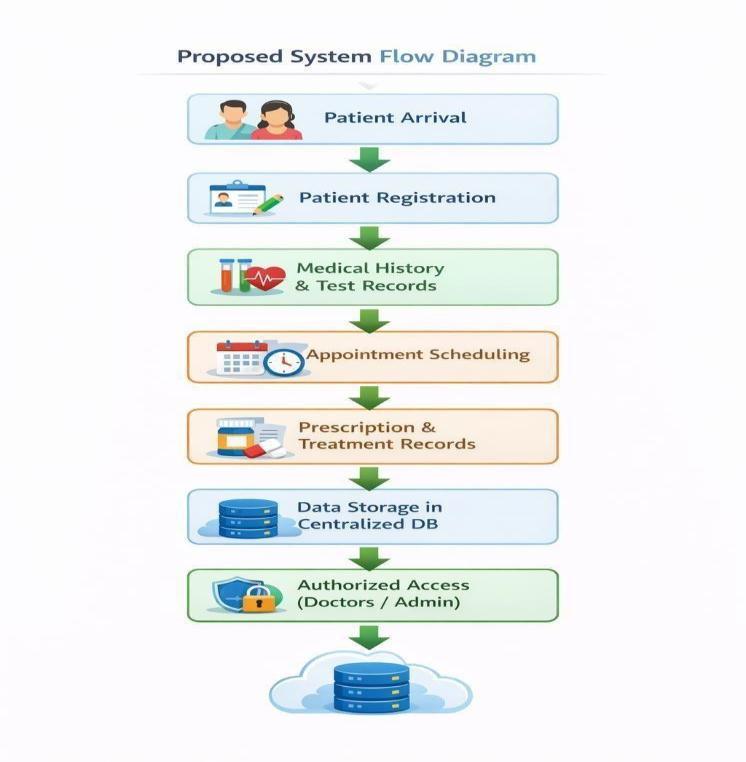
Thepresentationlayer,applicationlayer,anddatabaselayer.
The presentation layer providesuser-friendlyinterfacesfordifferentuserroles.
The application layer handlesbusinesslogic,datavalidation,andaccesscontrol.
The database layer stores patient records, user credentials, medical reports, and system logs securely. This architecturaldesignimprovesscalability,maintainability,andsystemreliability.
TheAdministratormoduleactsasthecorecontrol unitofthesystem.Administratorsareresponsibleformanagingsystem users,assigningroles,andmaintainingoverallsystemconfiguration.
This module allows the admin to add, update, or remove doctors and patients, monitor system activities, and ensure smoothsystemoperation.
International Research Journal of Engineering and Technology (IRJET) e-ISSN: 2395-0056
Volume: 13 Issue: 02 | Feb 2026 www.irjet.net p-ISSN: 2395-0072
The Doctor module is designed to support clinical decision- making by providing real-time access to patient medical records. Doctors can view patient history, update diagnoses, prescribe medications, and upload diagnostic reports. The systemensuresthatdoctorscanaccessonlytherecordsofpatientsassignedtothem,maintainingconfidentiality. This module reduces documentation time, minimizes errors, and improves the quality of patient care by enabling quick accesstoaccuratemedicalinformation.
ThePatientmoduleprovidestransparencyandengagementby allowing patients to securely access their own medical records. Patients can view prescriptions, test reports,appointment details, and treatment history. This module promotes patient awareness and supports bettercommunicationbetweenpatientsandhealthcareproviders. Patientsarerestrictedfrommodifyingclinicaldata,ensuringdataaccuracywhilestillprovidinginformationalaccess.
Theproposedsystemintegratesrole-basedaccesscontrol(RBAC)toprotectsensitivehealthcaredata.Userauthentication mechanismsensurethatonlyverifieduserscanaccessthesystem.Passwordencryption,sessionmanagement,andactivity loggingareimplementedtoenhancedatasecurityandaccountability.
Advantages of the Proposed System
Centralized and structured patient datamanagement
Improveddatasecurityandprivacy
Reducedpaperworkandadministrativeworkload
Fasteraccesstopatientrecords
Enhancedcoordinationbetweenhealthcarestaff
Improvedpatientinvolvementandtransparency
1. MODULE DESCRIPTION:
[1] Patient Registration Module
• Purpose:Recordandstorebasicpatientinformation.
• GenerateuniquePatientID
• Initial health details (allergies, bloodgroup,chronicdiseases)
Benefit: Enables accurate identification and quickaccesstopatientinformation.
[2] Medical History & Test Records Module
Purpose: Maintainacompletemedicalhistoryofeachpatient.
Features:
o Store past diagnoses, treatments,surgeries
o Record laboratory and diagnostic testresults
o Track follow-ups and previousprescriptions
Benefit: Allows doctors to make informeddecisionsquicklyandefficiently.
[3] Appointment Management Module
Purpose: Schedule and track patient visits withdoctors.
Features:
o Book new appointments and sendreminders
o Viewavailabletimeslotsofdoctors
o Managecancellationsandrescheduling
Benefit: Reducespatientwaittimeandimprovesworkflowefficiency.
International Research Journal of Engineering and Technology (IRJET) e-ISSN: 2395-0056
Volume: 13 Issue: 02 | Feb 2026 www.irjet.net p-ISSN: 2395-0072
[4] Prescription & Treatment Module
Purpose: Recordandmanagepatientmedicationsandtreatments.
Features:
o Createdigitalprescriptions
o Storedosageandtreatmentinstructions
o Linkprescriptionswithpatient’smedicalhistory
Benefit: Prevents errors in medication, ensurescontinuityofcare,andfacilitatesquickreference.
[5] Security & Access Control Module
Purpose: Protect sensitive patient data andcontroluseraccess.
Features:
o Userauthenticationandsecurelogin
o Role-basedaccess:Doctor,Nurse,Admin
o Encryptionofsensitiverecords
Benefit: Ensures confidentiality, preventsunauthorizedaccess,andmaintainstrust.
Features:
o Capture personal details: Name, Age,
o Gender,Contact,Address
[6] Centralized Database Module
Purpose: Actasasinglerepositoryforallpatientdata.
Stage 6: Centralized Database Storage
Allpatientdatafromregistration,medicalhistory,
Features:
o Storeallpatientrecordssecurely
o Quick retrieval of data for authorizedusers
o Backupandrecoverymechanisms
Benefit: Eliminates data duplication, improvesdataconsistency,andenhancessystemreliability.
2. EXECUTION STAGES:
Stage 1: Patient Arrival
Theprocessstartswhenthepatientarrivesatthehealthcarefacility.
Patient’s basic details and purpose of visit arenotedforinitialprocessing.
Stage 2: Patient Registration
Patient’spersonalanddemographicinformationisrecorded.
A unique Patient ID is generated to identifyrecords.
Initial medical details such as allergies, chronicdiseases,andbloodgrouparecaptured.
Stage 3: Medical History & Test Records
Pastmedicalhistory,previousdiagnoses,treatments,surgeries,andlabreportsaremaintaineddigitally. Appointments and prescriptions is stored in asecure,centralizeddatabase.
Ensures quick retrieval, data integrity, and reducedduplication.
Stage 7: Authorized Access
Only authorized users (doctors,
nurses,administrators)canaccesspatientinformation.
Role-based access ensures securityandconfidentialityofsensitivedata.
International Research Journal of Engineering and Technology (IRJET) e-ISSN: 2395-0056
Volume: 13 Issue: 02 | Feb 2026 www.irjet.net p-ISSN: 2395-0072
Stage 8: Monitoring & Updates
Recordsarecontinuouslyupdatedaftereachvisitortest.
Systemallowsauditandmonitoringforaccuracy,security,andperformanceimprovements. Database Design
Thedatabaseusesarelationalmodelwiththefollowingmajorentities:
EntityDescription Systemuserswithcredentials
Patient

Thisstageensuresdoctorscanquicklyaccesspriormedicalinformationforinformeddecision-making.
Stage 4: Appointment Scheduling
Patientappointmentswithdoctorsarescheduledandtracked.
Rescheduling, cancellations, and remindersarehandledefficiently.
Patient
Doctor
Medical_Record
Prescription personaldata andidentifiers
Doctorprofilesandspecialties
Recordslinkingpatientsandclinicaldata
Issuedmedicationdetails
Stage 5: Prescription & Treatment Records
Prescribed medicines, dosage, and treatmentinstructionsarerecorded.
Linksprescriptionswithpatient’smedicalhistorytoavoiderrorsandensurecontinuityofcare.
[1] HealthInformationSystems:Concepts,Methodologies,Tools,andApplications,IGIGlobal,2021.
[2] R.K.Gupta,“ElectronicMedicalRecords:AReviewonImplementationandChallenges,”InternationalJournalof HealthcareInformationSystems and Informatics, vol. 13, no. 2, pp. 45–60,2020.
[3] S.PatelandM.Sharma,“DesignandImplementationofHospitalManagementSystem,” InternationalJournalof ComputerApplications,vol.179,no.9,pp.12–18,2019.
[4] WorldHealthOrganization,ElectronicHealthRecordsandPatientDataManagement,Geneva,2018.
[5] K. Verma, “Digital Healthcare: Patient Record Management Systems,” Journal of Medical Systems, vol. 42, no. 11,pp.210–222,2018.
[6] Boonstra, A. Versluis, and J. F. J. Vos, “Implementing electronic health records in hospitals: a systematic literaturereview,”BMCHealthServicesResearch,vol.14,article370,2014.
[7] L. Bouayad, A. Ialynytchev, and B. Padmanabhan, “Patient Health Record Systems Scope and Functionalities: LiteratureReviewandFutureDirections,”JournalofMedicalInternetResearch,vol.19,no.11,e388,2017.
[8] N. Rahman et al., “Processing of Electronic Medical Records for Health Services Research in an Academic Medical Center:MethodsandValidation,”JMIRMedicalInformatics,vol.6,no.4,e10933,2018.
[9] Hossain, R. Rana, N. Higgins et al., “Natural Language Processing in Electronic Health Records in Relation to HealthcareDecision-making:ASystematicReview,”arXiv,2023.
[10] Naidu Chitikela, “Secure and Transparent Medical Record Management System Using Python and Blockchain,”arXiv,2024.
International Research Journal of Engineering and Technology (IRJET) e-ISSN: 2395-0056
Volume: 13 Issue: 02 | Feb 2026 www.irjet.net p-ISSN: 2395-0072
BIOGRAPHIES
MS.DISHA CHAUDHARI
PursuingPoly(Co)
S.Y.PSHREEYASHCOLLEGEOFENGINEERINGANDTECHNOLOGY(POLYTECHNIC)
MS. ANUJA CHAVAN
PursuingPoly(Co)
S.Y.PSHREEYASHCOLLEGEOFENGINEERINGANDTECHNOLOGY(POLYTECHNIC)
MS. KOMAL GHUNAWAT
PursuingPoly(Co)
S.Y.PSHREEYASHCOLLEGEOFENGINEERINGANDTECHNOLOGY(POLYTECHNIC)
PROF. ANIL NAIK
HOD,Dept.ofComputerEngineering
S.Y.PSHREEYASHCOLLEGEOFENGINEERINGAND TECHNOLOGY(POLYTECHNIC)