International Research Journal of Engineering and Technology (IRJET)
e-ISSN: 2395-0056
Volume: 13 Issue: | June 2026
p-ISSN: 2395-0072
www.irjet.net
Parametric Design in Structural Optimization: Long-Span Roof Optimization through Generative Processes Siddharth Gautam1, Chhabi Lal Singh2 1PG Student, Department of Civil Engineering, JS University, Sikohabad, U.P 2Assistant Professor, Department of Civil Engineering, JS University, Sikohabad, U.P
---------------------------------------------------------------------***--------------------------------------------------------------------2. GENERATIVE AND PARAMETRIC DESIGN Abstract - This paper explores the application of generative FRAMEWORK: design technology and parametric modeling in the structural optimization of architectural forms. Focusing on a long-span roof gridshell structure, this study utilizes computer-aided design tools to demonstrate how varying structural components can achieve optimal topology, mass, and displacement. By integrating parametric modeling (Rhinoceros/Grasshopper) with Finite Element Analysis (Karamba3D) and multi-objective optimization algorithms (Galapagos/Octopus), this research highlights the relationship between structural parameters and the variation of optimal design outcomes.
The shift from traditional passive design to computational design requires differentiating between two primary methodologies: Parametric Design: A process based on algorithmic thinking where symbolic parameters and rules constrain the design geometry. The user manually adjusts these parameters (such as positioning or dimensions) to evaluate model variations.
Keywords: Generative Design, Parametric Modeling, Structural Optimization, Topology Optimization, Gridshell, Finite Element Analysis
Generative Design (GD): A more autonomous process where algorithms generate and propose a multitude of design configurations that satisfy specific constraints and maximize a goal function. GD software uses artificial intelligence to mimic evolutionary processes, iteratively exploring a solution space to find optimal results with minimal human intervention.
1. INTRODUCTION: Building Simulation Optimization (BSO) is increasingly utilized in conceptual design phases to improve overall building performance and assist decision-making. In structural design, optimization can be categorized into three distinct methods:
3. METHODOLOGY: The case study focuses on developing an optimal topology for a steel long-span roof utilizing a grid shell structure. Grid shells are continuous structural surfaces where material has been removed to create a grid pattern, relying on double curvature and in-plane shear stiffness to efficiently carry loads.
Sizing Optimization: Adjusting specific cross-sectional areas or material thicknesses while maintaining the overall shape. Shape Optimization: Controlling the domain or contour of a structural boundary without altering its internal connectivity.
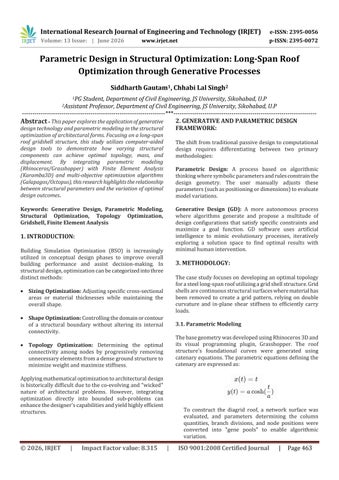
3.1. Parametric Modeling The base geometry was developed using Rhinoceros 3D and its visual programming plugin, Grasshopper. The roof structure's foundational curves were generated using catenary equations. The parametric equations defining the catenary are expressed as:
Topology Optimization: Determining the optimal connectivity among nodes by progressively removing unnecessary elements from a dense ground structure to minimize weight and maximize stiffness. Applying mathematical optimization to architectural design is historically difficult due to the co-evolving and "wicked" nature of architectural problems. However, integrating optimization directly into bounded sub-problems can enhance the designer's capabilities and yield highly efficient structures.
© 2026, IRJET
|
Impact Factor value: 8.315
To construct the diagrid roof, a network surface was evaluated, and parameters determining the column quantities, branch divisions, and node positions were converted into "gene pools" to enable algorithmic variation.
|
ISO 9001:2008 Certified Journal
|
Page 463