
International Research Journal of Engineering and Technology (IRJET) e-ISSN: 2395-0056
Volume: 12 Issue: 08 | Aug 2025 www.irjet.net p-ISSN: 2395-0072
International Research Journal of Engineering and Technology (IRJET) e-ISSN: 2395-0056
Volume: 12 Issue: 08 | Aug 2025 www.irjet.net p-ISSN: 2395-0072
E
Alluraiah1 , R Thirupathi2 , L
Sree Vardhan
3 ,
1Senior Research Fellow, Centre for Advanced Systems, DRDO, Hyderabad, India
2Technial Officer-A, Centre for Advanced Systems, DRDO, Hyderabad, India
3Scientist-F, Centre for Advanced Systems, DRDO, Hyderabad, India
Abstract - Autogenousfilletweldingoftube-in-tubeofMIL GradeSS321stainlesssteeltubeswith4mmto13mminternal diameter and 6mm to 16mm outer diameter, were joined using Orbitalum® OW 38S weld head and ORBIMAT 180 SW orbital welding machine, without electrode adaptor. Macrostructure and strength of the welded joints were investigated. Fillet welds with smooth contour and good penetration were achieved. The welded joints withstood required pneumatic pressure of 430 ksc and hydraulic pressure of 525 ksc. Welded joints yield strength and tensile strength were between 92% to100% of the base metal. Percentage of elongation achieved was 58% to 100% of the base metal.
Key Words: Orbital welding, fillet, NDT, stainless steel tube, strength
1.INTRODUCTION
Weldingintheaeronauticsindustryisexperiencingexciting developments.Thewidespreadapplicationofcomputersand the improved knowledge and design of new materials are shapingthe wayweldingis implementedandprocessand productarebeingdesigned. Weldsarereplacingrivetsina variety of components in both military and commercial airplanes, to improve both cost and structural integrity. Diffusion,laser,andelectron-beamweldingarepreferredin commercial aircraft, while electron-beam welding is continuallygaininggroundforthejoiningoftitaniumalloys inmilitaryairplanes.Inlargecommercial airplanes,laserbeamweldsarepoisedtoreplacerivetsinlargepartsofthe fuselage. Some new processes developed for the space industry also show promise for the aeronautics industry. These include friction stir welding and variable polarity plasmaarcwelding,whicharealreadybeingusedforcritical applicationsinrockets.
The penetration is measured as the ratio of depth to widthoftheweldcrosssectionincreasesdramaticallywith the intensity of the heat source. This makes the welding processmoreefficientandallowsforhigherweldingspeeds. moreefficientprocessrequireslessheatinputforthesame joint,resultinginastrongerweld,asasmallerheatsource movingatafasterspeedalsoimpliesamuch-reduceddwell timeatanyparticularpoint.Ifthedwelltimeistooshort,the process cannot be manually controlled and must be
automated. The minimum dwell time that can still be controlled manually corresponds to arc welding (approximately 0.3 seconds). Heat sources more intense thanarcshaveshorterdwelltimes;therefore,theymustbe automated.
Orbitalweldingisatechniquewherebytheweldingtool isrotatedthrough360°aroundastaticworkpiece.Originally developed to solve the problem of operator error in Tungsten Inert Gas (TIG) welding [2,5], and allow for a uniformweldaroundpipesandtubes,whichcanbedifficult to achieve with manual welding processes. The orbital welding process can create high quality repeatable welds withtheuseofacomputer,meaningthatthereislittleneed for intervention from a welding operator. The process is usedfortwomainapplications;tube-to-tube/pipe-to-pipe joiningandtube-to-tubesheetjoining,withpulsedcurrent [3]
MILGradeSS321typetubesofdifferentdiametersand thicknessareusedforthemanifoldpreparationrequiredfor defence applications. Only square butt weld joints are designed without beveling for the similar diameter tubes, keeping design criteria in view. For dissimilar diameter joints,threadedtypelock-tightjointsaredesigned.Tungsten electrodeisfixedtotheadaptortoweldorbitalfilletjoints. Inthiscurrentstudy,dissimilartubediameters,IDofbigger tubematchingwithODofsmallertubearetakenuptoweld byorbitalTIGweldingprocess,withouttheadaptorandto evaluatethejointstrengthanditsintegrity.Thecombination oftubesis4/6mm(ID/OD),6/8mm,8/10mm,10/12mm, 9/12 mm and 13/16 mm. The critical parameters were optimized[6,7]bytrialanderrormethod,andweldingwas performedin5Gposition,maintaininganoverlapof1mm, 2mm and 3mm, respectively in each type of ID/OD combination. To qualify the weld joint, radiographic inspection,macrostructure,hydraulicproofpressuretesting, pneumaticproofpressuretesting,andtensileproperties[4] wereevaluatedandreported.
2.1
TheparentmaterialisMILGradeSS321tubesofdifferent ID/OD Tubes,each150mminlengthwerecutusingspecial
International Research Journal of Engineering and Technology (IRJET) e-ISSN: 2395-0056
Volume: 12 Issue: 08 | Aug 2025 www.irjet.net p-ISSN: 2395-0072
diamondcuttingwheelfromMILstandardtubeof4-meter length. After cutting one face of each sample was treated withaburrremovaltool.Fortubes4/6mm,6/8mm,and 8/10mm,uptoalengthof4mm,buffingwasdoneforthe topsurfacestoaccommodateinsertionintotheotherpartof the respective joint tubes. The samples are then cleaned thoroughly in acetone and preserved in desiccators for welding purpose. The nominal composition of the SS321 tube material (wt%) is Fe-17-19Cr, 9-12Ni, 2Mn, 0.7Si, 0.045P,0.03S,0.1N,0.7Ti,and0.08C.
Themainpartsofanorbitalweldingsystemarethepower supply,ORBIMAT180SW(includinganintegratedcomputer control),theweldinghead OW38S Tungsten electrodeof 1.6mmdiameterisusedforwelding.Typicaljointset-upand welding set-up are shown in the Figrue-1 and Figure-2, respectively,below.
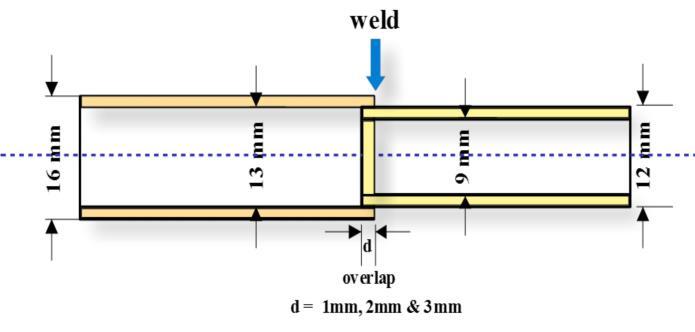
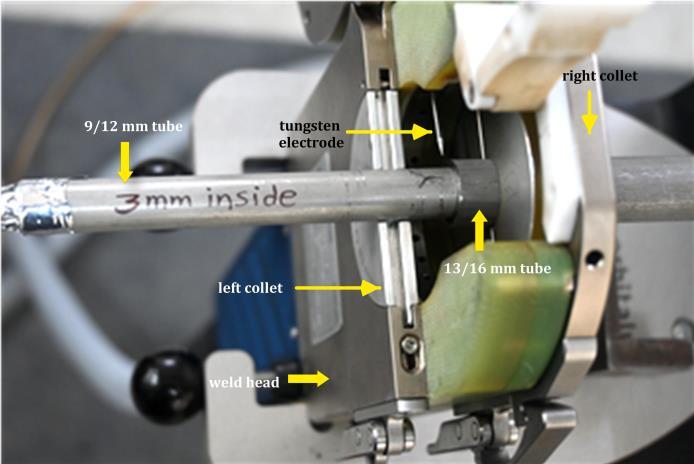
Fig-2:Typicalweldingset-upfor9/12mm#13/16mm tubejoint
2.3 Welding Parameters
Theweldingwasperformedwithoptimizedparametersof LPcurrentbetween13-16A,HPcurrentbetween35-58A, andtravelspeed(TS),between70-80mmmin-1
All the welded joints were sent for X-Ray radiographic examination for evaluation of the soundness of the joints. The X-Ray inspection was conducted using Comet 160kV sourceandDURR HDCR 35 leadplateimage scannerand recorded
2.4 Macrostructure Examination
Onesamplefromeachjointconfigurationwascutusing high speed diamond wheel with proper cooling, cleaned thoroughlyinacetone,driedandobservedfortheinsideweld featuresandreported
2.5 Hydraulic and Pneumatic Leak Testing
In order to evaluate the leak tightness of the welded joints,highpressurepneumatictestat430kscfor5minutes andhydraulicleaktestat525kscfor3minuteswerecarried outforalltheweldedjoints.
Three samples of the welded joints were tested using 300kN Universal Tensile Testing machine to evaluate the yield strength, ultimate tensile strength and percent of elongation. Figure-3 shows the tensile test sample configurationasperAWSSecIX.
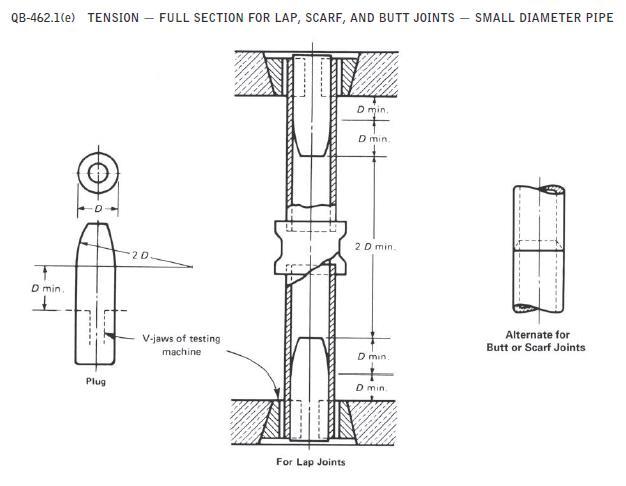
Fig-3:TensiletestsampleconfigurationasperAWSSecIX [8]
2.7 Fractography
After mechanical testing, the failed samples were examinedforfractographyandrecordedthefailuresurfaces underlowmagnification.
Volume: 12 Issue: 08 | Aug 2025 www.irjet.net p-ISSN: 2395-0072
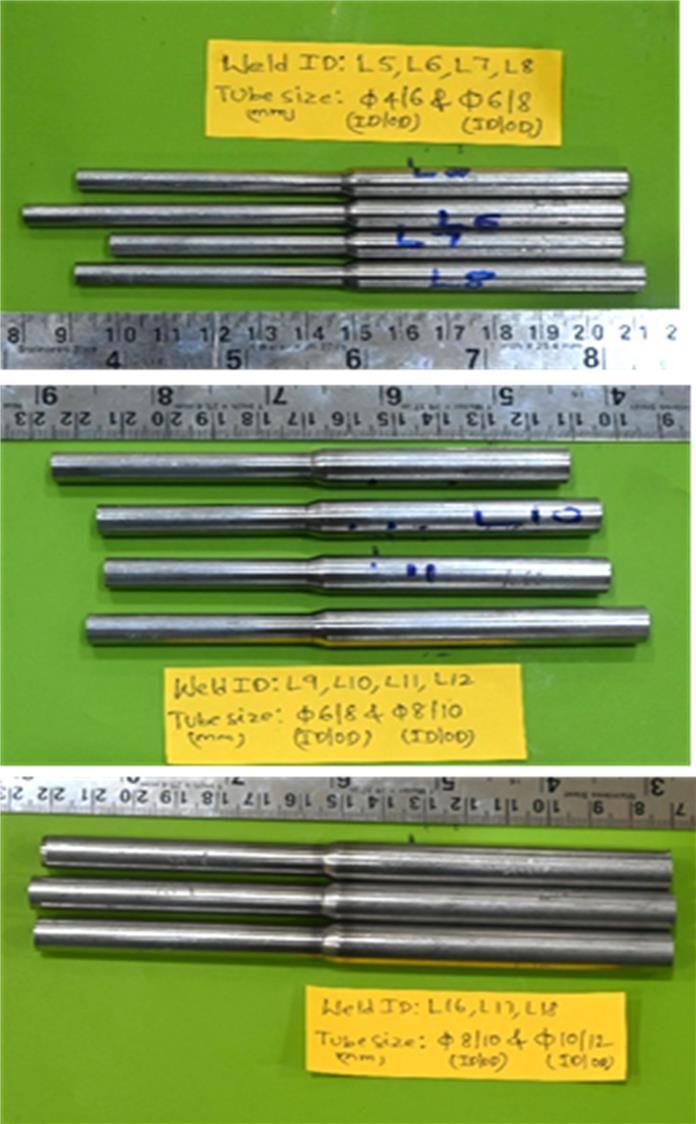
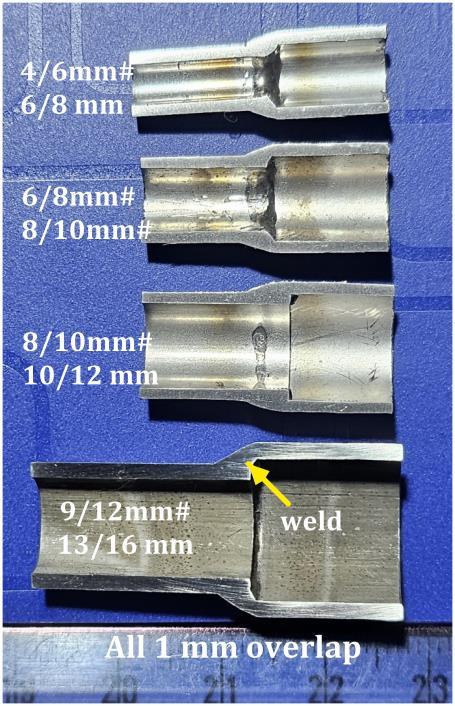
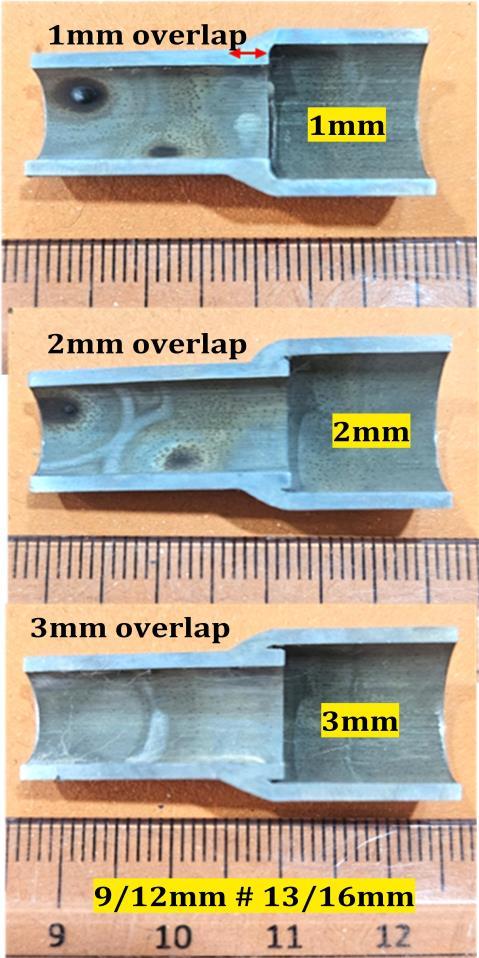
Figure-4 shows the welded samples with 1 mm, 2 mm and3mmoverlap,forthejointconfigurationof4/6mm,6/8 mm, and 8/10 mm. Visual observation of the joint shows smooth bead convex surface profile with excellent coalescence. Figure-5 shows the cut sections of all weld configurations for 1mm overlap. Figure-6 shows the cut sectionsoftheweldedjointsforthe9/12mm#13/16mm tube joint configuration. The average length of the fusion overlap, as shown by double-headed arrow in Figure-6, measuredis4.18mmfor1mmoverlap,3.68mmfor2mm overlapand3.63mmfor3mmoverlap.Butthiseffectmay be ignored as the measurement was made on two cutsurfaces. Also, when we consider the entire length of the circumferentialweld,alltheoverlaplengthmaybewithin ±10%ofvariation
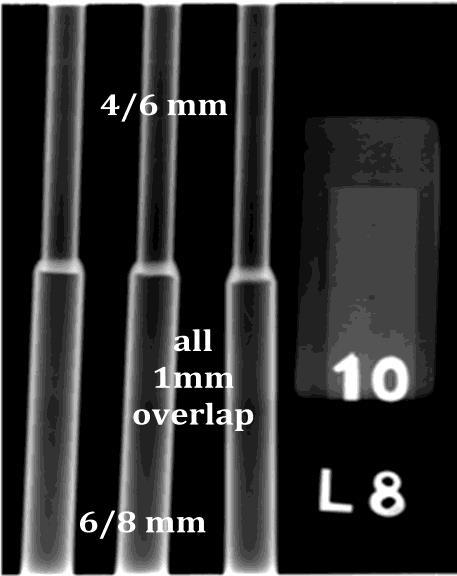
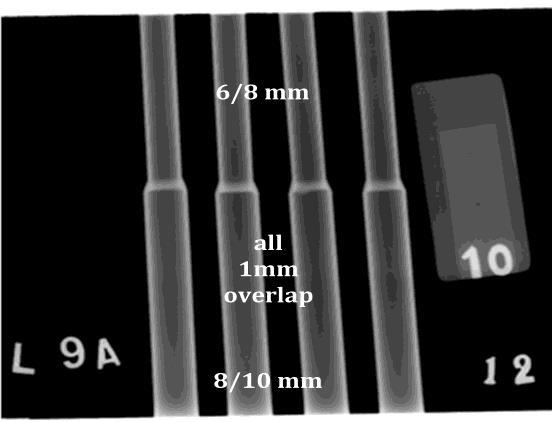
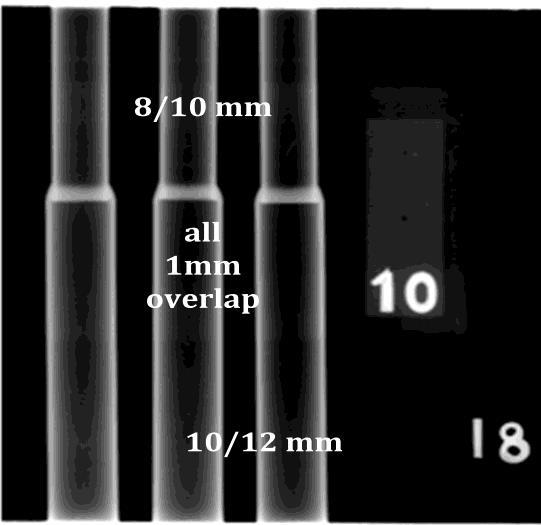
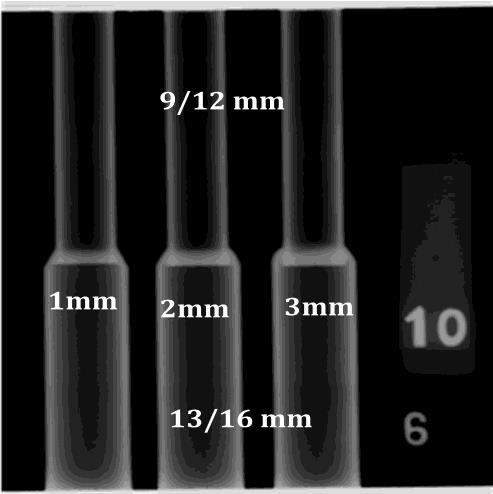
through Figure-10, shows the radiographic
images taken using 160kV X-Ray source. The joints show goodpenetrationwithoutanydefects.Leftandrightsideof the images, a 2T hole is seen clearly in the radiograph. It means, any defect of size 0.25mm or greater can be identifiedfromtheradiograph Figure-11showsthetestset upforhydraulicpressureprooftestingforevaluation,using DM water. Testing was carried out for all the welded configurations,at525kscfor3minutesandchecked with snoopsolutionduringtesting,andfoundnoleaks.Figure-12 showsthetestsetupforpneumaticpressureprooftesting for evaluation. Testing was carried out at 430 ksc for 5 minutes, pressuring with nitrogen gas for the dissimilar diameter tube joints. During application of pressure, the weldedjointswerecheckedwithsnoopsolution,andthereis noleakobservedfromthejoints.
International Research Journal of Engineering and Technology (IRJET) e-ISSN: 2395-0056
Volume: 12 Issue: 08 | Aug 2025 www.irjet.net p-ISSN: 2395-0072
International Research Journal of Engineering and Technology (IRJET) e-ISSN: 2395-0056
Volume: 12 Issue: 08 | Aug 2025 www.irjet.net p-ISSN: 2395-0072
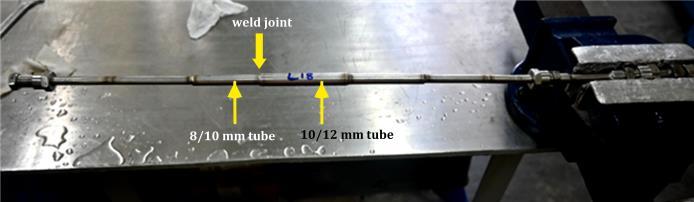
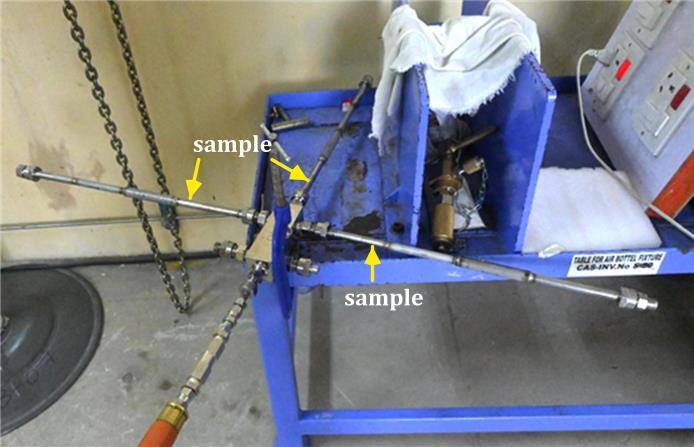
Fig-12:PneumaticLeakTestinginprogress
Figure-13showstensiletestingof3mmoverlapjointfor 9/12mm#13/16mm joint, under progress and Figure-14 showsthecompletionoftesting Inallthethreevariationof overlap,thefailureisobservedinthebasemetalof allthe configurations. The fractured samples are shown from Figure-15throughFigure-18.Asobservedinthecut-section macrostructuresinFig.4.2throughFig.4.4,themeanjoint crosssectionthicknessattheweldjointinterfaceisdouble thewallthickness(3mm)thanthatoftheindividualtube thickness(1.5mm).Hencethestressesduringtensiletesting willneverreachyieldstressduringtestingattheinterface. Thefailureisalwaysobservedin9/12mmtube,becausethe yieldstresslevelswillreachfirstin9/12mm,thenin13/16 mmduetohighercrosssectionalareaof13/16mmtube.
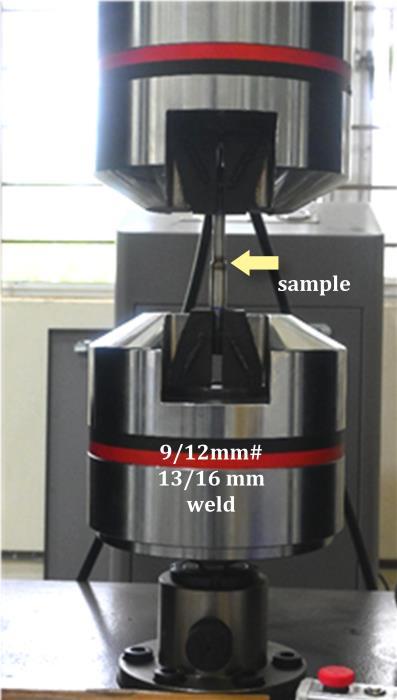
:Tensiletestingunderprogress 9/12mm#13/16mmjoint
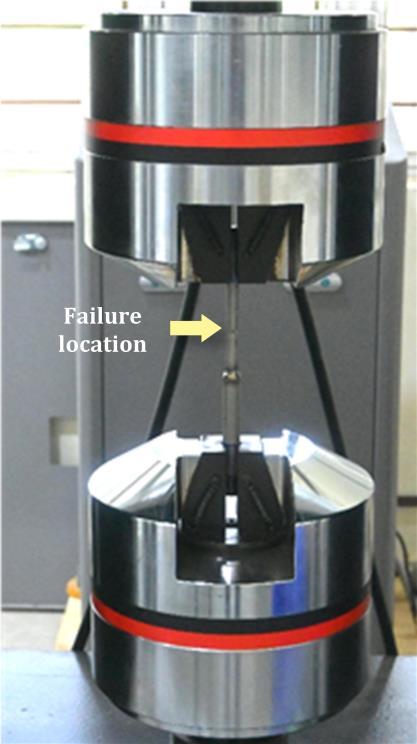
:Fracturelocationof9/12mm#13/16mmjoint duringtensiletesting
Similar behavior is observed in all other weld configurationsalso.Thetensiletestingresultsofotherjoint
International Research Journal of Engineering and Technology (IRJET) e-ISSN: 2395-0056
Volume: 12 Issue: 08 | Aug 2025 www.irjet.net p-ISSN: 2395-0072
configurationsarealsoshownsimilarbehavior.Thefailure locationsareshowninFigure-15.
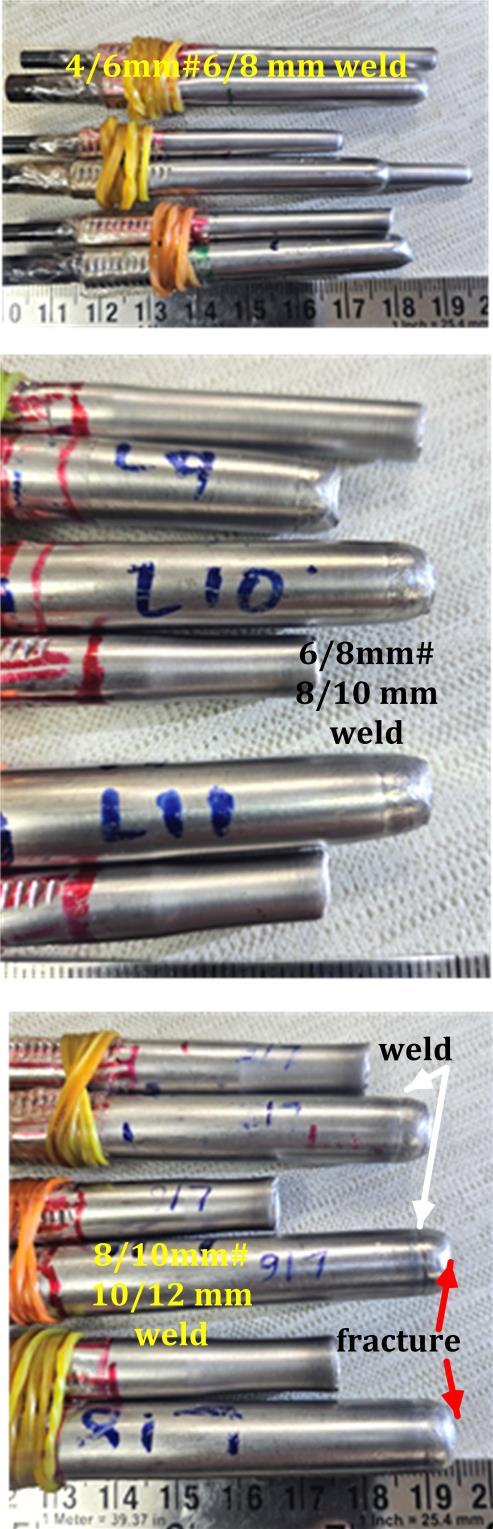
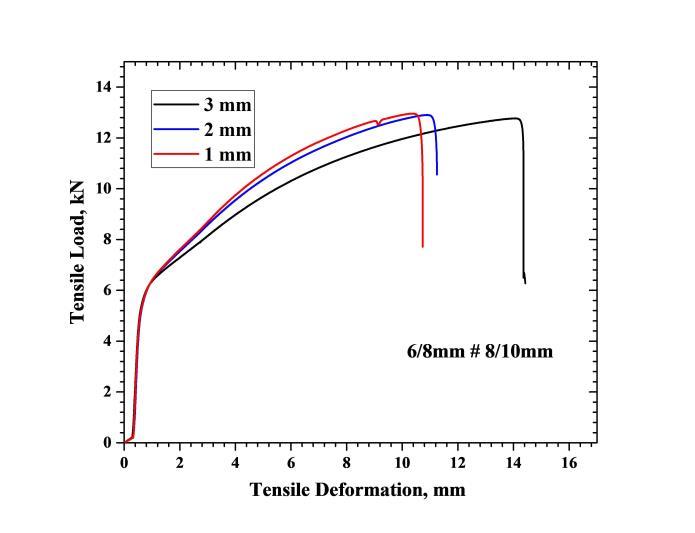
Figure-16 through Figure-18, show the tensile plots of welded joints for 6/8mm#8/10mm, 8/10mm#10/12mm, and 9/12mm#13/16mm, respectively. The yield strength andtensilestrengthare92–100%ofbasemetal.Percentage elongationis58–100%ofbasemetal.Theaboveproperties aretruly,thescatterinthebasemetalpropertiesofSS321 tube, as the failure always occurred in the base material. Hence,itcanbeclaimedthat,inthecurrentstudy,theweld jointshaveachieved100%efficiency.Themodeoffailureis ductileasthepercentageofductilityisalmostatparwiththe base metal. The average test results for three sample for each weld configuration and base metal are tabulated in Table-1.
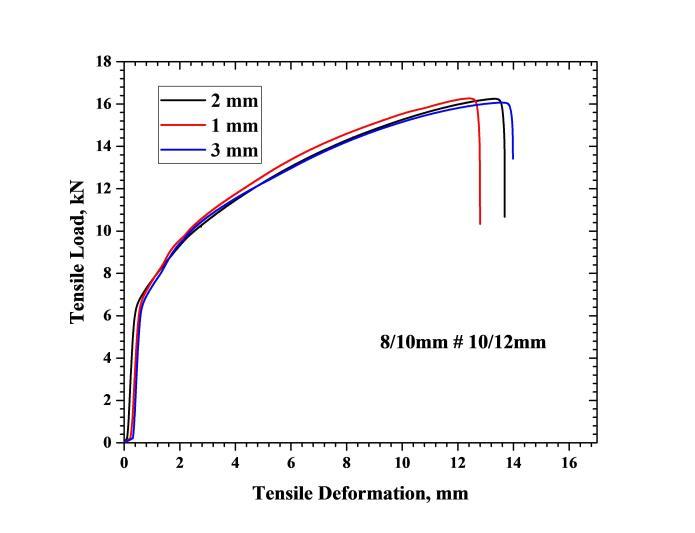
8/10mm#10/12mmjoints
International Research Journal of Engineering and Technology (IRJET) e-ISSN: 2395-0056
Table-1: TestResults
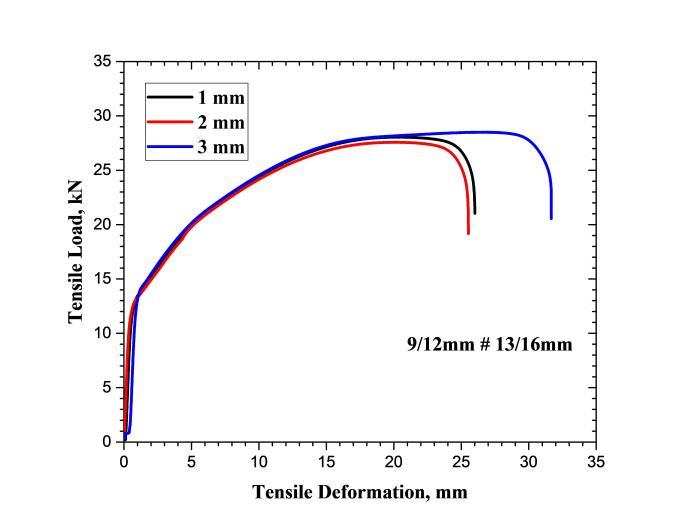
Fig-18:Tensileplotsfor9/12mm#13/16mmjoints
[1] Serafin, M. Orbital Welding for Space Program Applications: Producing Welds that Withstand the Rigors of Deep Space.TPJ - The Tube & Pipe Journal., July-August2000.
[2] Gadewar SP, Swaminadhan P, Harkare MG, Gawande SH.Experimentalinvestigationofweldcharacteristics forasinglepassTIGweldingwithSS304.International Journal of Engineering Science and Technology. 2010;2(8):3676-86.
[3] RaveendraA,KumarBR.ExperimentalstudyonPulsed andNon-PulsedCurrentTIGWeldingofStainlessSteel sheet (SS304). International Journal of Innovative ResearchinScience,EngineeringandTechnology.2013 Jun;2(6):2337-44
[4] Saha S, Mukherjee M, Pal T. Microstructure, Texture, and Mechanical Property Analysis of Gas Metal Arc WeldedAISI304AusteniticStainlessSteel.Journalof
Materials Engineering & Performance. 2015 Mar 1;24(3).
[5] MathurA,MuneerMdA,SricharanSS,ChandraShekar K. Gas Tungsten Arc Welding of AISI 304 Austenitic Stainless Steels. International Journal of Engineering Research&Technology.2015Dec;4(12):148-50.
[6] P.Viswabharathy,P.Gowthaman, R.Indirakumar, V.Jayasurya,D.Kalinganexperimentalinvestigationon parameter optimisation in orbital tig welding. International Journal of Novel Research and Development. 2018 IJNRD | Volume 3, Issue 4 April 2018|ISSN:2456-4184
[7] M.Karthikeyan,VallayilN.A.Naikan,R.NarayanandD. P. Sudhakar. Orbital TIG Welding Process Parameter Optimization using Design of Experiment for Satellite Application. International Journal of Performability Engineering,Vol.12,No.2,March2016,pp.155-172.
[8] 2010Boiler&PressureVesselCode,SectionIX,pp161.



Volume: 12 Issue: 08 | Aug 2025 www.irjet.net p-ISSN: 2395-0072 © 2025, IRJET | Impact Factor value: 8.315 | ISO 9001:2008
Eppala Alluraiah, is a Senior Research Fellow working in Production and NDT of RCS Systems,atCAS,DRDO,Hyderabad.
Thirupathi Rachakonda, is a TechnicalOfficer-AandisHeadfor RTandUTFacilitiesatCAS,DRDO, Hyderabad.
DR. L. Sree Vardhan, is a senior scientist and is currently Technology Director for NDT and R&QA,CAS,DRDO,Hyderabad.